From Caedmon to The Wire: World Pictures and the Play of Language

We find ourselves in a bewildering world. We want to make sense of what we see around us and to ask: What is the nature of the universe? What is our place in it and where did it and we come from? Why is it the way it is?

To try to answer these questions we adopt some “world picture.”

Stephen Hawking, A Brief History of Time

I’ve been reading Philip Pullman again, and reading as much as I can find of what he alludes to in the course of his stories. Among the books Dr Hannah Relf lends to young Malcolm Polstead, our protagonist in La Belle Sauvage, is A Brief History of Time, which exists in our universe as well. While I enjoyed The Body in the Library by a parallel Agatha Christie, presumably, which is the first book he chooses to borrow from her library, it’s the world picture conjured up by Hawking–and not the specific account of space-time so much as the idea of a “world picture” as such, as a way to answer fundamental questions–that has led me to think about Pullman’s project anew. After all, one of the first, unforgettable images from The Golden Compass is literally the picture of a world, another world visible in the aurora, projected from a lantern slide; and some of the final images in The Rose Field… well, we’ll get there when we get there.

Pullman’s illustration for Chapter 2: The Idea of North

Sometimes it becomes possible for an author to revisit a story and play with it, not to adapt it to another medium (it’s not always a good idea for the original author to do that), nor to revise or “improve” it (tempting though that is, it’s too late: you should have done that before it was published, and your business now is with new books, not old ones). But simply to play.
And in every narrative there are gaps: places where, although things happened and the characters spoke and acted and lived their lives, the story says nothing about them. It was fun to visit a few of these gaps and speculate a little on what I might see there.
As for why I call these little pieces lantern slides, it’s because I remember the wooden boxes my grandfather used to have, each one packed neatly with painted glass slides showing scenes from Bible stories or fairy tales or ghost stories or comic little plays with absurd-looking figures. From time to time he would get out the heavy old magic lantern and project some of these pictures on to a screen as we sat in the darkened room with the smell of hot metal and watched one scene succeed another, trying to make sense of the narrative and wondering what St. Paul was doing in the story of Little Red Riding Hood—because they never came out of the box in quite the right order.
I think it was my grandfather’s magic lantern that Lord Asriel used in the second chapter of The Golden Compass. Here are some lantern slides, and it doesn’t matter what order they come in. – Philip Pullman, the “lantern slides” edition of His Dark Materials

While most people I’ve talked to have expressed disappointment with the ending of The Book of Dust, and that was my own initial reaction, I’ve found it is growing on me with rereadings, particularly as I’ve been listening to the audio versions read by Michael Sheen. It doesn’t hurt that his interview with Pullman, accompanying the final volume, is the best of its kind that I’ve found so far. Particularly resonant are their discussions of the procession and the story, commenting on a little demonstration or rhetorical flourish of Pullman’s in another interview, a video for the Bodleian Library; and of the alethiometer contrasted with the myriorama as images of reading and writing or telling stories.
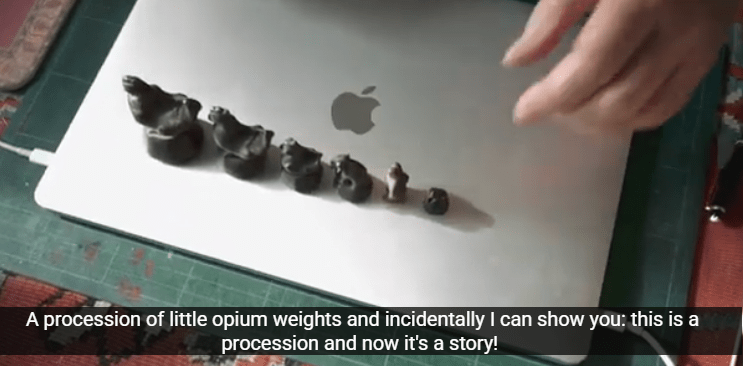
From procession to story, around 2:30 in Behind the Desk: Philip Pullman

So it strikes me that the first requirement of a compelling world picture–speaking only for myself–is that it should partake of that commingling of beauty and truth which Keats’ Grecian Urn attests. If in time irradiating its truth-beauty some contradiction should arise in our perception of that dear picture between the sense of its truth and its felt beauty, then we have to either discard it–Lewis has written powerfully about that in The Discarded Image–or, recurring again to Keats, we can abide with it at the limits of our “negative capability.”

This is where I strive to engage with Pullman, rather than rejecting him, believing us “capable of being in uncertainties, Mysteries, doubts, without any irritable reaching after fact & reason,” as he himself has pointed the way, having these very lines quoted by another one of his scholars, Dr Mary Malone, in The Subtle Knife. When I think of his work as a kind of invitation to think and feel in this way, its challenges, while no less agonistic and at times agonizing, take on a beautiful, sporting quality. And like few other authors, Pullman conduces to the “having of wonderful ideas,” in Duckworth’s model for learning, and to “the realization that prayer consists of attention,” in Weil’s formulation, which I take to be an end beyond the end of learning for its own sake.

“The poem was the authority here, not the teacher.”

One thought I’ve been noodling on along the way, which I’ll just lay down as best I can for now, is that language–language learning at the most basic and most advanced levels alike, literacy and reading of all degrees of interpretive complexity, and literature at its furthest avant garde edge–seems to live and move and leap ahead by way of play.

To adduce a handful of instances representing the movement between world-pictures and worlds:

  • Homeric games and the bow-stringing challenge
  • David dancing before the Lord; dance for Huizinga “the purest and most perfect form of play that exists”
  • Caedmon’s Hymn, considered the first English poem, and the story of its composition given in Bede
  • Chaucer’s pilgrims, making of their tales “ernest” and “game”
  • Shakespeare’s wandering players and kings and the “invention of the human” (Bloom)
  • Joyce’s “shout in the street” in Ulysses, and its echoes back in Araby

If these are the leaps that come to mind, still there are immense degrees of nuance in between each of them. Between Shakespeare and Joyce, a fair amount of literature survives. Or to zoom in further: between Keats’ vision of (his Bright star‘s vision of)

The moving waters at their priestlike task
Of pure ablution round earth’s human shores

and Matthew Arnold’s Dover Beach with its “melancholy, long, withdrawing roar,” and the near-contemporary Oxford Movement; or between Blake’s Marriage of Heaven and Hell and Wordsworth, Coleridge, Shelley, and Byron pushing at the boundary of reason with no little energy, with Mary Shelley producing Frankenstein as a byproduct of their play; or to jump ahead, within the work of a single writer, from Nabokov’s “link-and-bobolink,” “the correlated pattern in the game,” in Pale Fire to his Terra and Antiterra in Ada, where the “game of worlds” becomes almost literal; so much of any writer’s work which we still read seems to consist in the give and take between modeling and effacing world pictures.

And it seems like this is always including, if not in fact by way of, metaphors of play.

Where they get especially ambitious–or playful–writers absorb scientific and religious worldviews alike into their imaginations. Spariosu has given a much fuller treatment, and Sloek a much richer theory, but there is Kierkegaard’s interpretation of Don Giovanni; Bakhtin’s reading of Rabelais; Dostoevsky’s incorporations of scripture, and Bulgakov’s rewritings of it; Vonnegut’s invention of Kilgore Trout, or Milosz’s Bruno; John Crowley’s other worlds; Pullman’s, and his sprite-like narrators… 

I’ve tried to stick to the English language, but translations have crept into my magic circle, as literature itself wouldn’t mean much in any language without the likes of Homer, the Bible, Shakespeare, and Dostoevsky connecting ideas to images, but also helping their readers with the task of making connections between ideas and action, and thus knitting together the inner world or life to the outer, even up to and including that “consummation devoutly to be wished,” though Benjamin asserts that the storyteller is as much generated by as generating death, “death of the author” be darned.

Still, the question arises–the one Hawking asked back at the start–of what world picture or model best facilitates such summing up of the incommensurables, the infinitesimals, or which anyhow values it as an endeavor worth attempting, whether we have the language to express it or no. And it is a question to which in these posts I am continually responding, and trying to understand others’ responses.

For me, this has to include the roots of the language, religious and scientific and poetic alike. Caedmon has to be there, as well as Hawking, and Christie to help us solve the mystery. Then, perhaps with a little help from our friends, we can also better parse the world-pictures that assail us on the screens that surround us, like this one:

Just now hearing about this eruption of PlayStation iconography at last year’s Super Bowl halftime show by Kendrick Lamar, for example, and about shadow boxing from Babcock, so we’ll see if we can collaborate to write something about that. Or the great chess scenes in Nabokov or The Wire:

And I still haven’t read the large claims of the likes of McGonigal and Combs for the ameliorative power of games, nor Bogost on their rhetoric and persuasiveness, nor Miller on the theology of the same.

Looking next time, though, at Kendrick Lamar’s design patterns, with some serendipitous discoveries in Ortega y Gasset, starting with “The Sportive Origin of the State” (Translated into English; original Spanish) via Postman’s Technopoly (and footnoted in good old Homo Ludens to boot).

Tolkien and Lewis: Lang and Lit, Play and Games

So as to establish some sort of structure by which to embrace the world in all its complexity and learn about it as deeply as possible through the mediation of a shared, relatively safe and replicable experience, for a long time now we’ve been leaning on this lens of play and games here at The Video Game Academy. And yet it cannot have escaped anyone’s notice who might be following along that what we are up to is rather different from, say, the dream of “gamification” in education that various figures of wide-ranging levels of influence might talk about, or even “game studies” in any strictly defined sense. In fact, our courses, such as they are, are remarkably old-fashioned in many ways. Essentially, we play games and talk about them; or we take a larger theme, such as “mythology,” this year’s focus, and explore it through games and other recommended readings.

In the spirit of Pullman’s advice to “read like a butterfly, write like a bee,” we remain open-minded about the selection of readings that would ultimately find inclusion in our course of study. And because all this remains speculative and hobby-horsical, we don’t have to limit ourselves to fixed curricula and syllabi, as interesting as it is to think about these things from time to time (see recent episodes of “Unboxing” and our own Professor Kozlowski for reflections on some of the work that goes into professional academia).

But in the words of Buzz-Buzz, “a bee I am… not.” Much as I strive to keep up with the writing that is meant to accompany and give expression to all this reading (reading in the loose sense of listening and playing and so on), I find that weeks and months go by with little to show for all the ideas I intend to share out again. The occasional post, to say nothing of new courses or published pieces, is only with great effort and continual procrastination ever finished (again, in the loosest possible sense of the word). Still, as another artistic hero said to yet another, “work, always work” (Rodin to Rilke): the work is ongoing, the reading is happening, the notes are jotting, and thoughts thinking. If nothing else, a conversation on FFVIII is forthcoming more or less weekly.

Is it at least somewhat convincing to plead that I’m waiting for Pullman’s new book to release before diving into that podcast project again? Or that I’m collaborating again with Moses aka Red on a follow-up to his Gamelogica project, though what form that might take remains to be decided? Perhaps I’ll talk about the Nobel winners I’ve been reading, or attempt a playthrough of MOTHER 2 in Japanese…

Odysseus and the Sirens – The British Museum.

Meanwhile, in brief reviews and commentaries, I’ll keep tracking the connections between games and literature as best I can. From my attempt at putting The Sirens’ Call by Chris Hayes into dialogue with Deep Work by Cal Newport and Saving Time and How to Do Nothing by Jenny Odell, I arrived at the conclusion that for all their insights into the critical importance of attention, these contemporary authors seem to me to be completely missing the point. Instead of writing these popular sorts of books, long on citations and case studies and strikingly short on the deep reading they purportedly are calling for, they should have done better to craft a single reflection on the example that was most exemplary in each case. Lacking any demonstrable rootedness in their points of departure–whether Homer and Plato for Hayes, Jung and Montaigne for Newport, or Bergson and Benjamin for Odell–to say nothing of any perceptible religious or otherwise philosophical groundwork for their arguments, their books diffuse themselves into the culture as distractedly as any other media phenomenon, and will likely prove as ephemeral. And so I suggest readers turn instead to those sources in literature from which they are drawing, and abide in the original works for themselves. For a better guide as to how to do this, I could lift up Weil on the use of school studies; Bakhtin on Dostoevsky; and someday, perhaps, my own efforts on video games.

To connect this all to video games, then, can we do better than Jenny Odell’s reasoning behind her structuring of Saving Time? As she explains in this BOMB interview:

… I actually didn’t have the idea to structure the book that way until halfway through writing it. I landed on the idea because I was playing the video game, The Legend of Zelda: Breath of the Wild. I was spending a lot of time in a spatially dispersed story in which you understand that certain things can only happen in certain places, and you have some idea of something that’s coming both narratively and geographically down the road. You can see it, it’s in the distance.

At the time, I was thinking about how everyone’s experience of playing that game—even though it obviously suggests some routes to you—is pretty different, and thus, their memory of the story is going to be different. I was just really fascinated by that. So I think it made me look twice at these places that I was spending time in and it got me thinking about how I could string them together.

Odell is extremely close here to digging into the power of place for memory as represented in video games writ large. While she focuses on the differences among players, my mind goes as usual to EarthBound, and to the ultimately unified story it tells. No matter in what order the sanctuaries are visited, or in the case of Zelda, the memory locations, Koroks, shrines, etc., there are certain themes, timeless and universal, such as love, courage, and the joy of adventure, which these games will reliably lead players to consider.

It almost makes me want to go back and read her book again in light of this revelation!

In passing, I’ll note that Hayes and Newport each do make a few interesting references to video games, too. Apropos of Socrates’ critique of writing in the Phaedrus, Hayes remarks, “It seems safe to say in hindsight that writing was a pretty big net positive for human development, even if one of the greatest thinkers of all-time worried about it the same way contemporaries fret over video games” (6). And he later acquaints the reader with Addiction by Design, by Natasha Dow Schull, and the prevalence of loot boxes via this inarguable clickbait from The Washington Post: “Humankind Has Now Spent More Time Playing Call of Duty Than It Has Existed on Earth” (52-3).

Besides becoming bywords for the perennial moral panics accruing to new technologies and for the irresistibility of slot-machine-style addiction, video games, again exemplified in Call of Duty, return one more time towards the end of the book to provide Hayes with fodder for a brief rant: “Online interaction, which is where a growing share (for some the majority) of our human interactions now takes place, becomes, then, almost like a video game version of conversation, a gamified experience of inputs and outputs, so thoroughly mediated and divorced from the full breathing laughing suffering reality of other humans that dunking on someone or insulting someone online feels roughly similar to shooting up a bunch of guys in Call of Duty” (233-4).

A different paradigm shows up in Newport: “In MIT lore, it’s generally believed that this haphazard combination of different disciplines, thrown together in a large reconfigurable building, led to chance encounters and a spirit of inventiveness that generated breakthroughs at a fast pace, innovating topics as diverse as Chomsky grammars, Loran navigational radars, and video games, all within the same productive postwar decades” (129). The absence of a descriptor there, or if you like, the way in which “video” is returned to the role of descriptor of “games” according to the parallelism of Newport’s construction, is extremely interesting. I could gripe all day about the narrowness and specificity of the video games Hayes seems to have in mind; whereas for Newport, video games are a product almost without qualities other than their novelty and mythic origin in “MIT lore” and “haphazard…inventiveness.” Whatever he may think about particular games, Newport’s mention of them at least has a positive valence.

Eeriness, an ink drawing by J. R. R. Tolkien. Photo: Museoteca.com – via New Criterion.

By chance, the one episode of Newport’s podcast that I listened to so far (no. 288, on the recommendation of this article I was considering assigning next school year) includes towards the very end some reflections on Tolkien which might finally get me to segue back to the ostensible premise of this post. Specifically, a curator of medieval manuscripts at one of the libraries of Oxford sent Newport a quote that is found in a letter from Tolkien to Stanley Unwin: “Writing stories in prose or verse has been stolen, often guiltily, from time already mortgaged…”

Before addressing–or indeed quoting–the quote, Newport riffs on “The Consolations of Fantasy” exhibit (reviewed here) and pulls up some of the art for his youtube viewers. He read in a recent biography about Tolkien “being overwhelmed by…the stresses of being in a field–philology–transforming into modern linguistics,” noting that “he was on the old-fashioned side of that.” Repeatedly, he characterizes Tolkien’s art and writing as abounding in “almost childlike, fantastical images” and takes his desire to spend more time in the “fantastical worlds” of his “childlike,” albeit “sophisticated,” imagination, as another explanation of his acute sense of stress–along with his worries about money.

Newport may or may not have ever read Tolkien–it isn’t clear–but he sees his art anyhow as being illustrative of his own recent work on “Slow Productivity.” He argues that Tolkien’s success selling books is what allowed him to spend more time on his writing and worldbuilding and to worry less about his other responsibilities; again, though, Newport seems to completely miss the point. What is it about Tolkien’s books that so captivates readers? It has less to do with a yearning for time in which to daydream and more to do with his insights about myth, drawn straight from his studies of philology and given voice in a much more famous quote from Gandalf: “All we have to decide is what to do with the time that is given us.” In his fiction, both in major works like Lord of the Rings and in small masterpieces like “Leaf By Niggle,” as well as his scholarship (talks on Beowulf and Fairy-stories are essential) Tolkien touches on just those emphatically moral dimensions so absent from Newport’s pursuit of excellence.

Now reading widely and breezily in the literature of attention is as fine a way as any to pass the summertime for a none-too-disciplined teacher like me. But make no mistake: setting aside my personal affection for Pullman, not entirely shared by my colleagues, I should clarify that second to none among our professorial and scholarly lodestars, we at VGA also count JRR Tolkien and CS Lewis. Both were eminent in their fields of language and literature, and both were theorist-practitioners of the arts of teaching and of fiction alike. And their work is at the heart of the 20C turn to myth-making which continues most vivaciously in the video game medium to the present day, and which is particularly evident in the 90’s JRPGs we never tire of playing and studying.

If it may be objected, quite fairly, that discussions of classic game series like Final Fantasy and The Legend of Zelda have been done ad nauseum, whether as podcasts, video essays, or even books, so what do we mean by proposing continually to return to them anew; much more so discussions of Tolkien and Lewis, who are the subjects of innumerable books, articles, videos, podcasts, and courses? Even a cursory glance at the literature suggests that the influence of Tolkien, Lewis, and their circle and successors on video game development and reception has been immense, as is well understood. From the very first PhD dissertation on video games by Buckles to more recent work aimed at scholars (Young), hobbyists and serious fans (Peterson), and a popular audience alike (Kohler), it is clear we would be far from surprising anyone with our discoveries about the deep ties between the seemingly dusty “Lang and Lit” debates of the early 20C and the “ludology/narratology” tug of war or “magic circle” duck duck goose of near-contemporary game studies.

To my (admittedly very incomplete) knowledge, however, what remains little noted or discussed is the role of play within the work of the Inklings and Inkling-adjacent, their predecessors (ie. Chesterton and Morris), and their major intellectual heirs (whether imitators, who are legion, or virtual parricides, in Pullman’s case). What happens when we go back to their writing the hindsight afforded by reading them in the light of video games’ subsequent developments of the themes of mythopoesis so powerfully instaurated by the dynamic give-and-take between Tolkien, Lewis, and their fellows and followers?

To illustrate just a few potential starting points:

Tolkien’s thoughts on “faerian drama” in the light of video games (Makai); the impression made on him by the play Peter Pan in his early Cottage of Lost Play writings (Fimi); games as mythopoeic narratives (Fox-Lenz) and the riddle game at the heart of The Hobbit (Olsen).

Lewis’s language of “checkmate” and “poker” to describe his conversion (Dickieson), and the ways in which imagery of play and games functions elsewhere in his apologetic writings, fiction, and scholarship:

  • “Very often the only way to get a quality in reality is to start behaving as if you had it already. That is why children’s games are so important. They are always pretending to be grown-ups—playing soldiers, playing shop. But all the time, they are hardening their muscles and sharpening their wits so that the pretense of being grown-up helps them grow up in earnest (Mere Christianity)
  • The discovery, creation, and defense of Narnia are all couched in terms of play, ie. “I’m going to stand by the play world” (The Silver Chair); and for some reason “The Great Dance” at the end of Perelandra is also called “The Great Game”
  • In his analogy of Milton asking “What kind of poem do I want to make?” with “a boy debating whether to play hockey or football,” Lewis likens the game rules to the poetic form (Preface to Paradise Lost)

To my mind, there is ample material here for a course and a curriculum. But as I say, this summer I’m spoken for, reading in the backlists of the Nobel Prize laureates from a century and more. But keep an eye out for the follow-up to Moses’ Gamelogica channel, tentatively to be known as Legendaria!