Theory into Practice: hian, Patrick Holleman, and Dr Schmid

Congratulations, constant companion and perennial party member Alexander Schmid, on completing the PhD on Dante!

Select Academic Articles:

Dante and Video Game Adaptations: An Analysis of Dantean Elements in Dante’s Inferno, Devil May Cry, Final Fantasy VII and Final Fantasy VIII: ‎https://penn.manifoldapp.org/read/dante-and-video-game-adaptations-an-analysis-of-dantean-elements-in-dante-s-inferno-devil-may-cry-and-final-fantasy-vii-and-final-fantasy-viii/section/0150d052-744b-44a6-a86f-ec527f703d722) ‎

Contrapasso, Violence, and Madness in Dante’s The Divine Comedy and Westworld: https://www.mdpi.com/2076-0787/13/5/1093) 

Popularizing Paradiso: On the Difficulties of Podcasting Dante’s Most Academic Canticle: https://www.mdpi.com/2076-0787/13/1/13

And belated congrats to Patrick Holleman, friend via the internet and fantastic interlocutor, on fulfilling the dream of releasing Quartet!

interview

review

video (7 min in)

podcasts

I count myself fortunate to know people like these and look forward with great hopes for their future endeavors, always hoping in particular that they will still allow for continued participation in the amateur researches and intellectual adventures of our humble Video Game Academy.

As I’ve been reading the likes of Kingsnorth and the Pope on AI and thinking about the transformations it will bring, considering how to go about contributing to the somewhat overheated discourse with the help of Jason when he gets a chance to write his philosophical essay, deferred for the moment, I find myself wanting to insist naively on the promise of the underlying technology, which after all is even now permitting this very recording and communication of the simple thought, and which has facilitated finding so much else of interest for me over the years, including wonderful connections with friends and dialogue partners near and far.

I didn’t get around to participating in the latest round of essays from Prof Noctis, but I did find the topic of the meta-discourse surrounding Aeris/Aerith and Tifa in FFVII and what it says about the audience to be a potentially fruitful, if fraught, one. While I gave his call for papers for the upcoming Psychgeist volume on FFXV a pass due to not having played the game, the fact that he’s editing it is inspiring, and makes me wonder if certain other PhD’s herein mentioned might want to do the same for other FF games I have played. (Full disclosure: I’m finally getting around to wringing out this post from my dormant tabs mainly so as to procrastinate psuedo-productively a little longer on writing my own contribution to the volume on Chrono Trigger, which is due in a week or so!)

Naive optimism and good feelings are all right, of course, for some, but realistically I know that the critics of AI, social media, and big tech writ large have ample arguments as well as the tide of public sentiment on their side. I also have to remember the damaging examples closer to home for me personally, such as the smear campaign waged against the Well-Red Mage and subsequent distractions and dispiritings he’s endured. Unfortunately, this sort of difficulty is not unique to the medium (for all that it is its overriding message); viz. the parlous state of academia offline, too, as chronicled and fought-‘gainst by our in-house Quixote, Professor Kozlowski.

Just to wrap up with a final more citation of the more uplifting sort, though, I enclose an exchange over youtube comments on one of the recent videos on jrpgs and religion from Resonant Arc, which sent me down a little rabbit hole of my own trying to find out more about the person on the other end of the chat. It appears this hian is a kindred spirit, aspiring like us to one day go from podcaster to professional scholar, or critic to poet.

hian: Gnosticism is such a rabbit hole because, on one hand not many scholars like the term anymore precisely because there were no “gnostics” in the sense that there was never a group of people with a shared gnostic perspective. However, on the other side, serious scholarship is largely in agreement that the first Christian movements were more “gnostic” than they were orthodox because when you look at the development of the gospels, you see a clear evolution of the early traditions that were not trinitarian and far more wound up in middle-Platonism, evolving into what people think of as Christianity today. 

Moreover, one could even argue that the gnostic view is a far more sober appreciation of the Abrahamic faith’s evolution given that:

1.) Yahwism did not begin until 9th century BCE, supplanting the Canaanite primary worship of El Elyon, and;

2.) That the Judean religious national identity likely wasn’t formed until the Hellenistic period in contact with Greek philosophy per the fact that there’s literally no archeologic evidence to suggest the early semites lived according to the laws of the old testament—something further evidenced by archeological research in Elephantine. 

In those terms, given that the modern conception of the god of Abraham is a combination of El, Plato’s divine, and Yahweh, and that the three versions of these faiths are controlled by clergy whose allegiance is to secterian dogma rather than the historical truths of their own developments, the parallels to the gnostic view are very clear.

Also, in the context of jrpgs, it’s important not to forget the influence of their native religions—in particular Buddhism and Taoism, the latter which while brought up in the video wasn’t connected to the genre in terms of the thing that I think matters the most:

The likeliest reason the gnostic motifs happen so often in jrpgs is because they’re essentially (to the Japanese) an exotic refornulation of a set of beliefs already ubiquitous in their culture; namely that of Enlightenment and the escape from the shackles of the material realm. 

In this sense, gnosticism in jrpgs becomes more or less common Asian philosophy dressed up in western fantasy and historical iconography.

me: Fantastic comment, could you say more about sources/suggestions for further reading on some of these claims? I appreciated that in the episode they mention Paul, Pascal, Augustine, Origen and John Chrysostom, but it sounds like you have more recent authors in mind 🙂 

​hian: @wschantz2 

On early Yahwism and Israelite religion, there’s:

Mark S. Smith’s “The Early History of God”, William G. Dever’s “Did God Have a Wife?”, Thomas Römer’s “The Invention of God”, and Francesca Stavrakopoulou’s “God: An Anatomy”. 

On Hellenistic influence on the Hebrew Bible, there’s:

Martin Hengel’s “Judaism and Hellenism”, John J. Collins’ “Between Athens and Jerusalem”, Russell Gmirkin’s “Berossus and Genesis, Manetho and Exodus”, and Philippe Wajdenbaum’s “Argonauts of the Desert”. 

On Greek philosophy and early Christianity, there’s:

Henry Chadwick’s “Early Christian Thought and the Classical Tradition”, Jaroslav Pelikan’s “The Christian Tradition”, John Dillon’s “The Middle Platonists”, and Larry Hurtado’s Lord Jesus Christ”

On the topic of Elephantine, anything by Russell Gmirkin, Philippe Wajdenbaum, Thomas L. Thompson, and Niels Peter Lemche is interesting(for while still controversial, it’s making headway in the field and more parsimonious with our general understanding of history that doesn’t rely on religious presuppositions). 

Of course, you cannot not mention Bart Ehrman, though he gives more general accounts of scholarly consensus on the formation of Christianity with very little focus on, or appreciation of the classical period and its influence on early Judaism and Christianity. He’s more concerned with addressing very naive religious literalism and misconceptions about biblical scholarship in general.

​me: @hian thanks! I haven’t read much in the secondary sources on all this beyond Karen Armstrong, Dallas Willard, NT Wright, and CS Lewis… Avowedly somewhere between naive literalism and grounded in religious presuppositions myself but I appreciate the new wing of the library you’ve just unlocked! If I can offer just one relatively lesser known but remarkable book in return: Johannes Sloek’s Devotional Language. He’s a Kierkegaard scholar, so like Cornel West says somewhere, writing after everyone’s favorite theologian, but his approach is delightfully idiosyncratic and wide-ranging 

​​hian: @wschantz2 I see. I’m mostly interested in those who do historical, archeologic and linguistic studies on ancient religions from an academic point of view, so you might find those particular books a bit dry or boring if your primary interest is in the theological or philosphical lenses on religion, but I do appreciate the recommendation. 

Karen Armstrong is another favorite of mine, which I cannot believe I forgot. I knew there was someone.😢

Fascinating food for thought, or at least training material for the almighty algorithm.

To justify the ways of God [mode] to men: From Books to JPRGs and Back Again

On recent podcast conversations and sundry correspondence(s).

My mother-in-law pointed out the other night, quite astutely, that if I did a little more with marketing and Substack and YouTube, I should be able to get donations, maybe through Squarespace, subscriptions, or even sponsorships. She suggested I should work on getting a bed in this way. I must have looked tired, I guess.

But I’ve been staying up late reading Philip Pullman again, as I say, and making notes and podcasts, and corresponding with other readers for the benefit of their perspectives on it all. It’s an incredible privilege to connect with people all around the world through this project. The generosity of strangers never ceases to astonish me, and my gratitude for them sharing their time and ideas in this way–and, grudgingly, for the technology that facilitates our conversations, even as it eats away at the baseline of public discourse–only grows.

If someday I do turn some portion of all these recordings and researches into a salable publication, I’ll also be able to properly remunerate all my guests for their time with honoraria and grants, as I’ve dreamt of doing for a long time. For now, on all our parts, it’s unpaid labor, or in politer parlance, a labor of love.

To judge from the numbers, the internet wants to convince me that this love’s labor’s lost; but my strong hunch is that quality matters more than quantity, or at least, for my purposes of long-form commentary and analysis it does. If I can imagine that each one of those handful of listeners is someone like me–which I have to believe, or forfeit all the humility I pretend to own, as bedrock as anything about me and more important by far than fame or recognition of intellectual bona fides–then the data show that we’re doing just fine. I think I’m up to 50 subscribers!

On a recent episode of the podcast, David Nixon joined me to share his thoughts on The Book of Dust, and in the weeks since he’s followed up with a further recommendation: Paul Kingsnorth’s Against the Machine. When I hear about exciting leads like these in the orbit of my eccentric foci, Pullman’s books and those other great portrayals of religious thought in popular culture, golden age JRPGs such as EarthBound and Xenogears, I tend to perk up my ears. I found Philip Goff’s argument in Galileo’s Error persuasive as far as it goes, though I still have to read his more recent foray into Why? The Purpose of the Universe, no less. Iain McGilchrist, as far as I’m concerned, is a savant on the order of NT Wright, and their new books, The Matter with Things and The Vision of Ephesians: The Task of the Church and the Glory of God, respectively, similarly outrun my grasp as yet. And naturally, the Kingsnorth book is on hold at the library. I still haven’t finished my review of Kristin Poole’s Philip Pullman and the Historical Imagination, though that’s one I did manage to read and re-read, finding it excellent.

So for now I listen to their podcasts and videos. Once again, the internet comes to my rescue with its ambiguous riches. Search them up and see for yourself! (Or unexpectedly encounter them via another route entirely, like the Ephesians class in The Bible Project’s app…)

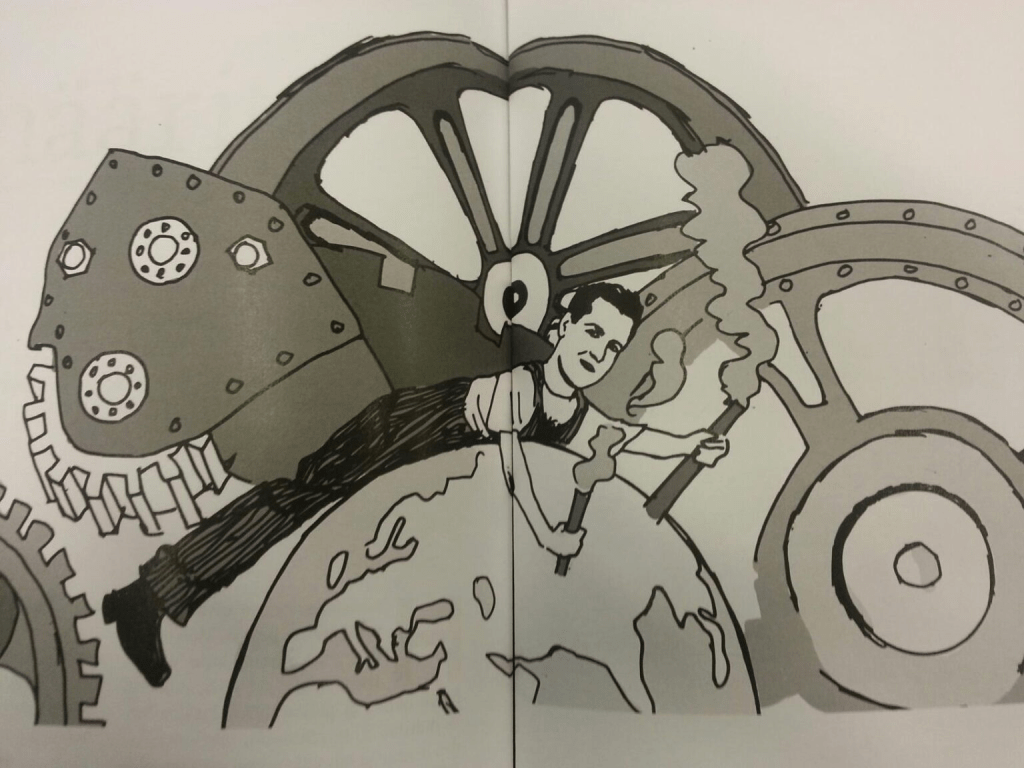
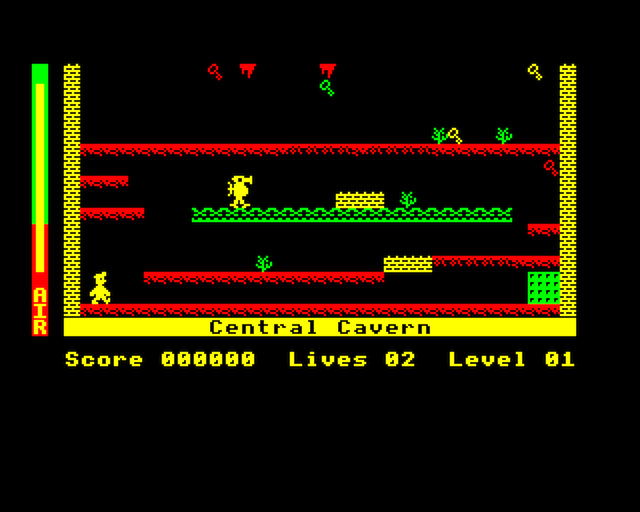
Manic Miner, cited in Kingsnorth’s “The Cross and the Machine”

On the video game side of things, my eyes are bigger than my memory card and my appetite likewise exceeds all reasonable bounds, so more and more I’ve been following along with let’s plays rather than playing new games myself. The spirit is willing, the flesh is weak–and paternity leave is fleeting!

Prof Noctis has been my resource for the new Final Fantasy VII: Remake Intergrade release on Switch 2. While he takes advantage of “God mode” affordances included in the game to speed things up, he’s also made time thereby to share the work of other creators, commenting on video essays and discussing “homework assignments” in the form of essays written by the audience, among them a couple by yours truly. Supposedly these will be published eventually in some form as well. Most importantly, though, he’s simultaneously playing through the intriguing mod of the original FFVII dubbed the Shinra Archaeology cut, a translation and adaptation with additional content based on that project’s painstaking study of the original release. It is fantastic.

Maybe because I’ve been watching videos where people say “God mode,” and Alex has been uploading videos where he and I discuss the tropes of JRPGs, among the best-known of which is that “you kill God,” the almighty algorithm, with all the astuteness of a mother-in-law, deemed the following video likely to be of interest. While it takes a while to get going, once it does, it does not disappoint.

Note the subtitles:

Do you hear the voice of life…

Do you hear the voice of the earth…

We were once human…

Then just remember: you’re not a god. – Hitsujibungaku

Which pretty much sums up the many, many hours of discussions we’ve been having of those golden age FF games on the PlayStation.

Meanwhile, my other streaming mainstay, Moses Norton, The Well-Red Mage, has nearly completed his years-long project of playing every RPG released on the SNES in English localization, on original hardware. Having written one volume of a book about the experience and currently working on the second, he took some time to talk with me about it. I loved the book, difficult as the circumstances of its release proved, and I can’t wait to see the full version when it is ready.

Of all my serial interlocutors, there are few more devoted to their craft and more deserving of wider recognition than Moses; then to see that recognition come all too suddenly in the form of undeserved notoriety, followed by a slow and deliberate recovery of confidence and reputation, with steadily accumulating acknowledgment of the extent of the harms on all sides and the possibility of forgiveness at least broached if not realized–I’m fairly in awe of his willingness to stick with these old games, playing them on air for all us sinners, when the internet is just as complex as the people who attempt to use it, and our interactions there are liable to be just as fraught, with all the potential for misuse we are heir to, only magnified by its reach.

And I’m very excited to hear that he’s considering playing next that much lengthier list (however you slice it) of RPGs that were never released officially outside Japan, but for which the resources now exist to allow many more of us to experience them on hardware that is as close to the original as possible, and with the aid of fan-translations and other study aids, whether collaborators helping out on the stream or coding agents of one sort or another facilitating a quick trot or interpretation of the text onscreen.

I’m imagining a version of Tolkien Professor Corey Olsen’s Students of the Word or my friend Brian’s Quran study program for video games like MOTHER 2, which I’ve always wanted to play in the Japanese original, as well as all those games I don’t even know about beyond perhaps the names. Because we are only human, let’s hope our electronic critters will be faithful to the good intentions of those of us attempting to use them for such harmless, educational purposes, but wiser than we always are about going wherever they lead.

From Caedmon to The Wire: World Pictures and the Play of Language

We find ourselves in a bewildering world. We want to make sense of what we see around us and to ask: What is the nature of the universe? What is our place in it and where did it and we come from? Why is it the way it is?

To try to answer these questions we adopt some “world picture.”

Stephen Hawking, A Brief History of Time

I’ve been reading Philip Pullman again, and reading as much as I can find of what he alludes to in the course of his stories. Among the books Dr Hannah Relf lends to young Malcolm Polstead, our protagonist in La Belle Sauvage, is A Brief History of Time, which exists in our universe as well. While I enjoyed The Body in the Library by a parallel Agatha Christie, presumably, which is the first book he chooses to borrow from her library, it’s the world picture conjured up by Hawking–and not the specific account of space-time so much as the idea of a “world picture” as such, as a way to answer fundamental questions–that has led me to think about Pullman’s project anew. After all, one of the first, unforgettable images from The Golden Compass is literally the picture of a world, another world visible in the aurora, projected from a lantern slide; and some of the final images in The Rose Field… well, we’ll get there when we get there.

Pullman’s illustration for Chapter 2: The Idea of North

Sometimes it becomes possible for an author to revisit a story and play with it, not to adapt it to another medium (it’s not always a good idea for the original author to do that), nor to revise or “improve” it (tempting though that is, it’s too late: you should have done that before it was published, and your business now is with new books, not old ones). But simply to play.
And in every narrative there are gaps: places where, although things happened and the characters spoke and acted and lived their lives, the story says nothing about them. It was fun to visit a few of these gaps and speculate a little on what I might see there.
As for why I call these little pieces lantern slides, it’s because I remember the wooden boxes my grandfather used to have, each one packed neatly with painted glass slides showing scenes from Bible stories or fairy tales or ghost stories or comic little plays with absurd-looking figures. From time to time he would get out the heavy old magic lantern and project some of these pictures on to a screen as we sat in the darkened room with the smell of hot metal and watched one scene succeed another, trying to make sense of the narrative and wondering what St. Paul was doing in the story of Little Red Riding Hood—because they never came out of the box in quite the right order.
I think it was my grandfather’s magic lantern that Lord Asriel used in the second chapter of The Golden Compass. Here are some lantern slides, and it doesn’t matter what order they come in. – Philip Pullman, the “lantern slides” edition of His Dark Materials

While most people I’ve talked to have expressed disappointment with the ending of The Book of Dust, and that was my own initial reaction, I’ve found it is growing on me with rereadings, particularly as I’ve been listening to the audio versions read by Michael Sheen. It doesn’t hurt that his interview with Pullman, accompanying the final volume, is the best of its kind that I’ve found so far. Particularly resonant are their discussions of the procession and the story, commenting on a little demonstration or rhetorical flourish of Pullman’s in another interview, a video for the Bodleian Library; and of the alethiometer contrasted with the myriorama as images of reading and writing or telling stories.

From procession to story, around 2:30 in Behind the Desk: Philip Pullman

So it strikes me that the first requirement of a compelling world picture–speaking only for myself–is that it should partake of that commingling of beauty and truth which Keats’ Grecian Urn attests. If in time irradiating its truth-beauty some contradiction should arise in our perception of that dear picture between the sense of its truth and its felt beauty, then we have to either discard it–Lewis has written powerfully about that in The Discarded Image–or, recurring again to Keats, we can abide with it at the limits of our “negative capability.”

This is where I strive to engage with Pullman, rather than rejecting him, believing us “capable of being in uncertainties, Mysteries, doubts, without any irritable reaching after fact & reason,” as he himself has pointed the way, having these very lines quoted by another one of his scholars, Dr Mary Malone, in The Subtle Knife. When I think of his work as a kind of invitation to think and feel in this way, its challenges, while no less agonistic and at times agonizing, take on a beautiful, sporting quality. And like few other authors, Pullman conduces to the “having of wonderful ideas,” in Duckworth’s model for learning, and to “the realization that prayer consists of attention,” in Weil’s formulation, which I take to be an end beyond the end of learning for its own sake.

“The poem was the authority here, not the teacher.”

One thought I’ve been noodling on along the way, which I’ll just lay down as best I can for now, is that language–language learning at the most basic and most advanced levels alike, literacy and reading of all degrees of interpretive complexity, and literature at its furthest avant garde edge–seems to live and move and leap ahead by way of play.

To adduce a handful of instances representing the movement between world-pictures and worlds:

  • Homeric games and the bow-stringing challenge
  • David dancing before the Lord; dance for Huizinga “the purest and most perfect form of play that exists”
  • Caedmon’s Hymn, considered the first English poem, and the story of its composition given in Bede
  • Chaucer’s pilgrims, making of their tales “ernest” and “game”
  • Shakespeare’s wandering players and kings and the “invention of the human” (Bloom)
  • Joyce’s “shout in the street” in Ulysses, and its echoes back in Araby

If these are the leaps that come to mind, still there are immense degrees of nuance in between each of them. Between Shakespeare and Joyce, a fair amount of literature survives. Or to zoom in further: between Keats’ vision of (his Bright star‘s vision of)

The moving waters at their priestlike task
Of pure ablution round earth’s human shores

and Matthew Arnold’s Dover Beach with its “melancholy, long, withdrawing roar,” and the near-contemporary Oxford Movement; or between Blake’s Marriage of Heaven and Hell and Wordsworth, Coleridge, Shelley, and Byron pushing at the boundary of reason with no little energy, with Mary Shelley producing Frankenstein as a byproduct of their play; or to jump ahead, within the work of a single writer, from Nabokov’s “link-and-bobolink,” “the correlated pattern in the game,” in Pale Fire to his Terra and Antiterra in Ada, where the “game of worlds” becomes almost literal; so much of any writer’s work which we still read seems to consist in the give and take between modeling and effacing world pictures.

And it seems like this is always including, if not in fact by way of, metaphors of play.

Where they get especially ambitious–or playful–writers absorb scientific and religious worldviews alike into their imaginations. Spariosu has given a much fuller treatment, and Sloek a much richer theory, but there is Kierkegaard’s interpretation of Don Giovanni; Bakhtin’s reading of Rabelais; Dostoevsky’s incorporations of scripture, and Bulgakov’s rewritings of it; Vonnegut’s invention of Kilgore Trout, or Milosz’s Bruno; John Crowley’s other worlds; Pullman’s, and his sprite-like narrators… 

I’ve tried to stick to the English language, but translations have crept into my magic circle, as literature itself wouldn’t mean much in any language without the likes of Homer, the Bible, Shakespeare, and Dostoevsky connecting ideas to images, but also helping their readers with the task of making connections between ideas and action, and thus knitting together the inner world or life to the outer, even up to and including that “consummation devoutly to be wished,” though Benjamin asserts that the storyteller is as much generated by as generating death, “death of the author” be darned.

Still, the question arises–the one Hawking asked back at the start–of what world picture or model best facilitates such summing up of the incommensurables, the infinitesimals, or which anyhow values it as an endeavor worth attempting, whether we have the language to express it or no. And it is a question to which in these posts I am continually responding, and trying to understand others’ responses.

For me, this has to include the roots of the language, religious and scientific and poetic alike. Caedmon has to be there, as well as Hawking, and Christie to help us solve the mystery. Then, perhaps with a little help from our friends, we can also better parse the world-pictures that assail us on the screens that surround us, like this one:

Just now hearing about this eruption of PlayStation iconography at last year’s Super Bowl halftime show by Kendrick Lamar, for example, and about shadow boxing from Babcock, so we’ll see if we can collaborate to write something about that. Or the great chess scenes in Nabokov or The Wire:

And I still haven’t read the large claims of the likes of McGonigal and Combs for the ameliorative power of games, nor Bogost on their rhetoric and persuasiveness, nor Miller on the theology of the same.

Looking next time, though, at Kendrick Lamar’s design patterns, with some serendipitous discoveries in Ortega y Gasset, starting with “The Sportive Origin of the State” (Translated into English; original Spanish) via Postman’s Technopoly (and footnoted in good old Homo Ludens to boot).

A Conversation with Otto Lehto on Video Games and Human Progress

Alex and I had a lovely chat with his friend and fellow scholar Otto this afternoon, out now on audio and video:

Please check it out! If all goes well, we’ll be discussing FFVII Remake, spoilers and all, in an upcoming ep.

Otto’s site: https://www.ottolehto.com/

His 2009 piece “The Collapse and Reconstitution of the Cinematic Narrative: Interactivity vs. Immersion in Game Worlds”

Which in turn cites a shortlist of works, some familiar, others less so–besides games like Xenogears and Tetris–the perusal of which would amount to a kind of course in itself; and which would then be of considerable interest to put into conversation with the retrospective Historiographies of Game Studies volume, or with other case studies from other points along our timeline, such as Crawford’s The Art of Computer Game Design and others featured on the GSSB podcast, or again in a splashy new book like Nguyen’s The Score. To list a few I’m curious about now:

Barthes, Mythologies and The Pleasure of the Text

Eco, The Open Work and A Theory of Semiotics

Ndalianis, Neo-Baroque Aesthetics and Contemporary Entertainment

King & Krzywinska eds, ScreenPlay

Juul, “Games Telling Stories?”

Loftus and Loftus, Mind at Play

Poole, Trigger Happy: The Inner Life of Video Games

Tarasti, Existential Semiotics… huh.

Barthes… not sure how I feel about that guy. “Death of the author,” my foot!

But that’s only one of Otto’s many papers. The other one that seems most germane to those of us concerned with understanding JRPGs might be “Nothingness as Nihilism: Nishitani Keiji and Karatani Kojin.”

Over email, Otto let me know that he also has an “interview with Jonne Valtonen, the prominent arranger and composer responsible for several orchestrations of Final Fantasy and other video game music, including the series of concerts with the German WDR Radio Orchestra, called Symphonic Shades (2008), Symphonic Fantasies (2009), Symphonic Legends (2010), and Symphonic Odysseys (2011). Unfortunately, our discussion, from over 10 years ago, is only available in Finnish… I have tried allowing for automatic English subtitles/captions, but it has not worked out…”

What a world!

Many thanks to Alex, soon to be Dr Schmid, for introducing us and setting up this conversation with Dr Lehto.

Photo credit: Teemu Perhiö, 2013 – https://www.ottolehto.com/

The Year of Worldbuilding

Belated as ever, I know, but the first of our weekly-to-monthly updates of the year is here! Happy New Year and welcome back, Video Game Academy readers. Welcome… to the Year of Worldbuilding.

“We went through some crazy stuff… But as you can see, I’m alright now!” (Let’s Play Archive)

(Whole articles could–and shall!–be written on the use of ellipses in JRPGs… the old oratorical flourish of a dramatic pause is the least of it. The thoughtful facial expression, the pensive self-forgetting, the grim determination, the speechless sorrow–so many ways this little trinity (give or take) of punctuation gets deployed…)

We are never done tinkering with myth in games, of course, but the time has come to turn our attention to a related key theme in the overlapping fields of video game studies and the humanities. Worldbuilding is the task before every would-be author of speculative fiction, which is to say everyone who has ever enjoyed a book or video game set in a (sub)created world and wondered if they could make one someday. Kudos to all those who do make the attempt! And all encouragement to those who, like us, wish that we might!

Laura shared this presentation on the Pixels discord, per the zeitgeist, and I recommended she send it to Resonant Arc, who just made a video interviewing several indie developers, including Pat Holleman!

It’s well worth watching the Gottliebs’ presentation about their experience. The insight that sticks with me is the twofold, bidirectional nature of the worldbuilding impulse which they elaborate together: how we as players are imaginatively involved in evoking the images and story of the game, particularly when it is retro in presentation, much like we do with the text of a written story; and how we are inspired to put ourselves in the place of the developer, to imagine how we might want to go about things if we were to make our own game.

Ever since Tolkien mused on “other minds and hands” in his famous letter to Milton Waldman, the full spectrum of fandom, from fanfiction followers to transparent imitators to anxiety-of-influence-laden latecomers and romantic originators of new classics, has been lured out into the open, though it feels like every day the flywheel of content creation and consumption spins faster, and its deleterious effect on whatever real world we still share becomes more lurid. Worldbuilding is just the sort of preliminary, lore-bearing activity we mostly carve out time for studying here, somewhat to our own chagrin, when all the cool philosophers and game studies kids prefer to say with Marx that after all the goal is not just to interpret the world, but to “change it.” Still, we prefer to stay with Rilke’s speaking image of the great, shattered beauty and listen when it says: “you must change your life.”

Why worldbuilding, though? Shouldn’t we start with building something on a slightly smaller scale, perhaps a school–or school of thought–or a neighborhood, or a home, or a steady devotion to some even smaller upbuilding practice of service or mentorship, reading or writing, meditation or prayer? Preposterously enough, the intuition that drives this whole quixotic project tells me that when we are at work in any of these vital ways, we are always also worldbuilding, and that by zooming out and seeing that largest possible framework, trying to get a glimpse of what sort of world we are in the process of fashioning, we might be able to better grasp all the day-to-day upbuilding efforts that we are about.

So, thank you for being here with us at the Video Game Academy for another year of reading, writing, playing, teaching, learning, working on languages and practicing music, or whatever your resolutions might entail.

While it’s still roughly the right time of year, I’m bound to share, like I seem to do every year, this obscure one from Sufjan Stevens–and wishing you once again all the best this 2026!

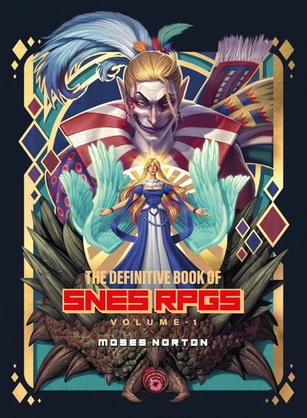
RPG Nirvana & JRPGana – The Definitive Book of SNES RPGs by Moses Norton & A Guide to Japanese Role-Playing Games by Kurt Kalata

The Definitive Book of SNES RPGs (Vol. 1) by Moses Norton and A Guide to Japanese Role-Playing Games by Kurt Kalata (ed.) are both published by Bitmap Books, new within the past month and last few years, respectively. They are doorstoppers, beautifully produced, quite pricey, and worth every penny. My name appears in the acknowledgements of the former; many of my favorite games–EarthBound/MOTHER 2, Chrono Trigger, Xenogears, Wild Arms, and so on–appear in the latter, though each game is afforded only a page or two due to the book’s massive scope.

I’ve long dreamt of writing a book like these, a kind of Haunted Wood for video games, but I haven’t actually played all that many of the incredibly rich and diverse body of games that Norton and Kalata cover. Particularly, I’ve wished I could better understand my favorite games of the golden age of console RPGs in their cross-cultural context, having tried, so far with little determination and less success, to learn Japanese for that purpose–so I’ll settle for reading others who can, for now.

A few disclaimers up front: I am aware that Moses and the Bitmap folks have faced a smear campaign and waves of cancel-cultural recrimination over comments he made, but I will step around that. This choice, like the review which follows, is, needless to say, not entirely unbiased by my personal friendship and professional respect for the writer also known online as The Well-Red Mage, nor my admiration, shading into jealousy, of the productions of the Bitmap team and writers of Kalata’s clout who have worked with them. But what’s an amateur Video Game Academy scholar to do? We have to talk about the games themselves, first and foremost, in all humility and giving grace as far as we can, extending the circle of dialogue, lifting up the voices of students, fellow hobbyists, fans, content creators, and industry professionals alike. None of us is perfect, none of us ought to feel we’re in a position to cast stones, in my view; with all deference to the righteous Redditors and other pharisaical denizens of the retro games discourse, I can’t see who is helped by such a pile-on. Or, if that disputed passage in John’s gospel is not to your taste, let’s say it in Dostoevsky’s terms, from Alyosha and Grushenka’s tete-a-tete in The Brothers Karamazov, with a Sakaguchi spin: I’m all for giving an onion (knight), giving a second chance or New Game Plus, once someone has apologized. I can only offer an apology of my own to whoever has been harmed by the exchange and its fallout. Certainly I wish Moses and his family the best after the wringer they’ve been through, and hope that Vol. 2 of his book is not too long in coming, whether from Bitmap or another source if they’re not able to patch things up.

Bitmap Books, via The Video Game Library

But without further ado. Per the title, and in line with its author’s long-time, courageous project of bringing greater objectivity and rigor to the discussion of widely beloved games from ye olde eras past, The Definitive Book of SNES RPGs (not only JRPGs, mind, as I initially thought) takes as one of its points of departure “a new systematic approach to defining an indefinite genre” (31). I found this section powerfully clarifying, as I tend to have a much more intuitive, wishy-washy stance on questions of categories and sub-genres. Norton lays out a practical “Rule of Three: Character, Combat, Narrative” with each of these further breaking down in to three elements: Roles, Progression, and Statistics for Characters; Combat as such, its Turn-Based mechanics, and Variables; and Narrative story arcs characterized by Economy and Exploration. Where two of the three larger headings overlap, or where an RPG is more heavily weighted towards one or the other, we get the sub-genres of “action” or “adventure,” or indeed “action-adventure,” but any game that has at least some significant elements of narrative, combat, and character development can be fairly called an RPG (37).

Ranging over the 22 games this rubric brings under discussion, covering the first half of the SNES RPG library’s alphabet, Norton’s analysis is anchored by these mechanical considerations–and isn’t it refreshing to see how he chooses to cut across the usual distinction between gameplay and story, opting instead for this powerful, flexible Rule of Three? Each chapter opens with a graphic indicating which elements are deemed to be in evidence, alongside the developer and publisher credits, and while plenty of the games have all nine icons, there are a handful of edge cases. “King of Dragons isn’t an RPG! I can hear you yelling” he remarks in the penultimate chapter; to which I have to reply, demurring, “I’ve never even heard of it” (501). And in fact these debatable RPG inclusions, especially ActRaiser and EVO, make for some of the most interesting chapters in the book in terms of defining what an RPG is, and what a particular blend of mechanics, story, and gameplay loops portends for thematic questions about the meaning of a given game as a work of art.

For, as even a cursory reader soon discovers, dipping into chapters here and there rather than plowing through the book cover to cover as I did on my first read (though I heeded Norton’s caveat to go out of ABC order so as to flip-flop Dragon View and Drakkhen,”the first SNES RPG” 302, and one with a fascinating lineage that may or may not intersect with Gary Gygax himself), the close analysis of game elements in line with a wider project of empirically defining the genre is only one of the book’s significant threads, and perhaps not its most important. Just as Narrative and Combat are mediated by Character, Norton’s own voice, experiences, predilections, and indeed his character are present throughout the discussion. Along with the requisite historical context, pertinent information about the games’ development and systems, and more or less entertaining trivia and Easter eggs, we get a personal tour of each game’s world, its challenges and triumphs, and reflections on all of it from a true connoisseur.

For me, the best sections of the book weren’t actually the ones about the best games: the tour de force of Chrono Trigger or the ebulliently playful-yet-earnest EarthBound (which I read and commented on for the author in draft), or the groundbreaking FFII or even the operatic FFIII; nor was it, on the other hand, Norton’s almost impossibly judicial, admirably evenhanded treatment of the execrable Lord of the Rings. Much as I appreciated these for how they provide wonderful, coherent perspectives on games I know and love (or rather hate, in the case of the SNES LotR, as one can only hate a missed opportunity, a fall as profound as that from a Melkor, brightest of the Ainur–Tolkien’s text–to a Morgoth, archfiend and all-around jerk–its SNES adaptation), I find myself thinking most about, and flipping back to most often, the Introduction and the chapters on the Breath of Fire games.

The Foreword by Alex Donaldson, co-Founder of RPG Site, does a solid job setting the tone, and it is probably noteworthy that both he and Moses Norton are mixed race authors writing authoritatively, confidently, and joyfully about an industry where people of color are not always represented. Norton’s Introduction grounds the book in his upbringing in Hawaii, and he makes explicit the connection between his Native background, his longing for home, and a Tolkienian sea-longing most memorably expressed in great art, which combine to convey the importance of nostalgia in his conception of quality video game critique and analysis. This is all very much catnip to me, preaching to the choir if you like, just as much as his wise words about the meaning of an ostensibly silly game like EarthBound call and respond across the distance to concerns I’ve written and thought about for years, here and on sites run by Norton himself. In sharp contrast, really, to the more technical discussion of the Rule of Three, though both the technical considerations and nostalgic themes become integral to the chapters that follow, this is a big swing of an Introduction after my own heart. If I hadn’t known Norton already beforehand, I’d have reached out to him on the strength of the opening few pages, because I recognize here “a friend I’ve never met,” to use the Pauline (EarthBound’s Paula, that is) locution, a fellow aficionado of 199X RPGs.

In the chapters on Breath of Fire and its sequel, the book’s throughlines of biographical experience and nostalgic retrospection come together in what for me were the most illuminating fashion with its other core thread of systematic, definitional concerns with RPGs as games of a particular type. Perhaps this is because I’ve only played later Breath of Fire iterations, and had little in the way of preconceived ideas about the series, but these chapters spoke to experiences I’ve had from a direction I wasn’t expecting, and landed with startling insight. Maybe this is how people who haven’t played Xenogears would feel listening to my interminable podcast commentary on that game; one can hope! I love the idea that within an objectively slightly janky game, “you may be able to spy the inner workings of a mythos in the making” (168). I would even go further and say that not despite but because of the obstacles in the way of such a glimpse of the seed of a mighty idea, old games like Breath of Fire are inseparably fused to this homeless time of ours, when we deal daily with such a dearth of living myths that we will grab onto them anywhere we can. The games’ religious ambiguity and political, race- and class-conflict story beats, in this light, are almost too poignantly prophetic of our current confusions and divisions. And they shed a light, a warmth, a breath, why not, over players who take the time, as Norton does, to connect deeply with their stories and weave them into their own. Witness some snippets:

Upon starting a new game… a voice in the darkness cries about giving yourself to God and becoming God’s strength…

This is none other than Breath of Fire II, the globe-trotting, history-spanning, darkly religious, draconically epic sequel to the original Breath of Fire, though I describe it simply as “formative”… I spend a lot of words in this book regarding themes, analyses and the meaning embedded in these stories told by means of the Super Nintendo, but when it comes to this game… it’s personal.

Breath of Fire II immediately won my heart from the moment I saw its beautifully realised world, a crystallisation of all of Capcom’s 16-bit sensibilities…

What I didn’t realise at the time was the fact that this game would not only win my heart, but also my soul. I know; even to me it still seems odd to describe encountering a video game, a mere sequel, as a religious experience. Yet somehow, I’ve wasted years describing the early Breath of Fire games as staunchly traditional. I’d like to recant…. (177-179, excerpts; British spellings courtesy of Bitmap.)

Over the course of a nuanced discussion of the game’s religious themes, centered on the duplicitous Church of St Eva, tied in with personal reflections about growing up “in the church” of Western missionaries looking at “the monarch chrysalis hanging from a branch outside” as an image of Pauline transformation (yep, that Paul), an image of the winged anime girl Nina above a cartouche of text discussing a goddess joining the player’s party is balanced against a lengthy passage from CS Lewis on “the Numinous” (182-3)–and lo, it hit me like the thunderbolt on Ryu’s sword that the construction of Norton’s book, heartfelt, syncretic, overflowing with connections between games, literature, and life, mirrored almost exactly the message of these games which he sought to express. The content and form, medium and message, like a successful dragon transformation, were one. And to cap it off, on the next page Ryu celebrates catching a fish as Norton explicates what I had perceived: “It was in this realm of fusion and confusion [Hawaii both as place and as touchstone for his studies of myth and religion] that the roots of my interest in spirituality dug deep, and I really have Breath of Fire II to thank for that” (185).

Again, I found the book immensely valuable precisely because it taught me so much about games I only knew the name of, if that, and will likely never play. Thankfully, Norton has trekked through the likes of Brain Lord and Inindo so I don’t have to, and recorded his discoveries. In a few cases, I also may go ahead and track down some of these more obscure titles just out of curiosity, or to show them to my students or my own kids out of a kind of historical whimsy. But I will undoubtedly move the Breath of Fire series right onto the mental shelf with EarthBound and FFII and find time to play them alongside one another someday.

Norton’s chapters each close with brief notes from other players corroborating and qualifying his reasoning, layering onto his experience of the games the texture of their own voices and memories. Of Breath of Fire, Livnat writes “I also loved that fact that for me, who was also just learning English, there was no real need for a lot of dialogue to get the picture; in fact it enabled me to fill the void of plot with my own understanding of the game, and my own ideas and thoughts” (173). This is much the way Toby Fox talks about learning to read from EarthBound, and how I remember learning from JRPGs like Dragon Quest and FFII my own language, reflected back to me across the bridge of terse NES and SNES localizations; or later, learning Spanish from Platero y yo, before I knew most of the vocabulary enchanted with its sound; or how Philip Pullman talks about the prose of Kipling’s Just So Stories, or the poetry of The Journey of the Magi and Paradise Lost. To repeat, these old games, like these great books, encode a universal archetype, that of the learner–of language, or myth, or a game’s rules–facing a mystery and patiently listening, imagining, playing their way towards comprehension.

It bears mentioning once more that the visual style of Norton’s book, too, is almost intoxicatingly good. The layout, the choice of sprites, backgrounds, and other assets, and still more the peculiar CRT-filter quality of the images, all argue as strongly as the words about the need for us a culture to continue re-evaluating the role of nostalgia and the place of games in the artistic canon.

All this is not to say the book is perfect. A line of text from Daniel Greenberg’s testimonial about Mystic Quest gets transposed 20 pages ahead to the top of Mama Terra’s for FFIII (421). Accompanying Norton’s text and his contributors’, exemplary screenshots from the games, many of which he played through while streaming on Twitch, and pull-quotes from developers and players alike carry the reader along. But as befits a book like this, not meant to be caparisoned in scholarly apparatus, these are not specifically cited.

Consider this passage from Yuji Horii: “The most important part of a RPG is the player feeling like they are taking the role of a character in a fully realised fantasy world. They can explore, visit various towns and places, talk to people, customise their character, collect various items, and defeat monsters. The story is not the focus of the experience and is only there to make the atmosphere of the fantasy world more interesting and engaging during the course of the game” (47).

Where did this quote come from? On the one hand, I can see the problem other armchair academics/neckbeard Karens might have with not knowing for sure, not knowing if Norton has done his homework and cited his sources properly. I, for my part, love that I can cite Norton’s book the next time I attempt to elucidate or take to task Horii-san for this seemingly apocryphal quote. It doesn’t matter so much where or even whether he said it, because he’ll a) never know I am writing about him, and b) if somehow my work were to come to his attention, he’d in all likelihood be perfectly secure in his stature as the godfather of the genre, caring not a whit for what I might quibble with in a quote attributed to him by, among many others, fellow scholar-fan-content-creator Moses Norton.

Bitmap Books, via The Video Game Library

To be Frankystein Mark II, I have not nearly so much to say about A Guide to JRPGs by Kalata et al., but I definitely wanted to note its presence in this connection. When I went to buy The Definitive Book from Bitmap, I couldn’t pass up the appeal of A Guide to JRPGs. It’s not that I don’t find the book as interesting or readable as Norton’s (though I don’t mind saying that I don’t); it’s a very different beast, and not as much to my personal taste. Almost devoid of the personal touches and wrestling with deep questions, both of meaning and mechanics, that characterizes Norton’s work, Kalata’s instead aims for breadth of inclusion rather than depth of inquiry. So I allude to it here mostly as a point of reference.

Now, there are definite strengths to A Guide’s approach, and enormous quantities of information to be found there much more pleasantly than by trying to search for it on wikis with the help of google translate. The very unassumingness of its title, A Guide, belies the wealth of arcana in store for the reader. Even I, I’ll confess, have not managed to read this one cover to cover, though I made sure to dip into favorite games, obscure artifacts of the pre-Famicom era, and salient introductory sections like “What is a JRPG?” “A History of RPGs in Japan,” and “Attack and Dethrone God.” For anyone interested in topics like these–that is to say, just about anyone still reading this, AIs excepted–A Guide is a treasure trove. The perfect combination of bedside curio and coffee table conversation piece, its 650-odd pages and painterly cover adorned with a red binding somehow contrive to feel almost weightless. The prose, similarly, though it lacks Norton’s spiky charm and consistency of voice, being written by a large crew of expert contributors, is nevertheless light in tone, more journalistic than essayistic, and manages to remain easily readable despite the necessarily tiny font.

For a more Norton-esque entry in the same encyclopedic vein, see also Aidan Moher’s Fight, Magic, Items (and my review here) or the Boss Fight Books collection (ditto), though those are each about a single book, for the most part, and would have to be grouped together, Power-Ranger-like, to contend on something like the same scale. But do yourself and your RPG-loving loved ones a favor: the holidays are close enough, surely, to warrant a gift, even if it’s a bit pricey. Books like Norton’s and Kalata’s promise, in turn, the gift of conversations, debates, playthroughs and shared memories. To be passionate about old games is all well and good, but these debates are best conducted cordially, just as the books about them will be most profitable if read charitably. If the conversation that is our shared culture is to be sustained at all, we have to carry it on remembering that there is a person on the other side of the screen, someone who’s fortunate to have been bathed in the same sort of CRT glow we remember, maybe, from the sun of a winter’s or summer’s holiday long ago.

Please, read the books for yourselves and comment responsibly.
Untitled Edith Finch Essay – Guest Post by Dylan Mitten

Courtesy of the inimitable Dylan, whose work has enriched The Community School Game Jam and Mobius Shark Tank at the Spokane Central Library, and whose Hello Kitty Zen Garden graces the unpublished manuscript of TCS: The Book (working subtitle, albeit cliched, heartfelt: Building the Beloved Community School), here is a deep dive into a game I’ve only watched streams of, and yet can hardly imagine the games landscape without: What remains of Edith Finch. Dylan has also presented this as part of the Games Studies wellness, meeting W/F afternoons at TCS. Drop in when you’re in town, just sign in at the front office.

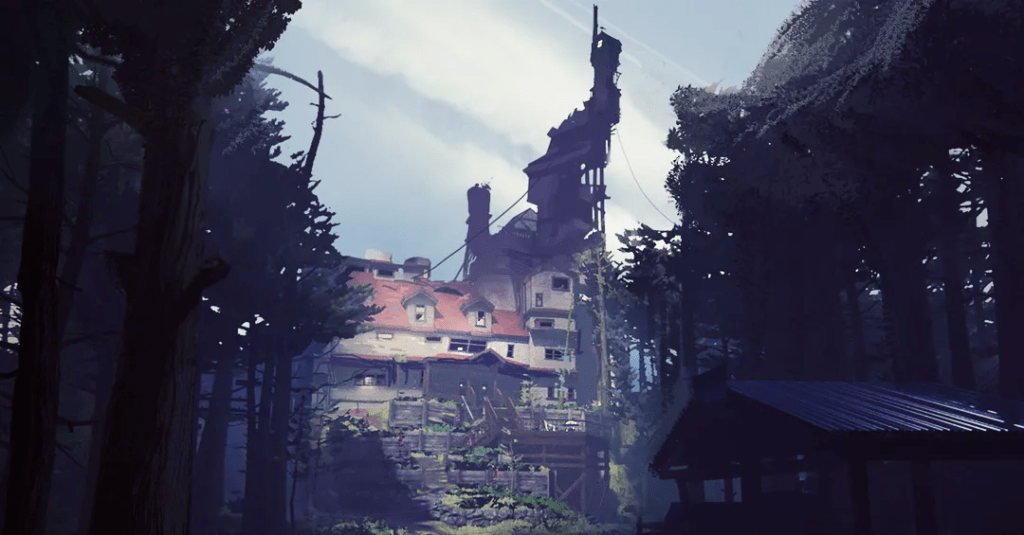
Annapurna Interactive, via WIRED

What remains of Edith Finch is a first-person narrative game where you play as – you guessed it – Edith Finch. Edith is the last living member of her family, and after the death of her mother, we follow her through her childhood home and watch as she uncovers secrets about her family that were buried. Some in walls, others, under beds… you get the idea. Let’s briefly go through the game, and then talk about the pressing issue of the game.

We start the game on a ferry. When we look down, we can see that our character has a cast on their right arm, and that they are holding a journal with “Edith Finch” written on the cover. When we open it, we hear the namesake of the game begin to narrate the writing. She talks about how, at 17, she is the last remaining member of her family. When she gets into the monster of a house that the Finch family home is, we start to learn about all the different members of her family – and moreover, why she is the only one left. 

We learn that in 1937, in an attempt to escape the curse that had claimed his wife and newborn son, Edith’s great-great-grandfather Odin Finch emigrates from Norway to the USA, setting sail with his daughter Edith (Edie, or  Edith Sr. as she’s referred to by Edith), and her husband Sven, as well as their newborn baby, Molly. He uses his house as the raft, but unfortunately, it seemed as though the curse was coming for him too. The wind picked up and a storm broke out. A wave unfortunately took Odin under, swallowing the house with him. Edie and Sven, along with baby Molly, made it to Orcas island safe. Their first order of business? Building a cemetery. 

Of course, this isn’t some happy ending – Edith had to be the last remaining Finch somehow, right? I’ll briefly go over the deaths. 

Edith Sr. ended up having five children with Sven, including Molly. She gave birth to Barbra, twins Sam and Calvin, and Walter. Edie initially believes they’ve left the curse behind, but of course, it’s never that simple. 

At 10, Molly dies from ingesting fluoride toothpaste and holly berries after going to bed without eating. At 16, Barbra is murdered after an argument with her boyfriend over her long-gone stardom. Walter hears all of this happen, and believes it was a monster. After spending 30 years hiding from this monster in the bunker of the house, the day he decides to leave, he is struck by a train. Calvin dies at 11 after swinging too high and flying off of a cliff. At 49, Sven dies from falling off of the house’s roof whilst building a slide.

Sam lives into adulthood, and marries a woman and has Dawn, Edith’s mother, and Gus. Later, he marries a woman named Kay, and they have Gregory.  Dawn is the only one to make it to adulthood. 

At 13, Gus is crushed by a totem pole during a storm. Gregory drowns at 22 months after being left unattended by his mother in the bath. Sam, who at this point is divorced, dies at 33 whist on a hunting trip with dawn. Dawn shoots a buck and Sam wants to take a picture with it and her. Whilst posing for the photo, the buck thrashes and pushes Sam off of a cliff.

Traumatized by all of this, Dawn moves to India, where she marries a man named Sanjay. Together, they have three kids. Lewis, Milton, and Edith jr. 

Sanjay is killed by an earthquake, so Dawn moves her and her kids back into the Finch family home. At 11, Milton mysteriously disappears seemingly out of nowhere, making Dawn become paranoid. She seals all the doors of the rooms of deceased family members. Edie drills peepholes. Lewis, after battling drug abuse and mental health struggles, commits suicide during work. This is when Dawn decides it’s time to leave. She arranges for a nursing home to pick Edie up, and packs the belongings of her and Edith. They leave that night, with Edie meant to get picked up the next day. She doesn’t make it to the morning. Edie is found dead after ingesting alcohol with her medication. Years later, Dawn succumbs to an unspecified illness, leaving a 17 year old Edith to inherit everything. 

In the final scene of the game, we kid out that the character on the ferry with the cast is Edith’s son, and it’s revealed that she died during childbirth shortly after we see her learn of all the secrets of the house. We see her child place flowers on her grave.

That’s the very bare bones of the story. Is there more to explore? More to dig deep on? Yes, of course, but I simply want to talk about my personal opinion with the curse. 

I think that during my first playthrough of the game, I did indeed think there was really a curse – a monster, even, as Walter puts it. He’s convinced that a monster killed Molly, since that’s what she talked about in her journal entry not long before her passing. It was also likely the monster that killed Barbra, since Walter heard it himself!

I definitely believed this theory at first – but the more replays I did, the more I understood the real story, which is the one I placed out for you earlier. I don’t think there’s a monster, nor a curse. I think it’s a bunch of wacky coincidences. Let me explain; I think that the “Curse” is simply a self-fullfilling prophecy, a mindset where you, or someone else, believes that something will happen in the future, and because of that, your actions are affected by that hypothetical event, and eventually, that event happens because you influenced it to!

I think, that given the fact that Edie had recently seen not only her mother and young brother pass away, but also her father while trying to escape the “curse” that supposedly followed them, that she made this connection in her brain that she and her kids were living on borrowed time. I think that this belief made her act less rationally when it came to taking care of her kids, and therefore, the only kid she had that made it to adulthood and had their own kids unintentionally instilled that into them, too. Leading to one of those kids growing up and maybe trying to break the “curse”, but only leading to curiosity about it rather than education about what it truly is. 

Finally, Edith, deciding to find out about the secrets her family holds, died tragically in childbirth in what I believe to be a sad and cruel coincidence. 

So, no. I don’t believe that the Finch family ever had a curse. Instead, I think that the game represents a very straightforward story of generational trauma and how it affects a family. I think that the fear that death was creeping closer resulted in much of the Finch family acting in reckless ways. Some acted as if every day was their last, or didn’t seem too concerned with the danger of it all. Others hid away, or became over protective of themselves and possibly their kids. 

What Remains of Edith Finch is a beautifully dark and morbid game. And I know that at least for me, it allowed me to gain a whole new perspective of what it means to be alive. It gave me an appreciation I didn’t even know I had for life. I think also, that its story about death, highlights just how important it is to cherish every moment, but to also not be afraid to express yourself and do the things that might be a little risky. Enjoy yourself! Don’t be afraid of some silly curse.

Thanks again, Dylan. We look forward to your future endeavors, including the follow up on Little Nightmares and a generation of young players impacted by it!

Books on the Writing Desk

I am looking forward to reading–a familiar feeling for me, but with an unusually heightened clarity and specificity at the moment–several things this month. Towards the end of October in this year of our Lord 2025, the third volume in Philip Pullman’s Book of Dust is set to release. About 40 years after we first met Lyra and Pan in The Golden Compass, we might finally be seeing their final adventure. For years (albeit many fewer), I’ve made it my scholarly hobby-horse to commentary-write, read, interview and podcast on Pullman’s work, and I’m eager to pick up where I left off, now that there is a kind of boundedness to his latest project. My pet theory is that this new book, and the series of which it is a part, is closely linked to his earliest published writing, two novels for adult readers of literature which are largely forgotten… but who knows.

This photo from The Bookseller website suggests some of what we might expect The Rose Field to include (or to open onto, if the picture dates from after the book’s composition), to judge based on the stack of books on the desk in front of the author: Baudelaire, Wallace Stevens; Pullman’s own Northern Lights; dictionaries of modern English usage (Oxford, naturally) and of Merleau-Ponty; All That Is Solid Melts Into Air; The Reader Over Your Shoulder; 101 Middle Eastern Tales and Their Impact on Western Oral Tradition, and a couple of books and loose sheets of paper too small to tell what they are, as well as a big book at the bottom of the pile whose spine is obscured by a tape dispenser. Another reference work? A Bible? And what about all the other books ready to hand over his shoulder? I wonder.

Where do ideas come from? How do we decide which ones to give room in our mind? These are questions which Pullman (and his young readers) and Persona 4 both seem interested in, and to which they give unusually thoughtful responses in the form of their stories. At least part of an answer, though, is suggested by the books we place in front of us, aids and distractions in equal measure as we sit down to write. It’s always tempting to read more instead of writing. In particular, I’m thinking of what Pullman is reading, and yet I’m sure that neither reading that stack of books nor an nth read-through of his own books would prove as effective an apprenticeship as the work of writing three pages a day and telling stories aloud, from memory, to children. Or anyhow this was his practice as a writer and teacher, as he recounts more than once, and it seems to have served him well.

The long-awaited Historiographies of Video Game Studies, while I read it over the summer, insofar as it is possible to read anthologies like this cover to cover, will certainly bear revisiting soon as I set to work on a submission for the zine follow-up to my virtual talk at The Manchester Game Centre. As Jacob Geller recently gave an interview on GSSB, I’m reminded again that both he and Cameron Kunzelman have other essays and books, too, that I’ve been meaning to read.

I still owe Aaron Suduiko a piece on EarthBound in response to the “Comprehensive Theory” series on his website. It’s been a year already since I talked with him and the writer, Max Gorynski. I wonder what they’re up to.

Brian Eno, in conversation with Ezra Klein and evidently in his book, defines art as something like play for grown ups, which must be at least partly true.

Nel Noddings, contrasting the rule-bound and relational in her foundational work on the ethics of care, comes close to refuting Kierkegaard and Sloek alike, with her readings of the binding of Isaac and the myth of Demeter. And Benjamin (Walter, not Kozlowski) might come close to undercutting Tolkien on myth and fairy tales, though I take solace in not quite being able to understand what he is saying towards the end of his essay on Leskov, “The Storyteller.”

Friends and students who I flatter myself I’ve inspired in some way have been sending me things they are writing, and I look forward to reading more and sharing them with other readers, if I can, soon.

Most pressing, though, there is Moses Norton, aka The Well Red Mage or Red for short, who has just released his Definitive Book of SNES RPGs (vol 1). While it has yet to ship, I’ve got the pdf here and am eager to read it and interview the author. Biased as I am, I have to believe the book itself will matter more than what any of us might say online, and I can’t wait to see it take up space on my desk and time in my mind.

The Poetry of Virtual Worlds – Guest Post by Greg Bem

“This was written with Forbidden West in mind”

Maurice Merleau-Ponty (1945) emphasized the role of the body in human experience:

Insofar as, when I reflect on the essence of subjectivity, I find it bound up with that of the body and that of the world, this is because my existence as subjectivity is merely one with my existence as a body and with the existence of the world, and because the subject that I am, when taken concretely, is inseparable from this body and this world.

(Doyle, New Opportunities for Artistic Practice in Virtual Worlds, 2015, pages 93-94)

*

But what of multiple worlds

and worlds within worlds

Cognition a gray sweater

that illuminates nothingness

when flames (worlds) arrive.

*

You were killed by lava. You were killed by a serpent. You were killed by ______.

The disclaimers will continue. Death becomes a spiral outwards and upwards, a lesson, a reincarnation.

*

Where there is world there is life, and where there is life there is death, and it’s impossible not to know rebirth in this model, this statement that humans have imposed upon themselves.

Who was the first to say “Game Over” is a misnomer?

Who was the first to turn life into lives, to give “extra,” to provide a plurality to our relationship? To keep us hijacked, smiling, blissful, tethered into a “this could always become and become more”?

*

Death as joy.

*

The way we die, or log off, or quit. Exit to the main menu. Exit to desktop. The intrinsic meeting the ecstatic: it is all temporary, we will be back.

*

I begin sitting down. My body disappears. I begin in a place. There is no more weight. There is no more shapes. The ether fills. Eyes take over. Vision.

The screen moves from absence to presence. The ground loads. The sky loads. Shapes begin to populate. And I am breathing. And there is a flicker of breath, a digital soul shifts position, in the movement in front of me. If I stare just long enough, I am in conversation. This entity in front of me is a character. And we are beginning to dance.

Each moment entering into a world is incredibly special, a welcoming in, a beckoning. I can almost feel the waves of air parting between me and a world as the hand slices through in urgency. Come, be with us, come, explore with us.

A sprig of grass bounces back and forth. A small mammal makes a cry as it darts away into the horizon. Clouds silently expand and diminish in algorithmic intelligence.

*

Each moment entering into a world. Each moment entering. This sense of load, save, load, save. The returning, the coming back. There is always a coming back.

*

Under layers of pixels my beating heart is sustained and low for ages. Waiting for the crisis to crack, the heart getting massaged by mouse click and key tap.

*

Shift feet on carpet, plastic foot rest, plastic cover. Easy for wheels to slide. Easy for rotation, getting settled in, getting up and exploding out into the everything that exists beneath the hood.

*

This is not about what I do, it is all about how I am.

Stand up.

More coffee.

Sit down.

And stand up.

Ice cream.

Sit down.

And stand up.

Snacks.

Sit down.

Stand up.

Water.

Sit down.

*

There is something about the stack of beers that used to pile up around his desk as he ground through MOBAs and MMOs for hours every night. I’ll always remember that altar of numbness. Though I called it a glass cathedral. Was it bigger than him? The individual? Was it bigger than us? Was it emblematic of all the followers of the subtle, brutal, intensely ever-present escapism?

*

Who are we when we’re running around arenas together? Fighting complacency, finding the will to live. Is this modeling? Crafting new models? Designing the new approach? Quake leads to parkour. Bunny hopping leads to summiting peaks. There is time travel; dissonance between discovery and translation.

On the verge of turning forty, I know my breath is what I’ve held in place for countless hours. Countless becomes dozens. Becomes hundreds. Becomes thousands.

*

And yearning to imagine more, always yearning to image. I can see you, oh androgynous anonymous, with your thousands of hour in your nook of cyber love, co-existing. You bring the soul shiver just by contributing.

Electrical requirements. Taking so much for granted. And when the device breaks, the power stops, there is great sorrow. And when it all returns, there is great joy.

Why does leaving not have a fading away, a deconstruction, a slow removal of objects until we are left with the faint outlines of a skybox and a giant, ever after void?

Early MMOs, find a place to sit, and sit there. Then, and only then, can you properly log off.

And if you don’t follow the rules, what happens? Will your “progress” go “unsaved”?

K makes a game that involves a pit. One can jump out of it, but they need to learn how to jump. I didn’t learn how to jump. I died in the pit. “You were killed by lava.” Or something. And I feel the vague sense that learning is the next step. There is no need. There is no “necessity.” It is not “You must learn how to jump.” It is simply is the unabashed next step.

*

Or I could never return. I could leave. I could escape the escape. For another option. An alternative method. Excitement is matched and balanced with anxiety: to embrace nuance, to give and to take, to accept and to reject. Humanity continues to impose its limitations, including choice.

*

The future will be permutations upon permutations. The future will be all options at once. The future will be beyond “extra lives” to “infinite lives.” Infinite living will be the next surge, the next spike.

*

Will we then be forced to move into limitation as a future future iteration? To remember that linearity always had its benefits, its quaking benefits, its beginning and end, its sense of level, leveling, finite structure, rigidity as a great exclamation?

*

We may still find ourselves loading into the space, the flow of endorphins twin spirals between screen and body of player, the real of the in real life is equal parts virtual, a concoction, a cocktail, of here and everywhere, of linear and open, of possibility and action. The long form list of dualities that builds pressure and enhances the techno relationship ad infinitum.

*

There’s time to clear our heads with all of this. Beneath the logistics and the observations, there is a literary subtext. There is a reason beneath it all, beneath all the questions, the individuals, the collectives, the objectively disconnected and isolated. Deconstruction bedamned, it needs only be to continue being, the narrative is a tapestry, the story is a web of stories, it is storied, it has happened, and that is enough.

*

Greg Bem is a poet, publisher, and librarian in Spokane, Washington. A lifelong gamer and game enthusiast, one of his current creative writing projects is a book-length lyrical essay on virtual worlds and performance. An additional sequence is available in the 2025 issue of LEGENDS, the Spokane Community College literary magazine. Earlier in his timeline, he published a game studies blog, and many of his other creative projects can be found at gregbem.com.

Back to Academia

Welcome to our humble Video Game Academy, and welcome back if you’ve been here before. For our part, we sure have. We know it all too well: the familiar feeling of nerves and excitement, the prospect of introducing ourselves all over again, and the challenge of learning everyone’s name. It’s time for the obligatory back to school post once more.

Professor Kozlowski has been busy as anything, consolidating a summer of reading widely in the political, economic, and social sciences into a course which he plans to wrap up shortly, lecture-wise, with the philosophy of language which undergirds any foray into rule-making, though in real time The History of Social Thought, along with the murderer’s row of other classes he’s teaching this semester, has only just begun. Yet he somehow makes time, every week or two, to chat on the Academy discord about games; games also feature prominently in the suggested readings for his students to chose from for their short presentations at the start of every class session. Last week we talked about FFVIII, picking up in Winhill with Laguna, where his long essay on the black sheep of the franchise leaves off.

With a whole series of podcast discussions on FFVII and, some years later now, FFVIII completed at last, the inimitable Alexander Schmid, all-but-dissertation away from his doctorate, and I, your faithful Moogle-like amanuensis, have just launched into a playthrough of FFIX. The course page will be up momentarily in the Current Semester, where you might also notice several more or less unfinished discussion series still lingering. Sooner or later, we’ll get around to them! But we’ve also been reading and talking about books, working on a sort of monograph on literary modernism and the video game medium, in a segment we sometimes record under the moniker Night School.

In a moment here, I’ll finally get around to posting some writing on virtual worlds from a guest speaker and Spokane-area neighbor, Greg Bem, which he has kindly shared. We met through his helping me with a project my students were doing about AI last spring, and he shepherded an anthology of their writing through publication with his very own Carbonation Press.

For all my regular interlocutors, Ben, Alex, and Steve (who’s been on a well-deserved late-summer vacation), guests old and new like Pat and Greg, and all you readers, thanks for your time. I’m in awe that you’d find it worthwhile to visit this digital Video Game Academy, to pause and think for a spell about the possibilities of imagined worlds with us, and feel like that time is well spent upon returning your attention to the wild, inescapable world of natural sunlight and analog continuity. Long may it last!

Jess (photo credits), Ben, and I capitulated to William’s preference for the park over the museum