On recent podcast conversations and sundry correspondence(s).
My mother-in-law pointed out the other night, quite astutely, that if I did a little more with marketing and Substack and YouTube, I should be able to get donations, maybe through Squarespace, subscriptions, or even sponsorships. She suggested I should work on getting a bed in this way. I must have looked tired, I guess.
But I’ve been staying up late reading Philip Pullman again, as I say, and making notes and podcasts, and corresponding with other readers for the benefit of their perspectives on it all. It’s an incredible privilege to connect with people all around the world through this project. The generosity of strangers never ceases to astonish me, and my gratitude for them sharing their time and ideas in this way–and, grudgingly, for the technology that facilitates our conversations, even as it eats away at the baseline of public discourse–only grows.
If someday I do turn some portion of all these recordings and researches into a salable publication, I’ll also be able to properly remunerate all my guests for their time with honoraria and grants, as I’ve dreamt of doing for a long time. For now, on all our parts, it’s unpaid labor, or in politer parlance, a labor of love.
To judge from the numbers, the internet wants to convince me that this love’s labor’s lost; but my strong hunch is that quality matters more than quantity, or at least, for my purposes of long-form commentary and analysis it does. If I can imagine that each one of those handful of listeners is someone like me–which I have to believe, or forfeit all the humility I pretend to own, as bedrock as anything about me and more important by far than fame or recognition of intellectual bona fides–then the data show that we’re doing just fine. I think I’m up to 50 subscribers!
On a recent episode of the podcast, David Nixon joined me to share his thoughts on The Book of Dust, and in the weeks since he’s followed up with a further recommendation: Paul Kingsnorth’s Against the Machine. When I hear about exciting leads like these in the orbit of my eccentric foci, Pullman’s books and those other great portrayals of religious thought in popular culture, golden age JRPGs such as EarthBound and Xenogears, I tend to perk up my ears. I found Philip Goff’s argument in Galileo’s Error persuasive as far as it goes, though I still have to read his more recent foray into Why? The Purpose of the Universe, no less. Iain McGilchrist, as far as I’m concerned, is a savant on the order of NT Wright, and their new books, The Matter with Things and The Vision of Ephesians: The Task of the Church and the Glory of God, respectively, similarly outrun my grasp as yet. And naturally, the Kingsnorth book is on hold at the library. I still haven’t finished my review of Kristin Poole’s Philip Pullman and the Historical Imagination, though that’s one I did manage to read and re-read, finding it excellent.
So for now I listen to their podcasts and videos. Once again, the internet comes to my rescue with its ambiguous riches. Search them up and see for yourself! (Or unexpectedly encounter them via another route entirely, like the Ephesians class in The Bible Project’s app…)
On the video game side of things, my eyes are bigger than my memory card and my appetite likewise exceeds all reasonable bounds, so more and more I’ve been following along with let’s plays rather than playing new games myself. The spirit is willing, the flesh is weak–and paternity leave is fleeting!
Prof Noctis has been my resource for the new Final Fantasy VII: Remake Intergrade release on Switch 2. While he takes advantage of “God mode” affordances included in the game to speed things up, he’s also made time thereby to share the work of other creators, commenting on video essays and discussing “homework assignments” in the form of essays written by the audience, among them a couple by yours truly. Supposedly these will be published eventually in some form as well. Most importantly, though, he’s simultaneously playing through the intriguing mod of the original FFVII dubbed the Shinra Archaeology cut, a translation and adaptation with additional content based on that project’s painstaking study of the original release. It is fantastic.
Maybe because I’ve been watching videos where people say “God mode,” and Alex has been uploading videos where he and I discuss the tropes of JRPGs, among the best-known of which is that “you kill God,” the almighty algorithm, with all the astuteness of a mother-in-law, deemed the following video likely to be of interest. While it takes a while to get going, once it does, it does not disappoint.
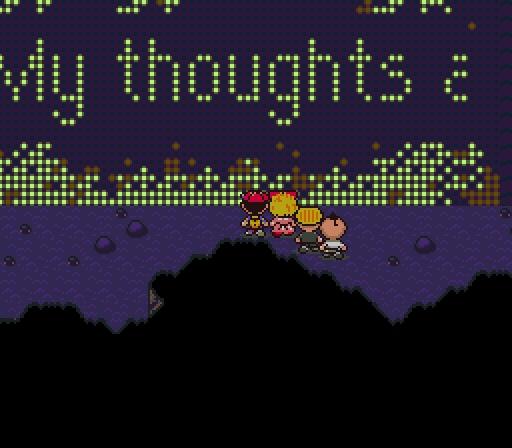
Note the subtitles:
Do you hear the voice of life…
Do you hear the voice of the earth…
We were once human…
Then just remember: you’re not a god. – Hitsujibungaku
Which pretty much sums up the many, many hours of discussions we’ve been having of those golden age FF games on the PlayStation.
Meanwhile, my other streaming mainstay, Moses Norton, The Well-Red Mage, has nearly completed his years-long project of playing every RPG released on the SNES in English localization, on original hardware. Having written one volume of a book about the experience and currently working on the second, he took some time to talk with me about it. I loved the book, difficult as the circumstances of its release proved, and I can’t wait to see the full version when it is ready.
Of all my serial interlocutors, there are few more devoted to their craft and more deserving of wider recognition than Moses; then to see that recognition come all too suddenly in the form of undeserved notoriety, followed by a slow and deliberate recovery of confidence and reputation, with steadily accumulating acknowledgment of the extent of the harms on all sides and the possibility of forgiveness at least broached if not realized–I’m fairly in awe of his willingness to stick with these old games, playing them on air for all us sinners, when the internet is just as complex as the people who attempt to use it, and our interactions there are liable to be just as fraught, with all the potential for misuse we are heir to, only magnified by its reach.
And I’m very excited to hear that he’s considering playing next that much lengthier list (however you slice it) of RPGs that were never released officially outside Japan, but for which the resources now exist to allow many more of us to experience them on hardware that is as close to the original as possible, and with the aid of fan-translations and other study aids, whether collaborators helping out on the stream or coding agents of one sort or another facilitating a quick trot or interpretation of the text onscreen.
I’m imagining a version of Tolkien Professor Corey Olsen’s Students of the Word or my friend Brian’s Quran study program for video games like MOTHER 2, which I’ve always wanted to play in the Japanese original, as well as all those games I don’t even know about beyond perhaps the names. Because we are only human, let’s hope our electronic critters will be faithful to the good intentions of those of us attempting to use them for such harmless, educational purposes, but wiser than we always are about going wherever they lead.
We find ourselves in a bewildering world. We want to make sense of what we see around us and to ask: What is the nature of the universe? What is our place in it and where did it and we come from? Why is it the way it is?
To try to answer these questions we adopt some “world picture.”
I’ve been reading Philip Pullman again, and reading as much as I can find of what he alludes to in the course of his stories. Among the books Dr Hannah Relf lends to young Malcolm Polstead, our protagonist in La Belle Sauvage, is A Brief History of Time, which exists in our universe as well. While I enjoyed The Body in the Library by a parallel Agatha Christie, presumably, which is the first book he chooses to borrow from her library, it’s the world picture conjured up by Hawking–and not the specific account of space-time so much as the idea of a “world picture” as such, as a way to answer fundamental questions–that has led me to think about Pullman’s project anew. After all, one of the first, unforgettable images from The Golden Compass is literally the picture of a world, another world visible in the aurora, projected from a lantern slide; and some of the final images in The Rose Field… well, we’ll get there when we get there.
Pullman’s illustration for Chapter 2: The Idea of North
Sometimes it becomes possible for an author to revisit a story and play with it, not to adapt it to another medium (it’s not always a good idea for the original author to do that), nor to revise or “improve” it (tempting though that is, it’s too late: you should have done that before it was published, and your business now is with new books, not old ones). But simply to play. And in every narrative there are gaps: places where, although things happened and the characters spoke and acted and lived their lives, the story says nothing about them. It was fun to visit a few of these gaps and speculate a little on what I might see there. As for why I call these little pieces lantern slides, it’s because I remember the wooden boxes my grandfather used to have, each one packed neatly with painted glass slides showing scenes from Bible stories or fairy tales or ghost stories or comic little plays with absurd-looking figures. From time to time he would get out the heavy old magic lantern and project some of these pictures on to a screen as we sat in the darkened room with the smell of hot metal and watched one scene succeed another, trying to make sense of the narrative and wondering what St. Paul was doing in the story of Little Red Riding Hood—because they never came out of the box in quite the right order. I think it was my grandfather’s magic lantern that Lord Asriel used in the second chapter of The Golden Compass. Here are some lantern slides, and it doesn’t matter what order they come in. – Philip Pullman, the “lantern slides” edition of His Dark Materials
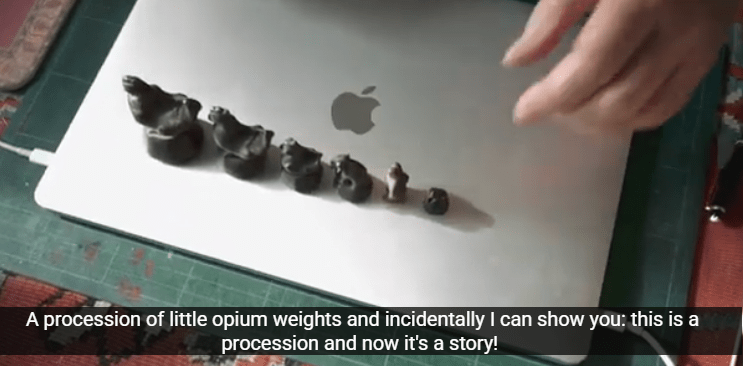
While most people I’ve talked to have expressed disappointment with the ending of The Book of Dust, and that was my own initial reaction, I’ve found it is growing on me with rereadings, particularly as I’ve been listening to the audio versions read by Michael Sheen. It doesn’t hurt that his interview with Pullman, accompanying the final volume, is the best of its kind that I’ve found so far. Particularly resonant are their discussions of the procession and the story, commenting on a little demonstration or rhetorical flourish of Pullman’s in another interview, a video for the Bodleian Library; and of the alethiometer contrasted with the myriorama as images of reading and writing or telling stories.
So it strikes me that the first requirement of a compelling world picture–speaking only for myself–is that it should partake of that commingling of beauty and truth which Keats’ Grecian Urn attests. If in time irradiating its truth-beauty some contradiction should arise in our perception of that dear picture between the sense of its truth and its felt beauty, then we have to either discard it–Lewis has written powerfully about that in The Discarded Image–or, recurring again to Keats, we can abide with it at the limits of our “negative capability.”
This is where I strive to engage with Pullman, rather than rejecting him, believing us “capable of being in uncertainties, Mysteries, doubts, without any irritable reaching after fact & reason,” as he himself has pointed the way, having these very lines quoted by another one of his scholars, Dr Mary Malone, in The Subtle Knife. When I think of his work as a kind of invitation to think and feel in this way, its challenges, while no less agonistic and at times agonizing, take on a beautiful, sporting quality. And like few other authors, Pullman conduces to the “having of wonderful ideas,” in Duckworth’s model for learning, and to “the realization that prayer consists of attention,” in Weil’s formulation, which I take to be an end beyond the end of learning for its own sake.
“The poem was the authority here, not the teacher.”
One thought I’ve been noodling on along the way, which I’ll just lay down as best I can for now, is that language–language learning at the most basic and most advanced levels alike, literacy and reading of all degrees of interpretive complexity, and literature at its furthest avant garde edge–seems to live and move and leap ahead by way of play.
To adduce a handful of instances representing the movement between world-pictures and worlds:
Homeric games and the bow-stringing challenge
David dancing before the Lord; dance for Huizinga “the purest and most perfect form of play that exists”
Caedmon’s Hymn, considered the first English poem, and the story of its composition given in Bede
Chaucer’s pilgrims, making of their tales “ernest” and “game”
Shakespeare’s wandering players and kings and the “invention of the human” (Bloom)
Joyce’s “shout in the street” in Ulysses, and its echoes back in Araby
If these are the leaps that come to mind, still there are immense degrees of nuance in between each of them. Between Shakespeare and Joyce, a fair amount of literature survives. Or to zoom in further: between Keats’ vision of (his Bright star‘s vision of)
The moving waters at their priestlike task Of pure ablution round earth’s human shores
and Matthew Arnold’s Dover Beach with its “melancholy, long, withdrawing roar,” and the near-contemporary Oxford Movement; or between Blake’s Marriage of Heaven and Hell and Wordsworth, Coleridge, Shelley, and Byron pushing at the boundary of reason with no little energy, with Mary Shelley producing Frankenstein as a byproduct of their play; or to jump ahead, within the work of a single writer, from Nabokov’s “link-and-bobolink,” “the correlated pattern in the game,” in Pale Fire to his Terra and Antiterra in Ada, where the “game of worlds” becomes almost literal; so much of any writer’s work which we still read seems to consist in the give and take between modeling and effacing world pictures.
And it seems like this is always including, if not in fact by way of, metaphors of play.
Where they get especially ambitious–or playful–writers absorb scientific and religious worldviews alike into their imaginations. Spariosu has given a much fuller treatment, and Sloek a much richer theory, but there is Kierkegaard’s interpretation of Don Giovanni; Bakhtin’s reading of Rabelais; Dostoevsky’s incorporations of scripture, and Bulgakov’s rewritings of it; Vonnegut’s invention of Kilgore Trout, or Milosz’s Bruno; John Crowley’s other worlds; Pullman’s, and his sprite-like narrators…
I’ve tried to stick to the English language, but translations have crept into my magic circle, as literature itself wouldn’t mean much in any language without the likes of Homer, the Bible, Shakespeare, and Dostoevsky connecting ideas to images, but also helping their readers with the task of making connections between ideas and action, and thus knitting together the inner world or life to the outer, even up to and including that “consummation devoutly to be wished,” though Benjamin asserts that the storyteller is as much generated by as generating death, “death of the author” be darned.
Still, the question arises–the one Hawking asked back at the start–of what world picture or model best facilitates such summing up of the incommensurables, the infinitesimals, or which anyhow values it as an endeavor worth attempting, whether we have the language to express it or no. And it is a question to which in these posts I am continually responding, and trying to understand others’ responses.
For me, this has to include the roots of the language, religious and scientific and poetic alike. Caedmon has to be there, as well as Hawking, and Christie to help us solve the mystery. Then, perhaps with a little help from our friends, we can also better parse the world-pictures that assail us on the screens that surround us, like this one:
Just now hearing about this eruption of PlayStation iconography at last year’s Super Bowl halftime show by Kendrick Lamar, for example, and about shadow boxing from Babcock, so we’ll see if we can collaborate to write something about that. Or the great chess scenes in Nabokov or The Wire:
And I still haven’t read the large claims of the likes of McGonigal and Combs for the ameliorative power of games, nor Bogost on their rhetoric and persuasiveness, nor Miller on the theology of the same.
Looking next time, though, at Kendrick Lamar’s design patterns, with some serendipitous discoveries in Ortega y Gasset, starting with “The Sportive Origin of the State” (Translated into English; original Spanish) via Postman’s Technopoly (and footnoted in good old Homo Ludens to boot).
I am looking forward to reading–a familiar feeling for me, but with an unusually heightened clarity and specificity at the moment–several things this month. Towards the end of October in this year of our Lord 2025, the third volume in Philip Pullman’s Book of Dust is set to release. About 40 years after we first met Lyra and Pan in The Golden Compass, we might finally be seeing their final adventure. For years (albeit many fewer), I’ve made it my scholarly hobby-horse to commentary-write, read, interview and podcast on Pullman’s work, and I’m eager to pick up where I left off, now that there is a kind of boundedness to his latest project. My pet theory is that this new book, and the series of which it is a part, is closely linked to his earliest published writing, two novels for adult readers of literature which are largely forgotten… but who knows.
This photo from The Bookseller website suggests some of what we might expect The Rose Field to include (or to open onto, if the picture dates from after the book’s composition), to judge based on the stack of books on the desk in front of the author: Baudelaire, Wallace Stevens; Pullman’s own Northern Lights; dictionaries of modern English usage (Oxford, naturally) and of Merleau-Ponty; All That Is Solid Melts Into Air; The Reader Over Your Shoulder; 101 Middle Eastern Tales and Their Impact on Western Oral Tradition, and a couple of books and loose sheets of paper too small to tell what they are, as well as a big book at the bottom of the pile whose spine is obscured by a tape dispenser. Another reference work? A Bible? And what about all the other books ready to hand over his shoulder? I wonder.
Where do ideas come from? How do we decide which ones to give room in our mind? These are questions which Pullman (and his young readers) and Persona 4 both seem interested in, and to which they give unusually thoughtful responses in the form of their stories. At least part of an answer, though, is suggested by the books we place in front of us, aids and distractions in equal measure as we sit down to write. It’s always tempting to read more instead of writing. In particular, I’m thinking of what Pullman is reading, and yet I’m sure that neither reading that stack of books nor an nth read-through of his own books would prove as effective an apprenticeship as the work of writing three pages a day and telling stories aloud, from memory, to children. Or anyhow this was his practice as a writer and teacher, as he recounts more than once, and it seems to have served him well.
The long-awaited Historiographies of Video Game Studies, while I read it over the summer, insofar as it is possible to read anthologies like this cover to cover, will certainly bear revisiting soon as I set to work on a submission for the zine follow-up to my virtual talk at The Manchester Game Centre. As Jacob Geller recently gave an interview on GSSB, I’m reminded again that both he and Cameron Kunzelman have other essays and books, too, that I’ve been meaning to read.
I still owe Aaron Suduiko a piece on EarthBound in response to the “Comprehensive Theory” series on his website. It’s been a year already since I talked with him and the writer, Max Gorynski. I wonder what they’re up to.
Brian Eno, in conversation with Ezra Klein and evidently in his book, defines art as something like play for grown ups, which must be at least partly true.
Nel Noddings, contrasting the rule-bound and relational in her foundational work on the ethics of care, comes close to refuting Kierkegaard and Sloek alike, with her readings of the binding of Isaac and the myth of Demeter. And Benjamin (Walter, not Kozlowski) might come close to undercutting Tolkien on myth and fairy tales, though I take solace in not quite being able to understand what he is saying towards the end of his essay on Leskov, “The Storyteller.”
Friends and students who I flatter myself I’ve inspired in some way have been sending me things they are writing, and I look forward to reading more and sharing them with other readers, if I can, soon.
Most pressing, though, there is Moses Norton, aka The Well Red Mage or Red for short, who has just released his Definitive Book of SNES RPGs (vol 1). While it has yet to ship, I’ve got the pdf here and am eager to read it and interview the author. Biased as I am, I have to believe the book itself will matter more than what any of us might say online, and I can’t wait to see it take up space on my desk and time in my mind.
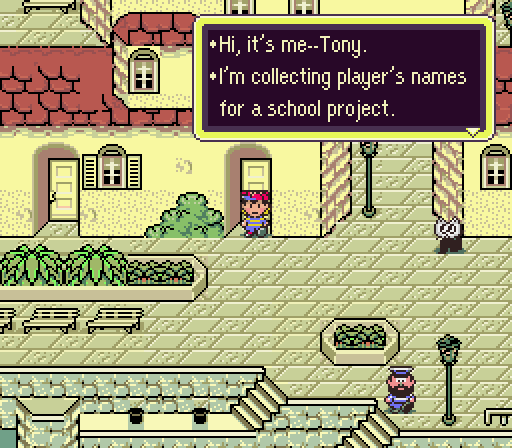
I’m slowly working on a few more essays related to books and games, but for now I wanted to share this recent piece on Philip Pullman and Earthbound, a talk given at Cascade Moot (August 31, 2024) on the theme: “From the Fringe: The Importance of Secondary and Tertiary Characters.”
Presentation slides – essential for playing Name That Tony! with us and reading text boxes from EarthBound
Reflecting on two secondary characters, Tony from Snow Wood and Tony Makarios, respectively appearing in EarthBound, a video game released for the Super Nintendo in 1995, and The Golden Compass, a book by Philip Pullman published that same year, players and readers of all ages are invited to consider themes of loss and recovery from a new perspective. Both characters are kidnapped, one at the start and one near the end of the adventures in which they figure; both characters have someone important taken away from them in turn. Their responses provide significant symbolic images and gameplay mechanics that draw us closer to the heart of these stories.
Thanks to the team at Signum U for hosting, and to you for listening.
My point of departure is a question: Where shall wisdom of the world be found?
I frame it like this, as a mashup of quotations–
But where shall wisdom be found? and where is the place of understanding? – Job 28:12
Show me the wisdom of the world Tell me the secrets of the heart And the sweet mysteries of love – “Wisdom of the World,” MOTHER arranged album. Catherine Warwick/Keiichi Suzuki. Lyrics by Linda Hennrick
–because the works cited are very dear to me. And because I believe other people might feel the same, I wanted to sit with them awhile, to share some of the ways in which these words and these games have helped me with the very deep questions they ask.
Abstract
The reader is asked to consider the role played by questions within the MOTHER/EarthBound games in an open-ended, poetic and philosophical light, both in service to replaying and wondering through the games and as a guide to related questions surrounding their significance, development, and reception. From “Which style of windows do you prefer?” to “THE END… ?” EarthBound, our principal focus, like its precursor EarthBound: Beginnings and its successor MOTHER 3, continually poses questions. Whether direct or implied, with or without affording players (to say nothing of the silent protagonists) ways to respond to them in-game, these questions present an opportunity to think more deeply about the games and what they mean for us who play them. Taken together, the games’ questions and our responses suggest a model for such thinking and meaning-seeking through play, reading, and dialogic inquiry.
Acknowledgements
The present essay expands on an article written for NES Pro Magazine, “In the EarthBound Beginnings…There was Shigesato Itoi.” That piece, in turn, augments and flows out of a long-running podcast project, Bookwarm Games: EarthBound. Illustrated transcripts from the podcast (as well as a shorter version of this piece) have been graciously published on The Pixels, with further course material hosted on Video Game Academy. Both online, through outlets like these, and in-person, in my video game studies courses at The Community School (Spokane, WA), my hope is that the scholarly conversation around these games should be ongoing and open to all.
I owe many of the ideas presented here, elliptically, playfully professorial and earnest, to discussions with friends and students. With thanks to them and acknowledgement that any errors or misrepresentations are my own, I invite you to join the dialogue. So much for housekeeping. Now on to a little homework, a little light reading and replaying to begin with.
Reviewing the Literature, or, Which style of windows do you prefer?
Naturally our main texts will be EarthBound Beginnings (1990-2010), EarthBound (1994), and MOTHER 3 (2008 localization patch). We should first of all and as much as possible allow the games to speak for themselves–more on that below. But besides the games themselves and the interpretations we form as we play, whose do we take to be some of the dominant voices in the conversation around EarthBound? Who are the main players in the critical discourse we are about to plunge into, around whom wavelike lines of force, whether of argument or personality, tend to concentrate?
There is Shigesato Itoi, of course. The creator and face of the franchise has gone on record many times in many contexts to share thoughts about his work. On the one hand, this makes for an invaluable source of information for fans and students of the games. Itoi is in a position to speak on his intentions, his inspirations, and tensions in the process of casting of his vision into a reality; he knows things, or can be understood to know things, no one else possibly has access to finding out definitively about these games. As I’ve argued in NES Pro despite my qualms with “the personal heresy” CS Lewis argues against in such cases, Itoi’s biography inscribes itself into his creation in unmistakable ways; as everyone who plays will discover, Itoi loves breaking the fourth wall to make us aware of his presence as writer–and of ours as player.
But on the other hand, Itoi as author, as author-insert or character, and as commentator alike must still be filtered through the same critical judgment: the player’s– “yes, you, the one holding the controller,” as Tony says. Authoritative as his statements can appear, Itoi amplifies and evolves his thinking from one interview to the next (cf. versions of the pitch to Nintendo, or meanings of the title MOTHER). He would be the first to insist upon his own human fallibility and proneness to errors of recollection, and to insist upon the importance of the players’ own memory and attention to detail (from the original MOTHER trailer to the Switch virtual console announcement). If I appeal to Itoi’s words in public pronouncements to undermine Itoi’s authorial-canonical status, let that logical tangle be the least of our worries. Instead of throwing up our hands, though, my hope is that we lend an ear to Itoi, but not so much that we close off and silence a world of other possible readings. Like the Hobonichi logo, let’s hope we have our great big ears open both ways.
Another caveat we have to bear in mind, apropos of language and logic, is the issue of localization. Whatever the games or Itoi or any of his Japanese-speaking interlocutors might actually be saying, not only are we ultimately speaking for ourselves in hazarding our judgments on the work, we’re mostly doing so in English. We’re mediated in our readings of the games’ meaning in all the ways so far considered, but also by the choices made by a chain of official and unofficial interpreters who have rendered us the service of reproducing everything about them in a language we (presumably the majority of us reading this, anyway) can read best.
In connection with this underlying concern, one whose importance can hardly be emphasized enough, let’s not go any further without bringing on board the discussion the only person whose importance for understanding the MOTHER games and their many meanings might rival Itoi’s, at least outside Japan: Clyde Mandelin, aka Tomato. After years of active leadership within the starmen.net community, concurrently running EarthBound Central, a clearinghouse for news and history, Mandelin led the team that made MOTHER 3 available to play in English. With Fangamer, he has turned his talents to publishing books on his expertise. Legends of Localization Book 2: EarthBound painstakingly walks us through nearly every line of the game’s text, providing insight and context for each choice by the developers and translators (one of whom, Marcus Lindblom, provides the foreword. Toby Fox, creator of Undertale and Deltarune, who honed his composing and game-developing skills on ROM hacks for the same starmen/ Fangamer community, contributes a lovely blurb). Let who will keeping hoping for an official MOTHER 3 release outside Japan; I’m hoping that an official biography of Itoi and translations of his books will be forthcoming from Mandelin and his collaborators.
Inventory Management
To take stock of our (limited) inventory so far: playing and replaying the games absent any rigorous theory of either the author or the material and ideological grounds of game development; reading up on the developer and localization while lacking much understanding of the original language or firsthand knowledge of the culture, our scattered, slovenly bibliography evincing familiarity with only a handful of significant sources–we’ve yet to really dive in, and yet all these challenges, or indeed any one of them, could sink our project before we begin. That is, if we really were by profession academic writers, and not just amateurs pretending like this for the fun of it, we’d need to do a better job of shoring up our basic premises. Then we’d want to find a peer-reviewed journal or institution more or less in agreement with our presuppositions. Wherever we decided to land on these issues, and wherever we were fortunate enough to end up researching and teaching part- or full-time, publishing-or-perishing our way to tenure, we’d meanwhile read a good deal more specialized material in our chosen corner of the field. However, let’s muddle on in our own way.
Having spent some time playing through the games, researching Itoi–his biography, interviews on his games, and other works–and looking through Mandelin’s EarthBound book, what’s next? For me, it’s Shakespeare and the Bible. EarthBound’s opening sequence sends me back to Hamlet via Hamlet’s exclamation “buzz, buzz,” and his own late night visitor inspiring the questions he asks (and we ask) throughout the play. Buzz Buzz’s reference to the Apple of Enlightenment leads more directly still to the drama surrounding the fruit of the tree of knowledge of good and evil in the third chapter of Genesis. From there I follow the reverberations of their language and themes through the poets, Milton and Blake, much influenced in my reading by the work of Philip Pullman. Time and again this thread leads me to the conviction, in Blake’s phrase, that “eternity is in love with the productions of time.” Apropos of time-travel and the wisdom we’re after (or is it after us?), his next Proverbs of Hell run:
The busy bee has no time for sorrow. The hours of folly are measur’d by the clock, but of wisdom: no clock can measure.
Undisciplined as this may seem, I tend to agree with Pullman when in homage to Muhammad Ali he says, in the afterword to His Dark Materials, “read like a butterfly, write like a bee.” Yet all this flows from and brings us back to our opening question, still unanswered and all but unformulated. We might put it like this:
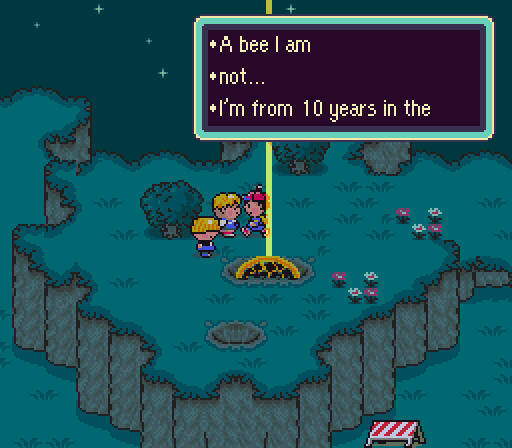
Who or what is Buzz Buzz, this bee-like being inciting the beginning of EarthBound, and what is the Apple of Enlightenment whose message he bears?
In the original MOTHER 2, Bunbuun, the Japanese onomatopoeia for Buzz Buzz’s name, is “actually a rhinoceros beetle (or not),” while the Apple of Enlightenment is called a “prophecy-telling machine” and “The Apple of Wisdom” in Tomato’s literal translation. That’s seems promising. Still more helpfully, his Legends of Localization volume explains,
Throughout the game there are mentions of a prophecy given to Giygas by something called the Apple of Enlightenment. General information about the prophecy can be surmised from bits and pieces of the game’s script, but the full details are never revealed in the game. The official MOTHER 2 guide provides those details, though! Below is a translation of the discussion between Giygas and the Apple of Enlightenment, which is described as an ‘ultra-prophecy device’.
Q: PROPHESIZE FOR ME. WHEN WILL MY PLAN REACH FRUITION?
A: THAT CANNOT BE PROPHESIZED. YOUR QUESTION IS FLAWED.
Q: THEN I WILL ASK AGAIN. WHEN WILL MY PLAN TO COMPLETELY RULE THE GALAXY SUCCEED?
A: IT DOES NOT SUCCEED. THE PLAN ENDS IN FAILURE. (187)
Wisdom found, right? A whole Apple of it. And questions answered–albeit in such a way that Giygas decides to set the events of the game in motion based on what the Apple tells him. Deep Thought meets Oedipus Rex.
Q: WHAT HAPPENS IF I GO BACK IN TIME AND GET RID OF THEM?
A: THE RESULTS OF TEMPORAL INTERFERENCE CANNOT BE PROPHESIZED.
If we are like Giygas in our dealings with this Apple of Wisdom (the games themselves unfolding Itoi’s story), or if we are like Pokey’s mom with respect to Buzz Buzz (messengers like Clyde Mandelin, bringing us new knowledge about it all these years later)–that is, if we are impatiently demanding discursive answers to these questions, they will only lead, at best, to playing the game through again from the beginning (an attempt to go back to the past), and at worst, to doing a violence to the text of the game, silencing it and moving on from its words without giving it another thought. If we are like Ness, though, these questions set us on a journey here and now to grow in “wisdom, courage, and friendship,” and to find “Your Sanctuary.”
THE END… ?
I can understand how that trajectory may seem idiosyncratic. Let’s hope that wherever you turn for help answering underlying questions of this sort, besides replaying the MOTHER games you’ll try reading and revisiting for yourself some of the literary stepping-stones thrown out there above, arrayed as it were in mid-air like the platforms in ur-NES games, Mario Bros. and Donkey Kong. I hope you go clambering Shadow of the Colossus-like onto the shoulders of those giants and enlist the aid, Breath of the Wild-like, of those divine beasts we’ve been citing. But it really depends on what interests you, what scholarly questions you’re pursuing.
In lieu of Shakespeare and the Bible and the rest, the student of MOTHER/EarthBound interested in canon-completionism might want to turn first to the official novelizations by Saori Kumi, recently made available in English translation, and to other paratexts accompanying the games, such as published scripts, advertising materials, trade show videos, box art and instruction booklets, and the official (and official-esque) player’s guides.
For another sort of research, what matters most is fandom and reception, so diving into decades-old forum posts, viral tweets (Terry Crews’ “localize MOTHER 3” @ Reggie Fils-Aime), fan productions, and discussions of the influence of these games on social phenomena, like online communities, and works significant in their own right, like Undertale. The secondary sources shedding light on the games and bringing more attention to them, (in much the way EarthBound, for me anyway, brings attention and light to Shakespeare and the rest), might include the likes of The Angry Video Game Nerd in one of his more heartfelt efforts; Ken Baumann’s memoiristic account of the impact EarthBound has had on him; the gonzo journalism of Tim Rogers; and other video essays, analyses, and blog posts loitering unassuming yet insightful somewhere down the lists generated by the almighty search algorithms.
More academic studies of EarthBound do exist, but the conversation on the game and its place in history remains in its infancy, for the simple reason that we’re still too close to it to really appreciate it. What we’re attempting here is a prophecy or a promise that these games will remain significant, as much as an essay seeking to explicate their possible significance.
Does a place called paradise Wait beyond the azure skies Bright as day? Look into your crystal ball Read the future in the stars Does it say? – “Wisdom of the World”
To paraphrase the not-bee himself, thanks for listening to my long prolegomena. On to more questions.






 Video Game Academy