Empty Stadium Summer

Empty stadiums, arcade blues. Writing about games and reveling in learning, play, and art while there is so much else to worry about, and still enjoying the shimmering threshold of summer break–as I always say, still playing EarthBound, I just want to acknowledge nevertheless all the ways this could go sideways, and has already for so many.
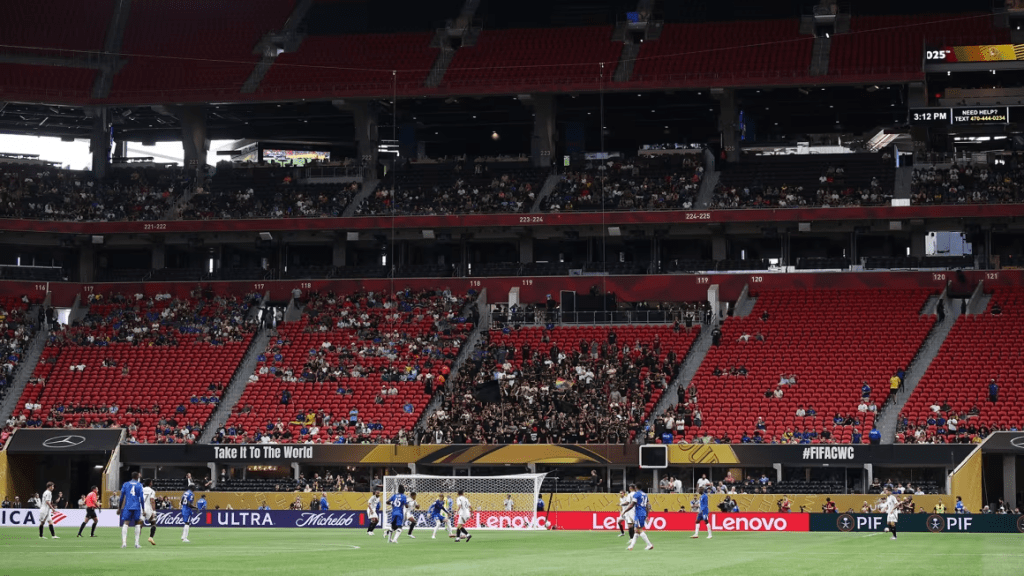
Chelsea 2-0 LAFC in Atlanta last week opening the Club World Cup. Alex Grimm/Getty Images via CNN

Can we look at those empty seats and think of anything other than what has been going on across the country in LA, and with the funding of Qatar and the backing of the US a world away in Israel and Gaza?

And can we register sufficiently the juxtaposition of the birthday parade wrapped in assumed glory of the world’s premier military against the popular protests openly threatened with that very force?

Can we agree that it is possible to stand for the country, with all its baggage, and stand against its own overweening power? One would have thought these were settled questions, but then one’s history has been bifurcated and multifarious from the get-go.

Or is it too little to berate the angels of history, without going further and saying that only learning, play, and art, traced back to their very deepest roots have any hope of saving the world?

Among the news and news-like content, most of it bad, as ever, I’ve recently overheard some interesting, hopeful things about games:

‘And I’m now talking as an historian, looking back… big changes are not the creation of old guys like me… we’re not the people who have the ideas that will work to build social capital and to save America… I’m gonna be long gone. So first thing is go young and inspire the young people to come up with the new bowling leagues. It’s not gonna be bowling leagues, it’s gonna be something else. But almost surely will involve something of, of high tech. But it, it will involve real personal relations with other people–‘

‘Before you move on. A perfect example of that for me was Pokemon Go. So I I’m assuming neither of you played it, but I was, I was a huge Pokemon Go fan. Huge. Huge, huge. I think this was the best execution of a video game in the modern age because it was a video game that everyone played. It was on your phones. Yeah. Right. And the goal was to catch Pokemon. You don’t need to know what any of this is, just think of a game where you’re trying to catch little creatures. (Okay.) But what they did that was amazing was you had to catch the creatures in the real world. (Ah.) So they used your camera on your phone and you would literally have to run out into the streets to catch these digital creatures.

‘And so at first it was just like, oh, this is silly and this is fun. But I’ll never forget the joy I experienced when one night I was in New York and I was running with a group of people in Central Park–strangers at 11:30 PM–because someone had tweeted and told us that there was a Snorlax, which is one of the creatures. There was a Snorlax in Central Park. And Bob and Christiana, when I tell you there were, if I was just to estimate, there were like maybe 500 people from like little kids who had dragged their parents out of the house all the way through to like adults who are playing the game running. And I remember at one point one of the kids turned looked at me, well ’cause we’re all running ’cause there’s a time limit. You don’t know how long the creature will be there for. So we’re all running through Central Park together. And one of the kid turns, turns, looks at me, this kid’s like maybe like 14, 15. And he looks at me and he is like, he’s like “Trevor Noah!” He’s like, “you, you play Pokemon Go!” And he’s like, “now I know I’m in the right place,” and we’re running together.

‘But I what I, what I loved about it was it, to what you’re saying, it was the perfect culmination. It wasn’t the either/or. (Yeah.) We were all playing all digital game. It was the alloy. You could play the game at home and we were playing it at home, but you could not help but bump into other people who were playing the game as well in the real world. And it, it was such a beautiful– ’cause once the Snorlax was gone, all everyone could do now is talk. “Where are you from? (Yeah.) Hey, where do you live? (Yeah.) Where did you, what’s the best one you’ve caught?” What have you. And this was like the game won awards, by the way, even for getting people fit and running and moving it. Yeah. But I I, I love that. So like when you say the going young and figuring out the, the hybrid, I think there are ways to do it. ‘Cause some people would be like, oh, I don’t know if you can, I think we actually have seen one of the ways, and I know because I played it, but Yes. Okay, so what’s rule number two?’

‘Rule number two is go local. Go local…

(Trevor Noah in conversation with Robert Putnam, circa 56 minutes in, per the transcription)

And then on The Bible Project, they’re beginning a series on the theme of Redemption:

Jon: But if I’m in an arcade, right? You bring your kids to an arcade, and they get—
Tim: Oh.
Jon: And they get the tickets.
Tim: Redeem the tickets.
Jon: And you redeem the tickets for, like, prizes?
Tim: Mhm.
Jon: I think I would use—maybe use redeem, there.
Tim: Yeah.
Jon: Okay.
Tim: Yep. Okay. So we have, by our house, in southeast Portland—is one of Portland’s
oldest—
Jon: Oh, yeah.
Tim: Classic video arcades.
Jon: The nickel arcade.
Tim: Yeah. It’s called Avalon. The building’s a hundred years old. And it smells and
feels like it when you go inside.
[Laughter]
Tim: And they have accumulated this collection of—it’s, like, three big rooms. It’s—
actually, now, when I go with my kids—which I’ve really limited how often they can
go.
[Laughter]
Jon: They love going?
Tim: They love going. But you go into these dark rooms. It’s like a kid’s version of a
casino.
Jon: Yeah.
Tim: There’s no—
[Laughter]
Tim: Windows.
Jon: Totally.
Tim: There’s no external light.
Jon: Yeah.
Tim: It’s dark.
Jon: Yeah.
Tim: And the only light there is purple, and blue, and green—
Jon: Yeah.
Tim: And red from the games. And it’s just so—a cacophony of noise.
Jon: Yeah.
Tim: And it’s—for me, it’s oppressive.
[Laughter]
Tim: And, uhm—
Jon: And then you spend 20 dollars—
Tim: Yeah.
Jon: And you end up with like 200 tickets.
Tim: Exactly. But many of the games—some of the classic ones like Ski Ball and—
Jon: Yeah.
Tim: The basketball hoop either prints out tickets, or now, it all happens on these
little cards.
Jon: Digital—
Tim: Digital cards.
Jon: Tickets.
Tim: And if you get tickets, then they’ll accumulate on your card. And so then the, the
end of the ritual—it’s like a liturgy—
Jon: Yeah.
Tim: Is—
Jon: How many Tootsie Rolls can I get from these—
Tim: Going to the counter.
[Laughter]
Tim: And then they stand there, and these poor—
Jon: Oh my gosh.
Tim: Workers—
Jon: I know.
Tim: At the arcade—
Jon: Yeah.
Tim: God bless them.
[Laughter]
Tim: Just these indecisive, you know, wishy-washy ten-year-olds being like: “Do I
want the mint Tootsie Roll, or the blueberry, or the chocolate?” You know. And
they’re so patient. So what they’re doing, in that moment—is that my kids have
played these games, and they’ve earned this—
Jon: Tickets.
Tim: This value.
Jon: Yeah.
Tim: They’ve generated value.
[Laughter]
Tim: Right?
Jon: Yeah. Mhm.
Tim: Isn’t that right?
Jon: Yeah.
Tim: In the economy of the arcade—
Jon: Yeah.
Tim: They’ve generated value by winning these games. And then they can take that
value and then go look at a glass case with, like, cheap plastic laser guns or Tootsie
Rolls. And what they do is they lay a claim to that. They’ve accumulated value—
Jon: Yeah.
Tim: And they see something else of value. And they’re like: “I want that to be mine.”
And then you—
Jon: Exchange.
Tim: The exchange.
Jon: I’m exchanging my tickets for the laser gun.
Tim: That’s it. Yeah.
Jon: But you need like 2000 tickets for the laser gun.
Tim: That’s r—
[Laughter]
Jon: You’re not going to get that one.
Tim: Tot—it’s so ridiculous.
[Laughter]
Tim: It’s like somebody actually paid thirty dollars—
Jon: Yeah.
Tim: For a, a cheap—
Jon: Yeah.
Tim: Toy laser gun that breaks in a week. Anyway. So it’s that exchange of value.
Jon: An exchange of value.
Tim: Yeah. There’s something that I’m going to lay claim to, and that will be mine.
And then I do—I go through some process of transferring it into my possession. And
th—that whole process is, I think, what the word redemption, and or redeem
classically, means in English.
Jon: Okay. Is that the main meaning of the word that we’re translating from Hebrew
or Greek? …

(Relying again on the transcript, but give it a listen)

Of course it’s called the Avalon

So anyway. Part of what I’ll be doing this summer is still playing EarthBound and trying to learn Japanese yet, and part of what I’ll be doing, as ever, is singing along and listening for what I can hear of these Redemption Songs through the noise.

EarthBound Zero to Kentucky Route Zero: On “Music and the Video Game as Ritual Encounter,” by Tim Summers, and some of Itoi’s Influences

With plenty else to do this weekend, being as it is at once the end of MAR10 week and the day after pi day, the ides of March and the eve of St. Paddy’s, I’m popping in here at the humble video game academy just to direct your attention to a few other wonderful reads.

An imaginary video game, a Kentana Cold Snack.

First, Professor Kozlowski is back with his long-awaited, long-form essay on Library of Ruina, which will be serialized here for the next little while. In this first post, he sets the groundwork for future anthropologists interested in the MAGA, redux era in which we find ourselves, and lays out the stakes for the commentary to follow:

I came to Library of Ruina with more expectations than were reasonable.  I wanted it to be more than a game—I wanted it to be life advice, solace, and wisdom.

As it happened, I was not disappointed.

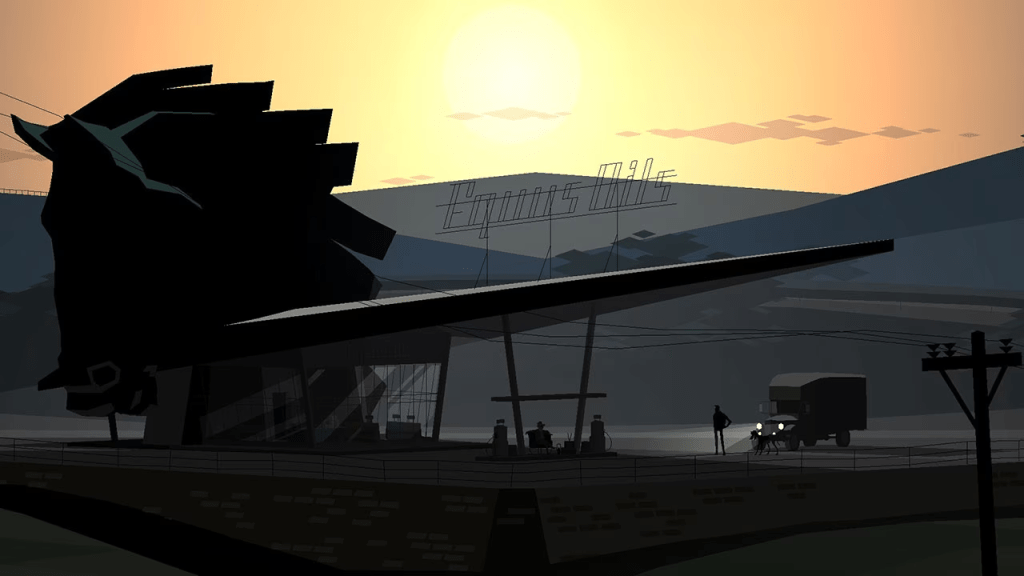
In a similar vein, I find myself turning to games and their mythological content for solace, but also to getting outside to walk and play in nature now that we are beginning to thaw. I think back to unfinished posts from past summers about then-unfinished games, like Kentucky Route Zero, and how I imagined a mod of it for every state, like Sufjan Stevens’ quixotic project of musical albums.

“Soulful, evocative, and one of the most important games of the last decade” – Elise Favis (Washington Post). That’s the 2010’s, the decade in which I played Undertale, Kentucky, and not much else that was new.

Only I would start not, like Suf, with Michigan, but with Montana, our next-state-but-one neighbor with its “Hiawatha names” (CS Lewis by way of Philip Pullman), its bike route along the repurposed train tracks, its trestles and tunnels and tales of sleeping car porters and frontier towns, like the town of Falcon. Placards along the trail, just as in an RPG or as in liner notes to an album, contribute to the worldbuilding, the sense of depth and history. While the treetops down below exhale their leaves’ water toward the sky, somewhere a driver on the highway is worrying how he’ll pay a medical bill; a trickle of water runs downhill. Call it Montana Exit Zero.

I first encountered the (actual) game at an exhibit at the Seattle Museum of Pop Culture (MOPOP; then known as the EMP). Similarly, Tim Summers, in a presentation on games and music as ritual space, notes: “the museum sequence of Kentucky Route Zero found an additional parallel when the game featured in the exhibition Design, Play, Disrupt held at London’s V&A Museum, an exhibition intended to illustrate the connections and interplay between video games and other art forms.” While he references work by Dorothea von Hantelmann, who in turn cites other artists and scholars including Chinua Achebe and Pierre Bourdieu, I can’t help but wish there were more substantial engagement with mythic language, which games speak and make space for at least as well as they foster ritual engagement. Thinking of course of Sloek, but also of a classic text like Jenkins’ “Complete Freedom of Movement,” as transmitted via Alyse Knorr’s Mario 3.

Fundamentally, though, I think Summers is on the right track. To quote from the conclusion:

If the theatre is too homogenizing and restrictive, and the museum too isolating, then games occupy a middleground of play. Kentucky Route Zero’s depictions of museums and performances make this middleground particularly telling, but the example merely provides an explicit manifestation of aspects of engaging with games more generally evident in games. It is helpful to recognize the ritual qualities of games, their structural framework, social functions and connectedness to past forms of ritual. These ritual discussions can then help to illuminate how games create a powerful and compelling aesthetic experience, and how music is an important part of this experience.

His Mother/EarthBound Zero and the Power of the Naïve Aesthetic: No Crying Until the Ending,” (chapter in Music in the Role-Playing Game) was why I became interested in Summers’ work, directed to it by the references in the anthology Nostalgia and Video Game Music. There, too, he makes a point about the effects of diegetic music (drawing on the work of a film critic named Winters, which I find delightfully serendipitous given the EarthBound connection) very similar to the approach I take in my discussions of moments of artistic ekphrasis and self-consciousness in games such as EarthBound, Xenogears, and most recently Final Fantasy VIII.

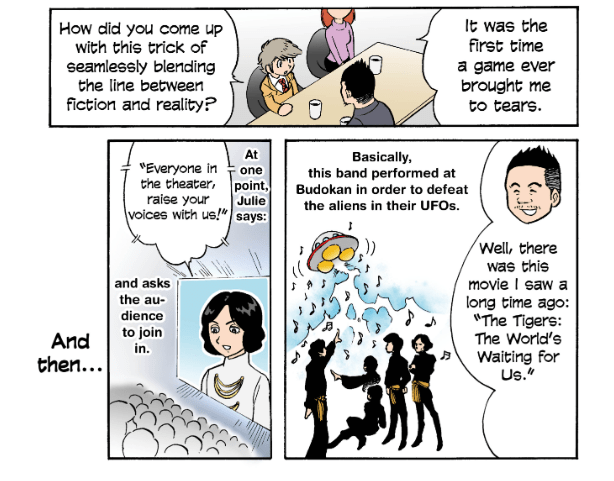
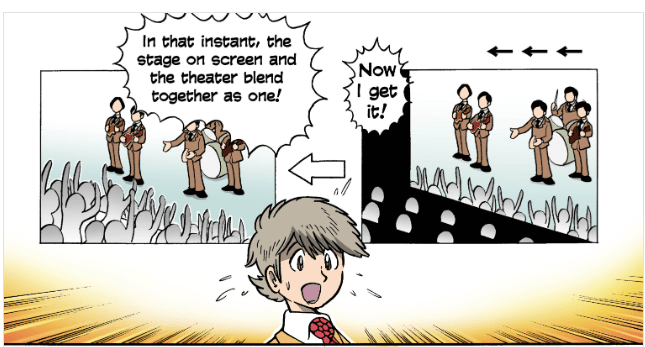
What’s more, he cites an article in comic form by Keiichi Tanaka: “A Tapestry Woven from the Words of Shigesato Itoi and the ingenuity of Satoru Iwata,” wherein Itoi’s inspiration for the conceit of including the player’s name in the credits, following Tanaka’s line of questioning, reveals itself on Summers’ reading to be a a key point of departure for the use of diegetic music in the MOTHER games. The relevant portion of the manga interview is recounted as follows:

If you could only see the manga-level big emotions on my face, “smiles and tears,” as I’m over here processing this. Maybe I should start twitch streaming myself reading and writing…

The “Climax of The Tigers: The World is Waiting for Us” has been uploaded to youtube, and segments of it are on archive.org. A screenshot of the moment Itoi is remembering (autotranslated):

Part of what makes this such a revelation (to me at least; the top commenter on the video knew 10 months ago and more–

So chalk another one up to the power of the collective internet hive mind over against, say, sensitive scholarly types like your author and Clyde Mandelin, my main resource for Itoi knowledge)–part of what makes this such a revelation that I can’t get a coherent sentence together is that it strikes me as uncannily akin to the experience JRR Tolkien had with the stage version of Peter Pan.

According to Carpenter’s biography: “In April 1910 Tolkien saw Peter Pan at a Birmingham theatre, and wrote in his diary: ‘Indescribable but shall never forget it as long as I live. Wish E. had been with me'” (53). “E” is Tolkien’s muse and future wife, Edith Bratt. Carpenter goes on immediately to another early influence, “Catholic mystic poet Francis Thompson” and especially his Sister Songs, but it is worth dwelling–and no doubt plenty of Tolkien scholars have dwelt–on Tolkien’s connection to Peter Pan and this particular version of it, which he could not describe for all his poetic, sub-creative powers of description, and regarding whose inexpressible contents he had a particular audience or rather companion in mind. Particularly in light of his discussion of “faerian drama” as “Enchantment” in his essay On Fairy-stories, Tolkien’s experience of the audience participation in reviving Tinkerbell by applauding (or not) and Itoi’s of the audience cheering and singing along with the Tigers make for a fascinating comparison.

Tigers also provides an equally illuminating contrast with the film influence that I did know about when I was really studying Itoi’s games, thanks to Mandelin and his Legends of Localization:

The Traumatic Inspiration Behind Giygas’ Dialogue
Shigesato Itoi has stated that the mixture of pain and joy that Giygas speaks about was inspired by a traumatic childhood memory. As a young boy in the 1950s, Itoi visited a movie theater but accidentally went into the wrong screening room. He saw a scene from Kempei to Barabara Shibijin (“The Military Policeman and the Dismembered Beauty”), a mystery film with elements that were considered dark and appalling at the time.

The scene in question involved a woman being murdered while making love to her fiance. The sickening mixture of pain and pleasure greatly disturbed the young Itoi, who ran home and barely spoke a word that night. Itoi wanted players to experience that same feeling during the final battle of Mother 2, so he wrote Giygas’ text to include a combination of pain, pleasure, and more.

Itoi recalls another incident that inspired Giygas’ dialogue:

Gyiyg snaps and loses his mind, as you know. Well, this probably isn’t the nicest topic to bring up, but a long time ago I happened to witness a traffic accident. A young woman was lying on the ground, but instead of saying “I can’t breathe!” or “Help!”, she cried out, “It hurts!” That really disturbed me. I felt that having Gyiyg say this same line would make you reluctant to attack him, even though he’s the enemy. He’s even calling your name the entire time. As for the line “It’s not right”, it means “What you’re doing isn’t right, and what I’m doing isn’t right.” I have to say, a chill went through me when I was coming up with all of these lines.

Whereas, Summers points out in his analysis, with the “Eight Melodies” theme Itoi not only has indelibly marked a generation of players of the original game with a distinctly childlike and “naive” impression of the power of art, but this song has even been included in Japanese elementary school music textbooks for decades, touching a generation that perhaps has never played the original game. Here are Itoi, Suzuki, and Tanaka in conversation about it: “MOTHER’s music was demonic” 😮

With that, I’ll go back to my own reading and writing and touching grass. As Thompson has it:

From its red leash my heart strains tamelessly,
For Spring leaps in the womb of the young year!

Hope you enjoyed your St. Paddersday, and here’s to spring!