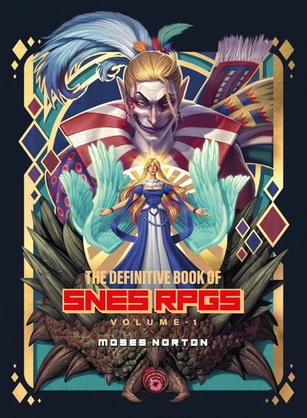
RPG Nirvana & JRPGana – The Definitive Book of SNES RPGs by Moses Norton & A Guide to Japanese Role-Playing Games by Kurt Kalata

The Definitive Book of SNES RPGs (Vol. 1) by Moses Norton and A Guide to Japanese Role-Playing Games by Kurt Kalata (ed.) are both published by Bitmap Books, new within the past month and last few years, respectively. They are doorstoppers, beautifully produced, quite pricey, and worth every penny. My name appears in the acknowledgements of the former; many of my favorite games–EarthBound/MOTHER 2, Chrono Trigger, Xenogears, Wild Arms, and so on–appear in the latter, though each game is afforded only a page or two due to the book’s massive scope.

I’ve long dreamt of writing a book like these, a kind of Haunted Wood for video games, but I haven’t actually played all that many of the incredibly rich and diverse body of games that Norton and Kalata cover. Particularly, I’ve wished I could better understand my favorite games of the golden age of console RPGs in their cross-cultural context, having tried, so far with little determination and less success, to learn Japanese for that purpose–so I’ll settle for reading others who can, for now.

A few disclaimers up front: I am aware that Moses and the Bitmap folks have faced a smear campaign and waves of cancel-cultural recrimination over comments he made, but I will step around that. This choice, like the review which follows, is, needless to say, not entirely unbiased by my personal friendship and professional respect for the writer also known online as The Well-Red Mage, nor my admiration, shading into jealousy, of the productions of the Bitmap team and writers of Kalata’s clout who have worked with them. But what’s an amateur Video Game Academy scholar to do? We have to talk about the games themselves, first and foremost, in all humility and giving grace as far as we can, extending the circle of dialogue, lifting up the voices of students, fellow hobbyists, fans, content creators, and industry professionals alike. None of us is perfect, none of us ought to feel we’re in a position to cast stones, in my view; with all deference to the righteous Redditors and other pharisaical denizens of the retro games discourse, I can’t see who is helped by such a pile-on. Or, if that disputed passage in John’s gospel is not to your taste, let’s say it in Dostoevsky’s terms, from Alyosha and Grushenka’s tete-a-tete in The Brothers Karamazov, with a Sakaguchi spin: I’m all for giving an onion (knight), giving a second chance or New Game Plus, once someone has apologized. I can only offer an apology of my own to whoever has been harmed by the exchange and its fallout. Certainly I wish Moses and his family the best after the wringer they’ve been through, and hope that Vol. 2 of his book is not too long in coming, whether from Bitmap or another source if they’re not able to patch things up.

Bitmap Books, via The Video Game Library

But without further ado. Per the title, and in line with its author’s long-time, courageous project of bringing greater objectivity and rigor to the discussion of widely beloved games from ye olde eras past, The Definitive Book of SNES RPGs (not only JRPGs, mind, as I initially thought) takes as one of its points of departure “a new systematic approach to defining an indefinite genre” (31). I found this section powerfully clarifying, as I tend to have a much more intuitive, wishy-washy stance on questions of categories and sub-genres. Norton lays out a practical “Rule of Three: Character, Combat, Narrative” with each of these further breaking down in to three elements: Roles, Progression, and Statistics for Characters; Combat as such, its Turn-Based mechanics, and Variables; and Narrative story arcs characterized by Economy and Exploration. Where two of the three larger headings overlap, or where an RPG is more heavily weighted towards one or the other, we get the sub-genres of “action” or “adventure,” or indeed “action-adventure,” but any game that has at least some significant elements of narrative, combat, and character development can be fairly called an RPG (37).

Ranging over the 22 games this rubric brings under discussion, covering the first half of the SNES RPG library’s alphabet, Norton’s analysis is anchored by these mechanical considerations–and isn’t it refreshing to see how he chooses to cut across the usual distinction between gameplay and story, opting instead for this powerful, flexible Rule of Three? Each chapter opens with a graphic indicating which elements are deemed to be in evidence, alongside the developer and publisher credits, and while plenty of the games have all nine icons, there are a handful of edge cases. “King of Dragons isn’t an RPG! I can hear you yelling” he remarks in the penultimate chapter; to which I have to reply, demurring, “I’ve never even heard of it” (501). And in fact these debatable RPG inclusions, especially ActRaiser and EVO, make for some of the most interesting chapters in the book in terms of defining what an RPG is, and what a particular blend of mechanics, story, and gameplay loops portends for thematic questions about the meaning of a given game as a work of art.

For, as even a cursory reader soon discovers, dipping into chapters here and there rather than plowing through the book cover to cover as I did on my first read (though I heeded Norton’s caveat to go out of ABC order so as to flip-flop Dragon View and Drakkhen,”the first SNES RPG” 302, and one with a fascinating lineage that may or may not intersect with Gary Gygax himself), the close analysis of game elements in line with a wider project of empirically defining the genre is only one of the book’s significant threads, and perhaps not its most important. Just as Narrative and Combat are mediated by Character, Norton’s own voice, experiences, predilections, and indeed his character are present throughout the discussion. Along with the requisite historical context, pertinent information about the games’ development and systems, and more or less entertaining trivia and Easter eggs, we get a personal tour of each game’s world, its challenges and triumphs, and reflections on all of it from a true connoisseur.

For me, the best sections of the book weren’t actually the ones about the best games: the tour de force of Chrono Trigger or the ebulliently playful-yet-earnest EarthBound (which I read and commented on for the author in draft), or the groundbreaking FFII or even the operatic FFIII; nor was it, on the other hand, Norton’s almost impossibly judicial, admirably evenhanded treatment of the execrable Lord of the Rings. Much as I appreciated these for how they provide wonderful, coherent perspectives on games I know and love (or rather hate, in the case of the SNES LotR, as one can only hate a missed opportunity, a fall as profound as that from a Melkor, brightest of the Ainur–Tolkien’s text–to a Morgoth, archfiend and all-around jerk–its SNES adaptation), I find myself thinking most about, and flipping back to most often, the Introduction and the chapters on the Breath of Fire games.

The Foreword by Alex Donaldson, co-Founder of RPG Site, does a solid job setting the tone, and it is probably noteworthy that both he and Moses Norton are mixed race authors writing authoritatively, confidently, and joyfully about an industry where people of color are not always represented. Norton’s Introduction grounds the book in his upbringing in Hawaii, and he makes explicit the connection between his Native background, his longing for home, and a Tolkienian sea-longing most memorably expressed in great art, which combine to convey the importance of nostalgia in his conception of quality video game critique and analysis. This is all very much catnip to me, preaching to the choir if you like, just as much as his wise words about the meaning of an ostensibly silly game like EarthBound call and respond across the distance to concerns I’ve written and thought about for years, here and on sites run by Norton himself. In sharp contrast, really, to the more technical discussion of the Rule of Three, though both the technical considerations and nostalgic themes become integral to the chapters that follow, this is a big swing of an Introduction after my own heart. If I hadn’t known Norton already beforehand, I’d have reached out to him on the strength of the opening few pages, because I recognize here “a friend I’ve never met,” to use the Pauline (EarthBound’s Paula, that is) locution, a fellow aficionado of 199X RPGs.

In the chapters on Breath of Fire and its sequel, the book’s throughlines of biographical experience and nostalgic retrospection come together in what for me were the most illuminating fashion with its other core thread of systematic, definitional concerns with RPGs as games of a particular type. Perhaps this is because I’ve only played later Breath of Fire iterations, and had little in the way of preconceived ideas about the series, but these chapters spoke to experiences I’ve had from a direction I wasn’t expecting, and landed with startling insight. Maybe this is how people who haven’t played Xenogears would feel listening to my interminable podcast commentary on that game; one can hope! I love the idea that within an objectively slightly janky game, “you may be able to spy the inner workings of a mythos in the making” (168). I would even go further and say that not despite but because of the obstacles in the way of such a glimpse of the seed of a mighty idea, old games like Breath of Fire are inseparably fused to this homeless time of ours, when we deal daily with such a dearth of living myths that we will grab onto them anywhere we can. The games’ religious ambiguity and political, race- and class-conflict story beats, in this light, are almost too poignantly prophetic of our current confusions and divisions. And they shed a light, a warmth, a breath, why not, over players who take the time, as Norton does, to connect deeply with their stories and weave them into their own. Witness some snippets:

Upon starting a new game… a voice in the darkness cries about giving yourself to God and becoming God’s strength…

This is none other than Breath of Fire II, the globe-trotting, history-spanning, darkly religious, draconically epic sequel to the original Breath of Fire, though I describe it simply as “formative”… I spend a lot of words in this book regarding themes, analyses and the meaning embedded in these stories told by means of the Super Nintendo, but when it comes to this game… it’s personal.

Breath of Fire II immediately won my heart from the moment I saw its beautifully realised world, a crystallisation of all of Capcom’s 16-bit sensibilities…

What I didn’t realise at the time was the fact that this game would not only win my heart, but also my soul. I know; even to me it still seems odd to describe encountering a video game, a mere sequel, as a religious experience. Yet somehow, I’ve wasted years describing the early Breath of Fire games as staunchly traditional. I’d like to recant…. (177-179, excerpts; British spellings courtesy of Bitmap.)

Over the course of a nuanced discussion of the game’s religious themes, centered on the duplicitous Church of St Eva, tied in with personal reflections about growing up “in the church” of Western missionaries looking at “the monarch chrysalis hanging from a branch outside” as an image of Pauline transformation (yep, that Paul), an image of the winged anime girl Nina above a cartouche of text discussing a goddess joining the player’s party is balanced against a lengthy passage from CS Lewis on “the Numinous” (182-3)–and lo, it hit me like the thunderbolt on Ryu’s sword that the construction of Norton’s book, heartfelt, syncretic, overflowing with connections between games, literature, and life, mirrored almost exactly the message of these games which he sought to express. The content and form, medium and message, like a successful dragon transformation, were one. And to cap it off, on the next page Ryu celebrates catching a fish as Norton explicates what I had perceived: “It was in this realm of fusion and confusion [Hawaii both as place and as touchstone for his studies of myth and religion] that the roots of my interest in spirituality dug deep, and I really have Breath of Fire II to thank for that” (185).

Again, I found the book immensely valuable precisely because it taught me so much about games I only knew the name of, if that, and will likely never play. Thankfully, Norton has trekked through the likes of Brain Lord and Inindo so I don’t have to, and recorded his discoveries. In a few cases, I also may go ahead and track down some of these more obscure titles just out of curiosity, or to show them to my students or my own kids out of a kind of historical whimsy. But I will undoubtedly move the Breath of Fire series right onto the mental shelf with EarthBound and FFII and find time to play them alongside one another someday.

Norton’s chapters each close with brief notes from other players corroborating and qualifying his reasoning, layering onto his experience of the games the texture of their own voices and memories. Of Breath of Fire, Livnat writes “I also loved that fact that for me, who was also just learning English, there was no real need for a lot of dialogue to get the picture; in fact it enabled me to fill the void of plot with my own understanding of the game, and my own ideas and thoughts” (173). This is much the way Toby Fox talks about learning to read from EarthBound, and how I remember learning from JRPGs like Dragon Quest and FFII my own language, reflected back to me across the bridge of terse NES and SNES localizations; or later, learning Spanish from Platero y yo, before I knew most of the vocabulary enchanted with its sound; or how Philip Pullman talks about the prose of Kipling’s Just So Stories, or the poetry of The Journey of the Magi and Paradise Lost. To repeat, these old games, like these great books, encode a universal archetype, that of the learner–of language, or myth, or a game’s rules–facing a mystery and patiently listening, imagining, playing their way towards comprehension.

It bears mentioning once more that the visual style of Norton’s book, too, is almost intoxicatingly good. The layout, the choice of sprites, backgrounds, and other assets, and still more the peculiar CRT-filter quality of the images, all argue as strongly as the words about the need for us a culture to continue re-evaluating the role of nostalgia and the place of games in the artistic canon.

All this is not to say the book is perfect. A line of text from Daniel Greenberg’s testimonial about Mystic Quest gets transposed 20 pages ahead to the top of Mama Terra’s for FFIII (421). Accompanying Norton’s text and his contributors’, exemplary screenshots from the games, many of which he played through while streaming on Twitch, and pull-quotes from developers and players alike carry the reader along. But as befits a book like this, not meant to be caparisoned in scholarly apparatus, these are not specifically cited.

Consider this passage from Yuji Horii: “The most important part of a RPG is the player feeling like they are taking the role of a character in a fully realised fantasy world. They can explore, visit various towns and places, talk to people, customise their character, collect various items, and defeat monsters. The story is not the focus of the experience and is only there to make the atmosphere of the fantasy world more interesting and engaging during the course of the game” (47).

Where did this quote come from? On the one hand, I can see the problem other armchair academics/neckbeard Karens might have with not knowing for sure, not knowing if Norton has done his homework and cited his sources properly. I, for my part, love that I can cite Norton’s book the next time I attempt to elucidate or take to task Horii-san for this seemingly apocryphal quote. It doesn’t matter so much where or even whether he said it, because he’ll a) never know I am writing about him, and b) if somehow my work were to come to his attention, he’d in all likelihood be perfectly secure in his stature as the godfather of the genre, caring not a whit for what I might quibble with in a quote attributed to him by, among many others, fellow scholar-fan-content-creator Moses Norton.

Bitmap Books, via The Video Game Library

To be Frankystein Mark II, I have not nearly so much to say about A Guide to JRPGs by Kalata et al., but I definitely wanted to note its presence in this connection. When I went to buy The Definitive Book from Bitmap, I couldn’t pass up the appeal of A Guide to JRPGs. It’s not that I don’t find the book as interesting or readable as Norton’s (though I don’t mind saying that I don’t); it’s a very different beast, and not as much to my personal taste. Almost devoid of the personal touches and wrestling with deep questions, both of meaning and mechanics, that characterizes Norton’s work, Kalata’s instead aims for breadth of inclusion rather than depth of inquiry. So I allude to it here mostly as a point of reference.

Now, there are definite strengths to A Guide’s approach, and enormous quantities of information to be found there much more pleasantly than by trying to search for it on wikis with the help of google translate. The very unassumingness of its title, A Guide, belies the wealth of arcana in store for the reader. Even I, I’ll confess, have not managed to read this one cover to cover, though I made sure to dip into favorite games, obscure artifacts of the pre-Famicom era, and salient introductory sections like “What is a JRPG?” “A History of RPGs in Japan,” and “Attack and Dethrone God.” For anyone interested in topics like these–that is to say, just about anyone still reading this, AIs excepted–A Guide is a treasure trove. The perfect combination of bedside curio and coffee table conversation piece, its 650-odd pages and painterly cover adorned with a red binding somehow contrive to feel almost weightless. The prose, similarly, though it lacks Norton’s spiky charm and consistency of voice, being written by a large crew of expert contributors, is nevertheless light in tone, more journalistic than essayistic, and manages to remain easily readable despite the necessarily tiny font.

For a more Norton-esque entry in the same encyclopedic vein, see also Aidan Moher’s Fight, Magic, Items (and my review here) or the Boss Fight Books collection (ditto), though those are each about a single book, for the most part, and would have to be grouped together, Power-Ranger-like, to contend on something like the same scale. But do yourself and your RPG-loving loved ones a favor: the holidays are close enough, surely, to warrant a gift, even if it’s a bit pricey. Books like Norton’s and Kalata’s promise, in turn, the gift of conversations, debates, playthroughs and shared memories. To be passionate about old games is all well and good, but these debates are best conducted cordially, just as the books about them will be most profitable if read charitably. If the conversation that is our shared culture is to be sustained at all, we have to carry it on remembering that there is a person on the other side of the screen, someone who’s fortunate to have been bathed in the same sort of CRT glow we remember, maybe, from the sun of a winter’s or summer’s holiday long ago.

Please, read the books for yourselves and comment responsibly.

Video Games in The Haunted Wood

The Haunted Wood: A History of Childhood Reading, by Sam Leith, comes highly recommended.

“One of the best surveys of children’s literature I’ve read,” blurbs Philip Pullman. “It takes a particular sort of sensibility to look at children’s literature with all the informed knowledge of a lifetime’s reading of ‘proper’ books, and neither patronise (terribly good for a children’s book) nor solemnly over-praise. Sam Leith hits the right spot again and again. The Haunted Wood is a marvel, and I hope it becomes a standard text for anyone interested in literature of any sort.”

In the run up to the release, Leith appeared on an episode of Backlisted, a wonderful podcast which I first found thanks to their episode with Pullman on The Anatomy of Melancholy, one of those tomes, like Gargantua and Pantagruel, anchoring my own personal backlisted pile.

The main reason I bought Leith’s book new and read it right away is that its final chapter is about Pullman’s work. As far as that goes, I’ll have more to say in another place. But what brings me out of my extended spring break to write about it here is the way video games surface in the text as a point of comparison and contrast with children’s books.

The first reference to video games comes roughly midway through the book in a strangely interpolated chapter, “The Idiot Box,” which does not appear in the table of contents. We are in the transition from the era of Philippa Pearce, CS Lewis, and Tove Jansson (about all of whom Pullman has quite a bit to opine) to that cohort of writers, immediately preceding Pullman himself in publication, that includes Alan Garner, Susan Cooper, Ursula K. Le Guin, and Madeleine L’Engle.

Here Leith takes up Roald Dahl’s critique of television, memorably sung by the Oompa Loompas against Mike Teavee in Charlie and the Chocolate Factory, in order to set the scene for “the early sixties”: “Dahl’s message…was not just that the then infant technology would make children stupid: it was that it existed in a zero-sum war against children’s literature” (369).

Leith goes on: “The relationship between television and children’s fiction is a complicated one–and not as simply antagonistic as Dahl suggests. What is undoubtedly the case is that the narrative worlds of children were changing, and that television, as the dominant cultural medium, had a huge part in that… But it hasn’t shown any sign of wiping out children’s literature, any more than videogames (the moral panic of our own day) have seen off television.” The only problem with this framing is that “our own day” is already too dated. The moral panics of “our” youth, such as Dungeons and Dragons and video games, have been largely eclipsed by smartphones, social media, and AI.

Citing Jacqueline Wilson’s memoir to support his contention that “Television came to be freighted with the same anxieties as, two centuries before, fairy stories had been,” along with early studies of the effects of television on children in England from Hilde T Himmelweit, Leith comes around to “a crucial point. Children’s stories have always existed, where they get the chance, in more than one medium, and spilled between them. Playground games draw on things that children have read about in books–remember the Bastables playing The Jungle Book on the lawn?–and children’s stories in turn draw on or feature playground games and children’s books. Children’s stories themselves depict children consuming children’s stories and using children’s stories to make more children’s stories. In this respect, these properties have something of the quality I’ve remarked on in myth: a blurriness, an availability to be reinvented, and even an orality, in the way that the spoken performances of the playground remix the mythos each time. The boundaries of children’s writing, of children’s storytelling, are as indistinct as the boundaries of the haunted wood itself” (373).

This is all brilliant. As everywhere in a wide-ranging, mellifluously written book such as this, there leap out opportunities to widen and enrich the field still more: reference to Neil Postman’s far more trenchant critique of television, rather than the strawman Dahl, would have made the same “crucial point” even stronger; acknowledging the ways in which fears about video games have flowed into still more addictive technologies would have kept Leith’s work, at least momentarily, abreast of the present time rather than snug in “our own” childhood at the end of the past century.

Again: “In our own age there are probably more videogames that have become TV series than there are videogames made of TV series… From the top-down point of view, this is no more than the free market doing what it does… but from the bottom-up, child’s-eye perspective, it’s completely natural: stories spill over. When you’re playing with an action figure, you’re writing a story” (374). A world of interpretive, ideological messiness hinges on that “but” distinguishing the “market” from the “natural,” but all we would add, really, is that when you’re playing a video game, particularly from the early era of the medium which Leith seems to be thinking about, your imagination is engaged in filling out the story in much the same way. He would probably agree; it’s implied in the thick bundling of media connections here evoked.

So it is strange that when we come to the end of the book, Leith writes in his Epilogue, “as an unashamed lover of videogames,” that “even in the sort-of-storytelling ones, the story and world-building are secondary to the gameplay… A videogame will always struggle to do what fiction does, which is to allow yourself to envision what it might be like to be somebody else… If you and I play through a videogame, we will have experienced the same world on screen” (552-3). All of which is preposterous, especially given the story-embracing account of play that Leith provided around the midpoint of the book.

Perhaps Leith is carried away by the fear of “more than just figuratively addictive” games like Fortnite, which he singles out and sums up with the footnote: “If you don’t know what this is, count yourself lucky–or ask an eleven-year-old. It’s a hectic videogame in which everyone’s trying to shoot everyone else.” In an attempt to acknowledge and reckon with more recent statistics which paint a much bleaker picture of the reading habits of young people, Leith produces his own Oompa-Loompa-shaped strawman doing a DLC dance. He conflates online games like Fortnite with videogames writ large, setting them in opposition to fiction, as if that, too, were a monolith.

As a history of children’s books, The Haunted Wood is wonderful. As cultural commentary on the interplay between books and video games over the more recent history during which both have figured in our imaginative and social lives, it demands considerable filling out. To be fair, Leith does not even pretend to provide such a commentary, with the exception of these two widely separated passages. But as a lover of video games and reader of books, I will say I remain perplexed and disappointed by the turn from that one passage to the other.

If I ever get around to writing something comparable for the games that have shaped my experience of the world, alongside books by the likes of Tolkien and Pullman, I’ll be sure to credit The Haunted Wood for encouraging me by its example.

What Remains: From the Poems of Hannah Arendt to What Remains of Edith Finch

Illuminations and ruminations on what remains at the end of the week, the game, the century.

When I go looking for one thing and come up with another, and another, and… well, after awhile I almost can’t carry it all; I have to call it a day (a week, etc.), throw it together as best I can for the moment (see the present post), and let it go back out into the world, hoping another will find it as well–and will find it interesting, with any luck. Or at the very least, I’ll circle back to it one of these days to contemplate it anew in all its rich associations and, with the benefit of this open-ended time to come, will understand it a little better at last.

For example, the original point of departure here was meant to be a passage in Walter Benjamin’s Theses on the Philosophy of History, placed at the end of Illuminations, a volume of essays and reflections edited by Hannah Arendt:

The story is told of an automaton constructed in such a way that it could play a winning game of chess, answering each move of an opponent with a countermove. A puppet in Turkish attire and with a hookah in its mouth sat before a chessboard placed on a large table. A system of mirrors created the illusion that this table was transparent from all sides. Actually, a little hunchback who was an expert chess player sat inside and guided the puppet’s hand by means of strings. One can imagine a philosophical counterpart to this device. The puppet called “historical materialism” is to win all the time. It can easily be a match for anyone if it enlists the services of theology, which today, as we know, is wizened and has to keep out of sight. (253)

Of course this passage leapt out at me, as it has for countless readers, for many reasons. Marxists of the Frankfurt school and AI prognosticators, Christian apologists and modern-day techno-charlatans alike, in all their combinations and permutations, will find in Benjamin a provocative thought partner. In my case, the drawing together of the imagery of play and theology makes for an endlessly fascinating analogy. I am a poor chess player and a slovenly scholar, but I do love to “imagine a philosophical counterpart” to games, and particularly love to wax philosophical about the ways in which their mechanics interact with their stories.

As for this particular image of “The Chess-Playing Turk,” its “story is told,” among other places, in a section bearing that name in Philip Pullman’s little-known early novel, Galatea:

In the next room were a number of curious automata, such as the famous Chess-Playing Turk designed by the Baron Von Kempelen, which sat cross-legged at a cabinet too full of intricate machinery to conceal a person, and which had defeated the finest chess-players of its time. There was also a machine called the Temple of the Arts, consisting of an automated view of Gibraltar, with moving warships, a platoon of tiny soldiers marching up and down, and a band of mechanical musicians, playing suitable tunes. There was an orange tree which blossomed and bore perfect painted fruit in less than a minute. There was a duck which quacked, breathed, ate and drank. There was a life-size automaton fluteplayer made by Jacques de Vaucanson which, according to its label, performed so realistically that many learned men had thought that it was human. (211)

Advertising poster for a show of Vaucanson’s automata (wikipedia)

Though written in the ’70s, Pullman’s unsuccessful novel, with its shades of magic realism and its author’s avowed admiration for the mystical quest narrative of A Voyage to Arcturus on full display, remains prescient for its surfacing of the question of the role of “the work of art in the age of mechanical [and electronic] reproduction”.

Add to this the fact that the title of Benjamin’s book is also that of Rimbaud’s, and then of Britten’s song cycle based on Rimbaud’s Illuminations, as I learned when I went looking for the searchable text on archive.org (and the search terms threw up the EarthBound player’s guide, somehow, as well. As ever, EB is in good canonical company–though maybe that’s just based on my own search history).

As the program notes have it:

Britten was deeply affected by the emotional intensity of these prose poems and decided to set them to music as soon as he had read them.  As the soprano Sophie Wyss, the dedicatee of the cycle, recalled:  “He was so full of this poetry he just could not stop talking about it, I suspect he must have seen a copy of Rimbaud’s works while he was recently staying with [W.H.] Auden in Birmingham.”

Britten chose a sentence from one of the poems as the motto for his cycle:  “J’ai seul la clef de cette parade sauvage” (“I alone have the key to this savage parade”).  This sentence also provides the “key” to Britten’s view of Rimbaud’s poetry:  only the artist, observing the world from the outside, can hope to make sense of the “savage parade” that is life.

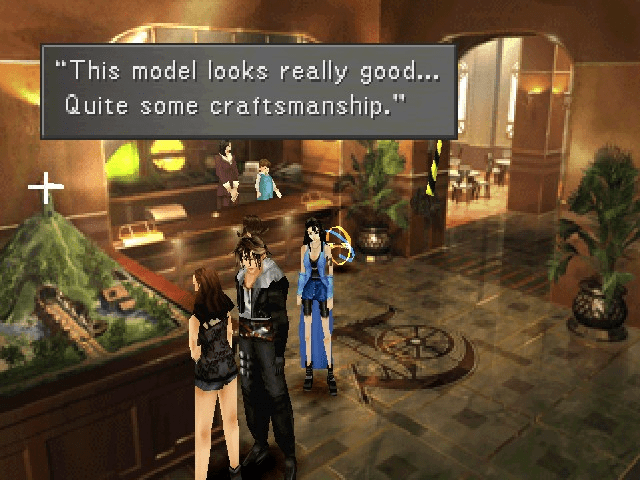
Having just played through the end of the first disc of Final Fantasy VIII, with its own “savage parade” and botched assassination attempt on the Sorceress, I can well understand the impression produced by being “so full of this poetry [I] just could not stop talking about it”–podcasting about it, in my case, with my friend Alexander Schmid. But I draw the line at this notion of being alone in having the key; for it is only through our dialogues, on the contrary, that I feel like I begin to be able to process the meaning of such a densely woven text.

I certainly don’t have a clue about what Rimbaud might be up to, and lovely as Britten’s songs are, I doubt he is the first or the best interpreter of the poet, either in terms of music or meaning. If, as the program notes say, artists alone think themselves able to interpret the world, so much the worse for them; though we may benefit from the confidence embodied in such art as they are thereby moved to produce, it sounds like a terribly solipsistic and lonely activity. To observe the effect of such a belief in the case of Rimbaud’s life, it appears to be part of what drove him to seek exile and enterprise in the desert, giving up poetry for salesmanship.

Klee’s Angelus Novus, Benjamin’s “angel of history” (wikipedia)

Though you never know. Lost poems may yet come to light. Or like Kierkegaard’s knight of faith, perhaps Rimbaud carried the heart of his poetry with him through a superficially ordinary life of infinite resignation. My own opinion, to which I stubbornly cling with a fierce devotion, is that these knights are inside us all, hidden better than the chess-player theologian under the mechanical turk’s table, and opening us like the Silenus of Socrates in The Symposium (and memorably related in Rabelais’ Prologue). When the time is right, we are all “found to contain images of gods”. In that light, the speaker of Rimbaud’s line may well be this precious cargo, and his famous line “I is another” can be brought to bear in this connection as well. In which case I heartily agree: no one else could possibly hold the key to the “savage parade” of life.

In dusting off these reflections years later for a belated spring break post in this year of myth in games, I was actuated by another chance discovery: one of my favorite podcasts, Backlisted, just released an episode discussing What Remains: The Collected Poems of Hannah Arendt. Give it a listen! Arendt, besides editing the collection of Benjamin’s essays, is the author of more than one of the 20th century’s classic works of philosophy, and has bequeathed us the clearest and most cutting precis of her time: “the banality of evil”–though, as the podcast mentions, its meaning, and the work in which it is formulated, Eichmann in Jerusalem, is contested.

I can’t be the only one to have noticed the resonances of What Remains of Edith Finch in the title chosen by the editors of Arendt’s poetry, and echoes of Osip Mandelshtam, of Reginald Gibbons, of Hölderlin and Heidegger

Last but not least, in the spirit of Dirt newsletter’s weekly tab round-up, since I was recommending they look at Backlisted, too, here is a bit of what remains in my browser:

The Digital Antiquarian, recommended by Dylan Holmes, is well worth a read. Mixing up What Remains of Edith Finch (which I did watch a full playthrough of) and Dear Esther (which I didn’t yet, though it’s the one Dylan actually wrote about and recommended in our conversations), like “memory and desire” in April, “the cruelest month” to Eliot’s speaker, perhaps, though that title by common consent is given to March here in Spokane, I finally sat down to read what he had to say about JRPGs and was captivated as much by the comments as the articles’ content. Posters suggest links to a number of papers on localization, games as carriers of Japanese culture and values and cuteness, as locus of reflections on design and affect, and in a wonderful bit of synchronicity, to Beyond Role and Play, a book on LARP including a chapter that riffs on Don Quixote. There’s also a FF series retrospective for the completionist.

What else? I still need to submit a proposal to this CFP, and break down and buy MJ Gallagher’s book, and maybe this one on “Deep Games” by Doris Rusch, and actually read some more Arendt, including her poems

This is the arrival:

Bread is no longer called bread

and wine in a foreign language changes the conversation.

–and the rest of Kentucky Route Zero, and Dear Esther, and the use of an invented Latin-ish language in FFVIII. I should submit a question for The Bible Project on the Tao and the Exodus Way. I should write more about Philip Pullman, the wheel of fortune as game show and ancient motif, saving as economic and theological image, Christmas subsumed, the spectral in Marx and the invisible hand in Smith…

Or what about this strange constellation of Benjamin’s bon mots on the theme of “backdrops”:

On the other hand, this heaven is only background; to explore it according to its own laws would be like framing the painted backdrop of the stage and hanging it in a picture gallery. (121)

 In his “Salon of 1859” Baudelaire lets the landscapes pass in review, concluding with this admission: “I long for the return of the dioramas whose enormous, crude magic subjects me to the spell of a useful illusion. I prefer looking at the backdrop paintings of the stage where I find my favorite dreams treated with consummate skill and tragic concision. Those things, so completely false, are for that very reason much closer to the truth, whereas the majority of our landscape painters are liars, precisely because they fail to lie.” (191)

?

Let it be said of me, as Arendt does of Benjamin in her introductory essay: “Well, he did not succeed in consolidating anything, and success would hardly have been possible.”

Powergaming the System: Don Quixote, The Idiot, and the Language of Play in Politics

What would the original LARPer make of his afterlives literary and metaphorical, and most recently of the propagation of gaming vernacular into the halls of power?

Doing my best Dostoevsky imitation, I take my theme this time straight from the headlines. In The Washington Post Opinion, George F. Will writes, comparing apples to orange one’s lackeys with most infelicitous aplomb:

Elon Musk, a Don Quixote with Vivek Ramaswamy tagging along as Sancho Panza, recently ascended Capitol Hill to warn the windmills of tiltings to come. (“Memo to Musk: Overhauling government isn’t rocket science. It’s harder.” Jan 3, 2025)

Not to be outdone, other pundits have turned to ludic rather than literary idioms, drawing their points of reference for the unfolding debacle from video games, and especially from the virulent online parlance surrounding and stemming from them.

Ezra Klein writes in The New York Times Opinion about “The Republicans’ NPC problem — and Ours.” The article from February 16, 2025 is paywalled, but audio and video versions may still be freely available. There, his intro is intercut with a montage of right-wing voices echoing the phrase and ringing the changes on it: “non-player character,” “non-playable character,” used as a “new epithet for liberals.”

Egoistic and a little hurtful to be sure, but in The Atlantic, the stakes are raised even higher. There I find Charlie Warzel, Ian Bogost, and Matteo Wong shouting into the void that “DOGE HAS ‘GOD MODE’ ACCESS TO GOVERNMENT DATA“:

Doge has achieved “god mode.” That’s according to an employee in senior leadership at USAID, who told us that Elon Musk’s Department of Government Efficiency now has full, unrestricted access to the agency’s digital infrastructure—including total control over systems that Americans working in conflict zones rely on, the ability to see and manipulate financial systems that have historically awarded tens of billions of dollars, and perhaps much more. (Feb 19, 2025)

That’s… not good. At least, it doesn’t look good from the point of view of us lowly mortals and ostensible NPCs. But maybe that’s our own small-mindedness and blindness to the bigger picture. Maybe we had better just get good.

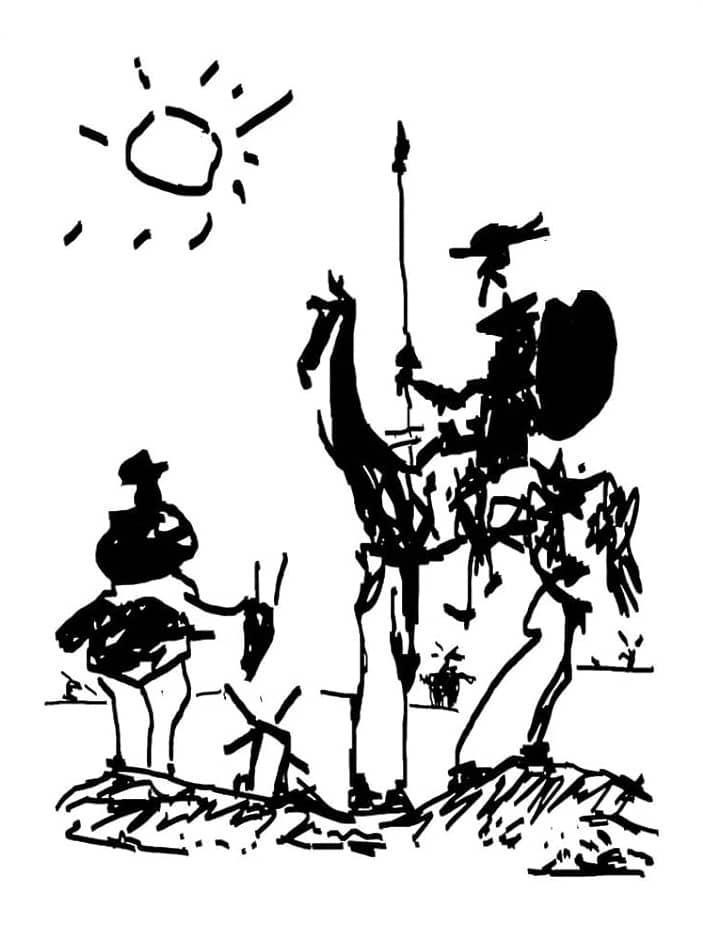
Obligatory Picasso sketch of Quixote. Is it good? Is he cancelled? I mean, I prefer Velazquez’s Meninas and Cezanne’s Bathers to Picasso’s, respectively, but he’s, well, Picasso (credit: pablopicasso.org)

Dreary sarcasm and ripped-from-context headlines aside, I actually think that going back to the literary exemplar of Don Quixote here might be a valuable way to get at the largest possible context for what is taking place in our time politically and economically as well as culturally, and that the “Poor Knight” of Cervantes and his re-interpreters will help us make sense of this sudden salience of a crude video game idiom in the halls of power and among its commentariat.

To begin working our way backwards: consider the last time that video games and politics intersected, to the glee of the trolls and the chagrin of the social-justice crowd. Well-known to the point of cliché, there was the outsize impact of “Gamergate” in the 2010s. Core to Alt-Right Playbooks and books like Black Pill, by Elle Reeve, still operative in the background of the current discourse, this was when the language of politics (“-gate”) and social justice infiltrated the discords and boards. And the reaction was fiery. “Keep your politics out of my games!” a tribe of neckbeards shouted, spewing doritos locos and dew. Less caricature-prone gamers, on the other hand, welcomed the incursion. Plenty of academics and other cultural elites, as well as people of all backgrounds and identities, play video games, and many of them evidently are not shy about their progressive-to-radical politics and aren’t afraid of breaking the proverbial lance with their normative antagonists.

The Pentagon discord leak; the high profile of gambling on the outcome of the 2024 election (and gambling in every aspect of life, especially professional sports); and still more recent instances like those cited above from the media make clear that just as political discourse has propagated itself into the video game cultural space, games have had their revenge, inserting their discourse into the political arena, cranking up its volume on either extreme of the ideological spectrum.

This is where Don Quixote comes in. By stepping back from the contemporary fray with the aid of a figure who so beautifully links the literary and the playful, perhaps we can trace a longer historical process at work, in which the logic of the market and politics to race to the bottom morally and intellectually nevertheless cast up such imaginative cultural artifacts and enduring personalities as to make their excesses and the ecological devastation that is their byproduct almost worth it. As Spariosu’s work along these lines has shown, there are many illustrative exemplars we might study with profit, but Quixote is certainly among them, and he offers a starting point which has the benefit of a sense of humor, however complex and at times jarring it may be.

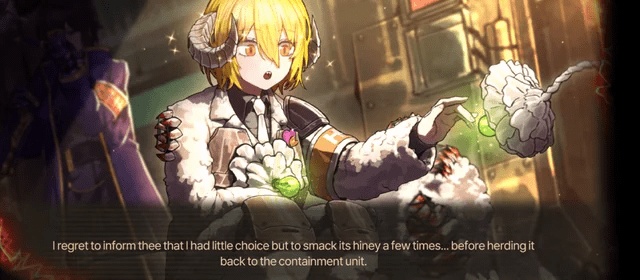
Don Quixote in Limbus Company. Image credit: Reddit.

To continue working our way reverse-chronologically to the source of the legend, in the remainder of this by-now-much-belated post we’ll touch on a few of the major instantiations of Don Quixote in media across the centuries. Most recently, as far as I know, he is depicted in video game form as one of the playable ensemble in Limbus Company. Intriguingly, her pronouns are she/her, and like Frog in Chrono Trigger, she speaks in a psuedo-old English, knight-errant register. We await impatiently Professor Kozlowski’s monograph on Limbus Company to unpack what is going on with this one, but unmistakably, given the wild premise of the game, a power fantasy of some kind is at play!

In the meanwhile, from a Diary of a Writer-esque post from October, here’s Prof Ben on Don Quixote, by Cervantes:

…the drama of Don Quixote isn’t in the text. The drama is in the reading. Quixote as character is one of the most famous literary heroes for a reason. And I think Cervantes wasn’t even sure what to do with him – not really. He’s clearly designed to be the butt of a joke; Cervantes uses Quixote to satirize and condemn the silly medieval romances of his day, pointing out the absurdity of these fantasies in his realistic modern context. But Quixote is too powerful for that. His mad dream of being a knight somehow transcends and transforms the realistic world Cervantes sends to confront him. We want Quixote to be right. His dream is more important than reality.

(Apropos of which, this is why I have such a problem with the comparison of Musk/Ramaswamy to Quixote and Sancho. I don’t see Musk in that light at all. If anything, he is more like the Duke and Duchess of the second volume, powerful figures who try to manipulate Quixote (idealistic voters or public servants, in this analogy) for the lolz.)

And Prof Ben on Don Quixote the character in Limbus Company:

So I wasn’t sure how I felt about Project Moon tackling Don Quixote’s chapter. Of all the characters in Limbus Company, Don Quixote has been, since the beginning, my absolute favorite. As filtered through Project Moon’s distorting lens, she (yes, she; Don Quixote is gender-swapped, like Raskolnikov, Ishmael, and Odysseus) is spunky, excitable, and idealistic. Where Cervantes’ Quixote idolizes knights, Project Moon’s Quixote idolizes fixers – the corporate mercenaries of the city; a surprisingly apt and deft adaptation. But this Quixote, like Cervantes’ Quixote, fails to see the hypocrisy underlying the fantastic tales of their exploits, and insists instead that the fixers are noble, heroic people, always defending and protecting the downtrodden, despite all of the overwhelming evidence that they do not. Where the other characters of Limbus Company are jaded, pessimistic, traumatized, or even unhinged, Don Quixote has remained fiercely, defiantly virtuous. And in a world as grim and miserable as the one Project Moon designed, this – perhaps unintentionally – makes Don Quixote surprisingly close to an audience POV character. The others accept the the wretched state of the city as given, resign themselves to the senseless loss of life and cruel realities of the corporations. But Don Quixote insists on fighting back, righting wrongs, and reforming the city. It may just be my bias, but it is easier for me to identify with the one character who does not countenance or tolerate the widespread destruction and loss of life, and who calls out the others for their callousness.

But in the lead-up to this chapter, it is revealed that Project Moon’s Quixote is, in fact, a vampire.

…But, more importantly, it is revealed that our Quixote is not the original Quixote. Our Quixote is actually Sancho Panza,…

It’s all typically-convoluted Project Moon storytelling, but the emotional throughline is this: faced with the reality of her origins, Sancho-Quixote must choose whether to accept or reject the dream that was offered to her.

Dear Ben, if you are reading this: I must know more! Would you consider publishing your thoughts on your Limbus Company playthrough in regular installments? Your work on Project Moon is far and away the best-performing content on our humble Video Game Academy!

Adaptations of the Quixote seem to have a way of going sideways. See also: Terry Gilliam’s Lost in La Mancha. Arguably even stranger, though, is Jorge Luis Borges’ Pierre Menard, Author of the Quixote, which recounts the tale of a writer who so enters into the soul of the novel that he rewrites it, word for word. Transposing back into literature, then, the process of emulation (of books of chivalry in Quixote’s case, of Quixote itself in Menard’s) that sent the old man on his knight-errantry in the first place, Borges’ story raises profound, slightly silly questions in truly quixotic fashion: What is an author? (Fortunately, Foucault can tell us! Oh, no, wait, this just in from Barthes…) And what is originality? What is it to live out one’s dream?

Forthcoming: Prof Schmid’s article on quixotic and Iliadic elements in Final Fantasy VIII. The windmill atop the hill makes a cameo in our recent Side Quests pod. (LP Archive)

Nor was Project Moon’s Limbus Company the first to transpose Quixote and Sancho Panza. Franz Kafka has a retelling, too, based on this conceit. Of course he does; though it hardly feels right to call it a mere conceit, given the prophetic weight of Kafka’s insight. First translated in a volume called The Great Wall of China, it comes from his collection of “parables and paradoxes,” and is brief enough to be given here in full:

Without making any boast of it Sancho Panza succeeded in the course of years, by devouring a great number of romances of chivalry and adventure in the evening and night hours, in so diverting from him his demon, whom he later called Don Quixote, that his demon thereupon set out in perfect freedom on the maddest exploits, which, however, for the lack of a pre-ordained object, which should have been Sancho Panza himself, harmed nobody. A free man, Sancho Panza philosophically followed Don Quixote on his crusades, perhaps out of a sense of responsibility, and had of them a great and edifying entertainment to the end of his days.

Given the serenity of the old man’s death at the end of Cervantes’ book, I suppose I agree: that for all his mad exploits, Don Quixote harmed no one, not even himself, and brought joy, if that is not putting it too strongly, “a great and edifying entertainment,” to many, Sancho included. For all his bruises and lost time, and despite never getting his promised island, Quixote’s squire is indeed immortalized through his adventures. Not for nothing does he crystalize the Spanish language’s rich store of proverbs and quips and unite them with a reenactment of the wise judgments of Solomon. Despite his master’s return to sanity at the close, their knight-errantry does in its small, strange way contribute to the cause of truth, which is to say, in video game parlance, saving the world.

Ultimately, I would have to read the whole book again in light of this parable-paradox of Kafka’s to see what I make of the Quixote-as-Sancho’s-demon theory. Maybe we can make a video essay about it. Imagine the numbers, the comments from the Limbus Company stans! See above: niche content, when politicized, can still break out and seemingly break the world.

We could follow it up with another on the deathbed retraction motif, stretching back to Solon in Aristotle’s Ethics, and Chaucer’s Canterbury Tales, and Tolstoy’s abjuration of his great novels, and perhaps Shakespeare’s via Prospero in The Tempest, and how many others? Even Aquinas called his philosophical works chaff at the end.

Likewise, this whole quixotic bit about reenacting books: that certainly deserves another, more extensive treatment. Spariosu would direct our attention, rightly, to Tristram Shandy and Uncle Toby’s bowling green, where the good man whiles away his time playing at war. What do we make of the remarkable resemblance to another, historical rather than fictional Quixote figure, St Ignatius Loyola, whose inspiration to found the Order of the Jesuits was born of reading replacements for books of chivalry? “In order to divert the weary hours of convalescence, he asked for the romances of chivalry, his favourite reading, but there were none in the castle, and instead, his beloved sister-in-law, Magdalena de Araoz brought him the lives of Christ and of the saints” (wikipedia). Or the resemblance of Uncle Toby and St Ignatius alike to the mythical Wounded King of The Waste Land? I mean, It can’t be a coincidence that The Fisher King is another Terry Gilliam movie!

To wrap up this deranged little essay, though, we have to mention The Idiot. Dostoevsky, having killed it with Crime and Punishment and yet to reach the tragicomic heights or depths of Demons and The Brothers Karamazov, plays upon references to Don Quixote for its hero’s unconventional social graces and compelling insights into the secret hearts of those around him. Beautiful, earnest, and a little boring at times, The Idiot was reportedly Dostoevsky’s favorite book in some ways: “the book in which he embodies his most intimate, cherished, and sacred convictions,” according to Joseph Frank; and those who appreciated it he would have found “kindred souls.” In Prince Myshkin, he “approximates the extremest incarnation of the Christian ideal of love that humanity can reach in its present form, but his is torn apart by the conflict between the contradictory imperatives of his apocalyptic aspirations and his earthly limitations” (577).

Still more, Dostoevsky later prefigured Borges, writing a chapter in imitation of Don Quixote that was only revealed much later to be his own and not translated from Cervantes. I can’t track down the page number in Frank on that, but I know it’s in one of those five volumes somewhere! And as he says, “We tend to take Dostoevsky’s comparison of Don Quixote with Christ more or less for granted, but it was still a novelty at the time he made it. In his highly informative study, Eric Zioikowski singles out Kierkegaard as ‘the first and, aside from Turgenev, the only person before Dostoevsky to compare Christ with Don Quixote’ (94)” (274).

Kierkegaard. Now there’s someone who knew about reduplication, which I take to be something akin to reenactment as we’ve been discussing it. That, however, would really take us pretty far afield.

And then there is Jesus, the son of Mary: the original of Don Quixote and Prince Myshkin alike, reenacting the prophets and fulfilling the scriptures down to every jot and tittle of the law.

To this day, we’re all doing our best to imitate him; though some look like they’re more just trying to cosplay him.

PS: Now that it’s spring break, I sat down to read the rest of Itoi’s conversation with the MOTHER games’ music composition and sound design duo, Hirokazu Tanaka and Keiichi Suzuki, interspersed with what look like email messages from fans, which Tim Summers’ paper put me onto. In section 10, we get the following exchange (per google page translation):

Tanaka: Children don’t just play with parts of their body, they play with their whole body and feel things with their whole body. My child was born when “MOTHER” was released, so he wasn’t around in real time, but he played “MOTHER 2” when he was in elementary school. Around that time, while eating dinner, he would say to me , “Dad, Mr. Saturn… he really is a great guy.”

Itoi: Wahahaha!!

Suzuki: That’s a good story (lol)!

Tanaka: I was really like, “What?!” for a moment. He was completely normal and serious. And, not just once, but “Hmm… he’s really a good guy…” over and over again. And for some reason, it was always around mealtimes.

Itoi: That would make me cry (lol)!

Tanaka: So my wife was like, “What?! Who is that? Where are you friends from?” (laughs)

Itoi: Well, I said in a previous interview that Mr. Saturn is a symbol of innocence, but there’s also another background to it. It’s Dostoevsky.

–Dostoevsky? [I’m unclear on who this fourth interlocutor is]

Itoi: Yes (laughs). It’s Prince Myshkin from Dostoyevsky’s novel “The Idiot.” When I read it, I thought, “Prince Myshkin is a really good guy!” Akira Kurosawa also made a movie out of it, but I tried to include him in Mr. Saturn. However, it’s really hard to portray a “really good guy.” It’s not something you can usually portray. So to express a “really good guy,” I added another character to the background. That’s the penguin from “Passionate Penguin Meal” (a manga written by Shigesato Itoi and illustrated by Teruhiko Yumura). If I don’t do that, I probably won’t be told by Hirokachan’s son that he’s a “really good guy.” He’ll just be “a fun, interesting guy.”

They go on to discuss other references, in the music, especially, and circle back to the idea of borrowing from Dostoevsky:

Itoi: So it’s the same with Dostoevsky! No one will feel anything like Dostoevsky, in the end. Not even Mr. Saturn. But there might be a chance that some Dostoevsky fan out there will think of something. In the same sense, something Dostoevsky-like might be conveyed to children who don’t know anything about it.

Passionate Penguin Meal

The Tale of Genji (Gloves): Gilgamesh, Benkei, and Basho in Final Fantasy

Playing fast and loose as usual with the connections, often tenuous but ever-present, between games and literature, this time let’s nevertheless open with a fairly straightforward question: Why are the Genji Gloves a recurring peak item in the Final Fantasy series?

And a little reading and searching provides at least three possible literary references.

Continue reading “The Tale of Genji (Gloves): Gilgamesh, Benkei, and Basho in Final Fantasy”

All Myths are Myths of Creation: Devotional Language, by Johannes Sloek

I’ve just been rereading this book and I won’t stop telling everyone how much I love it: it’s as good and better than I remember. Look, I tell them, if you’re at all interested in mythology, theology, philosophy, language, culture, education–practically anything relevant to the inner life, and the possibility of cultivating and expressing it in any way–you should read Devotional Language, by Johannes Sloek. I’ll send you a pdf that I found, since the book is expensive and hard to find, and it’s not even all that long; you can read it in few sittings; you can sit with it a lifetime. Just ask! So far exactly one person has taken me up on this belated enthusiasm for the preeminent 20th-century Kierkegaard scholar’s work, my friend and co-founder of this humble Video Game Academy, Ben, known online and to his students as Professor Kozlowski.

Continue reading “All Myths are Myths of Creation: Devotional Language, by Johannes Sloek”