Empty stadiums, arcade blues. Writing about games and reveling in learning, play, and art while there is so much else to worry about, and still enjoying the shimmering threshold of summer break–as I always say, still playing EarthBound, I just want to acknowledge nevertheless all the ways this could go sideways, and has already for so many.
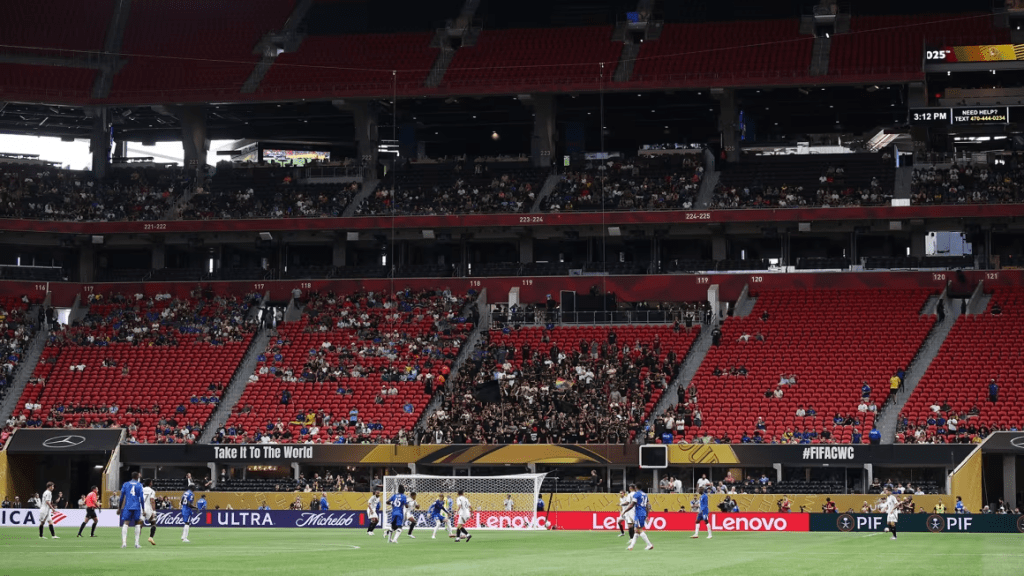
Can we look at those empty seats and think of anything other than what has been going on across the country in LA, and with the funding of Qatar and the backing of the US a world away in Israel and Gaza?
And can we register sufficiently the juxtaposition of the birthday parade wrapped in assumed glory of the world’s premier military against the popular protests openly threatened with that very force?
Can we agree that it is possible to stand for the country, with all its baggage, and stand against its own overweening power? One would have thought these were settled questions, but then one’s history has been bifurcated and multifarious from the get-go.
Or is it too little to berate the angels of history, without going further and saying that only learning, play, and art, traced back to their very deepest roots have any hope of saving the world?
Among the news and news-like content, most of it bad, as ever, I’ve recently overheard some interesting, hopeful things about games:
‘And I’m now talking as an historian, looking back… big changes are not the creation of old guys like me… we’re not the people who have the ideas that will work to build social capital and to save America… I’m gonna be long gone. So first thing is go young and inspire the young people to come up with the new bowling leagues. It’s not gonna be bowling leagues, it’s gonna be something else. But almost surely will involve something of, of high tech. But it, it will involve real personal relations with other people–‘
‘Before you move on. A perfect example of that for me was Pokemon Go. So I I’m assuming neither of you played it, but I was, I was a huge Pokemon Go fan. Huge. Huge, huge. I think this was the best execution of a video game in the modern age because it was a video game that everyone played. It was on your phones. Yeah. Right. And the goal was to catch Pokemon. You don’t need to know what any of this is, just think of a game where you’re trying to catch little creatures. (Okay.) But what they did that was amazing was you had to catch the creatures in the real world. (Ah.) So they used your camera on your phone and you would literally have to run out into the streets to catch these digital creatures.
‘And so at first it was just like, oh, this is silly and this is fun. But I’ll never forget the joy I experienced when one night I was in New York and I was running with a group of people in Central Park–strangers at 11:30 PM–because someone had tweeted and told us that there was a Snorlax, which is one of the creatures. There was a Snorlax in Central Park. And Bob and Christiana, when I tell you there were, if I was just to estimate, there were like maybe 500 people from like little kids who had dragged their parents out of the house all the way through to like adults who are playing the game running. And I remember at one point one of the kids turned looked at me, well ’cause we’re all running ’cause there’s a time limit. You don’t know how long the creature will be there for. So we’re all running through Central Park together. And one of the kid turns, turns, looks at me, this kid’s like maybe like 14, 15. And he looks at me and he is like, he’s like “Trevor Noah!” He’s like, “you, you play Pokemon Go!” And he’s like, “now I know I’m in the right place,” and we’re running together.
‘But I what I, what I loved about it was it, to what you’re saying, it was the perfect culmination. It wasn’t the either/or. (Yeah.) We were all playing all digital game. It was the alloy. You could play the game at home and we were playing it at home, but you could not help but bump into other people who were playing the game as well in the real world. And it, it was such a beautiful– ’cause once the Snorlax was gone, all everyone could do now is talk. “Where are you from? (Yeah.) Hey, where do you live? (Yeah.) Where did you, what’s the best one you’ve caught?” What have you. And this was like the game won awards, by the way, even for getting people fit and running and moving it. Yeah. But I I, I love that. So like when you say the going young and figuring out the, the hybrid, I think there are ways to do it. ‘Cause some people would be like, oh, I don’t know if you can, I think we actually have seen one of the ways, and I know because I played it, but Yes. Okay, so what’s rule number two?’
‘Rule number two is go local. Go local…
(Trevor Noah in conversation with Robert Putnam, circa 56 minutes in, per the transcription)
And then on The Bible Project, they’re beginning a series on the theme of Redemption:
Jon: But if I’m in an arcade, right? You bring your kids to an arcade, and they get—
Tim: Oh.
Jon: And they get the tickets.
Tim: Redeem the tickets.
Jon: And you redeem the tickets for, like, prizes?
Tim: Mhm.
Jon: I think I would use—maybe use redeem, there.
Tim: Yeah.
Jon: Okay.
Tim: Yep. Okay. So we have, by our house, in southeast Portland—is one of Portland’s
oldest—
Jon: Oh, yeah.
Tim: Classic video arcades.
Jon: The nickel arcade.
Tim: Yeah. It’s called Avalon. The building’s a hundred years old. And it smells and
feels like it when you go inside.
[Laughter]
Tim: And they have accumulated this collection of—it’s, like, three big rooms. It’s—
actually, now, when I go with my kids—which I’ve really limited how often they can
go.
[Laughter]
Jon: They love going?
Tim: They love going. But you go into these dark rooms. It’s like a kid’s version of a
casino.
Jon: Yeah.
Tim: There’s no—
[Laughter]
Tim: Windows.
Jon: Totally.
Tim: There’s no external light.
Jon: Yeah.
Tim: It’s dark.
Jon: Yeah.
Tim: And the only light there is purple, and blue, and green—
Jon: Yeah.
Tim: And red from the games. And it’s just so—a cacophony of noise.
Jon: Yeah.
Tim: And it’s—for me, it’s oppressive.
[Laughter]
Tim: And, uhm—
Jon: And then you spend 20 dollars—
Tim: Yeah.
Jon: And you end up with like 200 tickets.
Tim: Exactly. But many of the games—some of the classic ones like Ski Ball and—
Jon: Yeah.
Tim: The basketball hoop either prints out tickets, or now, it all happens on these
little cards.
Jon: Digital—
Tim: Digital cards.
Jon: Tickets.
Tim: And if you get tickets, then they’ll accumulate on your card. And so then the, the
end of the ritual—it’s like a liturgy—
Jon: Yeah.
Tim: Is—
Jon: How many Tootsie Rolls can I get from these—
Tim: Going to the counter.
[Laughter]
Tim: And then they stand there, and these poor—
Jon: Oh my gosh.
Tim: Workers—
Jon: I know.
Tim: At the arcade—
Jon: Yeah.
Tim: God bless them.
[Laughter]
Tim: Just these indecisive, you know, wishy-washy ten-year-olds being like: “Do I
want the mint Tootsie Roll, or the blueberry, or the chocolate?” You know. And
they’re so patient. So what they’re doing, in that moment—is that my kids have
played these games, and they’ve earned this—
Jon: Tickets.
Tim: This value.
Jon: Yeah.
Tim: They’ve generated value.
[Laughter]
Tim: Right?
Jon: Yeah. Mhm.
Tim: Isn’t that right?
Jon: Yeah.
Tim: In the economy of the arcade—
Jon: Yeah.
Tim: They’ve generated value by winning these games. And then they can take that
value and then go look at a glass case with, like, cheap plastic laser guns or Tootsie
Rolls. And what they do is they lay a claim to that. They’ve accumulated value—
Jon: Yeah.
Tim: And they see something else of value. And they’re like: “I want that to be mine.”
And then you—
Jon: Exchange.
Tim: The exchange.
Jon: I’m exchanging my tickets for the laser gun.
Tim: That’s it. Yeah.
Jon: But you need like 2000 tickets for the laser gun.
Tim: That’s r—
[Laughter]
Jon: You’re not going to get that one.
Tim: Tot—it’s so ridiculous.
[Laughter]
Tim: It’s like somebody actually paid thirty dollars—
Jon: Yeah.
Tim: For a, a cheap—
Jon: Yeah.
Tim: Toy laser gun that breaks in a week. Anyway. So it’s that exchange of value.
Jon: An exchange of value.
Tim: Yeah. There’s something that I’m going to lay claim to, and that will be mine.
And then I do—I go through some process of transferring it into my possession. And
th—that whole process is, I think, what the word redemption, and or redeem
classically, means in English.
Jon: Okay. Is that the main meaning of the word that we’re translating from Hebrew
or Greek? …(Relying again on the transcript, but give it a listen)

So anyway. Part of what I’ll be doing this summer is still playing EarthBound and trying to learn Japanese yet, and part of what I’ll be doing, as ever, is singing along and listening for what I can hear of these Redemption Songs through the noise.
 Video Game Academy