If you haven’t, perhaps read PART ONE first?
ACT II: In which we begin our explanation of the world of Clair Obscur, in the hopes of understanding its artistic priorities, themes, and aspirations
I’m still not entirely sure how I want to tackle this section. I would normally prefer to avoid spoilers, but we can’t very well talk about the world of Clair Obscur without spoiling what you’ll find there, and we can’t talk about it without also talking about the plot and lore of the game. And, further complicating the matter is the fact that I’m writing this with people who can’t play it in mind. I want to share how awesome this game is with friends and family who really won’t ever have an opportunity to play it, because they don’t play video games, are don’t play these kinds of video games.
So we’re going to do something fairly unprecedented—at least for me and my essays.
I’m going to treat this as an adaptation. I’m going to effectively try and transmute the experience of playing the game to prose. I will walk through the major plot points, and the major areas of the game. I will describe, as best I can, the locations and beats.
That means that this will be all spoilers going forward, but I will be intentionally staggering them, since I’ll be following the game’s own story and plot and revealing what happens in chronological order.
BUT:
- We will save the major major plot spoilers (i.e., the endgame) to Act III of our essay.
- We will break up this section by the organization of the game’s own Acts, so you can ditch the essay anytime we get too spoiler-y for your liking. (Hopefully, I’ll also be able to sell at least some of you on the game while we go…)
AND:
- CONTENT WARNING: Things are going to get pretty dark here. This is a violent game about the ways people react (and overreact) to grief and loss. There are multiple depictions of suicide, trauma, waning mental health, and physical disfigurement. I think the game handles these subjects with understanding and maturity, and I hope to do the same, but use your judgment going forward.
Alright. Let’s do this.
Prologue: Lumière
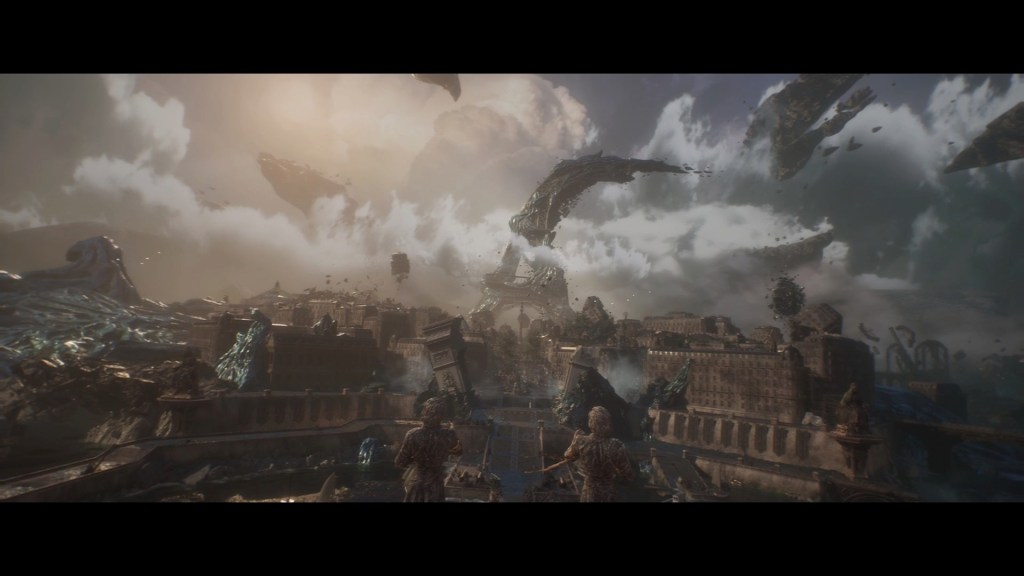
Lumière is Paris—though the Belle-Époque Paris in that state of static-disintegration we discussed earlier. The top of the Eiffel Tower is smeared to one side; the Arc de Triomphe’s shattered peak floats in a rough arch over its two legs. Nondescript Parisian apartment buildings line crowded streets. But the city is surrounded by the sea, and in the distance you can see a giant monolith, and, at its base, the form of a woman with long ash-gray hair, huddled into the fetal position. Above her head glows a number: 34.
We are introduced to Gustave and Maelle. Gustave is man in his early thirties, wearing an elaborate dark purple suit; Maelle is a young girl in her teens, wearing a stereotypically-French horizontal-striped shirt and red kerchief. They talk together like brother and sister: she teases him about the fact that he is throwing rocks ineffectually at the distant monolith; he plays along, wry and kind. We get a combat tutorial, and traverse the rooftops of Lumière together.
The greater heft of the scene is only gradually revealed, though. Gustave is in the rooftop garden to avoid going to see Sophie, an ex-girlfriend he’s lost touch with. Today is her gommage—and that means that this is Gustave’s last chance to set things right. He has a flower for her—this is apparently traditional—and she thanks him for it. It comes out that they separated over some pretty important differences in perspective. Gustave has been working hard, preparing for this year’s Expedition onto the dangerous continent; Sophie has been trying to enjoy this last year of her life.
Because here’s the thing: the gommage means the death of Sophie, and everyone else her age.
As the characters watch, the woman at the faraway monolith—the Paintress, they call her—wipes away the “34” inscribed on the stone and replaces it with a new number: “33.” And when she does, all the citizens of Lumière over the age of 33 (including Sophie) slowly dissolve into red-and-white flower petals: gone forever.
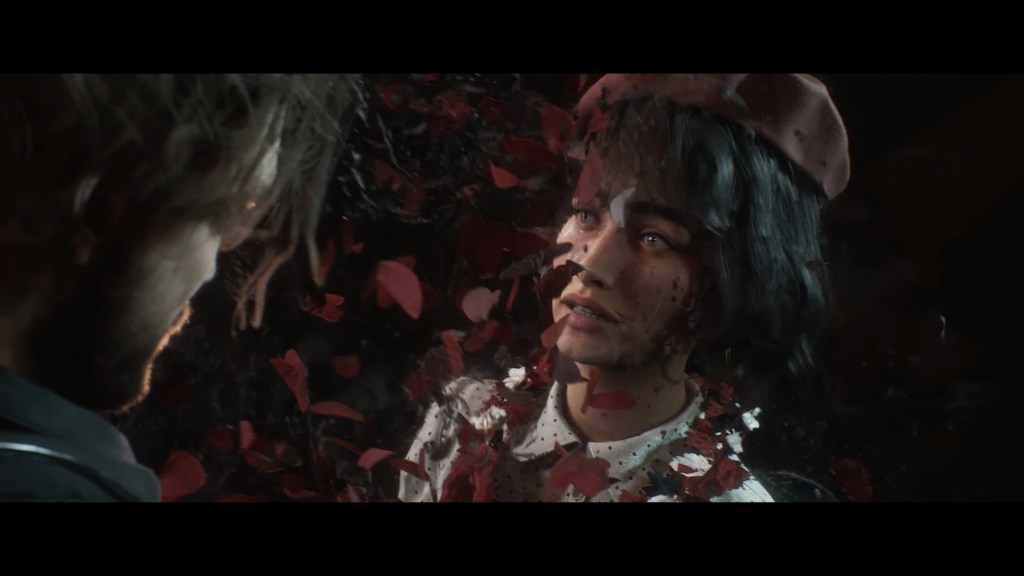
Hence our call to action, and our title. Gustave (and Maelle) has committed himself to joining Expedition 33—not the 33rd Expedition, but closer to the sixtieth or seventieth, with each Expedition naming itself after the number on the monolith when it set out—and the mission of these Expeditions is to travel to the unknown continent across the sea, confront the Paintress, and kill her, so the gommages will stop and the citizens of Lumière can live their lives without fear.
But Expedition 33 is an unmitigated disaster. Immediately after landing on the shore of the continent, they are confronted—impossibly—by an old man (why hasn’t he gommaged…?!) in the company of the monstrous Nevrons (Nevrons come in many varieties: these are nightmare creatures with no head or eyes but two hands composing a kind of face), who start to lay utter waste to the Expedition with power beyond anything they could have prepared for. There’s a frankly harrowing cutscene where all the characters we’ve met are positively wrecked.
Gustave tries desperately to find safety. Eventually, though, he is knocked unconscious and blacks out.
We rejoin Gustave as he wakes up—but nobody else is around. He’s been relocated from the horrible beach—where the massacre took place—to a glowing blue tree, but he’s completely alone. Dazed, he walks for a little while, calling out for the others, but nobody comes. He eventually arrives at a cave full of the corpses of past Expeditions (it would seem theirs was not the only one to be immediately thwarted by terrible powers), sits down, and withdraws a pistol to end his own life.
But he is stopped. Lune—one of the other Expeditioners—takes his hand. He is not alone. Others have survived, but presumably only a few. Together, Gustave and Lune will try to find the survivors and continue the mission together.
Prologue – Debrief
OK, so we’re barely an hour into the game and it is already more emotionally harrowing than most full games I’ve played. The folks at Sandfall pull no punches with their emotional beats, but it is also not just some grim-dark tragedy-porn experience either. The scenes in Lumière especially are buoyant and lively; even the festival leading up to the gommage is full of surprisingly-rich characterization. These are people trying to figure out how to live their lives in the shadow of this terrible situation. They have traditions. There are little kids running around. Sophie even has a bit of a tense conversation with a mother about whether or not it is responsible (or, indeed, imperative) to have children in light of the gommage (most of these children are orphans, after all—including Maelle).
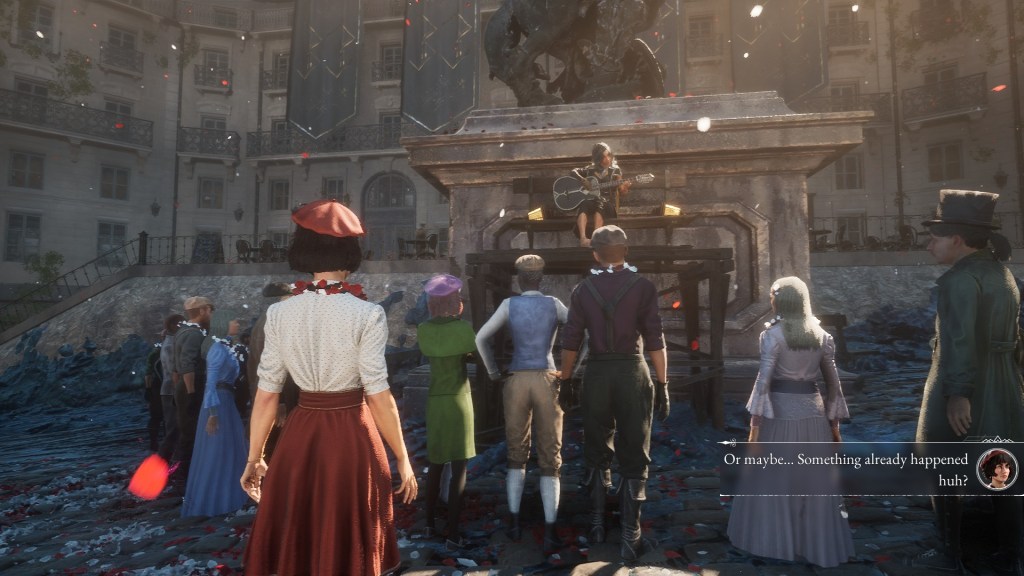
During the send-off celebration for the Expedition, in particular, many of the characters confess their hopes and dreams. Some are apprehensive; others defiantly resolute. Lune herself, if you notice her among the crowd, comes off as a bit of a space cadet. She can be found sitting on the pedestal of a statue, playing her guitar and singing, barefoot, before the gommage. They’re people—not props. The situation is terrible, but they are trying to make the best of it anyway. Because that’s what people do. This is a game about grief, sure. That much is clear even from this first hour of play. But specifically, this is a game about how we deal with grief. And I think the game wants us to notice that the people of Lumière have made a certain amount a peace with their situation. They don’t consider the broken fragments of buildings strange or disruptive, even though they are the result of a historical catastrophe only dimly-remembered. Their surreal situation has become normal, even if it is strikingly abnormal to the player. Sophie and Gustave disagree about whether they should accept, or fight against this situation (which itself serves as a good indication of normalcy to the player – we’re not going to question the floating bricks, but we are going to question the arbitrary mass killings that also serve as a death-clock for the whole society). Gustave intends to fight, but Sophie intends to accept. It isn’t clear who is right; it will, after all, get much, much worse by the end.
Still, the scene with Gustave—this lively, wry, caring character—sitting down to commit suicide…? It has to be one of the most affecting scenes in any video game I’ve ever played. Even in the one short hour we’ve had to get to know him, he’s been characterized as standoffish, warm, protective, creative, and a little irritating. For him to lose all hope so quickly is both understandable and horrifying. As he walks toward the cave, reduced to a stupor, eyes blank and staring, I feel all that despair and loss and helplessness, even from a man who had said that he would do all he could “for those who come after.”
This doesn’t read like a plot point, orchestrated by some writer for shock value. This reads like an actual human being, reduced to despair by unfathomable trauma.
(It’s almost a shame I’m not still running my “The First Hour” series—because this should be on the short list for “most impressive first hour of a video game ever.)
The World To This Point
This is intended to be an essay about world-building, and, as such, I want to make sure we circle back around to the world at every stage of our discussion.
But there isn’t a whole lot to say at this point. So far we have only seen the town of Lumière (which is very nice, don’t get me wrong), the beachhead where the massacre took place (which we only see in a cutscene), and a little bit of the verdant—if alien—meadow and macabre cave where Gustave faces his despair. We’ve only fought Maelle in a tutorial sparring match, possibly a rogue mime in Lumière, and a Nevron or two along the path to the cave. We haven’t seen much, in short.
But that doesn’t mean it isn’t important. Lumière is festooned with red-and-white for the gommage: the people about to gommage wear garlands of red flowers, and the dominant landmark (even Gustave and Maelle draw attention to it) is a massive red-and-white tree in the square where Gustave meets Sophie. It isn’t “lore,” exactly, but every part of the design of Lumière resonates with and anticipates the gommage that’s about to happen. By contrast, the sending-off celebration for Expedition 33 takes place at night, and we are introduced to the stark, snappy-looking black-and-purple-with-gold-trim uniforms of all the Expeditions past. Here, again, the color palette reinforces the theme. Red-and-white for lost innocence, grief, and aborted happiness; purple-and-black for resolution, purpose, and sacrifice.
When we do reach the continent, the beach is a barren, ashy stretch of sand and debris. The mysterious old man wears a white beard and a severe black suit (and seems to resemble an older Gustave). The entire cutscene is nearly monochromatic: the Expeditioners wield colorful pictos, but the enemies fire devastating bursts of pure white energy that light up the black sand.
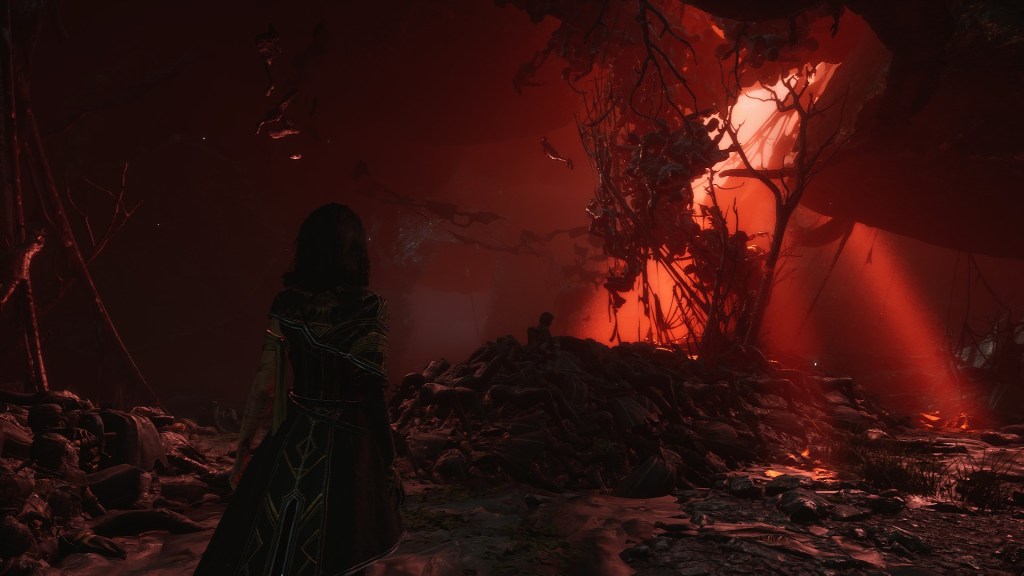
Then there is the glade, with its verdant greens and alien blues. And the cave, its ashy-gray bodies lit blood-red by some trick of the light filtering into the cave.
This isn’t what we usually mean when we talk about “world-building” in video games. Instead, we’re used to thinking of lore, or environmental storytelling, or details that add up to a larger picture of social complexity or backgrounds for character development. When I wrote about Morrowind, I emphasized that its believability as a place derives from its complex social dynamics, which are foregrounded, but have to be learned. In some of my other favorite worlds (say, that of Bioshock or Batman: Arkham City), much of the world-building is rooted in environmental details: Bioshock’s bloody messages scrawled across walls, or Arkham City’s villain-related details spread across Gotham.
Here in Clair Obscur, though, world-building is almost always in service to the emotional weight of the scene. Like any good surrealist work, we are not speaking to the conscious mind, but to the unconscious mind. These spaces aren’t necessarily logical, don’t have to make pragmatic sense, and don’t typically invite analysis for the purpose of piecing together a puzzle. You are, in a very real sense, supposed to feel these places. Walking through Lumière, the experienced video-game explorer is likely alert to details that describe the day-to-day lives of its people. And there are some: Gustave and Sophie remark that the piles of furniture (that conveniently block access to alleys the game doesn’t want you to explore) are the belongings of people about to gommage—now free to anyone who wants or needs them. And there’s a café where people have congregated to eat, performances (like Lune’s song) by its denizens, and even a dance that uses the colorful Pictos you’ll use in battle for visual spectacle. But it isn’t really a livable space, the way some other games (like Bioshock) would emphasize. It’s a vibe. And it’s less important to convince the player of its reality than to anticipate the emotional value of this place in the game to come. Lumière doesn’t need to make sense as a lived-in space; it needs to stick in the player’s mind: a symbol of life, normality, and grief that must be protected and saved in the player’s travels. Likewise, the beach doesn’t need to make topographical or geological sense; it needs to represent horror, death, and despair—and, hopefully, scare the player away from it for the foreseeable future (you can go back and get your butt kicked there only later in the game). And, most glaringly, the blood-red light of the cave doesn’t need to make sense; it needs to highlight Gustave’s own bloody despair and failure in his darkest hour.
That’s what makes this so frustrating to discuss: this is a carefully-crafted world, but it exists in service to the experience—to the emotional heft of the story, the characters’ suffering, and to the themes of grief and survival. It is not a world that can be dissected into its speculative elements, but it is no less calculated, no less intricate. Here on The Continent, we will discover, and we will explore, but we will rarely be intellectually satisfied. Instead, we will feel—and that is a noble, if underappreciated goal of the world-building craft.
Act I: Gustave’s Journey
I’m not going to summarize the whole game in this kind of detail. But I felt it necessary to explain the emotional weight of the world here, where we can get into the specifics, and let this be our default understanding of the rest of the world as well. There will be specific locations I want to investigate in more detail, but certainly not all of them.
Leaving the cave, Gustave and Lune quickly find themselves in a forest of these alien-blue trees. Night is falling, it seems, and we have to find a safe place to camp where the Nevrons can’t reach us. This is made especially urgent when we encounter our first Nevron boss—who kills one of the other survivors in front of us, just to drive home the stakes. Beat him, and Gustave and Lune discover a message scrawled at the top of a massive blue tree: Maelle is alive, and has been carried away by someone determined to protect her—but not an Expeditioner, it seems. They aren’t following protocol.
The trail leads us to our first encounter with the world map, where we are given a little bit of space to explore. (And a few world-map enemies to challenge!) But our next destination is one of the truly spectacular and memorable places on the continent: a canyon of rock populated by a forest of coral and kelp. Whatever surrealist elements we may have seen before, this is an idea that would seem right at home in a Magritte painting. The land even has little spouts ejecting bubbles into the air—I honestly couldn’t tell in my first game whether I was supposed to be underwater, or on land, or what. The characters are also a bit mystified, but press on. (Surreal-as-normal, remember? We’re on a mission; no time to figure out the physics…)
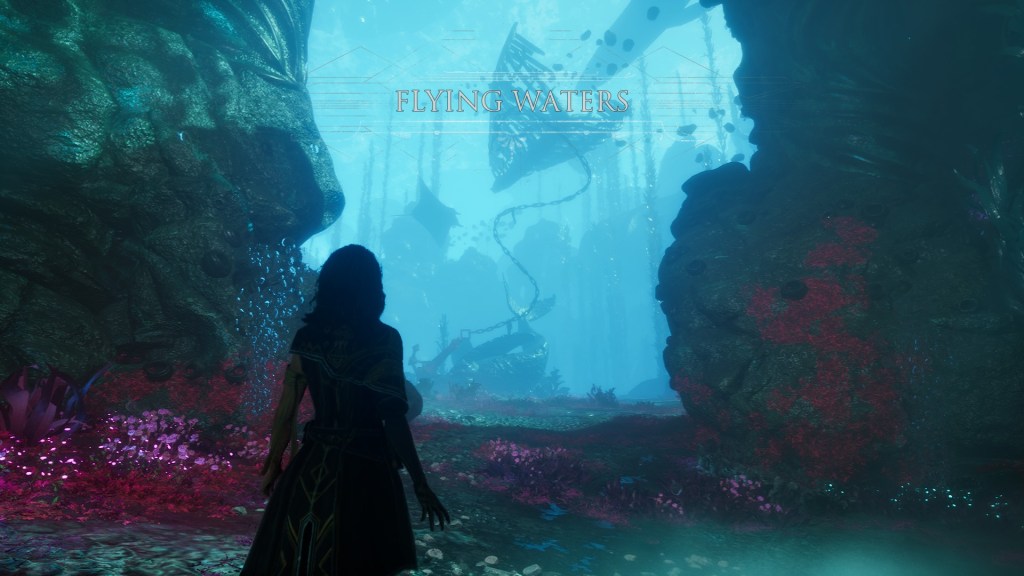
In the middle of the coral caves we find more oddities. First, one of the Gestrals: a supposedly-mythical race of paintbrush people. This Gestral’s name is Noco, and he’s a traveling merchant who would also love to fight you, if you’re interested (most Gestrals love a good fight). Second is an out-of-place ornate black-and-gold door in a pillar of rock. Go inside, and you will find the Manor, where it seems Maelle has become quite comfortable. She’s met a strange, but not hostile, denizen of the Manor she calls The Curator—he has a blasted hole where his face would be and speaks only in hollow grunts, but he has apparently been helping her, and will join the party to help us manage our resources and strengthen our weapons (but not fight).
From here, Maelle and Noco lead us to the Gestral village, where we are attacked by autonomous Gestral guardians (who turn out to be massive mechanical armor suits being tested by Gestral engineers). We meet the leader of the village, who encourages us to seek out Esquie, and offers us passage to Esquie’s lair, but only if we go a few rounds in the Gestral arena and confront their new champion. That champion turns out to be the fourth (and final) survivor of the beachhead massacre: Sciel, who will in fact fight us before joining the party properly (she, too, just loves a good fight).
Esquie turns out to be a big, silly, masked guy who would normally have the power to ferry us over the water, but has recently lost his stones that allow him these powers (this apparently happens). He asks us to get his rock-traversal stone from François, his cantankerous turtle-esque neighbor, who attacks us with his “Strongest Ice Attack Ever”—but he isn’t really much of a threat, and seems a bit fond of Esquie despite his grumpiness.
Once Esquie has his stone back, he asks us to help him find Florrie, the stone that allows him to swim over the sea. He believes he dropped it in a cave network nearby, which is our next destination. It’s a massive, sprawling area with lots of smaller caverns and tough enemies, and when we finally find Florrie, it’s guarded by the Lamplighter—a terrifying, multi-armed enemy who attacks us with its lamps, and who resurrects after he is beaten. Once he is finally put to rest, we restore Florrie to Esquie, and he offers to swim us to the next land mass.
But just as we’re about to embark, with half the party in the water below and Gustave and Maelle still in the cave, the mysterious old man from the beachhead suddenly appears and impales Gustave. Gustave urges Maelle to leave and confronts the man in a heroic last stand, but is killed. Maelle is likely to be next, but she is saved by another mysterious outsider with a wild mane of graying hair, who confronts the old man and rushes the party out onto the sea.
Act I ends with the party disheveled: Gustave is dead; Maelle is rattled, and the newcomer, Verso, is little more than an enigma.
Act I: Debrief
Gustave’s loss is devastating, and will haunt the rest of the game. There aren’t many games daring enough to kill off the primary player character (though the death of 2B in NieR: Automata comes to mind), but this seems especially heartbreaking because Lune saved his life at the cave. There is something senseless, tragic, and wasteful about his death, even if it is, also, a kind of heroic last stand. And you’ll often be reminded of it: Gestral merchants will still list Gustave’s cosmetic items in their inventory with the message that you’ll need to find a missing party member before they will sell to you. Many times in the rest of the game you’ll be reminded of his absence. And Maelle will take over his responsibility of writing in the Expedition journal “for those who come after.”
It also seems like the last straw for poor Maelle. Throughout the first act, when the party camps for the night, Maelle suffers from dreams or visions of a similar-looking girl with a ruined face. Sometimes she is confronted by the mysterious old man in these visions, who speaks to her as a familiar, but not in any way loving or friendly. Her relationship with the Curator, too, seems strange: she is the only one who understands his moans. Gustave was her anchor to herself, to her former life, and to her sanity. Gustave was like a brother, but also her caretaker and protector through the Expedition. Now that he is dead, she begins the next Act devastated, and it will take some time before she recovers.
Verso, by contrast, is pure enigma at this point. He slots into Gustave’s spot in the party without any trouble (he even uses all of the weapons you’ve collected for Gustave), but he is slow to trust the rest of the party with personal details, and they are slow to trust his advice and insight. Like the old man, Verso should not be here—he should have gommaged by now, or been killed by the many hostile Nevrons. His very existence is somehow wrong, and the other characters worry that his help may hide ulterior motives.
Esquie, too, is more than he appears. When he first meets the party, he mentions that he has met Sciel before, but she does not remember it. The party has heard stories of Esquie (there’s even a statue in Lumière), but assumed (like the Gestrals) that he was just a myth. But where Verso is immediately suspicious, Esquie is impossible to suspect. His awkward intonation and mannerisms, his goofy affectations, and his plump, huggable, velvety body seem totally unthreatening. He’s not designed to be familiar or inviting, but he has all the otherworldly childlike charm of the laughing Buddha.
We’ll have a lot more to say about Esquie later.
The World of Act I
Compared to the strictly linear path of the Prologue, Act 1 offers a lot of room to explore. The World Map is littered with collectibles and enemy fights; many of the individual locations hide secrets down optional paths (especially in the cave system where Gustave meets his end), and all are just as evocative as the locations from the prologue.
But along the way there are some particular details I’d like to point out:
- The Gestrals
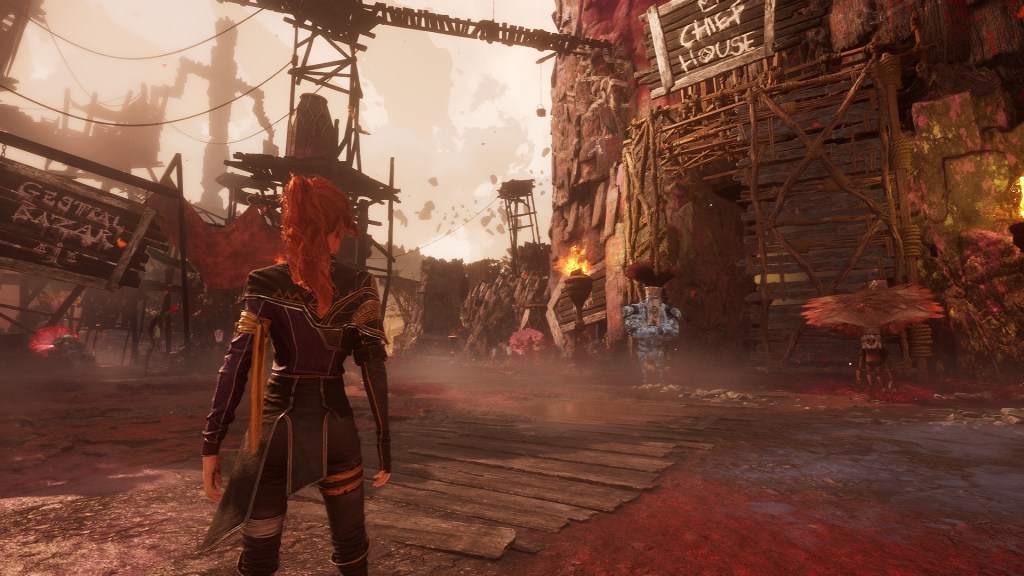
Once you meet Noco and visit the Gestral village, you’ll start finding Gestrals everywhere. And they are delightful. Noco is child-sized, and has a child’s temperament: rowdy, inquisitive, and eager to explore. His stated mission is to become “the greatest merchant ever!” which will apparently involve exploring the far corners of the continent. But the rest of the Gestrals are equally enthusiastic, equally rowdy, and equally bumbling. As much as the big Gestral constructs (sakapatate!) present real threats to the player, the area where you fight them is serene—a red forest known as the “Sanctuary” which the Gestrals consider sacred. And the music that plays when you fight these sakapatates is upbeat, cheery, and wistful, not at all menacing like the other combat music so far. (The title of the track is literally “Gestral Summer Party.”) Fighting the Gestral merchants, too, is framed as a fun side activity: you have to duel with only one party member, and neither Gestral nor party member risks death in the encounter. Outside of the Sanctuary (and the arena) you will rarely find Gestrals who are hostile, but most are still spoiling for a fight if you’re willing.
I want to emphasize this because the game is careful to walk us through our different emotional reactions on The Continent. Our first encounter with the old man makes the Continent seem terribly threatening, but the mysterious, beautiful, and alien places we experience next suggest that this is just as much a place of wonder, beauty, and serenity. The Gestrals in particular add a layer of whimsical fun to that feeling. Coming off of the strange undersea canyon, the Gestral community feels odd, but comfortable and lived-in. They like to fight, but their aggression is posture, not threat. You can even challenge the village leader (who will immediately whup you at this stage of the game), but it’s not personal or anything. Gestrals are also apparently immortal. When they are killed—for whatever reason—they are reborn, though without their memories. You will see dead Gestrals on the world map from time to time, and their tell-tale (paint) jars with brushes sticking out of them as they wait to reincarnate. But that just helps to explain why they seem so unconcerned with fighting and dying—it is all just a kind of game to them. These are comic relief characters, essentially, though their endearing sincerity overrides their buffoonery. It’s easy to fall in love with the silly little guys.
- The Nevrons
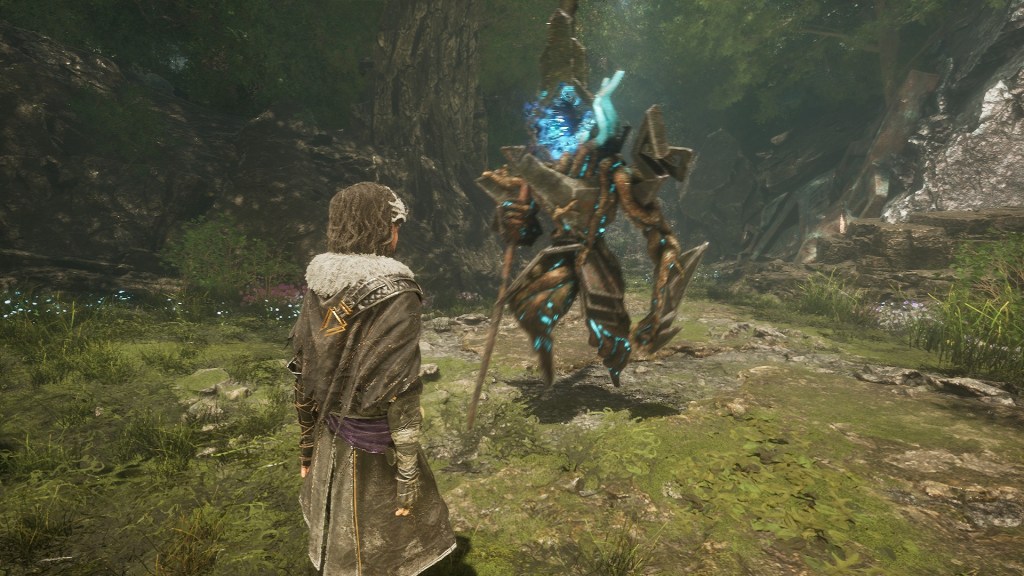
At this point in the game, there is no single aesthetic that describes the Nevrons. The monstrous hand-faced creatures of the beachhead echo the whirling arms of the Lamplighter, but we also encounter the diamond-headed spearmen of the world map, massive club-wielding bruisers with porous, pumice-like bodies, and smaller, quicker Nevrons that dodge traditional attacks. In the coral canyon there are skinny floating Nevrons wearing what look like diving helmets, holding old-school porcupine-like sea mines like balloons floating over their heads (shoot them in combat and they’ll explode, damaging all the enemies in the fight). Some seem stone-like and heavy; others are spry, floating in place or flying across the battlefield to attack. Most seem distinct to their environments: stony four-legged eyeless brutes with luminous hexagonal crystals in the caves by the sea; divers and anchor-wielding toughs in the coral canyon; spear- and swords-men on the world map. There is something suggestive about them, like the sexually-themed monsters of Silent Hill 2, but the theming is rarely so obvious. They may well be the most surreal element of this surreal world—insofar as they are hostile, but conscious, automatic, and not social like the Gestrals or people of Lumière.
Some, though, are not hostile at all. By this point in the game, you may have found several “white Nevrons,” who don’t attack you and will offer you quests. Usually they are missing something—the white Nevron who wields a lamppost as a weapon wants to light the lamp like his friends. The miniature Nevron in an optional area near the coral canyon wants to be huge like the massive, hulking monsters who loom over the landscape (and who Esquie advises you avoid, at least for now). When you help them, they will clue you in to the origin of the Nevrons (and their creator…?), but you will also always have the option to fight them (instead, or after finishing their quests). I never took the game up on the option—there seemed to be enough violence and death going on, thank you very much—but I think the game wants this choice to be deliberate. It won’t be the last time that we mix up our friends and enemies, after all.
And, of course, there are the Chromatic Nevrons—palette-swapped variants of familiar Nevrons, but much stronger, and often with radically different attack patterns. Chromatic Nevrons tend to hide down optional paths or in optional areas, and while you may have beaten several by this point in the game, you’ve probably been beaten by several as well. They are nasty tough, compared to their counterparts.
- The Fallen Expeditions
The cave where Gustave considers suicide is littered with bodies of fallen Expeditioners, but we’ll find more as the game progresses. They leave behind flags, which serve as the game’s save points, and will also refill your health and supplies (though at the cost of respawning all the defeated enemies in the area). Some leave behind journal entries as well, which helps to explain the circumstances of their final hours in audiolog style (like Bioshock). Gustave and Maelle also remark on the goals of Expeditions past: one installed all the grapple points you encounter throughout the game; one made the rough maps we use to navigate The Continent. One employed giant Ferris Wheels to traverse the land. It is important to remember that so much of your ability to progress depends on those who have gone before: as much as this is a game about grief, the sacrifices of the foregoing are rarely vain. Every time you save, every time you climb the ledges installed in a wall, you have other Expeditioners to thank. Much as your party is left alone by the disastrous beachhead landing, you are protected by the efforts of the fallen and the lost.
- Mimes and Petanks (sic)
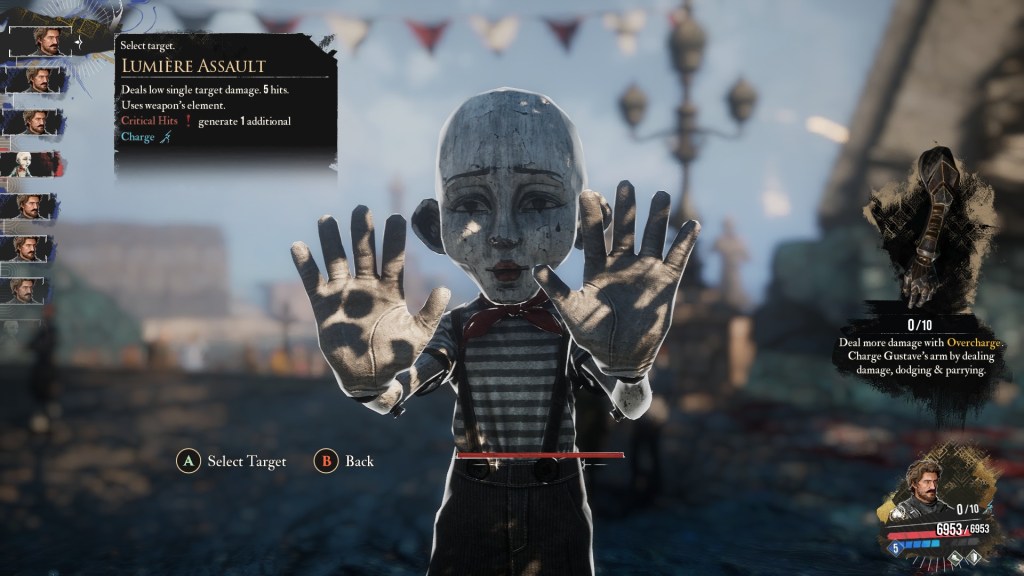
In addition to the typical run of Nevrons blocking progress, you’ll also occasionally encounter (with a little exploration), weirdo mimes and ball dudes running around the locations. These critters tend to mind their own business (you actually have to trap the Petanks by chasing them into dead-ends before you can fight them), but offer up pretty great rewards if you do in fact fight them. Leveling up in Clair Obscur is a pretty boilerplate affair, but real strength comes from finding Pictos and the Lumina you need to equip them. So it is usually worth your while to fight the Petanks for their goodies, and you may as well fight the Mimes for their cosmetic items while you’re at it. These fights are also tests: unlike the usual Nevrons, which can typically be brute-forced into submission, Mimes tend to be very high-powered, but they all share the same predictable attack patterns (which can be easily dodged or parried), and Petanks all have unique defense patterns that must be overcome before they run away (denying you rewards). These are tricky fights, and the satisfaction of winning is matched by the wealth of rewards.
- Optional Locations
I didn’t actually spend much time exploring optional areas outside the plot-related locations during the first acts of the game: I felt the urgency of the plot necessitated my progress, and I also liked playing the game a bit underpowered, so each new area pushed me to get better at learning attack patterns and employing Pictos strategically. I always felt a little weak, and that’s how I thought the game should feel. But there are several little areas you can visit to find collectibles and pickups. Many are simple one-screen affairs (like the 2D pictures you traverse in the PS1 era of Final Fantasy), and only have a single music record or other doodad to find. Others feature quest-giving white Nevrons in a limited space. The truly deep and complex optional areas remain mostly gated off at this point, but the game is training you to look for them and wonder about the places you can’t access, even now.
- The Manor
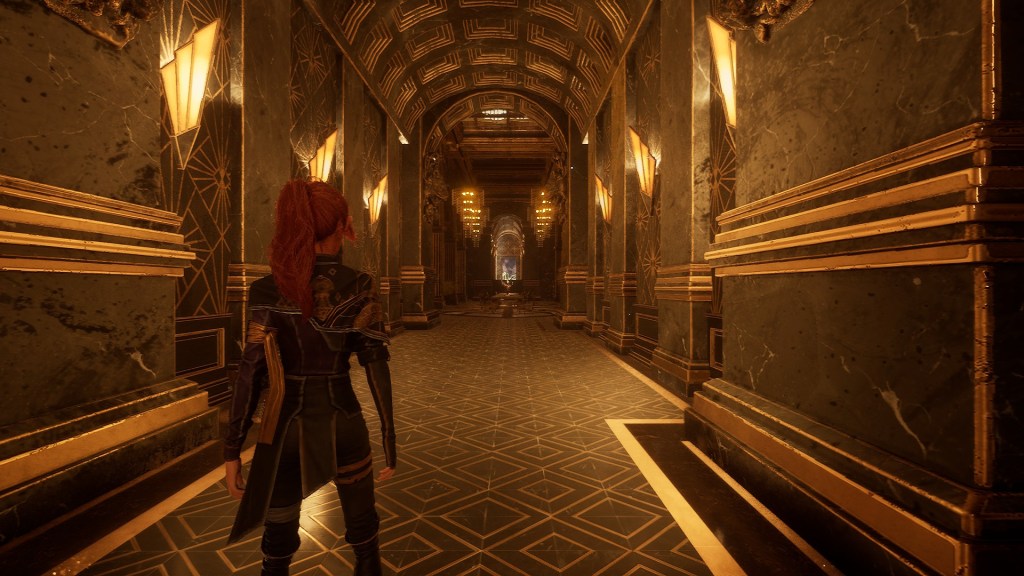
When we first find the Manor in the coral canyon, it is an ornate gold-and-black mansion, in a style that’s art-deco-by-way-of-Baroque detailing. We can walk throughout the manor’s main halls, but all the doors are locked. As we explore the world, we will find more doors to the Manor, and each one places us in a different room of the manor, usually with a collectible, cosmetic item, or journal entry as a reward. Many of these rooms have obvious, familiar purposes: bedrooms, bathrooms, a kitchen, a library; but the decorations are often strange: statuettes and paintings of Nevrons or other locations on The Continent. Without more context, it’s hard to say what it means, beyond a kind of “hallways under the Matrix” or “Ways beyond the World” vibe. But it’s no hub: you only ever come in and out of the Manor in the same place. You cannot use it as a shortcut across the Continent, and while you may find yourself dumped in a bedroom or kitchen when you encounter a door on the Continent, walk through that door and it will only ever take you to the manor’s main hall, and its main door, which will drop you off at the very same place you entered. It’s as good as a save point, and you are safe as long as you are inside, but there’s no explanation for its presence in a world it does not seem to belong to.
- The Faceless Residents
Like the Curator, you will occasionally encounter other human-like beings with broken faces as you travel from location to location. It’s unclear what exactly they are: they aren’t hostile, speak in riddles, and go silent after they’ve made their meditation on life, art, or grief. It’s also unclear how many there are. There are several distinct models—a long-haired woman, a short-haired woman, a boy in a jaunty hat, a man in a top hat—but they recur, and it’s unclear whether you are meeting the same ones over and over, or if they are all supposed to be different persons. Chalk this one up to “needs more context,” too.
- Music
Now that we’re starting to pick up records, we should probably talk about Clair Obscur’s frankly incredible score.
It’s not terribly atypical of RPGs like this to have different music for different areas, but it is unusual (at least in my experience) for them to have different combat music for different areas as well (like the “Gestral Summer Party” for the Sanctuary). Clair Obscur also indulges in a lot more sung music than is typical of a game like this. The Lumière theme, Gustave’s theme, the Lamplighter boss fight music (yes, most of the boss fights get their own unique themes, too), and even some of the routine combat encounters feature singing—in French—over the orchestral score. Plainly, a lot of time, effort, and money went into the composition of the score, and I believe it pays off—it is a masterpiece on its own merits.
Most notably of all, the climactic encounter between Gustave and the Old Man features an incredibly dramatic piece: “Une vie a t’aimer” (= “One life to love you”), which evolves from heartfelt piano music to a rock ballad duet of vying pleas—all, again, in French.
And, look. I speak a little bit of French, and could pick up on some of what was saying, but not much. And I think that’s actually intentional. Because if you understand the lyrics of “Une vie a t’aimer,” it kind of spoils what is going on behind the scenes of the game so far. It is meant to be dramatic and emotional, but not necessarily understandable to the majority of Clair Obscur’s audience. Like the opening music to an animé, the Latin chanting behind a Final Fantasy boss, or the nonsense ballads of NieR: Automata, it is meant to be evocative, but the foreignness is intentional. We are supposed to intuit the stakes, but not understand them.
What you need to know is that the music is ambitious, striking, beautiful, dramatic, and also weirdly direct in its discussion of the deep lore of the game. We’ll circle back around when it’s appropriate.
Though maybe now is as good a time as any to mention that “Clair Obscur” (a phrase often repeated in the game’s musical score, as well as its title) translates literally to “Light Obscured”—which could mean “twilight,” but is also the French term for the Italian “chiaroscuro”—the technique of employing sharp contrasts between light and shadow for effect in post-Renaissance painting.
All three of these translations seem relevant, and I have no doubt that the ambiguity of the term is intentional, however lost to non-French-speaking audiences. Again “light obscured” seems especially relevant here: we can intuit the emotional weight of what’s going on, but we can’t understand it.
For now, we should keep moving. There’s still much to do.
Act II: Verso’s Journey
Verso is cagey about revealing his past to the party, but he does explain enough to give the Expedition new purpose. He explains that the Old Man, Renoir, is his father. They were part of the first Expedition (Expedition Zero), which penetrated deep into the heart of The Continent, but Renoir, Verso, and his sister Alicia were granted immortality by the Paintress, and have lived on the Continent since. Renoir has taken to annihilating the Expeditions, lest they defeat the Paintress and end his immortality, but Verso has decided to oppose Renoir, and aid the Expedition, even if it means death. To do this, the party must destroy the Paintress’ Heart, which Renoir protects, so they can travel beyond the otherwise-impassable barrier that protects the Monolith.
Our first stop after the death of Gustave is a battlefield. According to Verso, some of the earliest Expeditions mustered massive armies to invade the Continent and challenge the Paintress directly, but they were all thwarted by the armies of Nevrons that roamed the area, and, in particular the Dualliste—a devastatingly fast and powerful Nevron who could single-handedly decimate armies with his powerful swords. Maelle, already traumatized by the loss of Gustave, seems especially fragile in this place, but Verso assures her that there is a tranquil glade beyond the mountains of dead Expeditioners where they can lay Gustave to rest.
That’s little consolation. This area is full of grueling fights, twisting paths, and dead ends. Then, finally, with the glade just over the horizon, the team is ambushed by the Dualliste, who destroys the bridge we are trying to cross and plunges us into a hellish void of bloody water and mountains of fallen Expeditioners. Maelle, her face covered in blood, seems on the verge of losing what little grip on reality and hope remains to her, but Verso and the other Expeditioners swoop in to combat the Dualliste—certainly the most challenging fight so far—and carry Maelle out of this horrible place.
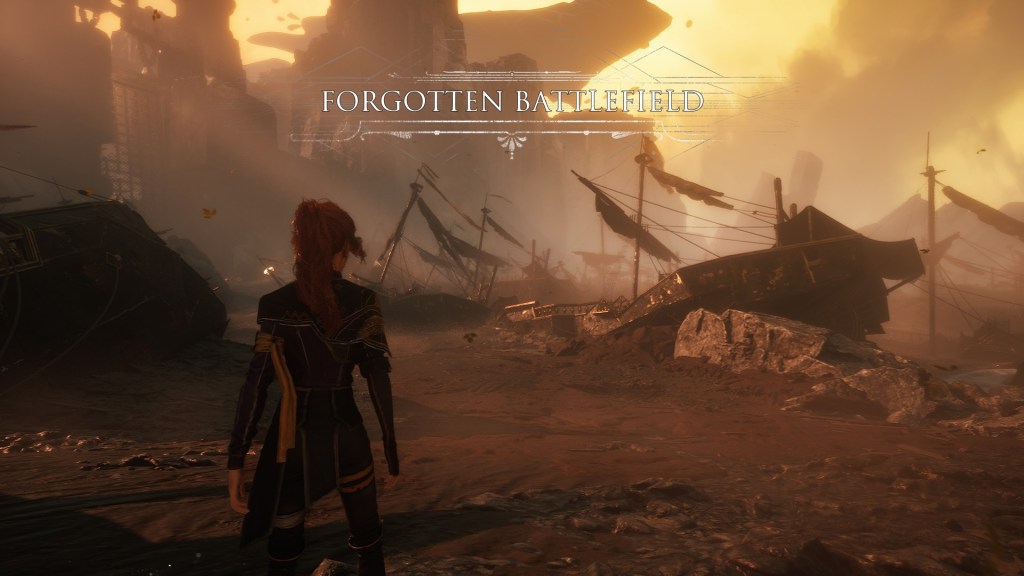
There is great, terrible catharsis in finally laying Gustave to rest beneath a gold-leaved tree, where the graves of many other Expeditioners dot the landscape, their numbered armbands flapping in the breeze. The trials were many, and unkind, but Maelle may finally start to heal.
From there, we must pass through the mountains to Old Lumière, where we can finally confront the Old Man—Renoir—and destroy the heart of the Paintress (which he protects). First, we must cross the Mountain pass and meet Monoco, a grouchy, hair-covered Gestral who lives in a strange train station near the mountain summit. He apparently has a long history with Verso, and he challenges us to a fight before joining the party (our last member). Interestingly, Monoco can transform into Nevrons when he attacks—an ability reminiscent of Final Fantasy’s Blue Mages—but we’ll discuss that when we break down each character in the next essay.
Beyond the mountain pass lies Old Lumière, a blackened ashy wasteland littered with the ruins of Parisian city blocks—like Lumière itself. Verso explains that the city was sundered in the cataclysm that destroyed the world: half remains here, but the other half lies across the sea (where we started our game). Standing amongst the ruins are glowing golden swords, presumably a token of whatever force destroyed the city. The Nevrons here are also martial: swordsmen who impale themselves before attacking the whole party with many sweeping blows. Beyond the ruined city lies The Manor—nestled between two gardens, its distinct black and gold aesthetic is a familiar contrast to the broken city we just left. And there we confront Renoir again—after he rebukes Verso for being an ungrateful son.
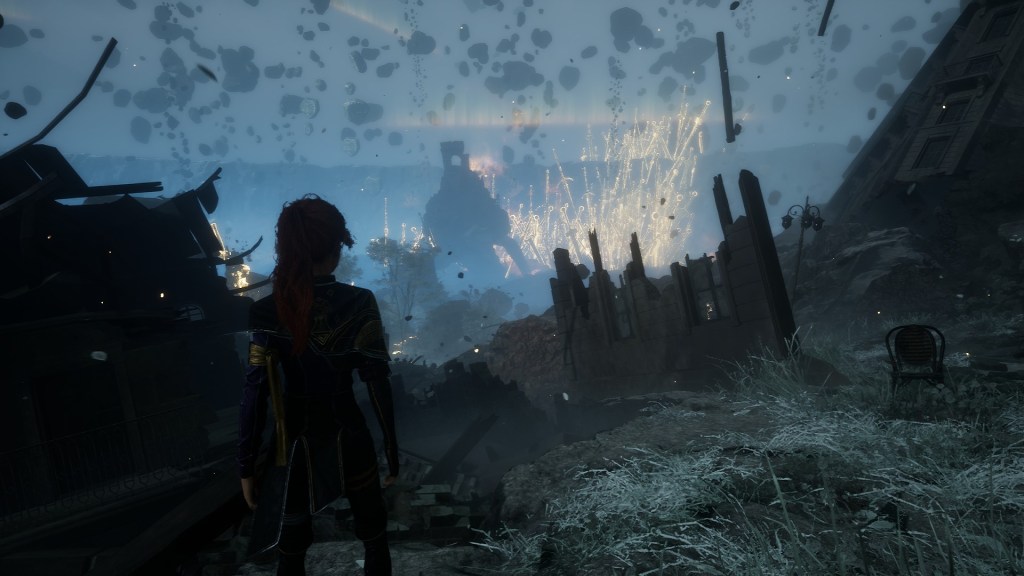
It’s a tough fight, and the party doesn’t “win” so much as “survives.” The disfigured, masked girl—Alicia—intervenes with Renoir, and Maelle discovers a power that threatens Renoir enough that he transports himself, the Manor, and Alicia away, beyond the barrier.
But Verso has another plan. He suggests the party should destroy the Axons—two terribly-powerful beings on islands near the monolith—and claim their essences. With them, the Curator can make a weapon that will penetrate the barrier.
The player can fight the Axons in any order they choose—the game offers more of these freedoms (and more optional areas) the farther the player proceeds. The easier of the two Axons (or so Verso suggests) lives on the island of Visages: a stony outcrop composed of endless stone masks. In addition to challenging the Axon directly, the party may overcome three masked minibosses: one expressing rage, another expressing joy, and a third expressing grief. The Axon itself seems to be a three-faced giant (weakened if you defeated the optional minibosses), but in fact the giant just supports the true Axon, a faceless messenger who uses the giant’s power to unleash devastating attacks. The second Axon is Sirene, a faceless dancer in a sandy tower; her dance entrances the party at first, and they must resist falling into a stupor watching her. Here, too, the party can overcome an optional boss to weaken the Axon, but must ultimately face a difficult fight against the boss proper.
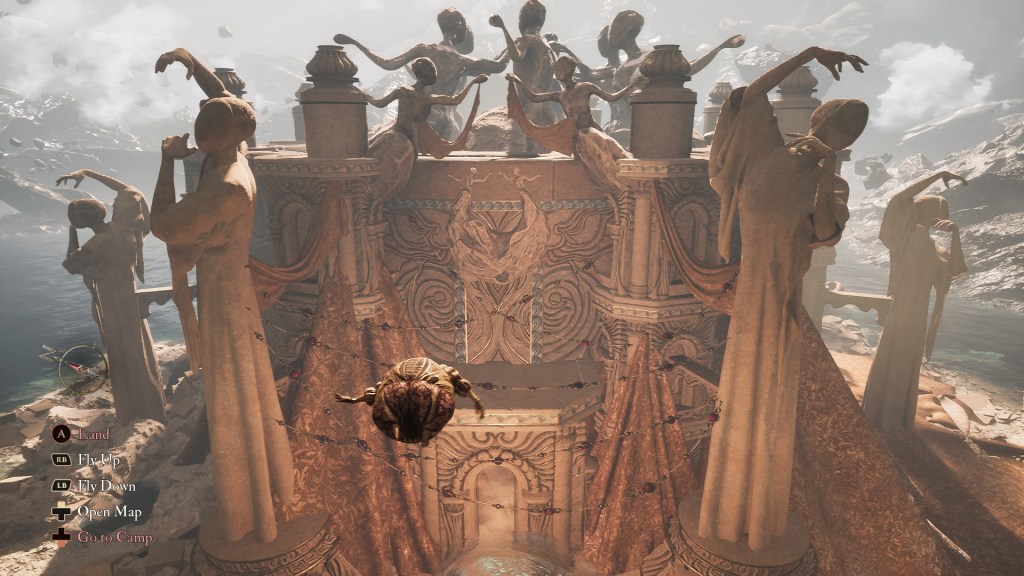
Both Axons, though, are powerful surreal symbols with greater depth than the usual run of enemies so far. In Visages, each mask-miniboss has its own area, and the enemies change according to the mask. The rage mask’s enemies will attack one another, ignoring you unless you get too close; the other masks’ enemies will be too preoccupied grieving or dancing to interact with you at all—unless you attack them outright. Each time the characters voice their misgivings: if the enemies aren’t hostile, why are we attacking them? In the case of the Dancer, the approach to the boss is populated by miniature dancing enemies, all of whom are dangerous, and will attack you on sight, but there is also a wistfulness to the music both in- and outside-combat that suggests you don’t belong here—and that you are destroying something worthwhile and beautiful by fighting here. Combat against the Nevrons is usually framed as a matter of necessity and survival; combat against the Gestrals is a fun challenge—it is strange that combat here should feel just as necessary, but still wrong somehow.
Having defeated the Axons, you can forge Maelle’s barrier-breaking sword, pass beyond the barrier around the monolith, and confront the Paintress. First you must overcome her heart. Then you are challenged by Renoir again in his last defense. Finally, after a long journey through a pastiche of familiar locations with familiar enemies, you confront the Paintress herself.
It’s a tough fight: she has many powerful attacks and, like the Axons, she seems to come in two forms: a faceless homunculus like the Curator, and the giant avatar we first saw sitting at the base of the monolith. At one point, to reach her, Verso suddenly reveals that he has Esquie’s flying stone (how long has he been holding onto that?), and the whole party takes to the sky. But when she is defeated, she does not give up, but instead starts healing and buffing the party as we lay down the final blows.
When she is finally cut down for good, Esquie flies the party to Lumière. But the celebration is quickly cut short. The Paintress was not the one gommaging the citizens of Lumière—she was protecting them. Her painted numbers were not a death sentence, but a warning: she could only protect those under the age inscribed on the monolith from the power of…
…The Curator.
Act II Debrief:
There’s a lot of heavy-duty spoilers up ahead, so let’s take a moment to recap.
There is a marked shift in tone between Act I and Act II of the game. The locations become darker, bleaker—starting with the battlefield where the party fights the Dualliste, and proceeding through the ruined city of Old Lumière. There are upbeat moments, too—like when Maelle sees snow for the first time on the slopes of Monoco’s mountain—but the world is growing more hostile the closer we get to the Paintress, and that reflects the grave stakes that we discover as more of the story is revealed. Visages and Sirene aren’t as bleak or hostile, but our relationship to their beauty has changed: now we are the destroyers and they are the victims. Power, it seems, has come at a cost. At the beginning of Act II we are woefully outmatched by threats like the Dualliste. By the end of Act II we are making real mistakes about how we use our power: the Paintress and the Axons seem more like innocents, and our destructive efforts have proven ultimately self-destructive: we have in fact freed the Curator to gommage all the surviving citizens of Lumière—including Lune and Sciel.
There is also a deeper intimacy to the story at this point. Gustave set out to destroy an existential threat to his community, but now we’ve found that Verso, Renoir, and Alicia were living rich, full lives under the protection of the Paintress. Verso has deep friendships with Esquie and Monoco, and his conflict with his father smacks as much of personal rebellion as ideological disagreement. There is love there, but a love ruined by divergent convictions. As much as Renoir has been the villain throughout this game, he acts out of sadness and grief—to protect his family and his world. He is not evil, and not even all that short-sighted. Like Gustave and Maelle, he fights to protect the ones he loves. But he also loves them according to his terms: he cannot capitulate to Verso’s choice to opt out of immortality, presumably out of a wish to protect Verso from himself. Renoir will have security at the price of freedom. And that is a valid choice, though one still worth fighting against.
We also learn much more about the world during this Act, thanks to Verso’s insights. Verso and Renoir both remember the Fracture that broke the world and killed most of its inhabitants. That first Expedition was not a venture based in Lumière, but a rescue mission to save as many survivors as possible, and had the unexpected consequence of Verso, Renoir, and Alicia’s immortality. Verso knows the world, too. He’s been everywhere. He’s fought the Axons (and failed) many times before. Even into Act III, when you start taking on some of the most impressive threats in the world (like the dragon, Serpenphare), he mentions that he’s been beaten by them hundreds of times before.
But more than anything, this act leaves us conflicted. We have grown much more powerful, but seem even more helpless to save Lumière, our friends and family, or complete our mission. As powerful as we become, it seems the sense of it all is slipping away. How much more will we lose in order to “win”? Gustave is dead. Verso’s relationship with his father is irreparably damaged. Now Lune, Sciel, and all of Lumière are gone—what is left to lose? What have we actually gained? Was the yearly gommage really so bad that we should risk destroying all Lumière for the hope of something better? And, now that it’s happened—now that Lumière is lost—what can we possibly do next?
The World We Found
Obviously we have much more to say about the plot and themes of the game, but I would like to conclude this part of the essay with some discussion of the world as it stands, here at the end of Act II. Our relationship to that world is going to change dramatically with the revelations of Act III, and we’ll have plenty to say once we’re ready to have that discussion. But for now, we should discuss the world as it has been presented to us so far, without that complicated contextualization.
First, and most obviously, the world of Clair Obscur is beautiful. I doubt my screenshots do justice to the place as a world to explore, traverse, and interact with, but it is clear that the developers and artists put a lot of time and effort into crafting the landscape, the non-linear paths, and the vistas stretching out to the horizon. Some of these vistas are clearly intended: the game often uses bottlenecks, area entry points, or high ground to show off its most impressive visions of the world. Sometimes this feels a bit manipulative, but more often it’s just gorgeous. And the unplanned views are often equally impressive. There is a clear mastery of visual design on display here.
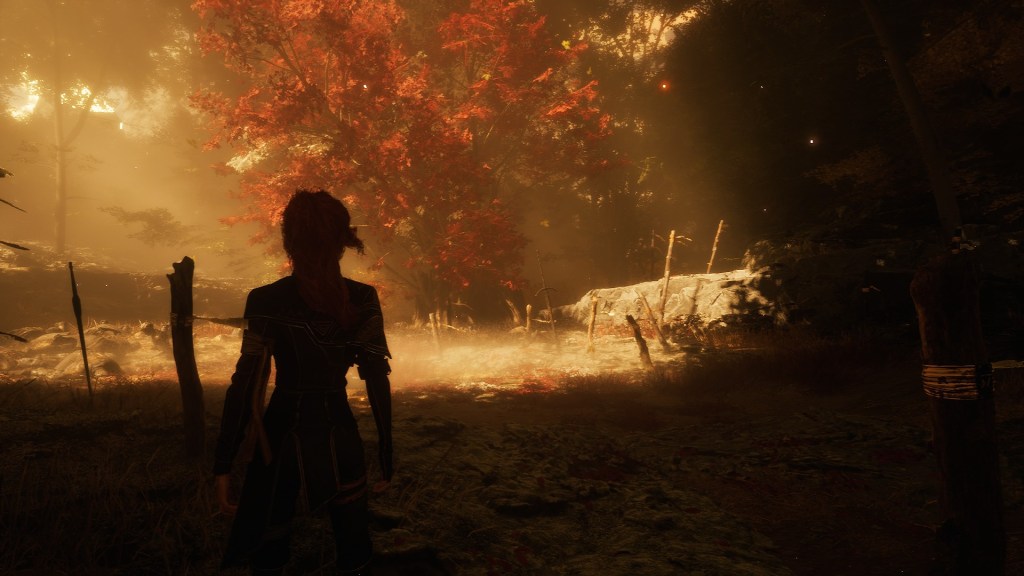
But I should stress that even the manipulation happening as developers funnel players into especially scenic areas is a part of the world-building efforts I see here, which brings us to our second point. As I mentioned earlier, this is a game that uses its world to deliberately heighten the emotional effect of the plot. Color, light, and texture are all carefully applied to evoke a specific emotional reaction in the player that dovetails with whatever is going on around them. Perhaps the clearest example occurs at the beginning of Act II. We fight our way across the desolate battlefield, full of grueling fights on a dusky, burning plain. We are dropped into a dark mass grave by the attack of the Dualliste, and must fight the most difficult battle so far. Then we are treated to the tranquil gravesite for fallen Expeditioners. We are, through the design of the world, the plot of the game, and even the basic symbolism of descent and ascent, led on an emotional journey in parallel with Maelle’s despair and regained hope. Start to finish, this has been an emotionally harrowing experience, and every step of the way has been carefully plotted by the art team behind the game.
I stress this because I don’t think it’s a craftsmanship we gamers are likely to appreciate otherwise. Gamers tend to be a left-brained lot, more enamored with logic and science than emotional earnestness. We tend to resent emotional manipulation when we are able to detect it. And we tend to associate the skill of world-building with a game’s lore, rather than its effect on the player. When we write thinkpieces or film YouTube videos about our favorite games, we tend to emphasize these lore details, and how they add up to richer stories or more sophisticated metaphysical systems. We prefer the sorts of worlds that convince us they do not need the player, rather than appreciating when the whole world conspires to perfectly evoke certain player reactions. We like our fantasy complex and nuanced, like Brandon Sanderson or Tolkien, with only a limited appreciation for the fact that the latter can lead us to tears where the former cannot. We poo-poo the craftsmanship of Steven Spielberg, ignoring his pitch-perfect emotional manipulation in movies like E.T. or Close Encounters of the Third Kind.
Clair Obscur has its lore, and there is plenty for the left-brained gamer to appreciate about the characters, themes, and story details embedded in the text. But, like the great works of surrealism, it is also a work more interested in engaging with our subconscious, with our emotional life, and with mysteries we cannot explain. Much of this world will be “explained” in our coming discussion, but much will not. The mimes and petanks, the strange doppelgangers we find across the world, the logic of Verso’s immortality or Esquie’s ability to fly: we are not invited to answer or solve these questions. They are here because, on some level below logic, they should be. They are here because the artistic and emotional logic of the game demands them, even if that breaks the rules of the game world.
There are many reasons to want to dwell in a fictional world, and many qualities that could draw us to those worlds. We may want a fantasy full of verisimilitude, like Tolkien’s languages or cultural histories. We may want a fantasy full of sophisticated rules to follow, like Sanderson’s metaphysical complexities. We may want a realistic social fiction like Morrowind, or a plausibly grand speculative experiment like the future described by Cixin Liu. We may want fun characters to hang out with, like the heroes of the Marvel Cinematic Universe. We may want to dwell in a particular historical period, like those offered by Assassin’s Creed. And we may want to feel the sort of catharsis offered by Clair Obscur. Some of these are easier to praise in prose; others are more difficult to explore, since we run up against the limits of a linguistic medium. I worry that, like E. T., Clair Obscur may be underappreciated by future gamers, simply because it is considered “emotional” and therefore less valuable or important to our masculine, stoic, logic-driven tendencies.
Clair Obscur is a masterpiece, and its world, however illogical and contrived, should be held up as one of the greatest this medium has produced. Perhaps because it isn’t typically the sort we appreciate. And because we tend to de-prioritize the works of art that speak to our emotions rather than our logic, or that resist explanation in words.
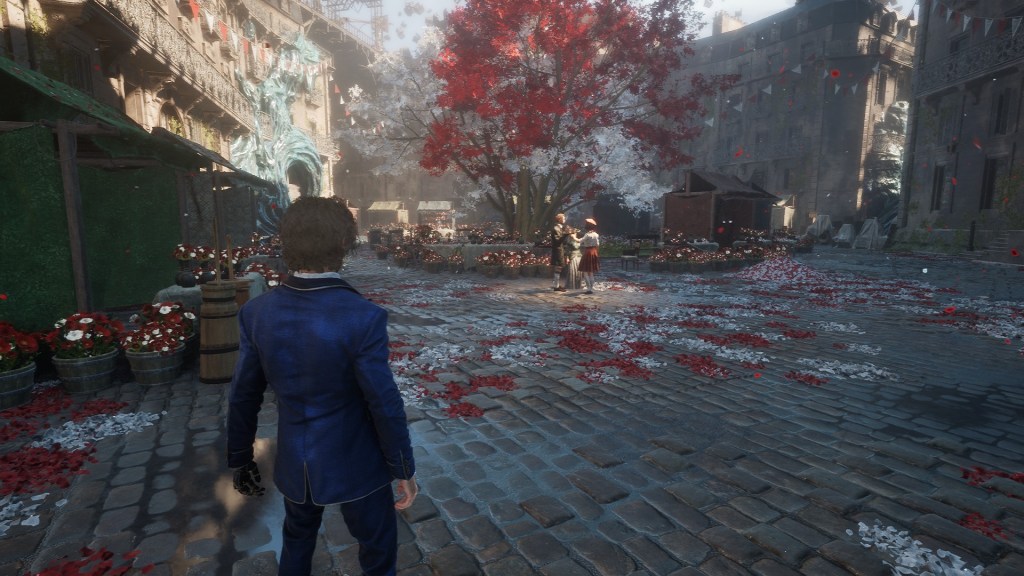
Beauty is an audacious enough goal, after all.
So let’s take a minute to appreciate the world on its own terms, before we reckon with its underlying meaning.


 Video Game Academy