I honestly feel a bit daunted by the prospect of writing about Clair Obscur: Expedition 33.
I want to—it’s a truly great game that moved me emotionally, intellectually, and whatever adverb describes the thrill of a good, strong challenge—but it’s also a true work of art, with depth and nuance and personal investment beyond the scale of many of the other video games we discuss at Video Game Academy. In our “year of world-building,” especially, it seems apt to discuss this game that not only builds one of the most engrossing worlds I’ve ever wandered, but that also discusses the business of world-building and why we world-build as a central theme. And it’s a game I spent 99 hours in without regretting a single one of them—every hour was spent eagerly, raptly engaged with this game without a drop of boredom and only the most passable frustration.
But I also feel like it is a game that must be experienced. I don’t think I can effectively convey the emotional highs and lows of following Gustave, Maelle, and their band of Expeditioners through the mysterious world beyond Lumière, nor the joy of walking into some strange new location with the pure curiosity of wanderlust (and the confidence that I will be satisfied by some new wonder), nor the white-knuckle concentration of tackling some insanely daunting boss fight and overcoming it through a mix of ingenuity, trained skill, and dumb luck.
Instead, I want to tell you to just quit reading this and GO PLAY IT. The hype is real and justified. There simply isn’t another game this good, this creative, and this insightful—to my knowledge at least.
The trouble is, I’m not sure I can.
PROLOGUE: In which we discuss PC Privilege and other caveats, then make a plan of attack for our foray into Clair Obscur’s Continent
I: PC Privilege
Since I started playing Clair Obscur, I’ve found a deep need to discuss it with my friends and found a pretty serious difficulty:
It’s only on PC, PS5, and Xbox Series X. Which doesn’t sound that bad to the serious gamer, but PS5s and XSX’s aren’t terribly ubiquitous these days, outside those serious gaming circles. I know a lot of folks who own Switches, and one or two who own high-end PCs, but only one with a PS5, and nobody with an XSX. (I assume people do, in fact, own these?) I suspect the coincidence of the new console generation with outrageous inflation and economic hardship may be to blame here (though I’m sure PS5 scarcity didn’t help, either…)
This is not a problem I’ve run into often—or at least, not recently. I’m usually behind-the-times in my video gaming. I still haven’t played any of the Horizon games, or the new God of War games, and only just got around to Red Dead Redemption 2 in 2024. Clair Obscur represents the first time since Triangle Strategy (2021) that I was excited to buy and play a major release that came out in the same year. Sure, I’m always on top of the weird indie stuff from my favorite developers—I’ve been playing Mewgenics and Slay the Spire 2 since their release in the last month or so—but I’m rarely so excited about the big new mega-hyped releases from big name studios. At time of writing, the buzz is hanging around Resident Evil: Requiem, and I’m politely interested, though also very conscious of the fact that I probably won’t ever play it. Which is usually how these things go. Sometimes I’ll make a mental note to go back and play something especially exciting, interesting, or suited to my tastes (again, Red Dead Redemption 2 comes to mind, but I’m also waiting for the right time to dig into Cyberpunk 2077, Death Stranding, and Final Fantasy VII: Rebirth), but it usually takes me a few years, seeing as I really only have the time for one or two of these in a given year. Plus, it’s cheap: I can wait three years before playing Final Fantasy XV and find it for $20 when I finally pick it up.
But we PC gamers do not realize the luxury of being able (whether we take advantage of it or not) to click on virtually any game and download it to our magic box. It might only happen once in a blue moon, but it is a power I enjoy unthinkingly. I so rarely have to consider platform limitations, console exclusivity, or even price (the mighty Steam sale reduces all games to their most reasonable rates), that it did not occur to me how privileged I was when I bought this on a whim.
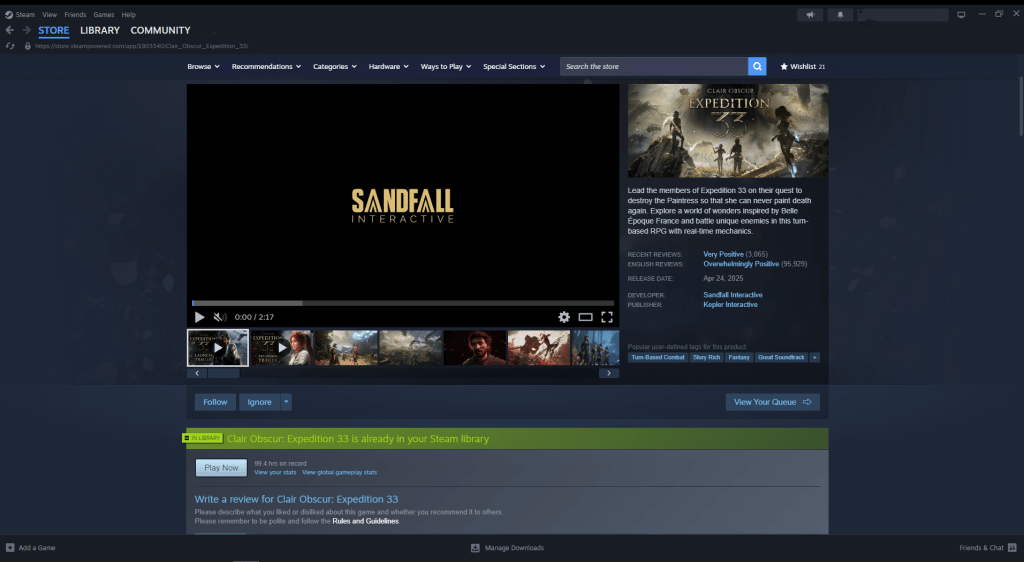
But when I started contacting my friends to say “Clair Obscur is really good, actually—let’s talk about it!”—the typical response was: “I can’t play it.” I do have one friend who played it on PS5, but that’s it. The rest are stuck either watching Let’s Plays (which I can’t in good conscience recommend on this one), waiting for a port to Switch (which would be nice, but I’m not counting on it), or waiting for the price of a PS5 to come down (which seems especially unlikely in our current tariff-hell).
Even more strange is the fact that I want to talk about this game with people outside my usual video-game circles. Like I said, I consider this a work of art, beyond being just a good game, and consequently I want to talk about it with people who aren’t gamers. My Mom, an ardent Francophile and decades-long French teacher, would love this game (even though she really doesn’t play video games like this). So I’ve shared some of the music with her and she’s gone nuts for it. My wife, whose video game experience reaches just further than Animal Crossing, also likes the music well enough, but I’ve got no way to share the game itself with her.
This is all kind of surreal to me. And it gives me pause while I take up this essay.
II. The Discourse
Also giving me pause is the extremely strange place this game has now found itself in video game criticism and discussion.
When Clair Obscur came out, early in 2025, it became something of a quiet critical darling. I saw a few scattered thinkpieces about it, most notably a piece by Second Wind’s Marty Silva about its use of turn-based combat, and Yahtzee Croshaw’s review on Fully Ramblomatic (which I want to circle back to), but it didn’t exactly cause a huge stir when it first arrived. Most of my other favorite gaming commentators gave it a pass. I bought it on the summer Steam sale, mostly on the grounds that: 1) it looked pretty; 2) it looked interesting (Revisionist history Belle Époque France? Surreal, wildly speculative story and world-building? Light horror imagery with psychologically-taxing stakes? Sign me up!); and 3) Yahtzee said (however begrudgingly) that it was good.
And then the Game Awards happened and it WON ALL OF THE THINGS. And I’m honestly not sure anyone saw this coming—least of all the devs, who seemed over the moon throughout the whole thing. Suddenly this was the biggest game of the year, despite everyone kind of sleeping on it for six months or so. I actually think there are more thinkpieces and reviews and discussions now than there were when it came out (or maybe it’s just the algorithm adapting to my research).
This adds up to what might be a new landmark in video-game discourse:
Namely, this may be our first Oscar-bait discussion.

I mean this in a very narrow (but hopefully apt) sense. We’ve had critical darlings in the past. I remember when Journey came out back in 2012, when we were young and innocent (just before GamerGate) and there was a bunch of talk about whether or not it was actually a game, whether or not the critics were just pretending to like it, and whether or not it was any good. And it was right around the same time that the indie boom was really starting in earnest, and people were celebrating indie games in parallel with big-budget games, largely because that seemed the safest way to highlight the cool new stuff coming out from smaller studios without alienating the Call of Duty/GTA crowd who wanted to see their big-budget slaughterfest validated as art.
But here in 2026 Clair Obscur won all the indie awards and the big-budget awards, kicking off a whole wave of discussion about its deserts. Now that we’ve got mid-tier studios like Bloober Team, Ninja Theory (pre-acquisition, anyway), and Sandfall, is it right to call them “indie” when they clearly have more resources than some tiny one-man affair like Toby Fox’s Deltarune, or small-team projects like Supergiant’s Hades? Are The Game Awards—usually mocked for its slavish devotion to big-name brands and promotional stunts—attempting some kind of artistic coup here?
And, perhaps most relevant to my Oscar-bait comparison:
Is this weird arty game that so few have played (since, again, it’s only out on PC and PS5), really good enough to deserve all this praise?
In his review, Yahtzee agreed that Clair Obscur was good, but only with the major caveat that it was pretentious. And, in retrospect, after winning its butt-ton of awards, it’s hard not to wonder—was Clair Obscur our first-ever awards-bait video game, designed for critical success?
III: On Pretentiousness
No. Just…no.
Again, The Game Awards is a manic, Red-Bull-fueled ceremony built on promotional stunts and corporate sponsorships. It’s come a long way since Madden 2004 won Best game in 2003, but it’s still as much a vehicle for promotional announcements and publisher grandstanding. You can’t pander to their critical tastes the way you can with proper Oscar-bait.

But that word pretentious does bother me a bit.
As a lover of modern art, Dostoevsky, and indie video games, I wonder sometimes if I’ve gotten pretentious without noticing. And if I love this game that others call pretentious, and then defend it from these accusations of pretentiousness, there’s always the possibility that I’m just so danged pretentious that I can’t appreciate it in the things I like. In the same way that someone fully six-and-a-half feet tall probably wouldn’t consider someone six feet tall to be properly “tall,” presumably I could be so dang pretentious that I can’t see that this obviously pretentious thing is pretentious.
So let’s define our terms.
I’m not going to Oxford English Dictionary this one (that would be pretentious), but just define from context here. And with that in mind, I think we’ve got three different plausible definitions of pretentious.
- Having the pretense of quality without its presence (i.e., pretending)
When people accuse a person or work of art of being pretentious, the assumption is usually that there is some element of hypocrisy here. When we criticize a movie for being “Oscar-bait,” the assumption is that the producers have made something that fakes or affects (as in affectation) quality without actually providing it: the movie is set in some “important” period like World War II or the Cold War, or it’s about “important” things like AIDS, developmental disorders, racism, or concentration camps. Whether or not the movie is any good, people will hem and haw about its “cultural value” and it will ultimately get more attention than it deserves.
This is tricky, though. By this definition, a movie that pretends to be more important, serious, or “thinky” than it actually is would be the most obvious candidate for the accusation of pretentiousness, but this is rarely the case in practice. When a movie like Joker comes out, and virtually all the critics agree that it’s pretending to be smarter than it actually is, the word “pretentious” still doesn’t seem to come up all that much. Likewise, when some obviously-corporate-IP-related blockbuster movie shows up with something emotionally-resonant or intellectually-stimulating to say (like, say The Lego Movie or Barbie), whether or not it succeeds, we’re usually not talking about “pretentiousness.”
So as much as I think this is the right definition, and I suspect we would all agree about this, the actual use of the word suggests something else. We want “pretentiousness” to be our word for calling out the emperor’s nakedness, but in fact it’s doing something else.
2. Aspiring to critical attention without popular appeal (i.e., awards-bait)
We’re only a shade removed from (1) here, but I think it’s an important shade. (1) was specifically about quality—whether or not the work in question was actually good; (2) is about audience—and thus discards the notion of quality altogether. It could explain why Joker and Barbie don’t get called “pretentious”—they are intended for a mass, popular audience and critical appeal. By contrast, movies that do get accused of “pretentiousness” usually go hand-in-hand with accusations of “Oscar-bait.” These are typically films with limited releases, made by auteur directors celebrated by a cinephile elite. They often feature unsubtle celebrations of industry history (think Mank, The Artist, or Argo) which appeal to the vanity of the people immersed in that industry. They are often technically flashy, even to the point of distracting or alienating audiences. And they win lots of awards, despite most movie-goers never having heard of them until Oscar-time.
But in Hollywood, there’s a function to all this, and a well-trodden trajectory for talented artists to walk. You make your big box-office blockbuster for a major studio (say, The Dark Knight), and you win the trust of your industry to make more auteur-driven independent projects (like Inception), which enables you to make more daring, artistic decisions to attract the attention of your colleagues in the industry (like Dunkirk or Oppenheimer). The idea is that you need lots of actors, directors, and other talented artists to make expensive, crowd-pleasing, tent-pole fare, and so most folks are going to get their start doing the work that attracts the crowds. But Hollywood also has its pretensions to grandeur and artistry, so the most talented and successful of those artists will go on to make movies that appeal to a more discerning (and International) body of critics. Hollywood gets to have its cake and eat it, too: make all the money at the box office to keep the lights on, AND make art from time to time to keep the prestige of the studios intact.
But video games just don’t do this. Sure, if you work in the indie space and make a big splash (like with Hellblade: Senua’s Sacrifice), there’s a chance that your company will get bought out by some big studio (like Microsoft), but that usually ends with the studio dissolving, no job security for any of the employees, and half the devs going back to other indie projects. Meanwhile, the developers for big-budget games like GTA, Call of Duty, Assassin’s Creed, or God of War don’t become rock stars followed by the community—they just get handed the reins of more big-budget games by the same publisher. There are exceptions (Miyamoto, Kojima, and Suda 51 all come to mind—notice, though, that they’re all Japanese), but the pipeline of video game success just looks very different from cinematic success. For most gamers, (and most employees working for video game companies, I suspect), it’s the studio, the corporation, or the brand that gets the praise for a successful game. So it makes sense that The Game Awards is less interested in the individual developer than the corporate entities they work for. (Sort of. This also works to the advantage of the corporations, since they can fire talented people without disturbing their brand integrity.)
But that means you can’t pander to The Game Awards. By and large, this is not the place where the community rewards the accomplishments of its own. (I suspect that’s more GDC’s line.) The Game Awards is more of a money-making venture, and therefore has a vested interest in keeping the publishers and fans happy, rather than making some artistic statement.
So the winners of The Game Awards’ Game of the Year of the last decade or so tend to be the most popular big-budget game with some aspiration to artistic merit, like God of War (2016), or Breath of the Wild, or Elden Ring. Meanwhile, the indie awards, similarly, tend to go to the most popular indie darling of the year, like Inside, Cuphead, Disco Elysium, Stray, or Balatro. But it’s hard to say that any of these choices should be considered “awards-bait,” or that the critics are in love with games the fans don’t care for. How the heck are you supposed to call Balatro pretentious? I’m pretty sure the designer himself had zero expectations for how popular the game became. Nor is there anything especially critic-friendly about the game. You could make a case for some patterns: Stray, Inside, and Kena: Bridge of Spirits are all variations on “aesthetically-striking platformer about a lone player character navigating a hostile world”—but most of these games are wildly different from one another. If Disco Elysium is pretentious, it’s not because it’s sticking to some formula of success.
Nor is there any distance between die-hard fanbases and critical success. Every one of these games—big budget or indie—is wildly popular, or at least beloved by its fans. Again, you can make a case for Balatro’s artistic merits, but it got to The Game Awards because it was popular as buttered toast. If Disco Elysium appealed to the critics, it appealed to gamers first, if the thinkpieces and memes and cosplaying is any indication. There just isn’t really any such thing as “awards-bait” for The Game Awards, and if there is, Clair Obscur is not it.
Which brings us to our final definition:
3. Highbrow, artsy (i.e., French)
(That last bit is Yahtzee-specific: he spends most of his Clair Obscur review railing about the French-ness of the game, which leads me he’s more preoccupied with his Francophobia than the actual merits of the game.)
I think this definition is the one we most need to wrestle with. I don’t think we like it. I don’t think we want to admit it. But every time I hear the word “pretentious” these days, it’s in reference to the aesthetic decisions rather than some critique of the work’s substance. A movie set in World War II like The Brutalist or which adapts a famous work of literature like “Wuthering Heights” will almost certainly get an “is it pretentious?” discussion, where movies that fail to live up to their intellectual aspirations (like Joker) get a pass if they are sufficiently lowbrow. Artsy movies like Anora or Poor Things will inevitably get called “pretentious” while pandering lowbrow fare like Sound of Freedom are ignored, whatever their artistic merits (or demerits). Nobody called out The Bourne Identity for pretentiousness when it applied novel cinematic techniques to action scenes, because it’s still a crowd-pleasing action movie with fistfights, car chases, and explosions.
And I can’t deny it: Clair Obscur is highbrow. It’s a French game about grief, loss, and escapism set in a world resembling surrealist/impressionist paintings, with a full orchestral soundtrack, art deco architectural highlights, and characters wrestling with deep trauma. It’s about creativity and world-building and, just, art. And it’s beautiful. And it’s trying to be beautiful (which may be exactly the problem).
And, yes: it’s also French as hell.
Which isn’t to say “all highbrow things are pretentious”—I’m pretty sure that’s why we have these discussions about whether or not a particular work of highbrow art is pretentious—but it means that aspiration to “highbrow” or “artsy” is a prerequisite for pretentiousness. Nobody is interested in whether or not a Quentin Tarantino film is only pretentiously schlocky, or whether Lego Batman is only pretentiously metatextual, or Red Dead Redemption 2 is pretentiously graphics-intensive, but everyone wants to know whether Clair Obscur is only pretentiously great art.
What frustrates me is that every time I hear it accused of being pretentious, I can’t help but respond:
“But it’s so heartfelt! So achingly, gut-wrenchingly sincere!”
But that’s my confusion. I think we’re talking about (1) when we’re actually talking about (3).
And, like Clair Obscur, I suspect I, too, am guilty of (3) while being innocent of (1). (After all, I can gush ad nauseum about Dostoevsky, or Homer, or Faulkner—my love of these highbrow things is pretty dang sincere.) By my logic, that makes me unpretentious (and for the same key reasons: sincerity and enthusiasm), but I can understand, however irritating I find it, that (3) is the more important criterion.
Worst of all, though, is that this is not an accusation you can successfully defend against. Like being called “racist” or “sexist” (or “woke,” for that matter), the accusation functions as a “poisoning the well” argument, rather than a subject for serious discussion. The goal isn’t to engage meaningfully with the art, it’s to introduce a suspicion to the minds of the audience that the art is not worth engaging with. Once the accusation of pretentiousness is out there, it won’t go away. It lingers, like a bad smell, tainting all the discussions it touches. You can’t disprove the pretentiousness of a work of art, because you will necessarily fall into that “but what if you’re pretentious, too” trap. And if our definition of “pretentious” is, roughly, “not as highbrow/artsy as it thinks it is”—how the heck are you even supposed to disagree?
IV: Accessibility
I suspect all of this is exacerbated by the game’s inaccessibility. Just as the usual criticism of Oscar-bait boils down to “but they only showed it in a few theaters for a limited run!”—so, I suspect, does a lot of the criticism here boil down to “but I couldn’t play it!”
And I really wish I could help you with that.
Seriously. I don’t want to contribute to any more video-game class-elitism than is already out there. The “git gud” gatekeepers irritate the crap out of me because I’d like to enjoy the world of Dark Souls but do not have the time or patience. I was never much for the console wars of my childhood and have no real allegiance to Nintendo, Playstation, Microsoft, or even Steam—and I worry we might be returning to that idiocy, now that the Switch/PS5 dichotomy is growing stronger again. At least part of the reason I love novels (and, indeed, indie games) is because they are so dang accessible. You have to go to New York City to see a Broadway show, or the paintings on display at the Met, or any number of other works of performance art, ballet, musical performance, or what have you—and that’s just not feasible for 99.9% of people. Whatever the other merits of these works, I will always consider that exclusivity a huge, glaring demerit.
Meanwhile, I can buy a copy of Dostoevsky’s The Brothers Karamazov for a dollar at a used book sale and engage with one of the greatest artistic experiences man has devised. For five bucks you can download Morrowind to a used laptop and play it for a hundred hours. With a cursory Internet search you can find most of the greatest poetry ever written. That’s the kind of art I love.

You should be able to play Clair Obscur: Expedition 33. We should be able to talk about it. I don’t want this to just be mine. So I hope it gets a Switch port (or at least a Switch 2 port). I hope it gets a dozen re-masters for whatever future consoles dominate the 2030s. I hope it becomes a part of our shared gaming lexicon. But it probably won’t in the near future. Whether or not this game is highbrow, exclusive, or pretentious, I don’t think that was ever part of its intention. Everything I’ve seen about the devs and the development suggests that this was a labor of love by talented, creative, passionate people, intended as an expression of our common humanity and experience—like all great art should be. And I worry that this “is it pretentious” discussion drowns out that fundamental truth—that Clair Obscur wants to talk about universal human truths like loss and creativity and escapism. And I worry that it might betray some fundamental reluctance on our part to discuss those very same truths—or at least, to discuss them directly, without the smokescreen of genre conventions or metaphorical abstraction or artistic distance between us and them.
But I suspect that’s just me getting all pretentious again.
V. Plan of Attack
With all this in mind, here’s how I want to tackle this essay.
Clair Obscur is divided into three acts, with a prologue and epilogue. So it seems appropriate to structure this essay in the same way. And, like the game, we’ll dole out our information carefully and deliberately.
In Act I, I want to talk about the game’s inspirations. One of the most immediately striking things about Clair Obscur’s game design is its diversity of brilliant thefts. There’s the DNA of a dozen or more great game design choices on display here, and this is an opportunity to talk about the game without actually talking about the game at all. Instead, we can discuss the game as the sum of its spoiler-free parts.
In Act II, I want to talk about the game’s world. It is the “year of world-building” after all, and we’ve got a doozy of a world on display here. But, naturally, this will require discussing the details of that world, and a good bit of plot information to boot. So there will be mild-to-moderate spoilers throughout.
And in Act III, I want to talk about the game’s biggest reveals, its characters, and its ending. Spoilers will abound; beg, borrow, or steal a PS5 before you proceed.
And maybe we’ll have an Epilogue, too. It’ll probably be warranted by the time we get there.
ACT I: In which we explore the many possible inspirations, real and imagined, that echo the experience of exploring and playing Clair Obscur: Expedition 33, in the hopes of explaining its basic mechanics and priorities in a way that effectively describes the game without spoiling anything.
Let’s not beat around the bush here: this is as much an excuse to talk about a bunch of great games and their great design choices as it is an opportunity to talk about Clair Obscur’s genius in bringing these ideas together. So there’s probably going to be a good bit of gushing about games I love, and we’re going to be looking at how these ideas and mechanics work in their original game, as well as how they transition to Clair Obscur.
There’s also the possibility that these ideas are not unique or original to the games I discuss here. Some of that comes down to my own inexperience; these are just the games I thought of while playing Clair Obscur. And, indeed, it seemed like I spent hours of this game just saying—“Wait! They took that from XXXXX! Like that meme from Once Upon a Time in Hollywood.
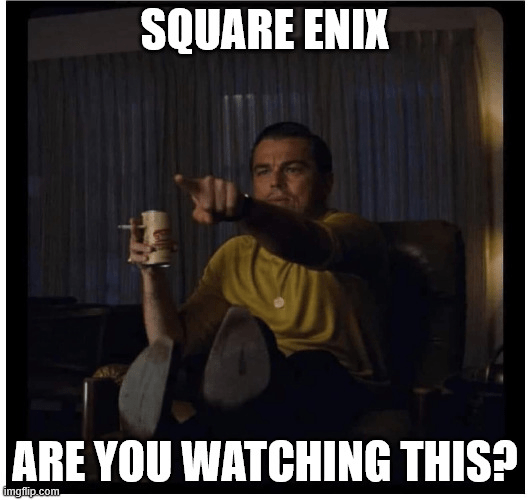
I apologize for none of this; mostly I just want to express this part of the experience to you.
And, finally, if I do get a bit sidetracked, I want to remind you here and now that this does not make Clair Obscur some kind of stitched-together Frankenstein’s Monster of good ideas. This happens sometimes, but not here. In my experience, these ideas and mechanics fit together seamlessly, and added up to a game that was radically original, not hopelessly derivative. This is not Immortals: Fenix Rising–levels of messy duplication; this is Breath of the Wild-level synthesis into originality.
Cool? Cool. Let’s get started.
- Reactive Turn-Based Combat from Paper Mario
I’ll happily concede Marty Silva’s thesis from the video I linked in the prologue: turn-based combat did not need saving. I love roguelike deckbuilders, tactics games, creature-collector RPGs, and I’ve seen a zillion different interesting takes on turn-based combat in the past few years.
But that doesn’t change the fact that the turn-based combat of Clair Obscur feels like a freaking revelation.
The truth is, though, that it’s a very old idea.
Gaming historians may well point to the fact that Mario was hopping to avoid turn-based attacks as far back as Super Mario RPG, but I think Clair Obscur is more obviously indebted to the more recent iterations of Mario-style turn-based reactivity. That might be bias on my part (I’ve never made it through the whole of Super Mario RPG, but I’m replaying Paper Mario for the umpteenth time on Switch as we speak), but I also think it has to do with the contextualization.
In 2001, when Paper Mario first came out, it released on the N64: a notoriously RPG-hostile console. Final Fantasy had been wrecking shop on the PS1, and Final Fantasy X released the same year as Paper Mario. If Paper Mario had been designed to compete with Final Fantasy X, it wouldn’t have stood a chance.
But the genius of Paper Mario is that it didn’t try to compete with Final Fantasy. Instead, it filled the need Final Fantasy had left behind. On NES and SNES, Dragon Quest and Final Fantasy had been the JRPGs that introduced new players and Western audiences to JRPG-style games; but Final Fantasy had grown into an adolescent-targeted property with its dense narratives, fate-of-the-world stakes, and edgy teen heroes, while Dragon Quest had fallen out of favor with Western audiences.
And in walks Paper Mario with its cute papercraft aesthetic, its too-clever-by-half sense of deconstructionist humor, and its simplistic but engaging combat system, and it almost certainly introduced a whole generation to story-based (read: non-Pokemon) JRPGs in a way that was gentle, fun, and lasting.
It’s also important to note that turn-based-combat in 2001 was kind of in a strange place. Final Fantasy had been using the Active Time Battle system since Final Fantasy IV, and RPGs were increasingly trying to avoid the analog “everybody take a turn in order” approach, as though it had become outdated with the advent of higher-end graphics. Pokemon was one major exception, but it was also a handheld game, exclusive to Game Boy (and thus given a pass). It also had a unnoticeably-unique simultaneous execution design to accommodate competitive battling (which always reminds me of samurai movies, where both charge forward and one falls over after a slight, tense delay).
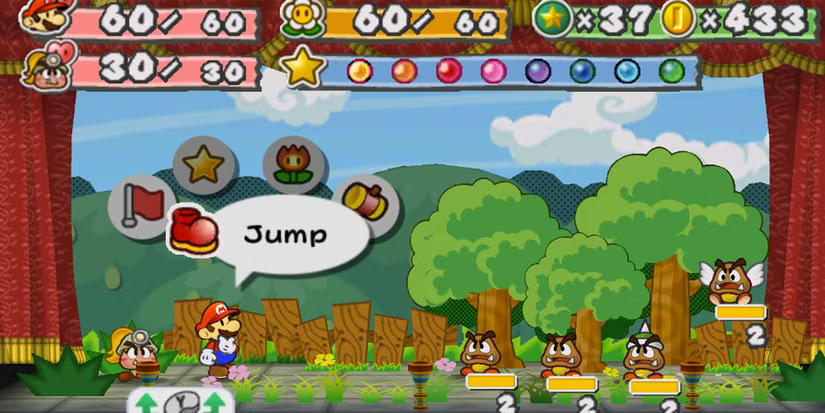
Paper Mario, following its Super Mario RPG predecessor, bypassed the need for any ATB-like real-time system by making the player able to react to and mitigate the damage on the opponent’s turn. Where Final Fantasy made combat time-sensitive with its gradually charging bars, Paper Mario made it possible to block attacks with carefully timed, quick-time-event-esque button prompts. Simple ones: a single well-timed button press would prevent one damage of your adversary’s attacks—but that gets important in a game where you’re likely to top out at seven or eight damage at a blow. On the offensive, a similar button prompt would increase the damage you inflicted. So it was still run of the mill, polite turn-based JRPG combat, without all the complexity and particle effects of Final Fantasy, but it was still engaging, required skill and practice, and was especially satisfying to execute.
Later games iterated on this formula. The sequel, Thousand-Year Door, introduced additional timed button presses on the offensive for fancy flourishes (winning audience appeal) and the extremely powerful (but difficult-to-execute) parry, which allowed you to negate enemy damage altogether (especially relevant to our discussion here). Later still, the Mario and Luigi games would ask you to respond to different attacks with different button presses: enemies would attack either Mario or Luigi and you’d have to press A or B depending on which one was in the line of fire, canceling damage. (My knowledge runs out after Superstar Saga, though. If Origami King is doing something really cool, I don’t know about it…)
I gotta say, though: much as I love these games, and much as I’m enjoying replaying them, the difference in style from Paper Mario to Clair Obscur is like trading in your Cozy Coupe for a Cadillac. Where Paper Mario is slow and methodical, with the clear intention of teaching new players the joys of engaging with JRPG combat scenarios, Clair Obscur is fast-paced, intense, and relentless. Where Paper Mario is visually simple and clear, Clair Obscur revels in elaborate, balletic, Final-Fantasy-style acrobatics during attacks. In Clair Obscur, successful dodges negate all enemy damage, but enemy attack patterns hit multiple times—sometimes many times in the case of bosses and unique enemies. Even more challenging, rather than dodge (which takes longer and is more forgiving), players can parry attacks (but it requires more exact timing), and if every instance of damage in an attack is parried, the character performs a counter-attack, often for substantial damage. Clair Obscur players must also react to many different attack types: some must be jumped, others can’t be dodged and must be parried, some special attacks require a separate kind of parry altogether, and enemies often feint, draw out attack animations, or vary attack patterns to throw off timing. It’s the difference between having a snowball fight with a neighbor, and entering a paintball match with a dozen opponents. The scope, scale, and requirements on the player’s reflexes are multiplied exponentially.
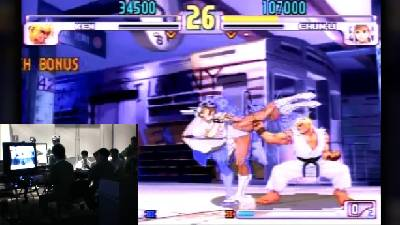
But if it felt good in Paper Mario to block or parry some otherwise-lethal attack, it feels amazing in Clair Obscur to parry every damage in some stupidly complicated attack pattern that flattened you in battles past, then rain sweet destructive hell on the monster who foolishly dared to provoke you. It feels like that famous video of the Street Fighter II championship, where one competitor blocked every hit of Chun Li’s spinning kick only to counterattack and knock her out—only it feels like this every time. Omigosh what a high.
But here’s the secret:
They want you to do this.
As much as the fancy animations and effects contribute to the Cadillac/Cozy Coupe divide in player experiences, the real secret here is the way Clair Obscur structures its battles. As I said above, the dodge move is more forgiving than the parry—it lasts for more frames and doesn’t have to be as precisely-timed. But if you do time it precisely, the game lets you know. That’s a perfect dodge, and the character flashes to indicate you’ve executed the dodge perfectly. But the timing for a perfect dodge is the same as a parry. So the game is effectively treating dodging like training wheels or bowling-alley bumpers: it’s a teaching tool to get you to parry. Once you’re consistently executing perfect dodges against the enemies you’re fighting, you’re ready to start parrying instead—and getting those sweet, sweet counterattacks in.
Moreover, each instance of combat is treated like its own tutorial. If you beat all the enemies on the first try—good for you, here’s your experience and other rewards. But if you fail, the game offers you two options: keep fighting with the rest of your party (at most, you have five party members, but only three can fight at a time; continuing with your remaining two party members represents a significant power decrease, but you could still win if you’ve figured out the enemy attack patterns and can consistently dodge or parry), or you can start the fight over from the beginning.
This means that Clair Obscur is far more difficult than Paper Mario, but actually less punishing. You’re supposed to fight the same goon squad, or boss, or mime multiple times in a row, building muscle memory until you can not only dodge but parry every attack thrown at you. The game is oh-so-gently guiding you toward the incredible high of knocking back the enemy’s attacks and flattening them with a counterattack. It’ll wait as long as it takes for you to figure it out. As much as the intense music and battle animations suggest this crazy, pitched battle with epic stakes—and you get caught up emotionally, trembling as you hover your fingers over the right buttons—really this game is wonderfully forgiving, and accommodates failure without missing a beat.
Brilliant, brilliant stuff here.
We should also probably point out that Clair Obscur’s Pictos are little more than Paper Mario’s Badges.
In Paper Mario, character customization was very limited. Each time you leveled up, you got to choose to augment your health points, flower (magic) points, or badge points. Badges would give you new moves, augment your damage or decrease flower-point-use, or give you other passive bonuses. Badges could be equipped and unequipped at will, which enabled players to build their own playstyle from their favorites, and/or adapt to difficult fights or levels by choosing badges that suited the situation (like using fire attacks on ice enemies).
This honestly isn’t terribly far from some of Final Fantasy’s combat systems—especially the one in Final Fantasy IX—but it is, predictably for Paper Mario, simple, versatile, and easy-to-use.
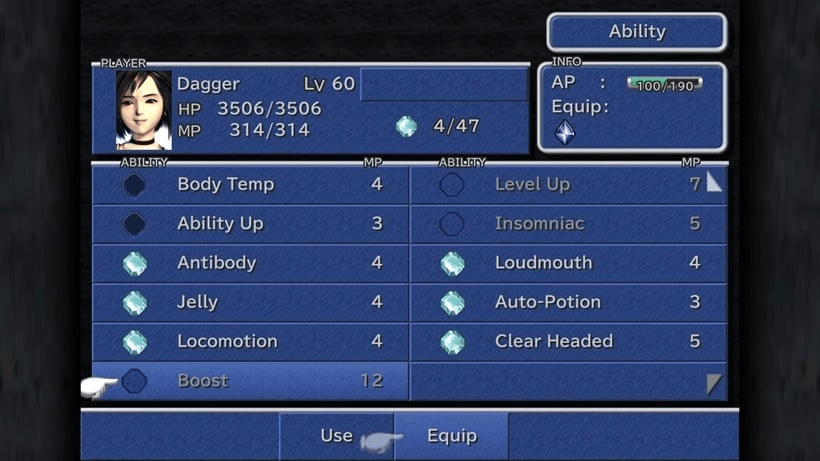
I suspect Clair Obscur is borrowing from Final Fantasy IX more than Paper Mario with its Pictos, but the mechanics are functionally identical. You discover Pictos in the wild, either lying around the world, bought from merchants, or won in fights, and you can equip them on whichever character you choose. Each character has a fixed number of points to use, though that number can be increased using a relatively common item (my characters all had over 200 points by the end of the game). Unlike Paper Mario (and like Final Fantasy IX), one character must “learn” the Picto by equipping it in four battles before its power can be equipped apart from the item, though each Picto also augments your basic statistics like damage, defense, and speed—so there is a bit of a balancing act between the Pictos you use for abilities, and the Pictos you use for stat increases.
But unlike Final Fantasy IX, the Pictos are not tied to specific characters, and therefore allow a much greater level of character customization, more akin to Paper Mario. And the sheer variety of Pictos you can use dwarfs both games. It’s not quite Final Fantasy VIII’s Junction system—there are severe limitations here than cannot be contravened—but it is extraordinarily powerful, nonetheless, and figuring out the potential combinations of character skills, weapon choice, and Picto allocation yields an enormous variety of potential playstyles for each character.
Again, it’s a forward-thinking reinterpretation of familiar systems, exponentially expanding the possibilities these older games allowed. The systems are both expanded and streamlined—or would be, if the interface wasn’t just a bit too clunky to make these customizations straightforward to implement.
You can’t win ‘em all, I guess.
II. Style Lessons from Persona
A strong aesthetic covers up a multitude of sins. And I doubt anyone understands this quite as well as the Persona games.
That’s not to say that the games are bad—not at all: Persona 4 remains one of my all-time favorite games—but all the Persona games suffer from repetitive gameplay through simple, meager levels, featuring monsters that reappear, re-skinned, throughout the game and a battle system that remains largely unchanged after several sequels. Take away the music, the textures, the dialogue barks, and the dynamic combat animations and it might be tough to support five games with these mechanics.
But music, textures, dialogue, and dynamic combat animations make all the difference. Combat in Persona always feels quick, strategic, joyful, and tense—and rewarding to boot. The big, broad, primary colors and overly-expressive animations all serve to make every combat encounter feel like a party, with the monsters as the killjoy party crashers whose collective butts desperately need kicking. Even the subtler touches—the rapid edits, the bobbing of the characters’ idle poses, the simple but stylish menus—all contribute to the game’s lively, fast-paced vibe. And it’s hard not to get caught up in it all.
Even to the point that nobody, but nobody criticizes the Persona games for their strict turn-based combat. There are no reaction prompts here, no ATB system, and no half-measure real-time mechanics either. Everybody takes their turn in a regular, predictable order, makes their move, and passes to the next. And it still feels great because of that bouncy music, snappy editing, and bold color scheme.
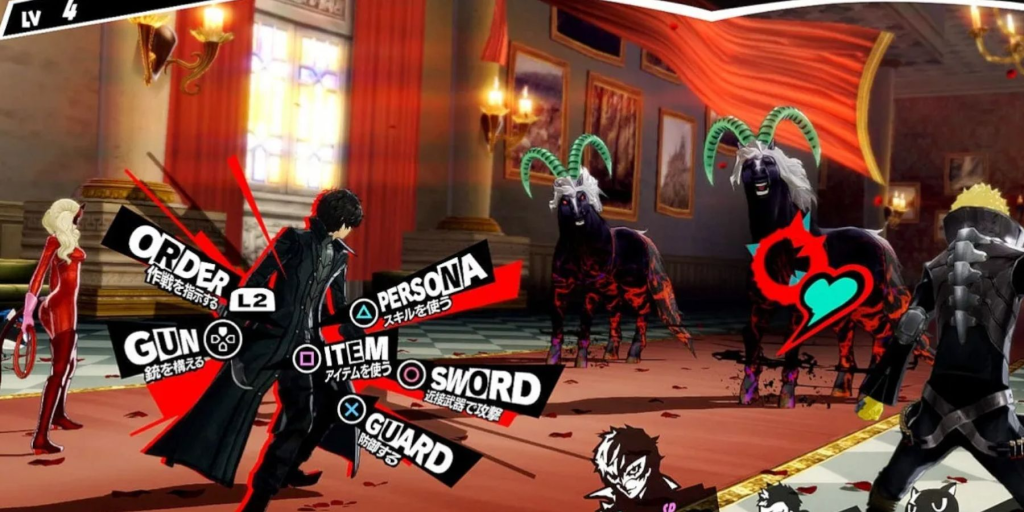
On the surface, Clair Obscur steals nothing from the Persona games—it’s plausible deniability all the way down. You won’t find the garish colors or character designs or pop music sensibility anywhere. But every combat encounter features the same propulsive, snappy editing top-to-bottom. The camera whips around every time you press a button, whether it’s to aim your projectile weapon, select a command, or suffer an attack—all wonderfully functional (zoom out when enemies attack so you can see and time your dodges; zoom in when choosing attacks to emphasize the character’s face and expression; level out when choosing an item or support skill so you can see your other characters’ ailments and status), but also stylish and propulsive. Once you’ve committed the menus to memory, selecting even the most routine actions turns into a dance of camera, character, and enemy: the view swoops and dives even as the characters fling themselves headlong across the battlefield at their enemies. It’s even more balletic than the Persona games tend to be.
Because the trick here is that Clair Obscur’s style is all so much its own. The stark primary colors and jagged, irregular edges of Persona’s pop-art menus are here replaced with something more stark and Baroque: black-with-gold-trim art-deco-by-way-of-steampunk sensibilities that feel wonderfully timeless, realistic, and otherworldly. Clair Obscur is operatic where Persona feels jazzy. Clair Obscur is stylishly ornate where Persona is ultramodern simplicity. Clair Obscur is Monet’s Paris to Persona’s Tokyo-by-way-of-Worhol. The styles themselves couldn’t be more different, but the boldness of execution are much the same. They feel worlds different to play, especially given the reactive combat we discussed above, but the pedigree is unmistakable.
There is another combat detail I might attribute to Persona, but it’s a bit less obvious, and I suspect the inspiration is coming from elsewhere. Like Persona, Clair Obscur has a six-color elemental system (fire, water, earth, wind, light, and dark) where specific enemies have specific elemental weaknesses. Unlike Persona, these weaknesses do not instantly stun enemies; instead, Clair Obscur has a “break” bar parallel to the health bar, which gradually accumulates progress over time. Once “broken,” enemies are, like fallen enemies in Persona, more susceptible to damage and stunned for a turn (though there’s nothing like an “all-out-attack” here, either).
I suspect that this feature of the combat honestly has more in common with other JRPGs. I’m specifically reminded of Octopath Traveler, but I’m pretty sure there are earlier precedents. Nor is it such a huge feature of the combat that it warrants its own discussion. There will be plenty of battles where you don’t think to use the break system at all; there are others where it is critical. It is a weapon in your arsenal, not a core principle of the game’s design—but it does bear mentioning while we’re here talking about Persona anyway.
Instead, let’s talk about the elephant in the room.
III. Eating Final Fantasy’s Lunch
There were probably a dozen times during my 99 hours of playtime when I felt like shouting at my computer screen, “I hope Square Enix is taking notes!”
I played Clair Obscur right on the heels of Final Fantasy VII: Re-Make, which might have been a mistake. Part of the reason I want to emphasize that I played 99 hours of Clair Obscur without boredom or frustration, is because I played a mere 40 hours of Re-Make and still felt like it was about fifteen hours too long. It took me four or five months to log those 40 hours, but it only took me a month-and-a-half to blow through Clair Obscur’s 99. And while some of that was purely a matter of timing (I played Clair Obscur during my December-January break), a lot was purely self-motivated. Many an evening in the chill November I considered playing Final Fantasyand really just…didn’t want to—but I always felt eager to return to Clair Obscur.
So let’s talk about why.
- Dialogue scenes
Probably the first time I wanted to scream at my screen was about one-and-a-half-minutes into Clair Obscur, in the very first dialogue scene between Gustave and Maelle. Gustave is throwing rocks into the sea, Maelle suggests he use his fancy robotic arm for more distance. They banter. It’s a breezy little scene.
That’s it. It’s just a breezy little scene. It’s not weighted down with heaving sighs or emotional angst or dire stakes. The stakes are there—Gustave is actually avoiding meeting his ex-girlfriend because she’s ABOUT TO DIE, but the characters are playful and maybe a little flirtatious because people don’t look grave stakes straight in the eye, and they talk around their problems rather than confronting them.
It just felt so dang natural, especially on the heels of Re-Make’s affected anime mannerisms.
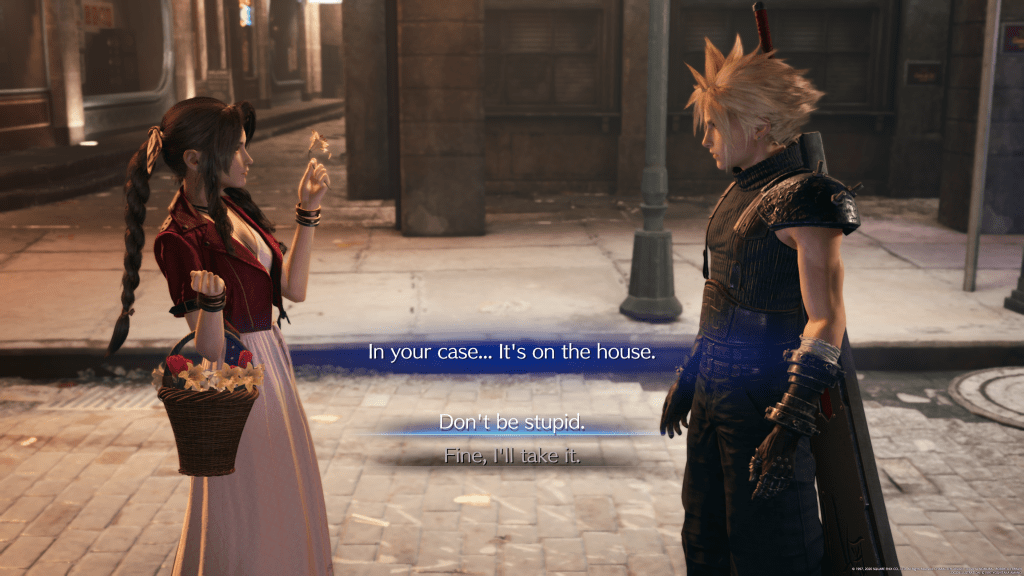
And I realize this is dangerous ground I’m treading on. We could be in cultural divide territory here—at the very least, I know enough about the distinct artistic conventions in the West and East to know that some of those over-the-top gestures in Re-Make are genre expectations, and even Kurosawa and Ozu will drop one now and then to drive home a point. But Kurosawa and Ozu are also carefully subtle where Re-Make very much is not. And I doubt either filmmaker would ever condone the naked fan service Tifa and Aerith regularly commit in Re-Make. I’ll willingly chalk up my preference for Western mannerisms to cultural upbringing, but that doesn’t mean Re-Make gets a pass, even by its own cultural standards. Less is more.
- Maturity
I’ve talked a fair bit about the weird relationship between video games and the appearance of maturity. And I’ve talked about it with respect to Final Fantasy specifically. The short version is that I think Final Fantasy often panders to a juvenile sense of maturity rather than aspiring to maturity itself. This isn’t always the case: there have been plenty of Final Fantasy games that really do manage to engage with mature themes and mature questions (I would argue Final Fantasy VI, despite its superficial silliness, is among the best), but especially since Final Fantasy X, the games as often seem to mistake soap-opera hysterics, adolescent posturing, or melodramatic tragedy for “maturity.” It is, in some sense, an adolescent’s understanding of maturity, rather than maturity proper.
Which is fine, by the way. Teenagers have to vibe just like anyone else.
But when Clair Obscur came along and said, “Hey, we’re an adult-oriented, visually-striking, turn-based RPG set in a fantastical open world full of strange technology, and our posse of playable characters are going to set out to fight the powers that govern the world!”—it’s hard not to take it as a challenge to Final Fantasy. That’s been their turf for decades now. And the sheer artistic success of Clair Obscur reveals just how darn pretentious Final Fantasy has been this whole time. I’ve enjoyed my time with Final Fantasy X, XII, XIII, and XV, but it doesn’t change the fact that they all look pretty shallow, immature, and awkward when you see Clair Obscur pull off a rich story with real, serious emotional and moral stakes for its characters, seemingly effortlessly, and with very little of the bombast or “cinematic” flourishes Final Fantasy constantly indulges in. And, yeah, Clair Obscur willingly embraces its “M” rating where Final Fantasy has typically stayed in “T” territory—until XVI, anyway, which makes this comparison all the more unavoidable.
I admittedly haven’t played XVI; maybe it’s just as good?
It doesn’t sound like it, though.
Time to get your shit together, Final Fantasy. The newbies are coming for your turf.
- Turn-Based Combat
But we’re not done! Not by a long shot!
The weird addendum to all that discussion about Final Fantasy and Paper Mario earlier is that Final Fantasy X actually did polite, run-of-the-mill turn-based combat. They threw out the ATB system altogether for that one game and just lined ‘em up old-school.
It was also great? I give Final Fantasy X a lot of crap, but it is a really good game, and its combat system is really engaging.
XII for me is the low point in the attempt to fuse turn-based and real-time combat in the Final Fantasy franchise: I could not figure out their pseudo-programming triggers in that game. It drove me nuts. But since then it seems like Final Fantasy is really struggling to figure out how to do combat in the modern video gaming landscape. XIII was perfectly functional (I liked it, anyway), but apparently a bit too turn-based for the fans. So XV was basically just real-time combat with menus, and XVI (which, again, I haven’t played, and thus operate on hearsay) is basically just Dark Souls.
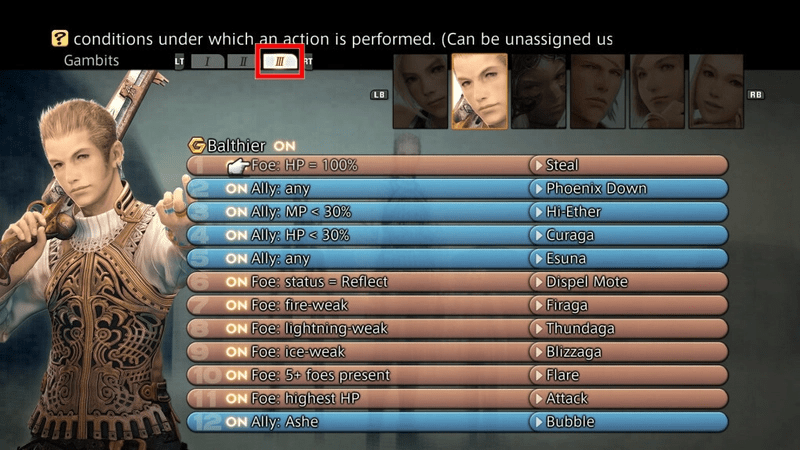
Then here comes Clair Obscur and just eats Final Fantasy’s lunch. Like, sits down in their turn-based combat backyard, which Final Fantasy had condemned and shuttered and ignored, and Clair Obscur just shows up, slaps a new coat of paint on the walls, and takes all the money Final Fantasy could have been making. And now they’re winning all the awards and selling a zillion copies (or at least making everyone wish they had a PS5), and everybody is talking about how awesome the turn-based-combat was in this game and how turn-based JRPG combat can totally be fun again, because this Western RPG showed it was possible.
ARE YOU WATCHING, SQUARE ENIX? TURN-BASED COMBAT CAN STILL BE A LOT OF FUN IF YOU DO IT RIGHT!
- Level Design
Some of these others are jokey-jokes. This one is super-serious.
When did Square Enix forget how to do basic level design in Final Fantasy games?
‘Cuz it’s been a while. I remember the first two-to-three hours of Final Fantasy XIII were basically just a series of literal linear corridors, where you would just walk down the hallway in front of you while flashy stuff happened off to the left or right, and you would get interrupted by text dumps of lore, exciting cinematic cutscenes, menu and combat tutorials—and that was it. That was the first two hours of the game. And I remember spending a lot of that game wandering around pretty lackluster environments with more aesthetic flourish than intricate level design, wondering why it took so dang long to run down all these hallways.
It sucked. And everyone said that it sucked. And everyone made fun of Final Fantasy for it.
In Final Fantasy XV, you can see the devs taking this lesson to heart. It’s a big, sprawling open world game where you drive your car around the big sprawling open-world map doing sidequests like it’s Borderlands or something. But then you get to the back half of the game and there’s this truly god-awful dungeon where you’re trapped in some King jerk’s basement running down cement corridors and I had to wonder: is this where the budget ran out? Did we just give up? Are we padding out the game for two hours to make the ending more climactic?
And as much as Re-Make covers up a lot of these sins with some really great aesthetic flourishes—Midgar really does come alive in this game—it doesn’t change the fact that you will spend hours running around linear corridors (most of which look very nice, though some of those laboratory levels don’t), A-to-B, just like in those first hours of Final Fantasy XIII.
Meanwhile, pick virtually any location in Clair Obscur, and you’ll find these complex webs of overlapping paths, often looping back around to make shortcuts or open new areas, with the occasional platforming challenge to mix things up. Where there are linear corridors (as in the first hours of the game), they are gorgeous, with lots of things to see and do, people to talk to or nooks and crannies to investigate, or world-building happening all around. Never mind the fact that each of these areas is aesthetically unique, sometimes in wildly divergent ways. I was always exploring, always discovering, always getting a bit turned around, and always, always present.
Which brings us to a pretty controversial, and not quite Final-Fantasy-relevant detail…
- No Minimap
Yahtzee called this one out, and so have some other critics, and I get it.
But you can keep your stinking minimap.
Clair Obscur, a bit aggressively, does not have any minimap at all. There is a worldmap you can peruse when you’re on the overworld, but anytime you are in a location, there is no map present for guidance.
This is, in fact, something I would change—gently. If it were up to me, the minimap would be something you unlock in the later stages of the game, probably in Act III.
But I respect the crap out of this decision. Having played so many games with minimaps, you eventually reach the point where you watch the minimap more than the actual world around you. Final Fantasy may not be the worst perpetrator of this crime, but it’s hardened nonetheless, and I can remember looking at the minimap for more topographical detail than the actual world in front of me on multiple occasions in Final Fantasy XIII and XV. But in Clair Obscur, that is not an option, so you are constantly looking at the world. Which is good, because it is beautiful, and carefully designed to be intelligible and logical (even when it is also labyrinthine and confusing). This is a game that demands exploration, and I love it in the same way that I love Morrowind for foregoing quest markers and Hollow Knight for making you find mapmakers. This is a bold choice, and frustrates completionist players, but it is wonderful for the explorer in touch with the world. In Clair Obscur I was occasionally lost, and occasionally confused, but I was also, always, emphatically present in its world.
And, like Morrowind, I suspect I’ll be vacationing on The Continent again someday, but that’s a conversation for a later act. For now, let’s blow this out to its logical conclusion:
- The World Map
At no point did I feel more triumphantly embarrassed for Square Enix than when Clair Obscur gave me the ability to fly over the World Map.
“They did it,” I thought. “The crazy bastards finally did it.”
This might technically count as a spoiler, but I don’t even think it’s that big. It’s teased early in the game, and seems like an inevitability for most of Act II.
But seriously, when did we give up on airships?
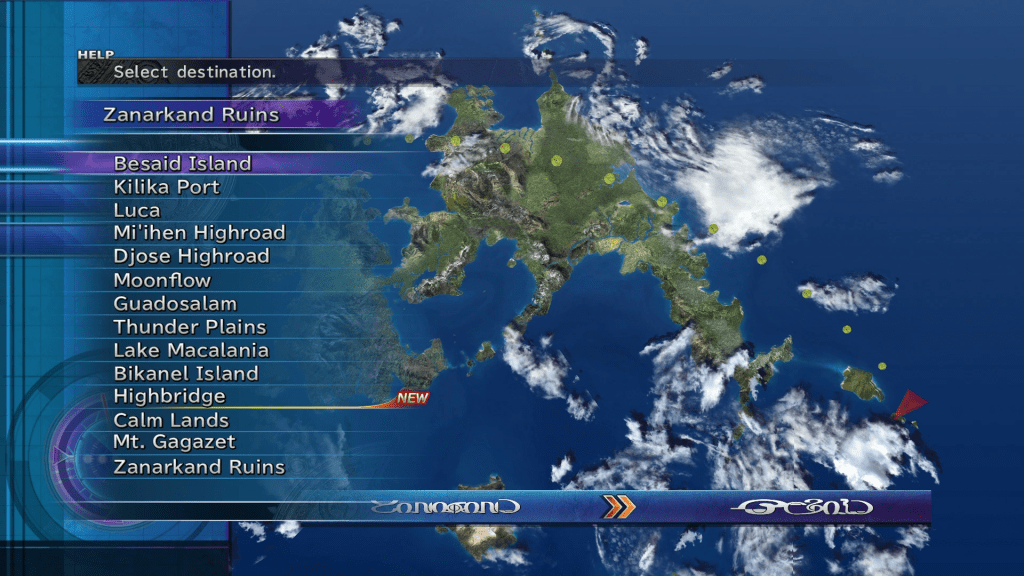
Final Fantasy X was apparently too invested in its own prettiness to include a low-fidelity world map for the player to fly around, and that choice followed through the rest of the franchise. You get the car in XV, but only in the front half of the game; the back-half rather mercilessly repossesses the open world for the sake of its plot, which is frustrating.
But here it is in Clair Obscur. Final Fantasy’s classic locations-on-a-world-map setup, complete with a couched linear progression for early areas, unlocked modes of transportation for water travel and other obstacles, and, finally, the mighty airship which allows you to seamlessly fly all over the map in the endgame.
It is weird how cathartic it was to do this again. And it’s weird that Clair Obscur feels more like a classic Final Fantasy game (i.e., pre-X) than any more recent Final Fantasy game in this way.
They ate your lunch, guys. They ate your whole lunch. It was right there on the table, but you weren’t eating it, so they did instead.
What I find so surreal about all this is how effortless it all seems. Clair Obscur doesn’t even explain itself with plot points or dramatic setups or anything like that. It just does Final Fantasy, often better than Final Fantasy, without any pretense or fanfare or veiled allusion. It’s just being itself, I think—doing what comes naturally. Of course its dialogue is understated and naturalistic; and of course it has excellent, engrossing turn-based combat; and of course it has a single world map linking together all of its locations which you can traverse via land, sea, or air. Why wouldn’t it? These are all well-worn artistic and design solutions to storytelling problems that video games have been ignoring for decades. Why not trot them out again? Why can’t we do this with our advanced hardware? And isn’t it more cost-effective for a smaller, lower-budget team than some of the back-of-the-box features boasted by bigger studios? When did we stop thinking these things were cool? Or necessary? Or just good ideas?
Why does this feel so freaking original?
IV: The Broken World of NieR: Automata
With our discussion of Final Fantasy finished, we can broaden our view a bit, but that means the allusions are also going to grow a bit more abstract. It’s easy to pin down the design decisions that inform Clair Obscur’s combat system, or its traversal mechanics; the art style, themes, and bigger-scale decisions are trickier beasts.
But it’s also really hard not to think of NieR: Automata while playing Clair Obscur.
There are a few reasons for this.
First, there are some notable, if undefinable, aesthetic similarities. There’s a graininess to the graphics in both games that I can’t quite place—since I’m not terribly knowledgable about the engines or animation decisions informing both games. Apparently NieR: Automata used a homegrown graphics engine, completely unique, even among the other Platinum titles; Clair Obscur used good old Unreal, though they did switch from 4 to 5 during development. So that means it’s not some kind of common ancestry, but a deliberate choice. But that’s as much as I’ve got here.
Second, there is the world. Both games feature a kind of post-apocalyptic setting: NieR: Automata is located in some unknown, familiar city long overtaken by nature; Clair Obscur is located in a world where the very laws of reality seem to have been broken in some prior cataclysm. Consequently, both games use a fascinating blend of urban and natural environments, familiar (and even iconic) architecture and locations broken apart by these forces.
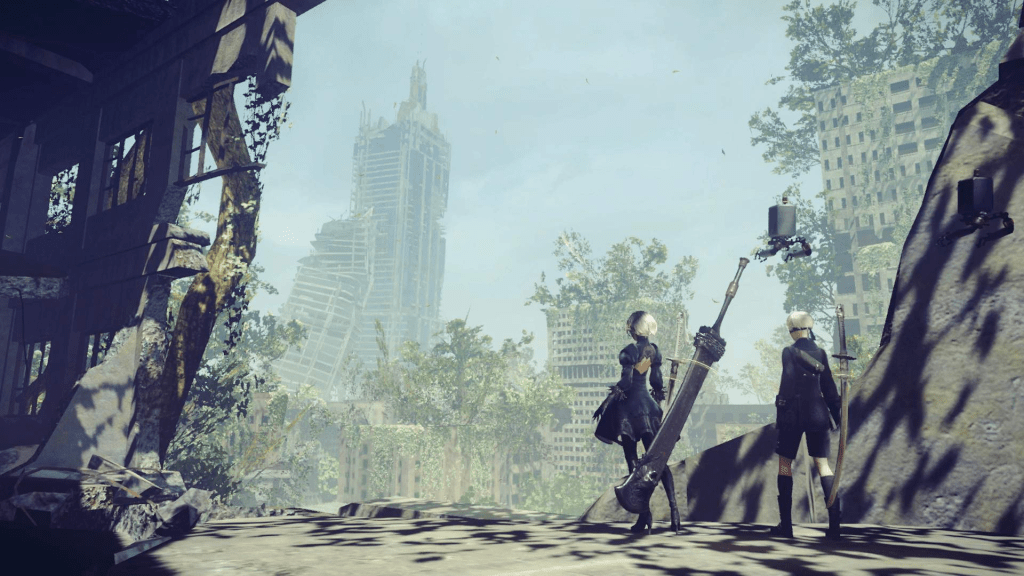
Third, there is the character design. This might be a subtler touch, but the cast of both games are young(ish) people, dressed in fairly conservative uniforms, but with some effort expended to animate the hair in a way that is free-flowing and natural. And these choices tie in to some of the themes and iconography of these games: in both we play as soldiers lost in a hostile world; in both we are the arm of an organization we have largely left behind; in both we are explorers mapping a frontier. And in both we are trying to figure out how to balance our identity and personal goals with the goals of our collective organization. But now we’re wandering into the next category…
Fourth, and perhaps most obviously, there is the theming. Both games are about loss. Both games are about being caught in cycles of violence. Both games are about rediscovering or asserting humanity. And, importantly, both games are highbrow (read: pretentious). NieR: Automata is full of allusions to philosophy and literature; Clair Obscur is full of allusions to painting and sculpture. Which means they’re both artsy according to our reductive definition in the prologue. But that counts—because big sprawling RPG games usually aren’t about these things unless they’re coy about it. Xenogears and Final Fantasy can get away with their dense allusions to philosophy and literature and mythology because the moment-to-moment gameplay is about giant mechs and casting spells and toppling governments—but they’re not about art and philosophy. Not explicitly, anyway.
Right?
(Not really, but the aesthetic difference is relevant…)
At the end of the day, both games are off-beat RPGs by mid-tier studios, using unusual mechanics and a bold visual style to explore a rich post-apocalyptic world, though organically—without lore dumps or expository speeches or some non-diagetic glossary. And, yeah, when you put it that way, it seems kind of obvious. Except that “off-beat RPG using unusual mechanics and a bold visual style to organically explore a rich post-apocalyptic world…etc., etc.” could also describe another really important influence that very obviously belongs in this discussion.
V. The Long Tail of Dark Souls
It always comes back to Dark Souls one way or another, doesn’t it?
I imagine some of you would like to push back against my inclusion of Dark Souls as an “off-beat RPG…etc.,” but I stand by it. In the year of our Lord 2026, with “soulslike” as a genre determination and a good ten of these things on the market, it might seem weird to call Dark Souls “off-beat” or “unusual,” but that’s only because it was the one of these things that hit big and became the new normal.
I imagine some others of you are waiting to pick up your torches and pitchforks on the off-chance that I dare to call Clair Obscur a “soulslike.” Don’t worry. I’m not going to.
But I will say that Clair Obscur is clearly borrowing a lot of ideas from Dark Souls and the rest of From Software’s catalogue. That damage-cancelling dodge we discussed as an upgrade to the Paper Mario combat system? That seems like a pretty Souls-y addition to the pre-established formula. Quietly pottering around a post-apocalyptic fantasy world? Also pretty Souls-y. Crazy difficult combat encounters? A world defined by generational conflict over many years? Narrative and lore drip-fed to the player in the form of environmental design and boss encounters? All pretty Souls-y.
But there is one major influence that I think it entirely unmistakable, though it only comes in the last portion of the game. Clair Obscur is positively littered with optional boss fights. These are by far the most difficult combat encounters in the game. Many have their own locations or areas devoted to them, and many of them are used as opportunities to reveal the deep lore of the game: they are the footprints of characters or aftermath of events we do not personally meet or see, but hear about and deduce through snatches of dialogue, journal entries, and exploration. Clair Obscur is more charitable with lore dumps than Souls games typically tend to be (it is, after all, a character-driven RPG, rather than the more typically Souls-y mute player avatar with an RPG leveling system), but if you want to know the game’s real secrets, or reveal more of the story than the characters are willing to literally tell you, you’ll have to do some serious spelunking, and pick fights with some truly terrifying bad guys.
That is unmistakably a Souls-like influence.
Of my 99 hours, I think I spent fully half on the last Act of the game—exploring optional areas, getting into tense boss fights, and piecing together the deep lore of the game. Which I suspect is fairly typical of the devoted FromSoft player, based on what I’ve heard from commentators and let’s plays. And it is the part of Soulslike design that I am most attracted to—my favorite part of Hollow Knight or the little bit of Demon’s Souls I’ve played. You can’t sell me on the punishing gameplay, or the arcane character customization, or the unusual multiplayer experience, but you can absolutely sell me on the drip-fed storytelling through exploration.
And if you’ll remember, I mentioned earlier that Clair Obscur was less punishing than Paper Mario, with its careful combat encounter design—this means, to me at least, Clair Obscur is the perfect balance. It removed the punishment of Dark Souls but retained much of its difficulty. It enabled the careful storytelling-by-exploration and conflict without the frustrating limitations of the bonfire system. I bounce off of Dark Souls because I can’t afford the time to “git gud” and can’t afford the emotional investment of its punishment and frustration—but Clair Obscur was exactly as welcoming as I needed to make my investment of time, energy, and curiosity.
Maybe one day I’ll be able to give what Dark Souls asks of me, but I did not need to wait to meet Clair Obscur’s demands.
VI. Exploring History with Assassin’s Creed
Guillaume Broche, the lead designer on Clair Obscur, is an ex-Ubisoft employee who used to be a Narrative Lead at Ubisoft Shanghai. He’s the primary founder of Sandfall Interactive, the independent development team behind the game, and I suspect that many of the designers, artists, and writers who worked on the game were also working at Ubisoft at some point.
This information is not impossible to find, for those willing and patient enough to do the work, but I’m not making money writing these essays, and I don’t think it’s really worth my time to track down all the possible connections I could make here. What research I have done suggests that most of the games on this list were artistic inspirations—not projects the designers worked on themselves. Broche grew up on Final Fantasy VIII, IX, and X, fell in love with the parry system in Sekiro, and the team cites Persona as an inspiration as well.
But I have to wonder if some of the artists working on this game had experience in some of Ubisoft’s past projects. And Assassin’s Creed—especially Assassin’s Creed Unity—immediately springs to mind. To my knowledge, Broche doesn’t talk about working on Assassin’s Creed—the two Ubisoft games he does seem connected to are Ghost Recon: Breakpoint, and Might and Magic: Heroes VII. But Ubisoft Shanghai is credited with doing some of the work on Unity, even if Broche isn’t credited specifically.
It could be purely coincidental; Unity is the distinctly French game in the franchise, and Clair Obscur is unapologetically French as well. But Unity also played with surreal, disintegrating imagery in a side-mission taking place (anachronistically) in Belle-Époque Paris, and that seems too obvious a connection to be a coincidence here.
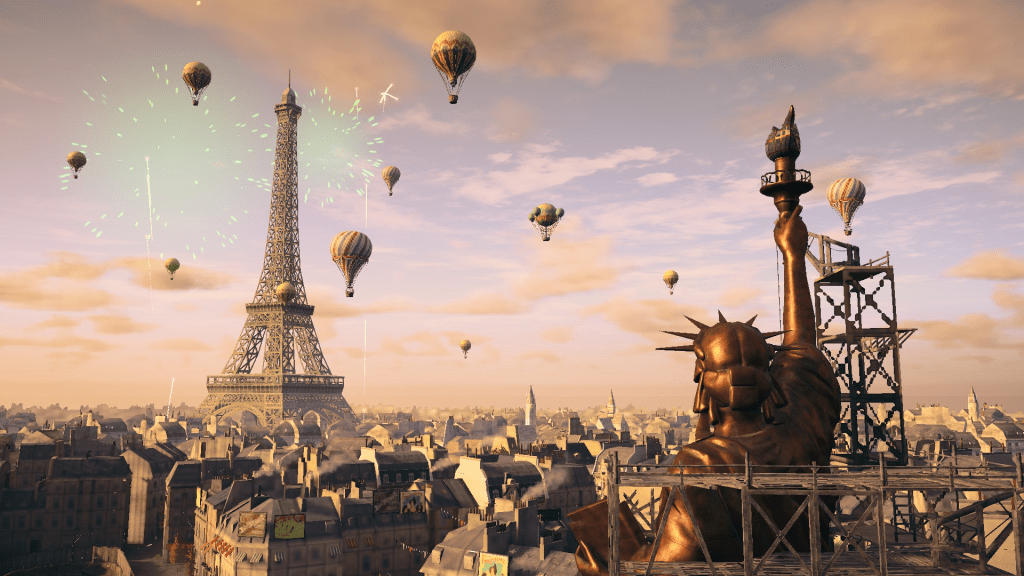
All I really have to say here is the obvious: like Assassin’s Creed Unity, Clair Obscur is a game rooted in a particular place at a particular moment. It is interested in history and real-world locations and architecture, as much as it is interested in the fantastic revisions it makes to that history and these places. Like Assassin’s Creed Unity, it is inspired by Parisian architecture, past and present, and uses it to set the stage and tone of the game.
And I wouldn’t be surprised if a few of these creators were burned in the fallout surrounding Unity’s botched launch, and decided to make a game studio—and a game—they could be proud of, instead.
VI. The Worldmakers of Myst
If you thought that last one got a little tin-foil-hatty, this one’s going to be way worse.
With the exception of Paper Mario and NieR: Automata, all of the games on this list are cited as direct inspirations by the developers or the team—or, in the case of Assassin’s Creed, they seem connected by virtue of the developers’ history and possible past projects.
Myst fits neither of these categories.
Sort of.
So the history of the Myst games is nearly as tortured and complicated as Assassin’s Creed. Cyan, the original development team, produced Myst and Riven, but the rights to the franchise were transferred out of Cyan’s hands and into Ubisoft’s. Ubisoft independently developed Myst III: Exile and Myst IV: Revelation while Cyan put together Uru and, eventually, Myst V: End of Ages, which closed out the series in 2005.
We can’t really talk about the artistic connections between Myst and Clair Obscur until we get some spoilers under the belt, but suffice to say there is a kinship, at the very least because both are games that are about world-building in addition to both having richly realized worlds themselves. I’d like to suggest that some old Ubisoft hands worked on both Revelation and Clair Obscur, but that would be a crazy reach. More likely Broche’s team was inspired by the games themselves, but nobody has mentioned them to my knowledge.
On some level, though, I’m not sure how much that matters. Even more than Paper Mario, Myst is deep in the DNA of contemporary gaming traditions. Any game with a richly realized world is almost certainly indebted to Myst’s revolutionary commitment to an immersive world in 1993. It transformed gaming as surely and completely as Doom that same year, or Dragon Quest on NES. But at that point we might as well also point to other gaming legends like The Legend of Zelda, Ultima, or even Dungeons & Dragons itself. At some point we have to stop going backward in time, if only because the intervening causes and effects become impossible to tease out of the direct line we’re trying to draw.
Or we would, if it wasn’t for the unmistakable similarities we’ll be discussing later. It’ll have to wait though.
For now, I have one more major inspiration to highlight.
VII. Surrealism

I keep using the term “surreal” to describe Clair Obscur. That term might not be entirely accurate, but it is deliberate.
Clair Obscur’s world is caught in a kind of stasis of disintegration. The buildings, the objects, and even the land itself seem to be paused in the act of tearing itself apart. Even the starting town and its famous Parisian landmarks are in this state: the Eiffel Tower is bent and smudged into a left-leaning smear; the Arc de Triomphe is broken at its peak, the two legs of the arch falling away as the top scatters into the sky. Cobblestones and roofing tiles float impossibly above the street. Rocks float out of reach. And there are even platforming sections in the game where you have to hop from floating debris to floating debris like in Bastion. (I’m not confident in calling that an inspiration, though.)
And nobody talks about this. It isn’t explained in dialogue or journal entries. It is, by the standard of the game world and its inhabitants, normal. What is obviously, manifestly impossible to our eyes is routine to theirs.
I call it “surreal” because that’s the best descriptor I’ve got. This stasis-of-disintegration isn’t necessarily a hallmark of surreal painting, but it is one of the many oddities you’ll find there.
But let’s back up and do this one right.
Surrealism has been a fascination of mine since I was a little kid. My mother introduced me to the work of Salvador Dali at a very young age, and I never tired of puzzling through his dream worlds. Later, in high school, I encountered the famous French surrealist Rene Magritte, whose simple and iconic images have burrowed deeply into my brain. These days, I find myself running into the postwar British surrealists strangely often, and I’m gradually tracing a direct line from the work of these British surrealist painters through Pink Floyd’s animation in The Wall to the novels of Alan Moore and Brian Catling.
Surrealism is usually characterized as “dreamlike”—one of the stated goals of the surrealist movement was to bypass the conscious mind and reach the subconscious directly. Surrealist art in all its forms aspires to reach a kind of subconscious iconography, a rearranging of the world into impossible shapes that baffle or frustrate our efforts to interpret them. In surrealist art, recognizable shapes are used in unrecognizable ways: clocks melt, castles float, and drawers grow out of human chests. Faces are obscured or transformed or are half-suggested by strategic conglomerations of objects. Landscapes are composed out of metal and water, barren of detail or filled with confusing objects.
For the surrealists, this was all within their scope (along with plenty more besides). As an art movement, it was open to many interpretations, and tended to be free of judgment or boundaries. Many surrealists took their cues from the foregoing Dada movement, which deliberately challenged artistic conventions, incorporating found objects (like Duchamp’s famous urinal, re-titled “Fountain”), mass media clippings, or photographs. Like Dada, surrealism was aggressively anti-political: artists were sick of having their work co-opted by politicians to serve as propaganda, so Dadaists and Surrealists both composed works of art that could not be co-opted, that could not serve to heighten emotions of national pride or fervor, but could only speak for themselves, antagonistic to contextualization and interpretation.
Many surrealists were also unapologetically commercial. Dali in particular sold the shit out of his paintings, turning himself into one of the twentieth century’s first pop-star artists. He saw no shame in marketing himself, or his most iconic images (like the melting clocks of The Persistence of Memory); he regularly photographed himself in promotional or advertising photos, and even encouraged the rumor that his pointed mustache received messages from aliens. For the surrealists, it was all part of the game: the weirder and the crasser, the better. Where abstract painters like Klee, Kandinsky, and Pollock tended to practice a kind of artistic austerity, the surrealists were all about excess and confusion. Anything goes; whatever sticks is worthwhile.
I think this is part of the reason why “surreal” seems to have become so broad a term. It was intentionally broad, intentionally open, and intentionally left without boundaries. One might look at a Kandinsky painting and reasonably argue that it is “surreal,” but it would be more difficult to look at a Dali and call it “abstract”.
But here in video game land, surrealism has its own complicated baggage. For a long time now, games have often incorporated a kind of surrealism into the basic lexicon of play. As early as Final Fantasy VII and VIII we have images of characters superimposed on one another, or floating in some kind of void, or in a twisted illogical space to communicate their internal division or a conscious break from reality. Batman: Arkham Asylum famously used twisted, surreal stealth sections to characterize Batman’s encounters with Scarecrow’s fear-gas: Batman had to metaphorically face his own inner demons while being hunted by a gigantic monstrous Scarecrow avatar looming over hollow buildings suspended in a void. Since then, the trope has been everywhere: walking simulators like Dear Esther or Ether One, Corvo’s encounters with the Outsider in Dishonored, even major franchise games like Call of Duty or Alan Wake have gotten in on the platforming-through-a-void surrealism-as-internal-metaphor action.
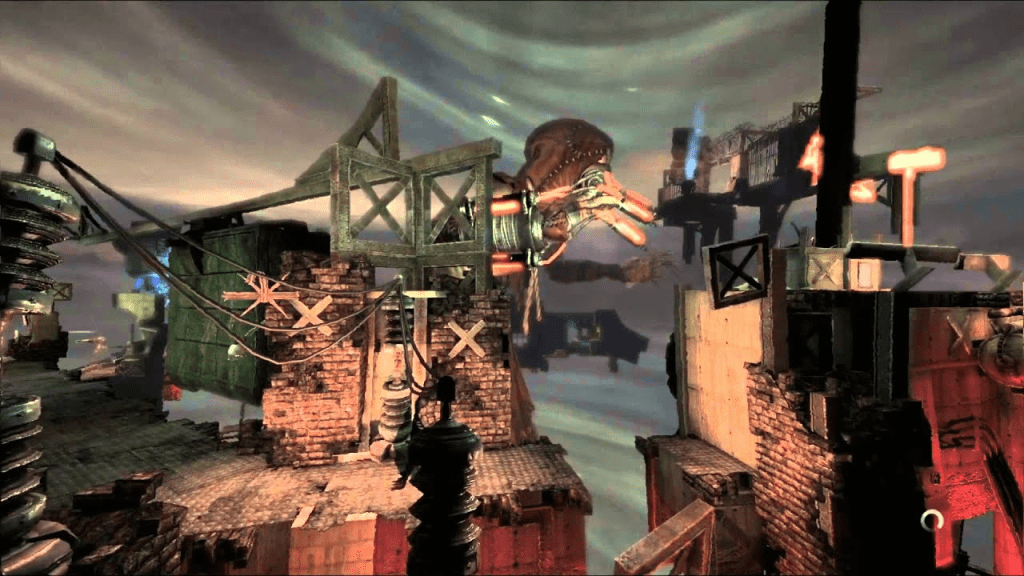
A trope this ubiquitous naturally becomes trite and frustrating, but I think it speaks to something special in the medium of video games. The barren voids or senseless spaces of surrealist painting have an actual historical value in the medium of video games: in the distant history of the medium, when assets were expensive and space limited, many of our games took place in barren spaces, with only the merest suggestion of a sky and earth to guide our play. Some of our most iconic mechanics—like the wrap-around maze of Pac-Man where you can march off one edge of the screen only to emerge on the opposite edge, or the floating blocks and coins of Mario, or the invisible walls that prevent players from wandering beyond the game space—these are all nonsensical in the real world, but accepted shortcuts and conventions of games. It is known that, just beyond the walls and skybox of our field of view, you’ll find a different kind of empty void: every video game world is just construct, and you need only slip through the world geometry or clip through a faulty surface to be suddenly exposed to the true unreality of a space no developer thought you could reach. Some games, like Daniel Mullins’ The Hex or The Magic Circle even invite you to explore those spaces: violating the developer’s intentions is a part of the developer’s intentions.
Clair Obscur, then, sits at the intersection of these two surrealist traditions. On the one hand, the visual language is rooted in painting—not only are the images of broken buildings and floating objects something easily found in surrealist painting, but the game’s resources: chroma, lumina, picots, and colors—are all tools of the painter. The floating debris could easily have fallen from a Magritte painting, and the static destruction seems especially evocative of Dali’s The Disintegration of the Persistence of Memory. But on the other is the video game language, where a bolder claim is being made. In this game, the unreal is real; the video game signifiers of a mental state—disconnected floating objects in a void—are here permanent and constant. This aesthetic of the abnormal has been made normal. The artificiality of the game is ever-present, despite the clear effort devoted to making the world real and believable.
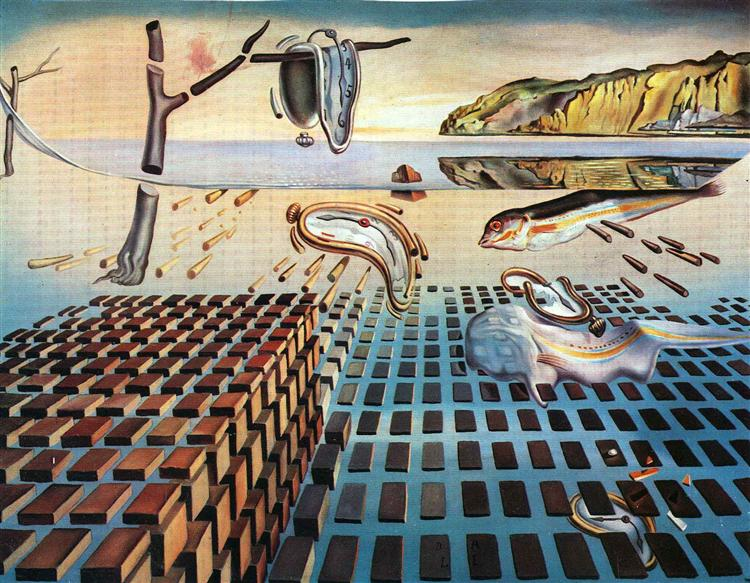
And that’s before you meet any monsters or see any of the real disintegrations before your eyes.
I don’t know how much of this is deliberate or intentional. For most players, I suspect they would just say that “it looks cool.” Even for some of the artists, that may be as far as they wanted to reach. I suspect we’re supposed to intuit the unreality of the space, and almost certainly understand this static destruction as a kind of world-paused-in-its-disintegration. But I don’t know if we’re supposed to be thinking about dreams, or apolitical statements, or Batman’s encounters with Scarecrow.
But I also think that Clair Obscur is tapping into the same cultural zeitgeist Moore has found with The Great When, or Jeff Vandermeer in Annihilation, or that the animators at Sony have found with the Spider-verse movies. Surrealism is back in a big way, it seems. The absurdity of its unreal spaces and its rejection of fascist political statements resonates with us in our own absurd, fascist, hyper-commercial time. Maybe in spite of AI art; maybe because of it, we find meaning in images and virtual spaces that speak to the subconscious, rather than the conscious mind. Ours is the era of the “elevated” horror movie, the absurdist meme, and the guerrilla artist: all children of surrealism in one way or another. We don’t reach far in our memory to find images of smoking skyscrapers, human shadows in Chernobyl, or streets abandoned in the wake of the pandemic. And the imagery of today’s protestors against fascism are dancing frogs and dirty jokes. We live in a surreal age.
Clair Obscur’s odd tension, then—the surreal made normal—seems especially apt. Many of us have ceased to question the strangeness of our circumstances; why would the residents of a literally-disintegrating world do any different?
But enough of this. We’re right on the verge of exploring Clair Obscur’s own unique world. Let’s stop here; next time, we’ll take the plunge.
Continued in PART TWO








 Video Game Academy