Untitled Edith Finch Essay – Guest Post by Dylan Mitten

Courtesy of the inimitable Dylan, whose work has enriched The Community School Game Jam and Mobius Shark Tank at the Spokane Central Library, and whose Hello Kitty Zen Garden graces the unpublished manuscript of TCS: The Book (working subtitle, albeit cliched, heartfelt: Building the Beloved Community School), here is a deep dive into a game I’ve only watched streams of, and yet can hardly imagine the games landscape without: What remains of Edith Finch. Dylan has also presented this as part of the Games Studies wellness, meeting W/F afternoons at TCS. Drop in when you’re in town, just sign in at the front office.

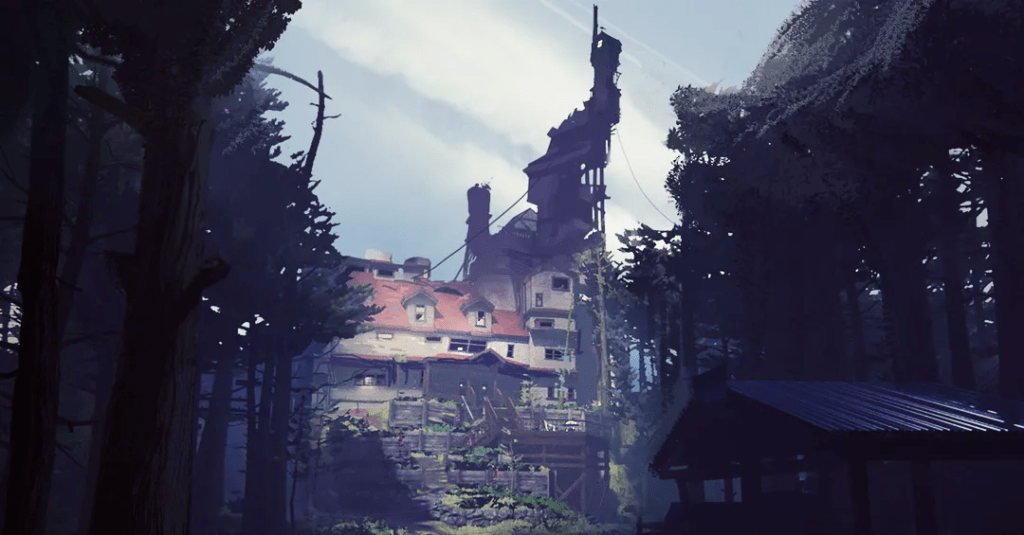
Annapurna Interactive, via WIRED

What remains of Edith Finch is a first-person narrative game where you play as – you guessed it – Edith Finch. Edith is the last living member of her family, and after the death of her mother, we follow her through her childhood home and watch as she uncovers secrets about her family that were buried. Some in walls, others, under beds… you get the idea. Let’s briefly go through the game, and then talk about the pressing issue of the game.

We start the game on a ferry. When we look down, we can see that our character has a cast on their right arm, and that they are holding a journal with “Edith Finch” written on the cover. When we open it, we hear the namesake of the game begin to narrate the writing. She talks about how, at 17, she is the last remaining member of her family. When she gets into the monster of a house that the Finch family home is, we start to learn about all the different members of her family – and moreover, why she is the only one left. 

We learn that in 1937, in an attempt to escape the curse that had claimed his wife and newborn son, Edith’s great-great-grandfather Odin Finch emigrates from Norway to the USA, setting sail with his daughter Edith (Edie, or  Edith Sr. as she’s referred to by Edith), and her husband Sven, as well as their newborn baby, Molly. He uses his house as the raft, but unfortunately, it seemed as though the curse was coming for him too. The wind picked up and a storm broke out. A wave unfortunately took Odin under, swallowing the house with him. Edie and Sven, along with baby Molly, made it to Orcas island safe. Their first order of business? Building a cemetery. 

Of course, this isn’t some happy ending – Edith had to be the last remaining Finch somehow, right? I’ll briefly go over the deaths. 

Edith Sr. ended up having five children with Sven, including Molly. She gave birth to Barbra, twins Sam and Calvin, and Walter. Edie initially believes they’ve left the curse behind, but of course, it’s never that simple. 

At 10, Molly dies from ingesting fluoride toothpaste and holly berries after going to bed without eating. At 16, Barbra is murdered after an argument with her boyfriend over her long-gone stardom. Walter hears all of this happen, and believes it was a monster. After spending 30 years hiding from this monster in the bunker of the house, the day he decides to leave, he is struck by a train. Calvin dies at 11 after swinging too high and flying off of a cliff. At 49, Sven dies from falling off of the house’s roof whilst building a slide.

Sam lives into adulthood, and marries a woman and has Dawn, Edith’s mother, and Gus. Later, he marries a woman named Kay, and they have Gregory.  Dawn is the only one to make it to adulthood. 

At 13, Gus is crushed by a totem pole during a storm. Gregory drowns at 22 months after being left unattended by his mother in the bath. Sam, who at this point is divorced, dies at 33 whist on a hunting trip with dawn. Dawn shoots a buck and Sam wants to take a picture with it and her. Whilst posing for the photo, the buck thrashes and pushes Sam off of a cliff.

Traumatized by all of this, Dawn moves to India, where she marries a man named Sanjay. Together, they have three kids. Lewis, Milton, and Edith jr. 

Sanjay is killed by an earthquake, so Dawn moves her and her kids back into the Finch family home. At 11, Milton mysteriously disappears seemingly out of nowhere, making Dawn become paranoid. She seals all the doors of the rooms of deceased family members. Edie drills peepholes. Lewis, after battling drug abuse and mental health struggles, commits suicide during work. This is when Dawn decides it’s time to leave. She arranges for a nursing home to pick Edie up, and packs the belongings of her and Edith. They leave that night, with Edie meant to get picked up the next day. She doesn’t make it to the morning. Edie is found dead after ingesting alcohol with her medication. Years later, Dawn succumbs to an unspecified illness, leaving a 17 year old Edith to inherit everything. 

In the final scene of the game, we kid out that the character on the ferry with the cast is Edith’s son, and it’s revealed that she died during childbirth shortly after we see her learn of all the secrets of the house. We see her child place flowers on her grave.

That’s the very bare bones of the story. Is there more to explore? More to dig deep on? Yes, of course, but I simply want to talk about my personal opinion with the curse. 

I think that during my first playthrough of the game, I did indeed think there was really a curse – a monster, even, as Walter puts it. He’s convinced that a monster killed Molly, since that’s what she talked about in her journal entry not long before her passing. It was also likely the monster that killed Barbra, since Walter heard it himself!

I definitely believed this theory at first – but the more replays I did, the more I understood the real story, which is the one I placed out for you earlier. I don’t think there’s a monster, nor a curse. I think it’s a bunch of wacky coincidences. Let me explain; I think that the “Curse” is simply a self-fullfilling prophecy, a mindset where you, or someone else, believes that something will happen in the future, and because of that, your actions are affected by that hypothetical event, and eventually, that event happens because you influenced it to!

I think, that given the fact that Edie had recently seen not only her mother and young brother pass away, but also her father while trying to escape the “curse” that supposedly followed them, that she made this connection in her brain that she and her kids were living on borrowed time. I think that this belief made her act less rationally when it came to taking care of her kids, and therefore, the only kid she had that made it to adulthood and had their own kids unintentionally instilled that into them, too. Leading to one of those kids growing up and maybe trying to break the “curse”, but only leading to curiosity about it rather than education about what it truly is. 

Finally, Edith, deciding to find out about the secrets her family holds, died tragically in childbirth in what I believe to be a sad and cruel coincidence. 

So, no. I don’t believe that the Finch family ever had a curse. Instead, I think that the game represents a very straightforward story of generational trauma and how it affects a family. I think that the fear that death was creeping closer resulted in much of the Finch family acting in reckless ways. Some acted as if every day was their last, or didn’t seem too concerned with the danger of it all. Others hid away, or became over protective of themselves and possibly their kids. 

What Remains of Edith Finch is a beautifully dark and morbid game. And I know that at least for me, it allowed me to gain a whole new perspective of what it means to be alive. It gave me an appreciation I didn’t even know I had for life. I think also, that its story about death, highlights just how important it is to cherish every moment, but to also not be afraid to express yourself and do the things that might be a little risky. Enjoy yourself! Don’t be afraid of some silly curse.

Thanks again, Dylan. We look forward to your future endeavors, including the follow up on Little Nightmares and a generation of young players impacted by it!

Books on the Writing Desk

I am looking forward to reading–a familiar feeling for me, but with an unusually heightened clarity and specificity at the moment–several things this month. Towards the end of October in this year of our Lord 2025, the third volume in Philip Pullman’s Book of Dust is set to release. About 40 years after we first met Lyra and Pan in The Golden Compass, we might finally be seeing their final adventure. For years (albeit many fewer), I’ve made it my scholarly hobby-horse to commentary-write, read, interview and podcast on Pullman’s work, and I’m eager to pick up where I left off, now that there is a kind of boundedness to his latest project. My pet theory is that this new book, and the series of which it is a part, is closely linked to his earliest published writing, two novels for adult readers of literature which are largely forgotten… but who knows.

This photo from The Bookseller website suggests some of what we might expect The Rose Field to include (or to open onto, if the picture dates from after the book’s composition), to judge based on the stack of books on the desk in front of the author: Baudelaire, Wallace Stevens; Pullman’s own Northern Lights; dictionaries of modern English usage (Oxford, naturally) and of Merleau-Ponty; All That Is Solid Melts Into Air; The Reader Over Your Shoulder; 101 Middle Eastern Tales and Their Impact on Western Oral Tradition, and a couple of books and loose sheets of paper too small to tell what they are, as well as a big book at the bottom of the pile whose spine is obscured by a tape dispenser. Another reference work? A Bible? And what about all the other books ready to hand over his shoulder? I wonder.

Where do ideas come from? How do we decide which ones to give room in our mind? These are questions which Pullman (and his young readers) and Persona 4 both seem interested in, and to which they give unusually thoughtful responses in the form of their stories. At least part of an answer, though, is suggested by the books we place in front of us, aids and distractions in equal measure as we sit down to write. It’s always tempting to read more instead of writing. In particular, I’m thinking of what Pullman is reading, and yet I’m sure that neither reading that stack of books nor an nth read-through of his own books would prove as effective an apprenticeship as the work of writing three pages a day and telling stories aloud, from memory, to children. Or anyhow this was his practice as a writer and teacher, as he recounts more than once, and it seems to have served him well.

The long-awaited Historiographies of Video Game Studies, while I read it over the summer, insofar as it is possible to read anthologies like this cover to cover, will certainly bear revisiting soon as I set to work on a submission for the zine follow-up to my virtual talk at The Manchester Game Centre. As Jacob Geller recently gave an interview on GSSB, I’m reminded again that both he and Cameron Kunzelman have other essays and books, too, that I’ve been meaning to read.

I still owe Aaron Suduiko a piece on EarthBound in response to the “Comprehensive Theory” series on his website. It’s been a year already since I talked with him and the writer, Max Gorynski. I wonder what they’re up to.

Brian Eno, in conversation with Ezra Klein and evidently in his book, defines art as something like play for grown ups, which must be at least partly true.

Nel Noddings, contrasting the rule-bound and relational in her foundational work on the ethics of care, comes close to refuting Kierkegaard and Sloek alike, with her readings of the binding of Isaac and the myth of Demeter. And Benjamin (Walter, not Kozlowski) might come close to undercutting Tolkien on myth and fairy tales, though I take solace in not quite being able to understand what he is saying towards the end of his essay on Leskov, “The Storyteller.”

Friends and students who I flatter myself I’ve inspired in some way have been sending me things they are writing, and I look forward to reading more and sharing them with other readers, if I can, soon.

Most pressing, though, there is Moses Norton, aka The Well Red Mage or Red for short, who has just released his Definitive Book of SNES RPGs (vol 1). While it has yet to ship, I’ve got the pdf here and am eager to read it and interview the author. Biased as I am, I have to believe the book itself will matter more than what any of us might say online, and I can’t wait to see it take up space on my desk and time in my mind.

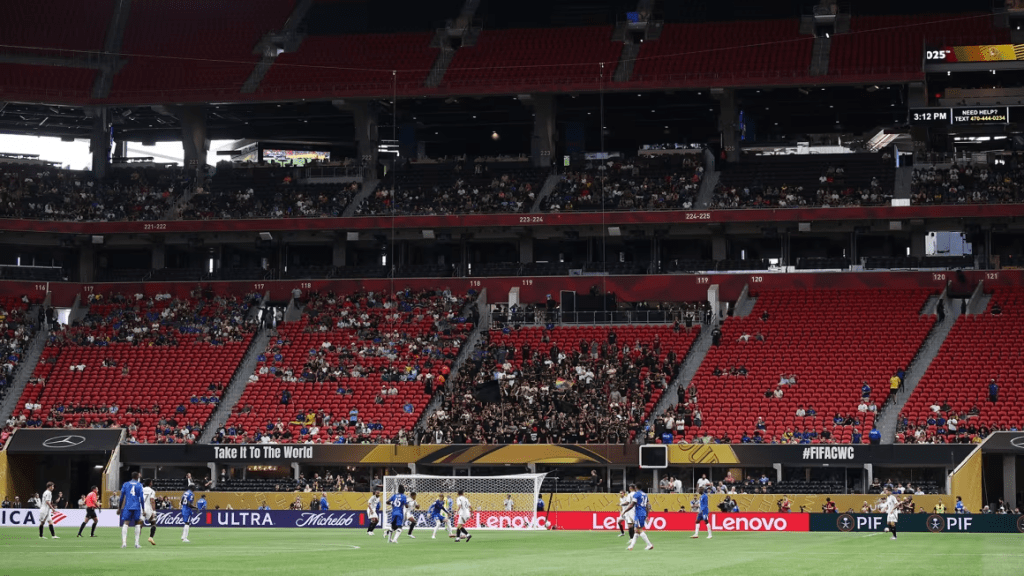
Empty Stadium Summer

Empty stadiums, arcade blues. Writing about games and reveling in learning, play, and art while there is so much else to worry about, and still enjoying the shimmering threshold of summer break–as I always say, still playing EarthBound, I just want to acknowledge nevertheless all the ways this could go sideways, and has already for so many.

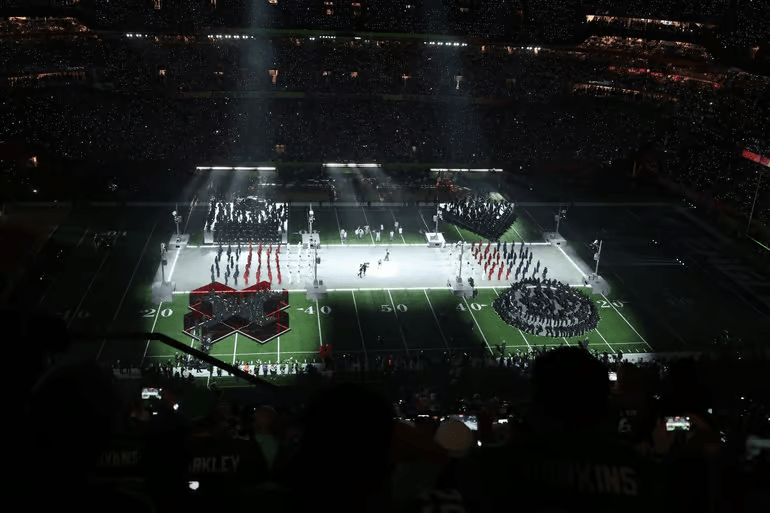
Chelsea 2-0 LAFC in Atlanta last week opening the Club World Cup. Alex Grimm/Getty Images via CNN

Can we look at those empty seats and think of anything other than what has been going on across the country in LA, and with the funding of Qatar and the backing of the US a world away in Israel and Gaza?

And can we register sufficiently the juxtaposition of the birthday parade wrapped in assumed glory of the world’s premier military against the popular protests openly threatened with that very force?

Can we agree that it is possible to stand for the country, with all its baggage, and stand against its own overweening power? One would have thought these were settled questions, but then one’s history has been bifurcated and multifarious from the get-go.

Or is it too little to berate the angels of history, without going further and saying that only learning, play, and art, traced back to their very deepest roots have any hope of saving the world?

Among the news and news-like content, most of it bad, as ever, I’ve recently overheard some interesting, hopeful things about games:

‘And I’m now talking as an historian, looking back… big changes are not the creation of old guys like me… we’re not the people who have the ideas that will work to build social capital and to save America… I’m gonna be long gone. So first thing is go young and inspire the young people to come up with the new bowling leagues. It’s not gonna be bowling leagues, it’s gonna be something else. But almost surely will involve something of, of high tech. But it, it will involve real personal relations with other people–‘

‘Before you move on. A perfect example of that for me was Pokemon Go. So I I’m assuming neither of you played it, but I was, I was a huge Pokemon Go fan. Huge. Huge, huge. I think this was the best execution of a video game in the modern age because it was a video game that everyone played. It was on your phones. Yeah. Right. And the goal was to catch Pokemon. You don’t need to know what any of this is, just think of a game where you’re trying to catch little creatures. (Okay.) But what they did that was amazing was you had to catch the creatures in the real world. (Ah.) So they used your camera on your phone and you would literally have to run out into the streets to catch these digital creatures.

‘And so at first it was just like, oh, this is silly and this is fun. But I’ll never forget the joy I experienced when one night I was in New York and I was running with a group of people in Central Park–strangers at 11:30 PM–because someone had tweeted and told us that there was a Snorlax, which is one of the creatures. There was a Snorlax in Central Park. And Bob and Christiana, when I tell you there were, if I was just to estimate, there were like maybe 500 people from like little kids who had dragged their parents out of the house all the way through to like adults who are playing the game running. And I remember at one point one of the kids turned looked at me, well ’cause we’re all running ’cause there’s a time limit. You don’t know how long the creature will be there for. So we’re all running through Central Park together. And one of the kid turns, turns, looks at me, this kid’s like maybe like 14, 15. And he looks at me and he is like, he’s like “Trevor Noah!” He’s like, “you, you play Pokemon Go!” And he’s like, “now I know I’m in the right place,” and we’re running together.

‘But I what I, what I loved about it was it, to what you’re saying, it was the perfect culmination. It wasn’t the either/or. (Yeah.) We were all playing all digital game. It was the alloy. You could play the game at home and we were playing it at home, but you could not help but bump into other people who were playing the game as well in the real world. And it, it was such a beautiful– ’cause once the Snorlax was gone, all everyone could do now is talk. “Where are you from? (Yeah.) Hey, where do you live? (Yeah.) Where did you, what’s the best one you’ve caught?” What have you. And this was like the game won awards, by the way, even for getting people fit and running and moving it. Yeah. But I I, I love that. So like when you say the going young and figuring out the, the hybrid, I think there are ways to do it. ‘Cause some people would be like, oh, I don’t know if you can, I think we actually have seen one of the ways, and I know because I played it, but Yes. Okay, so what’s rule number two?’

‘Rule number two is go local. Go local…

(Trevor Noah in conversation with Robert Putnam, circa 56 minutes in, per the transcription)

And then on The Bible Project, they’re beginning a series on the theme of Redemption:

Jon: But if I’m in an arcade, right? You bring your kids to an arcade, and they get—
Tim: Oh.
Jon: And they get the tickets.
Tim: Redeem the tickets.
Jon: And you redeem the tickets for, like, prizes?
Tim: Mhm.
Jon: I think I would use—maybe use redeem, there.
Tim: Yeah.
Jon: Okay.
Tim: Yep. Okay. So we have, by our house, in southeast Portland—is one of Portland’s
oldest—
Jon: Oh, yeah.
Tim: Classic video arcades.
Jon: The nickel arcade.
Tim: Yeah. It’s called Avalon. The building’s a hundred years old. And it smells and
feels like it when you go inside.
[Laughter]
Tim: And they have accumulated this collection of—it’s, like, three big rooms. It’s—
actually, now, when I go with my kids—which I’ve really limited how often they can
go.
[Laughter]
Jon: They love going?
Tim: They love going. But you go into these dark rooms. It’s like a kid’s version of a
casino.
Jon: Yeah.
Tim: There’s no—
[Laughter]
Tim: Windows.
Jon: Totally.
Tim: There’s no external light.
Jon: Yeah.
Tim: It’s dark.
Jon: Yeah.
Tim: And the only light there is purple, and blue, and green—
Jon: Yeah.
Tim: And red from the games. And it’s just so—a cacophony of noise.
Jon: Yeah.
Tim: And it’s—for me, it’s oppressive.
[Laughter]
Tim: And, uhm—
Jon: And then you spend 20 dollars—
Tim: Yeah.
Jon: And you end up with like 200 tickets.
Tim: Exactly. But many of the games—some of the classic ones like Ski Ball and—
Jon: Yeah.
Tim: The basketball hoop either prints out tickets, or now, it all happens on these
little cards.
Jon: Digital—
Tim: Digital cards.
Jon: Tickets.
Tim: And if you get tickets, then they’ll accumulate on your card. And so then the, the
end of the ritual—it’s like a liturgy—
Jon: Yeah.
Tim: Is—
Jon: How many Tootsie Rolls can I get from these—
Tim: Going to the counter.
[Laughter]
Tim: And then they stand there, and these poor—
Jon: Oh my gosh.
Tim: Workers—
Jon: I know.
Tim: At the arcade—
Jon: Yeah.
Tim: God bless them.
[Laughter]
Tim: Just these indecisive, you know, wishy-washy ten-year-olds being like: “Do I
want the mint Tootsie Roll, or the blueberry, or the chocolate?” You know. And
they’re so patient. So what they’re doing, in that moment—is that my kids have
played these games, and they’ve earned this—
Jon: Tickets.
Tim: This value.
Jon: Yeah.
Tim: They’ve generated value.
[Laughter]
Tim: Right?
Jon: Yeah. Mhm.
Tim: Isn’t that right?
Jon: Yeah.
Tim: In the economy of the arcade—
Jon: Yeah.
Tim: They’ve generated value by winning these games. And then they can take that
value and then go look at a glass case with, like, cheap plastic laser guns or Tootsie
Rolls. And what they do is they lay a claim to that. They’ve accumulated value—
Jon: Yeah.
Tim: And they see something else of value. And they’re like: “I want that to be mine.”
And then you—
Jon: Exchange.
Tim: The exchange.
Jon: I’m exchanging my tickets for the laser gun.
Tim: That’s it. Yeah.
Jon: But you need like 2000 tickets for the laser gun.
Tim: That’s r—
[Laughter]
Jon: You’re not going to get that one.
Tim: Tot—it’s so ridiculous.
[Laughter]
Tim: It’s like somebody actually paid thirty dollars—
Jon: Yeah.
Tim: For a, a cheap—
Jon: Yeah.
Tim: Toy laser gun that breaks in a week. Anyway. So it’s that exchange of value.
Jon: An exchange of value.
Tim: Yeah. There’s something that I’m going to lay claim to, and that will be mine.
And then I do—I go through some process of transferring it into my possession. And
th—that whole process is, I think, what the word redemption, and or redeem
classically, means in English.
Jon: Okay. Is that the main meaning of the word that we’re translating from Hebrew
or Greek? …

(Relying again on the transcript, but give it a listen)

Of course it’s called the Avalon

So anyway. Part of what I’ll be doing this summer is still playing EarthBound and trying to learn Japanese yet, and part of what I’ll be doing, as ever, is singing along and listening for what I can hear of these Redemption Songs through the noise.

Video Games in The Haunted Wood

The Haunted Wood: A History of Childhood Reading, by Sam Leith, comes highly recommended.

“One of the best surveys of children’s literature I’ve read,” blurbs Philip Pullman. “It takes a particular sort of sensibility to look at children’s literature with all the informed knowledge of a lifetime’s reading of ‘proper’ books, and neither patronise (terribly good for a children’s book) nor solemnly over-praise. Sam Leith hits the right spot again and again. The Haunted Wood is a marvel, and I hope it becomes a standard text for anyone interested in literature of any sort.”

In the run up to the release, Leith appeared on an episode of Backlisted, a wonderful podcast which I first found thanks to their episode with Pullman on The Anatomy of Melancholy, one of those tomes, like Gargantua and Pantagruel, anchoring my own personal backlisted pile.

The main reason I bought Leith’s book new and read it right away is that its final chapter is about Pullman’s work. As far as that goes, I’ll have more to say in another place. But what brings me out of my extended spring break to write about it here is the way video games surface in the text as a point of comparison and contrast with children’s books.

The first reference to video games comes roughly midway through the book in a strangely interpolated chapter, “The Idiot Box,” which does not appear in the table of contents. We are in the transition from the era of Philippa Pearce, CS Lewis, and Tove Jansson (about all of whom Pullman has quite a bit to opine) to that cohort of writers, immediately preceding Pullman himself in publication, that includes Alan Garner, Susan Cooper, Ursula K. Le Guin, and Madeleine L’Engle.

Here Leith takes up Roald Dahl’s critique of television, memorably sung by the Oompa Loompas against Mike Teavee in Charlie and the Chocolate Factory, in order to set the scene for “the early sixties”: “Dahl’s message…was not just that the then infant technology would make children stupid: it was that it existed in a zero-sum war against children’s literature” (369).

Leith goes on: “The relationship between television and children’s fiction is a complicated one–and not as simply antagonistic as Dahl suggests. What is undoubtedly the case is that the narrative worlds of children were changing, and that television, as the dominant cultural medium, had a huge part in that… But it hasn’t shown any sign of wiping out children’s literature, any more than videogames (the moral panic of our own day) have seen off television.” The only problem with this framing is that “our own day” is already too dated. The moral panics of “our” youth, such as Dungeons and Dragons and video games, have been largely eclipsed by smartphones, social media, and AI.

Citing Jacqueline Wilson’s memoir to support his contention that “Television came to be freighted with the same anxieties as, two centuries before, fairy stories had been,” along with early studies of the effects of television on children in England from Hilde T Himmelweit, Leith comes around to “a crucial point. Children’s stories have always existed, where they get the chance, in more than one medium, and spilled between them. Playground games draw on things that children have read about in books–remember the Bastables playing The Jungle Book on the lawn?–and children’s stories in turn draw on or feature playground games and children’s books. Children’s stories themselves depict children consuming children’s stories and using children’s stories to make more children’s stories. In this respect, these properties have something of the quality I’ve remarked on in myth: a blurriness, an availability to be reinvented, and even an orality, in the way that the spoken performances of the playground remix the mythos each time. The boundaries of children’s writing, of children’s storytelling, are as indistinct as the boundaries of the haunted wood itself” (373).

This is all brilliant. As everywhere in a wide-ranging, mellifluously written book such as this, there leap out opportunities to widen and enrich the field still more: reference to Neil Postman’s far more trenchant critique of television, rather than the strawman Dahl, would have made the same “crucial point” even stronger; acknowledging the ways in which fears about video games have flowed into still more addictive technologies would have kept Leith’s work, at least momentarily, abreast of the present time rather than snug in “our own” childhood at the end of the past century.

Again: “In our own age there are probably more videogames that have become TV series than there are videogames made of TV series… From the top-down point of view, this is no more than the free market doing what it does… but from the bottom-up, child’s-eye perspective, it’s completely natural: stories spill over. When you’re playing with an action figure, you’re writing a story” (374). A world of interpretive, ideological messiness hinges on that “but” distinguishing the “market” from the “natural,” but all we would add, really, is that when you’re playing a video game, particularly from the early era of the medium which Leith seems to be thinking about, your imagination is engaged in filling out the story in much the same way. He would probably agree; it’s implied in the thick bundling of media connections here evoked.

So it is strange that when we come to the end of the book, Leith writes in his Epilogue, “as an unashamed lover of videogames,” that “even in the sort-of-storytelling ones, the story and world-building are secondary to the gameplay… A videogame will always struggle to do what fiction does, which is to allow yourself to envision what it might be like to be somebody else… If you and I play through a videogame, we will have experienced the same world on screen” (552-3). All of which is preposterous, especially given the story-embracing account of play that Leith provided around the midpoint of the book.

Perhaps Leith is carried away by the fear of “more than just figuratively addictive” games like Fortnite, which he singles out and sums up with the footnote: “If you don’t know what this is, count yourself lucky–or ask an eleven-year-old. It’s a hectic videogame in which everyone’s trying to shoot everyone else.” In an attempt to acknowledge and reckon with more recent statistics which paint a much bleaker picture of the reading habits of young people, Leith produces his own Oompa-Loompa-shaped strawman doing a DLC dance. He conflates online games like Fortnite with videogames writ large, setting them in opposition to fiction, as if that, too, were a monolith.

As a history of children’s books, The Haunted Wood is wonderful. As cultural commentary on the interplay between books and video games over the more recent history during which both have figured in our imaginative and social lives, it demands considerable filling out. To be fair, Leith does not even pretend to provide such a commentary, with the exception of these two widely separated passages. But as a lover of video games and reader of books, I will say I remain perplexed and disappointed by the turn from that one passage to the other.

If I ever get around to writing something comparable for the games that have shaped my experience of the world, alongside books by the likes of Tolkien and Pullman, I’ll be sure to credit The Haunted Wood for encouraging me by its example.