RPG Nirvana & JRPGana – The Definitive Book of SNES RPGs by Moses Norton & A Guide to Japanese Role-Playing Games by Kurt Kalata

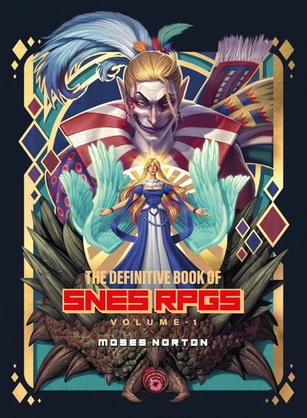
The Definitive Book of SNES RPGs (Vol. 1) by Moses Norton and A Guide to Japanese Role-Playing Games by Kurt Kalata (ed.) are both published by Bitmap Books, new within the past month and last few years, respectively. They are doorstoppers, beautifully produced, quite pricey, and worth every penny. My name appears in the acknowledgements of the former; many of my favorite games–EarthBound/MOTHER 2, Chrono Trigger, Xenogears, Wild Arms, and so on–appear in the latter, though each game is afforded only a page or two due to the book’s massive scope.

I’ve long dreamt of writing a book like these, a kind of Haunted Wood for video games, but I haven’t actually played all that many of the incredibly rich and diverse body of games that Norton and Kalata cover. Particularly, I’ve wished I could better understand my favorite games of the golden age of console RPGs in their cross-cultural context, having tried, so far with little determination and less success, to learn Japanese for that purpose–so I’ll settle for reading others who can, for now.

A few disclaimers up front: I am aware that Moses and the Bitmap folks have faced a smear campaign and waves of cancel-cultural recrimination over comments he made, but I will step around that. This choice, like the review which follows, is, needless to say, not entirely unbiased by my personal friendship and professional respect for the writer also known online as The Well-Red Mage, nor my admiration, shading into jealousy, of the productions of the Bitmap team and writers of Kalata’s clout who have worked with them. But what’s an amateur Video Game Academy scholar to do? We have to talk about the games themselves, first and foremost, in all humility and giving grace as far as we can, extending the circle of dialogue, lifting up the voices of students, fellow hobbyists, fans, content creators, and industry professionals alike. None of us is perfect, none of us ought to feel we’re in a position to cast stones, in my view; with all deference to the righteous Redditors and other pharisaical denizens of the retro games discourse, I can’t see who is helped by such a pile-on. Or, if that disputed passage in John’s gospel is not to your taste, let’s say it in Dostoevsky’s terms, from Alyosha and Grushenka’s tete-a-tete in The Brothers Karamazov, with a Sakaguchi spin: I’m all for giving an onion (knight), giving a second chance or New Game Plus, once someone has apologized. I can only offer an apology of my own to whoever has been harmed by the exchange and its fallout. Certainly I wish Moses and his family the best after the wringer they’ve been through, and hope that Vol. 2 of his book is not too long in coming, whether from Bitmap or another source if they’re not able to patch things up.

Bitmap Books, via The Video Game Library

But without further ado. Per the title, and in line with its author’s long-time, courageous project of bringing greater objectivity and rigor to the discussion of widely beloved games from ye olde eras past, The Definitive Book of SNES RPGs (not only JRPGs, mind, as I initially thought) takes as one of its points of departure “a new systematic approach to defining an indefinite genre” (31). I found this section powerfully clarifying, as I tend to have a much more intuitive, wishy-washy stance on questions of categories and sub-genres. Norton lays out a practical “Rule of Three: Character, Combat, Narrative” with each of these further breaking down in to three elements: Roles, Progression, and Statistics for Characters; Combat as such, its Turn-Based mechanics, and Variables; and Narrative story arcs characterized by Economy and Exploration. Where two of the three larger headings overlap, or where an RPG is more heavily weighted towards one or the other, we get the sub-genres of “action” or “adventure,” or indeed “action-adventure,” but any game that has at least some significant elements of narrative, combat, and character development can be fairly called an RPG (37).

Ranging over the 22 games this rubric brings under discussion, covering the first half of the SNES RPG library’s alphabet, Norton’s analysis is anchored by these mechanical considerations–and isn’t it refreshing to see how he chooses to cut across the usual distinction between gameplay and story, opting instead for this powerful, flexible Rule of Three? Each chapter opens with a graphic indicating which elements are deemed to be in evidence, alongside the developer and publisher credits, and while plenty of the games have all nine icons, there are a handful of edge cases. “King of Dragons isn’t an RPG! I can hear you yelling” he remarks in the penultimate chapter; to which I have to reply, demurring, “I’ve never even heard of it” (501). And in fact these debatable RPG inclusions, especially ActRaiser and EVO, make for some of the most interesting chapters in the book in terms of defining what an RPG is, and what a particular blend of mechanics, story, and gameplay loops portends for thematic questions about the meaning of a given game as a work of art.

For, as even a cursory reader soon discovers, dipping into chapters here and there rather than plowing through the book cover to cover as I did on my first read (though I heeded Norton’s caveat to go out of ABC order so as to flip-flop Dragon View and Drakkhen,”the first SNES RPG” 302, and one with a fascinating lineage that may or may not intersect with Gary Gygax himself), the close analysis of game elements in line with a wider project of empirically defining the genre is only one of the book’s significant threads, and perhaps not its most important. Just as Narrative and Combat are mediated by Character, Norton’s own voice, experiences, predilections, and indeed his character are present throughout the discussion. Along with the requisite historical context, pertinent information about the games’ development and systems, and more or less entertaining trivia and Easter eggs, we get a personal tour of each game’s world, its challenges and triumphs, and reflections on all of it from a true connoisseur.

For me, the best sections of the book weren’t actually the ones about the best games: the tour de force of Chrono Trigger or the ebulliently playful-yet-earnest EarthBound (which I read and commented on for the author in draft), or the groundbreaking FFII or even the operatic FFIII; nor was it, on the other hand, Norton’s almost impossibly judicial, admirably evenhanded treatment of the execrable Lord of the Rings. Much as I appreciated these for how they provide wonderful, coherent perspectives on games I know and love (or rather hate, in the case of the SNES LotR, as one can only hate a missed opportunity, a fall as profound as that from a Melkor, brightest of the Ainur–Tolkien’s text–to a Morgoth, archfiend and all-around jerk–its SNES adaptation), I find myself thinking most about, and flipping back to most often, the Introduction and the chapters on the Breath of Fire games.

The Foreword by Alex Donaldson, co-Founder of RPG Site, does a solid job setting the tone, and it is probably noteworthy that both he and Moses Norton are mixed race authors writing authoritatively, confidently, and joyfully about an industry where people of color are not always represented. Norton’s Introduction grounds the book in his upbringing in Hawaii, and he makes explicit the connection between his Native background, his longing for home, and a Tolkienian sea-longing most memorably expressed in great art, which combine to convey the importance of nostalgia in his conception of quality video game critique and analysis. This is all very much catnip to me, preaching to the choir if you like, just as much as his wise words about the meaning of an ostensibly silly game like EarthBound call and respond across the distance to concerns I’ve written and thought about for years, here and on sites run by Norton himself. In sharp contrast, really, to the more technical discussion of the Rule of Three, though both the technical considerations and nostalgic themes become integral to the chapters that follow, this is a big swing of an Introduction after my own heart. If I hadn’t known Norton already beforehand, I’d have reached out to him on the strength of the opening few pages, because I recognize here “a friend I’ve never met,” to use the Pauline (EarthBound’s Paula, that is) locution, a fellow aficionado of 199X RPGs.

In the chapters on Breath of Fire and its sequel, the book’s throughlines of biographical experience and nostalgic retrospection come together in what for me were the most illuminating fashion with its other core thread of systematic, definitional concerns with RPGs as games of a particular type. Perhaps this is because I’ve only played later Breath of Fire iterations, and had little in the way of preconceived ideas about the series, but these chapters spoke to experiences I’ve had from a direction I wasn’t expecting, and landed with startling insight. Maybe this is how people who haven’t played Xenogears would feel listening to my interminable podcast commentary on that game; one can hope! I love the idea that within an objectively slightly janky game, “you may be able to spy the inner workings of a mythos in the making” (168). I would even go further and say that not despite but because of the obstacles in the way of such a glimpse of the seed of a mighty idea, old games like Breath of Fire are inseparably fused to this homeless time of ours, when we deal daily with such a dearth of living myths that we will grab onto them anywhere we can. The games’ religious ambiguity and political, race- and class-conflict story beats, in this light, are almost too poignantly prophetic of our current confusions and divisions. And they shed a light, a warmth, a breath, why not, over players who take the time, as Norton does, to connect deeply with their stories and weave them into their own. Witness some snippets:

Upon starting a new game… a voice in the darkness cries about giving yourself to God and becoming God’s strength…

This is none other than Breath of Fire II, the globe-trotting, history-spanning, darkly religious, draconically epic sequel to the original Breath of Fire, though I describe it simply as “formative”… I spend a lot of words in this book regarding themes, analyses and the meaning embedded in these stories told by means of the Super Nintendo, but when it comes to this game… it’s personal.

Breath of Fire II immediately won my heart from the moment I saw its beautifully realised world, a crystallisation of all of Capcom’s 16-bit sensibilities…

What I didn’t realise at the time was the fact that this game would not only win my heart, but also my soul. I know; even to me it still seems odd to describe encountering a video game, a mere sequel, as a religious experience. Yet somehow, I’ve wasted years describing the early Breath of Fire games as staunchly traditional. I’d like to recant…. (177-179, excerpts; British spellings courtesy of Bitmap.)

Over the course of a nuanced discussion of the game’s religious themes, centered on the duplicitous Church of St Eva, tied in with personal reflections about growing up “in the church” of Western missionaries looking at “the monarch chrysalis hanging from a branch outside” as an image of Pauline transformation (yep, that Paul), an image of the winged anime girl Nina above a cartouche of text discussing a goddess joining the player’s party is balanced against a lengthy passage from CS Lewis on “the Numinous” (182-3)–and lo, it hit me like the thunderbolt on Ryu’s sword that the construction of Norton’s book, heartfelt, syncretic, overflowing with connections between games, literature, and life, mirrored almost exactly the message of these games which he sought to express. The content and form, medium and message, like a successful dragon transformation, were one. And to cap it off, on the next page Ryu celebrates catching a fish as Norton explicates what I had perceived: “It was in this realm of fusion and confusion [Hawaii both as place and as touchstone for his studies of myth and religion] that the roots of my interest in spirituality dug deep, and I really have Breath of Fire II to thank for that” (185).

Again, I found the book immensely valuable precisely because it taught me so much about games I only knew the name of, if that, and will likely never play. Thankfully, Norton has trekked through the likes of Brain Lord and Inindo so I don’t have to, and recorded his discoveries. In a few cases, I also may go ahead and track down some of these more obscure titles just out of curiosity, or to show them to my students or my own kids out of a kind of historical whimsy. But I will undoubtedly move the Breath of Fire series right onto the mental shelf with EarthBound and FFII and find time to play them alongside one another someday.

Norton’s chapters each close with brief notes from other players corroborating and qualifying his reasoning, layering onto his experience of the games the texture of their own voices and memories. Of Breath of Fire, Livnat writes “I also loved that fact that for me, who was also just learning English, there was no real need for a lot of dialogue to get the picture; in fact it enabled me to fill the void of plot with my own understanding of the game, and my own ideas and thoughts” (173). This is much the way Toby Fox talks about learning to read from EarthBound, and how I remember learning from JRPGs like Dragon Quest and FFII my own language, reflected back to me across the bridge of terse NES and SNES localizations; or later, learning Spanish from Platero y yo, before I knew most of the vocabulary enchanted with its sound; or how Philip Pullman talks about the prose of Kipling’s Just So Stories, or the poetry of The Journey of the Magi and Paradise Lost. To repeat, these old games, like these great books, encode a universal archetype, that of the learner–of language, or myth, or a game’s rules–facing a mystery and patiently listening, imagining, playing their way towards comprehension.

It bears mentioning once more that the visual style of Norton’s book, too, is almost intoxicatingly good. The layout, the choice of sprites, backgrounds, and other assets, and still more the peculiar CRT-filter quality of the images, all argue as strongly as the words about the need for us a culture to continue re-evaluating the role of nostalgia and the place of games in the artistic canon.

All this is not to say the book is perfect. A line of text from Daniel Greenberg’s testimonial about Mystic Quest gets transposed 20 pages ahead to the top of Mama Terra’s for FFIII (421). Accompanying Norton’s text and his contributors’, exemplary screenshots from the games, many of which he played through while streaming on Twitch, and pull-quotes from developers and players alike carry the reader along. But as befits a book like this, not meant to be caparisoned in scholarly apparatus, these are not specifically cited.

Consider this passage from Yuji Horii: “The most important part of a RPG is the player feeling like they are taking the role of a character in a fully realised fantasy world. They can explore, visit various towns and places, talk to people, customise their character, collect various items, and defeat monsters. The story is not the focus of the experience and is only there to make the atmosphere of the fantasy world more interesting and engaging during the course of the game” (47).

Where did this quote come from? On the one hand, I can see the problem other armchair academics/neckbeard Karens might have with not knowing for sure, not knowing if Norton has done his homework and cited his sources properly. I, for my part, love that I can cite Norton’s book the next time I attempt to elucidate or take to task Horii-san for this seemingly apocryphal quote. It doesn’t matter so much where or even whether he said it, because he’ll a) never know I am writing about him, and b) if somehow my work were to come to his attention, he’d in all likelihood be perfectly secure in his stature as the godfather of the genre, caring not a whit for what I might quibble with in a quote attributed to him by, among many others, fellow scholar-fan-content-creator Moses Norton.

Bitmap Books, via The Video Game Library

To be Frankystein Mark II, I have not nearly so much to say about A Guide to JRPGs by Kalata et al., but I definitely wanted to note its presence in this connection. When I went to buy The Definitive Book from Bitmap, I couldn’t pass up the appeal of A Guide to JRPGs. It’s not that I don’t find the book as interesting or readable as Norton’s (though I don’t mind saying that I don’t); it’s a very different beast, and not as much to my personal taste. Almost devoid of the personal touches and wrestling with deep questions, both of meaning and mechanics, that characterizes Norton’s work, Kalata’s instead aims for breadth of inclusion rather than depth of inquiry. So I allude to it here mostly as a point of reference.

Now, there are definite strengths to A Guide’s approach, and enormous quantities of information to be found there much more pleasantly than by trying to search for it on wikis with the help of google translate. The very unassumingness of its title, A Guide, belies the wealth of arcana in store for the reader. Even I, I’ll confess, have not managed to read this one cover to cover, though I made sure to dip into favorite games, obscure artifacts of the pre-Famicom era, and salient introductory sections like “What is a JRPG?” “A History of RPGs in Japan,” and “Attack and Dethrone God.” For anyone interested in topics like these–that is to say, just about anyone still reading this, AIs excepted–A Guide is a treasure trove. The perfect combination of bedside curio and coffee table conversation piece, its 650-odd pages and painterly cover adorned with a red binding somehow contrive to feel almost weightless. The prose, similarly, though it lacks Norton’s spiky charm and consistency of voice, being written by a large crew of expert contributors, is nevertheless light in tone, more journalistic than essayistic, and manages to remain easily readable despite the necessarily tiny font.

For a more Norton-esque entry in the same encyclopedic vein, see also Aidan Moher’s Fight, Magic, Items (and my review here) or the Boss Fight Books collection (ditto), though those are each about a single book, for the most part, and would have to be grouped together, Power-Ranger-like, to contend on something like the same scale. But do yourself and your RPG-loving loved ones a favor: the holidays are close enough, surely, to warrant a gift, even if it’s a bit pricey. Books like Norton’s and Kalata’s promise, in turn, the gift of conversations, debates, playthroughs and shared memories. To be passionate about old games is all well and good, but these debates are best conducted cordially, just as the books about them will be most profitable if read charitably. If the conversation that is our shared culture is to be sustained at all, we have to carry it on remembering that there is a person on the other side of the screen, someone who’s fortunate to have been bathed in the same sort of CRT glow we remember, maybe, from the sun of a winter’s or summer’s holiday long ago.

Please, read the books for yourselves and comment responsibly.
EarthBound Zero to Kentucky Route Zero: On “Music and the Video Game as Ritual Encounter,” by Tim Summers, and some of Itoi’s Influences

With plenty else to do this weekend, being as it is at once the end of MAR10 week and the day after pi day, the ides of March and the eve of St. Paddy’s, I’m popping in here at the humble video game academy just to direct your attention to a few other wonderful reads.

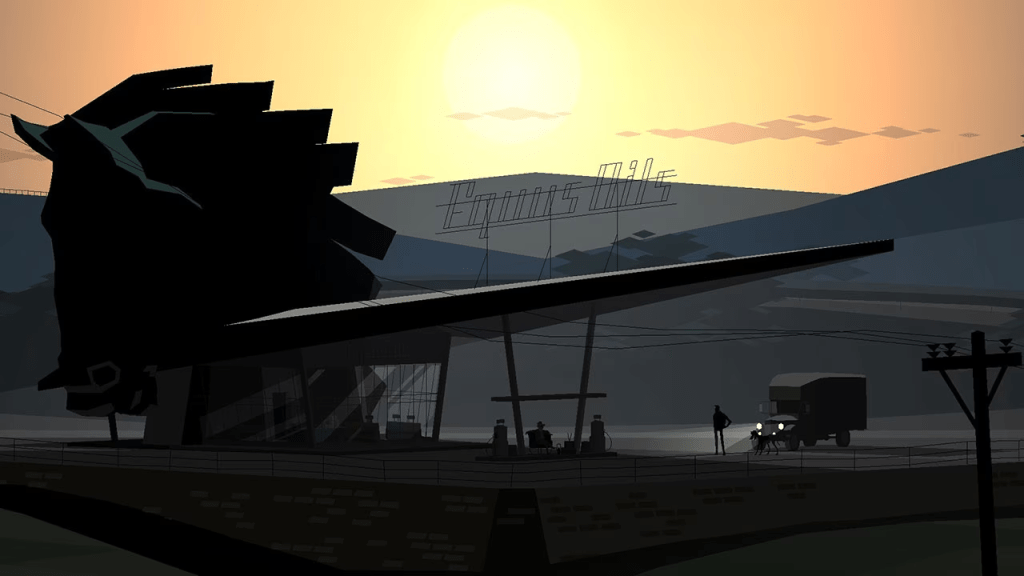
An imaginary video game, a Kentana Cold Snack.

First, Professor Kozlowski is back with his long-awaited, long-form essay on Library of Ruina, which will be serialized here for the next little while. In this first post, he sets the groundwork for future anthropologists interested in the MAGA, redux era in which we find ourselves, and lays out the stakes for the commentary to follow:

I came to Library of Ruina with more expectations than were reasonable.  I wanted it to be more than a game—I wanted it to be life advice, solace, and wisdom.

As it happened, I was not disappointed.

In a similar vein, I find myself turning to games and their mythological content for solace, but also to getting outside to walk and play in nature now that we are beginning to thaw. I think back to unfinished posts from past summers about then-unfinished games, like Kentucky Route Zero, and how I imagined a mod of it for every state, like Sufjan Stevens’ quixotic project of musical albums.

“Soulful, evocative, and one of the most important games of the last decade” – Elise Favis (Washington Post). That’s the 2010’s, the decade in which I played Undertale, Kentucky, and not much else that was new.

Only I would start not, like Suf, with Michigan, but with Montana, our next-state-but-one neighbor with its “Hiawatha names” (CS Lewis by way of Philip Pullman), its bike route along the repurposed train tracks, its trestles and tunnels and tales of sleeping car porters and frontier towns, like the town of Falcon. Placards along the trail, just as in an RPG or as in liner notes to an album, contribute to the worldbuilding, the sense of depth and history. While the treetops down below exhale their leaves’ water toward the sky, somewhere a driver on the highway is worrying how he’ll pay a medical bill; a trickle of water runs downhill. Call it Montana Exit Zero.

I first encountered the (actual) game at an exhibit at the Seattle Museum of Pop Culture (MOPOP; then known as the EMP). Similarly, Tim Summers, in a presentation on games and music as ritual space, notes: “the museum sequence of Kentucky Route Zero found an additional parallel when the game featured in the exhibition Design, Play, Disrupt held at London’s V&A Museum, an exhibition intended to illustrate the connections and interplay between video games and other art forms.” While he references work by Dorothea von Hantelmann, who in turn cites other artists and scholars including Chinua Achebe and Pierre Bourdieu, I can’t help but wish there were more substantial engagement with mythic language, which games speak and make space for at least as well as they foster ritual engagement. Thinking of course of Sloek, but also of a classic text like Jenkins’ “Complete Freedom of Movement,” as transmitted via Alyse Knorr’s Mario 3.

Fundamentally, though, I think Summers is on the right track. To quote from the conclusion:

If the theatre is too homogenizing and restrictive, and the museum too isolating, then games occupy a middleground of play. Kentucky Route Zero’s depictions of museums and performances make this middleground particularly telling, but the example merely provides an explicit manifestation of aspects of engaging with games more generally evident in games. It is helpful to recognize the ritual qualities of games, their structural framework, social functions and connectedness to past forms of ritual. These ritual discussions can then help to illuminate how games create a powerful and compelling aesthetic experience, and how music is an important part of this experience.

His Mother/EarthBound Zero and the Power of the Naïve Aesthetic: No Crying Until the Ending,” (chapter in Music in the Role-Playing Game) was why I became interested in Summers’ work, directed to it by the references in the anthology Nostalgia and Video Game Music. There, too, he makes a point about the effects of diegetic music (drawing on the work of a film critic named Winters, which I find delightfully serendipitous given the EarthBound connection) very similar to the approach I take in my discussions of moments of artistic ekphrasis and self-consciousness in games such as EarthBound, Xenogears, and most recently Final Fantasy VIII.

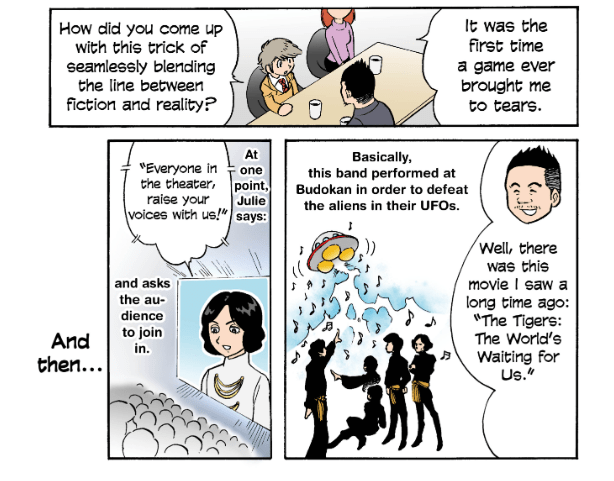
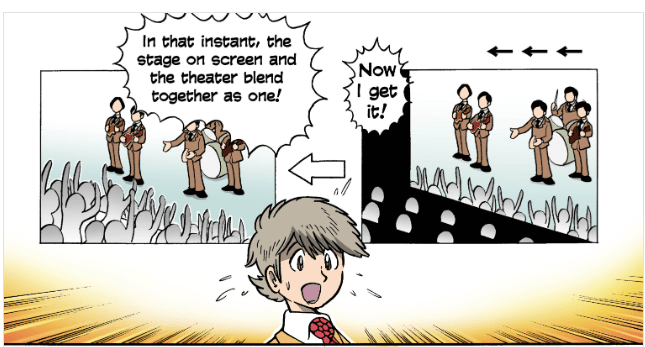
What’s more, he cites an article in comic form by Keiichi Tanaka: “A Tapestry Woven from the Words of Shigesato Itoi and the ingenuity of Satoru Iwata,” wherein Itoi’s inspiration for the conceit of including the player’s name in the credits, following Tanaka’s line of questioning, reveals itself on Summers’ reading to be a a key point of departure for the use of diegetic music in the MOTHER games. The relevant portion of the manga interview is recounted as follows:

If you could only see the manga-level big emotions on my face, “smiles and tears,” as I’m over here processing this. Maybe I should start twitch streaming myself reading and writing…

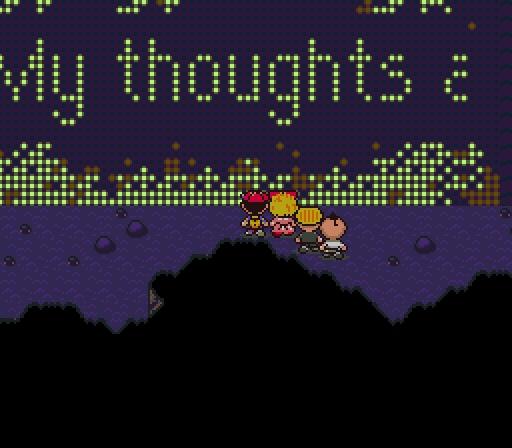
The “Climax of The Tigers: The World is Waiting for Us” has been uploaded to youtube, and segments of it are on archive.org. A screenshot of the moment Itoi is remembering (autotranslated):

Part of what makes this such a revelation (to me at least; the top commenter on the video knew 10 months ago and more–

So chalk another one up to the power of the collective internet hive mind over against, say, sensitive scholarly types like your author and Clyde Mandelin, my main resource for Itoi knowledge)–part of what makes this such a revelation that I can’t get a coherent sentence together is that it strikes me as uncannily akin to the experience JRR Tolkien had with the stage version of Peter Pan.

According to Carpenter’s biography: “In April 1910 Tolkien saw Peter Pan at a Birmingham theatre, and wrote in his diary: ‘Indescribable but shall never forget it as long as I live. Wish E. had been with me'” (53). “E” is Tolkien’s muse and future wife, Edith Bratt. Carpenter goes on immediately to another early influence, “Catholic mystic poet Francis Thompson” and especially his Sister Songs, but it is worth dwelling–and no doubt plenty of Tolkien scholars have dwelt–on Tolkien’s connection to Peter Pan and this particular version of it, which he could not describe for all his poetic, sub-creative powers of description, and regarding whose inexpressible contents he had a particular audience or rather companion in mind. Particularly in light of his discussion of “faerian drama” as “Enchantment” in his essay On Fairy-stories, Tolkien’s experience of the audience participation in reviving Tinkerbell by applauding (or not) and Itoi’s of the audience cheering and singing along with the Tigers make for a fascinating comparison.

Tigers also provides an equally illuminating contrast with the film influence that I did know about when I was really studying Itoi’s games, thanks to Mandelin and his Legends of Localization:

The Traumatic Inspiration Behind Giygas’ Dialogue
Shigesato Itoi has stated that the mixture of pain and joy that Giygas speaks about was inspired by a traumatic childhood memory. As a young boy in the 1950s, Itoi visited a movie theater but accidentally went into the wrong screening room. He saw a scene from Kempei to Barabara Shibijin (“The Military Policeman and the Dismembered Beauty”), a mystery film with elements that were considered dark and appalling at the time.

The scene in question involved a woman being murdered while making love to her fiance. The sickening mixture of pain and pleasure greatly disturbed the young Itoi, who ran home and barely spoke a word that night. Itoi wanted players to experience that same feeling during the final battle of Mother 2, so he wrote Giygas’ text to include a combination of pain, pleasure, and more.

Itoi recalls another incident that inspired Giygas’ dialogue:

Gyiyg snaps and loses his mind, as you know. Well, this probably isn’t the nicest topic to bring up, but a long time ago I happened to witness a traffic accident. A young woman was lying on the ground, but instead of saying “I can’t breathe!” or “Help!”, she cried out, “It hurts!” That really disturbed me. I felt that having Gyiyg say this same line would make you reluctant to attack him, even though he’s the enemy. He’s even calling your name the entire time. As for the line “It’s not right”, it means “What you’re doing isn’t right, and what I’m doing isn’t right.” I have to say, a chill went through me when I was coming up with all of these lines.

Whereas, Summers points out in his analysis, with the “Eight Melodies” theme Itoi not only has indelibly marked a generation of players of the original game with a distinctly childlike and “naive” impression of the power of art, but this song has even been included in Japanese elementary school music textbooks for decades, touching a generation that perhaps has never played the original game. Here are Itoi, Suzuki, and Tanaka in conversation about it: “MOTHER’s music was demonic” 😮

With that, I’ll go back to my own reading and writing and touching grass. As Thompson has it:

From its red leash my heart strains tamelessly,
For Spring leaps in the womb of the young year!

Hope you enjoyed your St. Paddersday, and here’s to spring!

Powergaming the System: Don Quixote, The Idiot, and the Language of Play in Politics

What would the original LARPer make of his afterlives literary and metaphorical, and most recently of the propagation of gaming vernacular into the halls of power?

Doing my best Dostoevsky imitation, I take my theme this time straight from the headlines. In The Washington Post Opinion, George F. Will writes, comparing apples to orange one’s lackeys with most infelicitous aplomb:

Elon Musk, a Don Quixote with Vivek Ramaswamy tagging along as Sancho Panza, recently ascended Capitol Hill to warn the windmills of tiltings to come. (“Memo to Musk: Overhauling government isn’t rocket science. It’s harder.” Jan 3, 2025)

Not to be outdone, other pundits have turned to ludic rather than literary idioms, drawing their points of reference for the unfolding debacle from video games, and especially from the virulent online parlance surrounding and stemming from them.

Ezra Klein writes in The New York Times Opinion about “The Republicans’ NPC problem — and Ours.” The article from February 16, 2025 is paywalled, but audio and video versions may still be freely available. There, his intro is intercut with a montage of right-wing voices echoing the phrase and ringing the changes on it: “non-player character,” “non-playable character,” used as a “new epithet for liberals.”

Egoistic and a little hurtful to be sure, but in The Atlantic, the stakes are raised even higher. There I find Charlie Warzel, Ian Bogost, and Matteo Wong shouting into the void that “DOGE HAS ‘GOD MODE’ ACCESS TO GOVERNMENT DATA“:

Doge has achieved “god mode.” That’s according to an employee in senior leadership at USAID, who told us that Elon Musk’s Department of Government Efficiency now has full, unrestricted access to the agency’s digital infrastructure—including total control over systems that Americans working in conflict zones rely on, the ability to see and manipulate financial systems that have historically awarded tens of billions of dollars, and perhaps much more. (Feb 19, 2025)

That’s… not good. At least, it doesn’t look good from the point of view of us lowly mortals and ostensible NPCs. But maybe that’s our own small-mindedness and blindness to the bigger picture. Maybe we had better just get good.

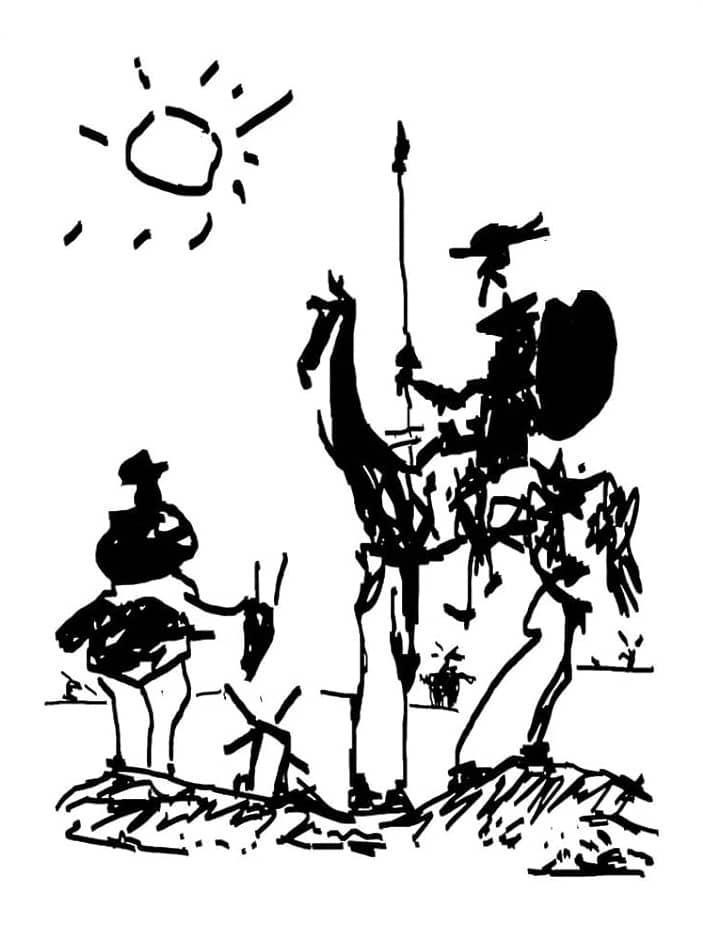
Obligatory Picasso sketch of Quixote. Is it good? Is he cancelled? I mean, I prefer Velazquez’s Meninas and Cezanne’s Bathers to Picasso’s, respectively, but he’s, well, Picasso (credit: pablopicasso.org)

Dreary sarcasm and ripped-from-context headlines aside, I actually think that going back to the literary exemplar of Don Quixote here might be a valuable way to get at the largest possible context for what is taking place in our time politically and economically as well as culturally, and that the “Poor Knight” of Cervantes and his re-interpreters will help us make sense of this sudden salience of a crude video game idiom in the halls of power and among its commentariat.

To begin working our way backwards: consider the last time that video games and politics intersected, to the glee of the trolls and the chagrin of the social-justice crowd. Well-known to the point of cliché, there was the outsize impact of “Gamergate” in the 2010s. Core to Alt-Right Playbooks and books like Black Pill, by Elle Reeve, still operative in the background of the current discourse, this was when the language of politics (“-gate”) and social justice infiltrated the discords and boards. And the reaction was fiery. “Keep your politics out of my games!” a tribe of neckbeards shouted, spewing doritos locos and dew. Less caricature-prone gamers, on the other hand, welcomed the incursion. Plenty of academics and other cultural elites, as well as people of all backgrounds and identities, play video games, and many of them evidently are not shy about their progressive-to-radical politics and aren’t afraid of breaking the proverbial lance with their normative antagonists.

The Pentagon discord leak; the high profile of gambling on the outcome of the 2024 election (and gambling in every aspect of life, especially professional sports); and still more recent instances like those cited above from the media make clear that just as political discourse has propagated itself into the video game cultural space, games have had their revenge, inserting their discourse into the political arena, cranking up its volume on either extreme of the ideological spectrum.

This is where Don Quixote comes in. By stepping back from the contemporary fray with the aid of a figure who so beautifully links the literary and the playful, perhaps we can trace a longer historical process at work, in which the logic of the market and politics to race to the bottom morally and intellectually nevertheless cast up such imaginative cultural artifacts and enduring personalities as to make their excesses and the ecological devastation that is their byproduct almost worth it. As Spariosu’s work along these lines has shown, there are many illustrative exemplars we might study with profit, but Quixote is certainly among them, and he offers a starting point which has the benefit of a sense of humor, however complex and at times jarring it may be.

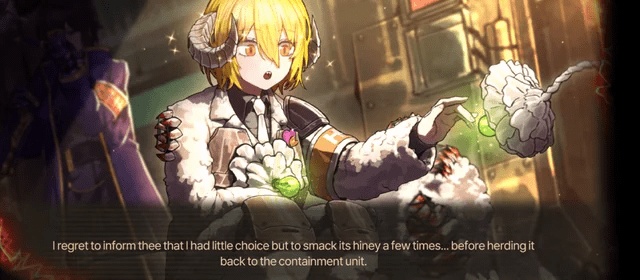
Don Quixote in Limbus Company. Image credit: Reddit.

To continue working our way reverse-chronologically to the source of the legend, in the remainder of this by-now-much-belated post we’ll touch on a few of the major instantiations of Don Quixote in media across the centuries. Most recently, as far as I know, he is depicted in video game form as one of the playable ensemble in Limbus Company. Intriguingly, her pronouns are she/her, and like Frog in Chrono Trigger, she speaks in a psuedo-old English, knight-errant register. We await impatiently Professor Kozlowski’s monograph on Limbus Company to unpack what is going on with this one, but unmistakably, given the wild premise of the game, a power fantasy of some kind is at play!

In the meanwhile, from a Diary of a Writer-esque post from October, here’s Prof Ben on Don Quixote, by Cervantes:

…the drama of Don Quixote isn’t in the text. The drama is in the reading. Quixote as character is one of the most famous literary heroes for a reason. And I think Cervantes wasn’t even sure what to do with him – not really. He’s clearly designed to be the butt of a joke; Cervantes uses Quixote to satirize and condemn the silly medieval romances of his day, pointing out the absurdity of these fantasies in his realistic modern context. But Quixote is too powerful for that. His mad dream of being a knight somehow transcends and transforms the realistic world Cervantes sends to confront him. We want Quixote to be right. His dream is more important than reality.

(Apropos of which, this is why I have such a problem with the comparison of Musk/Ramaswamy to Quixote and Sancho. I don’t see Musk in that light at all. If anything, he is more like the Duke and Duchess of the second volume, powerful figures who try to manipulate Quixote (idealistic voters or public servants, in this analogy) for the lolz.)

And Prof Ben on Don Quixote the character in Limbus Company:

So I wasn’t sure how I felt about Project Moon tackling Don Quixote’s chapter. Of all the characters in Limbus Company, Don Quixote has been, since the beginning, my absolute favorite. As filtered through Project Moon’s distorting lens, she (yes, she; Don Quixote is gender-swapped, like Raskolnikov, Ishmael, and Odysseus) is spunky, excitable, and idealistic. Where Cervantes’ Quixote idolizes knights, Project Moon’s Quixote idolizes fixers – the corporate mercenaries of the city; a surprisingly apt and deft adaptation. But this Quixote, like Cervantes’ Quixote, fails to see the hypocrisy underlying the fantastic tales of their exploits, and insists instead that the fixers are noble, heroic people, always defending and protecting the downtrodden, despite all of the overwhelming evidence that they do not. Where the other characters of Limbus Company are jaded, pessimistic, traumatized, or even unhinged, Don Quixote has remained fiercely, defiantly virtuous. And in a world as grim and miserable as the one Project Moon designed, this – perhaps unintentionally – makes Don Quixote surprisingly close to an audience POV character. The others accept the the wretched state of the city as given, resign themselves to the senseless loss of life and cruel realities of the corporations. But Don Quixote insists on fighting back, righting wrongs, and reforming the city. It may just be my bias, but it is easier for me to identify with the one character who does not countenance or tolerate the widespread destruction and loss of life, and who calls out the others for their callousness.

But in the lead-up to this chapter, it is revealed that Project Moon’s Quixote is, in fact, a vampire.

…But, more importantly, it is revealed that our Quixote is not the original Quixote. Our Quixote is actually Sancho Panza,…

It’s all typically-convoluted Project Moon storytelling, but the emotional throughline is this: faced with the reality of her origins, Sancho-Quixote must choose whether to accept or reject the dream that was offered to her.

Dear Ben, if you are reading this: I must know more! Would you consider publishing your thoughts on your Limbus Company playthrough in regular installments? Your work on Project Moon is far and away the best-performing content on our humble Video Game Academy!

Adaptations of the Quixote seem to have a way of going sideways. See also: Terry Gilliam’s Lost in La Mancha. Arguably even stranger, though, is Jorge Luis Borges’ Pierre Menard, Author of the Quixote, which recounts the tale of a writer who so enters into the soul of the novel that he rewrites it, word for word. Transposing back into literature, then, the process of emulation (of books of chivalry in Quixote’s case, of Quixote itself in Menard’s) that sent the old man on his knight-errantry in the first place, Borges’ story raises profound, slightly silly questions in truly quixotic fashion: What is an author? (Fortunately, Foucault can tell us! Oh, no, wait, this just in from Barthes…) And what is originality? What is it to live out one’s dream?

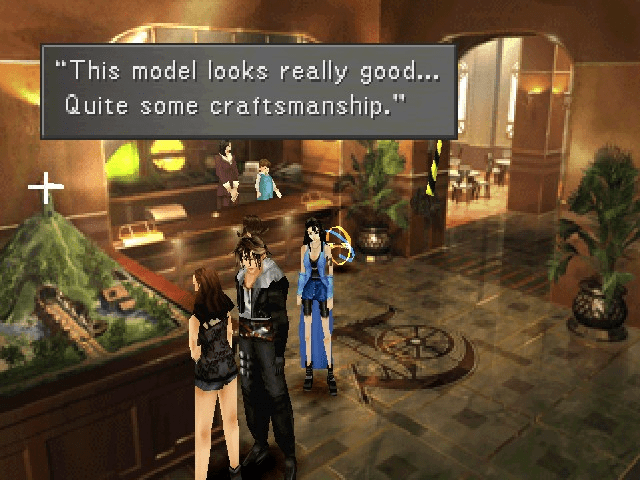
Forthcoming: Prof Schmid’s article on quixotic and Iliadic elements in Final Fantasy VIII. The windmill atop the hill makes a cameo in our recent Side Quests pod. (LP Archive)

Nor was Project Moon’s Limbus Company the first to transpose Quixote and Sancho Panza. Franz Kafka has a retelling, too, based on this conceit. Of course he does; though it hardly feels right to call it a mere conceit, given the prophetic weight of Kafka’s insight. First translated in a volume called The Great Wall of China, it comes from his collection of “parables and paradoxes,” and is brief enough to be given here in full:

Without making any boast of it Sancho Panza succeeded in the course of years, by devouring a great number of romances of chivalry and adventure in the evening and night hours, in so diverting from him his demon, whom he later called Don Quixote, that his demon thereupon set out in perfect freedom on the maddest exploits, which, however, for the lack of a pre-ordained object, which should have been Sancho Panza himself, harmed nobody. A free man, Sancho Panza philosophically followed Don Quixote on his crusades, perhaps out of a sense of responsibility, and had of them a great and edifying entertainment to the end of his days.

Given the serenity of the old man’s death at the end of Cervantes’ book, I suppose I agree: that for all his mad exploits, Don Quixote harmed no one, not even himself, and brought joy, if that is not putting it too strongly, “a great and edifying entertainment,” to many, Sancho included. For all his bruises and lost time, and despite never getting his promised island, Quixote’s squire is indeed immortalized through his adventures. Not for nothing does he crystalize the Spanish language’s rich store of proverbs and quips and unite them with a reenactment of the wise judgments of Solomon. Despite his master’s return to sanity at the close, their knight-errantry does in its small, strange way contribute to the cause of truth, which is to say, in video game parlance, saving the world.

Ultimately, I would have to read the whole book again in light of this parable-paradox of Kafka’s to see what I make of the Quixote-as-Sancho’s-demon theory. Maybe we can make a video essay about it. Imagine the numbers, the comments from the Limbus Company stans! See above: niche content, when politicized, can still break out and seemingly break the world.

We could follow it up with another on the deathbed retraction motif, stretching back to Solon in Aristotle’s Ethics, and Chaucer’s Canterbury Tales, and Tolstoy’s abjuration of his great novels, and perhaps Shakespeare’s via Prospero in The Tempest, and how many others? Even Aquinas called his philosophical works chaff at the end.

Likewise, this whole quixotic bit about reenacting books: that certainly deserves another, more extensive treatment. Spariosu would direct our attention, rightly, to Tristram Shandy and Uncle Toby’s bowling green, where the good man whiles away his time playing at war. What do we make of the remarkable resemblance to another, historical rather than fictional Quixote figure, St Ignatius Loyola, whose inspiration to found the Order of the Jesuits was born of reading replacements for books of chivalry? “In order to divert the weary hours of convalescence, he asked for the romances of chivalry, his favourite reading, but there were none in the castle, and instead, his beloved sister-in-law, Magdalena de Araoz brought him the lives of Christ and of the saints” (wikipedia). Or the resemblance of Uncle Toby and St Ignatius alike to the mythical Wounded King of The Waste Land? I mean, It can’t be a coincidence that The Fisher King is another Terry Gilliam movie!

To wrap up this deranged little essay, though, we have to mention The Idiot. Dostoevsky, having killed it with Crime and Punishment and yet to reach the tragicomic heights or depths of Demons and The Brothers Karamazov, plays upon references to Don Quixote for its hero’s unconventional social graces and compelling insights into the secret hearts of those around him. Beautiful, earnest, and a little boring at times, The Idiot was reportedly Dostoevsky’s favorite book in some ways: “the book in which he embodies his most intimate, cherished, and sacred convictions,” according to Joseph Frank; and those who appreciated it he would have found “kindred souls.” In Prince Myshkin, he “approximates the extremest incarnation of the Christian ideal of love that humanity can reach in its present form, but his is torn apart by the conflict between the contradictory imperatives of his apocalyptic aspirations and his earthly limitations” (577).

Still more, Dostoevsky later prefigured Borges, writing a chapter in imitation of Don Quixote that was only revealed much later to be his own and not translated from Cervantes. I can’t track down the page number in Frank on that, but I know it’s in one of those five volumes somewhere! And as he says, “We tend to take Dostoevsky’s comparison of Don Quixote with Christ more or less for granted, but it was still a novelty at the time he made it. In his highly informative study, Eric Zioikowski singles out Kierkegaard as ‘the first and, aside from Turgenev, the only person before Dostoevsky to compare Christ with Don Quixote’ (94)” (274).

Kierkegaard. Now there’s someone who knew about reduplication, which I take to be something akin to reenactment as we’ve been discussing it. That, however, would really take us pretty far afield.

And then there is Jesus, the son of Mary: the original of Don Quixote and Prince Myshkin alike, reenacting the prophets and fulfilling the scriptures down to every jot and tittle of the law.

To this day, we’re all doing our best to imitate him; though some look like they’re more just trying to cosplay him.

PS: Now that it’s spring break, I sat down to read the rest of Itoi’s conversation with the MOTHER games’ music composition and sound design duo, Hirokazu Tanaka and Keiichi Suzuki, interspersed with what look like email messages from fans, which Tim Summers’ paper put me onto. In section 10, we get the following exchange (per google page translation):

Tanaka: Children don’t just play with parts of their body, they play with their whole body and feel things with their whole body. My child was born when “MOTHER” was released, so he wasn’t around in real time, but he played “MOTHER 2” when he was in elementary school. Around that time, while eating dinner, he would say to me , “Dad, Mr. Saturn… he really is a great guy.”

Itoi: Wahahaha!!

Suzuki: That’s a good story (lol)!

Tanaka: I was really like, “What?!” for a moment. He was completely normal and serious. And, not just once, but “Hmm… he’s really a good guy…” over and over again. And for some reason, it was always around mealtimes.

Itoi: That would make me cry (lol)!

Tanaka: So my wife was like, “What?! Who is that? Where are you friends from?” (laughs)

Itoi: Well, I said in a previous interview that Mr. Saturn is a symbol of innocence, but there’s also another background to it. It’s Dostoevsky.

–Dostoevsky? [I’m unclear on who this fourth interlocutor is]

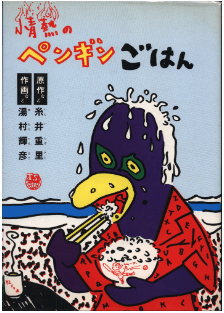
Itoi: Yes (laughs). It’s Prince Myshkin from Dostoyevsky’s novel “The Idiot.” When I read it, I thought, “Prince Myshkin is a really good guy!” Akira Kurosawa also made a movie out of it, but I tried to include him in Mr. Saturn. However, it’s really hard to portray a “really good guy.” It’s not something you can usually portray. So to express a “really good guy,” I added another character to the background. That’s the penguin from “Passionate Penguin Meal” (a manga written by Shigesato Itoi and illustrated by Teruhiko Yumura). If I don’t do that, I probably won’t be told by Hirokachan’s son that he’s a “really good guy.” He’ll just be “a fun, interesting guy.”

They go on to discuss other references, in the music, especially, and circle back to the idea of borrowing from Dostoevsky:

Itoi: So it’s the same with Dostoevsky! No one will feel anything like Dostoevsky, in the end. Not even Mr. Saturn. But there might be a chance that some Dostoevsky fan out there will think of something. In the same sense, something Dostoevsky-like might be conveyed to children who don’t know anything about it.

Passionate Penguin Meal

Remaking the RPG: Super Mario RPG and the Paper Mario Series

“Let’s-a go!”

Super Mario is perhaps the iconic video game character, full stop. Unquestionably, the success of the flagship series featuring the portly, indomitable plumber has impacted each generation of Nintendo consoles to such an extent that it is comparable in this regard only to Shigeru Miyamoto’s other most iconic creation, Link and the Legend of Zelda series. To understand the history of games in this era, then, given the importance of Nintendo and the home console market, it would not be too much to say that we have to understand Super Mario.

Continue reading “Remaking the RPG: Super Mario RPG and the Paper Mario Series”

Belated Cascade Moot

I’m slowly working on a few more essays related to books and games, but for now I wanted to share this recent piece on Philip Pullman and Earthbound, a talk given at Cascade Moot (August 31, 2024) on the theme: “From the Fringe: The Importance of Secondary and Tertiary Characters.”

A Tale of Two Tonys: Loss and Recovery in The Golden Compass and EarthBound

⁠Presentation slides ⁠ – essential for playing Name That Tony! with us and reading text boxes from EarthBound

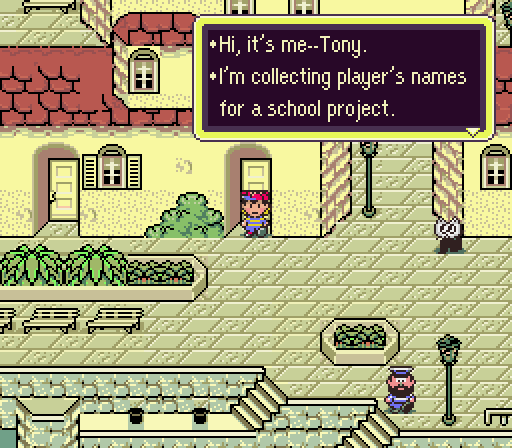
Reflecting on two secondary characters, Tony from Snow Wood and Tony Makarios, respectively appearing in EarthBound, a video game released for the Super Nintendo in 1995, and The Golden Compass, a book by Philip Pullman published that same year, players and readers of all ages are invited to consider themes of loss and recovery from a new perspective. Both characters are kidnapped, one at the start and one near the end of the adventures in which they figure; both characters have someone important taken away from them in turn. Their responses provide significant symbolic images and gameplay mechanics that draw us closer to the heart of these stories.

Thanks to the team at Signum U for hosting, and to you for listening.

Bird Journaling: The Salience of Play

Sometimes I think about taking up hobbies that require nothing but attention. Bird-watching, mushroom-hunting, tree-identifying. I think about how I should just write a little each day, like the thought-leaders counsel, your Anne Lamotts (Bird by Bird) and Brene Browns (Dare to Lead). I should make the time by jettisoning a bunch of other stuff that gets in the way, a la Marie Kondo, buckle down and write my three pages a day like my idol, Philip Pullman, whose His Dark Materials all but divinizes attention itself.

(Time, knowledge, care, curiosity–all are wrapped up in that “nothing but attention”–whether in the nothing but or the attention I can’t quite decide–and so I persevere in temporizing, zigzagging in em-dashes, putting off doing any new thing, just reflecting on it. Very rarely anymore do I even make it as far as writing down this process, that act of recording being a fraught piece of attention-requisition in its own right.)

And yet I do think about it from time to time. Before other things take their place, these possible, imagined practices do hold my attention, and they recur when the decks are cleared. When I go running, when I zone out listening to something, when I look out the window, when I sit on the porch, I think about learning the names and properties of birds and fungi and plants. I write about it now and then.

Whenever I do manage to write and take the time to post what I’ve written for anyone else, it seems to be about a pastime that has held my attention as long as I can recall: videogames. Of course, given to pattern-seeking and meaning-making as I am, I suspect that underlying all these hobbies and vague interests is some thread that connects them. Observing attention and its ways, wayward as they are, I call the connection salience. Its characteristic note, however multifarious, I would have to call play.

People study this, psychologists and institutes, writers and teachers, and I’ve begun little by little to follow in their footsteps, or at least to imagine what it might be like to do so. I play at understanding play, and through play, everything else.

Here are some recent bird sightings, places where play makes an appearance, rising to the level of salience:

In the scheme of things, I call them recent, but then this post was started months ago, it shames me to say. I wonder if would have been noteworthy even at the time of its release that Toy Story 2‘s opening sequence takes the form of a video game played by living toys. Did Nintendo and their famously litigious brand managers mind that the mentions they get in Stranger Things Season 4 are all along the lines of a Peter Pan existence, a prize or bribe? Still, for whatever reason, I think these videogamey sorts of things are interesting, rather like the marmots along the path where I run by the Spokane River. I’m always happy to notice they’re there.

Where Shall Wisdom of the World Be Found?

On questions within–and in conversation with–the MOTHER/EarthBound games

All images from the let’s play archive

My point of departure is a question: Where shall wisdom of the world be found?

I frame it like this, as a mashup of quotations–

But where shall wisdom be found? and where is the place of understanding? – Job 28:12

Show me the wisdom of the world
Tell me the secrets of the heart
And the sweet mysteries of love
– “Wisdom of the World,” MOTHER arranged album. Catherine Warwick/Keiichi Suzuki. Lyrics by Linda Hennrick

–because the works cited are very dear to me. And because I believe other people might feel the same, I wanted to sit with them awhile, to share some of the ways in which these words and these games have helped me with the very deep questions they ask.

Abstract

The reader is asked to consider the role played by questions within the MOTHER/EarthBound games in an open-ended, poetic and philosophical light, both in service to replaying and wondering through the games and as a guide to related questions surrounding their significance, development, and reception. From “Which style of windows do you prefer?” to “THE END… ?” EarthBound, our principal focus, like its precursor EarthBound: Beginnings and its successor MOTHER 3, continually poses questions. Whether direct or implied, with or without affording players (to say nothing of the silent protagonists) ways to respond to them in-game, these questions present an opportunity to think more deeply about the games and what they mean for us who play them. Taken together, the games’ questions and our responses suggest a model for such thinking and meaning-seeking through play, reading, and dialogic inquiry.

Acknowledgements

The present essay expands on an article written for NES Pro Magazine, “In the EarthBound Beginnings…There was Shigesato Itoi.” That piece, in turn, augments and flows out of a long-running podcast project, Bookwarm Games: EarthBound. Illustrated transcripts from the podcast (as well as a shorter version of this piece) have been graciously published on The Pixels, with further course material hosted on Video Game Academy. Both online, through outlets like these, and in-person, in my video game studies courses at The Community School (Spokane, WA), my hope is that the scholarly conversation around these games should be ongoing and open to all.

I owe many of the ideas presented here, elliptically, playfully professorial and earnest, to discussions with friends and students. With thanks to them and acknowledgement that any errors or misrepresentations are my own, I invite you to join the dialogue. So much for housekeeping. Now on to a little homework, a little light reading and replaying to begin with.

Reviewing the Literature, or, Which style of windows do you prefer?

Naturally our main texts will be EarthBound Beginnings (1990-2010), EarthBound (1994), and MOTHER 3 (2008 localization patch). We should first of all and as much as possible allow the games to speak for themselves–more on that below. But besides the games themselves and the interpretations we form as we play, whose do we take to be some of the dominant voices in the conversation around EarthBound? Who are the main players in the critical discourse we are about to plunge into, around whom wavelike lines of force, whether of argument or personality, tend to concentrate?

There is Shigesato Itoi, of course. The creator and face of the franchise has gone on record many times in many contexts to share thoughts about his work. On the one hand, this makes for an invaluable source of information for fans and students of the games. Itoi is in a position to speak on his intentions, his inspirations, and tensions in the process of casting of his vision into a reality; he knows things, or can be understood to know things, no one else possibly has access to finding out definitively about these games. As I’ve argued in NES Pro despite my qualms with “the personal heresy” CS Lewis argues against in such cases, Itoi’s biography inscribes itself into his creation in unmistakable ways; as everyone who plays will discover, Itoi loves breaking the fourth wall to make us aware of his presence as writer–and of ours as player.

But on the other hand, Itoi as author, as author-insert or character, and as commentator alike must still be filtered through the same critical judgment: the player’s– “yes, you, the one holding the controller,” as Tony says. Authoritative as his statements can appear, Itoi amplifies and evolves his thinking from one interview to the next (cf. versions of the pitch to Nintendo, or meanings of the title MOTHER). He would be the first to insist upon his own human fallibility and proneness to errors of recollection, and to insist upon the importance of the players’ own memory and attention to detail (from the original MOTHER trailer to the Switch virtual console announcement). If I appeal to Itoi’s words in public pronouncements to undermine Itoi’s authorial-canonical status, let that logical tangle be the least of our worries. Instead of throwing up our hands, though, my hope is that we lend an ear to Itoi, but not so much that we close off and silence a world of other possible readings. Like the Hobonichi logo, let’s hope we have our great big ears open both ways.

Another caveat we have to bear in mind, apropos of language and logic, is the issue of localization. Whatever the games or Itoi or any of his Japanese-speaking interlocutors might actually be saying, not only are we ultimately speaking for ourselves in hazarding our judgments on the work, we’re mostly doing so in English. We’re mediated in our readings of the games’ meaning in all the ways so far considered, but also by the choices made by a chain of official and unofficial interpreters who have rendered us the service of reproducing everything about them in a language we (presumably the majority of us reading this, anyway) can read best.

In connection with this underlying concern, one whose importance can hardly be emphasized enough, let’s not go any further without bringing on board the discussion the only person whose importance for understanding the MOTHER games and their many meanings might rival Itoi’s, at least outside Japan: Clyde Mandelin, aka Tomato. After years of active leadership within the starmen.net community, concurrently running EarthBound Central, a clearinghouse for news and history, Mandelin led the team that made MOTHER 3 available to play in English. With Fangamer, he has turned his talents to publishing books on his expertise. Legends of Localization Book 2: EarthBound painstakingly walks us through nearly every line of the game’s text, providing insight and context for each choice by the developers and translators (one of whom, Marcus Lindblom, provides the foreword. Toby Fox, creator of Undertale and Deltarune, who honed his composing and game-developing skills on ROM hacks for the same starmen/ Fangamer community, contributes a lovely blurb). Let who will keeping hoping for an official MOTHER 3 release outside Japan; I’m hoping that an official biography of Itoi and translations of his books will be forthcoming from Mandelin and his collaborators.

Inventory Management

To take stock of our (limited) inventory so far: playing and replaying the games absent any rigorous theory of either the author or the material and ideological grounds of game development; reading up on the developer and localization while lacking much understanding of the original language or firsthand knowledge of the culture, our scattered, slovenly bibliography evincing familiarity with only a handful of significant sources–we’ve yet to really dive in, and yet all these challenges, or indeed any one of them, could sink our project before we begin. That is, if we really were by profession academic writers, and not just amateurs pretending like this for the fun of it, we’d need to do a better job of shoring up our basic premises. Then we’d want to find a peer-reviewed journal or institution more or less in agreement with our presuppositions. Wherever we decided to land on these issues, and wherever we were fortunate enough to end up researching and teaching part- or full-time, publishing-or-perishing our way to tenure, we’d meanwhile read a good deal more specialized material in our chosen corner of the field. However, let’s muddle on in our own way.

Having spent some time playing through the games, researching Itoi–his biography, interviews on his games, and other works–and looking through Mandelin’s EarthBound book, what’s next? For me, it’s Shakespeare and the Bible. EarthBound’s opening sequence sends me back to Hamlet via Hamlet’s exclamation “buzz, buzz,” and his own late night visitor inspiring the questions he asks (and we ask) throughout the play. Buzz Buzz’s reference to the Apple of Enlightenment leads more directly still to the drama surrounding the fruit of the tree of knowledge of good and evil in the third chapter of Genesis. From there I follow the reverberations of their language and themes through the poets, Milton and Blake, much influenced in my reading by the work of Philip Pullman. Time and again this thread leads me to the conviction, in Blake’s phrase, that “eternity is in love with the productions of time.” Apropos of time-travel and the wisdom we’re after (or is it after us?), his next Proverbs of Hell run:

The busy bee has no time for sorrow. The hours of folly are measur’d by the clock, but of wisdom: no clock can measure.

Undisciplined as this may seem, I tend to agree with Pullman when in homage to Muhammad Ali he says, in the afterword to His Dark Materials, “read like a butterfly, write like a bee.” Yet all this flows from and brings us back to our opening question, still unanswered and all but unformulated. We might put it like this:

Who or what is Buzz Buzz, this bee-like being inciting the beginning of EarthBound, and what is the Apple of Enlightenment whose message he bears?

In the original MOTHER 2, Bunbuun, the Japanese onomatopoeia for Buzz Buzz’s name, is “actually a rhinoceros beetle (or not),” while the Apple of Enlightenment is called a “prophecy-telling machine” and “The Apple of Wisdom” in Tomato’s literal translation. That’s seems promising. Still more helpfully, his Legends of Localization volume explains,

Throughout the game there are mentions of a prophecy given to Giygas by something called the Apple of Enlightenment. General information about the prophecy can be surmised from bits and pieces of the game’s script, but the full details are never revealed in the game. The official MOTHER 2 guide provides those details, though! Below is a translation of the discussion between Giygas and the Apple of Enlightenment, which is described as an ‘ultra-prophecy device’.

Q: PROPHESIZE FOR ME. WHEN WILL MY PLAN REACH FRUITION?

A: THAT CANNOT BE PROPHESIZED. YOUR QUESTION IS FLAWED.

Q: THEN I WILL ASK AGAIN. WHEN WILL MY PLAN TO COMPLETELY RULE THE GALAXY SUCCEED?

A: IT DOES NOT SUCCEED. THE PLAN ENDS IN FAILURE. (187)

Wisdom found, right? A whole Apple of it. And questions answered–albeit in such a way that Giygas decides to set the events of the game in motion based on what the Apple tells him. Deep Thought meets Oedipus Rex.

Q: WHAT HAPPENS IF I GO BACK IN TIME AND GET RID OF THEM?

A: THE RESULTS OF TEMPORAL INTERFERENCE CANNOT BE PROPHESIZED.

If we are like Giygas in our dealings with this Apple of Wisdom (the games themselves unfolding Itoi’s story), or if we are like Pokey’s mom with respect to Buzz Buzz (messengers like Clyde Mandelin, bringing us new knowledge about it all these years later)–that is, if we are impatiently demanding discursive answers to these questions, they will only lead, at best, to playing the game through again from the beginning (an attempt to go back to the past), and at worst, to doing a violence to the text of the game, silencing it and moving on from its words without giving it another thought. If we are like Ness, though, these questions set us on a journey here and now to grow in “wisdom, courage, and friendship,” and to find “Your Sanctuary.”

THE END… ?

I can understand how that trajectory may seem idiosyncratic. Let’s hope that wherever you turn for help answering underlying questions of this sort, besides replaying the MOTHER games you’ll try reading and revisiting for yourself some of the literary stepping-stones thrown out there above, arrayed as it were in mid-air like the platforms in ur-NES games, Mario Bros. and Donkey Kong. I hope you go clambering Shadow of the Colossus-like onto the shoulders of those giants and enlist the aid, Breath of the Wild-like, of those divine beasts we’ve been citing. But it really depends on what interests you, what scholarly questions you’re pursuing.

In lieu of Shakespeare and the Bible and the rest, the student of MOTHER/EarthBound interested in canon-completionism might want to turn first to the official novelizations by Saori Kumi, recently made available in English translation, and to other paratexts accompanying the games, such as published scripts, advertising materials, trade show videos, box art and instruction booklets, and the official (and official-esque) player’s guides.

For another sort of research, what matters most is fandom and reception, so diving into decades-old forum posts, viral tweets (Terry Crews’ “localize MOTHER 3” @ Reggie Fils-Aime), fan productions, and discussions of the influence of these games on social phenomena, like online communities, and works significant in their own right, like Undertale. The secondary sources shedding light on the games and bringing more attention to them, (in much the way EarthBound, for me anyway, brings attention and light to Shakespeare and the rest), might include the likes of The Angry Video Game Nerd in one of his more heartfelt efforts; Ken Baumann’s memoiristic account of the impact EarthBound has had on him; the gonzo journalism of Tim Rogers; and other video essays, analyses, and blog posts loitering unassuming yet insightful somewhere down the lists generated by the almighty search algorithms.

More academic studies of EarthBound do exist, but the conversation on the game and its place in history remains in its infancy, for the simple reason that we’re still too close to it to really appreciate it. What we’re attempting here is a prophecy or a promise that these games will remain significant, as much as an essay seeking to explicate their possible significance.

Does a place called paradise
Wait beyond the azure skies
Bright as day?
Look into your crystal ball
Read the future in the stars
Does it say?
– “Wisdom of the World”

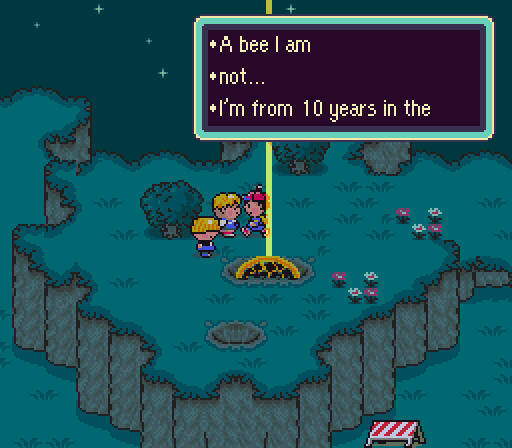
To paraphrase the not-bee himself, thanks for listening to my long prolegomena. On to more questions.