I am looking forward to reading–a familiar feeling for me, but with an unusually heightened clarity and specificity at the moment–several things this month. Towards the end of October in this year of our Lord 2025, the third volume in Philip Pullman’s Book of Dust is set to release. About 40 years after we first met Lyra and Pan in The Golden Compass, we might finally be seeing their final adventure. For years (albeit many fewer), I’ve made it my scholarly hobby-horse to commentary-write, read, interview and podcast on Pullman’s work, and I’m eager to pick up where I left off, now that there is a kind of boundedness to his latest project. My pet theory is that this new book, and the series of which it is a part, is closely linked to his earliest published writing, two novels for adult readers of literature which are largely forgotten… but who knows.
This photo from The Bookseller website suggests some of what we might expect The Rose Field to include (or to open onto, if the picture dates from after the book’s composition), to judge based on the stack of books on the desk in front of the author: Baudelaire, Wallace Stevens; Pullman’s own Northern Lights; dictionaries of modern English usage (Oxford, naturally) and of Merleau-Ponty; All That Is Solid Melts Into Air; The Reader Over Your Shoulder; 101 Middle Eastern Tales and Their Impact on Western Oral Tradition, and a couple of books and loose sheets of paper too small to tell what they are, as well as a big book at the bottom of the pile whose spine is obscured by a tape dispenser. Another reference work? A Bible? And what about all the other books ready to hand over his shoulder? I wonder.
Where do ideas come from? How do we decide which ones to give room in our mind? These are questions which Pullman (and his young readers) and Persona 4 both seem interested in, and to which they give unusually thoughtful responses in the form of their stories. At least part of an answer, though, is suggested by the books we place in front of us, aids and distractions in equal measure as we sit down to write. It’s always tempting to read more instead of writing. In particular, I’m thinking of what Pullman is reading, and yet I’m sure that neither reading that stack of books nor an nth read-through of his own books would prove as effective an apprenticeship as the work of writing three pages a day and telling stories aloud, from memory, to children. Or anyhow this was his practice as a writer and teacher, as he recounts more than once, and it seems to have served him well.
The long-awaited Historiographies of Video Game Studies, while I read it over the summer, insofar as it is possible to read anthologies like this cover to cover, will certainly bear revisiting soon as I set to work on a submission for the zine follow-up to my virtual talk at The Manchester Game Centre. As Jacob Geller recently gave an interview on GSSB, I’m reminded again that both he and Cameron Kunzelman have other essays and books, too, that I’ve been meaning to read.
I still owe Aaron Suduiko a piece on EarthBound in response to the “Comprehensive Theory” series on his website. It’s been a year already since I talked with him and the writer, Max Gorynski. I wonder what they’re up to.
Brian Eno, in conversation with Ezra Klein and evidently in his book, defines art as something like play for grown ups, which must be at least partly true.
Nel Noddings, contrasting the rule-bound and relational in her foundational work on the ethics of care, comes close to refuting Kierkegaard and Sloek alike, with her readings of the binding of Isaac and the myth of Demeter. And Benjamin (Walter, not Kozlowski) might come close to undercutting Tolkien on myth and fairy tales, though I take solace in not quite being able to understand what he is saying towards the end of his essay on Leskov, “The Storyteller.”
Friends and students who I flatter myself I’ve inspired in some way have been sending me things they are writing, and I look forward to reading more and sharing them with other readers, if I can, soon.
Most pressing, though, there is Moses Norton, aka The Well Red Mage or Red for short, who has just released his Definitive Book of SNES RPGs (vol 1). While it has yet to ship, I’ve got the pdf here and am eager to read it and interview the author. Biased as I am, I have to believe the book itself will matter more than what any of us might say online, and I can’t wait to see it take up space on my desk and time in my mind.
The World of Final Fantasy VII: Essays on the Game and Its Legacy, edited by Jason C. Cash and Craig T. Olsen, was published in 2023 as part of McFarland’s Studies in Gaming. It has the heft of an academic textbook in terms of scholarly accoutrements (footnotes, dense argumentation, etc.) but not in terms of cost or page length. The contents can be viewed on the series website or at The Video Game Library entry; I borrowed a paper copy via interlibrary loan, and would certainly recommend that before buying to anyone interested in reading this sort of text.
My guess is that, like me, the main purpose they would have for doing so, if anyone is so inclined after reading my own crabbed persiflage, would be to cite and quote from the authors so as to enter into the scholarly conversation around the game itself or some related field in which FFVII and the literature on it might serve as fodder for discussion, whether as case studies, evidence for a thesis, or counterexamples to array against another interpretation. For playing the game of academia, in short, with Final Fantasy, this volume is an entirely adequate starting point.
If none of the essays are brilliantly written or persuasive, if none looks like the definitive take on FFVII in this early phase of its influence, the book as a whole nevertheless suggests a noteworthy current of thought forming about some of FFVII‘s core themes and, by its very existence, it shows a willingness on the part of the scholarly community to engage with the game’s undeniable impact on the culture. As for what the nature of that impact and its meaning might prove to be, I’ll venture to say a close reading of the game itself, like Alex and I did a few years ago replaying it for our podcast, would come closer to giving the full picture. So give it a replay, give us a listen, and who knows, maybe you’ll be the one to respond with an epochal study truly worthy of the material. For now, in what follows, I’ll briefly sketch what I see as significant takeaways from the various essays here. As the alphabetically primary editor Cash says, quoting our spikey haired hero in the title of his Introduction, “Let’s Mosey.”
Cid is so done with this meme.
First, let’s not, though. Instead of breezing right through to the essays proper, let’s go on a little side quest to ponder the citational repertoire of this opening piece, since it sets the tone and reveals something about the editorial perspective for the book as a whole. Appropriately enough, the game has the first and last word in Cash’s introduction: “All right, everyone, let’s mosey,” he concludes, having set the temporal scene for the game’s release, highlighted some of the more objective ways in which it stands out in the franchise, and given summaries of each of the essays to follow (9). For a short introduction meant to provide context and perhaps a kind of call to action as to the significance of the work we’re about to study, as well as invite the reader into the volume with a bit of an inside joke, however, Cash’s use of this quote is telling. There is no explanation of the point at which Cloud’s iconic line appears, ie. right at the end of the game in the original localization, nor any attempt to understand the original phrase or how it is used in the Japanese version. The question of the language of the game is effectively sidestepped, here and throughout the book. All the authors would have had to say is that plenty of articles and video essays can help fill in the omission (see Caldwell and Rogers, or consult the Shinra Archaeology Dept translation spreadsheet). Cash’s references are limited to appeals to two Statistica articles about the popularity and demographics of “gamers,” a shout-out to Courcier and El Kanafi’s groundbreaking monograph, The Legend of Final Fantasy VII (though Holleman’s Reverse Design entry is ignored), and an allusion to the “hikikomori phenomenon” and “moral panic” surrounding video game play habits in Japan and the US in Addictive Behavioral Reports (1).
Having set the stage in this somewhat brusque and scattershot manner, the editors then make the decision to structure the presentation of essays according to the unfortunate “narratology/ludology” divide of “Disc 1: Narrative,” “Disc 2: Player Experience,” and “Disc 3: Legacy.” For more (than you probably ever imagined people could care) about this distinction, see the recent Historiographies of Game Studies. It’s too bad, because a disc by disc approach could have actually been incredibly fruitful for the sort of close attention to the unified effect of story, gameplay, and cultural impact in FFVII as these unfold over the course of the game.
Disc 1 leads with one of the stronger essays in the collection, “The Bringer of Light Becomes the Fallen Angel: Sephiroth, Lucifer, and Frankenstein’s Creature,” by Ceschino P. Brooks de Vita. Albeit in service to his focus on the villains, he does a better job than Cash in situating the game and what is at stake, referencing FFVI’s Kefka, Jonah Mitropoulos’s essay on the “Japanese-Shinto ‘value-orientation'” and Shusaku Endo’s Silence (14), along with Neon Genesis Evangelion to help ground the discussion (15). The remainder of the essay is a clear and straightforward comparison of Milton’s Satan and Shelley’s Creature with Sephiroth, concluding with an intriguing addendum on the women of FFVII as “a significant departure from the follies of Paradise Lost and Frankenstein, in which the men repeatedly disregard the potential of the women in their lives to help them” (30). Arguably, the essay’s inclusion of material from Crisis Core and Advent Children expands its scope, but I would have preferred a deeper investigation of such characters as Hojo, to say nothing of Tifa and Aerith who are mostly relegated to the tail end, as they are portrayed in the original release.
The second essay, “Angelus ex Machina: Economic and Environmental Justice in the Compilation of Final Fantasy VII,” by Cash, continues this equivocation about the scope of the artifact under consideration in the volume, at least making it plain from the outset that more media than the original game will be brought to bear for this particular essay. It also seeks to tie the expansion of the story’s ambitions, both within FFVII and across the “compilation” it has spawned, to the diminution of its actual effectiveness at developing the core themes Cash is most interested in. This is a subtle and sophisticated argument, and I think Cash has it almost exactly backwards. I hedge with that “almost” only because there is ample evidence that a kind of decline is at work with each new release, insofar as it makes it more difficult to see the ever-compiling FFVII in its entirety as any sort of coherent experience conveying a discernable theme, other than the proposition that fans will keep paying for more of it. In fact, far from diminishing returns, the expansion of the game beyond Midgar and the revelations of Cloud and Sephiroth’s complex relationship to one another and to the Planet they are respectively out to save and to dominate make clear that the political is always, and not only with in the framework of the game, just one manifestation of the mythic. The importance of such themes as environmentalism and class conflict are not, however, thereby diminished, but can be seen in accordance with a larger perspective. I agree with Cash that in later areas such as Corel and Gold Saucer, “providing an arguably deeper and richer interrogation of class inequality than Midgar, the moral center becomes harder and harder to pin down” (50). I certainly can acknowledge “no narrative media, no matter how developed it may be, can solve all of the problems it touches on” (51). Where he adduces these points in his conclusion as weaknesses generated by the game’s epic narrative, I would simply accept them as proofs of its literary merit, resistant to reductive readings.
Yasheng She’s essay on “The Death of Aerith: Traumatic Femininity and Japan’s Postwar Modernity” goes some way to sketching in the cultural background implicit in this reversal. She gets it: “While FFVII seems to focus on the dangers of nuclear power, the real danger lies with the wartime masculinity that allowed nuclear destruction” (61). Technological, environmental, and social justice concerns are all in play in FFVII, and all contribute to its total effect; She’s essay is mostly concerned with how history and gender inflect and inform the meaning of the game’s concrete referents to real-world wars and ideologies as they carry across in its more metaphorical and open-ended, but no less powerful, moments of individual and collective trauma and recovery. She has an unhelpful tendency, though it’s one I recognize that I’m guilty of when I set myself to write this sort of thing, too, to give only the barest shrift to citations. Of particular interest are references to Igarashi Yoshikuni on Japan’s “positioning wartime and postwar trauma as the onset of Japanese modernity,” Souvik Mukherjee’s “postcolonialism as an intervention to the studies of video games,” Soraya Murray seeking “to address ‘the popular depoliticization on video games'” (all these in successive sentences on 55), and Koichi Iwabuchi’s concepts of “hybridity” and “mukokuseki” or “no nationality” tagged onto a tantalizing description of the game’s use of “English and Japanese signages” right before the end of the paper (65-6).
“Fragile Materials: Memory and Ecology in Final Fantasy VII,” by Nickk Hertzog, along the same lines as Cash in his essay, juxtaposes themes that I’m calling, broadly, mythic and political. While I applaud his brave choice to focus on “the original FFVII” (69) I find Hertzog’s frequent use of secondary sources such as Zizek and Deleuze/Guattari to be profoundly corrosive for his argument. How does the “arborescent” view of memory put forward by the latter (71; allegedly–I haven’t read them, and if I tried to, I doubt I would understand what they’re actually saying) provide any more insight than actually looking at the scenes in the game where Cloud’s memory is represented as text, gameplay, and interior landscape? Why not abide with the Proustian view of recovering lost time, rather than jumping to the Deleuzian “sickness” (71)? Why lean on Zizek to assert that “Cloud’s journey shows that an opposition to the impacts of science is ultimately a pointless one” (80)? Hertzog does engage with Robbie Sykes’ paper on “Earth Jurisprudence” in a sustained way, but he buries what looks like a crucial distinction relating to individual agency in a final footnote (82). By the end, I’m not sure he’s accomplished anything beyond summoning up and wrestling with a handful of all-too-significant predecessors, like the ghosts of the Gii (74)–and reversing Cash’s framing, which is a good start.
The next section, “Disc 2: Player Experience” opens with a still more off-putting entry, “‘A body hast thou prepared me’: Algorithmic Suture, Gamic Memory, and (Co)-creating a Rhetorical Network of Identity-Trauma in Final Fantasy VII.” The author, Samuel Stinson, not content with this howler of a title, doubles down with the passage from the Letter to the Hebrews (10:5) as an epigraph. It’s not so much the ludicrous mouthful of a subtitle as the egregious formatting on the citation of the Bible “(King James Version, Heb. 10.5)” that makes me wonder what, if anything, the editors tried to do to wrangle this piece into presentability. They evidently never asked or couldn’t convince him that it would help to actually engage with the text from Hebrews, aside from this cryptic conclusion:
Within the context of FFVII, Aeris must continually be permitted to die, instead of once and for all, because in her death there is a reminding, a remanding, for the player through each play-through, as a body has been prepared fo the enactment, and the water is ready.
Being dead, the game speaks: Why tarriest thou? (102)
Now, proposing to supply us with a rhetorical “toolkit” and drawing on a dissertation called Writing with Video Games for the purposes of publishing an article about… writing about games… to help students write with/about games–this all seems pretty circular, if well-meaning. The essay is too condescending in tone for me to give Stinson the benefit of the doubt that he might have anything substantive to say amidst all the jargon and posturing, though I appreciate his loyalty to the spelling of Aeris and the original release, his inclusion of an example from FFIV (98; though FFVIII seems like it would offer the better point of comparison for romantic insights), and his boldness in bookending his flimsy essay with KJV English.
If Stinson leaves us wondering “what hath [FFVII] to do with Christ?” the following essay, “Final FantaSi’ VII: Role-Playing the Eco-Ethics of Laudato si‘” by Gregory D. Jones, Jr. provides an answer. A very specific riposte is discernable in the concluding paragraphs to the “dead” game of the prior essay: with the final screen “an ever-unfolding starfield, where FFVII’s ‘Prelude’ plays in the background… the game plays on; it never truly ends” (120). To the believer, and to anyone open to a resolutely sunny application of Catholic encyclicals and virtue ethics to the specter of environmental catastrophe, it is no doubt a satisfying one. For more jaded readers, Jones’ trotting out of psychological research on the benefits of games may register as naive or one-sided. Regardless of one’s disposition, this central essay in the volume makes for a refreshing contrast. Again refreshingly, Jones is not stinting in his quotations from the game’s actual text, with well-chosen passages incorporated throughout.
In “‘Action combat trash’: Final Fantasy VII Remake, Control, and Combat Nostalgia,” Indira Neill Hoch puts her finger on the pulse of fan reception. Drawing on forum comments rather than interviews or other long-form analysis, she predictably finds that both positive and negative views of the remake are “predicated on the existence of a desirable, idealized past” (134). “Very little, if anything emerges in the comments regarding FFVII as a narrative… little commentary on…. themes of capitalist and corporatist systems, environmentalism, resistance, poverty, and war,” she writes, “Instead, what they hoped to protect was a fabricated, nostalgic gaming past, defined through combat mechanics, silly distractions [ie. the “frog” status ailment], and defending their own memories of the experience of playing” (ibid.). Neill Hoch has a clear, ironclad argument, based on a narrowly defined dataset and an unusually copious swathe of citations including both stalwarts of the fields of games, cultural studies, and communications (Huizinga, Aareseth, Consalvo, Wolf, Gray, Jenkins, Jameson) and specific deep dive investigations into nostalgia among gamers (Garda, Heineman, Sloan, Suominen, Wulf, Cruz, Hodson, Payne). Hers is the second essay, after Cash’s, to conclude with an apologetic footnote about how Barret’s racial representation falls “beyond the scope of the current essay.” Aside from nostalgic neckbeards (and in some cases the datasets no doubt overlap), no one is as cognizant of boundaries not-to-be-overstepped than academics writing within their chosen specialization.
Turning to the final section, “Disc 3: Legacy,” we’re again hard-pressed to see the distinction as being all that meaningful, with Craig T. Olsen’s “Very Superstitious Spoilers on the Wall: A Deep Read of Fan Reactions to Tragedy in Final Fantasy VII” picking up much where Neill Hoch left off. Olsen looks at the deaths of playable characters throughout the series and, for the sake of comparison, in Chrono Trigger and Secret of Mana, as well as jumping into Remake at the conclusion to revive interest in what one should have thought a thoroughly discussed-to-death topic if ever there was one.
In “‘Because, you are… a puppet’: How Final Fantasy VII Anticipated the ‘Posthuman Turn'” Nicholas Langenberg swerves back into the sort of territory we encountered with Hertzog’s essay, engaging closely with the narrative and themes contested there. He invites us to “embrace the fluid, disjointed, rhizomatic nature of our existence… to reconcile our understanding of ourselves with the discourses that have led to the decline of humanism while also establishing an image of ourselves and others that leads to greater empowerment” (174). To which I can only reply, no thanks. By aligning Sephiroth with the “Humanist Attachment” and Cloud with the “Posthumanist Acceptance” of his conclusion (176), Langenberg seems to have defined his terms in such a way that readers are bullied into agreement, but these definitions are shaky at best. I’m open to the notion that such a “turn” has taken place, if only within the heads of the people he cites, and it certainly seems like a respectable read of the ending scenes of Midgar to suppose that the world of FFVII is literally on a path to posthumanity, but Langenberg confusingly connects this highfalutin’ term with the “inability to find comfort in grand narratives,” as if both “posthumanism” and FFVII itself were anything other than just such grand narratives. Like Hertzog, he winds up a formidable concoction of theory and stares closely into the central conflict Cash shies away from, but I can’t help but disagreeing with his inferences at practically every step.
The second to last essay, by Carlos Cruz, “Square’s Lifestream: Examining the Impact of Final Fantasy VII Characters Across the Gaming World,” goes beyond the Compilation to trace the instances of intertextual references in the form of cameo appearances by Cloud and co. in games such as Dissidia, Super Smash Bros., and of course Kingdom Hearts. This is probably the least presumptuous, if least profound, of the essays included. Essentially trivial, thinly supported by a smattering of psychological research, and nonetheless fascinating for the fan of the games, Cruz disappoints only insofar as he does not take a moment to remark on the simultaneous development of Xenogears alongside FFVII and Cloud’s strange hallucinations about this sister game.
Even the LP Archivist couldn’t be bothered to include this one
Implicit in most of these essays, and more or less explicitly stated in several, is the question Hertzog had formulated: “is continuing to focus on this game an unhealthy exercise in reliving earlier pleasures? Or does FFVII captivate because of its continued, even heightening, contemporary relevance?” (69). It’s worth asking, a fortiori, if continuing to respond to these records of that focus is anything other than nostalgia, trivial gatekeeping, and more bookish sour grapes. As a particular instance of the specter of posthumanism, it is hard to deny that given a little prompting, the currently available large language models, for all their hallucinations, could probably write papers just as interesting and insightful as the ones in The World of Final Fantasy VII, and respond to them with more grace and wisdom than I could manage here.
Which is all to say that when Kathleen Morrissey asks her version of the question–“In other words, how can one understand the timelessness of FFVII? (197)–in the course of her essay closing the book, and she arrives at the answer that we “renounce idolized heroes in favor of flawed teams when managing collective struggles” (200), we can discern a kind of circling around the same territory as many other contributors, as if they were grinding for levels or seeking a particularly rare enemy or item drop, and a recognizable theme from any number of conversations about these games. As the kids say, “It was the friends we made along the way.” And they’re not wrong. What Morrissey has to add is a wider range of video game comparisons and a more nuanced discussion of mental health as it is represented in FFVII. Their reliance on procedural rhetoric and Bogost/Galloway aside, Grimwood on “Heroic Madness” sounds like a keeper.
Awkward.
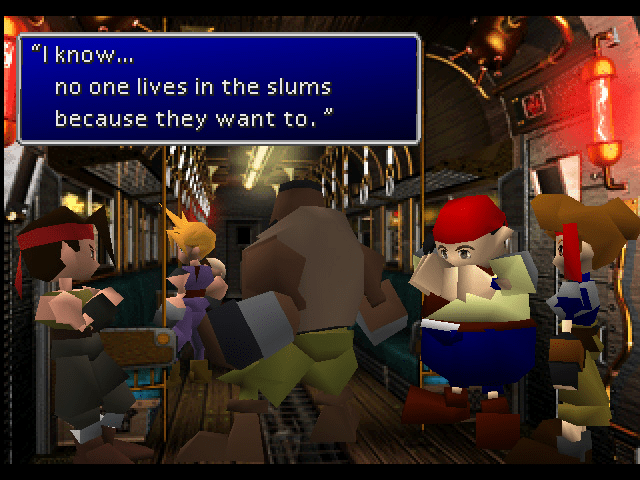
Less a “Conclusion” than a prose envoi, “Where the Rail Takes Us,” by Craig T. Olsen, briefly recapitulates the preaching-to-the-choir, protest-too-much-methinks claims about the value of games as cultural artifacts, and about the beloved characters of FFVII in particular, that anyone still reading would, it goes without saying, grudgingly concede. And we might gently point out that of the train-themed quotes that have attained meme status over the years, the editor has chosen a real humdinger. Again assuming we actually look at the line in context, we note that it comes in Cloud’s discussion of the slums underneath Midgar’s reactors, and the academic equivalent of a slum, if one is permitted to make the inference… we might call it a peripheral field. Whereas an academic book, even if just a collection of essays by passionate scholars and students, worthy of its subject would position FFVII much closer to the interdisciplinary promised land dreamt of by the new historiographers of games, and by Spariosu before them.
The Haunted Wood: A History of Childhood Reading, by Sam Leith, comes highly recommended.
“One of the best surveys of children’s literature I’ve read,” blurbs Philip Pullman. “It takes a particular sort of sensibility to look at children’s literature with all the informed knowledge of a lifetime’s reading of ‘proper’ books, and neither patronise (terribly good for a children’s book) nor solemnly over-praise. Sam Leith hits the right spot again and again. The Haunted Wood is a marvel, and I hope it becomes a standard text for anyone interested in literature of any sort.”
In the run up to the release, Leith appeared on an episode of Backlisted, a wonderful podcast which I first found thanks to their episode with Pullman on The Anatomy of Melancholy, one of those tomes, like Gargantua and Pantagruel, anchoring my own personal backlisted pile.
The main reason I bought Leith’s book new and read it right away is that its final chapter is about Pullman’s work. As far as that goes, I’ll have more to say in another place. But what brings me out of my extended spring break to write about it here is the way video games surface in the text as a point of comparison and contrast with children’s books.
The first reference to video games comes roughly midway through the book in a strangely interpolated chapter, “The Idiot Box,” which does not appear in the table of contents. We are in the transition from the era of Philippa Pearce, CS Lewis, and Tove Jansson (about all of whom Pullman has quite a bit to opine) to that cohort of writers, immediately preceding Pullman himself in publication, that includes Alan Garner, Susan Cooper, Ursula K. Le Guin, and Madeleine L’Engle.
Here Leith takes up Roald Dahl’s critique of television, memorably sung by the Oompa Loompas against Mike Teavee in Charlie and the Chocolate Factory, in order to set the scene for “the early sixties”: “Dahl’s message…was not just that the then infant technology would make children stupid: it was that it existed in a zero-sum war against children’s literature” (369).
Leith goes on: “The relationship between television and children’s fiction is a complicated one–and not as simply antagonistic as Dahl suggests. What is undoubtedly the case is that the narrative worlds of children were changing, and that television, as the dominant cultural medium, had a huge part in that… But it hasn’t shown any sign of wiping out children’s literature, any more than videogames (the moral panic of our own day) have seen off television.” The only problem with this framing is that “our own day” is already too dated. The moral panics of “our” youth, such as Dungeons and Dragons and video games, have been largely eclipsed by smartphones, social media, and AI.
Citing Jacqueline Wilson’s memoir to support his contention that “Television came to be freighted with the same anxieties as, two centuries before, fairy stories had been,” along with early studies of the effects of television on children in England from Hilde T Himmelweit, Leith comes around to “a crucial point. Children’s stories have always existed, where they get the chance, in more than one medium, and spilled between them. Playground games draw on things that children have read about in books–remember the Bastables playing The Jungle Book on the lawn?–and children’s stories in turn draw on or feature playground games and children’s books. Children’s stories themselves depict children consuming children’s stories and using children’s stories to make more children’s stories. In this respect, these properties have something of the quality I’ve remarked on in myth: a blurriness, an availability to be reinvented, and even an orality, in the way that the spoken performances of the playground remix the mythos each time. The boundaries of children’s writing, of children’s storytelling, are as indistinct as the boundaries of the haunted wood itself” (373).
This is all brilliant. As everywhere in a wide-ranging, mellifluously written book such as this, there leap out opportunities to widen and enrich the field still more: reference to Neil Postman’s far more trenchant critique of television, rather than the strawman Dahl, would have made the same “crucial point” even stronger; acknowledging the ways in which fears about video games have flowed into still more addictive technologies would have kept Leith’s work, at least momentarily, abreast of the present time rather than snug in “our own” childhood at the end of the past century.
Again: “In our own age there are probably more videogames that have become TV series than there are videogames made of TV series… From the top-down point of view, this is no more than the free market doing what it does… but from the bottom-up, child’s-eye perspective, it’s completely natural: stories spill over. When you’re playing with an action figure, you’re writing a story” (374). A world of interpretive, ideological messiness hinges on that “but” distinguishing the “market” from the “natural,” but all we would add, really, is that when you’re playing a video game, particularly from the early era of the medium which Leith seems to be thinking about, your imagination is engaged in filling out the story in much the same way. He would probably agree; it’s implied in the thick bundling of media connections here evoked.
So it is strange that when we come to the end of the book, Leith writes in his Epilogue, “as an unashamed lover of videogames,” that “even in the sort-of-storytelling ones, the story and world-building are secondary to the gameplay… A videogame will always struggle to do what fiction does, which is to allow yourself to envision what it might be like to be somebody else… If you and I play through a videogame, we will have experienced the same world on screen” (552-3). All of which is preposterous, especially given the story-embracing account of play that Leith provided around the midpoint of the book.
Perhaps Leith is carried away by the fear of “more than just figuratively addictive” games like Fortnite, which he singles out and sums up with the footnote: “If you don’t know what this is, count yourself lucky–or ask an eleven-year-old. It’s a hectic videogame in which everyone’s trying to shoot everyone else.” In an attempt to acknowledge and reckon with more recent statistics which paint a much bleaker picture of the reading habits of young people, Leith produces his own Oompa-Loompa-shaped strawman doing a DLC dance. He conflates online games like Fortnite with videogames writ large, setting them in opposition to fiction, as if that, too, were a monolith.
As a history of children’s books, The Haunted Wood is wonderful. As cultural commentary on the interplay between books and video games over the more recent history during which both have figured in our imaginative and social lives, it demands considerable filling out. To be fair, Leith does not even pretend to provide such a commentary, with the exception of these two widely separated passages. But as a lover of video games and reader of books, I will say I remain perplexed and disappointed by the turn from that one passage to the other.
If I ever get around to writing something comparable for the games that have shaped my experience of the world, alongside books by the likes of Tolkien and Pullman, I’ll be sure to credit The Haunted Wood for encouraging me by its example.



 Video Game Academy