From Caedmon to The Wire: World Pictures and the Play of Language

We find ourselves in a bewildering world. We want to make sense of what we see around us and to ask: What is the nature of the universe? What is our place in it and where did it and we come from? Why is it the way it is?

To try to answer these questions we adopt some “world picture.”

Stephen Hawking, A Brief History of Time

I’ve been reading Philip Pullman again, and reading as much as I can find of what he alludes to in the course of his stories. Among the books Dr Hannah Relf lends to young Malcolm Polstead, our protagonist in La Belle Sauvage, is A Brief History of Time, which exists in our universe as well. While I enjoyed The Body in the Library by a parallel Agatha Christie, presumably, which is the first book he chooses to borrow from her library, it’s the world picture conjured up by Hawking–and not the specific account of space-time so much as the idea of a “world picture” as such, as a way to answer fundamental questions–that has led me to think about Pullman’s project anew. After all, one of the first, unforgettable images from The Golden Compass is literally the picture of a world, another world visible in the aurora, projected from a lantern slide; and some of the final images in The Rose Field… well, we’ll get there when we get there.
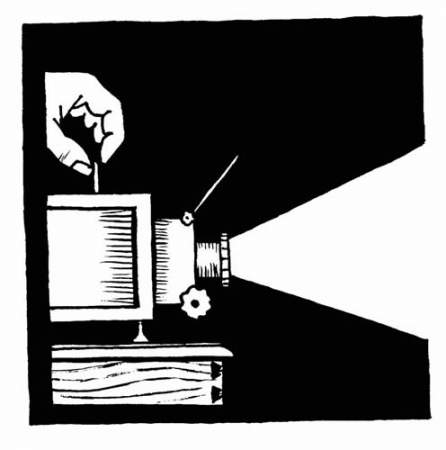
Pullman’s illustration for Chapter 2: The Idea of North

Sometimes it becomes possible for an author to revisit a story and play with it, not to adapt it to another medium (it’s not always a good idea for the original author to do that), nor to revise or “improve” it (tempting though that is, it’s too late: you should have done that before it was published, and your business now is with new books, not old ones). But simply to play.
And in every narrative there are gaps: places where, although things happened and the characters spoke and acted and lived their lives, the story says nothing about them. It was fun to visit a few of these gaps and speculate a little on what I might see there.
As for why I call these little pieces lantern slides, it’s because I remember the wooden boxes my grandfather used to have, each one packed neatly with painted glass slides showing scenes from Bible stories or fairy tales or ghost stories or comic little plays with absurd-looking figures. From time to time he would get out the heavy old magic lantern and project some of these pictures on to a screen as we sat in the darkened room with the smell of hot metal and watched one scene succeed another, trying to make sense of the narrative and wondering what St. Paul was doing in the story of Little Red Riding Hood—because they never came out of the box in quite the right order.
I think it was my grandfather’s magic lantern that Lord Asriel used in the second chapter of The Golden Compass. Here are some lantern slides, and it doesn’t matter what order they come in. – Philip Pullman, the “lantern slides” edition of His Dark Materials

While most people I’ve talked to have expressed disappointment with the ending of The Book of Dust, and that was my own initial reaction, I’ve found it is growing on me with rereadings, particularly as I’ve been listening to the audio versions read by Michael Sheen. It doesn’t hurt that his interview with Pullman, accompanying the final volume, is the best of its kind that I’ve found so far. Particularly resonant are their discussions of the procession and the story, commenting on a little demonstration or rhetorical flourish of Pullman’s in another interview, a video for the Bodleian Library; and of the alethiometer contrasted with the myriorama as images of reading and writing or telling stories.
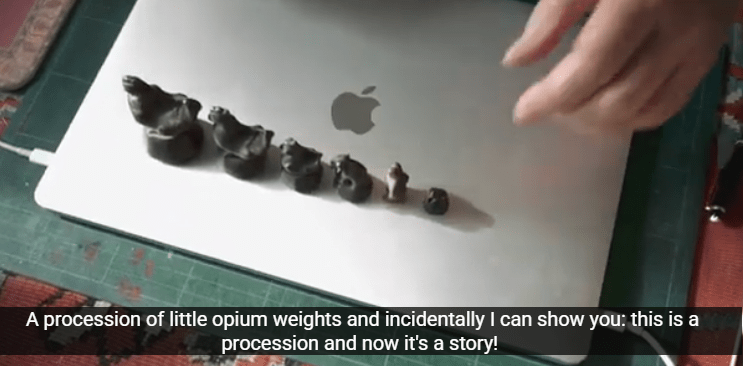
From procession to story, around 2:30 in Behind the Desk: Philip Pullman

So it strikes me that the first requirement of a compelling world picture–speaking only for myself–is that it should partake of that commingling of beauty and truth which Keats’ Grecian Urn attests. If in time irradiating its truth-beauty some contradiction should arise in our perception of that dear picture between the sense of its truth and its felt beauty, then we have to either discard it–Lewis has written powerfully about that in The Discarded Image–or, recurring again to Keats, we can abide with it at the limits of our “negative capability.”

This is where I strive to engage with Pullman, rather than rejecting him, believing us “capable of being in uncertainties, Mysteries, doubts, without any irritable reaching after fact & reason,” as he himself has pointed the way, having these very lines quoted by another one of his scholars, Dr Mary Malone, in The Subtle Knife. When I think of his work as a kind of invitation to think and feel in this way, its challenges, while no less agonistic and at times agonizing, take on a beautiful, sporting quality. And like few other authors, Pullman conduces to the “having of wonderful ideas,” in Duckworth’s model for learning, and to “the realization that prayer consists of attention,” in Weil’s formulation, which I take to be an end beyond the end of learning for its own sake.

“The poem was the authority here, not the teacher.”

One thought I’ve been noodling on along the way, which I’ll just lay down as best I can for now, is that language–language learning at the most basic and most advanced levels alike, literacy and reading of all degrees of interpretive complexity, and literature at its furthest avant garde edge–seems to live and move and leap ahead by way of play.

To adduce a handful of instances representing the movement between world-pictures and worlds:

  • Homeric games and the bow-stringing challenge
  • David dancing before the Lord; dance for Huizinga “the purest and most perfect form of play that exists”
  • Caedmon’s Hymn, considered the first English poem, and the story of its composition given in Bede
  • Chaucer’s pilgrims, making of their tales “ernest” and “game”
  • Shakespeare’s wandering players and kings and the “invention of the human” (Bloom)
  • Joyce’s “shout in the street” in Ulysses, and its echoes back in Araby

If these are the leaps that come to mind, still there are immense degrees of nuance in between each of them. Between Shakespeare and Joyce, a fair amount of literature survives. Or to zoom in further: between Keats’ vision of (his Bright star‘s vision of)

The moving waters at their priestlike task
Of pure ablution round earth’s human shores

and Matthew Arnold’s Dover Beach with its “melancholy, long, withdrawing roar,” and the near-contemporary Oxford Movement; or between Blake’s Marriage of Heaven and Hell and Wordsworth, Coleridge, Shelley, and Byron pushing at the boundary of reason with no little energy, with Mary Shelley producing Frankenstein as a byproduct of their play; or to jump ahead, within the work of a single writer, from Nabokov’s “link-and-bobolink,” “the correlated pattern in the game,” in Pale Fire to his Terra and Antiterra in Ada, where the “game of worlds” becomes almost literal; so much of any writer’s work which we still read seems to consist in the give and take between modeling and effacing world pictures.

And it seems like this is always including, if not in fact by way of, metaphors of play.

Where they get especially ambitious–or playful–writers absorb scientific and religious worldviews alike into their imaginations. Spariosu has given a much fuller treatment, and Sloek a much richer theory, but there is Kierkegaard’s interpretation of Don Giovanni; Bakhtin’s reading of Rabelais; Dostoevsky’s incorporations of scripture, and Bulgakov’s rewritings of it; Vonnegut’s invention of Kilgore Trout, or Milosz’s Bruno; John Crowley’s other worlds; Pullman’s, and his sprite-like narrators… 

I’ve tried to stick to the English language, but translations have crept into my magic circle, as literature itself wouldn’t mean much in any language without the likes of Homer, the Bible, Shakespeare, and Dostoevsky connecting ideas to images, but also helping their readers with the task of making connections between ideas and action, and thus knitting together the inner world or life to the outer, even up to and including that “consummation devoutly to be wished,” though Benjamin asserts that the storyteller is as much generated by as generating death, “death of the author” be darned.

Still, the question arises–the one Hawking asked back at the start–of what world picture or model best facilitates such summing up of the incommensurables, the infinitesimals, or which anyhow values it as an endeavor worth attempting, whether we have the language to express it or no. And it is a question to which in these posts I am continually responding, and trying to understand others’ responses.

For me, this has to include the roots of the language, religious and scientific and poetic alike. Caedmon has to be there, as well as Hawking, and Christie to help us solve the mystery. Then, perhaps with a little help from our friends, we can also better parse the world-pictures that assail us on the screens that surround us, like this one:

Just now hearing about this eruption of PlayStation iconography at last year’s Super Bowl halftime show by Kendrick Lamar, for example, and about shadow boxing from Babcock, so we’ll see if we can collaborate to write something about that. Or the great chess scenes in Nabokov or The Wire:

And I still haven’t read the large claims of the likes of McGonigal and Combs for the ameliorative power of games, nor Bogost on their rhetoric and persuasiveness, nor Miller on the theology of the same.

Looking next time, though, at Kendrick Lamar’s design patterns, with some serendipitous discoveries in Ortega y Gasset, starting with “The Sportive Origin of the State” (Translated into English; original Spanish) via Postman’s Technopoly (and footnoted in good old Homo Ludens to boot).

What Remains: From the Poems of Hannah Arendt to What Remains of Edith Finch

Illuminations and ruminations on what remains at the end of the week, the game, the century.

When I go looking for one thing and come up with another, and another, and… well, after awhile I almost can’t carry it all; I have to call it a day (a week, etc.), throw it together as best I can for the moment (see the present post), and let it go back out into the world, hoping another will find it as well–and will find it interesting, with any luck. Or at the very least, I’ll circle back to it one of these days to contemplate it anew in all its rich associations and, with the benefit of this open-ended time to come, will understand it a little better at last.

For example, the original point of departure here was meant to be a passage in Walter Benjamin’s Theses on the Philosophy of History, placed at the end of Illuminations, a volume of essays and reflections edited by Hannah Arendt:

The story is told of an automaton constructed in such a way that it could play a winning game of chess, answering each move of an opponent with a countermove. A puppet in Turkish attire and with a hookah in its mouth sat before a chessboard placed on a large table. A system of mirrors created the illusion that this table was transparent from all sides. Actually, a little hunchback who was an expert chess player sat inside and guided the puppet’s hand by means of strings. One can imagine a philosophical counterpart to this device. The puppet called “historical materialism” is to win all the time. It can easily be a match for anyone if it enlists the services of theology, which today, as we know, is wizened and has to keep out of sight. (253)

Of course this passage leapt out at me, as it has for countless readers, for many reasons. Marxists of the Frankfurt school and AI prognosticators, Christian apologists and modern-day techno-charlatans alike, in all their combinations and permutations, will find in Benjamin a provocative thought partner. In my case, the drawing together of the imagery of play and theology makes for an endlessly fascinating analogy. I am a poor chess player and a slovenly scholar, but I do love to “imagine a philosophical counterpart” to games, and particularly love to wax philosophical about the ways in which their mechanics interact with their stories.

As for this particular image of “The Chess-Playing Turk,” its “story is told,” among other places, in a section bearing that name in Philip Pullman’s little-known early novel, Galatea:

In the next room were a number of curious automata, such as the famous Chess-Playing Turk designed by the Baron Von Kempelen, which sat cross-legged at a cabinet too full of intricate machinery to conceal a person, and which had defeated the finest chess-players of its time. There was also a machine called the Temple of the Arts, consisting of an automated view of Gibraltar, with moving warships, a platoon of tiny soldiers marching up and down, and a band of mechanical musicians, playing suitable tunes. There was an orange tree which blossomed and bore perfect painted fruit in less than a minute. There was a duck which quacked, breathed, ate and drank. There was a life-size automaton fluteplayer made by Jacques de Vaucanson which, according to its label, performed so realistically that many learned men had thought that it was human. (211)

Advertising poster for a show of Vaucanson’s automata (wikipedia)

Though written in the ’70s, Pullman’s unsuccessful novel, with its shades of magic realism and its author’s avowed admiration for the mystical quest narrative of A Voyage to Arcturus on full display, remains prescient for its surfacing of the question of the role of “the work of art in the age of mechanical [and electronic] reproduction”.

Add to this the fact that the title of Benjamin’s book is also that of Rimbaud’s, and then of Britten’s song cycle based on Rimbaud’s Illuminations, as I learned when I went looking for the searchable text on archive.org (and the search terms threw up the EarthBound player’s guide, somehow, as well. As ever, EB is in good canonical company–though maybe that’s just based on my own search history).

As the program notes have it:

Britten was deeply affected by the emotional intensity of these prose poems and decided to set them to music as soon as he had read them.  As the soprano Sophie Wyss, the dedicatee of the cycle, recalled:  “He was so full of this poetry he just could not stop talking about it, I suspect he must have seen a copy of Rimbaud’s works while he was recently staying with [W.H.] Auden in Birmingham.”

Britten chose a sentence from one of the poems as the motto for his cycle:  “J’ai seul la clef de cette parade sauvage” (“I alone have the key to this savage parade”).  This sentence also provides the “key” to Britten’s view of Rimbaud’s poetry:  only the artist, observing the world from the outside, can hope to make sense of the “savage parade” that is life.

Having just played through the end of the first disc of Final Fantasy VIII, with its own “savage parade” and botched assassination attempt on the Sorceress, I can well understand the impression produced by being “so full of this poetry [I] just could not stop talking about it”–podcasting about it, in my case, with my friend Alexander Schmid. But I draw the line at this notion of being alone in having the key; for it is only through our dialogues, on the contrary, that I feel like I begin to be able to process the meaning of such a densely woven text.

I certainly don’t have a clue about what Rimbaud might be up to, and lovely as Britten’s songs are, I doubt he is the first or the best interpreter of the poet, either in terms of music or meaning. If, as the program notes say, artists alone think themselves able to interpret the world, so much the worse for them; though we may benefit from the confidence embodied in such art as they are thereby moved to produce, it sounds like a terribly solipsistic and lonely activity. To observe the effect of such a belief in the case of Rimbaud’s life, it appears to be part of what drove him to seek exile and enterprise in the desert, giving up poetry for salesmanship.

Klee’s Angelus Novus, Benjamin’s “angel of history” (wikipedia)

Though you never know. Lost poems may yet come to light. Or like Kierkegaard’s knight of faith, perhaps Rimbaud carried the heart of his poetry with him through a superficially ordinary life of infinite resignation. My own opinion, to which I stubbornly cling with a fierce devotion, is that these knights are inside us all, hidden better than the chess-player theologian under the mechanical turk’s table, and opening us like the Silenus of Socrates in The Symposium (and memorably related in Rabelais’ Prologue). When the time is right, we are all “found to contain images of gods”. In that light, the speaker of Rimbaud’s line may well be this precious cargo, and his famous line “I is another” can be brought to bear in this connection as well. In which case I heartily agree: no one else could possibly hold the key to the “savage parade” of life.

In dusting off these reflections years later for a belated spring break post in this year of myth in games, I was actuated by another chance discovery: one of my favorite podcasts, Backlisted, just released an episode discussing What Remains: The Collected Poems of Hannah Arendt. Give it a listen! Arendt, besides editing the collection of Benjamin’s essays, is the author of more than one of the 20th century’s classic works of philosophy, and has bequeathed us the clearest and most cutting precis of her time: “the banality of evil”–though, as the podcast mentions, its meaning, and the work in which it is formulated, Eichmann in Jerusalem, is contested.

I can’t be the only one to have noticed the resonances of What Remains of Edith Finch in the title chosen by the editors of Arendt’s poetry, and echoes of Osip Mandelshtam, of Reginald Gibbons, of Hölderlin and Heidegger

Last but not least, in the spirit of Dirt newsletter’s weekly tab round-up, since I was recommending they look at Backlisted, too, here is a bit of what remains in my browser:

The Digital Antiquarian, recommended by Dylan Holmes, is well worth a read. Mixing up What Remains of Edith Finch (which I did watch a full playthrough of) and Dear Esther (which I didn’t yet, though it’s the one Dylan actually wrote about and recommended in our conversations), like “memory and desire” in April, “the cruelest month” to Eliot’s speaker, perhaps, though that title by common consent is given to March here in Spokane, I finally sat down to read what he had to say about JRPGs and was captivated as much by the comments as the articles’ content. Posters suggest links to a number of papers on localization, games as carriers of Japanese culture and values and cuteness, as locus of reflections on design and affect, and in a wonderful bit of synchronicity, to Beyond Role and Play, a book on LARP including a chapter that riffs on Don Quixote. There’s also a FF series retrospective for the completionist.

What else? I still need to submit a proposal to this CFP, and break down and buy MJ Gallagher’s book, and maybe this one on “Deep Games” by Doris Rusch, and actually read some more Arendt, including her poems

This is the arrival:

Bread is no longer called bread

and wine in a foreign language changes the conversation.

–and the rest of Kentucky Route Zero, and Dear Esther, and the use of an invented Latin-ish language in FFVIII. I should submit a question for The Bible Project on the Tao and the Exodus Way. I should write more about Philip Pullman, the wheel of fortune as game show and ancient motif, saving as economic and theological image, Christmas subsumed, the spectral in Marx and the invisible hand in Smith…

Or what about this strange constellation of Benjamin’s bon mots on the theme of “backdrops”:

On the other hand, this heaven is only background; to explore it according to its own laws would be like framing the painted backdrop of the stage and hanging it in a picture gallery. (121)

 In his “Salon of 1859” Baudelaire lets the landscapes pass in review, concluding with this admission: “I long for the return of the dioramas whose enormous, crude magic subjects me to the spell of a useful illusion. I prefer looking at the backdrop paintings of the stage where I find my favorite dreams treated with consummate skill and tragic concision. Those things, so completely false, are for that very reason much closer to the truth, whereas the majority of our landscape painters are liars, precisely because they fail to lie.” (191)

?

Let it be said of me, as Arendt does of Benjamin in her introductory essay: “Well, he did not succeed in consolidating anything, and success would hardly have been possible.”