Maurice Merleau-Ponty (1945) emphasized the role of the body in human experience:
Insofar as, when I reflect on the essence of subjectivity, I find it bound up with that of the body and that of the world, this is because my existence as subjectivity is merely one with my existence as a body and with the existence of the world, and because the subject that I am, when taken concretely, is inseparable from this body and this world.
(Doyle, New Opportunities for Artistic Practice in Virtual Worlds, 2015, pages 93-94)
*
But what of multiple worlds
and worlds within worlds
Cognition a gray sweater
that illuminates nothingness
when flames (worlds) arrive.
*
You were killed by lava. You were killed by a serpent. You were killed by ______.
The disclaimers will continue. Death becomes a spiral outwards and upwards, a lesson, a reincarnation.
*
Where there is world there is life, and where there is life there is death, and it’s impossible not to know rebirth in this model, this statement that humans have imposed upon themselves.
*
Who was the first to say “Game Over” is a misnomer?
*
Who was the first to turn life into lives, to give “extra,” to provide a plurality to our relationship? To keep us hijacked, smiling, blissful, tethered into a “this could always become and become more”?
*
Death as joy.
*
The way we die, or log off, or quit. Exit to the main menu. Exit to desktop. The intrinsic meeting the ecstatic: it is all temporary, we will be back.
*
I begin sitting down. My body disappears. I begin in a place. There is no more weight. There is no more shapes. The ether fills. Eyes take over. Vision.
The screen moves from absence to presence. The ground loads. The sky loads. Shapes begin to populate. And I am breathing. And there is a flicker of breath, a digital soul shifts position, in the movement in front of me. If I stare just long enough, I am in conversation. This entity in front of me is a character. And we are beginning to dance.
Each moment entering into a world is incredibly special, a welcoming in, a beckoning. I can almost feel the waves of air parting between me and a world as the hand slices through in urgency. Come, be with us, come, explore with us.
A sprig of grass bounces back and forth. A small mammal makes a cry as it darts away into the horizon. Clouds silently expand and diminish in algorithmic intelligence.
*
Each moment entering into a world. Each moment entering. This sense of load, save, load, save. The returning, the coming back. There is always a coming back.
*
Under layers of pixels my beating heart is sustained and low for ages. Waiting for the crisis to crack, the heart getting massaged by mouse click and key tap.
*
Shift feet on carpet, plastic foot rest, plastic cover. Easy for wheels to slide. Easy for rotation, getting settled in, getting up and exploding out into the everything that exists beneath the hood.
*
This is not about what I do, it is all about how I am.
Stand up.
More coffee.
Sit down.
And stand up.
Ice cream.
Sit down.
And stand up.
Snacks.
Sit down.
Stand up.
Water.
Sit down.
*
There is something about the stack of beers that used to pile up around his desk as he ground through MOBAs and MMOs for hours every night. I’ll always remember that altar of numbness. Though I called it a glass cathedral. Was it bigger than him? The individual? Was it bigger than us? Was it emblematic of all the followers of the subtle, brutal, intensely ever-present escapism?
*
Who are we when we’re running around arenas together? Fighting complacency, finding the will to live. Is this modeling? Crafting new models? Designing the new approach? Quake leads to parkour. Bunny hopping leads to summiting peaks. There is time travel; dissonance between discovery and translation.
*
On the verge of turning forty, I know my breath is what I’ve held in place for countless hours. Countless becomes dozens. Becomes hundreds. Becomes thousands.
*
And yearning to imagine more, always yearning to image. I can see you, oh androgynous anonymous, with your thousands of hour in your nook of cyber love, co-existing. You bring the soul shiver just by contributing.
*
Electrical requirements. Taking so much for granted. And when the device breaks, the power stops, there is great sorrow. And when it all returns, there is great joy.
*
Why does leaving not have a fading away, a deconstruction, a slow removal of objects until we are left with the faint outlines of a skybox and a giant, ever after void?
*
Early MMOs, find a place to sit, and sit there. Then, and only then, can you properly log off.
And if you don’t follow the rules, what happens? Will your “progress” go “unsaved”?
*
K makes a game that involves a pit. One can jump out of it, but they need to learn how to jump. I didn’t learn how to jump. I died in the pit. “You were killed by lava.” Or something. And I feel the vague sense that learning is the next step. There is no need. There is no “necessity.” It is not “You must learn how to jump.” It is simply is the unabashed next step.
*
Or I could never return. I could leave. I could escape the escape. For another option. An alternative method. Excitement is matched and balanced with anxiety: to embrace nuance, to give and to take, to accept and to reject. Humanity continues to impose its limitations, including choice.
*
The future will be permutations upon permutations. The future will be all options at once. The future will be beyond “extra lives” to “infinite lives.” Infinite living will be the next surge, the next spike.
*
Will we then be forced to move into limitation as a future future iteration? To remember that linearity always had its benefits, its quaking benefits, its beginning and end, its sense of level, leveling, finite structure, rigidity as a great exclamation?
*
We may still find ourselves loading into the space, the flow of endorphins twin spirals between screen and body of player, the real of the in real life is equal parts virtual, a concoction, a cocktail, of here and everywhere, of linear and open, of possibility and action. The long form list of dualities that builds pressure and enhances the techno relationship ad infinitum.
*
There’s time to clear our heads with all of this. Beneath the logistics and the observations, there is a literary subtext. There is a reason beneath it all, beneath all the questions, the individuals, the collectives, the objectively disconnected and isolated. Deconstruction bedamned, it needs only be to continue being, the narrative is a tapestry, the story is a web of stories, it is storied, it has happened, and that is enough.
*
Greg Bem is a poet, publisher, and librarian in Spokane, Washington. A lifelong gamer and game enthusiast, one of his current creative writing projects is a book-length lyrical essay on virtual worlds and performance. An additional sequence is available in the 2025 issue of LEGENDS, the Spokane Community College literary magazine. Earlier in his timeline, he published a game studies blog, and many of his other creative projects can be found at gregbem.com.
Illuminations and ruminations on what remains at the end of the week, the game, the century.
When I go looking for one thing and come up with another, and another, and… well, after awhile I almost can’t carry it all; I have to call it a day (a week, etc.), throw it together as best I can for the moment (see the present post), and let it go back out into the world, hoping another will find it as well–and will find it interesting, with any luck. Or at the very least, I’ll circle back to it one of these days to contemplate it anew in all its rich associations and, with the benefit of this open-ended time to come, will understand it a little better at last.
For example, the original point of departure here was meant to be a passage in Walter Benjamin’s Theses on the Philosophy of History, placed at the end of Illuminations, a volume of essays and reflections edited by Hannah Arendt:
The story is told of an automaton constructed in such a way that it could play a winning game of chess, answering each move of an opponent with a countermove. A puppet in Turkish attire and with a hookah in its mouth sat before a chessboard placed on a large table. A system of mirrors created the illusion that this table was transparent from all sides. Actually, a little hunchback who was an expert chess player sat inside and guided the puppet’s hand by means of strings. One can imagine a philosophical counterpart to this device. The puppet called “historical materialism” is to win all the time. It can easily be a match for anyone if it enlists the services of theology, which today, as we know, is wizened and has to keep out of sight. (253)
Of course this passage leapt out at me, as it has for countless readers, for many reasons. Marxists of the Frankfurt school and AI prognosticators, Christian apologists and modern-day techno-charlatans alike, in all their combinations and permutations, will find in Benjamin a provocative thought partner. In my case, the drawing together of the imagery of play and theology makes for an endlessly fascinating analogy. I am a poor chess player and a slovenly scholar, but I do love to “imagine a philosophical counterpart” to games, and particularly love to wax philosophical about the ways in which their mechanics interact with their stories.
As for this particular image of “The Chess-Playing Turk,” its “story is told,” among other places, in a section bearing that name in Philip Pullman’s little-known early novel, Galatea:
In the next room were a number of curious automata, such as the famous Chess-Playing Turk designed by the Baron Von Kempelen, which sat cross-legged at a cabinet too full of intricate machinery to conceal a person, and which had defeated the finest chess-players of its time. There was also a machine called the Temple of the Arts, consisting of an automated view of Gibraltar, with moving warships, a platoon of tiny soldiers marching up and down, and a band of mechanical musicians, playing suitable tunes. There was an orange tree which blossomed and bore perfect painted fruit in less than a minute. There was a duck which quacked, breathed, ate and drank. There was a life-size automaton fluteplayer made by Jacques de Vaucanson which, according to its label, performed so realistically that many learned men had thought that it was human. (211)
Advertising poster for a show of Vaucanson’s automata (wikipedia)
Though written in the ’70s, Pullman’s unsuccessful novel, with its shades of magic realism and its author’s avowed admiration for the mystical quest narrative of A Voyage to Arcturus on full display, remains prescient for its surfacing of the question of the role of “the work of art in the age of mechanical [and electronic] reproduction”.
Add to this the fact that the title of Benjamin’s book is also that of Rimbaud’s, and then of Britten’s song cycle based on Rimbaud’s Illuminations, as I learned when I went looking for the searchable text on archive.org (and the search terms threw up the EarthBound player’s guide, somehow, as well. As ever, EB is in good canonical company–though maybe that’s just based on my own search history).
Britten was deeply affected by the emotional intensity of these prose poems and decided to set them to music as soon as he had read them. As the soprano Sophie Wyss, the dedicatee of the cycle, recalled: “He was so full of this poetry he just could not stop talking about it, I suspect he must have seen a copy of Rimbaud’s works while he was recently staying with [W.H.] Auden in Birmingham.”
Britten chose a sentence from one of the poems as the motto for his cycle: “J’ai seul la clef de cette parade sauvage” (“I alone have the key to this savage parade”). This sentence also provides the “key” to Britten’s view of Rimbaud’s poetry: only the artist, observing the world from the outside, can hope to make sense of the “savage parade” that is life.
Having just played through the end of the first disc of Final Fantasy VIII, with its own “savage parade” and botched assassination attempt on the Sorceress, I can well understand the impression produced by being “so full of this poetry [I] just could not stop talking about it”–podcasting about it, in my case, with my friend Alexander Schmid. But I draw the line at this notion of being alone in having the key; for it is only through our dialogues, on the contrary, that I feel like I begin to be able to process the meaning of such a densely woven text.
I certainly don’t have a clue about what Rimbaud might be up to, and lovely as Britten’s songs are, I doubt he is the first or the best interpreter of the poet, either in terms of music or meaning. If, as the program notes say, artists alone think themselves able to interpret the world, so much the worse for them; though we may benefit from the confidence embodied in such art as they are thereby moved to produce, it sounds like a terribly solipsistic and lonely activity. To observe the effect of such a belief in the case of Rimbaud’s life, it appears to be part of what drove him to seek exile and enterprise in the desert, giving up poetry for salesmanship.
Klee’s Angelus Novus, Benjamin’s “angel of history” (wikipedia)
Though you never know. Lost poems may yet come to light. Or like Kierkegaard’s knight of faith, perhaps Rimbaud carried the heart of his poetry with him through a superficially ordinary life of infinite resignation. My own opinion, to which I stubbornly cling with a fierce devotion, is that these knights are inside us all, hidden better than the chess-player theologian under the mechanical turk’s table, and opening us like the Silenus of Socrates in The Symposium(and memorably related in Rabelais’ Prologue). When the time is right, we are all “found to contain images of gods”. In that light, the speaker of Rimbaud’s line may well be this precious cargo, and his famous line “I is another” can be brought to bear in this connection as well. In which case I heartily agree: no one else could possibly hold the key to the “savage parade” of life.
In dusting off these reflections years later for a belated spring break post in this year of myth in games, I was actuated by another chance discovery: one of my favorite podcasts, Backlisted, just released an episode discussing What Remains: The Collected Poems of Hannah Arendt. Give it a listen! Arendt, besides editing the collection of Benjamin’s essays, is the author of more than one of the 20th century’s classic works of philosophy, and has bequeathed us the clearest and most cutting precis of her time: “the banality of evil”–though, as the podcast mentions, its meaning, and the work in which it is formulated, Eichmann in Jerusalem, is contested.
Last but not least, in the spirit of Dirt newsletter’s weekly tab round-up, since I was recommending they look at Backlisted, too, here is a bit of what remains in my browser:
The Digital Antiquarian, recommended by Dylan Holmes, is well worth a read. Mixing up What Remains of Edith Finch (which I did watch a full playthrough of) and Dear Esther (which I didn’t yet, though it’s the one Dylan actually wrote about and recommended in our conversations), like “memory and desire” in April, “the cruelest month” to Eliot’s speaker, perhaps, though that title by common consent is given to March here in Spokane, I finally sat down to read what he had to say about JRPGs and was captivated as much by the comments as the articles’ content. Posters suggest links to a number of papers on localization, games as carriers of Japanese culture and values and cuteness, as locus of reflections on design and affect, and in a wonderful bit of synchronicity, to Beyond Role and Play, a book on LARP including a chapter that riffs on Don Quixote. There’s also a FF series retrospective for the completionist.
and wine in a foreign language changes the conversation.
–and the rest of Kentucky Route Zero, and Dear Esther, and the use of an invented Latin-ish language in FFVIII. I should submit a question for The Bible Project on the Tao and the Exodus Way. I should write more about Philip Pullman, the wheel of fortune as game show and ancient motif, saving as economic and theological image, Christmas subsumed, the spectral in Marx and the invisible hand in Smith…
Or what about this strange constellation of Benjamin’s bon mots on the theme of “backdrops”:
On the other hand, this heaven is only background; to explore it according to its own laws would be like framing the painted backdrop of the stage and hanging it in a picture gallery. (121)
In his “Salon of 1859” Baudelaire lets the landscapes pass in review, concluding with this admission: “I long for the return of the dioramas whose enormous, crude magic subjects me to the spell of a useful illusion. I prefer looking at the backdrop paintings of the stage where I find my favorite dreams treated with consummate skill and tragic concision. Those things, so completely false, are for that very reason much closer to the truth, whereas the majority of our landscape painters are liars, precisely because they fail to lie.” (191)
?
Let it be said of me, as Arendt does of Benjamin in her introductory essay: “Well, he did not succeed in consolidating anything, and success would hardly have been possible.”
For better or worse, I wrote this in October/November of 2024, before the Presidential Election, and the time informs the tone. Rather than rewrite it all and delay publishing this *again*, it seems wiser to consider this a period piece in its own right, especially since it’s a piece about a period already, and we’re publishing it serially now. So: 2024 reflecting on 2021 – go.
CW: AmErIcAn PoLiTiCs
2021 seems like a long time ago, here in 2024.
I hope I still remember how this story goes.
Vacation
At the end of May 2021, I was at possibly the lowest point I’d reached in years. The pandemic was raging around me. My students were plagiarizing at record levels. And that month I’d been threatened with legal action by plagiarists defending their own plagiarism, all while my computer was utterly crashed—and while I’d fought off those threats with some combination of stubborn determination and painstaking documentation, I was now exhausted.
Truly, deeply exhausted.
So I skipped town.
That January I’d decided to go camping in the summer. I hadn’t been camping in years—probably over a decade at that point. I talked to my wife about it, found a secluded state park in the Alleghenies, and a very cheap cabin to rent for a week, scheduled my vacation for the first week after my spring semester concluded – and now the time was come. Now, after a year-and-a-half of stuttering lockdowns and closures and stir-craziness, I was going to get a vacation. I was going on an adventure, like the ones I used to take when I was in college.
This probably requires some context.
Context
View of the backyard where I grew up, ca. 2022.
I grew up in Northern New Jersey. As far North as you can get without ending up in Upstate New York. This amounts to growing up in the most rural part of the most urban state in the United States (Pine Barrens folk will fight me on this; I concede the ground – I’m just trying to make a point). So I have, as long as I’ve been alive, found myself caught between these two worlds. And in America, the force behind these two worlds is pretty palpable.
“Rural” in American means “redneck”—Conservative, separated from major urban centers (and often a little resentful of those urban centers), Christian, blue-collar, outdoorsy.
“Urban” in American means “citified”—Liberal, dwelling predominantly in major urban centers (and taking significant pride in how close one resides to those centers), religiously open-minded, white-collar (or at least Bohemian), cultivated.
There is a serious cultural divide between these two groups. One serious enough that when I got to college and started meeting people in the entrenched “urban” category, I was shocked that such people existed.
(If you’re thinking about political divisions, here’s a cookie: we’re getting to that. For now, I want to keep this very basic, and very personal.)
But in my little middle-class corner of rural-ish New Jersey, we coexisted peaceably. On the one hand I was surrounded by Jeff Foxworthy-loving rednecks—farmers and laborers and lower-middle-class office workers (my father was an insurance agent for many years); on the other, my teachers were typically ex-hippies and New York City expatriates, Liberal to their bones (my mother taught French at my high school for many years). At least as far as I could see from my child’s vantage point, these two forces existed in tension, but not in hostility. White-collar conservatives and academically-minded liberals could agree to prioritize children in school board elections. Ex-hippies respected the honest work of running a farm, while conservative farmers and shopkeepers relied on the business of their liberal neighbors to keep their doors open.
Furthermore, we as a community found reasons to laugh at outsiders from either end of this spectrum. Locals often mocked the tourists who would come to our town from the city, only to pull over and gawk at cows standing in fields (an everyday occurrence for us)—or we would gossip about the woman who, while visiting a local park, fed a sandwich to a bear and had the skin of her hand ripped clean off. And yet we had a certain disdain and apprehension of the angry poor men who would congregate in the town bar, picking fights and running up bills—“white trash,” we called them.
We were neither of these people. We laughed at big city tourists who’d never seen a cow before, because all their money and status had distanced them from what was normal. And we pitied and protected the poor people who struggled with alcoholism and abuse and homelessness—so long as we didn’t have to go to the unpleasant places where they fought and fornicated.
Local Entertainment Photo courtesy of Sparta Independent
I say we and they because this is always the binary. I’d say “in America,” but I’m not sure that’s true. I suspect this is the case everywhere. We are always we and they are always them, though who is “we” and who is “them” changes from person to person, place to place.
But because the we’s and them’s existed cheek-by-jowl in our little corner of the world, I quickly learned that those barriers were porous, malleable. I remember a conversation in third grade—a boy told me his parents were voting for one particular local town council candidate (I don’t remember who), and I immediately—reflexively—replied: “but he’s a Democrat!” And he responded, as though it wasn’t some kind of scandalous transgression: “Yeah. So?” Or the time I went to a friend’s house and discovered that it was squalid, ill-kept, like one of the white-trash people. Or the time my high-school English teacher counseled me that “maybe liberals aren’t so bad, after all.” Or the time I rode in the bed of a pickup truck to a friend’s house, only to have the dog accompanying us leap out and start fighting with another dog—all of which was understood as good sport by the people I was with.
There is no good way to express this. The abstractions only make sense in the American worldview I have; the examples only reveal the abstractions when you’ve met and known the type of people that surrounded me on all sides.
But the point is: there were two worlds, possibly more, and I between them. And in many ways, I was exposed to the best and worst of each. I once spent a day in the offices of the New York Times, watching over the shoulder of one of the editors, who commuted into the city from my town. On a different day, I had a tour of a dairy farm, and helped milk a cow. School field trips included independent book stores and off-Broadway playhouses in Brooklyn, as well as hiking trips down secluded streams. And I liked to think I was raised to be reasonably comfortable in all these places, with all these people. I’ve never been social, but I could get along with the conservative Christians, the retired academics, the men who worked the land and talked football in the evenings, the women who studied literature and culture and history and encouraged me to do the same.
I was taught to see the value—and the danger—in all of these things. I learned to appreciate the beauty and tranquility of camping, but was taught to respect its dangers as well. I learned to love the intelligence and skill of cultural study and pursuit, but to disdain its elitism and detachment. I learned how hard (and rewarding) a day’s manual labor could be, but also that it was not an excuse for poor behavior or belittling others. I learned that you could gain great knowledge and wisdom from books, computers, and experts, but that such knowledge could prove to be stupidly narrow when faced with the basic realities of another person’s life.
I learned, in short, that they was really just we with a different way of going about things. That under different circumstances, or from a different point of view, it was easy enough to see that they and we had more in common than we did dividing us, and you could pretty easily trace the divergence points, if you took the time to try.
And, importantly, I respected this about myself. I liked having a foot in both worlds. I liked having the company of both kinds of people. And I would feel incomplete if I were forced to give up one or the other. My home was in the center. My aspiration was to balance these parts of my life.
Encounters
College brought new worlds to engage with, and a new desire to explore and investigate these worlds. I went to college in Maryland—a state with its own complex history of having one foot each in the North and South. I went to a Liberal college on the Conservative Eastern Shore—and found myself equally enamored by the academic world of my professors, and the proud history of Shoremen crab-fishers, farmers, and shopkeepers (even as the “townies” would occasionally make trouble on our campus out of disdain for outsider college students). I took trips to visit friends at their homes during the summer—and discovered that their worlds were even more foreign to me. One lived in a dilapidated house in South Philadelphia. Another lived in a secluded mansion outside York, Pennsylvania, protected from the highway by a portentously-long driveway. Another lived on an immense horse farm, where past Kentucky-derby winners were often pastured by absent owners. Another lived in a tight-knit suburb of Washington, D.C. Another dwelt in a cozy house in the middle of nowhere, across the street from a biker bar where drunk bikers would accidentally decapitate themselves on low-hanging branches.
Perfectly normal college behavior
Twice, after college, I expanded my wanderlust to the corners of the country. Once with a friend; once with my sister, I drove from sea to shining sea, across Kansas plains, South Dakota Badlands, up the Rocky mountains, and through the hills of Napa valley. We camped where we could, stayed with friends where we had them, and took rooms in cheap motels or made camp where we didn’t. I’ve at least driven through all 48 of the contiguous United States; I’ve spent several days vacationing or visiting well over a dozen of them, and (at this point) lived in five. I’ve driven through most major American cities, visited many National Parks, and have tried to see the appeal of every place I’ve been. Sometimes, that comes with difficulty (I did not adapt easily to life in Boston while pursuing my Master’s); other times, I fall in love with a place at first sight (Vermont, Utah, Oregon).
On some, deep level I consider myself a true patriot in these United States. I love this land. I love the wild, diverse ways that people have made homes here. I have stories to burn about friends, neighbors, strangers, and encounters with people all over this country. And I have a perennial desire to venture out into the unknown and make peace with those places as well. Like Bilbo Baggins or Innocent Smith, my love of foreign climes and my love of home enrich one another: adventuring makes my home fonder; long spans at home make my adventures richer.
Enemy Territory
So I decided to go adventuring. I rented my cabin. I bought some supplies (Food, mostly. I make no pretense at survivalism, and can barely make a fire if they provide me with a woodstove.) I packed my books, and notebooks for writing. And on some unassuming Tuesday after my hellish week of grading and computer-wrangling, I left. I hopped from major Pennsylvania interstates to dusty farm roads, through small, one-traffic-light towns, and past homes dotted along hilly, remote lanes.
But something was not right. Something I should have expected, but had not.
These places did not feel like home anymore.
There’s a line in the first Captain America movie: “People forget that the first country the Nazis took over was their own.” You can find the same sentiment in Mann’s Doctor Faustus.
That’s how I feel about Donald Trump.
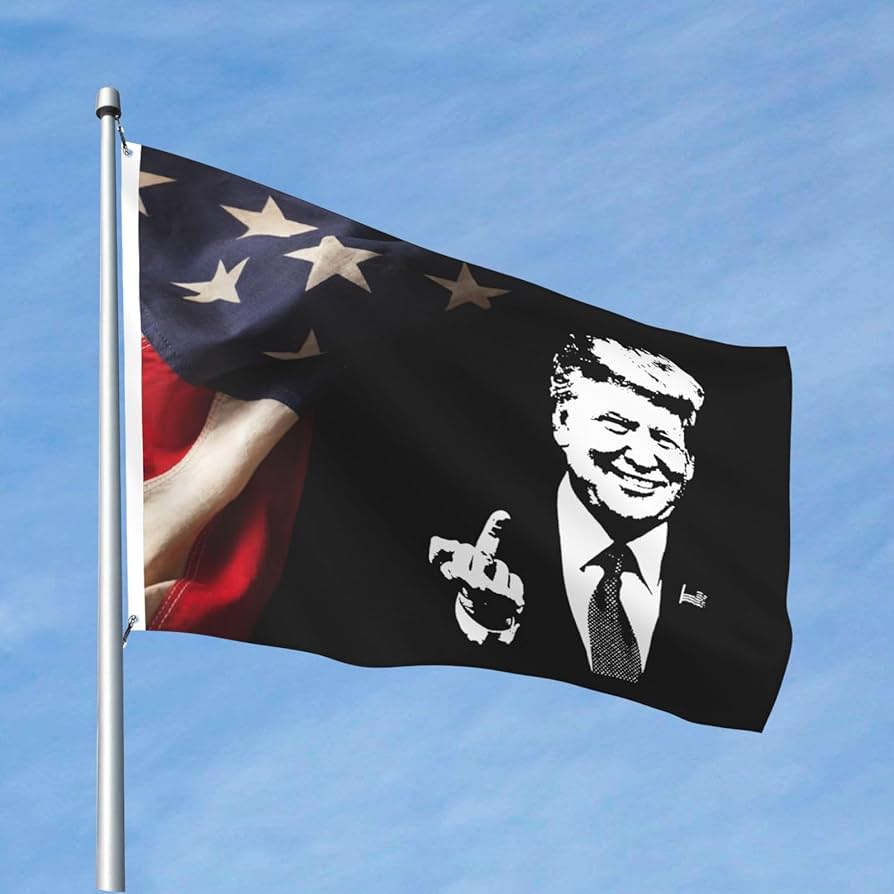
I wanted a picture of a Trump flag in the wild, but Google Earth scrubs its images and I saw no reason at the time to take pictures – so indulge in this horror from Getty Images instead
Before 2016 he was just a CEO caricature, but the 2016 election somehow turned him into a demagogue, and his followers into a cult of personality. There’s a lot more to say here, and I’m not qualified to say most of it, but we do have to talk about this if it’s going to make sense.
Donald Trump took over my country. This is how I feel. In my little corner of rural New Jersey, the uneasy and delicate tension between rural and urban, redneck and hippie, Conservative and Liberal, suddenly became untenable. Suddenly, there were Trump flags flying from the beds of pickup trucks. Red MAGA hats were everywhere. Bumper stickers and lawn signs and billboards all announcing allegiance to Donald Trump.
Look, I’m not naïve. I’d seen political movements like this before. There had been strong support for George W. Bush in my community, even after he invaded Iraq—but this was different. This was not your garden-variety political friction ramping up for a presidential election: this was a cultural force. People were as excited about Donald Trump as they were for their favorite sports team, and showed the kind of performative allegiance that you would for that team. And after Trump won the election, those signs and flags and bumper stickers and hats didn’t go away. They stayed around, littering yards, broadcasting from trees and silo walls and bumpers, dotting roadsides. Why? What purpose did they serve, after the election had ended? Why did people still feel this kind of allegiance?
Then Trump took office and—look, there’s a litany of terrible things he did while in office, but I’m not here to make a political plea. That much should be obvious to anyone reading this post at this point. I don’t see the sense of preaching to the choir, or stirring up Trump supporters by antagonizing them. Suffice it to say that I think he made a terrible president—like, competing for the title of worst-ever president of these United States.
But here’s the kicker: the signs, the hats, the bumper stickers, and the flags never went away. It didn’t matter what new terrible thing he did, what accusations of racism, islamaphobia, or misogyny were leveled at him. It didn’t matter that he was firing staff and cabinet members left and right, or couldn’t string a cogent sentence together, or was rattling sabers with North Korea and Iran. People still pledged their allegiance, flew his flag, announced their support. He still conducted rallies, regularly, well into his presidency. People felt connected to him.
And increasingly, I felt afraid of those people.
I remember walking into a diner with a friend of mine, back in 2016, and there was an older man in a MAGA hat leaving as we came in. And my friend admitted it was the first time he’d seen one in the wild—not on some televised rebroadcast of a Trump rally, or as an Internet meme—and he felt shaken. Honestly, I felt the same. There was nothing terribly upsetting about the man himself: maybe an awkward moment, holding the door, as we reacted to his hat, and he reacted to our reaction, but nothing more than that. No confrontation. No exchange of words or convictions. Just a mute acknowledgement that we were on different sides of the political spectrum, and maybe a bit of a shock that there were actual human beings occupying the opposite position, rather than faceless villains or bogeymen.
My friend and I had been taught to believe that wearing a MAGA hat was tantamount to a hate crime: it was an endorsement of a man whose convictions were ridiculous and execrable. It was a signal of political illiteracy: an admission to being suckered in by a man preying on fear and hatred rather than relying on logical arguments and experience.
But to this guy, I assume he was just showing his support.
That was in 2016.
In 2021, the situation had only grown worse. The 2020 election had been plagued by allegations of malfeasance: Trump spent the months of his campaign arguing that the mail-in ballots (necessitated by the pandemic) were untrustworthy and fraudulent, then cashed in that investment by alleging that the election was stolen from him by villainous officials and misdeeds. On January 6, 2021, his supporters went so far as to storm the capitol building, terrorizing Democratic politicians and destroying their property—all while flying Trump flags, and repeatedly professing their allegiance to his cause.
Note from 2025: Everyone in this picture has been pardoned now!
And in May 2021, as I left my safe suburban-New-Jersey apartment complex to go on my adventure into the woods, I did not expect what I found.
The flags were still up. The bumper stickers still on. The hats, the billboards, and the dozens of other signs of Trump-allegiance—all were still everywhere. Worse, there was a recent fad: flags depicting a human hand pulling one flag back like a curtain to reveal another icon beneath. On my trip I saw two that especially frustrated me: the first, an American flag pulled back to reveal a typical white-Christ-with-halo beneath (I really hope my memory is correct, and the two symbols weren’t reversed); the second, the same American flag pulled back to reveal a Trump flag beneath. Both I found semiotically-horrifying, an affront not only to my convictions but to good sense and self-awareness. Who were these people who misunderstood their faith and politics so egregiously?
I wasn’t going on a relaxing vacation to escape the political turmoil and stress of the last year—I was venturing into enemy territory: an unwelcome hostile combatant.
Checking My Privilege
This is not meant to be a sob story. I’m not looking for pity. I realize that I’m a white man, and am the least of Trump’s targets. I imagine that rural neighborhoods and backwoods campgrounds have not been safe spaces for black people, muslims, or lone women for decades, and I’ve only just gotten around to noticing it, protected as I was by the color of my skin and the gender I project. And that sucks. That sucks a whole heck of a lot.
I am sorry for that. I am sorry that some of America’s most beautiful places are cordoned off by race, class, and gender. I’m sorry that people who have been born and raised in this country—or are even just visiting from somewhere else—are alienated, antagonized, and even attacked when they venture out of friendlier neighborhoods. I wish I could rectify that. But I can’t.
Because I’m afraid I’ve exhausted my power to improve the situation for other, less-privileged people. By throwing in my lot with them, I’ve stopped being part of we. Because Trump has narrowed we to the people who support him: everyone else is them. I became them as soon as I chose not to senselessly hate the people he vilified.
This was my home. This was the place where I wanted to get away. And they took it from me.
I used to call these people neighbors and friends. Now, they terrify me. I used to try to reason with these people, appeal to their better natures, but now they do not listen to me. I am the enemy. I do not feel safe among them.
And as much as those signs and flags and bumper stickers and billboards are a sign of allegiance, they also function (intentionally, perhaps) as an expression of hostility.
Some more obviously than others.
No Trespassing.
You Are Not Welcome Here.
This Place Belongs to US.
The Human Under the Hat
Let’s be very real for a moment here.
I assume that under every MAGA hat is a living, breathing, thinking human being. And I assume that everyone who flies a Trump flag, or puts up a Trump sign is also a human being. And, because of my upbringing in philosophy, I believe that each human being is worthy of respect, has dignity in Kant’s language.
This is doubly the case because, remember, many of these people were my neighbors, once upon a time. I come from a place (and time) when conservatives and liberals worked together. Conservatives were friends, family, and neighbors. Our disagreements could be overcome in the pursuit of common goals.
But there is a fundamental difference between the person who chooses to vote for Trump (who decides, in their heart-of-hearts, that he is the best person to run the country, whatever his failings), and the person who aggressively, vocally, supports him. The person who votes for Trump may have reasons and misgivings, but the person who stakes a twenty-foot Trump sign in front of their house is not interested in talking about his policies or ideas: that person doesn’t speak rationally or respond to rational argument. Talk to that person, and you’ll hear not reason, but emotion. Immediately. This isn’t a matter of “getting worked up”, but reflexive anger, defensiveness, and dismissiveness. These are people who have gone well beyond making a thoughtful political decision, and moved directly to allegiance.
And, frankly, I blame Trump for this. His rhetoric is always self-focused. His promotional materials invite people to join his “army”, or frame the decision to “support” Trump as an act of “loyalty” or “dedication,” while liberals are always framed as monsters: pedophiles, conspirators, or traitors. He is not interested in appealing to reason, but encourages the engine of emotion to run freely. He is a demagogue. The most successful cult leader in American history.
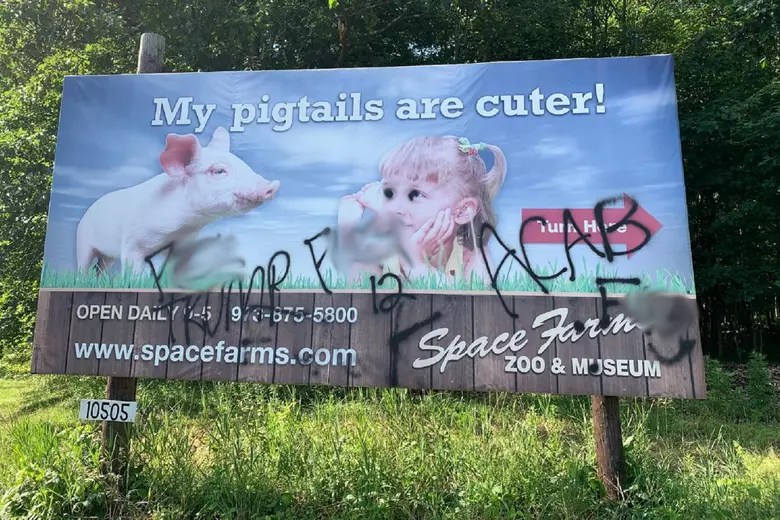
But his supporters are still people, right? Even the flag-flying, hat-wearing, I-will-spray-paint-“Let’s-Go-Brandon!”-in-fifteen-foot-high-letters-on-my-picket-fence crowd are people. Not just automatons, or the brainwashed. They vote. They have families. They work toward a functioning society, just like everyone else.
How do we—not just the liberals, I mean, but any thinking person upset by this fanaticism—deal with this reality?
In the week before going on my camping trip, I ran across a liberally-minded meme that was making the rounds. I don’t remember the exact wording, but it came out roughly to:
”We didn’t try to talk to the Nazis. We sent soldiers to kill them.”
Which was true enough in 1944, but in 2021, there was an incredibly dark undercurrent to these sentiments.
Is that really the only solution left? Are we really prepared to say that the people who vocally, emotionally support Trump are so far gone that the only solution is to kill them?
Local color from my hometown, courtesy NJ 101.5
In 2024, this might be an even more complicated conversation. After two assassination attempts on Donald Trump, there seems to be a pretty uneasy truth hanging over our heads. Much as there has been backlash against any public figure who claims to support the assassins, or who expresses any amount of sympathy with the desire to kill Donald Trump—it doesn’t change the fact that, even in liberal circles, the man has been vilified to the point that many believe it would be better if he was dead.
To make matters worse, this isn’t even an issue in Trump-circles. People regularly wear T-shirts announcing their intention to kill members of the press, or liberal politicians, or any number of celebrities or public figures representing opposition—but this is not condemned, and when judged by outsiders, the justification is that this is “ironic” or “exaggerated”.
But liberals, guided (rightly) by their morals and rationality, still find this thinking distasteful. As much as some, more radical progressives may call for violent opposition to Trump-ist fervor (“Nazis must be killed”), more moderate liberals find themselves caught between Trump supporters calling for unchecked violence (and Trump extremists committing violent acts), and the need for some kind of measured, rational response (which Trump supporters scoff at). But their solution isn’t working. Which arms the violent progressive who offers a violent solution. Which in turn confirms the Trump-ist assumption that fanatical liberals are attacking and destroying our country.
I don’t have answers for any of this. And I imagine I am not alone in being horrified at this culture war. I imagine we are all stressed-out of our minds, worried that the enemy is at our doorstep, worried that we, too, may be the victims of a random act of violence, politically-motivated or otherwise.
All of us. Remember that, lie or not, Trump supporters believe that every immigrant community hides thieves, rapists, and murderers, because Trump and his supporters repeat this message all the time. Liberals live in fear and paranoia because they fear (rightly) that Trump supporters want to destroy their way of life. But conservatives also live in fear and paranoia because they fear (wrongly) that liberals and immigrants are conspiring to destroy them.
I understand the situation of the Progressive: calling for violence against Trump and his supporters because there is no time to dawdle—people are suffering and dying under Trump-era policies now, suffering and dying by the hand of policemen and fanatics and bullies now. Any time wasted translates to lives lost and ruined. We need to help the suffering, not waste our efforts by compromising with and evangelizing to our enemies.
I understand the situation of the Moderate: seeking solutions that are peaceable to stem the tide of violence and prevent this cultural war from spilling out into all-out war. Surely a compromise is possible. Surely violence is preventable.
I understand the Trump-supporter: here is a man who claims to be able to fix the economy and restore America to its former grandeur. I, too, long for an era before all this polarization and anger. I, too, am looking for a scapegoat—for my economic failings, for the loss of national identity, for the reality I face today rather than the reality I was promised in 1991. I, too, want stability and security for my family, my friends, and my students. If I could just turn off the part of my brain that analyzes (and the part that empathizes with Trump’s usual scapegoats of immigrants, the Chinese, Muslims, and the Queer Community), I could see the appeal of committing myself to his cult of personality.
And, to some degree, I even understand the demagogue: I have a podcast and a platform; I respond to praise and criticism. I can see how a PewDiePie or Joe Rogen might start their careers as culture commentators and end up reinforcing a feedback loop of edgy humor that leads to right-wing-spokesmanship.
And, if I really, really work at it, I can (to some degree) understand Donald Trump. Say what you want about the man: he’s found a successful formula for power and adulation. I don’t think I have the ability to suspend my scruples, self-analysis, or honesty as far as he has, but I’ve also never tasted the success that tempts one to give these things up.
It’s all so human. It all comes from such honest, human places. Fears and desires and empathy and obsession—but it all ends in the same horrible binary: us vs. them. A cold, inhuman absolute, admitting of no human distinctions.
Bailing Is Easy Work
So much depends on a stack of gray cinderblocks…
I had come to my cabin to escape these problems, but my drive through Pennsylvania Trump Country continued to preoccupy me. My campsite in the Alleghenies was secluded enough—one other campsite was festooned and bedecked with Trump paraphernalia, but it was far enough away that I did not have to contend with it often. And nature is, as always, wonderfully apolitical. But anytime I ventured into town, I had to pass all of it: the flags with the hands, the “Trump 2024” billboard (in 2021!), the lawn signs and bumper stickers and other signals of support for the man I believed was destroying my country.
So I wrote.
I had a college professor who described it like this: As writers, we take in the world and take in the world, and when we can’t take in any more, we write.
I had taken in far too much of the world in 2021, with far too little time to write. Arguably, I’m still trying to exorcise the demons of that moment of my life, by writing this essay, by writing my current novel project, and by harboring ideas for more projects when I’ve finished all the others.
But at the time, I just needed to let it out. I came out to the wilderness to do just that: re-connect with myself as a writer (including re-reading John Gardner’s On Becoming a Novelist, which might be the most preternaturally descriptive account of my own life experience and perspective in print today, despite the fact that this man never met me, and died before I was born), and get away from all the distractions and obligations that distance me from my “best” self (at least as I see it).
“Killing Is Easy Work” is the name of the story I wrote. It is about killing our own empathy rather than trying to understand people. I think it’s reasonably good: you can find it here. It seems a bit silly to spend all this time contextualizing it when I believe it speaks for itself more eloquently than all this leadup, but here we are. Read it if you like; don’t if you’d rather get to the Library of Ruina stuff faster. I include it here because I’m proud of it (and allow myself a little indulgent self-promotion), but also as a window into my mental state: frustration at the senseless, politically-motivated hostilities, an effort at compassion and understanding in a world lacking the will to either, and a wish to go back to a home that had ceased to exist (or had never existed at all).
Anyway, after I finished the story, the camping trip went quickly downhill. A foul-mouthed woman claimed the next campsite over, and spent a lot of her time insulting her own children, letting the older ones wander the area freely with an axe (?!), and gossiping loudly with another adult woman.
By Friday I realized I’d made a grievous error: since the semester had started (and ended) late, the weekend I’d chosen for my vacation was (gasp!) Memorial Day Weekend! And not just Memorial Day Weekend, but Memorial Day Weekend, 2021—a weekend that will live in infamy as the weekend every American stood up and declared with one voice: We will not stay at home one more moment! We’re going outside, dammit!
By midafternoon every campsite in the park was crowded with people, and I could no longer enjoy the seclusion I sought.
I bailed. I’d paid for three more days at the campsite, but I didn’t care. Start-to-finish, this relaxing vacation had proved much more stressful than I’d hoped, and I have no sentimental aversion to wasting money. I checked out and drove home to my wife, and the now-preferable oasis of my own apartment.
I don’t regret any of the choices here. I needed the break and profited from it. And I needed to leave when I did. Maybe, better informed and more observant, I might have avoided wasting money by anticipating the Memorial Day crowd. Maybe I would have been better off choosing a more isolated campsite, even if it meant spending extra money. I don’t know. Really, I don’t care either.
But when I booked my trip, I thought this might become a yearly tradition. I thought I could start every summer with a trip into the woods alone. And that hope was very much dashed. I haven’t made the effort since. Some of that has been financial: one summer we moved, another was spent pinching pennies to avoid destitution. But I also haven’t felt a strong desire to experience that disappointment again. I don’t want to drive through more Trump towns to get to campsites crowded with people seeking something other than privacy and isolation. I don’t want to waste more money trying to get away from my responsibilities, only to find new ones waiting on my doorstep. And I suppose I can write as easily at home as I can anywhere else.
Besides, I had a game I wanted to play.
Welcome to the Library
I’ve said before that I play video games to be alone. And it stands to reason that my abortive effort to escape my responsibilities would drive me to my virtual escape all the more strongly. However complicated my feelings might be about just having finished Lobotomy Corporation, I’d come away from it feeling comforted and hopeful—I’d faced the horrors of the game alongside the horrors of my pandemic life and teaching, and triumphed over both. I felt seen, as the kids said then—like the developers of the game understood just how heavy the burden of basic human responsibility was proving to be in the contemporary world, and were making a game encouraging us to persevere and overcome, all the same.
And, you might remember, Lobotomy Corporation was supposed to be the appetizer: I was even more thrilled to try out this game about a secret library capturing the souls of its visitors in books in search of the one, perfect book. The Steam page described it as a strategic deck-builder (presumably in the style of Slay the Spire), but I knew from Lobotomy Corporation to expect wild, experimental gameplay and a masterful escalation curve.
In short, this seemed like a game absolutely tailor-made for me. I mean, we use that phrase unthinkingly, but the image is spot-on. There are many video games that aspire to reach a wide audience, but this one was made for me. It confessed a love of literature (and of libraries), of Pokemon-style capture and collection mechanics, of tactical gameplay, all topped by its playfully dark mood.
I mean, seriously, watch that trailer video again:
In 2024, after watching Neon Genesis Evangelion, it’s impossible to miss the connections to its opening titles, but at the time I was blown away by the tenacious, fragmentary abstraction of the trailer. It felt like nothing I’d ever seen before: daring and exciting, ebulliently warped, thought-provoking and existential and insightful and—I don’t even know what else! As C. S. Lewis said of myth, the explanations all fall short of the thing itself. It’s a riot of symbol and archetype: gambling and puppet-strings, organ players and distorted mirrors, all set against that music.
That music!
Lobotomy Corporation did a good job selecting its royalty-free soundtrack, as I’ve discussed, but the double-threat of Mili’s song-writing (and singing) and Studio EIM’s score adds an incredible depth to what’s on screen. All this heavy archetypal imagery set against the backdrop of that bouncy, saxophone-led jazz music, the lyrics equally heavy with allusion—it perfectly matched the smile-because-you-have-to, horror-by-way-of-mundanity energy that so characterized Lobotomy Corporation.
Some of the trailer is parse-able, especially after finishing Lobotomy Corporation: clearly Angela is struggling against Carmen’s humanity. But the rest is pure mystery—evocative and compelling in itself, but only a promise of what the game has to offer.
This was a mystery I ached to explore, from a developer I admired, in a game that seemed uniquely mine. I don’t think I managed to wait twenty-four hours after arriving home from my complicated vacation experience. I wanted to see what the game had to offer.
I wanted it to fix what was wrong with me.
Wow, That Was Dark. Care to Elaborate?
Art affects different people differently. Art affects the same people differently at different times in their life. This is a truism, and probably doesn’t warrant elaboration. It’s also why I insist on contextualizing my long-form essays with these long personal explanations, even though conventional wisdom would consider it trivial, tangential, or unimportant.
And maybe, for a professional critic, it would be.
But I cannot talk about Library of Ruina without talking about where I was when I played it. I played Lobotomy Corporation through one of the most difficult times in my life, and it matched challenge for challenge, up to and including an episode of despair so deep it damaged my faith in humanity. And Lobotomy Corporation gathered me up and gave me solace. Without pandering. Without demeaning. Without belittling. And, as I said in my earlier essay, I mapped my experience onto it.
So it only seems natural that I’d look to Library of Ruina planning to do the same.
Natural, but unhealthy.
I don’t think it’s terribly unusual for people to look to art for answers when their questions become unbearable. It is common practice in Christian circles for Christians in a crisis of faith (or dark night of despair) to open the Bible at random, read the first passage that jumps out at them, and find meaning and solace in an isolated verse. Heck, it’s even a plot point in Dostoevsky, the moment of conversion for Augustine. And at various times in my life I’ve found deep, resonant meaning in all kinds of art: The Bible, most obviously, but also Shakespeare, Goethe, Don Quixote, The Master and Margarita, Zelda: Majora’s Mask, Donnie Darko and Everything Everywhere All At Once. Even going on my camping vacation I brought Gardner’s On Becoming A Novelist as a way of deliberately invoking my past self, like I was trying to summon it across a decade by re-creating the experience I had reading it for the first time.
During the pandemic I did this too. I deliberately read Kafka’s The Trial and Joe Hill’s The Fireman (especially on the nose, seeing as it’s a post-Trump novel about a pandemic destroying society while society tears itself apart on political lines—we should have questions about Joe Hill’s preternatural predictive abilities). I wanted to make myself feel these things, think these things. I wanted to see myself in the mirror of art, see my circumstances reflected back at me. I wanted the consolation of knowing that other writers in other times had stood on the same ground and found meaning (or unmeaning), and survived.
And the great joy (and trepidation) of encountering a new work of art is opening oneself to that possibility. Each time I crack the cover of a new book, or boot up a new game, or sit quietly through the final previews in a movie theater, there is that hope: this could change my life.
I’m not sure everyone shares this hope. I’m not sure many would admit it if they did. But I think it is a fundamental part of the way we encounter art. I think our favorite movies, books, music, and video games—the ones we return to over and over again—are not just the ones we “like”, but the ones that speak to us and shape us into who we are. Sometimes that relationship is positive (The Matrix urges the marginalized to assert themselves and accept themselves for who they are); sometimes that relationship is damaging or pernicious (The Matrix is interpreted by teenage boys as a power fantasy justifying their superiority over a conformist dystopia). But I suspect we all do this. At least, all of us who find their time well spent reading an essay about somebody who does.
The Matrix is complicated, but not as complicated as our reactions to it
For me, I’ve collected hundreds of works that speak to me in this way. Art—and especially literature—is my life. I have an entire shelf dedicated to works of fiction that have changed my perspective, never mind the works of philosophy I teach in my classes, the religious texts I know by heart across half-a-dozen world religions, the movies and TV shows and video games that I enshrine on “Top 100 lists” in my own personal accounting. It is a joy to me to share these works with others—teach them in my classes, share experiences with my students, urge them on beleaguered friends and family—and might be the primary way I try to communicate my deepest-held beliefs and convictions.
Hence essays like this one.
But I don’t think I’ve ever come to a work as open, as hungry, as searching, as I did for Library of Ruina. After playing Lobotomy Corporation, suffering through my failed soulsearching camping trip, and coming home to a newly-restored computer, I really did expect Library of Ruina to fix me, to offer a solution in the dark summer of 2021.
There are stories in many religious traditions of men and women who are willing to drop everything in their lives to follow a sage. Jesus’ disciples, the early followers of Siddhartha Gautama, Confucius’ students, even the Vedic gods seek wisdom from Brahman and Prajapati in the Upanishads. I’ve always fancied that I would do the same: if Jesus came again, I’d like to think I would recognize and follow him when he called.
But I wonder if that’s what the Trump supporters say, too.
My search history is going to hell after finding pictures to accompany this post. Time to clear the ‘ol cookies…
The truth is, I suspect I wouldn’t follow Jesus if he showed up. He would call and I would argue that I need to teach my classes, or provide for my wife, or think of my parents. Like the young rich man, I would let my responsibilities hinder me from the true pursuit of wisdom. Or, worse, I would call Jesus a liar and accuse him of being a demagogue.
I say this because intellectual humility is a much-needed lesson, and a great truth of the New Testament. Even Peter denied Him three times. Revelation tells us that many will fail to recognize the Savior when he comes, and many more will accept the Antichrist as Savior instead. If anything, the church is the most vulnerable to these lies and attacks.
To follow a sage, then, is not just difficult but treacherous. Many a false sage has lured the unsuspecting to destruction. America is not necessarily distinguished for its Christianity, but I’ll bet we have the rest of the world beat on crazy cults and crackpot saviors. Our homegrown Christian heresies: Mormonism and the Jehovah’s Witnesses, are as distinctly American as baseball, apple pie, and pickup trucks.
The comparison here is deliberate. I came to Library of Ruina like a student seeking a sage, or like a cultist following a leader. The Christian may criticize me for abandoning my faith—that would be warranted, but Christian community not misled or warped by political demagoguery was tough to find in 2021. Call it a moment of weakness, a failure of judgment, an act of desperation—the point is that I was vulnerable. And vulnerable people seek strength outside themselves.
This is why I try not to judge those who have been misled (or indoctrinated) by bigots, demagogues, or cult figures. “There but for the grace of God go I,” after all. And it is always grace—or luck, the atheist might argue—that points us in the right direction when we are desperate and vulnerable.
I came to Library of Ruina with more expectations than were reasonable. I wanted it to be more than a game—I wanted it to be life advice, solace, and wisdom.
Super Mario is perhaps the iconic video game character, full stop. Unquestionably, the success of the flagship series featuring the portly, indomitable plumber has impacted each generation of Nintendo consoles to such an extent that it is comparable in this regard only to Shigeru Miyamoto’s other most iconic creation, Link and the Legend of Zelda series. To understand the history of games in this era, then, given the importance of Nintendo and the home console market, it would not be too much to say that we have to understand Super Mario.






 Video Game Academy