On recent podcast conversations and sundry correspondence(s).
My mother-in-law pointed out the other night, quite astutely, that if I did a little more with marketing and Substack and YouTube, I should be able to get donations, maybe through Squarespace, subscriptions, or even sponsorships. She suggested I should work on getting a bed in this way. I must have looked tired, I guess.
But I’ve been staying up late reading Philip Pullman again, as I say, and making notes and podcasts, and corresponding with other readers for the benefit of their perspectives on it all. It’s an incredible privilege to connect with people all around the world through this project. The generosity of strangers never ceases to astonish me, and my gratitude for them sharing their time and ideas in this way–and, grudgingly, for the technology that facilitates our conversations, even as it eats away at the baseline of public discourse–only grows.
If someday I do turn some portion of all these recordings and researches into a salable publication, I’ll also be able to properly remunerate all my guests for their time with honoraria and grants, as I’ve dreamt of doing for a long time. For now, on all our parts, it’s unpaid labor, or in politer parlance, a labor of love.
To judge from the numbers, the internet wants to convince me that this love’s labor’s lost; but my strong hunch is that quality matters more than quantity, or at least, for my purposes of long-form commentary and analysis it does. If I can imagine that each one of those handful of listeners is someone like me–which I have to believe, or forfeit all the humility I pretend to own, as bedrock as anything about me and more important by far than fame or recognition of intellectual bona fides–then the data show that we’re doing just fine. I think I’m up to 50 subscribers!
On a recent episode of the podcast, David Nixon joined me to share his thoughts on The Book of Dust, and in the weeks since he’s followed up with a further recommendation: Paul Kingsnorth’s Against the Machine. When I hear about exciting leads like these in the orbit of my eccentric foci, Pullman’s books and those other great portrayals of religious thought in popular culture, golden age JRPGs such as EarthBound and Xenogears, I tend to perk up my ears. I found Philip Goff’s argument in Galileo’s Error persuasive as far as it goes, though I still have to read his more recent foray into Why? The Purpose of the Universe, no less. Iain McGilchrist, as far as I’m concerned, is a savant on the order of NT Wright, and their new books, The Matter with Things and The Vision of Ephesians: The Task of the Church and the Glory of God, respectively, similarly outrun my grasp as yet. And naturally, the Kingsnorth book is on hold at the library. I still haven’t finished my review of Kristin Poole’s Philip Pullman and the Historical Imagination, though that’s one I did manage to read and re-read, finding it excellent.
So for now I listen to their podcasts and videos. Once again, the internet comes to my rescue with its ambiguous riches. Search them up and see for yourself! (Or unexpectedly encounter them via another route entirely, like the Ephesians class in The Bible Project’s app…)
On the video game side of things, my eyes are bigger than my memory card and my appetite likewise exceeds all reasonable bounds, so more and more I’ve been following along with let’s plays rather than playing new games myself. The spirit is willing, the flesh is weak–and paternity leave is fleeting!
Prof Noctis has been my resource for the new Final Fantasy VII: Remake Intergrade release on Switch 2. While he takes advantage of “God mode” affordances included in the game to speed things up, he’s also made time thereby to share the work of other creators, commenting on video essays and discussing “homework assignments” in the form of essays written by the audience, among them a couple by yours truly. Supposedly these will be published eventually in some form as well. Most importantly, though, he’s simultaneously playing through the intriguing mod of the original FFVII dubbed the Shinra Archaeology cut, a translation and adaptation with additional content based on that project’s painstaking study of the original release. It is fantastic.
Maybe because I’ve been watching videos where people say “God mode,” and Alex has been uploading videos where he and I discuss the tropes of JRPGs, among the best-known of which is that “you kill God,” the almighty algorithm, with all the astuteness of a mother-in-law, deemed the following video likely to be of interest. While it takes a while to get going, once it does, it does not disappoint.
Note the subtitles:
Do you hear the voice of life…
Do you hear the voice of the earth…
We were once human…
Then just remember: you’re not a god. – Hitsujibungaku
Which pretty much sums up the many, many hours of discussions we’ve been having of those golden age FF games on the PlayStation.
Meanwhile, my other streaming mainstay, Moses Norton, The Well-Red Mage, has nearly completed his years-long project of playing every RPG released on the SNES in English localization, on original hardware. Having written one volume of a book about the experience and currently working on the second, he took some time to talk with me about it. I loved the book, difficult as the circumstances of its release proved, and I can’t wait to see the full version when it is ready.
Of all my serial interlocutors, there are few more devoted to their craft and more deserving of wider recognition than Moses; then to see that recognition come all too suddenly in the form of undeserved notoriety, followed by a slow and deliberate recovery of confidence and reputation, with steadily accumulating acknowledgment of the extent of the harms on all sides and the possibility of forgiveness at least broached if not realized–I’m fairly in awe of his willingness to stick with these old games, playing them on air for all us sinners, when the internet is just as complex as the people who attempt to use it, and our interactions there are liable to be just as fraught, with all the potential for misuse we are heir to, only magnified by its reach.
And I’m very excited to hear that he’s considering playing next that much lengthier list (however you slice it) of RPGs that were never released officially outside Japan, but for which the resources now exist to allow many more of us to experience them on hardware that is as close to the original as possible, and with the aid of fan-translations and other study aids, whether collaborators helping out on the stream or coding agents of one sort or another facilitating a quick trot or interpretation of the text onscreen.
I’m imagining a version of Tolkien Professor Corey Olsen’s Students of the Word or my friend Brian’s Quran study program for video games like MOTHER 2, which I’ve always wanted to play in the Japanese original, as well as all those games I don’t even know about beyond perhaps the names. Because we are only human, let’s hope our electronic critters will be faithful to the good intentions of those of us attempting to use them for such harmless, educational purposes, but wiser than we always are about going wherever they lead.
Welcome to our humble Video Game Academy, and welcome back if you’ve been here before. For our part, we sure have. We know it all too well: the familiar feeling of nerves and excitement, the prospect of introducing ourselves all over again, and the challenge of learning everyone’s name. It’s time for the obligatory back to school post once more.
Professor Kozlowski has been busy as anything, consolidating a summer of reading widely in the political, economic, and social sciences into a course which he plans to wrap up shortly, lecture-wise, with the philosophy of language which undergirds any foray into rule-making, though in real time The History of Social Thought, along with the murderer’s row of other classes he’s teaching this semester, has only just begun. Yet he somehow makes time, every week or two, to chat on the Academy discord about games; games also feature prominently in the suggested readings for his students to chose from for their short presentations at the start of every class session. Last week we talked about FFVIII, picking up in Winhill with Laguna, where his long essay on the black sheep of the franchise leaves off.
With a whole series of podcast discussions on FFVII and, some years later now, FFVIII completed at last, the inimitable Alexander Schmid, all-but-dissertation away from his doctorate, and I, your faithful Moogle-like amanuensis, have just launched into a playthrough of FFIX. The course page will be up momentarily in the Current Semester, where you might also notice several more or less unfinished discussion series still lingering. Sooner or later, we’ll get around to them! But we’ve also been reading and talking about books, working on a sort of monograph on literary modernism and the video game medium, in a segment we sometimes record under the moniker Night School.
In a moment here, I’ll finally get around to posting some writing on virtual worlds from a guest speaker and Spokane-area neighbor, Greg Bem, which he has kindly shared. We met through his helping me with a project my students were doing about AI last spring, and he shepherded an anthology of their writing through publication with his very own Carbonation Press.
For all my regular interlocutors, Ben, Alex, and Steve (who’s been on a well-deserved late-summer vacation), guests old and new like Pat and Greg, and all you readers, thanks for your time. I’m in awe that you’d find it worthwhile to visit this digital Video Game Academy, to pause and think for a spell about the possibilities of imagined worlds with us, and feel like that time is well spent upon returning your attention to the wild, inescapable world of natural sunlight and analog continuity. Long may it last!
Jess (photo credits), Ben, and I capitulated to William’s preference for the park over the museum
Illuminations and ruminations on what remains at the end of the week, the game, the century.
When I go looking for one thing and come up with another, and another, and… well, after awhile I almost can’t carry it all; I have to call it a day (a week, etc.), throw it together as best I can for the moment (see the present post), and let it go back out into the world, hoping another will find it as well–and will find it interesting, with any luck. Or at the very least, I’ll circle back to it one of these days to contemplate it anew in all its rich associations and, with the benefit of this open-ended time to come, will understand it a little better at last.
For example, the original point of departure here was meant to be a passage in Walter Benjamin’s Theses on the Philosophy of History, placed at the end of Illuminations, a volume of essays and reflections edited by Hannah Arendt:
The story is told of an automaton constructed in such a way that it could play a winning game of chess, answering each move of an opponent with a countermove. A puppet in Turkish attire and with a hookah in its mouth sat before a chessboard placed on a large table. A system of mirrors created the illusion that this table was transparent from all sides. Actually, a little hunchback who was an expert chess player sat inside and guided the puppet’s hand by means of strings. One can imagine a philosophical counterpart to this device. The puppet called “historical materialism” is to win all the time. It can easily be a match for anyone if it enlists the services of theology, which today, as we know, is wizened and has to keep out of sight. (253)
Of course this passage leapt out at me, as it has for countless readers, for many reasons. Marxists of the Frankfurt school and AI prognosticators, Christian apologists and modern-day techno-charlatans alike, in all their combinations and permutations, will find in Benjamin a provocative thought partner. In my case, the drawing together of the imagery of play and theology makes for an endlessly fascinating analogy. I am a poor chess player and a slovenly scholar, but I do love to “imagine a philosophical counterpart” to games, and particularly love to wax philosophical about the ways in which their mechanics interact with their stories.
As for this particular image of “The Chess-Playing Turk,” its “story is told,” among other places, in a section bearing that name in Philip Pullman’s little-known early novel, Galatea:
In the next room were a number of curious automata, such as the famous Chess-Playing Turk designed by the Baron Von Kempelen, which sat cross-legged at a cabinet too full of intricate machinery to conceal a person, and which had defeated the finest chess-players of its time. There was also a machine called the Temple of the Arts, consisting of an automated view of Gibraltar, with moving warships, a platoon of tiny soldiers marching up and down, and a band of mechanical musicians, playing suitable tunes. There was an orange tree which blossomed and bore perfect painted fruit in less than a minute. There was a duck which quacked, breathed, ate and drank. There was a life-size automaton fluteplayer made by Jacques de Vaucanson which, according to its label, performed so realistically that many learned men had thought that it was human. (211)
Advertising poster for a show of Vaucanson’s automata (wikipedia)
Though written in the ’70s, Pullman’s unsuccessful novel, with its shades of magic realism and its author’s avowed admiration for the mystical quest narrative of A Voyage to Arcturus on full display, remains prescient for its surfacing of the question of the role of “the work of art in the age of mechanical [and electronic] reproduction”.
Add to this the fact that the title of Benjamin’s book is also that of Rimbaud’s, and then of Britten’s song cycle based on Rimbaud’s Illuminations, as I learned when I went looking for the searchable text on archive.org (and the search terms threw up the EarthBound player’s guide, somehow, as well. As ever, EB is in good canonical company–though maybe that’s just based on my own search history).
Britten was deeply affected by the emotional intensity of these prose poems and decided to set them to music as soon as he had read them. As the soprano Sophie Wyss, the dedicatee of the cycle, recalled: “He was so full of this poetry he just could not stop talking about it, I suspect he must have seen a copy of Rimbaud’s works while he was recently staying with [W.H.] Auden in Birmingham.”
Britten chose a sentence from one of the poems as the motto for his cycle: “J’ai seul la clef de cette parade sauvage” (“I alone have the key to this savage parade”). This sentence also provides the “key” to Britten’s view of Rimbaud’s poetry: only the artist, observing the world from the outside, can hope to make sense of the “savage parade” that is life.
Having just played through the end of the first disc of Final Fantasy VIII, with its own “savage parade” and botched assassination attempt on the Sorceress, I can well understand the impression produced by being “so full of this poetry [I] just could not stop talking about it”–podcasting about it, in my case, with my friend Alexander Schmid. But I draw the line at this notion of being alone in having the key; for it is only through our dialogues, on the contrary, that I feel like I begin to be able to process the meaning of such a densely woven text.
I certainly don’t have a clue about what Rimbaud might be up to, and lovely as Britten’s songs are, I doubt he is the first or the best interpreter of the poet, either in terms of music or meaning. If, as the program notes say, artists alone think themselves able to interpret the world, so much the worse for them; though we may benefit from the confidence embodied in such art as they are thereby moved to produce, it sounds like a terribly solipsistic and lonely activity. To observe the effect of such a belief in the case of Rimbaud’s life, it appears to be part of what drove him to seek exile and enterprise in the desert, giving up poetry for salesmanship.
Klee’s Angelus Novus, Benjamin’s “angel of history” (wikipedia)
Though you never know. Lost poems may yet come to light. Or like Kierkegaard’s knight of faith, perhaps Rimbaud carried the heart of his poetry with him through a superficially ordinary life of infinite resignation. My own opinion, to which I stubbornly cling with a fierce devotion, is that these knights are inside us all, hidden better than the chess-player theologian under the mechanical turk’s table, and opening us like the Silenus of Socrates in The Symposium(and memorably related in Rabelais’ Prologue). When the time is right, we are all “found to contain images of gods”. In that light, the speaker of Rimbaud’s line may well be this precious cargo, and his famous line “I is another” can be brought to bear in this connection as well. In which case I heartily agree: no one else could possibly hold the key to the “savage parade” of life.
In dusting off these reflections years later for a belated spring break post in this year of myth in games, I was actuated by another chance discovery: one of my favorite podcasts, Backlisted, just released an episode discussing What Remains: The Collected Poems of Hannah Arendt. Give it a listen! Arendt, besides editing the collection of Benjamin’s essays, is the author of more than one of the 20th century’s classic works of philosophy, and has bequeathed us the clearest and most cutting precis of her time: “the banality of evil”–though, as the podcast mentions, its meaning, and the work in which it is formulated, Eichmann in Jerusalem, is contested.
Last but not least, in the spirit of Dirt newsletter’s weekly tab round-up, since I was recommending they look at Backlisted, too, here is a bit of what remains in my browser:
The Digital Antiquarian, recommended by Dylan Holmes, is well worth a read. Mixing up What Remains of Edith Finch (which I did watch a full playthrough of) and Dear Esther (which I didn’t yet, though it’s the one Dylan actually wrote about and recommended in our conversations), like “memory and desire” in April, “the cruelest month” to Eliot’s speaker, perhaps, though that title by common consent is given to March here in Spokane, I finally sat down to read what he had to say about JRPGs and was captivated as much by the comments as the articles’ content. Posters suggest links to a number of papers on localization, games as carriers of Japanese culture and values and cuteness, as locus of reflections on design and affect, and in a wonderful bit of synchronicity, to Beyond Role and Play, a book on LARP including a chapter that riffs on Don Quixote. There’s also a FF series retrospective for the completionist.
and wine in a foreign language changes the conversation.
–and the rest of Kentucky Route Zero, and Dear Esther, and the use of an invented Latin-ish language in FFVIII. I should submit a question for The Bible Project on the Tao and the Exodus Way. I should write more about Philip Pullman, the wheel of fortune as game show and ancient motif, saving as economic and theological image, Christmas subsumed, the spectral in Marx and the invisible hand in Smith…
Or what about this strange constellation of Benjamin’s bon mots on the theme of “backdrops”:
On the other hand, this heaven is only background; to explore it according to its own laws would be like framing the painted backdrop of the stage and hanging it in a picture gallery. (121)
In his “Salon of 1859” Baudelaire lets the landscapes pass in review, concluding with this admission: “I long for the return of the dioramas whose enormous, crude magic subjects me to the spell of a useful illusion. I prefer looking at the backdrop paintings of the stage where I find my favorite dreams treated with consummate skill and tragic concision. Those things, so completely false, are for that very reason much closer to the truth, whereas the majority of our landscape painters are liars, precisely because they fail to lie.” (191)
?
Let it be said of me, as Arendt does of Benjamin in her introductory essay: “Well, he did not succeed in consolidating anything, and success would hardly have been possible.”
What would the original LARPer make of his afterlives literary and metaphorical, and most recently of the propagation of gaming vernacular into the halls of power?
Doing my best Dostoevsky imitation, I take my theme this time straight from the headlines. In The Washington Post Opinion, George F. Will writes, comparing apples to orange one’s lackeys with most infelicitous aplomb:
Not to be outdone, other pundits have turned to ludic rather than literary idioms, drawing their points of reference for the unfolding debacle from video games, and especially from the virulent online parlance surrounding and stemming from them.
Ezra Klein writes in The New York Times Opinion about “The Republicans’ NPC problem — and Ours.” The article from February 16, 2025 is paywalled, but audio and video versions may still be freely available. There, his intro is intercut with a montage of right-wing voices echoing the phrase and ringing the changes on it: “non-player character,” “non-playable character,” used as a “new epithet for liberals.”
Egoistic and a little hurtful to be sure, but in The Atlantic, the stakes are raised even higher. There I find Charlie Warzel, Ian Bogost, and Matteo Wong shouting into the void that “DOGE HAS ‘GOD MODE’ ACCESS TO GOVERNMENT DATA“:
Doge has achieved “god mode.” That’s according to an employee in senior leadership at USAID, who told us that Elon Musk’s Department of Government Efficiency now has full, unrestricted access to the agency’s digital infrastructure—including total control over systems that Americans working in conflict zones rely on, the ability to see and manipulate financial systems that have historically awarded tens of billions of dollars, and perhaps much more. (Feb 19, 2025)
That’s… not good. At least, it doesn’t look good from the point of view of us lowly mortals and ostensible NPCs. But maybe that’s our own small-mindedness and blindness to the bigger picture. Maybe we had better just get good.
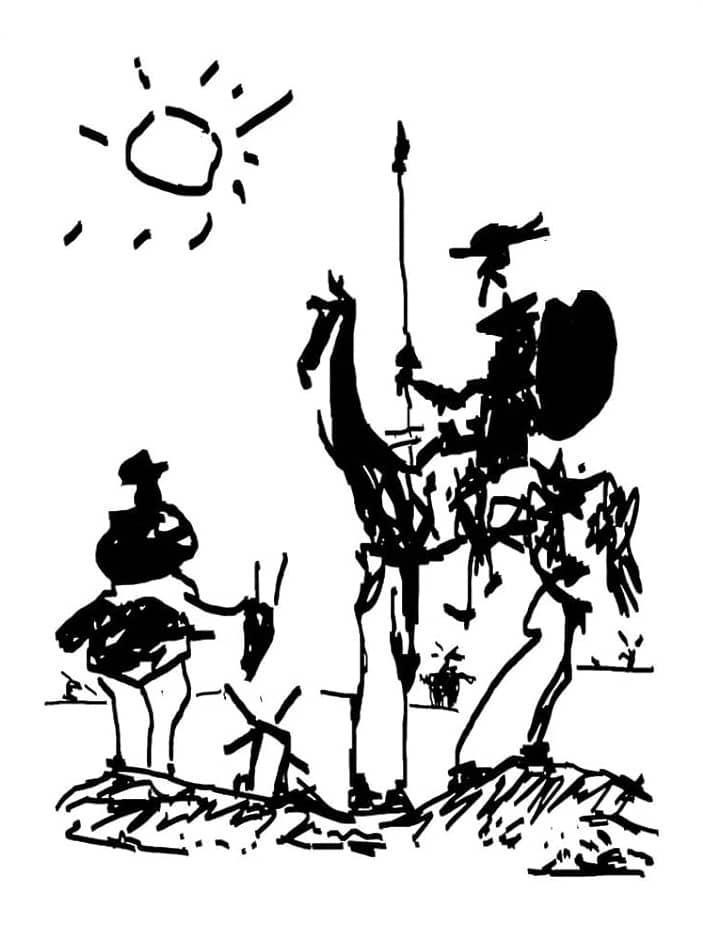
Obligatory Picasso sketch of Quixote. Is it good? Is he cancelled? I mean, I prefer Velazquez’s Meninas and Cezanne’s Bathers to Picasso’s, respectively, but he’s, well, Picasso (credit: pablopicasso.org)
Dreary sarcasm and ripped-from-context headlines aside, I actually think that going back to the literary exemplar of Don Quixote here might be a valuable way to get at the largest possible context for what is taking place in our time politically and economically as well as culturally, and that the “Poor Knight” of Cervantes and his re-interpreters will help us make sense of this sudden salience of a crude video game idiom in the halls of power and among its commentariat.
To begin working our way backwards: consider the last time that video games and politics intersected, to the glee of the trolls and the chagrin of the social-justice crowd. Well-known to the point of cliché, there was the outsize impact of “Gamergate” in the 2010s. Core to Alt-Right Playbooks and books like Black Pill, by Elle Reeve, still operative in the background of the current discourse, this was when the language of politics (“-gate”) and social justice infiltrated the discords and boards. And the reaction was fiery. “Keep your politics out of my games!” a tribe of neckbeards shouted, spewing doritos locos and dew. Less caricature-prone gamers, on the other hand, welcomed the incursion. Plenty of academics and other cultural elites, as well as people of all backgrounds and identities, play video games, and many of them evidently are not shy about their progressive-to-radical politics and aren’t afraid of breaking the proverbial lance with their normative antagonists.
The Pentagon discord leak; the high profile of gambling on the outcome of the 2024 election (and gambling in every aspect of life, especially professional sports); and still more recent instances like those cited above from the media make clear that just as political discourse has propagated itself into the video game cultural space, games have had their revenge, inserting their discourse into the political arena, cranking up its volume on either extreme of the ideological spectrum.
This is where Don Quixote comes in. By stepping back from the contemporary fray with the aid of a figure who so beautifully links the literary and the playful, perhaps we can trace a longer historical process at work, in which the logic of the market and politics to race to the bottom morally and intellectually nevertheless cast up such imaginative cultural artifacts and enduring personalities as to make their excesses and the ecological devastation that is their byproduct almost worth it. As Spariosu’s work along these lines has shown, there are many illustrative exemplars we might study with profit, but Quixote is certainly among them, and he offers a starting point which has the benefit of a sense of humor, however complex and at times jarring it may be.
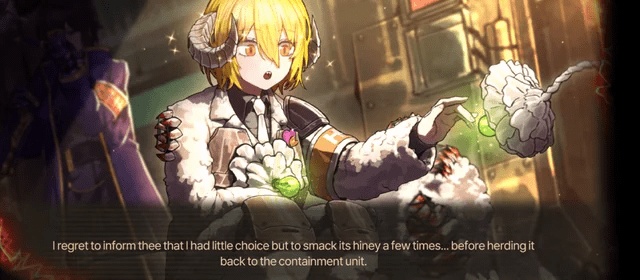
Don Quixote in Limbus Company. Image credit: Reddit.
To continue working our way reverse-chronologically to the source of the legend, in the remainder of this by-now-much-belated post we’ll touch on a few of the major instantiations of Don Quixote in media across the centuries. Most recently, as far as I know, he is depicted in video game form as one of the playable ensemble in Limbus Company. Intriguingly, her pronouns are she/her, and like Frog in Chrono Trigger, she speaks in a psuedo-old English, knight-errant register. We await impatiently Professor Kozlowski’s monograph on Limbus Company to unpack what is going on with this one, but unmistakably, given the wild premise of the game, a power fantasy of some kind is at play!
…the drama of Don Quixote isn’t in the text. The drama is in the reading. Quixote as character is one of the most famous literary heroes for a reason. And I think Cervantes wasn’t even sure what to do with him – not really. He’s clearly designed to be the butt of a joke; Cervantes uses Quixote to satirize and condemn the silly medieval romances of his day, pointing out the absurdity of these fantasies in his realistic modern context. But Quixote is too powerful for that. His mad dream of being a knight somehow transcends and transforms the realistic world Cervantes sends to confront him. We want Quixote to be right. His dream is more important than reality.
(Apropos of which, this is why I have such a problem with the comparison of Musk/Ramaswamy to Quixote and Sancho. I don’t see Musk in that light at all. If anything, he is more like the Duke and Duchess of the second volume, powerful figures who try to manipulate Quixote (idealistic voters or public servants, in this analogy) for the lolz.)
And Prof Ben on Don Quixote the character in Limbus Company:
So I wasn’t sure how I felt about Project Moon tackling Don Quixote’s chapter. Of all the characters in Limbus Company, Don Quixote has been, since the beginning, my absolute favorite. As filtered through Project Moon’s distorting lens, she (yes, she; Don Quixote is gender-swapped, like Raskolnikov, Ishmael, and Odysseus) is spunky, excitable, and idealistic. Where Cervantes’ Quixote idolizes knights, Project Moon’s Quixote idolizes fixers – the corporate mercenaries of the city; a surprisingly apt and deft adaptation. But this Quixote, like Cervantes’ Quixote, fails to see the hypocrisy underlying the fantastic tales of their exploits, and insists instead that the fixers are noble, heroic people, always defending and protecting the downtrodden, despite all of the overwhelming evidence that they do not. Where the other characters of Limbus Company are jaded, pessimistic, traumatized, or even unhinged, Don Quixote has remained fiercely, defiantly virtuous. And in a world as grim and miserable as the one Project Moon designed, this – perhaps unintentionally – makes Don Quixote surprisingly close to an audience POV character. The others accept the the wretched state of the city as given, resign themselves to the senseless loss of life and cruel realities of the corporations. But Don Quixote insists on fighting back, righting wrongs, and reforming the city. It may just be my bias, but it is easier for me to identify with the one character who does not countenance or tolerate the widespread destruction and loss of life, and who calls out the others for their callousness.
But in the lead-up to this chapter, it is revealed that Project Moon’s Quixote is, in fact, a vampire.
…But, more importantly, it is revealed that our Quixote is not the original Quixote. Our Quixote is actually Sancho Panza,…
It’s all typically-convoluted Project Moon storytelling, but the emotional throughline is this: faced with the reality of her origins, Sancho-Quixote must choose whether to accept or reject the dream that was offered to her.
Dear Ben, if you are reading this: I must know more! Would you consider publishing your thoughts on your Limbus Company playthrough in regular installments? Your work on Project Moon is far and away the best-performing content on our humble Video Game Academy!
Adaptations of the Quixote seem to have a way of going sideways. See also: Terry Gilliam’s Lost in La Mancha. Arguably even stranger, though, is Jorge Luis Borges’ Pierre Menard, Author of the Quixote, which recounts the tale of a writer who so enters into the soul of the novel that he rewrites it, word for word. Transposing back into literature, then, the process of emulation (of books of chivalry in Quixote’s case, of Quixote itself in Menard’s) that sent the old man on his knight-errantry in the first place, Borges’ story raises profound, slightly silly questions in truly quixotic fashion: What is an author? (Fortunately, Foucault can tell us! Oh, no, wait, this just in from Barthes…) And what is originality? What is it to live out one’s dream?
Forthcoming: Prof Schmid’s article on quixotic and Iliadic elements in Final Fantasy VIII. The windmill atop the hill makes a cameo in our recent Side Quests pod. (LP Archive)
Nor was Project Moon’s Limbus Company the first to transpose Quixote and Sancho Panza. Franz Kafka has a retelling, too, based on this conceit. Of course he does; though it hardly feels right to call it a mere conceit, given the prophetic weight of Kafka’s insight. First translated in a volume called The Great Wall of China, it comes from his collection of “parables and paradoxes,” and is brief enough to be given here in full:
Without making any boast of it Sancho Panza succeeded in the course of years, by devouring a great number of romances of chivalry and adventure in the evening and night hours, in so diverting from him his demon, whom he later called Don Quixote, that his demon thereupon set out in perfect freedom on the maddest exploits, which, however, for the lack of a pre-ordained object, which should have been Sancho Panza himself, harmed nobody. A free man, Sancho Panza philosophically followed Don Quixote on his crusades, perhaps out of a sense of responsibility, and had of them a great and edifying entertainment to the end of his days.
Given the serenity of the old man’s death at the end of Cervantes’ book, I suppose I agree: that for all his mad exploits, Don Quixote harmed no one, not even himself, and brought joy, if that is not putting it too strongly, “a great and edifying entertainment,” to many, Sancho included. For all his bruises and lost time, and despite never getting his promised island, Quixote’s squire is indeed immortalized through his adventures. Not for nothing does he crystalize the Spanish language’s rich store of proverbs and quips and unite them with a reenactment of the wise judgments of Solomon. Despite his master’s return to sanity at the close, their knight-errantry does in its small, strange way contribute to the cause of truth, which is to say, in video game parlance, saving the world.
Ultimately, I would have to read the whole book again in light of this parable-paradox of Kafka’s to see what I make of the Quixote-as-Sancho’s-demon theory. Maybe we can make a video essay about it. Imagine the numbers, the comments from the Limbus Company stans! See above: niche content, when politicized, can still break out and seemingly break the world.
We could follow it up with another on the deathbed retraction motif, stretching back to Solon in Aristotle’s Ethics, and Chaucer’s Canterbury Tales, and Tolstoy’s abjuration of his great novels, and perhaps Shakespeare’s via Prospero in The Tempest, and how many others? Even Aquinas called his philosophical works chaff at the end.
Likewise, this whole quixotic bit about reenacting books: that certainly deserves another, more extensive treatment. Spariosu would direct our attention, rightly, to Tristram Shandy and Uncle Toby’s bowling green, where the good man whiles away his time playing at war. What do we make of the remarkable resemblance to another, historical rather than fictional Quixote figure, St Ignatius Loyola, whose inspiration to found the Order of the Jesuits was born of reading replacements for books of chivalry? “In order to divert the weary hours of convalescence, he asked for the romances of chivalry, his favourite reading, but there were none in the castle, and instead, his beloved sister-in-law, Magdalena de Araoz brought him the lives of Christ and of the saints” (wikipedia). Or the resemblance of Uncle Toby and St Ignatius alike to the mythical Wounded King of The Waste Land? I mean, It can’t be a coincidence that The Fisher King is another Terry Gilliam movie!
To wrap up this deranged little essay, though, we have to mention The Idiot. Dostoevsky, having killed it with Crime and Punishment and yet to reach the tragicomic heights or depths of Demons and The Brothers Karamazov, plays upon references to Don Quixote for its hero’s unconventional social graces and compelling insights into the secret hearts of those around him. Beautiful, earnest, and a little boring at times, The Idiot was reportedly Dostoevsky’s favorite book in some ways: “the book in which he embodies his most intimate, cherished, and sacred convictions,” according to Joseph Frank; and those who appreciated it he would have found “kindred souls.” In Prince Myshkin, he “approximates the extremest incarnation of the Christian ideal of love that humanity can reach in its present form, but his is torn apart by the conflict between the contradictory imperatives of his apocalyptic aspirations and his earthly limitations” (577).
Still more, Dostoevsky later prefigured Borges, writing a chapter in imitation of Don Quixote that was only revealed much later to be his own and not translated from Cervantes. I can’t track down the page number in Frank on that, but I know it’s in one of those five volumes somewhere! And as he says, “We tend to take Dostoevsky’s comparison of Don Quixote with Christ more or less for granted, but it was still a novelty at the time he made it. In his highly informative study, Eric Zioikowski singles out Kierkegaard as ‘the first and, aside from Turgenev, the only person before Dostoevsky to compare Christ with Don Quixote’ (94)” (274).
Kierkegaard. Now there’s someone who knew about reduplication, which I take to be something akin to reenactment as we’ve been discussing it. That, however, would really take us pretty far afield.
And then there is Jesus, the son of Mary: the original of Don Quixote and Prince Myshkin alike, reenacting the prophets and fulfilling the scriptures down to every jot and tittle of the law.
To this day, we’re all doing our best to imitate him; though some look like they’re more just trying to cosplay him.
PS: Now that it’s spring break, I sat down to read the rest of Itoi’s conversation with the MOTHER games’ music composition and sound design duo, Hirokazu Tanaka and Keiichi Suzuki, interspersed with what look like email messages from fans, which Tim Summers’ paper put me onto. In section 10, we get the following exchange (per google page translation):
Tanaka: Children don’t just play with parts of their body, they play with their whole body and feel things with their whole body. My child was born when “MOTHER” was released, so he wasn’t around in real time, but he played “MOTHER 2” when he was in elementary school. Around that time, while eating dinner, he would say to me , “Dad, Mr. Saturn… he really is a great guy.”
Itoi: Wahahaha!!
Suzuki: That’s a good story (lol)!
Tanaka: I was really like, “What?!” for a moment. He was completely normal and serious. And, not just once, but “Hmm… he’s really a good guy…” over and over again. And for some reason, it was always around mealtimes.
Itoi: That would make me cry (lol)!
Tanaka: So my wife was like, “What?! Who is that? Where are you friends from?” (laughs)
Itoi: Well, I said in a previous interview that Mr. Saturn is a symbol of innocence, but there’s also another background to it. It’s Dostoevsky.
–Dostoevsky? [I’m unclear on who this fourth interlocutor is]
Itoi: Yes (laughs). It’s Prince Myshkin from Dostoyevsky’s novel “The Idiot.” When I read it, I thought, “Prince Myshkin is a really good guy!” Akira Kurosawa also made a movie out of it, but I tried to include him in Mr. Saturn. However, it’s really hard to portray a “really good guy.” It’s not something you can usually portray. So to express a “really good guy,” I added another character to the background. That’s the penguin from “Passionate Penguin Meal” (a manga written by Shigesato Itoi and illustrated by Teruhiko Yumura). If I don’t do that, I probably won’t be told by Hirokachan’s son that he’s a “really good guy.” He’ll just be “a fun, interesting guy.”
They go on to discuss other references, in the music, especially, and circle back to the idea of borrowing from Dostoevsky:
Itoi: So it’s the same with Dostoevsky! No one will feel anything like Dostoevsky, in the end. Not even Mr. Saturn. But there might be a chance that some Dostoevsky fan out there will think of something. In the same sense, something Dostoevsky-like might be conveyed to children who don’t know anything about it.




 Video Game Academy