The Year of Worldbuilding

Belated as ever, I know, but the first of our weekly-to-monthly updates of the year is here! Happy New Year and welcome back, Video Game Academy readers. Welcome… to the Year of Worldbuilding.

“We went through some crazy stuff… But as you can see, I’m alright now!” (Let’s Play Archive)

(Whole articles could–and shall!–be written on the use of ellipses in JRPGs… the old oratorical flourish of a dramatic pause is the least of it. The thoughtful facial expression, the pensive self-forgetting, the grim determination, the speechless sorrow–so many ways this little trinity (give or take) of punctuation gets deployed…)

We are never done tinkering with myth in games, of course, but the time has come to turn our attention to a related key theme in the overlapping fields of video game studies and the humanities. Worldbuilding is the task before every would-be author of speculative fiction, which is to say everyone who has ever enjoyed a book or video game set in a (sub)created world and wondered if they could make one someday. Kudos to all those who do make the attempt! And all encouragement to those who, like us, wish that we might!

Laura shared this presentation on the Pixels discord, per the zeitgeist, and I recommended she send it to Resonant Arc, who just made a video interviewing several indie developers, including Pat Holleman!

It’s well worth watching the Gottliebs’ presentation about their experience. The insight that sticks with me is the twofold, bidirectional nature of the worldbuilding impulse which they elaborate together: how we as players are imaginatively involved in evoking the images and story of the game, particularly when it is retro in presentation, much like we do with the text of a written story; and how we are inspired to put ourselves in the place of the developer, to imagine how we might want to go about things if we were to make our own game.

Ever since Tolkien mused on “other minds and hands” in his famous letter to Milton Waldman, the full spectrum of fandom, from fanfiction followers to transparent imitators to anxiety-of-influence-laden latecomers and romantic originators of new classics, has been lured out into the open, though it feels like every day the flywheel of content creation and consumption spins faster, and its deleterious effect on whatever real world we still share becomes more lurid. Worldbuilding is just the sort of preliminary, lore-bearing activity we mostly carve out time for studying here, somewhat to our own chagrin, when all the cool philosophers and game studies kids prefer to say with Marx that after all the goal is not just to interpret the world, but to “change it.” Still, we prefer to stay with Rilke’s speaking image of the great, shattered beauty and listen when it says: “you must change your life.”

Why worldbuilding, though? Shouldn’t we start with building something on a slightly smaller scale, perhaps a school–or school of thought–or a neighborhood, or a home, or a steady devotion to some even smaller upbuilding practice of service or mentorship, reading or writing, meditation or prayer? Preposterously enough, the intuition that drives this whole quixotic project tells me that when we are at work in any of these vital ways, we are always also worldbuilding, and that by zooming out and seeing that largest possible framework, trying to get a glimpse of what sort of world we are in the process of fashioning, we might be able to better grasp all the day-to-day upbuilding efforts that we are about.

So, thank you for being here with us at the Video Game Academy for another year of reading, writing, playing, teaching, learning, working on languages and practicing music, or whatever your resolutions might entail.

While it’s still roughly the right time of year, I’m bound to share, like I seem to do every year, this obscure one from Sufjan Stevens–and wishing you once again all the best this 2026!
Happy New Year, Video Game Academicians!

I’ve accepted the fact that 2025 will be bad. – Professor Kozlowski

We’re not exactly known for prompt and timely updates here at the old video game academy. But hey, we’re still here, in our fifth year, give or take, and ringing in this new year with a post and a promise of more to come.

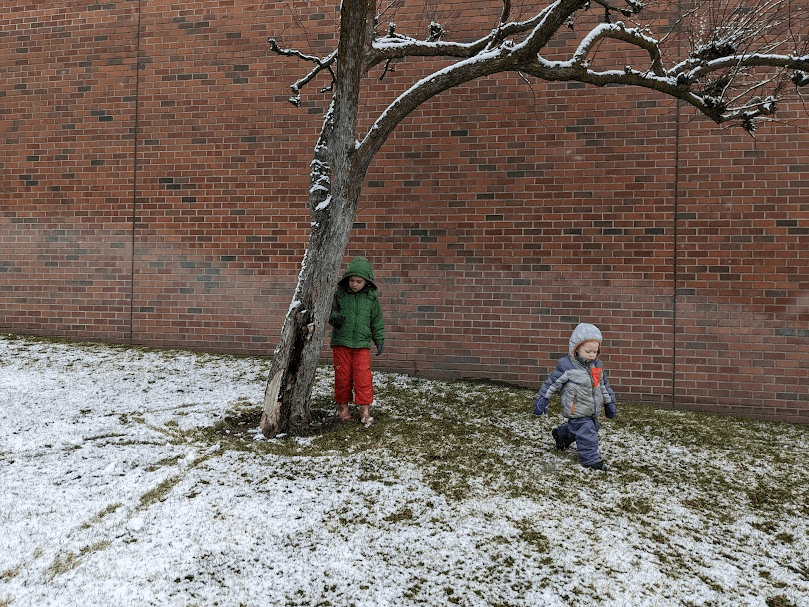
It even snowed yesterday at last

Taking stock, I have about 40 drafts ready to go, starting out from many points over these swiftly elapsing years, mostly along the lines of a games-in-literature connection. So many ideas for the student of games to contemplate, easily a year’s worth, are there in potentia. So that it’s my intention to shovel out this whole backlog little by little over the course of this year, knowing that the articles will be shorter and even looser than what I generally go for, because if not now, when?

Some of the topics I’ve been mulling over: cmrn of the infamous GSSB and his thesis on nonhumanism; the infinitely voyaging Sufjan; the inimitable Sloek; more Dostoevsky, naturally; Homer, Cervantes, Caedmon, Sterne; Monkey and Gargantua; Genji and his ambidextrous gloves; Pullman, of course, whose third Book of Dust should be dropping soon.

Whether there’s anyone out there reading them or not, I’m looking forward to the practice and discipline that will necessarily go along with such an undertaking. Much as I like the outlet for meditations on games and literature, though, my worry is that this site is not much help to anyone else, whether it be people teaching games or people working on their own researches, or some overlap of the two. To try again to connect with a community of people interested in reading and writing of this sort, then, is my main goal for the year, quixotic though it may be. The podcast form is a good one, insofar as anything on the internet is good, for conversations and interviews bringing people together and sharing ideas, and we’ll keep it going.

Understandably, this is already asking a lot. All I can say is, quoting Ben again, “Fires bring people together…In the fire, we were neighbors…We are in the fire now. We are always in the fire, especially when we cannot see the flames.” And this is fine.

The Break at the End of the Year

By fireplace nook or snowy windowpane, wherever this finds you, I hope you make some time for a little catching up with us at the Video Game Academy during the holidays.

Browse the post archives, poke around in the course links and resources, and generally stir up some dust revisiting the classic games and books we like to discuss.

Speaking of which: “At the present rate of progress,” Sir Philip Pullman says of Roses from the South (as yet unconfirmed title of his Book of Dust Volume 3), “it would be late next year” that it’s ready to release. That was in September 2022, according to Twitter/Reddit. So we have a while to wait yet. This time next year, perhaps, we’ll have more to say about it, and about the as-yet-imaginary games this and much of his work might yet be made into.

Though given his (and our) history of such prognostications, particularly with third and presumably final books in a series, perhaps not so fast.

In the meantime, there are a few more of Pullman’s stories to tide us over. From The Haunted Storm and Galatea to Serpentine and The Imagination Chamber, along with more reviews of the BBC/HBO adaptation and a playthrough of Undertale to balance things out media-wise, there’s plenty to look forward to in the new year.

So I hope this finds you well. Thanks again for reading, listening, and playing along.

Smatterings of Press

In the world of video game academia, we’re pretty small potatoes. But small as we are, we are!

The next iteration of Video Game Studies will (maybe) be taking place on Signum’s SPACE Program in January. It’s dependent on participant interest, so give it a look here. The long and short of it is, we’ll be reading Tomorrow, and Tomorrow, and Tomorrow, by Gabrielle Zevin, and discussing video games a couple hours a week. We’ll look at classic games and genres and considering how they tie into the novel form a variety of critical and imaginative lenses. If all goes well, I’ll follow up with future courses in SPACE. I have a notion I can write something for this CFP on “The Post-Gamer Turn” into the bargain.

Meanwhile, the Twitch stream for younger readers in Signum Academy continues next year with more video game discussions. I’m planning on adapting material from the days of Outschool (which I joined in the first place trying to get traction for SA). More news on that to come.

A couple of notes about other past and current versions of these courses: the Science of Video Games, which Stephanie taught last year, more or less complete, can now be found here, and the Language and Code Cafe iteration of last year’s wellness I’m revamping for The Community School in Spokane got a little write up from the local news.

With all that going on, the time has come for us to be shuttering the patreon. We’re feeling pretty launched at this point, and there’s plenty of other worthy causes out there to support–such as Professor Kozlowski’s lecture series.

Many thanks to everyone who helped us get going. We’re back on this horse, this Rocinante, this quixotic Rocket sim.

This potato thanks you!

Stories of the Year

Welcome back!

With our first goal for audience participation met and exceeded, we’ve gone ahead with a few upgrades to this site. Please cast a weather eye over the posts and pages and let us know if you spot any errors that have crept in with the new design. One thing you shouldn’t run across anymore are those bothersome ads. Thanks for putting up with their ilk thus far, and good riddance to them, along with the rest of a bad year!

This week we invite you to reflect with us on 2020 in terms of the video games that helped get us through it. From Animal Crossing: New Horizons to Cyberpunk 2077, we survey the year in games and consider some of the larger trends in the industry. How do open-world experiences like Breath of the Wild (a few years old already, but it’s new to me!) compare with the self-contained qualities of classic games and the innovations of indie studios? Where do we see ourselves heading next as a gaming community or a culture, and what resolutions do we have personally?

Enjoy this first half of our double-feature discussion from New Year’s Eve (and into the new year), The Video Game Academy Year in Review. The second half will be released next week, investigating the genre of visual novels.

More previews and plans for the coming year will be announced shortly, as we continue to expand our inventory here at the Academy. Thanks again for taking part in the adventure!

Speedrunner 100% Completes The Legend Of Zelda: Breath Of The Wild In 24  Hours | NintendoSoup
Yahaha!

Retrospectives and New Horizons

At our academy the patreon remains steady, the discord small, but the discussions lively. Somehow we’ve made it through our first year. Let’s celebrate with some good old-fashioned retrospection, and look ahead with much gusto.

First, a fun discussion about Animal Crossing with the better half of the Video Game Academy and our stalwart third-strongest patron. Happy Holidays!

Animal Crossing New Horizons: How to Start the Wedding Season Event, What  Rewards Are There? | USgamer
From a quaint wedding season guide at USGamer

As mentioned there and in the final Hex discussion, whose audio we’ve hidden behind fiendishly difficult ciphers buried in an imaginary friend’s video game’s code–or possibly just lost–we have big plans for our Video Game Academy in the new year. On the academic side, we’ll continue conversations invaluable in the moment and still pretty interesting after the fact. We owe Steve a few videos. They may end up being little more than slideshows, but we shall deliver. We want to weigh in on more major releases and relatively new games to go with the classics, and we have ambitions to offer critiques and reviews of others in the field. Besides books and articles, that means videos, podcasts, and all the fun social media artifacts out there might be fodder for debate.

Would a fresh run at more established youtubers and podcasters net some new readers? Certainly their audience is apt to overstate the strengths of their analysis, if the effusions of the kids on Outschool are any indication. Maybe this is the time to make mini-overtures, via comments and retweets, and try to find a few kindred spirits.

Surely the place to build out first, though, is at home, by restoring the confidence and earning the trust of such audience as we have already got with more consistent, quality posts. In terms of form, this means upgrades to the website, better recordings, and dipping a toe into those daunting videos and streams everyone seems to like so much. As to content, cool little games like Among Us and Animal Crossing are the order for the holidays, although thereafter it might be time to tackle Nier: Automata. Down the line we’ll see about another ur-text like Chrono Trigger or Mario RPG.

By the muddle of my words I come to know the jumble of my thoughts, and yet it still seems to me that some teaching of video games should be possible, even desirable, in the vanward of this larger project of educational renewal and reimagining that we’re after. What would a curriculum, to say nothing of a canon, of games for learning and discussion look like? We’ve been circling around this question informally, but now that it’s stated, we can hope to explore it directly.

The role of games has always been prominent in the fantasies of learning and teaching, from the Sword in the Stone to Harry Potter, Rabelais to Emile, Chaucer to Tristram Shandy, Huck Finn to Hopscotch. A long-term project for a series of posts over the coming year, then, will be a guided tour through the representations of play and games in literature.

Just as salient someday, perhaps, will be some of these first forays into video game studies and the popularization thereof. Atop the to-read stack: Pat Holleman’s Reverse Design series and Boss Fight’s lineup of authors and editors; Bogost’s Rhetoric, Kohler’s Power-Up, Bissell’s Extra Lives; and all the great video essayists giving shape to that dynamic form.

More vital than any of that verbiage, though, are our relationships with other people, the end-in-themselves all our playful communication’s meant to serve. In this strange time, neighbors become co-op pals and saboteurs, and old friends stay in touch playing games together online. Whatever the state of our democratic experiment, the pursuit of happiness is alive and well. Still, as anyone can see, the ever-increasing pressures on teachers, to say nothing of other workers, might make the cultivation of the intellect, the inner life, creative pursuits or even just a hobby practically impossible anymore. More than anything else, then, the work we undertake this coming year will be to support and encourage and appreciate the efforts of people who dare to play, to hold open the possibility of free time and uphold the value of freely-chosen activity. Ludere aude.