I am looking forward to reading–a familiar feeling for me, but with an unusually heightened clarity and specificity at the moment–several things this month. Towards the end of October in this year of our Lord 2025, the third volume in Philip Pullman’s Book of Dust is set to release. About 40 years after we first met Lyra and Pan in The Golden Compass, we might finally be seeing their final adventure. For years (albeit many fewer), I’ve made it my scholarly hobby-horse to commentary-write, read, interview and podcast on Pullman’s work, and I’m eager to pick up where I left off, now that there is a kind of boundedness to his latest project. My pet theory is that this new book, and the series of which it is a part, is closely linked to his earliest published writing, two novels for adult readers of literature which are largely forgotten… but who knows.
This photo from The Bookseller website suggests some of what we might expect The Rose Field to include (or to open onto, if the picture dates from after the book’s composition), to judge based on the stack of books on the desk in front of the author: Baudelaire, Wallace Stevens; Pullman’s own Northern Lights; dictionaries of modern English usage (Oxford, naturally) and of Merleau-Ponty; All That Is Solid Melts Into Air; The Reader Over Your Shoulder; 101 Middle Eastern Tales and Their Impact on Western Oral Tradition, and a couple of books and loose sheets of paper too small to tell what they are, as well as a big book at the bottom of the pile whose spine is obscured by a tape dispenser. Another reference work? A Bible? And what about all the other books ready to hand over his shoulder? I wonder.
Where do ideas come from? How do we decide which ones to give room in our mind? These are questions which Pullman (and his young readers) and Persona 4 both seem interested in, and to which they give unusually thoughtful responses in the form of their stories. At least part of an answer, though, is suggested by the books we place in front of us, aids and distractions in equal measure as we sit down to write. It’s always tempting to read more instead of writing. In particular, I’m thinking of what Pullman is reading, and yet I’m sure that neither reading that stack of books nor an nth read-through of his own books would prove as effective an apprenticeship as the work of writing three pages a day and telling stories aloud, from memory, to children. Or anyhow this was his practice as a writer and teacher, as he recounts more than once, and it seems to have served him well.
The long-awaited Historiographies of Video Game Studies, while I read it over the summer, insofar as it is possible to read anthologies like this cover to cover, will certainly bear revisiting soon as I set to work on a submission for the zine follow-up to my virtual talk at The Manchester Game Centre. As Jacob Geller recently gave an interview on GSSB, I’m reminded again that both he and Cameron Kunzelman have other essays and books, too, that I’ve been meaning to read.
I still owe Aaron Suduiko a piece on EarthBound in response to the “Comprehensive Theory” series on his website. It’s been a year already since I talked with him and the writer, Max Gorynski. I wonder what they’re up to.
Brian Eno, in conversation with Ezra Klein and evidently in his book, defines art as something like play for grown ups, which must be at least partly true.
Nel Noddings, contrasting the rule-bound and relational in her foundational work on the ethics of care, comes close to refuting Kierkegaard and Sloek alike, with her readings of the binding of Isaac and the myth of Demeter. And Benjamin (Walter, not Kozlowski) might come close to undercutting Tolkien on myth and fairy tales, though I take solace in not quite being able to understand what he is saying towards the end of his essay on Leskov, “The Storyteller.”
Friends and students who I flatter myself I’ve inspired in some way have been sending me things they are writing, and I look forward to reading more and sharing them with other readers, if I can, soon.
Most pressing, though, there is Moses Norton, aka The Well Red Mage or Red for short, who has just released his Definitive Book of SNES RPGs (vol 1). While it has yet to ship, I’ve got the pdf here and am eager to read it and interview the author. Biased as I am, I have to believe the book itself will matter more than what any of us might say online, and I can’t wait to see it take up space on my desk and time in my mind.
So as to establish some sort of structure by which to embrace the world in all its complexity and learn about it as deeply as possible through the mediation of a shared, relatively safe and replicable experience, for a long time now we’ve been leaning on this lens of play and games here at The Video Game Academy. And yet it cannot have escaped anyone’s notice who might be following along that what we are up to is rather different from, say, the dream of “gamification” in education that various figures of wide-ranging levels of influence might talk about, or even “game studies” in any strictly defined sense. In fact, our courses, such as they are, are remarkably old-fashioned in many ways. Essentially, we play games and talk about them; or we take a larger theme, such as “mythology,” this year’s focus, and explore it through games and other recommended readings.
In the spirit of Pullman’s advice to “read like a butterfly, write like a bee,” we remain open-minded about the selection of readings that would ultimately find inclusion in our course of study. And because all this remains speculative and hobby-horsical, we don’t have to limit ourselves to fixed curricula and syllabi, as interesting as it is to think about these things from time to time (see recent episodes of “Unboxing” and our own Professor Kozlowski for reflections on some of the work that goes into professional academia).
But in the words of Buzz-Buzz, “a bee I am… not.” Much as I strive to keep up with the writing that is meant to accompany and give expression to all this reading (reading in the loose sense of listening and playing and so on), I find that weeks and months go by with little to show for all the ideas I intend to share out again. The occasional post, to say nothing of new courses or published pieces, is only with great effort and continual procrastination ever finished (again, in the loosest possible sense of the word). Still, as another artistic hero said to yet another, “work, always work” (Rodin to Rilke): the work is ongoing, the reading is happening, the notes are jotting, and thoughts thinking. If nothing else, a conversation on FFVIII is forthcoming more or less weekly.
Is it at least somewhat convincing to plead that I’m waiting for Pullman’s new book to release before diving into that podcast project again? Or that I’m collaborating again with Moses aka Red on a follow-up to his Gamelogica project, though what form that might take remains to be decided? Perhaps I’ll talk about the Nobel winners I’ve been reading, or attempt a playthrough of MOTHER 2 in Japanese…
Meanwhile, in brief reviews and commentaries, I’ll keep tracking the connections between games and literature as best I can. From my attempt at putting The Sirens’ Call by Chris Hayes into dialogue with Deep Work by Cal Newport and Saving Time and How to Do Nothing by Jenny Odell, I arrived at the conclusion that for all their insights into the critical importance of attention, these contemporary authors seem to me to be completely missing the point. Instead of writing these popular sorts of books, long on citations and case studies and strikingly short on the deep reading they purportedly are calling for, they should have done better to craft a single reflection on the example that was most exemplary in each case. Lacking any demonstrable rootedness in their points of departure–whether Homer and Plato for Hayes, Jung and Montaigne for Newport, or Bergson and Benjamin for Odell–to say nothing of any perceptible religious or otherwise philosophical groundwork for their arguments, their books diffuse themselves into the culture as distractedly as any other media phenomenon, and will likely prove as ephemeral. And so I suggest readers turn instead to those sources in literature from which they are drawing, and abide in the original works for themselves. For a better guide as to how to do this, I could lift up Weil on the use of school studies; Bakhtin on Dostoevsky; and someday, perhaps, my own efforts on video games.
To connect this all to video games, then, can we do better than Jenny Odell’s reasoning behind her structuring of Saving Time? As she explains in this BOMB interview:
… I actually didn’t have the idea to structure the book that way until halfway through writing it. I landed on the idea because I was playing the video game, The Legend of Zelda: Breath of the Wild. I was spending a lot of time in a spatially dispersed story in which you understand that certain things can only happen in certain places, and you have some idea of something that’s coming both narratively and geographically down the road. You can see it, it’s in the distance.
At the time, I was thinking about how everyone’s experience of playing that game—even though it obviously suggests some routes to you—is pretty different, and thus, their memory of the story is going to be different. I was just really fascinated by that. So I think it made me look twice at these places that I was spending time in and it got me thinking about how I could string them together.
Odell is extremely close here to digging into the power of place for memory as represented in video games writ large. While she focuses on the differences among players, my mind goes as usual to EarthBound, and to the ultimately unified story it tells. No matter in what order the sanctuaries are visited, or in the case of Zelda, the memory locations, Koroks, shrines, etc., there are certain themes, timeless and universal, such as love, courage, and the joy of adventure, which these games will reliably lead players to consider.
It almost makes me want to go back and read her book again in light of this revelation!
In passing, I’ll note that Hayes and Newport each do make a few interesting references to video games, too. Apropos of Socrates’ critique of writing in the Phaedrus, Hayes remarks, “It seems safe to say in hindsight that writing was a pretty big net positive for human development, even if one of the greatest thinkers of all-time worried about it the same way contemporaries fret over video games” (6). And he later acquaints the reader with Addiction by Design, by Natasha Dow Schull, and the prevalence of loot boxes via this inarguable clickbait from The Washington Post: “Humankind Has Now Spent More Time Playing Call of Duty Than It Has Existed on Earth” (52-3).
Besides becoming bywords for the perennial moral panics accruing to new technologies and for the irresistibility of slot-machine-style addiction, video games, again exemplified in Call of Duty, return one more time towards the end of the book to provide Hayes with fodder for a brief rant: “Online interaction, which is where a growing share (for some the majority) of our human interactions now takes place, becomes, then, almost like a video game version of conversation, a gamified experience of inputs and outputs, so thoroughly mediated and divorced from the full breathing laughing suffering reality of other humans that dunking on someone or insulting someone online feels roughly similar to shooting up a bunch of guys in Call of Duty” (233-4).
A different paradigm shows up in Newport: “In MIT lore, it’s generally believed that this haphazard combination of different disciplines, thrown together in a large reconfigurable building, led to chance encounters and a spirit of inventiveness that generated breakthroughs at a fast pace, innovating topics as diverse as Chomsky grammars, Loran navigational radars, and video games, all within the same productive postwar decades” (129). The absence of a descriptor there, or if you like, the way in which “video” is returned to the role of descriptor of “games” according to the parallelism of Newport’s construction, is extremely interesting. I could gripe all day about the narrowness and specificity of the video games Hayes seems to have in mind; whereas for Newport, video games are a product almost without qualities other than their novelty and mythic origin in “MIT lore” and “haphazard…inventiveness.” Whatever he may think about particular games, Newport’s mention of them at least has a positive valence.
Eeriness,an ink drawing by J. R. R. Tolkien. Photo: Museoteca.com – via New Criterion.
By chance, the one episode of Newport’s podcast that I listened to so far (no. 288, on the recommendation of this article I was considering assigning next school year) includes towards the very end some reflections on Tolkien which might finally get me to segue back to the ostensible premise of this post. Specifically, a curator of medieval manuscripts at one of the libraries of Oxford sent Newport a quote that is found in a letter from Tolkien to Stanley Unwin: “Writing stories in prose or verse has been stolen, often guiltily, from time already mortgaged…”
Before addressing–or indeed quoting–the quote, Newport riffs on “The Consolations of Fantasy” exhibit (reviewed here) and pulls up some of the art for his youtube viewers. He read in a recent biography about Tolkien “being overwhelmed by…the stresses of being in a field–philology–transforming into modern linguistics,” noting that “he was on the old-fashioned side of that.” Repeatedly, he characterizes Tolkien’s art and writing as abounding in “almost childlike, fantastical images” and takes his desire to spend more time in the “fantastical worlds” of his “childlike,” albeit “sophisticated,” imagination, as another explanation of his acute sense of stress–along with his worries about money.
Newport may or may not have ever read Tolkien–it isn’t clear–but he sees his art anyhow as being illustrative of his own recent work on “Slow Productivity.” He argues that Tolkien’s success selling books is what allowed him to spend more time on his writing and worldbuilding and to worry less about his other responsibilities; again, though, Newport seems to completely miss the point. What is it about Tolkien’s books that so captivates readers? It has less to do with a yearning for time in which to daydream and more to do with his insights about myth, drawn straight from his studies of philology and given voice in a much more famous quote from Gandalf: “All we have to decide is what to do with the time that is given us.” In his fiction, both in major works like Lord of the Rings and in small masterpieces like “Leaf By Niggle,” as well as his scholarship (talks on Beowulf and Fairy-stories are essential) Tolkien touches on just those emphatically moral dimensions so absent from Newport’s pursuit of excellence.
Now reading widely and breezily in the literature of attention is as fine a way as any to pass the summertime for a none-too-disciplined teacher like me. But make no mistake: setting aside my personal affection for Pullman, not entirely shared by my colleagues, I should clarify that second to none among our professorial and scholarly lodestars, we at VGA also count JRR Tolkien and CS Lewis. Both were eminent in their fields of language and literature, and both were theorist-practitioners of the arts of teaching and of fiction alike. And their work is at the heart of the 20C turn to myth-making which continues most vivaciously in the video game medium to the present day, and which is particularly evident in the 90’s JRPGs we never tire of playing and studying.
If it may be objected, quite fairly, that discussions of classic game series like Final Fantasy and The Legend of Zelda have been done ad nauseum, whether as podcasts, video essays, or even books, so what do we mean by proposing continually to return to them anew; much more so discussions of Tolkien and Lewis, who are the subjects of innumerable books, articles, videos, podcasts, and courses? Even a cursory glance at the literature suggests that the influence of Tolkien, Lewis, and their circle and successors on video game development and reception has been immense, as is well understood. From the very first PhD dissertation on video games by Buckles to more recent work aimed at scholars (Young), hobbyists and serious fans (Peterson), and a popular audience alike (Kohler), it is clear we would be far from surprising anyone with our discoveries about the deep ties between the seemingly dusty “Lang and Lit” debates of the early 20C and the “ludology/narratology” tug of war or “magic circle” duck duck goose of near-contemporary game studies.
To my (admittedly very incomplete) knowledge, however, what remains little noted or discussed is the role of play within the work of the Inklings and Inkling-adjacent, their predecessors (ie. Chesterton and Morris), and their major intellectual heirs (whether imitators, who are legion, or virtual parricides, in Pullman’s case). What happens when we go back to their writing the hindsight afforded by reading them in the light of video games’ subsequent developments of the themes of mythopoesis so powerfully instaurated by the dynamic give-and-take between Tolkien, Lewis, and their fellows and followers?
To illustrate just a few potential starting points:
Tolkien’s thoughts on “faerian drama” in the light of video games (Makai); the impression made on him by the play Peter Pan in his early Cottage of Lost Play writings (Fimi); games as mythopoeic narratives (Fox-Lenz) and the riddle game at the heart of The Hobbit (Olsen).
Lewis’s language of “checkmate” and “poker” to describe his conversion (Dickieson), and the ways in which imagery of play and games functions elsewhere in his apologetic writings, fiction, and scholarship:
“Very often the only way to get a quality in reality is to start behaving as if you had it already. That is why children’s games are so important. They are always pretending to be grown-ups—playing soldiers, playing shop. But all the time, they are hardening their muscles and sharpening their wits so that the pretense of being grown-up helps them grow up in earnest (Mere Christianity)
The discovery, creation, and defense of Narnia are all couched in terms of play, ie. “I’m going to stand by the play world” (The Silver Chair); and for some reason “The Great Dance” at the end of Perelandra is also called “The Great Game”
In his analogy of Milton asking “What kind of poem do I want to make?” with “a boy debating whether to play hockey or football,” Lewis likens the game rules to the poetic form (Preface to Paradise Lost)
To my mind, there is ample material here for a course and a curriculum. But as I say, this summer I’m spoken for, reading in the backlists of the Nobel Prize laureates from a century and more. But keep an eye out for the follow-up to Moses’ Gamelogica channel, tentatively to be known as Legendaria!
The Haunted Wood: A History of Childhood Reading, by Sam Leith, comes highly recommended.
“One of the best surveys of children’s literature I’ve read,” blurbs Philip Pullman. “It takes a particular sort of sensibility to look at children’s literature with all the informed knowledge of a lifetime’s reading of ‘proper’ books, and neither patronise (terribly good for a children’s book) nor solemnly over-praise. Sam Leith hits the right spot again and again. The Haunted Wood is a marvel, and I hope it becomes a standard text for anyone interested in literature of any sort.”
In the run up to the release, Leith appeared on an episode of Backlisted, a wonderful podcast which I first found thanks to their episode with Pullman on The Anatomy of Melancholy, one of those tomes, like Gargantua and Pantagruel, anchoring my own personal backlisted pile.
The main reason I bought Leith’s book new and read it right away is that its final chapter is about Pullman’s work. As far as that goes, I’ll have more to say in another place. But what brings me out of my extended spring break to write about it here is the way video games surface in the text as a point of comparison and contrast with children’s books.
The first reference to video games comes roughly midway through the book in a strangely interpolated chapter, “The Idiot Box,” which does not appear in the table of contents. We are in the transition from the era of Philippa Pearce, CS Lewis, and Tove Jansson (about all of whom Pullman has quite a bit to opine) to that cohort of writers, immediately preceding Pullman himself in publication, that includes Alan Garner, Susan Cooper, Ursula K. Le Guin, and Madeleine L’Engle.
Here Leith takes up Roald Dahl’s critique of television, memorably sung by the Oompa Loompas against Mike Teavee in Charlie and the Chocolate Factory, in order to set the scene for “the early sixties”: “Dahl’s message…was not just that the then infant technology would make children stupid: it was that it existed in a zero-sum war against children’s literature” (369).
Leith goes on: “The relationship between television and children’s fiction is a complicated one–and not as simply antagonistic as Dahl suggests. What is undoubtedly the case is that the narrative worlds of children were changing, and that television, as the dominant cultural medium, had a huge part in that… But it hasn’t shown any sign of wiping out children’s literature, any more than videogames (the moral panic of our own day) have seen off television.” The only problem with this framing is that “our own day” is already too dated. The moral panics of “our” youth, such as Dungeons and Dragons and video games, have been largely eclipsed by smartphones, social media, and AI.
Citing Jacqueline Wilson’s memoir to support his contention that “Television came to be freighted with the same anxieties as, two centuries before, fairy stories had been,” along with early studies of the effects of television on children in England from Hilde T Himmelweit, Leith comes around to “a crucial point. Children’s stories have always existed, where they get the chance, in more than one medium, and spilled between them. Playground games draw on things that children have read about in books–remember the Bastables playing The Jungle Book on the lawn?–and children’s stories in turn draw on or feature playground games and children’s books. Children’s stories themselves depict children consuming children’s stories and using children’s stories to make more children’s stories. In this respect, these properties have something of the quality I’ve remarked on in myth: a blurriness, an availability to be reinvented, and even an orality, in the way that the spoken performances of the playground remix the mythos each time. The boundaries of children’s writing, of children’s storytelling, are as indistinct as the boundaries of the haunted wood itself” (373).
This is all brilliant. As everywhere in a wide-ranging, mellifluously written book such as this, there leap out opportunities to widen and enrich the field still more: reference to Neil Postman’s far more trenchant critique of television, rather than the strawman Dahl, would have made the same “crucial point” even stronger; acknowledging the ways in which fears about video games have flowed into still more addictive technologies would have kept Leith’s work, at least momentarily, abreast of the present time rather than snug in “our own” childhood at the end of the past century.
Again: “In our own age there are probably more videogames that have become TV series than there are videogames made of TV series… From the top-down point of view, this is no more than the free market doing what it does… but from the bottom-up, child’s-eye perspective, it’s completely natural: stories spill over. When you’re playing with an action figure, you’re writing a story” (374). A world of interpretive, ideological messiness hinges on that “but” distinguishing the “market” from the “natural,” but all we would add, really, is that when you’re playing a video game, particularly from the early era of the medium which Leith seems to be thinking about, your imagination is engaged in filling out the story in much the same way. He would probably agree; it’s implied in the thick bundling of media connections here evoked.
So it is strange that when we come to the end of the book, Leith writes in his Epilogue, “as an unashamed lover of videogames,” that “even in the sort-of-storytelling ones, the story and world-building are secondary to the gameplay… A videogame will always struggle to do what fiction does, which is to allow yourself to envision what it might be like to be somebody else… If you and I play through a videogame, we will have experienced the same world on screen” (552-3). All of which is preposterous, especially given the story-embracing account of play that Leith provided around the midpoint of the book.
Perhaps Leith is carried away by the fear of “more than just figuratively addictive” games like Fortnite, which he singles out and sums up with the footnote: “If you don’t know what this is, count yourself lucky–or ask an eleven-year-old. It’s a hectic videogame in which everyone’s trying to shoot everyone else.” In an attempt to acknowledge and reckon with more recent statistics which paint a much bleaker picture of the reading habits of young people, Leith produces his own Oompa-Loompa-shaped strawman doing a DLC dance. He conflates online games like Fortnite with videogames writ large, setting them in opposition to fiction, as if that, too, were a monolith.
As a history of children’s books, The Haunted Wood is wonderful. As cultural commentary on the interplay between books and video games over the more recent history during which both have figured in our imaginative and social lives, it demands considerable filling out. To be fair, Leith does not even pretend to provide such a commentary, with the exception of these two widely separated passages. But as a lover of video games and reader of books, I will say I remain perplexed and disappointed by the turn from that one passage to the other.
If I ever get around to writing something comparable for the games that have shaped my experience of the world, alongside books by the likes of Tolkien and Pullman, I’ll be sure to credit The Haunted Wood for encouraging me by its example.
Illuminations and ruminations on what remains at the end of the week, the game, the century.
When I go looking for one thing and come up with another, and another, and… well, after awhile I almost can’t carry it all; I have to call it a day (a week, etc.), throw it together as best I can for the moment (see the present post), and let it go back out into the world, hoping another will find it as well–and will find it interesting, with any luck. Or at the very least, I’ll circle back to it one of these days to contemplate it anew in all its rich associations and, with the benefit of this open-ended time to come, will understand it a little better at last.
For example, the original point of departure here was meant to be a passage in Walter Benjamin’s Theses on the Philosophy of History, placed at the end of Illuminations, a volume of essays and reflections edited by Hannah Arendt:
The story is told of an automaton constructed in such a way that it could play a winning game of chess, answering each move of an opponent with a countermove. A puppet in Turkish attire and with a hookah in its mouth sat before a chessboard placed on a large table. A system of mirrors created the illusion that this table was transparent from all sides. Actually, a little hunchback who was an expert chess player sat inside and guided the puppet’s hand by means of strings. One can imagine a philosophical counterpart to this device. The puppet called “historical materialism” is to win all the time. It can easily be a match for anyone if it enlists the services of theology, which today, as we know, is wizened and has to keep out of sight. (253)
Of course this passage leapt out at me, as it has for countless readers, for many reasons. Marxists of the Frankfurt school and AI prognosticators, Christian apologists and modern-day techno-charlatans alike, in all their combinations and permutations, will find in Benjamin a provocative thought partner. In my case, the drawing together of the imagery of play and theology makes for an endlessly fascinating analogy. I am a poor chess player and a slovenly scholar, but I do love to “imagine a philosophical counterpart” to games, and particularly love to wax philosophical about the ways in which their mechanics interact with their stories.
As for this particular image of “The Chess-Playing Turk,” its “story is told,” among other places, in a section bearing that name in Philip Pullman’s little-known early novel, Galatea:
In the next room were a number of curious automata, such as the famous Chess-Playing Turk designed by the Baron Von Kempelen, which sat cross-legged at a cabinet too full of intricate machinery to conceal a person, and which had defeated the finest chess-players of its time. There was also a machine called the Temple of the Arts, consisting of an automated view of Gibraltar, with moving warships, a platoon of tiny soldiers marching up and down, and a band of mechanical musicians, playing suitable tunes. There was an orange tree which blossomed and bore perfect painted fruit in less than a minute. There was a duck which quacked, breathed, ate and drank. There was a life-size automaton fluteplayer made by Jacques de Vaucanson which, according to its label, performed so realistically that many learned men had thought that it was human. (211)
Advertising poster for a show of Vaucanson’s automata (wikipedia)
Though written in the ’70s, Pullman’s unsuccessful novel, with its shades of magic realism and its author’s avowed admiration for the mystical quest narrative of A Voyage to Arcturus on full display, remains prescient for its surfacing of the question of the role of “the work of art in the age of mechanical [and electronic] reproduction”.
Add to this the fact that the title of Benjamin’s book is also that of Rimbaud’s, and then of Britten’s song cycle based on Rimbaud’s Illuminations, as I learned when I went looking for the searchable text on archive.org (and the search terms threw up the EarthBound player’s guide, somehow, as well. As ever, EB is in good canonical company–though maybe that’s just based on my own search history).
Britten was deeply affected by the emotional intensity of these prose poems and decided to set them to music as soon as he had read them. As the soprano Sophie Wyss, the dedicatee of the cycle, recalled: “He was so full of this poetry he just could not stop talking about it, I suspect he must have seen a copy of Rimbaud’s works while he was recently staying with [W.H.] Auden in Birmingham.”
Britten chose a sentence from one of the poems as the motto for his cycle: “J’ai seul la clef de cette parade sauvage” (“I alone have the key to this savage parade”). This sentence also provides the “key” to Britten’s view of Rimbaud’s poetry: only the artist, observing the world from the outside, can hope to make sense of the “savage parade” that is life.
Having just played through the end of the first disc of Final Fantasy VIII, with its own “savage parade” and botched assassination attempt on the Sorceress, I can well understand the impression produced by being “so full of this poetry [I] just could not stop talking about it”–podcasting about it, in my case, with my friend Alexander Schmid. But I draw the line at this notion of being alone in having the key; for it is only through our dialogues, on the contrary, that I feel like I begin to be able to process the meaning of such a densely woven text.
I certainly don’t have a clue about what Rimbaud might be up to, and lovely as Britten’s songs are, I doubt he is the first or the best interpreter of the poet, either in terms of music or meaning. If, as the program notes say, artists alone think themselves able to interpret the world, so much the worse for them; though we may benefit from the confidence embodied in such art as they are thereby moved to produce, it sounds like a terribly solipsistic and lonely activity. To observe the effect of such a belief in the case of Rimbaud’s life, it appears to be part of what drove him to seek exile and enterprise in the desert, giving up poetry for salesmanship.
Klee’s Angelus Novus, Benjamin’s “angel of history” (wikipedia)
Though you never know. Lost poems may yet come to light. Or like Kierkegaard’s knight of faith, perhaps Rimbaud carried the heart of his poetry with him through a superficially ordinary life of infinite resignation. My own opinion, to which I stubbornly cling with a fierce devotion, is that these knights are inside us all, hidden better than the chess-player theologian under the mechanical turk’s table, and opening us like the Silenus of Socrates in The Symposium(and memorably related in Rabelais’ Prologue). When the time is right, we are all “found to contain images of gods”. In that light, the speaker of Rimbaud’s line may well be this precious cargo, and his famous line “I is another” can be brought to bear in this connection as well. In which case I heartily agree: no one else could possibly hold the key to the “savage parade” of life.
In dusting off these reflections years later for a belated spring break post in this year of myth in games, I was actuated by another chance discovery: one of my favorite podcasts, Backlisted, just released an episode discussing What Remains: The Collected Poems of Hannah Arendt. Give it a listen! Arendt, besides editing the collection of Benjamin’s essays, is the author of more than one of the 20th century’s classic works of philosophy, and has bequeathed us the clearest and most cutting precis of her time: “the banality of evil”–though, as the podcast mentions, its meaning, and the work in which it is formulated, Eichmann in Jerusalem, is contested.
Last but not least, in the spirit of Dirt newsletter’s weekly tab round-up, since I was recommending they look at Backlisted, too, here is a bit of what remains in my browser:
The Digital Antiquarian, recommended by Dylan Holmes, is well worth a read. Mixing up What Remains of Edith Finch (which I did watch a full playthrough of) and Dear Esther (which I didn’t yet, though it’s the one Dylan actually wrote about and recommended in our conversations), like “memory and desire” in April, “the cruelest month” to Eliot’s speaker, perhaps, though that title by common consent is given to March here in Spokane, I finally sat down to read what he had to say about JRPGs and was captivated as much by the comments as the articles’ content. Posters suggest links to a number of papers on localization, games as carriers of Japanese culture and values and cuteness, as locus of reflections on design and affect, and in a wonderful bit of synchronicity, to Beyond Role and Play, a book on LARP including a chapter that riffs on Don Quixote. There’s also a FF series retrospective for the completionist.
and wine in a foreign language changes the conversation.
–and the rest of Kentucky Route Zero, and Dear Esther, and the use of an invented Latin-ish language in FFVIII. I should submit a question for The Bible Project on the Tao and the Exodus Way. I should write more about Philip Pullman, the wheel of fortune as game show and ancient motif, saving as economic and theological image, Christmas subsumed, the spectral in Marx and the invisible hand in Smith…
Or what about this strange constellation of Benjamin’s bon mots on the theme of “backdrops”:
On the other hand, this heaven is only background; to explore it according to its own laws would be like framing the painted backdrop of the stage and hanging it in a picture gallery. (121)
In his “Salon of 1859” Baudelaire lets the landscapes pass in review, concluding with this admission: “I long for the return of the dioramas whose enormous, crude magic subjects me to the spell of a useful illusion. I prefer looking at the backdrop paintings of the stage where I find my favorite dreams treated with consummate skill and tragic concision. Those things, so completely false, are for that very reason much closer to the truth, whereas the majority of our landscape painters are liars, precisely because they fail to lie.” (191)
?
Let it be said of me, as Arendt does of Benjamin in her introductory essay: “Well, he did not succeed in consolidating anything, and success would hardly have been possible.”
With plenty else to do this weekend, being as it is at once the end of MAR10 week and the day after pi day, the ides of March and the eve of St. Paddy’s, I’m popping in here at the humble video game academy just to direct your attention to a few other wonderful reads.
An imaginary video game, a Kentana Cold Snack.
First, Professor Kozlowski is back with his long-awaited, long-form essay on Library of Ruina, which will be serialized here for the next little while. In this first post, he sets the groundwork for future anthropologists interested in the MAGA, redux era in which we find ourselves, and lays out the stakes for the commentary to follow:
I came to Library of Ruina with more expectations than were reasonable. I wanted it to be more than a game—I wanted it to be life advice, solace, and wisdom.
As it happened, I was not disappointed.
In a similar vein, I find myself turning to games and their mythological content for solace, but also to getting outside to walk and play in nature now that we are beginning to thaw. I think back to unfinished posts from past summers about then-unfinished games, like Kentucky Route Zero, and how I imagined a mod of it for every state, like Sufjan Stevens’ quixotic project of musical albums.
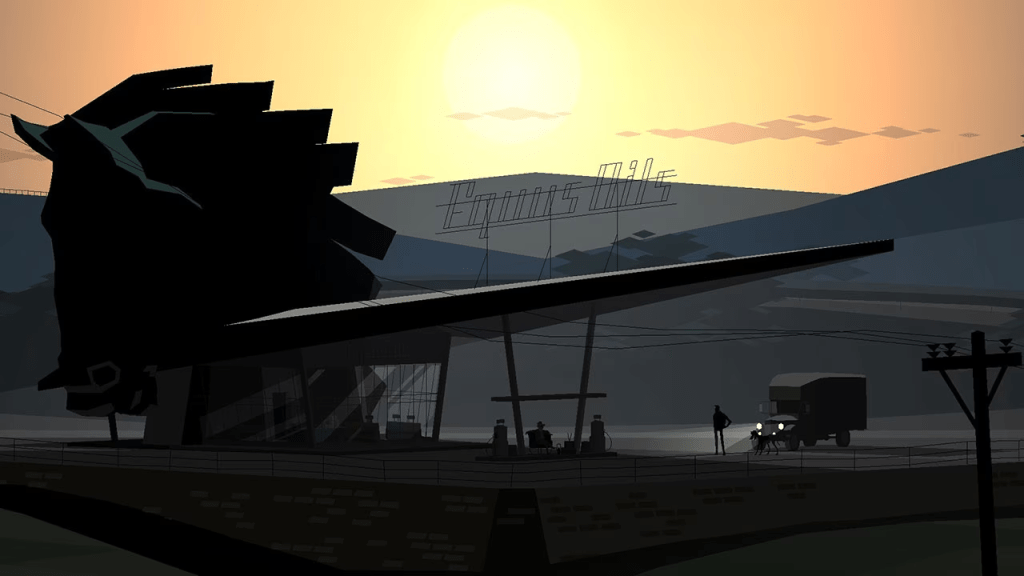
“Soulful, evocative, and one of the most important games of the last decade” – Elise Favis (Washington Post). That’s the 2010’s, the decade in which I played Undertale, Kentucky, and not much else that was new.
Only I would start not, like Suf, with Michigan, but with Montana, our next-state-but-one neighbor with its “Hiawatha names” (CS Lewis by way of Philip Pullman), its bike route along the repurposed train tracks, its trestles and tunnels and tales of sleeping car porters and frontier towns, like the town of Falcon. Placards along the trail, just as in an RPG or as in liner notes to an album, contribute to the worldbuilding, the sense of depth and history. While the treetops down below exhale their leaves’ water toward the sky, somewhere a driver on the highway is worrying how he’ll pay a medical bill; a trickle of water runs downhill. Call it Montana Exit Zero.
I first encountered the (actual) game at an exhibit at the Seattle Museum of Pop Culture (MOPOP; then known as the EMP). Similarly, Tim Summers, in a presentation on games and music as ritual space, notes: “the museum sequence of Kentucky Route Zero found an additional parallel when the game featured in the exhibition Design, Play, Disrupt held at London’s V&A Museum, an exhibition intended to illustrate the connections and interplay between video games and other art forms.” While he references work by Dorothea von Hantelmann, who in turn cites other artists and scholars including Chinua Achebe and Pierre Bourdieu, I can’t help but wish there were more substantial engagement with mythic language, which games speak and make space for at least as well as they foster ritual engagement. Thinking of course of Sloek, but also of a classic text like Jenkins’ “Complete Freedom of Movement,” as transmitted via Alyse Knorr’s Mario 3.
Fundamentally, though, I think Summers is on the right track. To quote from the conclusion:
If the theatre is too homogenizing and restrictive, and the museum too isolating, then games occupy a middleground of play. Kentucky Route Zero’s depictions of museums and performances make this middleground particularly telling, but the example merely provides an explicit manifestation of aspects of engaging with games more generally evident in games. It is helpful to recognize the ritual qualities of games, their structural framework, social functions and connectedness to past forms of ritual. These ritual discussions can then help to illuminate how games create a powerful and compelling aesthetic experience, and how music is an important part of this experience.
His “Mother/EarthBound Zero and the Power of the Naïve Aesthetic: No Crying Until the Ending,” (chapter in Music in the Role-Playing Game) was why I became interested in Summers’ work, directed to it by the references in the anthology Nostalgia and Video Game Music. There, too, he makes a point about the effects of diegetic music (drawing on the work of a film critic named Winters, which I find delightfully serendipitous given the EarthBound connection) very similar to the approach I take in my discussions of moments of artistic ekphrasis and self-consciousness in games such as EarthBound, Xenogears, and most recently Final Fantasy VIII.
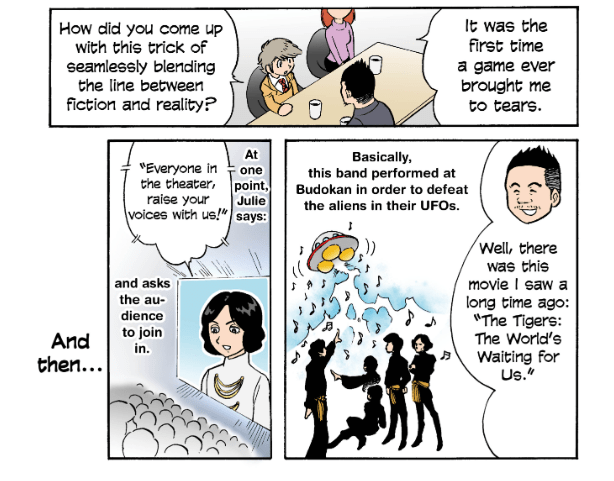
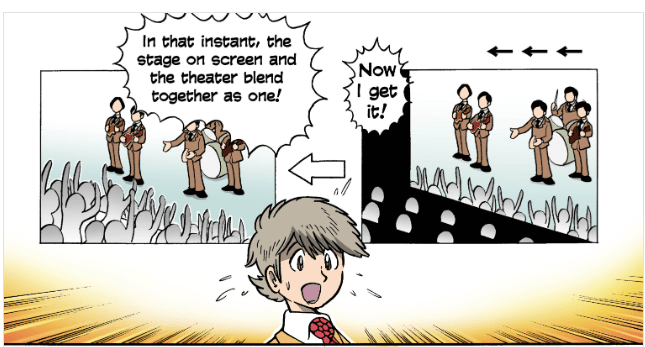
What’s more, he cites an article in comic form by Keiichi Tanaka: “A Tapestry Woven from the Words of Shigesato Itoi and the ingenuity of Satoru Iwata,” wherein Itoi’s inspiration for the conceit of including the player’s name in the credits, following Tanaka’s line of questioning, reveals itself on Summers’ reading to be a a key point of departure for the use of diegetic music in the MOTHER games. The relevant portion of the manga interview is recounted as follows:
If you could only see the manga-level big emotions on my face, “smiles and tears,” as I’m over here processing this. Maybe I should start twitch streaming myself reading and writing…
Part of what makes this such a revelation (to me at least; the top commenter on the video knew 10 months ago and more–
So chalk another one up to the power of the collective internet hive mind over against, say, sensitive scholarly types like your author and Clyde Mandelin, my main resource for Itoi knowledge)–part of what makes this such a revelation that I can’t get a coherent sentence together is that it strikes me as uncannily akin to the experience JRR Tolkien had with the stage version of Peter Pan.
According to Carpenter’s biography: “In April 1910 Tolkien saw Peter Pan at a Birmingham theatre, and wrote in his diary: ‘Indescribable but shall never forget it as long as I live. Wish E. had been with me'” (53). “E” is Tolkien’s muse and future wife, Edith Bratt. Carpenter goes on immediately to another early influence, “Catholic mystic poet Francis Thompson” and especially his Sister Songs, but it is worth dwelling–and no doubt plenty of Tolkien scholars have dwelt–on Tolkien’s connection to Peter Pan and this particular version of it, which he could not describe for all his poetic, sub-creative powers of description, and regarding whose inexpressible contents he had a particular audience or rather companion in mind. Particularly in light of his discussion of “faerian drama” as “Enchantment” in his essay On Fairy-stories, Tolkien’s experience of the audience participation in reviving Tinkerbell by applauding (or not) and Itoi’s of the audience cheering and singing along with the Tigers make for a fascinating comparison.
Tigers also provides an equally illuminating contrast with the film influence that I did know about when I was really studying Itoi’s games, thanks to Mandelin and his Legends of Localization:
The Traumatic Inspiration Behind Giygas’ Dialogue Shigesato Itoi has stated that the mixture of pain and joy that Giygas speaks about was inspired by a traumatic childhood memory. As a young boy in the 1950s, Itoi visited a movie theater but accidentally went into the wrong screening room. He saw a scene from Kempei to Barabara Shibijin (“The Military Policeman and the Dismembered Beauty”), a mystery film with elements that were considered dark and appalling at the time.
The scene in question involved a woman being murdered while making love to her fiance. The sickening mixture of pain and pleasure greatly disturbed the young Itoi, who ran home and barely spoke a word that night. Itoi wanted players to experience that same feeling during the final battle of Mother 2, so he wrote Giygas’ text to include a combination of pain, pleasure, and more.
Itoi recalls another incident that inspired Giygas’ dialogue:
Gyiyg snaps and loses his mind, as you know. Well, this probably isn’t the nicest topic to bring up, but a long time ago I happened to witness a traffic accident. A young woman was lying on the ground, but instead of saying “I can’t breathe!” or “Help!”, she cried out, “It hurts!” That really disturbed me. I felt that having Gyiyg say this same line would make you reluctant to attack him, even though he’s the enemy. He’s even calling your name the entire time. As for the line “It’s not right”, it means “What you’re doing isn’t right, and what I’m doing isn’t right.” I have to say, a chill went through me when I was coming up with all of these lines.
Whereas, Summers points out in his analysis, with the “Eight Melodies” theme Itoi not only has indelibly marked a generation of players of the original game with a distinctly childlike and “naive” impression of the power of art, but this song has even been included in Japanese elementary school music textbooks for decades, touching a generation that perhaps has never played the original game. Here are Itoi, Suzuki, and Tanaka in conversation about it: “MOTHER’s music was demonic” 😮
With that, I’ll go back to my own reading and writing and touching grass. As Thompson has it:
From its red leash my heart strains tamelessly, For Spring leaps in the womb of the young year!
Hope you enjoyed your St. Paddersday, and here’s to spring!
What would the original LARPer make of his afterlives literary and metaphorical, and most recently of the propagation of gaming vernacular into the halls of power?
Doing my best Dostoevsky imitation, I take my theme this time straight from the headlines. In The Washington Post Opinion, George F. Will writes, comparing apples to orange one’s lackeys with most infelicitous aplomb:
Not to be outdone, other pundits have turned to ludic rather than literary idioms, drawing their points of reference for the unfolding debacle from video games, and especially from the virulent online parlance surrounding and stemming from them.
Ezra Klein writes in The New York Times Opinion about “The Republicans’ NPC problem — and Ours.” The article from February 16, 2025 is paywalled, but audio and video versions may still be freely available. There, his intro is intercut with a montage of right-wing voices echoing the phrase and ringing the changes on it: “non-player character,” “non-playable character,” used as a “new epithet for liberals.”
Egoistic and a little hurtful to be sure, but in The Atlantic, the stakes are raised even higher. There I find Charlie Warzel, Ian Bogost, and Matteo Wong shouting into the void that “DOGE HAS ‘GOD MODE’ ACCESS TO GOVERNMENT DATA“:
Doge has achieved “god mode.” That’s according to an employee in senior leadership at USAID, who told us that Elon Musk’s Department of Government Efficiency now has full, unrestricted access to the agency’s digital infrastructure—including total control over systems that Americans working in conflict zones rely on, the ability to see and manipulate financial systems that have historically awarded tens of billions of dollars, and perhaps much more. (Feb 19, 2025)
That’s… not good. At least, it doesn’t look good from the point of view of us lowly mortals and ostensible NPCs. But maybe that’s our own small-mindedness and blindness to the bigger picture. Maybe we had better just get good.
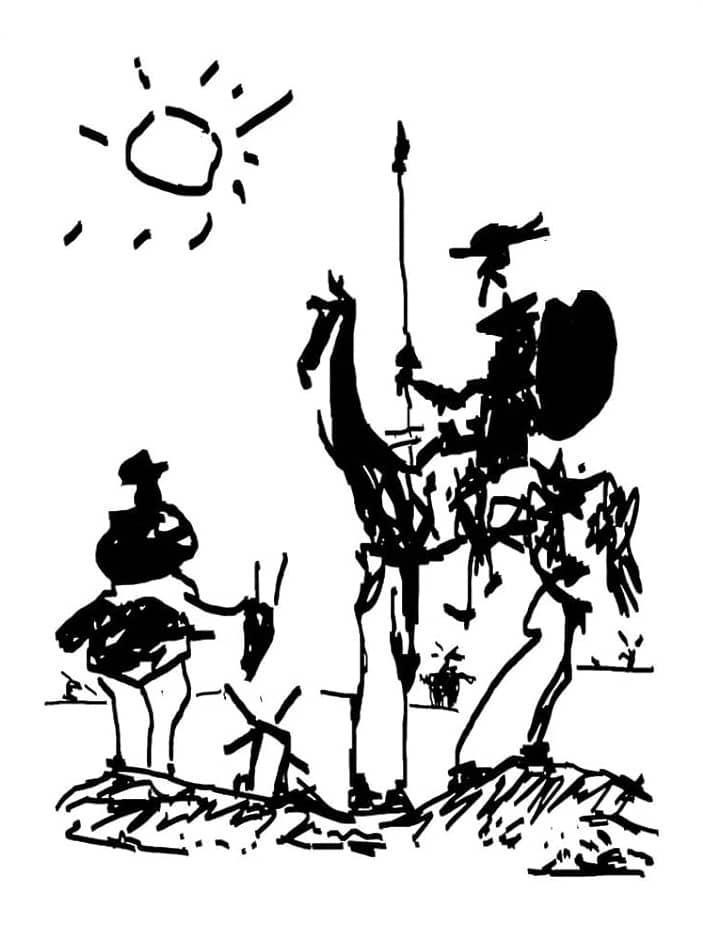
Obligatory Picasso sketch of Quixote. Is it good? Is he cancelled? I mean, I prefer Velazquez’s Meninas and Cezanne’s Bathers to Picasso’s, respectively, but he’s, well, Picasso (credit: pablopicasso.org)
Dreary sarcasm and ripped-from-context headlines aside, I actually think that going back to the literary exemplar of Don Quixote here might be a valuable way to get at the largest possible context for what is taking place in our time politically and economically as well as culturally, and that the “Poor Knight” of Cervantes and his re-interpreters will help us make sense of this sudden salience of a crude video game idiom in the halls of power and among its commentariat.
To begin working our way backwards: consider the last time that video games and politics intersected, to the glee of the trolls and the chagrin of the social-justice crowd. Well-known to the point of cliché, there was the outsize impact of “Gamergate” in the 2010s. Core to Alt-Right Playbooks and books like Black Pill, by Elle Reeve, still operative in the background of the current discourse, this was when the language of politics (“-gate”) and social justice infiltrated the discords and boards. And the reaction was fiery. “Keep your politics out of my games!” a tribe of neckbeards shouted, spewing doritos locos and dew. Less caricature-prone gamers, on the other hand, welcomed the incursion. Plenty of academics and other cultural elites, as well as people of all backgrounds and identities, play video games, and many of them evidently are not shy about their progressive-to-radical politics and aren’t afraid of breaking the proverbial lance with their normative antagonists.
The Pentagon discord leak; the high profile of gambling on the outcome of the 2024 election (and gambling in every aspect of life, especially professional sports); and still more recent instances like those cited above from the media make clear that just as political discourse has propagated itself into the video game cultural space, games have had their revenge, inserting their discourse into the political arena, cranking up its volume on either extreme of the ideological spectrum.
This is where Don Quixote comes in. By stepping back from the contemporary fray with the aid of a figure who so beautifully links the literary and the playful, perhaps we can trace a longer historical process at work, in which the logic of the market and politics to race to the bottom morally and intellectually nevertheless cast up such imaginative cultural artifacts and enduring personalities as to make their excesses and the ecological devastation that is their byproduct almost worth it. As Spariosu’s work along these lines has shown, there are many illustrative exemplars we might study with profit, but Quixote is certainly among them, and he offers a starting point which has the benefit of a sense of humor, however complex and at times jarring it may be.
Don Quixote in Limbus Company. Image credit: Reddit.
To continue working our way reverse-chronologically to the source of the legend, in the remainder of this by-now-much-belated post we’ll touch on a few of the major instantiations of Don Quixote in media across the centuries. Most recently, as far as I know, he is depicted in video game form as one of the playable ensemble in Limbus Company. Intriguingly, her pronouns are she/her, and like Frog in Chrono Trigger, she speaks in a psuedo-old English, knight-errant register. We await impatiently Professor Kozlowski’s monograph on Limbus Company to unpack what is going on with this one, but unmistakably, given the wild premise of the game, a power fantasy of some kind is at play!
…the drama of Don Quixote isn’t in the text. The drama is in the reading. Quixote as character is one of the most famous literary heroes for a reason. And I think Cervantes wasn’t even sure what to do with him – not really. He’s clearly designed to be the butt of a joke; Cervantes uses Quixote to satirize and condemn the silly medieval romances of his day, pointing out the absurdity of these fantasies in his realistic modern context. But Quixote is too powerful for that. His mad dream of being a knight somehow transcends and transforms the realistic world Cervantes sends to confront him. We want Quixote to be right. His dream is more important than reality.
(Apropos of which, this is why I have such a problem with the comparison of Musk/Ramaswamy to Quixote and Sancho. I don’t see Musk in that light at all. If anything, he is more like the Duke and Duchess of the second volume, powerful figures who try to manipulate Quixote (idealistic voters or public servants, in this analogy) for the lolz.)
And Prof Ben on Don Quixote the character in Limbus Company:
So I wasn’t sure how I felt about Project Moon tackling Don Quixote’s chapter. Of all the characters in Limbus Company, Don Quixote has been, since the beginning, my absolute favorite. As filtered through Project Moon’s distorting lens, she (yes, she; Don Quixote is gender-swapped, like Raskolnikov, Ishmael, and Odysseus) is spunky, excitable, and idealistic. Where Cervantes’ Quixote idolizes knights, Project Moon’s Quixote idolizes fixers – the corporate mercenaries of the city; a surprisingly apt and deft adaptation. But this Quixote, like Cervantes’ Quixote, fails to see the hypocrisy underlying the fantastic tales of their exploits, and insists instead that the fixers are noble, heroic people, always defending and protecting the downtrodden, despite all of the overwhelming evidence that they do not. Where the other characters of Limbus Company are jaded, pessimistic, traumatized, or even unhinged, Don Quixote has remained fiercely, defiantly virtuous. And in a world as grim and miserable as the one Project Moon designed, this – perhaps unintentionally – makes Don Quixote surprisingly close to an audience POV character. The others accept the the wretched state of the city as given, resign themselves to the senseless loss of life and cruel realities of the corporations. But Don Quixote insists on fighting back, righting wrongs, and reforming the city. It may just be my bias, but it is easier for me to identify with the one character who does not countenance or tolerate the widespread destruction and loss of life, and who calls out the others for their callousness.
But in the lead-up to this chapter, it is revealed that Project Moon’s Quixote is, in fact, a vampire.
…But, more importantly, it is revealed that our Quixote is not the original Quixote. Our Quixote is actually Sancho Panza,…
It’s all typically-convoluted Project Moon storytelling, but the emotional throughline is this: faced with the reality of her origins, Sancho-Quixote must choose whether to accept or reject the dream that was offered to her.
Dear Ben, if you are reading this: I must know more! Would you consider publishing your thoughts on your Limbus Company playthrough in regular installments? Your work on Project Moon is far and away the best-performing content on our humble Video Game Academy!
Adaptations of the Quixote seem to have a way of going sideways. See also: Terry Gilliam’s Lost in La Mancha. Arguably even stranger, though, is Jorge Luis Borges’ Pierre Menard, Author of the Quixote, which recounts the tale of a writer who so enters into the soul of the novel that he rewrites it, word for word. Transposing back into literature, then, the process of emulation (of books of chivalry in Quixote’s case, of Quixote itself in Menard’s) that sent the old man on his knight-errantry in the first place, Borges’ story raises profound, slightly silly questions in truly quixotic fashion: What is an author? (Fortunately, Foucault can tell us! Oh, no, wait, this just in from Barthes…) And what is originality? What is it to live out one’s dream?
Forthcoming: Prof Schmid’s article on quixotic and Iliadic elements in Final Fantasy VIII. The windmill atop the hill makes a cameo in our recent Side Quests pod. (LP Archive)
Nor was Project Moon’s Limbus Company the first to transpose Quixote and Sancho Panza. Franz Kafka has a retelling, too, based on this conceit. Of course he does; though it hardly feels right to call it a mere conceit, given the prophetic weight of Kafka’s insight. First translated in a volume called The Great Wall of China, it comes from his collection of “parables and paradoxes,” and is brief enough to be given here in full:
Without making any boast of it Sancho Panza succeeded in the course of years, by devouring a great number of romances of chivalry and adventure in the evening and night hours, in so diverting from him his demon, whom he later called Don Quixote, that his demon thereupon set out in perfect freedom on the maddest exploits, which, however, for the lack of a pre-ordained object, which should have been Sancho Panza himself, harmed nobody. A free man, Sancho Panza philosophically followed Don Quixote on his crusades, perhaps out of a sense of responsibility, and had of them a great and edifying entertainment to the end of his days.
Given the serenity of the old man’s death at the end of Cervantes’ book, I suppose I agree: that for all his mad exploits, Don Quixote harmed no one, not even himself, and brought joy, if that is not putting it too strongly, “a great and edifying entertainment,” to many, Sancho included. For all his bruises and lost time, and despite never getting his promised island, Quixote’s squire is indeed immortalized through his adventures. Not for nothing does he crystalize the Spanish language’s rich store of proverbs and quips and unite them with a reenactment of the wise judgments of Solomon. Despite his master’s return to sanity at the close, their knight-errantry does in its small, strange way contribute to the cause of truth, which is to say, in video game parlance, saving the world.
Ultimately, I would have to read the whole book again in light of this parable-paradox of Kafka’s to see what I make of the Quixote-as-Sancho’s-demon theory. Maybe we can make a video essay about it. Imagine the numbers, the comments from the Limbus Company stans! See above: niche content, when politicized, can still break out and seemingly break the world.
We could follow it up with another on the deathbed retraction motif, stretching back to Solon in Aristotle’s Ethics, and Chaucer’s Canterbury Tales, and Tolstoy’s abjuration of his great novels, and perhaps Shakespeare’s via Prospero in The Tempest, and how many others? Even Aquinas called his philosophical works chaff at the end.
Likewise, this whole quixotic bit about reenacting books: that certainly deserves another, more extensive treatment. Spariosu would direct our attention, rightly, to Tristram Shandy and Uncle Toby’s bowling green, where the good man whiles away his time playing at war. What do we make of the remarkable resemblance to another, historical rather than fictional Quixote figure, St Ignatius Loyola, whose inspiration to found the Order of the Jesuits was born of reading replacements for books of chivalry? “In order to divert the weary hours of convalescence, he asked for the romances of chivalry, his favourite reading, but there were none in the castle, and instead, his beloved sister-in-law, Magdalena de Araoz brought him the lives of Christ and of the saints” (wikipedia). Or the resemblance of Uncle Toby and St Ignatius alike to the mythical Wounded King of The Waste Land? I mean, It can’t be a coincidence that The Fisher King is another Terry Gilliam movie!
To wrap up this deranged little essay, though, we have to mention The Idiot. Dostoevsky, having killed it with Crime and Punishment and yet to reach the tragicomic heights or depths of Demons and The Brothers Karamazov, plays upon references to Don Quixote for its hero’s unconventional social graces and compelling insights into the secret hearts of those around him. Beautiful, earnest, and a little boring at times, The Idiot was reportedly Dostoevsky’s favorite book in some ways: “the book in which he embodies his most intimate, cherished, and sacred convictions,” according to Joseph Frank; and those who appreciated it he would have found “kindred souls.” In Prince Myshkin, he “approximates the extremest incarnation of the Christian ideal of love that humanity can reach in its present form, but his is torn apart by the conflict between the contradictory imperatives of his apocalyptic aspirations and his earthly limitations” (577).
Still more, Dostoevsky later prefigured Borges, writing a chapter in imitation of Don Quixote that was only revealed much later to be his own and not translated from Cervantes. I can’t track down the page number in Frank on that, but I know it’s in one of those five volumes somewhere! And as he says, “We tend to take Dostoevsky’s comparison of Don Quixote with Christ more or less for granted, but it was still a novelty at the time he made it. In his highly informative study, Eric Zioikowski singles out Kierkegaard as ‘the first and, aside from Turgenev, the only person before Dostoevsky to compare Christ with Don Quixote’ (94)” (274).
Kierkegaard. Now there’s someone who knew about reduplication, which I take to be something akin to reenactment as we’ve been discussing it. That, however, would really take us pretty far afield.
And then there is Jesus, the son of Mary: the original of Don Quixote and Prince Myshkin alike, reenacting the prophets and fulfilling the scriptures down to every jot and tittle of the law.
To this day, we’re all doing our best to imitate him; though some look like they’re more just trying to cosplay him.
PS: Now that it’s spring break, I sat down to read the rest of Itoi’s conversation with the MOTHER games’ music composition and sound design duo, Hirokazu Tanaka and Keiichi Suzuki, interspersed with what look like email messages from fans, which Tim Summers’ paper put me onto. In section 10, we get the following exchange (per google page translation):
Tanaka: Children don’t just play with parts of their body, they play with their whole body and feel things with their whole body. My child was born when “MOTHER” was released, so he wasn’t around in real time, but he played “MOTHER 2” when he was in elementary school. Around that time, while eating dinner, he would say to me , “Dad, Mr. Saturn… he really is a great guy.”
Itoi: Wahahaha!!
Suzuki: That’s a good story (lol)!
Tanaka: I was really like, “What?!” for a moment. He was completely normal and serious. And, not just once, but “Hmm… he’s really a good guy…” over and over again. And for some reason, it was always around mealtimes.
Itoi: That would make me cry (lol)!
Tanaka: So my wife was like, “What?! Who is that? Where are you friends from?” (laughs)
Itoi: Well, I said in a previous interview that Mr. Saturn is a symbol of innocence, but there’s also another background to it. It’s Dostoevsky.
–Dostoevsky? [I’m unclear on who this fourth interlocutor is]
Itoi: Yes (laughs). It’s Prince Myshkin from Dostoyevsky’s novel “The Idiot.” When I read it, I thought, “Prince Myshkin is a really good guy!” Akira Kurosawa also made a movie out of it, but I tried to include him in Mr. Saturn. However, it’s really hard to portray a “really good guy.” It’s not something you can usually portray. So to express a “really good guy,” I added another character to the background. That’s the penguin from “Passionate Penguin Meal” (a manga written by Shigesato Itoi and illustrated by Teruhiko Yumura). If I don’t do that, I probably won’t be told by Hirokachan’s son that he’s a “really good guy.” He’ll just be “a fun, interesting guy.”
They go on to discuss other references, in the music, especially, and circle back to the idea of borrowing from Dostoevsky:
Itoi: So it’s the same with Dostoevsky! No one will feel anything like Dostoevsky, in the end. Not even Mr. Saturn. But there might be a chance that some Dostoevsky fan out there will think of something. In the same sense, something Dostoevsky-like might be conveyed to children who don’t know anything about it.
Playing fast and loose as usual with the connections, often tenuous but ever-present, between games and literature, this time let’s nevertheless open with a fairly straightforward question: Why are the Genji Gloves a recurring peak item in the Final Fantasy series?
And a little reading and searching provides at least three possible literary references.
I’ve just been rereading this book and I won’t stop telling everyone how much I love it: it’s as good and better than I remember. Look, I tell them, if you’re at all interested in mythology, theology, philosophy, language, culture, education–practically anything relevant to the inner life, and the possibility of cultivating and expressing it in any way–you should read Devotional Language, by Johannes Sloek. I’ll send you a pdf that I found, since the book is expensive and hard to find, and it’s not even all that long; you can read it in few sittings; you can sit with it a lifetime. Just ask! So far exactly one person has taken me up on this belated enthusiasm for the preeminent 20th-century Kierkegaard scholar’s work, my friend and co-founder of this humble Video Game Academy, Ben, known online and to his students as Professor Kozlowski.
– Buber (quoted in Francis Su, Mathematics for Human Flourishing)
What if we were to read the philosophical tradition again from the top, noticing everywhere the ideas of ‘play’ and ‘games’ come up, and to try to give some account of how they are all related? In an invitation/invocation something like Augustine’s take and read, these words must have been heard, or their sentiment anyhow felt as it were irresistibly, by readers long before us. Read and play. For instance, sometime in the latter half of the 20C Mihai Spariosu must have heard and felt them, because that is what he did.
Sometimes I think about taking up hobbies that require nothing but attention. Bird-watching, mushroom-hunting, tree-identifying. I think about how I should just write a little each day, like the thought-leaders counsel, your Anne Lamotts (Bird by Bird) and Brene Browns (Dare to Lead). I should make the time by jettisoning a bunch of other stuff that gets in the way, a la Marie Kondo, buckle down and write my three pages a day like my idol, Philip Pullman, whose His Dark Materials all but divinizes attention itself.
(Time, knowledge, care, curiosity–all are wrapped up in that “nothing but attention”–whether in the nothing but or the attention I can’t quite decide–and so I persevere in temporizing, zigzagging in em-dashes, putting off doing any new thing, just reflecting on it. Very rarely anymore do I even make it as far as writing down this process, that act of recording being a fraught piece of attention-requisition in its own right.)
And yet I do think about it from time to time. Before other things take their place, these possible, imagined practices do hold my attention, and they recur when the decks are cleared. When I go running, when I zone out listening to something, when I look out the window, when I sit on the porch, I think about learning the names and properties of birds and fungi and plants. I write about it now and then.
Whenever I do manage to write and take the time to post what I’ve written for anyone else, it seems to be about a pastime that has held my attention as long as I can recall: videogames. Of course, given to pattern-seeking and meaning-making as I am, I suspect that underlying all these hobbies and vague interests is some thread that connects them. Observing attention and its ways, wayward as they are, I call the connection salience. Its characteristic note, however multifarious, I would have to call play.
People study this, psychologists and institutes, writers and teachers, and I’ve begun little by little to follow in their footsteps, or at least to imagine what it might be like to do so. I play at understanding play, and through play, everything else.
Here are some recent bird sightings, places where play makes an appearance, rising to the level of salience:
Mysterious threads joining Murakami and Itoi: one essay more about games, another more on books
In the scheme of things, I call them recent, but then this post was started months ago, it shames me to say. I wonder if would have been noteworthy even at the time of its release that Toy Story 2‘s opening sequence takes the form of a video game played by living toys. Did Nintendo and their famously litigious brand managers mind that the mentions they get in Stranger Things Season 4 are all along the lines of a Peter Pan existence, a prize or bribe? Still, for whatever reason, I think these videogamey sorts of things are interesting, rather like the marmots along the path where I run by the Spokane River. I’m always happy to notice they’re there.









 Video Game Academy