I am looking forward to reading–a familiar feeling for me, but with an unusually heightened clarity and specificity at the moment–several things this month. Towards the end of October in this year of our Lord 2025, the third volume in Philip Pullman’s Book of Dust is set to release. About 40 years after we first met Lyra and Pan in The Golden Compass, we might finally be seeing their final adventure. For years (albeit many fewer), I’ve made it my scholarly hobby-horse to commentary-write, read, interview and podcast on Pullman’s work, and I’m eager to pick up where I left off, now that there is a kind of boundedness to his latest project. My pet theory is that this new book, and the series of which it is a part, is closely linked to his earliest published writing, two novels for adult readers of literature which are largely forgotten… but who knows.
This photo from The Bookseller website suggests some of what we might expect The Rose Field to include (or to open onto, if the picture dates from after the book’s composition), to judge based on the stack of books on the desk in front of the author: Baudelaire, Wallace Stevens; Pullman’s own Northern Lights; dictionaries of modern English usage (Oxford, naturally) and of Merleau-Ponty; All That Is Solid Melts Into Air; The Reader Over Your Shoulder; 101 Middle Eastern Tales and Their Impact on Western Oral Tradition, and a couple of books and loose sheets of paper too small to tell what they are, as well as a big book at the bottom of the pile whose spine is obscured by a tape dispenser. Another reference work? A Bible? And what about all the other books ready to hand over his shoulder? I wonder.
Where do ideas come from? How do we decide which ones to give room in our mind? These are questions which Pullman (and his young readers) and Persona 4 both seem interested in, and to which they give unusually thoughtful responses in the form of their stories. At least part of an answer, though, is suggested by the books we place in front of us, aids and distractions in equal measure as we sit down to write. It’s always tempting to read more instead of writing. In particular, I’m thinking of what Pullman is reading, and yet I’m sure that neither reading that stack of books nor an nth read-through of his own books would prove as effective an apprenticeship as the work of writing three pages a day and telling stories aloud, from memory, to children. Or anyhow this was his practice as a writer and teacher, as he recounts more than once, and it seems to have served him well.
The long-awaited Historiographies of Video Game Studies, while I read it over the summer, insofar as it is possible to read anthologies like this cover to cover, will certainly bear revisiting soon as I set to work on a submission for the zine follow-up to my virtual talk at The Manchester Game Centre. As Jacob Geller recently gave an interview on GSSB, I’m reminded again that both he and Cameron Kunzelman have other essays and books, too, that I’ve been meaning to read.
I still owe Aaron Suduiko a piece on EarthBound in response to the “Comprehensive Theory” series on his website. It’s been a year already since I talked with him and the writer, Max Gorynski. I wonder what they’re up to.
Brian Eno, in conversation with Ezra Klein and evidently in his book, defines art as something like play for grown ups, which must be at least partly true.
Nel Noddings, contrasting the rule-bound and relational in her foundational work on the ethics of care, comes close to refuting Kierkegaard and Sloek alike, with her readings of the binding of Isaac and the myth of Demeter. And Benjamin (Walter, not Kozlowski) might come close to undercutting Tolkien on myth and fairy tales, though I take solace in not quite being able to understand what he is saying towards the end of his essay on Leskov, “The Storyteller.”
Friends and students who I flatter myself I’ve inspired in some way have been sending me things they are writing, and I look forward to reading more and sharing them with other readers, if I can, soon.
Most pressing, though, there is Moses Norton, aka The Well Red Mage or Red for short, who has just released his Definitive Book of SNES RPGs (vol 1). While it has yet to ship, I’ve got the pdf here and am eager to read it and interview the author. Biased as I am, I have to believe the book itself will matter more than what any of us might say online, and I can’t wait to see it take up space on my desk and time in my mind.
Welcome to our humble Video Game Academy, and welcome back if you’ve been here before. For our part, we sure have. We know it all too well: the familiar feeling of nerves and excitement, the prospect of introducing ourselves all over again, and the challenge of learning everyone’s name. It’s time for the obligatory back to school post once more.
Professor Kozlowski has been busy as anything, consolidating a summer of reading widely in the political, economic, and social sciences into a course which he plans to wrap up shortly, lecture-wise, with the philosophy of language which undergirds any foray into rule-making, though in real time The History of Social Thought, along with the murderer’s row of other classes he’s teaching this semester, has only just begun. Yet he somehow makes time, every week or two, to chat on the Academy discord about games; games also feature prominently in the suggested readings for his students to chose from for their short presentations at the start of every class session. Last week we talked about FFVIII, picking up in Winhill with Laguna, where his long essay on the black sheep of the franchise leaves off.
With a whole series of podcast discussions on FFVII and, some years later now, FFVIII completed at last, the inimitable Alexander Schmid, all-but-dissertation away from his doctorate, and I, your faithful Moogle-like amanuensis, have just launched into a playthrough of FFIX. The course page will be up momentarily in the Current Semester, where you might also notice several more or less unfinished discussion series still lingering. Sooner or later, we’ll get around to them! But we’ve also been reading and talking about books, working on a sort of monograph on literary modernism and the video game medium, in a segment we sometimes record under the moniker Night School.
In a moment here, I’ll finally get around to posting some writing on virtual worlds from a guest speaker and Spokane-area neighbor, Greg Bem, which he has kindly shared. We met through his helping me with a project my students were doing about AI last spring, and he shepherded an anthology of their writing through publication with his very own Carbonation Press.
For all my regular interlocutors, Ben, Alex, and Steve (who’s been on a well-deserved late-summer vacation), guests old and new like Pat and Greg, and all you readers, thanks for your time. I’m in awe that you’d find it worthwhile to visit this digital Video Game Academy, to pause and think for a spell about the possibilities of imagined worlds with us, and feel like that time is well spent upon returning your attention to the wild, inescapable world of natural sunlight and analog continuity. Long may it last!
Jess (photo credits), Ben, and I capitulated to William’s preference for the park over the museum
Empty stadiums, arcade blues. Writing about games and reveling in learning, play, and art while there is so much else to worry about, and still enjoying the shimmering threshold of summer break–as I always say, still playing EarthBound, I just want to acknowledge nevertheless all the ways this could go sideways, and has already for so many.
Chelsea 2-0 LAFC in Atlanta last week opening the Club World Cup. Alex Grimm/Getty Images via CNN
Can we look at those empty seats and think of anything other than what has been going on across the country in LA, and with the funding of Qatar and the backing of the US a world away in Israel and Gaza?
And can we register sufficiently the juxtaposition of the birthday parade wrapped in assumed glory of the world’s premier military against the popular protests openly threatened with that very force?
Can we agree that it is possible to stand for the country, with all its baggage, and stand against its own overweening power? One would have thought these were settled questions, but then one’s history has been bifurcated and multifarious from the get-go.
Or is it too little to berate the angels of history, without going further and saying that only learning, play, and art, traced back to their very deepest roots have any hope of saving the world?
Among the news and news-like content, most of it bad, as ever, I’ve recently overheard some interesting, hopeful things about games:
‘And I’m now talking as an historian, looking back… big changes are not the creation of old guys like me… we’re not the people who have the ideas that will work to build social capital and to save America… I’m gonna be long gone. So first thing is go young and inspire the young people to come up with the new bowling leagues. It’s not gonna be bowling leagues, it’s gonna be something else. But almost surely will involve something of, of high tech. But it, it will involve real personal relations with other people–‘
‘Before you move on. A perfect example of that for me was Pokemon Go. So I I’m assuming neither of you played it, but I was, I was a huge Pokemon Go fan. Huge. Huge, huge. I think this was the best execution of a video game in the modern age because it was a video game that everyone played. It was on your phones. Yeah. Right. And the goal was to catch Pokemon. You don’t need to know what any of this is, just think of a game where you’re trying to catch little creatures. (Okay.) But what they did that was amazing was you had to catch the creatures in the real world. (Ah.) So they used your camera on your phone and you would literally have to run out into the streets to catch these digital creatures.
‘And so at first it was just like, oh, this is silly and this is fun. But I’ll never forget the joy I experienced when one night I was in New York and I was running with a group of people in Central Park–strangers at 11:30 PM–because someone had tweeted and told us that there was a Snorlax, which is one of the creatures. There was a Snorlax in Central Park. And Bob and Christiana, when I tell you there were, if I was just to estimate, there were like maybe 500 people from like little kids who had dragged their parents out of the house all the way through to like adults who are playing the game running. And I remember at one point one of the kids turned looked at me, well ’cause we’re all running ’cause there’s a time limit. You don’t know how long the creature will be there for. So we’re all running through Central Park together. And one of the kid turns, turns, looks at me, this kid’s like maybe like 14, 15. And he looks at me and he is like, he’s like “Trevor Noah!” He’s like, “you, you play Pokemon Go!” And he’s like, “now I know I’m in the right place,” and we’re running together.
‘But I what I, what I loved about it was it, to what you’re saying, it was the perfect culmination. It wasn’t the either/or. (Yeah.) We were all playing all digital game. It was the alloy. You could play the game at home and we were playing it at home, but you could not help but bump into other people who were playing the game as well in the real world. And it, it was such a beautiful– ’cause once the Snorlax was gone, all everyone could do now is talk. “Where are you from? (Yeah.) Hey, where do you live? (Yeah.) Where did you, what’s the best one you’ve caught?” What have you. And this was like the game won awards, by the way, even for getting people fit and running and moving it. Yeah. But I I, I love that. So like when you say the going young and figuring out the, the hybrid, I think there are ways to do it. ‘Cause some people would be like, oh, I don’t know if you can, I think we actually have seen one of the ways, and I know because I played it, but Yes. Okay, so what’s rule number two?’
‘Rule number two is go local. Go local…
(Trevor Noah in conversation with Robert Putnam, circa 56 minutes in, per the transcription)
And then on The Bible Project, they’re beginning a series on the theme of Redemption:
Jon: But if I’m in an arcade, right? You bring your kids to an arcade, and they get— Tim: Oh. Jon: And they get the tickets. Tim: Redeem the tickets. Jon: And you redeem the tickets for, like, prizes? Tim: Mhm. Jon: I think I would use—maybe use redeem, there. Tim: Yeah. Jon: Okay. Tim: Yep. Okay. So we have, by our house, in southeast Portland—is one of Portland’s oldest— Jon: Oh, yeah. Tim: Classic video arcades. Jon: The nickel arcade. Tim: Yeah. It’s called Avalon. The building’s a hundred years old. And it smells and feels like it when you go inside. [Laughter] Tim: And they have accumulated this collection of—it’s, like, three big rooms. It’s— actually, now, when I go with my kids—which I’ve really limited how often they can go. [Laughter] Jon: They love going? Tim: They love going. But you go into these dark rooms. It’s like a kid’s version of a casino. Jon: Yeah. Tim: There’s no— [Laughter] Tim: Windows. Jon: Totally. Tim: There’s no external light. Jon: Yeah. Tim: It’s dark. Jon: Yeah. Tim: And the only light there is purple, and blue, and green— Jon: Yeah. Tim: And red from the games. And it’s just so—a cacophony of noise. Jon: Yeah. Tim: And it’s—for me, it’s oppressive. [Laughter] Tim: And, uhm— Jon: And then you spend 20 dollars— Tim: Yeah. Jon: And you end up with like 200 tickets. Tim: Exactly. But many of the games—some of the classic ones like Ski Ball and— Jon: Yeah. Tim: The basketball hoop either prints out tickets, or now, it all happens on these little cards. Jon: Digital— Tim: Digital cards. Jon: Tickets. Tim: And if you get tickets, then they’ll accumulate on your card. And so then the, the end of the ritual—it’s like a liturgy— Jon: Yeah. Tim: Is— Jon: How many Tootsie Rolls can I get from these— Tim: Going to the counter. [Laughter] Tim: And then they stand there, and these poor— Jon: Oh my gosh. Tim: Workers— Jon: I know. Tim: At the arcade— Jon: Yeah. Tim: God bless them. [Laughter] Tim: Just these indecisive, you know, wishy-washy ten-year-olds being like: “Do I want the mint Tootsie Roll, or the blueberry, or the chocolate?” You know. And they’re so patient. So what they’re doing, in that moment—is that my kids have played these games, and they’ve earned this— Jon: Tickets. Tim: This value. Jon: Yeah. Tim: They’ve generated value. [Laughter] Tim: Right? Jon: Yeah. Mhm. Tim: Isn’t that right? Jon: Yeah. Tim: In the economy of the arcade— Jon: Yeah. Tim: They’ve generated value by winning these games. And then they can take that value and then go look at a glass case with, like, cheap plastic laser guns or Tootsie Rolls. And what they do is they lay a claim to that. They’ve accumulated value— Jon: Yeah. Tim: And they see something else of value. And they’re like: “I want that to be mine.” And then you— Jon: Exchange. Tim: The exchange. Jon: I’m exchanging my tickets for the laser gun. Tim: That’s it. Yeah. Jon: But you need like 2000 tickets for the laser gun. Tim: That’s r— [Laughter] Jon: You’re not going to get that one. Tim: Tot—it’s so ridiculous. [Laughter] Tim: It’s like somebody actually paid thirty dollars— Jon: Yeah. Tim: For a, a cheap— Jon: Yeah. Tim: Toy laser gun that breaks in a week. Anyway. So it’s that exchange of value. Jon: An exchange of value. Tim: Yeah. There’s something that I’m going to lay claim to, and that will be mine. And then I do—I go through some process of transferring it into my possession. And th—that whole process is, I think, what the word redemption, and or redeem classically, means in English. Jon: Okay. Is that the main meaning of the word that we’re translating from Hebrew or Greek? …
So anyway. Part of what I’ll be doing this summer is still playing EarthBound and trying to learn Japanese yet, and part of what I’ll be doing, as ever, is singing along and listening for what I can hear of these Redemption Songs through the noise.
Super Mario is perhaps the iconic video game character, full stop. Unquestionably, the success of the flagship series featuring the portly, indomitable plumber has impacted each generation of Nintendo consoles to such an extent that it is comparable in this regard only to Shigeru Miyamoto’s other most iconic creation, Link and the Legend of Zelda series. To understand the history of games in this era, then, given the importance of Nintendo and the home console market, it would not be too much to say that we have to understand Super Mario.
I have yet to choose my 12 games, one for each month, to try to complete this year, but I appreciate the stipulations that make the challenge seem a little more within reach. For example, games one has started but never beaten are allowed, so both my file of Pokemon FireRed, started at the tail end of 2024, and my long-dormant FF8 save, which I’m spurred by Ben’s essay to pick up again, are fair game. The rules also specify that all “beating the game” entails in this case is reaching the end of the main story. The completionist in me is torn, then, between wanting to participate–finally playing through the rest of Planescape: Torment, perchance?–and knowing that to do so is to accept that my runs are likely to be cursory, fragmentary, and rushed, even if I do complete the historic challenge. I recognize from the outset that it isn’t very likely that I will.
Red’s list, shared on social media and discord
A similar spirit of fraught completionism is animating my scholarship this year, such as it is, here at the Video Game Academy, where I’m intending to write up all the unfinished drafts I have lying around. Cleaning the digital shed is how I think of it, looking forward to such light as might come along through the process.
We have been known to favor story-driven games, RPGs as well as visual novels, in our courses, and in our reading and theory-building we tend towards the myths at the roots of those stories. In the occasional writing meant to accompany and record all this playing and reading, it is natural that we should circle around the same themes time and again–innocence and experience, language, wisdom, courage, and friendship–rather than proceeding with an argument straight forward to its end. So often, that end is really to invite readers to contemplate anew what has seemed only a distraction or entertainment. And given that I am a halfhearted completionist at best, it is no wonder that I have so many stray essays only half begun, and that finishing them will mean putting them in the bare minimum of readiness to be read.
As a theme for the year, halfhearted completionism doesn’t really have the ring, however, that The Year of RPGs, or even The Year of Myth in Games properly does. So let’s go with that, understanding between ourselves that what we’re bound to deliver might not quite live up.
Along the way, sooner rather than later, I trust, we’ll get to that brief outline of Sloek’s Devotional Language I’ve been promising and attempt to explicate its bearing on the project of reading games mythologically. It’s not an easy book to find, but it’s one that we revere enough to shell out the textbook-high price for a used copy (or in a pinch, to scour the web for a pdf). Professor Kozlowski has been known to name-drop Sloek in his lectures, too.
Should you choose to review the extant literature rather than awaiting updates from us, however, a myriad of resources await the student of myth in games. Alarmingly, the wily Spariosu, who has been there long before us, tallying up philosophers and fiction writers from Homer to the late 20th century, hasn’t yet managed to transform the academy with respect to its stance towards games. And yet it is thanks to the far from mythically inclined Game Studies Study Buddies that I ever heard of his work. See also their discussion of what might be the first dissertation on storytelling in games, “Interactive Fiction: The Computer Story Game Adventure,” by Mary Ann Buckles, and their proposal for a countervailing archetypal work of game studies to supplant Huizinga and Caillois, Beyond a Boundary, by CLR James.
Contemporary broadly Jungian interpretations which might be of interest include two recent doctoral dissertations from Pacifica Graduate Institute, “Myth in Translation: The Ludic Imagination in Contemporary Video Games,” by Robert William Guyker, Jr, and “The (Virtual) Myth Conservancy: A Framework for Virtual Heritage and Game-Based Learning,” by Ashland Pym. On the assumption that anyone willing to read a blog post about such tomes would also be willing to at least skim the originals, a review of these is probably not forthcoming. But that is the beauty of abstracts, like this one from a conference in 2022, or the endless rollout of hits for a search of “keywords: myth and games” at (the admittedly very spammy) academia.edu. Video essays, likewise, are an endless trove of far more polished content than we’re ever likely to produce.
I wonder what ever became of this project of a “virtual myth conservancy”
To conclude for now: the myth at the heart of this project of ours at the Video Game Academy has always been the myth of the Lewisian light-looker-along and Tolkenian mythopoetic seeker of truth. It’s the Augustinian longing for a paradigm of a story to apply to our own lives, rather than an accumulation of facts, however playful. It’s the myth of creation, of the garden and the fall, of the exile and return to the land and the faith of our homes, where the TV glows with game systems and the local library and school cafeteria shelves are well stocked. It’s a certain blend of the erstwhile American Dream and the perennial search for meaning: the quest for the grail and the fight against the dragon, the legend with a core of literal and metaphorical truth in the midst of extravagant lies and beside-the-point problems, the poetry of the god-shaped absence in a culture where God has been said to be dead for a long time, and yet we act as though he lives. Our party has gone ahead and killed him time and again at the end of the main story of plenty of RPGs, and still there are countless others to play.
Call it cliché, call it poetry if you like, though rhetoric or ideology are also apt. When it comes to quibbling over words for getting at the relationships between games and myth, we have all day, all year, and more.
Or, Sakura’s Revenge: Danganronpan Mysteries and Truth Bullets
Recently I came across a good refresher on that song. Back in middle school, I distinctly remember a time that there was an assembly in the gym for us to hear about why we shouldn’t do drugs, and they blasted Third Eye Blind on the speakers. I would have done almost anything to escape… But this was my favorite track from the game.
Now that we’ve set the mood: be advised, more spoilers and nostalgic self-indulgence lie ahead.
The ending of Danganronpa reminds me sharply of Little Inferno, the little mobile game that launched us on our quixotic scholarly adventures here at Video Game Academy. I recollect, that is to say, the sun, which I take to be what is represented on the opening of the sealed main doors of Hope’s Peak Academy, and with it Plato’s whole allegory of the cave in the Republic comes flooding in. With that, in Platonic fashion, comes the idea of allegorical reading as such. Where are the limits of likeness and pattern, and how far should a sense of symbolic or thematic structures take us in interpreting their meaning? Where do they shade into free association and playful recurrence to unrelated hobby-horses? When is the sun just the sun, and we look into it too closely at our peril?
I basically agree with Eleanor Duckworth’s memorable turn of phrase, “the having of wonderful ideas is what I consider the essence of intellectual development.” I’m tempted to hear the capital I there on ideas, but either way, the Socratic approach of dialogue, questioning, myth-making and -unraveling together with friends seems entirely right for discussing games, books, or anything else we might want to learn. In Danganronpa, which aside from the standout trial scenes is hardly compelling as gameplay but rich in generating opportunities to wonder and cogitate, a big part of the intrigue of the game resides in theorizing and seeking community through that pursuit of the truth. It’s a game obsessed with the identities of spectacular individuals; naturally, it leads the player to reflect on their own. Know thyself, the ancient wisdom runs.
Then I think about Ben’s story of emailing the folks behind Extra Credits back in the day, and how they replied to his question about depictions of faith in games with a nod to EarthBound’s Pray mechanic. That, too, seems spot on. I believe, for all the baggage of Christian orthodoxy, the great stories behind the development of our allegorical and other habits of reading basically have it right when they say where two or three are gathered, the great I am is there. Chapter 3 I talked about with Steve, and 4 through the end with him and Ben, so we made a quorum. Of course, the Danganronpers are also very interested in status and popularity and, well, feeling some firsthand evidence of the sustaining love that moves the sun and other stars. That we can feel this so palpably and connect with them on it is a big part of their appeal and their convincingness as characters. Sayaka, in particular, is liable to totally take in the unwary player with sympathetic longing with her stories of working hard to become the sort of person she once looked up to on TV. Junko, for all her boredom, sets great store by the emotions of others, both those trapped with her in the school and those watching the broadcast live. The Junko we meet at the start of the game, too, radiates embarrassment in the moment and pathos in hindsight when Makoto mentions she doesn’t look like her picture on the magazine covers.
Much as I’d like to hope there are more friends we haven’t met yet listening in, thinking back on the twin founts of philosophy and the paradox of faith makes it all the more inconsequential to me whether we end up recording our conversations about these games and releasing them or not, so long as we get to have them and all the wonderful ideas that arise. I can well imagine plenty of other people are out there doing something similar with their friends, whether online or in person, about this game or some other resource of shared concern, and the thought gives me solace. While some of it is fresh in my mind, though, I wanted to make some notes about the remaining parts of the first game.
For myself, I don’t set much store by the canon/head-canon distinction the policing of which seems to occupy some people so fully. Good for them, but my interest doesn’t lie in persuading other people of my theories or arguing for or against a certain interpretation as being correct, whether that means in line with the author’s intentions or by some other measure of rightness. Particularly in the game’s more surreal moments, like the nightly Monokuma Theater micro-fictions, Danganronpa seems to take a wryly self-reflective tack against such attempts to pin down its narrative. Still, thinking and talking about it is fun and writing it down meanwhile seems worthwhile.
The final reveal, with Junko monologuing about her plans and motives in pure supervillain fashionista fashion, conspicuously includes her dismissal of any full disclosure of the how, so long as we can sort of wrap our heads around the what and why, of her erasure of the players’ memory before the killing game began. She resents the survivors’ hopeful interruptions and grows bored with straightforward questions about a few final subversions of tropes, such as secret twins, Cain-and-Abel-style fratricide, and amnesiac heroes coming together to overcome evil. The extent of that evil, whether it be godlike in fact or only in appearance, is left obscure. Once the manipulation of our minds on the level of the removal of two years of school memories is on the table, the idea of some sort of global “ideological” mischief, complete with the superposition of mascot heads on the representative monuments of culture and covering the faces of partakers in violent mobs in the streets alike, may as well be either simulation or actuality. The breakdown, whether social or psychological, is fait accompli, and the only question is whether there is some return or conversion possible for the players and the world.
Certainly there can be no turning back for the mastermind(s) behind its apparent destruction. Evidently, despite all the hints to the contrary, dead characters stay dead, and only in bonus content beyond the base story can they all be saved by the opening of the sealed door before the killing begins. When Junko embraces her theatrical multiple-stage suicide reprising each of the executions doled out so far, it includes that rocket-intro movie that we slowly realize accounted for the bones of Kyoko’s father. Like Junko, his face is turned away from us in all other images but this final one. True to the ways of video game villains, Junko provides us everything we needed in order to beat the game, even when she does so more out of determination to lose than due to the actual complete resolution of all the school’s mysteries that she stipulated (after all, we are left with plenty of questions).
There was something playful about the way Junko walked away.
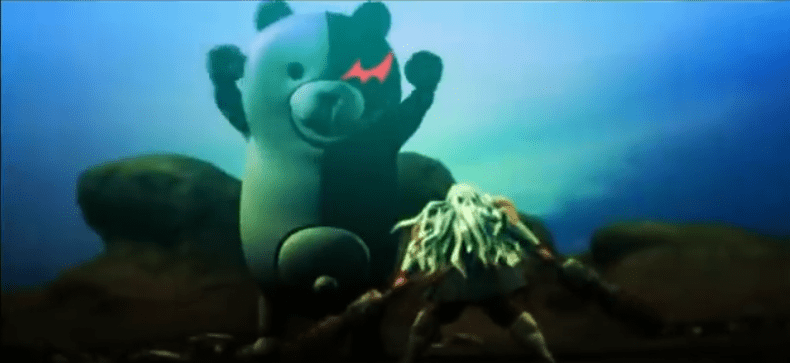
After the credits roll, the seemingly defunct Monokuma once more asserts in his tautological, self-referential way his continued existence as headmaster, and we are left awaiting further illumination/obfuscation of the identity of the Ultimate Despair or Team Rock- er, Fenrir in the sequel. It had already been promised, tongue-in-cheek, as a soulslike game featuring the noble Sakura dual-wielding polygonal lances of some sort against a giant-mech Monokuma during the final dream theater, but that imaginary game’s development was to be contingent on players buying lots of copies and getting everyone they knew to do the same. This whole-hearted if jokey embrace of the actual dominant ideology of neurotic complexes and quiet despair that is so-called late-stage capitalism is perhaps the funniest moment in a game that also regales players with Murakami-level short stories about UFOs and ersatz all-beef patties. The actual follow-ups in the series are appropriately on the same order as the first game: 2-D, just like Hifumi prefers, visual novel affairs that emphasize their superficiality and stylized appropriation of generic tropes.
To pick up with some highlights of the discussion prior to the end of the game, starting back in Chapter 3: Somehow, we come to care about the whole cast of cut-out cliches of characters, as surprising to us as the Ultimate Fanfic Artist’s rush of parasocial feelings for the AI program, Alter Ego, is to him. A friend is another self, as one old formulation has it; but Hifumi cannot hold onto the other saying, assuming its fair to appeal to it, that the things of friends are common. Makoto, at least, instantiates this latter idea in his process of gradually learning from others and gaining skills by getting to be closer friends with them. Meditating on what his status as the “ultimate lucky student” or indeed “ultimate hope” means, in this light, is surprisingly rich, while as gameplay enhancements or rewards these abilities are hardly significant.
But to return to Chapter 3 and Hifumi: his jealousy is what Celeste plays upon for her nonsensically elaborate double-or-nothing-homicide. She pits him against the powered-up Taka, who also confesses his love for Alter Ego for its portrayal of Mondo. Her betrayal of Hifumi is barely reciprocated in his final words, foreshadowing some recovery of memory before the end, along with the disclosure of a secret name. This is precisely one of the items on which Junko “fucking Enoshima” refuses to pontificate at the end of the game: why is her sister’s family name (Ikusaba, ie. “battlefield”) different from her own (lit. “bay island”)? So the mystery of the name and identity of the mastermind is hardly resolved, and that partial resolution points directly to another key theme haunting many of the game’s characters: their family relationships.
Celeste herself seems to represent an attempt to cast off her own cultural heritage and embrace that of another place. Changing her name, unlike the concealment and replacement tactics of Junko and Mukuro, seems to be purely aesthetic preference, in line with a certain self-construction. Her motive for the murder plot, such as it is, consists in her desire to bankroll her dream of buying a castle in Europe and staffing it with suitable servants. This vision of inhabiting an invented version of some distant land seems very clearly to play on the wishes and pretentions of so many fans of Japanese cultural products in the west. That she so despises Hifumi, in particular, is profoundly ironic. To the extent that either native Japanese audiences or foreign ones have reflected on this, they should be moved by curiosity about the history and language of the cultures they are fascinated with, and perhaps gain some new perspective on their own.
Makoto’s motivation to ensure the safety of his family, though we are apt to forget it, is pushed back in his face towards the end of the final trial. Byakuya’s fraught pride and perfectionism as the triumphant scion of a supposedly destroyed family of masters of the universe gives even this aloof figure a touch of humanity by the end. Comic relief clairvoyants and schizophrenic mass murderers drop mentions of watching antenna TV with their grandma and having two moms. Discourse around the game is focused mostly on the second trial, where Mondo’s jealousy of Chihiro’s strength and guilt over his brother’s death lead to his crime of passion, but the whole second half of the game, more or less, is driven by the search for a lost father (on Kyoko’s telling, in order to more formally disown him).
Sakura’s case, the turning point in the story, is almost as developed as Kyoko’s. Like Kyoko’s relationship to Makoto, Sakura’s protectiveness of Hina nearly leads to disaster, but the game suggests that friendships can ultimately prevail over the complex inherited strife of families. Sakura’s devotion to the dojo of her family is what leads her to initially agree to Monokuma’s proposal to get the killing moving, before Sayaka initiates it aided by Makoto’s misplaced tenderness, and Sakura later rebels. Her final act of sacrifice nearly backfires. Hina’s misprision of her motivation as loneliness and despair leads her to try to sink the whole surviving group, led astray as she is by the false suicide note. This is one of the clearest moments of the mastermind’s unreliability, and arguably should have given Kyoko more pause before she ventured to challenge Monokuma directly on the unfairness of the fifth trial, which framed her for a murder before she shifted the suspicion onto Makoto. However, the game does not dwell on either Hina’s or Kyoko’s treachery. This one moment of truly consequential choice in the game, should Makoto speak up and reveal Kyoko’s deception, produces a goofy group/family photo bad ending, but has little effect on their relationship as the true endgame plays itself out, as swiftly forgiven and forgotten as Hina’s jealous wrath.
Monokuma, for all his misdirection, does eventually reveal the true last words of Sakura so as to let the game continue. In this way, her suicide comes into line with a prototypically noble sacrifice, for all the problematic resonance it has with the real world of youthful despair. He also acquiesces to Kyoko’s bluff, again seemingly more on the strength of Junko’s commitment to her popular image and to delivering an entertaining show than on her fairytalesque legalism and observance of the rules she herself has arbitrarily laid down.
Sakura’s suicide is another of those key instances, like Chihiro’s gender identity or Celeste’s cultural one, of Danganronpa putting not just young bodies but young minds and souls under the gaze of the player. It flirts with voyeurism in scenes like the bathhouse “man’s fantasy” and the overt surveillance cameras in the rest of the school, and its treatment of gender nonconformity, school violence, and suicide are at least as problematic on reflection. The developers’ understanding of their audience’s being here for this edgy content presumably accounts for the otherwise inexplicable shots of Hina in bed–a piece of narration our POV character Makoto couldn’t have provided since he wasn’t there, and one that gets repeated as she recounts the events later anyway, and is thus doubly gratuitous–and the up-skirt views of Junko stomping Monokuma and Kyoko climbing the ladder up from the garbage heap. For all the emphasis on bodies, their surfaces and undergarments, Danganronpa is also addressing, albeit more obliquely, some of the psychological and even spiritual aspects of characters and identities. Bodies living and dead, uncomfortably sexualized and then disposed of, become the point of departure for reflections about trust, depression, habits of exercise, eating, and hygiene, discipline, and, most of all, talent. Whatever is ineffable, inexplicable, maybe only imaginary about what makes someone who they are and makes human connection possible, the game celebrates it in its own deranged way.
Sakura’s break-in of the headmaster’s room allows Kyoko access to the entire extant school, including the conspicuous lock on the door of the refuse room, using the key with a Monokuma face on it, though the building sure looks much bigger than five stories in the opening cutscenes. The secret room between the bathrooms and the library archive proves to be an open secret: once Makoto accesses it, he gets bonked on the head by a masked assailant, though never more severely punished, and the AI linked to the network there is part of Junko’s plan all along, just another one of the hints she gives to feed despair with glimmers of hope. Still, somehow Alter Ego manages to save his life, just as Kyoko heard the footsteps of the god of death and fought off a masked Junko before putting him in that predicament of facing execution in her place. She atones, perhaps, by diving into the garbage with him, cup noodles and all, to bring him back into the light, and to help solve the mysteries of their school life together. Perhaps.
Most of all, the player is left wishing for a better understanding or a more convincing portrayal of the inciting Tragedy, the true nature of which remains locked in those stolen memories, however it was they were stolen. It seems to include the presence of at least a handful of killers among the elite students at the nation’s most prestigious school, where a classroom on the fifth floor has been turned into a crime scene. If this was the focus of the Tragedy whose repercussions became truly society-ending in scope, it requires a huge escalation of our suspension of disbelief. Willing as we are to suppose the mastermind has an endless supply of technology for killing and gift-giving at their disposal, along with a degree of mind control and a knack for the spectacular, the possibility of a school-based tragedy spawning a global breakdown stretches all credulity. It would almost be nice to imagine it were possible, that the world’s attention and compassion could be so concentrated on the loss of life and hope in one classroom. But it makes no sense, given the otherwise surprisingly realistic portrayal of human nature in the main characters of the game. For all the absurdity of their circumstances, they do feel understandable, in a way the Monokuma-headed monuments and mobs do not.
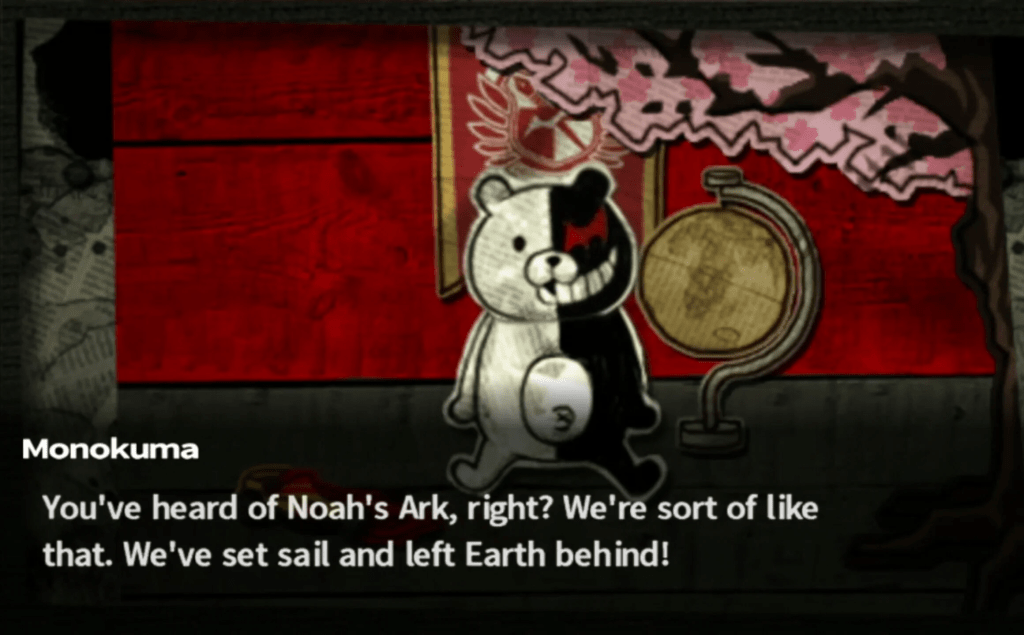
What matters to me is not whether the world outside the school gates is irrevocably shattered, or whether we’ve literally travelled on our spaceship ark of a school to the point of opening an airlock on the surface of the sun. The first game by itself doesn’t provide enough evidence, in my view, to prove or disprove that possibility, absurd though it seems. As for the subsequent games in the series, the jury is still out. We’ll be discussing them soon, if all goes according to plan. Metaphorically, though, the ending of Danganronpa, like so many other great games, is certainly about returning us to the world a little wiser and more hopeful. In this regard, it chimes with Tolkien’s notion of escape as much as Plato’s. The one cordially disliked allegory, the other denigrated poetry in favor of philosophy, and yet both reverberate with the same perennial themes, illumined all the more and anew by an encounter with this bizarre visual novel. See for yourself and try reading the Symposium or the Silmarillion in the light of Danganronpa’s vicarious youthful mayhem, jealous love, and joyous truthfinding. That’s what I hope, anyhow.
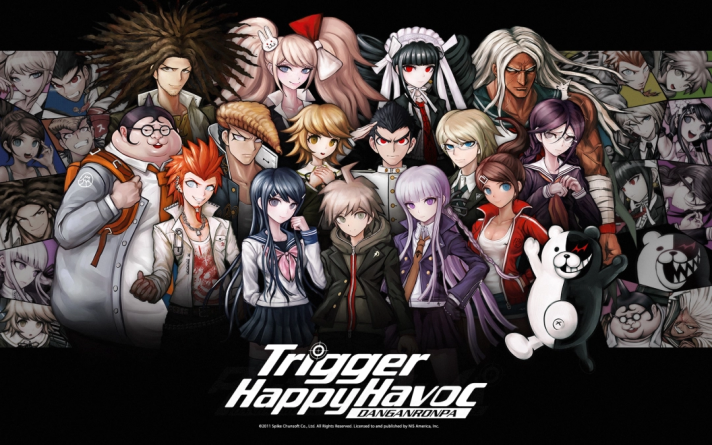
School’s out, and the summer of Danganronpa begins!
It’s true that we’ve been here before a time or two at the humble and not-quite-derelict Video Game Academy: see the spoiler-laden analysis from Professor Kozlowski on the game’s approach to Serving and Subverting Tropes, our introductory podcast episode, and other materials on our Intro to Visual Novels page. But summer school, after all, is about making up for lost time, in a not un-Proustian way, and so it’s never too late to begin again learning about this weird and discomforting game of mayhem, murder, and angst; through it, about games as such; and through games, about everything, really.
So get pumped with recommended readings such as Susan Sontag’s Notes on ‘Camp’ and play Danganronpa with us (or watch someone’s playthrough enough to get the gist of it, read the script, etc.)… it’s going to be a beautiful summer’s day.
What else we’re up to:
Professor Ben has been making lectures and videos for his course on the Philosophy of Love and Friendship
For myself, summer-reading Pedro Paramo, The Satanic Verses, The Tale of Genji, and The Beetle Leg with various friends, and playing through Paper Mario games with the fam
What’s new? Find us on discord and drop us a line!
Mathematics and politics, ripples in the pond of people; society the surface of human nature, music its denizens, and reading its depth.
Do not disturb my circles.
Archimedes, in Plutarch’s Lives (in Kierkegaard’s Philosophical Fragments [in our Reading on the Ground])
With Miyazaki’s Boy and the Heron, Dante on his pilgrimage, and Don Quixote on his knight-errantry, Alex and I have been circling around ideas for another project on myth in video games of late. More on that to come, I hope! For now, there are a number of other pieces I’d like to curate, to constellate around this resonant sigil of the circle.
Plenty of times we’ve heard about the Inklings, particularly the core duo of Tolkien and Lewis, and maybe the erudite Barfield and the weird Williams. Tolkien of course has his Lord of the Rings, Lewis his lecture on the theme of “The Inner Ring.” But there are many other great literary circles out there, too.
A little while ago I read the lively Magnificent Rebels by Andrea Wulf about Schiller, Goethe, and the rest of their Jena Set. Much further back in college it was the English Romantics, including the ghost story-telling contest that led to Frankenstein. Just now I’d add the excellent Journey to the Edge of Reason, by Stephen Budiansky, on Godel and the Vienna Circle (and subsequently the Institute for Advanced Study). No doubt before long I’ll want to cf. these with the New England Transcendentalists and Bloomsbury Set.
For myself, I’ve been connected with a group we might call the Arizona Seminar, though lately I’m more north by northwest. Our intellectual lineage traces through Santa Fe and Annapolis to Chicago and beyond, roughly along the lines of St John’s College and its formative lights. For another sampling of writing and music in this milieu, see the itinerant Brian Brock. Or just ask for the link to join the online Sunday seminar.
From Moses Norton, a delightful foray into–and sendup of–video game lore videos: Gamelogica.
Between all this and the subject of the latest episode in my own podcasting endeavors, Dylan Holmes’ A Mind Forever Voyaging: A History of Storytelling in Video Games, with all that book contains and all we touch on in our conversation, I’m feeling like a sentence crammed too full of ideas, more replete than complete. A fitting way to end this blog post that’s all outgoing links like those snakes in a can, for completionists still reading: you might also want to look up Chris Perry at Hampshire College, Barry Atkins, Tim Rogers, and the Digital Antiquarian, among others we mention.
It may not look like much. Sorry about that! The lack of new posts around here lately will not, I hope, have discouraged you from browsing some of the archives in the meantime. Reading around in the links, podcasts, and resources we’ve put together over the years, there should be no shortage of secrets to find and people to meet. But I think there’s more going on even now at our humble Video Game Academy than it might appear. And it’s not for nothing that we are still here.
Over a summer extended with paternity leave on the front end and now quickly licking at the heels of fall, I’ve been able to read and re-read some good stuff, that is by listening on Libby audiobooks but occasionally holding an actual book (usually also from the library) with my free hand that’s not holding the child, or more often than either, just on archive.org on my phone. Still threading my way through Spariosu, I subject Ben to my takes on that and Omeros, and Alex and Danny get my thoughts on Ulysses, Lea my questions about Either/Or. So I keep up with a couple of book groups, formal and informal, and I’ve started up again writing reviews, including a couple new ones, on The Pixels. Their push for Hawaii aid is well worth your consideration.
Ben, too, has been pitching in and accumulating wisdom. While preparing a new course in World Wisdom Traditions, the Professor’s rolling along with the Pentateuch piece of his larger hermeneutical-ethical project. Between that and moving house, he took some time out to make a new video: Replaying Assassin’s Creed, 2012-2014. And to go by the site stats, a decent audience is out there awaiting his next journal on Lobotomy Corporation…
As far as Twitch videos, I’ve shifted away from game playthroughs back to more text-based discussions. The current series is on William James’ Talks to Teachers and other foundational books for teachers and students. We’ll look at Douglass’ Narrative of the Life next, still making the connection to video games with the ways in which the theme of learning to read comes through in JRPGs like EarthBound and Dragon Quest.
Podcast-wise, here’s a conversation with Alyse Knorr, ‘achiever’ (to cite her Super Mario Bros 3, where I first encountered her work and reviewed it for The Pixels). In which we discuss:
– Sweetbitter Podcast, with new episodes coming soon about Mary Magdalen and a fourth season in the works
– Switchback Books, which she edits with her wife
– Regis University, where she teaches alongside colleagues such as Russ Arnold
– her poetry, research, and the novel she’s writing
For all you completionists: we talk about meaning and connection, truth and beauty, compassion, collaboration, and community; love poetry; queering religion and the reclamation of faith in a Jesus who speaks truth to power; spirituality and mystery; God (or goodness) as the still small voice; falling in love; taking inspiration from her students’ energy; Annotated Glass and Sappho fragment 31; coming out of the postmodern moment when sincere feeling was the most uncool thing; ‘Bright Star,’ Keats, Eliot, Carson’s Autobiography of Red; Gilgamesh and Enheduanna; ‘Anatomy Exam‘; Garcia Marquez; style and form, lyric and epic, ancient and sacred, emotion and bodily sensation, and finding new ways to render them, borrowing lines without knowing it; how form emerges and helps generate lines and line breaks; checking out legs at the library; respecting the uselessness of her art and the usefulness of her students’ (nursing); the act of naming; birdwatching as a mom of an infant; going from Edenic nescience to that corrupted knowledge place; naming the world; Ardor, a book of eco-queer domestic life and love; Every Last Thing, a book of tantrums and embarrassed apologies…
Does the poet hope for some response? Or is it nothing but a gift, this act of writing and learning from others’ experience and one’s own? To think about love, sincerity, earnestness? To celebrate queer joy as a political, radical act?
Micaela Tore’s MA thesis on Copper Mother; editing women and nonbinary authors; Gandalf the cat; the Voyager Golden Record (and around here you’ll get a musical interlude from moonbowmusic); the poets’ communal economy; editing and publishing poetry vs. prose, ie. at Boss Fight; the contest model; video game books with Gabe Durham, their upcoming Minesweeper, Xenogears, Animal Crossing; being an ideal reader; her SMB3 and GoldenEye 007 projects, memoir and journalism and creative writing; Nintendo interviews and how the limits of poetry, like early technology, feed creativity.
Video Games and Meaning: topics, problems, persuasion and social justice: Hair Nah and microaggressions; Oregon Trail and colonialism; Tomorrow, Tomorrow, and Tomorrow, by Gabrielle Zevin; Passage; citizen science; This War of Mine;Papers, Please;Train; Anna Anthropy’s Dys4ia,Queers in Love at End of World, and ZZT. Her new novel (agents, check it out), a post-apocalyptic story of love and a journey; Dhalgren;Ico; too much stuff, not enough people.
Alyse also recommends Merlin for birdwatching; “The Love Song of J Alfred Prufrock,” by TS Eliot; “Married,” “Alone,” “In Dispraise of Poetry,” and “Failing and Flying,” by Jack Gilbert.
Teaching-wise, I’m working on a collaborative research project with MG Prezioso, who studies literary enjoyment and understanding. Joe and I still have our liberal arts and leadership segments under the banner of the Thoughtful Dad, just not lately managing to record much.
Life-wise, back from visiting family. The Baltimore Aquarium, crowded as heck. Steve and his wife came down from Philadelphia (congrats you two!). DC museums with crying kids and a flash flood in the streets. Braving it all with the folks and Auntie Oli. Rehoboth Beach for a couple of days. Then back to Spokane, just trying to breathe through the smoke.
PS. On the flight home, I watched Living and Moonlight. Each on its own is very good. Together, they pair beautifully around the theme of play. In the one, a remake of Ikiru (itself based on The Death of Ivan Illich), we get renditions of ‘The Rowan Tree‘ and musings on the metaphor of play, with dying like a mother calling her children home. In the other, a movie that is almost too good to believe it found a way to exist, much like Everything Everywhere All in that at Once though different in practically every other way, we see one of those children who sits out of the game, almost, before being brought back in by a friend and making another kind of play all their own. Their song: ‘Hello Stranger,’ by Barbara Lewis.
In the world of video game academia, we’re pretty small potatoes. But small as we are, we are!
The next iteration of Video Game Studies will (maybe) be taking place on Signum’s SPACE Program in January. It’s dependent on participant interest, so give it a look here. The long and short of it is, we’ll be reading Tomorrow, and Tomorrow, and Tomorrow, by Gabrielle Zevin, and discussing video games a couple hours a week. We’ll look at classic games and genres and considering how they tie into the novel form a variety of critical and imaginative lenses. If all goes well, I’ll follow up with future courses in SPACE. I have a notion I can write something for this CFP on “The Post-Gamer Turn” into the bargain.
Meanwhile, the Twitch stream for younger readers in Signum Academy continues next year with more video game discussions. I’m planning on adapting material from the days of Outschool (which I joined in the first place trying to get traction for SA). More news on that to come.
A couple of notes about other past and current versions of these courses: the Science of Video Games, which Stephanie taught last year, more or less complete, can now be found here, and the Language and Code Cafe iteration of last year’s wellness I’m revamping for The Community School in Spokane got a little write up from the local news.
With all that going on, the time has come for us to be shuttering the patreon. We’re feeling pretty launched at this point, and there’s plenty of other worthy causes out there to support–such as Professor Kozlowski’s lecture series.
Many thanks to everyone who helped us get going. We’re back on this horse, this Rocinante, this quixotic Rocket sim.









 Video Game Academy