Fight, Magic, Items, by Aidan Moher – Book Reviewing the Literature on RPGs

In Fight, Magic, Items: The History of Final Fantasy, Dragon Quest, and the Rise of Japanese RPGs in the West, Aidan Moher delivers on the promise of an idea or idle dream many of us have shared but all too few have realized: recounting the stories of the games we love and weaving those stories together into the tale of a genre, a medium, and an industry over the course of a book.

Reviews abound, as the book has been out for a couple of years–mostly positive, from what I can tell, and for all my sour grapes I can’t disagree: the book itself is even out there in audio, so I highly recommend checking it out. While the definitive book on JRPGs, if there is such a thing, remains to be written–and while the writing of such an ideal book, even if quixotic, seems well worth the effort–having this bird of Moher’s in hand makes for encouragement, inspiration, and provocation.

As the book goes on, tracing the development of the genre chronologically, I personally grew less and less interested, even as (or perhaps because) the games under discussion were more new to me. Having set up the basic structure of the history of JRPGs as a kind of dialogue or dialectic between the Dragon Quest and Final Fantasy series, Moher slips into reportage rather than analysis for the bulk of the text. Still, there are a number of insights and simple points of fact that make the text perfectly adequate for what it is setting out to do. Appealing to a broad audience, Moher gives enough context for the general reader, as well as peppering his chapters with insights for those who are more familiar with the basic outline. Along with the many iterations and generations of the core series DQ and FF, he does fit in a range of lesser-known games and series into the narrative.

While convincingly making the case for the coherence of his subject, Moher also includes just enough of his own subjective experience to hint at the importance of this history for the individual. Plenty of background information is given for anyone in the audience who hasn’t lived through it, and those of us who would have liked to write such a book are spared the effort of a certain amount of historical research, while the work of introspection and deeper analysis remains. Given the scope of his work, Moher necessarily touches lightly on any given game. At times, even beloved and important games appear only in the form of inset thumbnail sketches, or in a stray reference. Just as the history of JRPGs is ongoing, so he acknowledges that his own research is only offering one viewpoint among many–including his own future writing, podcasting, and so on.

For another look at JRPGs, on the recommendation of sometime interlocutor and friend of the site Dylan Holmes–whose book A Mind Forever Forever Voyaging does touch on the genre as well–pay a visit to the Digital Antiquarian, where JPGs are placed within the much larger framework of CRPGs as a whole.

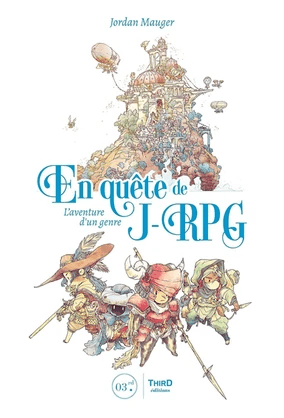
For more on those two other proverbial birds, and without too much beating around the bush, I heard that a certain gamelogician is working on a book on RPGs, which I’ve been looking forward to. Or was it a oiseau that told me? If you happen to read French, consider the approach taken by Jordan Mauger. En quête de J-RPG: L’aventure d’un genre has yet to be translated into English. The title might be translated In Search of J-RPG, as The Video Game Library has it, but it also puns on enquête, a word whose range of meanings includes “investigation, survey, inquiry” as well as the root meaning of “quest”. Like so many of us, Mauger is simultaneously making the case for the importance of his subject while also treating it as important and worthy of detailed analysis. My own French is far from adequate to understanding all the nuance of his argument and his numerous puns and plays on words, but insofar as I could read it, I definitely enjoyed and would recommend this book, as well.
In short–and again, I apologize for the brevity and slovenliness of these posts lately–anyone out there writing about games like these, like this, take heart! It can be done, and it is. And it can always be done better.
A Year of Myth in Games

By some measures, 2025 marks 50 years of computer role-playing games, and the Well-Red Mage Moses Norton suggests a few ways of celebrating accordingly. From playing and replaying RPGs to reading and writing about them, I’ve been preparing for this challenge for a lifetime, it seems, without knowing it.

I have yet to choose my 12 games, one for each month, to try to complete this year, but I appreciate the stipulations that make the challenge seem a little more within reach. For example, games one has started but never beaten are allowed, so both my file of Pokemon FireRed, started at the tail end of 2024, and my long-dormant FF8 save, which I’m spurred by Ben’s essay to pick up again, are fair game. The rules also specify that all “beating the game” entails in this case is reaching the end of the main story. The completionist in me is torn, then, between wanting to participate–finally playing through the rest of Planescape: Torment, perchance?–and knowing that to do so is to accept that my runs are likely to be cursory, fragmentary, and rushed, even if I do complete the historic challenge. I recognize from the outset that it isn’t very likely that I will.

Red’s list, shared on social media and discord

A similar spirit of fraught completionism is animating my scholarship this year, such as it is, here at the Video Game Academy, where I’m intending to write up all the unfinished drafts I have lying around. Cleaning the digital shed is how I think of it, looking forward to such light as might come along through the process.

We have been known to favor story-driven games, RPGs as well as visual novels, in our courses, and in our reading and theory-building we tend towards the myths at the roots of those stories. In the occasional writing meant to accompany and record all this playing and reading, it is natural that we should circle around the same themes time and again–innocence and experience, language, wisdom, courage, and friendship–rather than proceeding with an argument straight forward to its end. So often, that end is really to invite readers to contemplate anew what has seemed only a distraction or entertainment. And given that I am a halfhearted completionist at best, it is no wonder that I have so many stray essays only half begun, and that finishing them will mean putting them in the bare minimum of readiness to be read.

As a theme for the year, halfhearted completionism doesn’t really have the ring, however, that The Year of RPGs, or even The Year of Myth in Games properly does. So let’s go with that, understanding between ourselves that what we’re bound to deliver might not quite live up.

Along the way, sooner rather than later, I trust, we’ll get to that brief outline of Sloek’s Devotional Language I’ve been promising and attempt to explicate its bearing on the project of reading games mythologically. It’s not an easy book to find, but it’s one that we revere enough to shell out the textbook-high price for a used copy (or in a pinch, to scour the web for a pdf). Professor Kozlowski has been known to name-drop Sloek in his lectures, too.

Should you choose to review the extant literature rather than awaiting updates from us, however, a myriad of resources await the student of myth in games. Alarmingly, the wily Spariosu, who has been there long before us, tallying up philosophers and fiction writers from Homer to the late 20th century, hasn’t yet managed to transform the academy with respect to its stance towards games. And yet it is thanks to the far from mythically inclined Game Studies Study Buddies that I ever heard of his work. See also their discussion of what might be the first dissertation on storytelling in games, “Interactive Fiction: The Computer Story Game Adventure,” by Mary Ann Buckles, and their proposal for a countervailing archetypal work of game studies to supplant Huizinga and Caillois, Beyond a Boundary, by CLR James.

Contemporary broadly Jungian interpretations which might be of interest include two recent doctoral dissertations from Pacifica Graduate Institute, “Myth in Translation: The Ludic Imagination in Contemporary Video Games,” by Robert William Guyker, Jr, and “The (Virtual) Myth Conservancy: A Framework for Virtual Heritage and Game-Based Learning,” by Ashland Pym. On the assumption that anyone willing to read a blog post about such tomes would also be willing to at least skim the originals, a review of these is probably not forthcoming. But that is the beauty of abstracts, like this one from a conference in 2022, or the endless rollout of hits for a search of “keywords: myth and games” at (the admittedly very spammy) academia.edu. Video essays, likewise, are an endless trove of far more polished content than we’re ever likely to produce.

I wonder what ever became of this project of a “virtual myth conservancy”

To conclude for now: the myth at the heart of this project of ours at the Video Game Academy has always been the myth of the Lewisian light-looker-along and Tolkenian mythopoetic seeker of truth. It’s the Augustinian longing for a paradigm of a story to apply to our own lives, rather than an accumulation of facts, however playful. It’s the myth of creation, of the garden and the fall, of the exile and return to the land and the faith of our homes, where the TV glows with game systems and the local library and school cafeteria shelves are well stocked. It’s a certain blend of the erstwhile American Dream and the perennial search for meaning: the quest for the grail and the fight against the dragon, the legend with a core of literal and metaphorical truth in the midst of extravagant lies and beside-the-point problems, the poetry of the god-shaped absence in a culture where God has been said to be dead for a long time, and yet we act as though he lives. Our party has gone ahead and killed him time and again at the end of the main story of plenty of RPGs, and still there are countless others to play.

Call it cliché, call it poetry if you like, though rhetoric or ideology are also apt. When it comes to quibbling over words for getting at the relationships between games and myth, we have all day, all year, and more.