Courtesy of the inimitable Dylan, whose work has enriched The Community School Game Jam and Mobius Shark Tank at the Spokane Central Library, and whose Hello Kitty Zen Garden graces the unpublished manuscript of TCS: The Book (working subtitle, albeit cliched, heartfelt: Building the Beloved Community School), here is a deep dive into a game I’ve only watched streams of, and yet can hardly imagine the games landscape without: What remains of Edith Finch. Dylan has also presented this as part of the Games Studies wellness, meeting W/F afternoons at TCS. Drop in when you’re in town, just sign in at the front office.
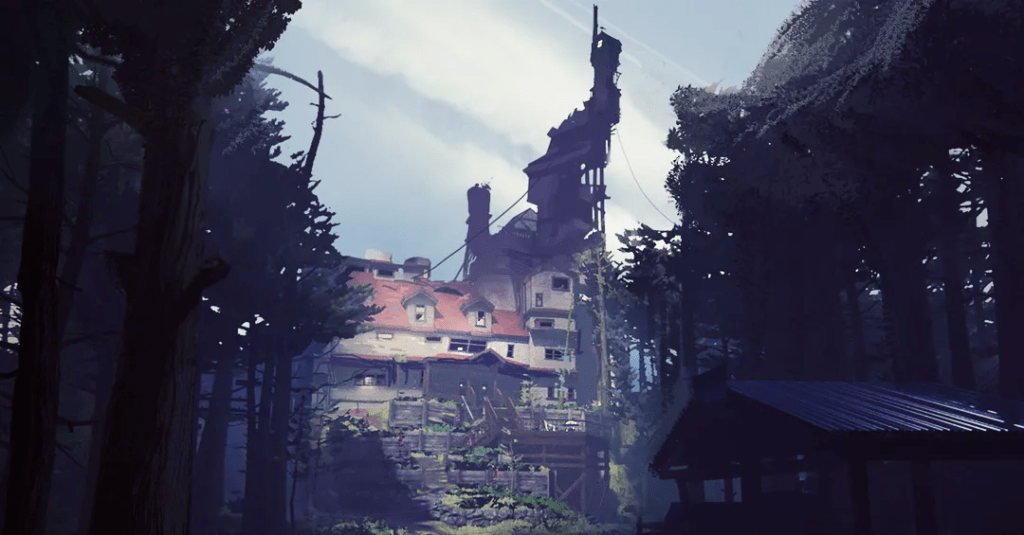
What remains of Edith Finch is a first-person narrative game where you play as – you guessed it – Edith Finch. Edith is the last living member of her family, and after the death of her mother, we follow her through her childhood home and watch as she uncovers secrets about her family that were buried. Some in walls, others, under beds… you get the idea. Let’s briefly go through the game, and then talk about the pressing issue of the game.
We start the game on a ferry. When we look down, we can see that our character has a cast on their right arm, and that they are holding a journal with “Edith Finch” written on the cover. When we open it, we hear the namesake of the game begin to narrate the writing. She talks about how, at 17, she is the last remaining member of her family. When she gets into the monster of a house that the Finch family home is, we start to learn about all the different members of her family – and moreover, why she is the only one left.
We learn that in 1937, in an attempt to escape the curse that had claimed his wife and newborn son, Edith’s great-great-grandfather Odin Finch emigrates from Norway to the USA, setting sail with his daughter Edith (Edie, or Edith Sr. as she’s referred to by Edith), and her husband Sven, as well as their newborn baby, Molly. He uses his house as the raft, but unfortunately, it seemed as though the curse was coming for him too. The wind picked up and a storm broke out. A wave unfortunately took Odin under, swallowing the house with him. Edie and Sven, along with baby Molly, made it to Orcas island safe. Their first order of business? Building a cemetery.
Of course, this isn’t some happy ending – Edith had to be the last remaining Finch somehow, right? I’ll briefly go over the deaths.
Edith Sr. ended up having five children with Sven, including Molly. She gave birth to Barbra, twins Sam and Calvin, and Walter. Edie initially believes they’ve left the curse behind, but of course, it’s never that simple.
At 10, Molly dies from ingesting fluoride toothpaste and holly berries after going to bed without eating. At 16, Barbra is murdered after an argument with her boyfriend over her long-gone stardom. Walter hears all of this happen, and believes it was a monster. After spending 30 years hiding from this monster in the bunker of the house, the day he decides to leave, he is struck by a train. Calvin dies at 11 after swinging too high and flying off of a cliff. At 49, Sven dies from falling off of the house’s roof whilst building a slide.
Sam lives into adulthood, and marries a woman and has Dawn, Edith’s mother, and Gus. Later, he marries a woman named Kay, and they have Gregory. Dawn is the only one to make it to adulthood.
At 13, Gus is crushed by a totem pole during a storm. Gregory drowns at 22 months after being left unattended by his mother in the bath. Sam, who at this point is divorced, dies at 33 whist on a hunting trip with dawn. Dawn shoots a buck and Sam wants to take a picture with it and her. Whilst posing for the photo, the buck thrashes and pushes Sam off of a cliff.
Traumatized by all of this, Dawn moves to India, where she marries a man named Sanjay. Together, they have three kids. Lewis, Milton, and Edith jr.
Sanjay is killed by an earthquake, so Dawn moves her and her kids back into the Finch family home. At 11, Milton mysteriously disappears seemingly out of nowhere, making Dawn become paranoid. She seals all the doors of the rooms of deceased family members. Edie drills peepholes. Lewis, after battling drug abuse and mental health struggles, commits suicide during work. This is when Dawn decides it’s time to leave. She arranges for a nursing home to pick Edie up, and packs the belongings of her and Edith. They leave that night, with Edie meant to get picked up the next day. She doesn’t make it to the morning. Edie is found dead after ingesting alcohol with her medication. Years later, Dawn succumbs to an unspecified illness, leaving a 17 year old Edith to inherit everything.
In the final scene of the game, we kid out that the character on the ferry with the cast is Edith’s son, and it’s revealed that she died during childbirth shortly after we see her learn of all the secrets of the house. We see her child place flowers on her grave.
That’s the very bare bones of the story. Is there more to explore? More to dig deep on? Yes, of course, but I simply want to talk about my personal opinion with the curse.
I think that during my first playthrough of the game, I did indeed think there was really a curse – a monster, even, as Walter puts it. He’s convinced that a monster killed Molly, since that’s what she talked about in her journal entry not long before her passing. It was also likely the monster that killed Barbra, since Walter heard it himself!
I definitely believed this theory at first – but the more replays I did, the more I understood the real story, which is the one I placed out for you earlier. I don’t think there’s a monster, nor a curse. I think it’s a bunch of wacky coincidences. Let me explain; I think that the “Curse” is simply a self-fullfilling prophecy, a mindset where you, or someone else, believes that something will happen in the future, and because of that, your actions are affected by that hypothetical event, and eventually, that event happens because you influenced it to!
I think, that given the fact that Edie had recently seen not only her mother and young brother pass away, but also her father while trying to escape the “curse” that supposedly followed them, that she made this connection in her brain that she and her kids were living on borrowed time. I think that this belief made her act less rationally when it came to taking care of her kids, and therefore, the only kid she had that made it to adulthood and had their own kids unintentionally instilled that into them, too. Leading to one of those kids growing up and maybe trying to break the “curse”, but only leading to curiosity about it rather than education about what it truly is.
Finally, Edith, deciding to find out about the secrets her family holds, died tragically in childbirth in what I believe to be a sad and cruel coincidence.
So, no. I don’t believe that the Finch family ever had a curse. Instead, I think that the game represents a very straightforward story of generational trauma and how it affects a family. I think that the fear that death was creeping closer resulted in much of the Finch family acting in reckless ways. Some acted as if every day was their last, or didn’t seem too concerned with the danger of it all. Others hid away, or became over protective of themselves and possibly their kids.
What Remains of Edith Finch is a beautifully dark and morbid game. And I know that at least for me, it allowed me to gain a whole new perspective of what it means to be alive. It gave me an appreciation I didn’t even know I had for life. I think also, that its story about death, highlights just how important it is to cherish every moment, but to also not be afraid to express yourself and do the things that might be a little risky. Enjoy yourself! Don’t be afraid of some silly curse.
Thanks again, Dylan. We look forward to your future endeavors, including the follow up on Little Nightmares and a generation of young players impacted by it!
 Video Game Academy