I’ve just been rereading this book and I won’t stop telling everyone how much I love it: it’s as good and better than I remember. Look, I tell them, if you’re at all interested in mythology, theology, philosophy, language, culture, education–practically anything relevant to the inner life, and the possibility of cultivating and expressing it in any way–you should read Devotional Language, by Johannes Sloek. I’ll send you a pdf that I found, since the book is expensive and hard to find, and it’s not even all that long; you can read it in few sittings; you can sit with it a lifetime. Just ask! So far exactly one person has taken me up on this belated enthusiasm for the preeminent 20th-century Kierkegaard scholar’s work, my friend and co-founder of this humble Video Game Academy, Ben, known online and to his students as Professor Kozlowski.
Continue reading “All Myths are Myths of Creation: Devotional Language, by Johannes Sloek”A Year of Myth in Games
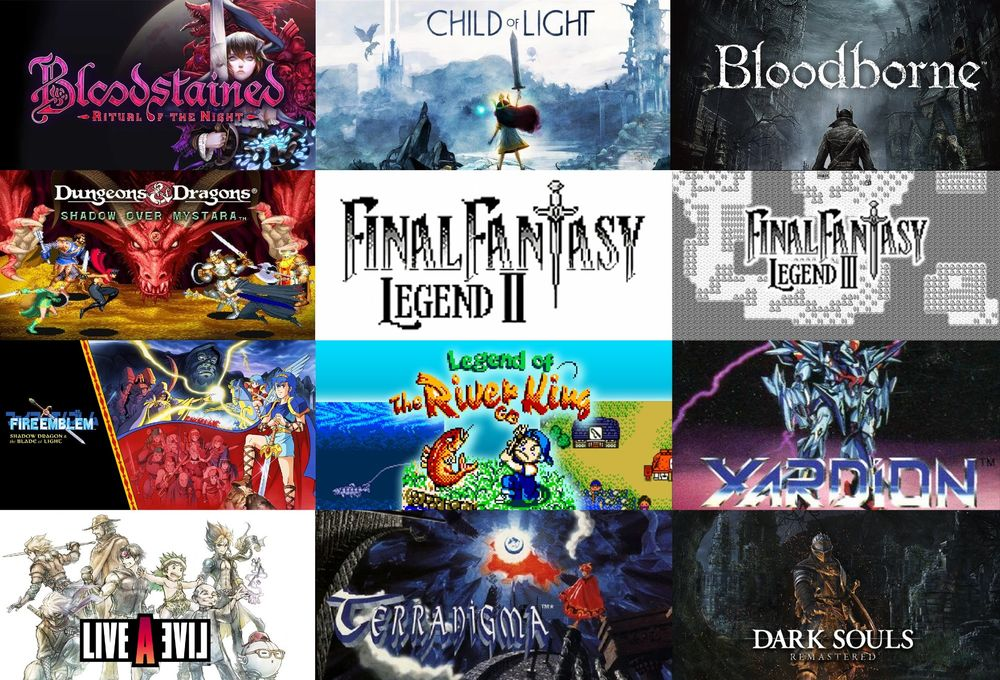
By some measures, 2025 marks 50 years of computer role-playing games, and the Well-Red Mage Moses Norton suggests a few ways of celebrating accordingly. From playing and replaying RPGs to reading and writing about them, I’ve been preparing for this challenge for a lifetime, it seems, without knowing it.
I have yet to choose my 12 games, one for each month, to try to complete this year, but I appreciate the stipulations that make the challenge seem a little more within reach. For example, games one has started but never beaten are allowed, so both my file of Pokemon FireRed, started at the tail end of 2024, and my long-dormant FF8 save, which I’m spurred by Ben’s essay to pick up again, are fair game. The rules also specify that all “beating the game” entails in this case is reaching the end of the main story. The completionist in me is torn, then, between wanting to participate–finally playing through the rest of Planescape: Torment, perchance?–and knowing that to do so is to accept that my runs are likely to be cursory, fragmentary, and rushed, even if I do complete the historic challenge. I recognize from the outset that it isn’t very likely that I will.
A similar spirit of fraught completionism is animating my scholarship this year, such as it is, here at the Video Game Academy, where I’m intending to write up all the unfinished drafts I have lying around. Cleaning the digital shed is how I think of it, looking forward to such light as might come along through the process.
We have been known to favor story-driven games, RPGs as well as visual novels, in our courses, and in our reading and theory-building we tend towards the myths at the roots of those stories. In the occasional writing meant to accompany and record all this playing and reading, it is natural that we should circle around the same themes time and again–innocence and experience, language, wisdom, courage, and friendship–rather than proceeding with an argument straight forward to its end. So often, that end is really to invite readers to contemplate anew what has seemed only a distraction or entertainment. And given that I am a halfhearted completionist at best, it is no wonder that I have so many stray essays only half begun, and that finishing them will mean putting them in the bare minimum of readiness to be read.
As a theme for the year, halfhearted completionism doesn’t really have the ring, however, that The Year of RPGs, or even The Year of Myth in Games properly does. So let’s go with that, understanding between ourselves that what we’re bound to deliver might not quite live up.
Along the way, sooner rather than later, I trust, we’ll get to that brief outline of Sloek’s Devotional Language I’ve been promising and attempt to explicate its bearing on the project of reading games mythologically. It’s not an easy book to find, but it’s one that we revere enough to shell out the textbook-high price for a used copy (or in a pinch, to scour the web for a pdf). Professor Kozlowski has been known to name-drop Sloek in his lectures, too.
Should you choose to review the extant literature rather than awaiting updates from us, however, a myriad of resources await the student of myth in games. Alarmingly, the wily Spariosu, who has been there long before us, tallying up philosophers and fiction writers from Homer to the late 20th century, hasn’t yet managed to transform the academy with respect to its stance towards games. And yet it is thanks to the far from mythically inclined Game Studies Study Buddies that I ever heard of his work. See also their discussion of what might be the first dissertation on storytelling in games, “Interactive Fiction: The Computer Story Game Adventure,” by Mary Ann Buckles, and their proposal for a countervailing archetypal work of game studies to supplant Huizinga and Caillois, Beyond a Boundary, by CLR James.
Contemporary broadly Jungian interpretations which might be of interest include two recent doctoral dissertations from Pacifica Graduate Institute, “Myth in Translation: The Ludic Imagination in Contemporary Video Games,” by Robert William Guyker, Jr, and “The (Virtual) Myth Conservancy: A Framework for Virtual Heritage and Game-Based Learning,” by Ashland Pym. On the assumption that anyone willing to read a blog post about such tomes would also be willing to at least skim the originals, a review of these is probably not forthcoming. But that is the beauty of abstracts, like this one from a conference in 2022, or the endless rollout of hits for a search of “keywords: myth and games” at (the admittedly very spammy) academia.edu. Video essays, likewise, are an endless trove of far more polished content than we’re ever likely to produce.

To conclude for now: the myth at the heart of this project of ours at the Video Game Academy has always been the myth of the Lewisian light-looker-along and Tolkenian mythopoetic seeker of truth. It’s the Augustinian longing for a paradigm of a story to apply to our own lives, rather than an accumulation of facts, however playful. It’s the myth of creation, of the garden and the fall, of the exile and return to the land and the faith of our homes, where the TV glows with game systems and the local library and school cafeteria shelves are well stocked. It’s a certain blend of the erstwhile American Dream and the perennial search for meaning: the quest for the grail and the fight against the dragon, the legend with a core of literal and metaphorical truth in the midst of extravagant lies and beside-the-point problems, the poetry of the god-shaped absence in a culture where God has been said to be dead for a long time, and yet we act as though he lives. Our party has gone ahead and killed him time and again at the end of the main story of plenty of RPGs, and still there are countless others to play.
Call it cliché, call it poetry if you like, though rhetoric or ideology are also apt. When it comes to quibbling over words for getting at the relationships between games and myth, we have all day, all year, and more.
Happy New Year, Video Game Academicians!
I’ve accepted the fact that 2025 will be bad. – Professor Kozlowski
We’re not exactly known for prompt and timely updates here at the old video game academy. But hey, we’re still here, in our fifth year, give or take, and ringing in this new year with a post and a promise of more to come.

Taking stock, I have about 40 drafts ready to go, starting out from many points over these swiftly elapsing years, mostly along the lines of a games-in-literature connection. So many ideas for the student of games to contemplate, easily a year’s worth, are there in potentia. So that it’s my intention to shovel out this whole backlog little by little over the course of this year, knowing that the articles will be shorter and even looser than what I generally go for, because if not now, when?
Some of the topics I’ve been mulling over: cmrn of the infamous GSSB and his thesis on nonhumanism; the infinitely voyaging Sufjan; the inimitable Sloek; more Dostoevsky, naturally; Homer, Cervantes, Caedmon, Sterne; Monkey and Gargantua; Genji and his ambidextrous gloves; Pullman, of course, whose third Book of Dust should be dropping soon.
Whether there’s anyone out there reading them or not, I’m looking forward to the practice and discipline that will necessarily go along with such an undertaking. Much as I like the outlet for meditations on games and literature, though, my worry is that this site is not much help to anyone else, whether it be people teaching games or people working on their own researches, or some overlap of the two. To try again to connect with a community of people interested in reading and writing of this sort, then, is my main goal for the year, quixotic though it may be. The podcast form is a good one, insofar as anything on the internet is good, for conversations and interviews bringing people together and sharing ideas, and we’ll keep it going.
Understandably, this is already asking a lot. All I can say is, quoting Ben again, “Fires bring people together…In the fire, we were neighbors…We are in the fire now. We are always in the fire, especially when we cannot see the flames.” And this is fine.
Imperturbable Circles–In Conversation with Dylan Holmes, author of A Mind Forever Voyaging
Mathematics and politics, ripples in the pond of people; society the surface of human nature, music its denizens, and reading its depth.
Do not disturb my circles.
Archimedes, in Plutarch’s Lives (in Kierkegaard’s Philosophical Fragments [in our Reading on the Ground])
With Miyazaki’s Boy and the Heron, Dante on his pilgrimage, and Don Quixote on his knight-errantry, Alex and I have been circling around ideas for another project on myth in video games of late. More on that to come, I hope! For now, there are a number of other pieces I’d like to curate, to constellate around this resonant sigil of the circle.
Plenty of times we’ve heard about the Inklings, particularly the core duo of Tolkien and Lewis, and maybe the erudite Barfield and the weird Williams. Tolkien of course has his Lord of the Rings, Lewis his lecture on the theme of “The Inner Ring.” But there are many other great literary circles out there, too.
A little while ago I read the lively Magnificent Rebels by Andrea Wulf about Schiller, Goethe, and the rest of their Jena Set. Much further back in college it was the English Romantics, including the ghost story-telling contest that led to Frankenstein. Just now I’d add the excellent Journey to the Edge of Reason, by Stephen Budiansky, on Godel and the Vienna Circle (and subsequently the Institute for Advanced Study). No doubt before long I’ll want to cf. these with the New England Transcendentalists and Bloomsbury Set.
For myself, I’ve been connected with a group we might call the Arizona Seminar, though lately I’m more north by northwest. Our intellectual lineage traces through Santa Fe and Annapolis to Chicago and beyond, roughly along the lines of St John’s College and its formative lights. For another sampling of writing and music in this milieu, see the itinerant Brian Brock. Or just ask for the link to join the online Sunday seminar.
What have some other friends been up to?
With Professor Kozlowski’s series on the Pentateuch in the books, he turns to Dostoevsky and Russian Nihilism. No shortage of interest in Dostoevsky and his Underground Man here.
From Moses Norton, a delightful foray into–and sendup of–video game lore videos: Gamelogica.
Between all this and the subject of the latest episode in my own podcasting endeavors, Dylan Holmes’ A Mind Forever Voyaging: A History of Storytelling in Video Games, with all that book contains and all we touch on in our conversation, I’m feeling like a sentence crammed too full of ideas, more replete than complete. A fitting way to end this blog post that’s all outgoing links like those snakes in a can, for completionists still reading: you might also want to look up Chris Perry at Hampshire College, Barry Atkins, Tim Rogers, and the Digital Antiquarian, among others we mention.
Alyse Knorr Conversation and World Wisdom Traditions / PS: Moonlight and Living
What all we’ve been up to
It may not look like much. Sorry about that! The lack of new posts around here lately will not, I hope, have discouraged you from browsing some of the archives in the meantime. Reading around in the links, podcasts, and resources we’ve put together over the years, there should be no shortage of secrets to find and people to meet. But I think there’s more going on even now at our humble Video Game Academy than it might appear. And it’s not for nothing that we are still here.
Over a summer extended with paternity leave on the front end and now quickly licking at the heels of fall, I’ve been able to read and re-read some good stuff, that is by listening on Libby audiobooks but occasionally holding an actual book (usually also from the library) with my free hand that’s not holding the child, or more often than either, just on archive.org on my phone. Still threading my way through Spariosu, I subject Ben to my takes on that and Omeros, and Alex and Danny get my thoughts on Ulysses, Lea my questions about Either/Or. So I keep up with a couple of book groups, formal and informal, and I’ve started up again writing reviews, including a couple new ones, on The Pixels. Their push for Hawaii aid is well worth your consideration.
Ben, too, has been pitching in and accumulating wisdom. While preparing a new course in World Wisdom Traditions, the Professor’s rolling along with the Pentateuch piece of his larger hermeneutical-ethical project. Between that and moving house, he took some time out to make a new video: Replaying Assassin’s Creed, 2012-2014. And to go by the site stats, a decent audience is out there awaiting his next journal on Lobotomy Corporation…
As far as Twitch videos, I’ve shifted away from game playthroughs back to more text-based discussions. The current series is on William James’ Talks to Teachers and other foundational books for teachers and students. We’ll look at Douglass’ Narrative of the Life next, still making the connection to video games with the ways in which the theme of learning to read comes through in JRPGs like EarthBound and Dragon Quest.
Podcast-wise, here’s a conversation with Alyse Knorr, ‘achiever’ (to cite her Super Mario Bros 3, where I first encountered her work and reviewed it for The Pixels). In which we discuss:
– Sweetbitter Podcast, with new episodes coming soon about Mary Magdalen and a fourth season in the works
– Switchback Books, which she edits with her wife
– Regis University, where she teaches alongside colleagues such as Russ Arnold
– her poetry, research, and the novel she’s writing
For all you completionists: we talk about meaning and connection, truth and beauty, compassion, collaboration, and community; love poetry; queering religion and the reclamation of faith in a Jesus who speaks truth to power; spirituality and mystery; God (or goodness) as the still small voice; falling in love; taking inspiration from her students’ energy; Annotated Glass and Sappho fragment 31; coming out of the postmodern moment when sincere feeling was the most uncool thing; ‘Bright Star,’ Keats, Eliot, Carson’s Autobiography of Red; Gilgamesh and Enheduanna; ‘Anatomy Exam‘; Garcia Marquez; style and form, lyric and epic, ancient and sacred, emotion and bodily sensation, and finding new ways to render them, borrowing lines without knowing it; how form emerges and helps generate lines and line breaks; checking out legs at the library; respecting the uselessness of her art and the usefulness of her students’ (nursing); the act of naming; birdwatching as a mom of an infant; going from Edenic nescience to that corrupted knowledge place; naming the world; Ardor, a book of eco-queer domestic life and love; Every Last Thing, a book of tantrums and embarrassed apologies…
Does the poet hope for some response? Or is it nothing but a gift, this act of writing and learning from others’ experience and one’s own? To think about love, sincerity, earnestness? To celebrate queer joy as a political, radical act?
Micaela Tore’s MA thesis on Copper Mother; editing women and nonbinary authors; Gandalf the cat; the Voyager Golden Record (and around here you’ll get a musical interlude from moonbowmusic); the poets’ communal economy; editing and publishing poetry vs. prose, ie. at Boss Fight; the contest model; video game books with Gabe Durham, their upcoming Minesweeper, Xenogears, Animal Crossing; being an ideal reader; her SMB3 and GoldenEye 007 projects, memoir and journalism and creative writing; Nintendo interviews and how the limits of poetry, like early technology, feed creativity.
Topophilia: Elizabeth Bishop’s ‘The Map’; Henry Jenkins’ ‘Complete Freedom of Movement’; Sean Fenty’s nostalgia piece in Playing the Past. The completionist impulse; worlds in games, in Anchorage, in the self; secret areas, heroes and princesses; Miyamoto’s childhood explorations; the Bishop archives; growing up in the South; lines on the map; exile and the Garden; Dante; ways of incorporating games in classes.
Video Games and Meaning: topics, problems, persuasion and social justice: Hair Nah and microaggressions; Oregon Trail and colonialism; Tomorrow, Tomorrow, and Tomorrow, by Gabrielle Zevin; Passage; citizen science; This War of Mine; Papers, Please; Train; Anna Anthropy’s Dys4ia, Queers in Love at End of World, and ZZT. Her new novel (agents, check it out), a post-apocalyptic story of love and a journey; Dhalgren; Ico; too much stuff, not enough people.
Alyse also recommends Merlin for birdwatching; “The Love Song of J Alfred Prufrock,” by TS Eliot; “Married,” “Alone,” “In Dispraise of Poetry,” and “Failing and Flying,” by Jack Gilbert.
Teaching-wise, I’m working on a collaborative research project with MG Prezioso, who studies literary enjoyment and understanding. Joe and I still have our liberal arts and leadership segments under the banner of the Thoughtful Dad, just not lately managing to record much.
Life-wise, back from visiting family. The Baltimore Aquarium, crowded as heck. Steve and his wife came down from Philadelphia (congrats you two!). DC museums with crying kids and a flash flood in the streets. Braving it all with the folks and Auntie Oli. Rehoboth Beach for a couple of days. Then back to Spokane, just trying to breathe through the smoke.

PS. On the flight home, I watched Living and Moonlight. Each on its own is very good. Together, they pair beautifully around the theme of play. In the one, a remake of Ikiru (itself based on The Death of Ivan Illich), we get renditions of ‘The Rowan Tree‘ and musings on the metaphor of play, with dying like a mother calling her children home. In the other, a movie that is almost too good to believe it found a way to exist, much like Everything Everywhere All in that at Once though different in practically every other way, we see one of those children who sits out of the game, almost, before being brought back in by a friend and making another kind of play all their own. Their song: ‘Hello Stranger,’ by Barbara Lewis.
Surprise! It’s a lecture. A new series on Assassin’s Creed — and another on being a dad
Summer’s almost over, with a new school year in no uncertain terms upon us. Apologies, but for the foreseeable future things might be a little quiet around here. For now, it’s going to be crossover posts abounding!
Prof Ben sneakily delivers the first in a new lecture series on the conspiracy-laden games.
And another quick link to a new project on being a dad.
Share it with a dad or thoughtful caretaker in your life!

