Zelda, we need to talk.
We’ve been in a relationship for a long time now. I first played an emulated copy of Link’s Awakening before I even owned a Game Boy, probably thirty years ago now. I remember going to friends’ houses and playing A Link to the Past and Ocarina of Time for the first time and getting positively entranced by the opening dungeons in what little time I had before my parents took me home. I remember being distraught as only middle-schoolers can be distraught when my parents refused to take me to Wal-Mart to pick up my pre-ordered copy of Majora’s Mask until A WHOLE DAY after the release date. I remember buying Oracle of Ages and Oracle of Seasons together with hard-earned first-job money, and buying Twilight Princess on the Gamecube because I couldn’t track down a Wii in the first few weeks after its release (even though, insanely, I already owned the Wii version of the game?). I canceled my Nintendo Power membership and rejoined, just so I could get the promotional Gamecube disc with Ocarina of Time and Majora’s Mask on it.
But we’ve had some rough patches in that time. I was initially wary of your Wind Waker phase, with its few dungeons and cartoonish art style, though I think I ultimately understood what you were doing. And I appreciate that you tried to make up for it with Twilight Princess, though I felt like your heart wasn’t in it. And it really felt like you lost your way with Phantom Hourglass and Spirit Tracks, to the point that I never even finished the latter (in part because my DS microphone didn’t work, and that blocked my progress). And it’s probably best if we don’t talk about Skyward Sword…
And, look: I’m happy for Breath of the Wild. I really am. You’re back on top after a long, tough journey. A whole new generation of gamers are falling in love with Zelda again and I wish you all the best. But I think we want different things. I think you and I are growing apart.
And I admit I’ve been fooling around with other games. Majora’s Mask used to be a lock on my favorite game of all time: now I’m considering that slot should go to Lobotomy Corporation or Clair Obscur: Expedition 33. I’ve changed, and you don’t necessarily satisfy my needs as a gamer like you did before. You don’t even really need my support, do you? There’s a whole world of indie games out there to explore and discover, and I really like to help them succeed by talking them up to the uninitiated. But you’re fine. Everybody knows The Legend of Zelda. Everybody knows Breath of the Wild and Tears of the Kingdom. You’re as successful as you’ve ever been. You don’t need me, do you?
So it’s OK that we don’t really hang out anymore, right? It’s OK that this is the longest I’ve gone without playing any Zelda game since I started playing them (besides the two hours I spent on Tears of the Kingdom before deciding it really wasn’t for me…). You’ve got my nephews, and Gen Z; I’ve got Limbus Company and Clair Obscur. Maybe it’s for the best if we just let this thing go.
Right?
Or maybe we could try a little relationship counseling first.
Not an Essay About Breath of the Wild, I Promise…
I don’t think we millennials care for Breath of the Wild.
It seems like every time I get into a conversation with a fellow millennial about Zelda, we inevitably end up crapping on Breath of the Wild. We don’t like that the story took place a thousand years ago, and that it honestly sounds more interesting than the story we’re playing now. We don’t like that Ganon is a villainous abstraction rather than a real-and-present threat (like he was in Ocarina of Time or Wind Waker). We don’t like the endless series of similarly-decorated shrines. And we definitely don’t like the hundred-hour run time.
A hundred hours is a lot of time to a millennial. When I first got my Switch, over Christmas break in 2017(?), I remember frenetically trying to beat Breath of the Wild in the little bit of time I had before the semester started in late-January. It was not the right way to play that game. Some of my most vivid memories were struggling through the vast snowfields of the Northwest region of the map, insufficiently-dressed, pausing to gobble down spicy meals every ten minutes or so, desperately trying to track down every single shrine in hours-long play sessions. It was memorable because it was one of the most harrowing gaming experiences I’ve ever had; and also because I just wanted it to be done, so I could move on with my life.
Stuff like that leaves a bad taste in your mouth.
But, from what I hear, other approaches fared no better. Film Critic Hulk says he played Breath of the Wild at a pretty leisurely clip—an hour here, an hour there, over months—and also thought he played the game wrong in some way. (Was there a right way?) When Tears of the Kingdom came out, I spotted a lot of my gamer friends on social media admitting that they should “finally get around to beating Breath of the Wild.”
Reports of its success seem to have been exaggerated.
But I don’t want this to be a hit piece, or a takedown. Breath of the Wild is beautiful. Breath of the Wild is rich with innovative game design. Breath of the Wild rightfully deserves a place in the hearts of everyone who loves it. And I don’t fault anyone for loving it.
It’s just not for me.
Meanwhile, I know tons of little kids who are obsessed with this game. My then-four-year-old nephew threw a tantrum because he couldn’t play it at our housewarming party in 2023. Kids of friends will babble endlessly about the game to me when they find out I’ve played it—then consider me with suspicious awe when they find out that I don’t really like it all that much. And Video Game Academy co-creator Wesley Schantz assures me that he loves playing Tears of the Kingdom with his son.
Much of this holds true for Minecraft as well. (And, to a lesser degree, Roblox.) These games are apparently MAJOR cultural touchstones for the up-and-coming generations, but they require the kind of immersion and personal investment that we adults are hard-pressed to make. I played—and enjoyed—Minecraft, back when it was still a weirdo indie game updated by Notch and not a Microsoft juggernaut. I futzed around, built some cool stuff, explored a dungeon or two. But when my nephews tell me about Ender Dragons and their potion hoards and show me their immaculately-crafted fortresses and treasuries, it all leaves me a bit cold. My modest little Minecraft creations only exist as screenshots now—my world was rendered obsolete and unplayable countless updates ago.
That, too, leaves a bad taste in your mouth.
Like Minecraft, Breath of the Wild is a sprawling, huge, open-world game. Like Minecraft, you’ll spend much of your Breath of the Wild adventure crafting, collecting powerful weapons, and preparing yourself for your grand confrontation with the final baddie. Like Minecraft, there’s a great deal of emphasis on creative problem-solving, understanding the world, and taking the time to explore and futz and learn the complicated mechanics underlying the game. And this all goes double for Tears of the Kingdom.
This leaves me with a lot of fairly complicated questions about these games.
First, there are the questions about age, maturity, and the generational divide. Questions like: Do I not appreciate these games because I am too old? Do I not have the time to enjoy a game like this anymore? Do little kids like these games because they don’t have to spend all their time balancing checkbooks, paying taxes, and earning money? And, more bleakly: Have I lost my sense of childlike wonder? Would I be able to enjoy these games even if I had unlimited time at my disposal? Or am I just too jaded now by disposable income and having access to hundreds of other games I could play?

We…probably shouldn’t try to answer these particular questions here. Maybe later. Maybe not.
Second, there are the questions about video games. What is the appeal of this kind of open-world gameplay—the sort we find in Minecraft and Breath of the Wild—to little kids, and, perhaps to a lesser degree, to adults? Why do older Zelda fans seem disinterested in these changes? Do these mechanics fit with the Zelda formula?
Which leads us pretty naturally to the underlying third round of questions:
What do we WANT from a Zelda game?
What IS the Zelda formula?
What the heck IS a Zelda game, anyway?
The Legend of Zelda: An Exercise in Genre
Let’s cut to the chase on this one, because I think the basic answer is pretty obvious.
The basic formula for a Zelda game is NOT consistent.
This is made especially obvious by contrasting Zelda with a pretty obvious rival: Final Fantasy.
Like Zelda, Final Fantasy is a storied game franchise that has adapted and transformed with new technologies over time. Like Zelda, Final Fantasy is constantly innovating, changing up its core mechanics, story, and plot with every outing. Like Zelda, Final Fantasy has a fairly loose canon [rimshot], where fans can impose continuity on the franchise without the games formalizing it.
But the devil’s in the distinctions on this one.
Final Fantasy seems to be constantly moving toward some kind of Platonic ideal of itself. Higher-fidelity graphics and photo-realistic cutscenes are always employed, where possible, to heighten the sense of cinematic engagement, character-driven storytelling, and larger-than-life drama. Its experimentation with gameplay mechanics, animation, and technological advancement is, almost always, in service to this goal. And, with the possible exception of Final Fantasy XVI, they are all, clearly, JRPGs.
Zelda is…not that. There is no Platonic ideal of a Zelda game, as much as some gamers might immediately point to Ocarina of Time and say: “That. That is the Platonic Ideal.”
In the course of its history, Zelda has been:
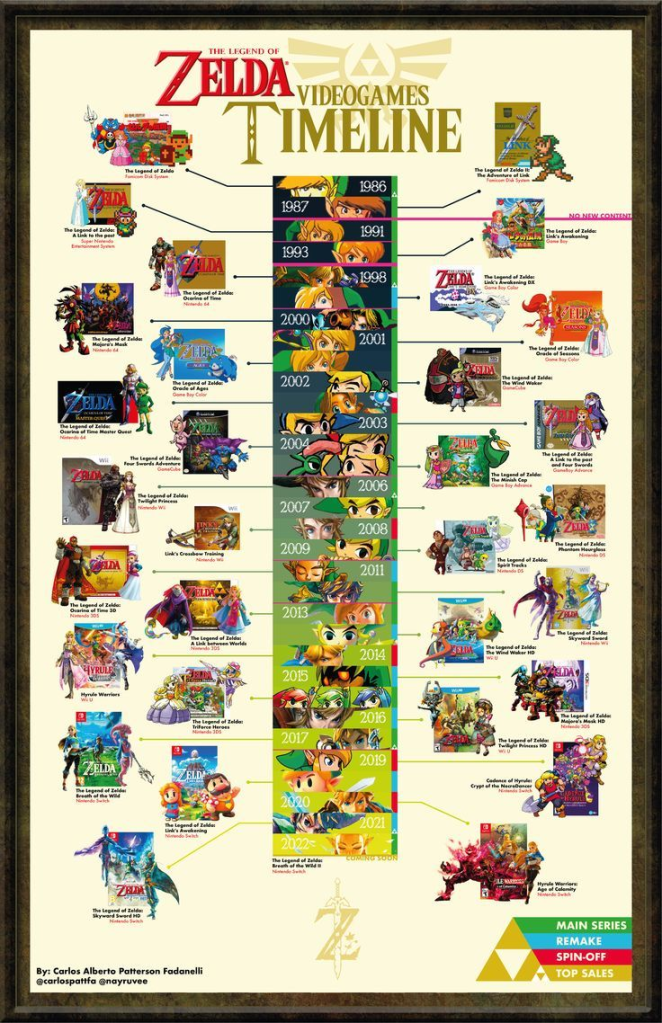
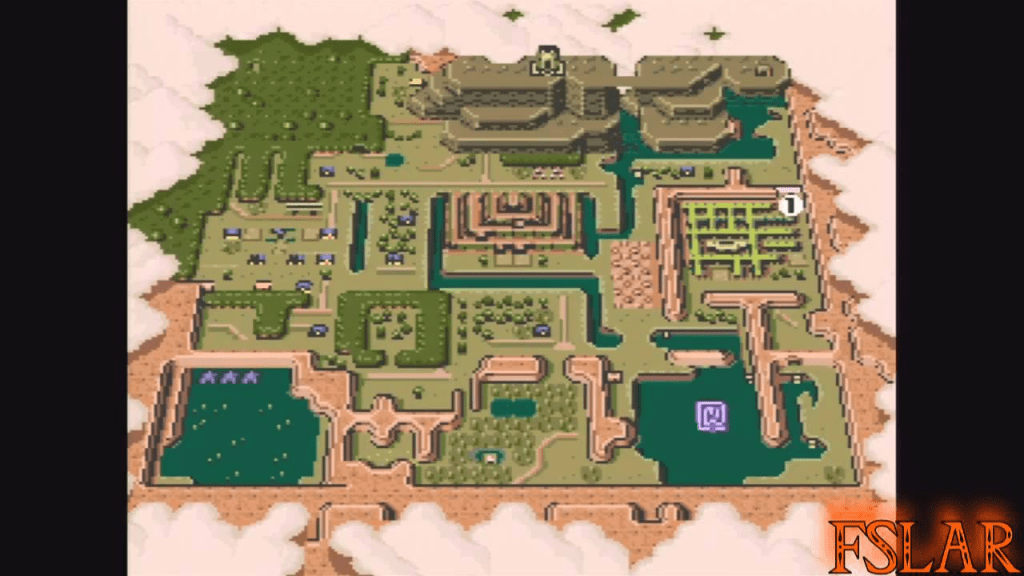
A top-down open world game (The Legend of Zelda, A Link to the Past, A Link Between Worlds)
A side-scrolling action-platformer (Zelda II)
A top-down game combining open-world elements with gated exploration (Link’s Awakening, Oracle of Ages/Seasons, Minish Cap)
A 3D game combining open-world elements with gated exploration (Ocarina of Time, Wind Waker, Twilight Princess, Skyward Sword)
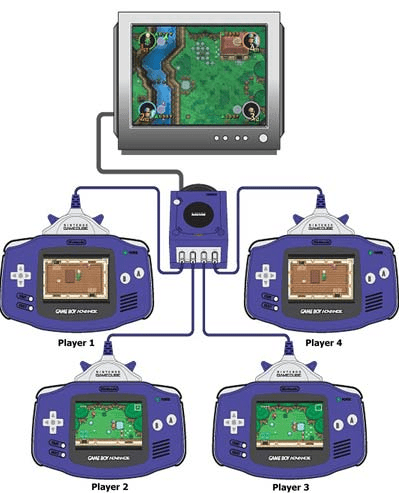
A top-down, mostly-linear co-op game (Four Swords, Four Swords Adventures, TriForce Heroes)
Majora’s Mask (Majora’s Mask)
A 3D open world game (Breath of the Wild, Tears of the Kingdom)
Whatever’s going on with Echoes of Wisdom, and, depending on what we consider “a Zelda game”—Hyrule Warriors, Link’s Crossbow Training, and maybe even Super Smash Brothers (and/or Soul Calibur 2).
Unlike Final Fantasy, Zelda returns to its older iterations and ideas without apology. Where Final Fantasy VII committed the franchise to 3D, Ocarina of Time did not. Some of that is due to Nintendo’s commitment to the handheld formula (like Oracle of Ages/Seasons), but games like Four Swords Adventures, the Link’s Awakening remaster, and Echoes of Wisdom complicate this significantly.
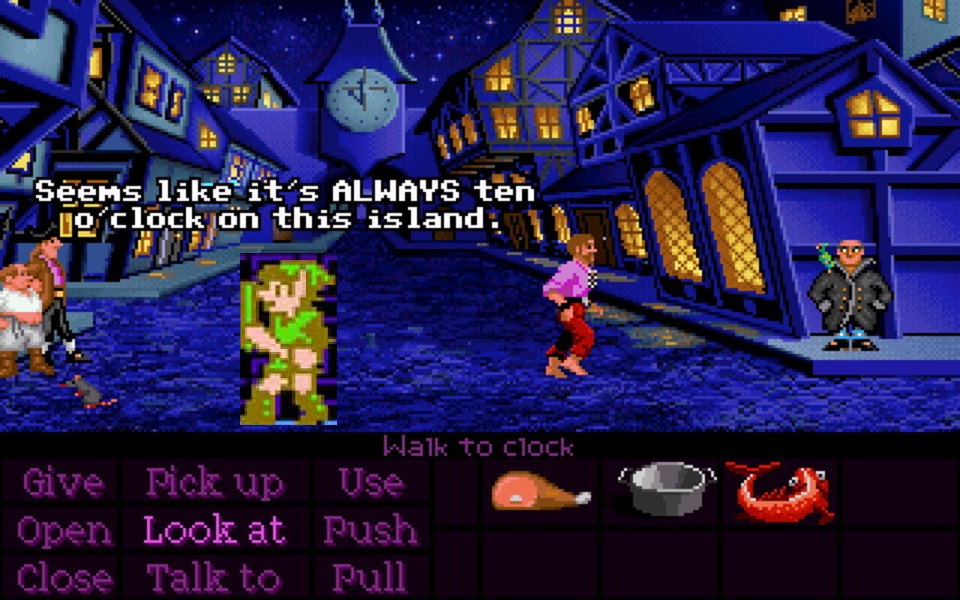
Also complicating this is Nintendo’s own genre nomenclature. For many years, Zelda games were referred to by Nintendo as “adventures”—which could include games like Mario 64 and Donkey Kong 64, but not Super Mario World or Donkey Kong Country (which were, by contrast, “platformers”). And this term is especially unhelpful given that Western gaming has its own “adventure game” genre with games like The Secret of Monkey Island or The 7th Guest or Myst—which has its own ongoing identity crisis. More recently, gamers have started referring to Zelda games as “action” games—which defies Nintendo’s own use of the term (Mega Man and Contra were classically called “action” games by Nintendo—now the term extends to Assassin’s Creed and Grand Theft Auto Switch ports), and which also apparently includes God of War and Devil May Cry, though these are radically different kinds of games (right…?). So for the purposes of this essay, we’re just going to ignore these terms on the grounds that they’re too vague, too broad, and not actually how gamers talk about Zelda at all.
If Zelda has a genre, it’s the genre of “being a Zelda game”—and even that’s subject to change with every new title. Innovation is a critical part of whatever Zelda formula we might postulate, and that innovation is so pervasive and dramatic that we might well wonder whether two Zelda games, set side-by-side, (say, Link’s Awakening and Breath of the Wild) have anything in common at all.
And yet, like the famous judge in the pornography case, we might also say: “I know it when I see it.” There are features that are consistent, like Link’s silence, the high-fantasy open(ish) world, castles and princesses, fantasy races like Gorons, Koroks, and Gerudo, swords and sorceries. There is also an aspiration to quality in Zelda, a tacit promise between Nintendo and the player that these games will be Important, Well-crafted, and Good, in a way that no other gaming franchise has ever consistently reached, except possibly Grand Theft Auto. And the commitment to innovation is, itself, a genre staple, even if it boils down to consistent inconsistency.
This makes for a pretty difficult puzzle. We can’t just dismiss the games as purely genre-less or inconsistent; nor can we easily identify the distinguishing characteristics that make a Zelda game a Zelda game. But if we want to tackle the big questions of taste that divide millennials’ love of Ocarina of Time from Gen Z (and beyond)’s love of Breath of the Wild, we’ll have to figure out some way of understanding these games’ relation to one another, and to the rest of gaming at large.
So let’s make a few experiments, and see how they go.
Genre Experiment #1: TV vs. Handheld
Even the most cursory Zelda fan will see that the top-down 2D games and 3D games compose two parallel lines of Zelda’s development, and should probably be treated as two completely different genres—or at least two different sub-genres under the Zelda umbrella. We millennials are especially sensitive to the distinction, because we remember owning an N64 (and/or Gamecube, Wii, etc.) AND a Game Boy (Advance, DS, etc.) as parallel consoles requiring parallel games. In the age of the Nintendo Switch, where the console you hook up to your TV is the same console you play hand-held, this distinction is rapidly dissolving, but it might be helpful to use the old-school distinction in organizing our Zelda games.
Top-down, 2D Zeldas: The Legend of Zelda, A Link to the Past, Link’s Awakening, Oracle of Ages/Seasons, Phantom Hourglass, etc.
3D Zeldas: Ocarina of Time, Majora’s Mask, Wind Waker, Twilight Princess, Skyward Sword, Breath of the Wild, etc.
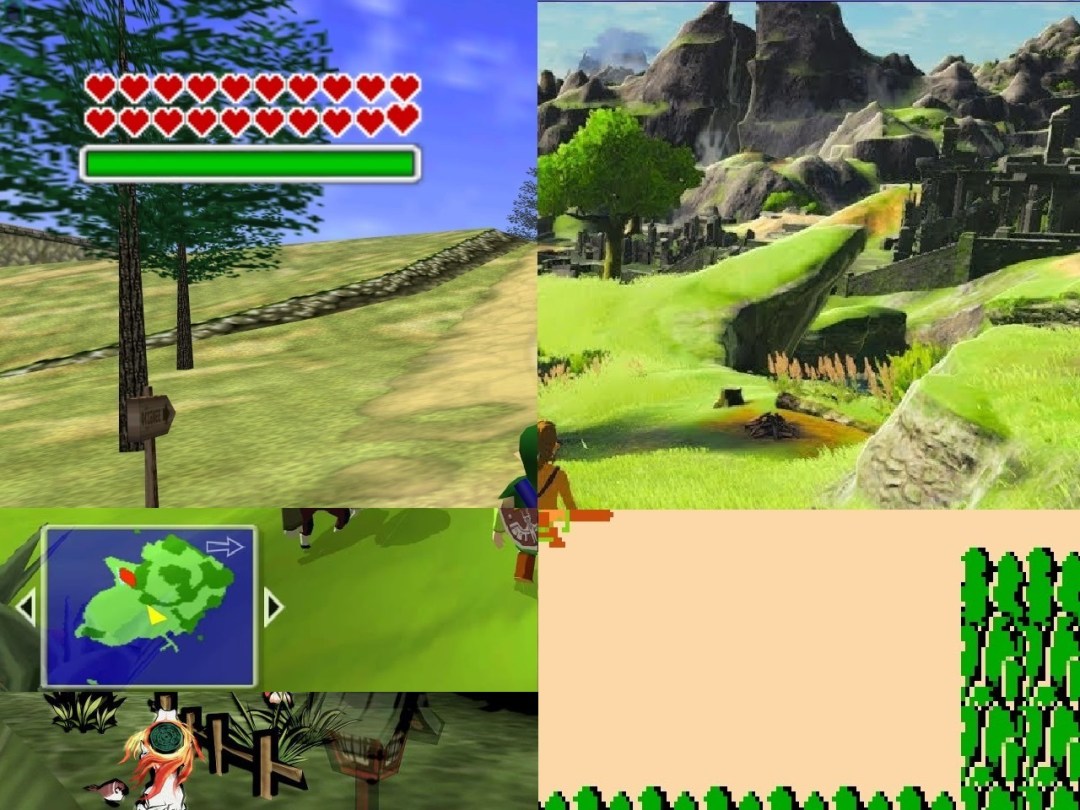
The trouble is that this model, however obvious from an aesthetic standpoint, falls apart pretty quickly when you start looking at the mechanics of the games in each category. The original The Legend of Zelda probably has more in common with Breath of the Wild than any of the other 2D games, just because it is non-linear and doesn’t do much to restrict exploration of its open world. And as much as we might say that this is because Breath of the Wild is a deliberate throwback to the earlier game, this gets complicated when we start to see that the other forays into non-linear, exploration-focused gameplay tend to be scattered across the two genres: A Link to the Past invites the player to complete dungeons out of order; A Link Between Worlds does the same—but some of the most exploration-focused games like Wind Waker and Skyward Sword are much more linear from a storytelling standpoint. The 2D/3D distinction doesn’t tell us much of what we need to know about these games—even before Nintendo started making 3D remasters of 2D games or hybrids like Phantom Hourglass.
Genre Experiment #2: Linear vs. Non-Linear
But that gives us another handle we can use to grab this problem. Clearly exploration and freedom are priorities for the Zelda franchise: can we use them to organize these games?
On some level, all Zelda games are “open-world” to a greater or lesser degree, so let’s put that off until later. For now, we do have another convenient binary for sorting our games.
Are the games linear? Or, to put it another way: Can you complete the dungeons out-of-order?
YES: The Legend of Zelda, A Link Between Worlds, Breath of the Wild, Tears of the Kingdom
Yes (but it’s discouraged or limited): A Link to the Past, Ocarina of Time, Majora’s Mask
NO: Link’s Awakening, Oracle of Ages/Seasons, Wind Waker, Minish Cap, Twilight Princess
This is obviously incomplete, and a bit of a judgement call in some cases. Breath of the Wild will let you explore any dungeon in any order (or skip them altogether), but The Legend of Zelda does require you to pick up certain items in order to reach certain dungeons, even if there is very little guidance or linearity. Meanwhile, A Link to the Past allows you visit many of the Dark World dungeons in any order you like, but there is a clear, intended path, seeing as the dungeons are numbered on the world map. Ocarina of Time will *technically* let you complete the Fire Temple and Water Temple before the Forest Temple, and the Shadow and Spirit Temples in either order, and you can exploit glitches to get to the Shadow Temple early, but the game will urge you into doing the dungeons in order. And I believe you can complete the dungeons in Link’s Awakening out of order, but only if you retrieve the items from each dungeon in order—which doesn’t count, by my reckoning.
I composed this list according to a pretty basic flowchart:
- Does the game REQUIRE you to see certain cutscenes or retrieve items in one dungeon before allowing progress to the next dungeon? If so, you can’t complete dungeons out of order.
- Of the games that don’t, does the game URGE you to complete dungeons in a certain order in a non-mechanical, story or plot-based way? If so, the game discourages you from completing dungeons out of order.
- Otherwise, you are welcome to complete dungeons out of order (or there’s no prescribed order at all).
So it’s not really a binary anymore, but the principle of linear vs. non-linear games proves pretty useful for sorting the games into new categories. But interesting as it is, it’s not especially helpful. We’re trafficking in technicalities here, not some kind of core experience to the Zelda franchise. Half this stuff I had to look up, because as easy as it may be to see that The Legend of Zelda and Breath of the Wild are less linear than Wind Waker and Twilight Princess, the fiddliness of Ocarina of Time or Link’s Awakening about dungeon order isn’t what most people remember about those games. In fact, with Wind Waker and Skyward Sword in particular, both of which have rigorously linear stories and dungeons that must be played in order, players remember their expansive overworlds—which you can explore at any time during the story. So is the linearity of the story really so important, if there’s so much non-linear exploration to do, whenever you feel like it?
We should also note that this non-linear freedom exists in a complicated tension with the games’ efforts to be accessible to new players, and especially children. The freedom to complete dungeons out-of-order stopped being a priority in this franchise right around Link’s Awakening and Ocarina of Time, which is also the same time that Navi—our first ever-present companion character—showed up to explain the world and remind us what we’re supposed to do. Mature gamers tend to hate Navi (and Fi), but I think this is an indication that Nintendo was worried that children would have trouble navigating the 3D space of Ocarina, and remembering what to do in such a complicated game. (And as a little kid who specifically bought the strategy guide for Ocarina, I can say that concern was warranted.) The linear design means less freedom, but it means that the developers at Nintendo have more control over our experience.
This tension between freedom and hand-holding may help us to organize our thoughts going forward, but for now it indicates that the freedom to complete challenges out-of-order is an optional part of the Zelda formula, and not necessarily a core principle of its design. There are other ways Zelda games can offer us freedom—like presenting us with a massive open world to explore at our leisure.
We should, however, note the two major tools Nintendo uses to gate progress and control the player’s experience: the items and the plot. Items make up a clear mechanical barrier that gates off certain parts of the game—you need the Hookshot to cross long gaps, or the Roc’s Feather/Cape to hop over short ones, or the Mirror Shield to pass a flamethrower, or what have you. The plot is less transparently blocking progress, but many of these games will stop you until you’ve completed certain plot-related events all the same. So the more the games prioritize the plot over freedom, the less non-linearity you can expect to find.
That sounds like a couple more binaries to explore…
Genre Experiment #3: Is Zelda a Metroidvania?
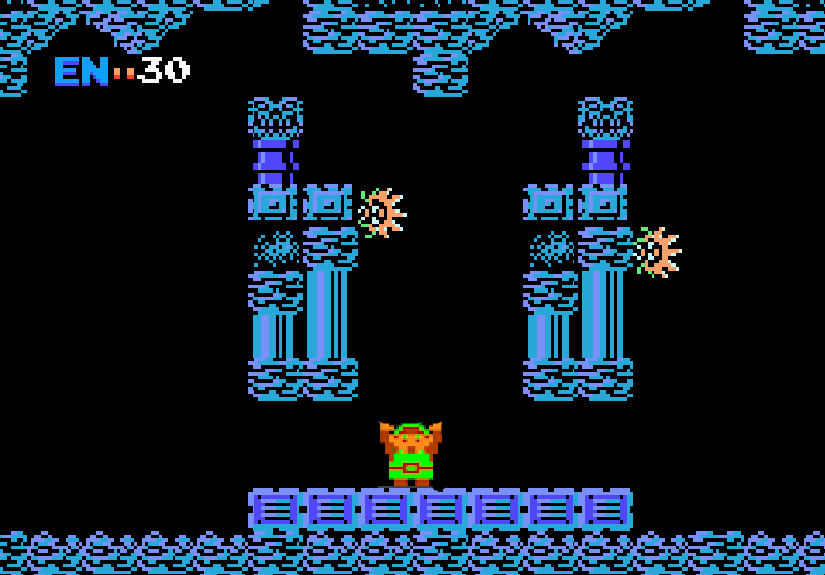
Got your hackles up on that one, did you?
But seriously, let’s look at the basic mechanics.
In a Metroidvania game—take something like Aria of Sorrow or Metroid Prime as an example—progress is gated by a combination of mechanical blocks (that can only be overcome when you’ve attained a certain power or item), and, less-organically, plot blocks (like a door that is inexplicably locked until something happens in the story, or a room that is empty until you fulfill some unknown condition). Metroidvanias tend to be open-world-ish, but these obstacles obstruct progress in the early game, allowing you to access more and more of the world as you unlock more and more items and powers.
I mean, that basically describes every Zelda game up to Breath of the Wild, right? Even the original Legend of Zelda had obstacles you could only cross when you unlocked the raft, or the ladder. And in the post-Link to the Past world of decreasing non-linearity, like Ocarina of Time, Wind Waker, and Twilight Princess, the basic loop of unlocking powers to open up more of the map was pretty identical to how it works in a Metroidvania. (Heck, even Breath of the Wild includes powers that unlock certain areas or approaches to problems, though they are all either mandatory and front-loaded, or optional.)
The major distinction here, of course, is presentation. Metroidvanias are traditionally 2D sidescrolling platformers (like Castlevania, Metroid, or their successors, Symphony of the Night, Super Metroid, etc.). Metroid made the jump to 3D with Metroid Prime, but even then Nintendo was careful to differentiate the franchise from Zelda by setting it in first-person perspective. By contrast, Zelda is usually in top-down 2D (not sidescrolling, though we might have questions about Zelda II), or 3rd person in 3D (with only occasional use of the 1st person, such as aiming).
But this all seems pretty superficial to me. If Nintendo made a Metroid game with a top-down 2D perspective, rather than a sidescroller, but you still upgraded your arm cannon to open certain doors and got special upgrades to jump over gaps in the floor (like the double jump or screw attack), wouldn’t it basically just be a sci-fi themed Zelda game? Or if you made a sidescrolling Zelda game with Link’s usual arsenal of unlockable weapons and powers that you use to progress through the game (like the hookshot, bow, bombs, etc.), wouldn’t it be a Metroidvania?
So in 3D, where the boundaries of the Metroidvania are still rather ill-defined, what is the difference? Either Metroid Prime isn’t a Metroidvania, or Ocarina of Time is.
(For my next trick, we will discuss whether or not Dark Souls is a Metroidvania, and piss off absolutely everyone.)
Look, I know many of you are unconvinced on this one, and that’s fine. These are genre experiments after all, and they’re meant to probe our understanding of the Zelda franchise, our genre expectations, and even our definition of certain genres, as in the case of Metroidvanias. If we really wanted to do this right, we would interrogate what makes a Metroidvania a Metroidvania—but seeing as we’re already busy trying to figure out what makes a Zelda game a Zelda game, that would constitute an unreasonable tangent.
What I mean to say here is that there is a lot of overlap between the two, and that this probably informs our expectations about what a Zelda game should be—especially for us millennials with our understanding of Zelda rooted in Ocarina of Time. Since Ocarina has so much in common with Metroidvanias, while Breath of the Wild distinctly departs from the Metroidvania format, it could be that part of our frustration with the new games comes from the fact that we want our Zelda games to be more Metroidvania-ish—with a distinct, linear set of unlockable items that open up more and more of the game. I don’t want to quibble about the specific parameters of these games and their genres; I want to use our understanding of genre to help us understand what we want from these games.
So let’s just leave it at this: some of us WANT a Metroidvania Zelda.
Genre Experiment #4: The Legend of The Legend of Zelda
How essential is the story to a Zelda game?
I ask this in earnest, because I think I will get different answers from different people.
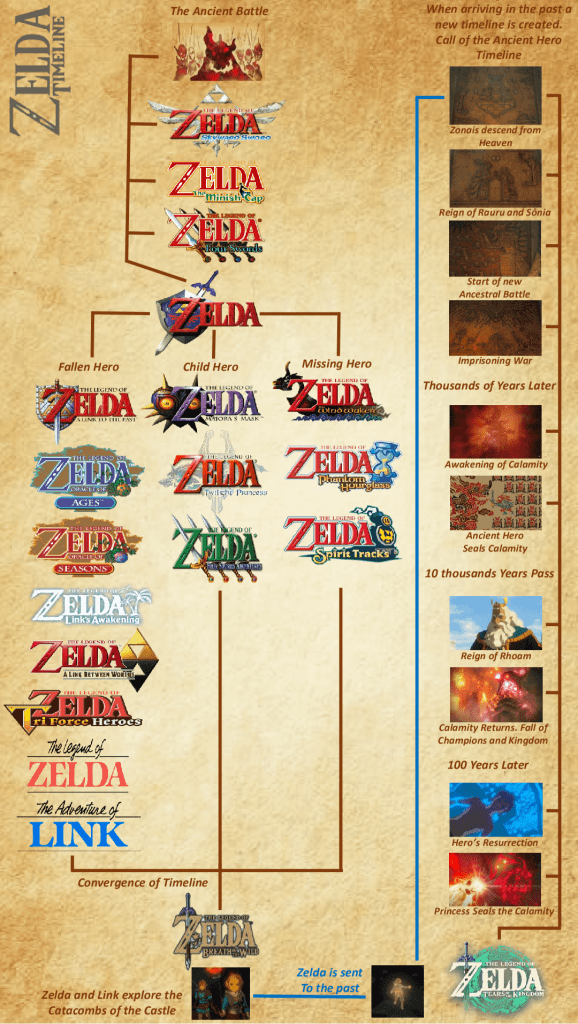
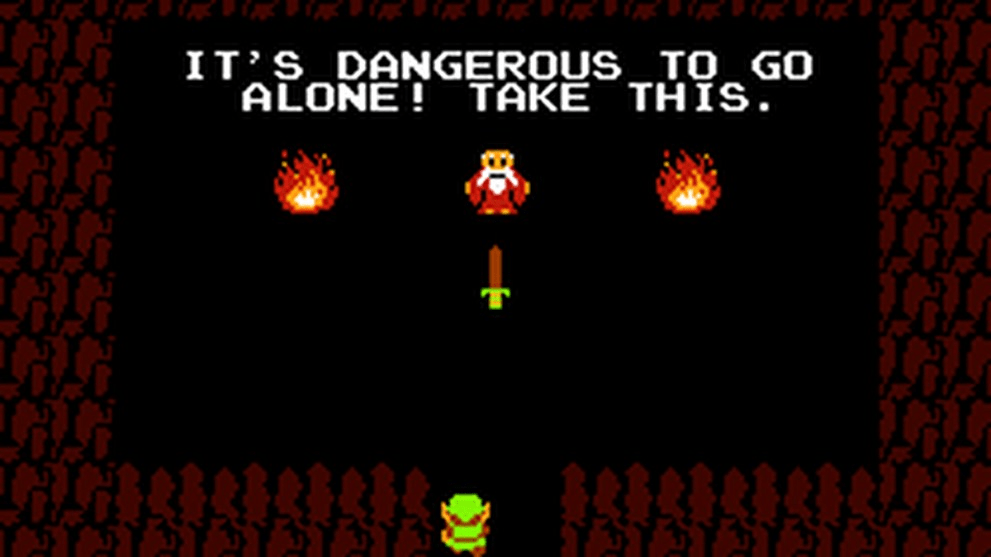
The earliest NES Zelda games had sparse, abstract stories out of necessity—not a lot of room on those little cartridges for anything but the most rudimentary text. The first Zelda game famously gives you a sword because “It’s dangerous to go alone,” and that’s all the setup you get for your epic adventure outside the manual and box art.
A Link to the Past makes a more determined effort on the SNES, with its dramatic princess rescue opening, invasion by Ganon, and transformation of the world map into the Dark World—but even these developments are rather arch and broad. There aren’t really many characters to keep track of, much less personalities and plots. You might meet the occasional funny bit player, like the bed-ridden kid who gives you his bug net since he can’t play outside, but we’re miles away from what Squaresoft is doing with Final Fantasy IV or LucasArts with The Secret of Monkey Island the same year. Nintendo’s priority is squarely on the adventure—the player is offered a pretty boilerplate scenario to justify running around slashing guards and monsters, pillaging dungeons, and collecting a wide variety of powerful items.
But we shouldn’t dismiss any of this. It may be only the one line, but “It’s dangerous to go alone” is memetic and memorable for a reason. The princess rescue during the storm in A Link to the Past’s opening hour is an exciting and tense adventure for the first-time player. These beats may be arch and broad, utterly pedestrian in other media, but they work here specifically because they are arch and broad. It’s the Princess Bride school of mythmaking, where you play the hits straight because some stories just don’t grow old.
And all of this goes triple for Ocarina of Time. I don’t intend for this essay to transform into a love letter to Ocarina of Time—I think we have enough of those already—but I do intend to use the frankly overwhelming evidence provided by all those love letters to argue that this game’s story, however simplistic, hit home for a lot of people my age. We millennials are still fighting over whether Ocarina of Time or Final Fantasy VII is the “greatest game of all time” on forums and websites we frequent (like GameFAQs or Tumblr)—even though the rest of the world has very much moved on, and there are plenty of deserving candidates who could unseat these two kings.
But for Ocarina in particular, it’s hard to say whether it’s really the story that is so important and affecting.
I would argue, instead, that Zelda’s stories are much more about individual moments. The success of a Zelda game’s story has less to do with setup and payoff (though that’s there), or human drama and psychology (though Majora’s Mask has plenty of that), or even the triumphant success at the end of the hero’s journey (though this, too, is necessary to a Zelda game’s success)—but some sort of thematic emotional catharsis that Zelda games manage to consistently capture across their history. When I hear my friends start to gush about Ocarina’s story, there’s a sort of regression into childhood that takes place—and must take place—for the excitement to work. It’s not just that Ganondorf is villainous and intimidating—it’s that he tricked us into opening the Temple of Time for him! Saria and Zelda are our friends, and they needed our help! And the great catharsis at the end of the game is perhaps most telling—Zelda plays the Ocarina so we can be a child again.
The story informs all of this, sure, but more than the details of the plot or the revelations and the reversals is the perspective. Ocarina of Time invites us to inhabit a child’s perspective. Even the narrative text—lines like “you don’t know what he’s talking about…”—lock us into a child’s view, looking up at the world of adults with a certain amount of wonder, trepidation, and distance. And then, when the reversal occurs and we must play as adult Link, the game pulls an even more complicated trick: we are invited to pretend to be an adult. But we’re not. We’re still a child. We play-act adulthood because all the actual adults have messed up the world to a fare-thee-well, and we sacrifice our own innocence to ensure that the world goes the way it’s supposed to go.
And then, in true Tolkienian eucastrophe, we get to go back to being a child at the end. Now that we’ve helped set the world right, it is only proper that we go back to being a child.
This, more than the story, seems to be the enduring allure of Ocarina of Time. It is a game where we will always be a child, and it speaks to some fundamental truth about the millennial (or perhaps the human) condition, where we all feel like we really are just children play-acting adulthood despite how unnatural and inappropriate it feels. And so returning to Ocarina will always feel, in a way, like going home. It is hypercharged nostalgia about nostalgia, harnessing the power of video games to immerse us in its childlike outlook.

Majora’s Mask pulls a similar trick, I think, but it isn’t quite as distilled or focused. We play a child there, too, and often playact as an adult when we put on certain masks—but the masks are more complicated: wearing the Deku mask renders us even more childlike and helpless, while the Goron and Zora masks allow us to put on and take off adulthood whenever we like. But unmasked Link is always an outsider: he doesn’t belong in Termina and never really achieves the sense of community and belonging that he reaches when he, masked, takes on the role of a character who already belongs. Where Ocarina is warm and protective, with all the NPCs (and the sages, specifically) looking out for child-Link playing at adulthood and heroism, Majora is alienating and lonely, the mask of belonging always superficial, false, and temporary—and thus a keener reminder of how truly alone Link actually is.
Needless to say, while many (myself included) love Majora’s Mask, it does not evoke the same sense of nostalgic loyalty that Ocarina does.
And the games that follow…don’t.
Wind Waker does a lot to drive home Link’s child-ness, what with the tearful departure from Grandma and Outset Island, but Link’s expressiveness renders him more of a character than a blank-slate-player-avatar like Ocarina Link. Twilight Princess actually works at making Link an adult, and a contributing member of society, with his opening-scene herding minigames and obvious sense of responsibility right at the start. Link in Twilight Princess is, quite firmly, an adult in an adult world, with adult responsibilities. And Skyward Sword is…unfocused, I think.
But while these games don’t necessarily provide as powerful a perspective, they often come up with something much closer to a traditional story. Wind Waker’s parable of a flooded Hyrule ultimately sacrificed by a repentant King is heady, powerful stuff—but Link is just a witness to the cosmic competition between the King of Red Lions and Ganondorf. Twilight Princess has a similar relationship to Midna, where the relationship between Link and Midna has an actual arc—however truncated by the midpoint of the game. And Skyward Sword is doing a whole lot of narrative scaffolding to support a more interconnected canon between the existing Zelda games—to mixed success.
Some of these story beats are really powerful and well-executed, but I think we appreciate them aesthetically, rather than the visceral self-identification that I see when people talk about their experiences in Ocarina.
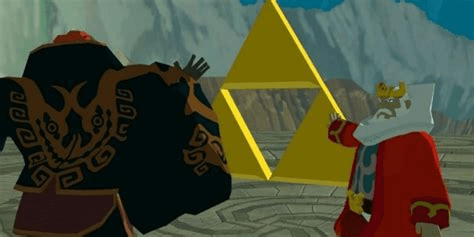
But I think this distance from the story, which Wind Waker and Twilight Princess pioneered, reaches its natural endpoint in Breath of the Wild—where Ganon is nothing more than a cipher and a plot device, and the story basically ended before the game begins, with only that last battle before the credits roll (one hundred hours later…). Like that one-line setup in the first Legend of Zelda, it gives us a reason to explore the world, and then lets us get on with it. And I think it works reasonably well.
But for those of us who still remember Ganondorf as that jerk who tried to kidnap Zelda back in Ocarina, there is something very anticlimactic about all this. We hated that guy, on a deep, personal level—because he personally hurt us. But here in Breath of the Wild he’s as much an abstraction as Ultimecia or Necron from Final Fantasy VIII and IX.
So I ask again: How essential is the story to a Zelda game?
I would point out that there have been plenty of Zelda games that don’t prioritize story much at all—due to hardware constraints, disinterest, or some combination of the two. I would argue that the Zelda games we most revere aren’t so much story-driven as vibes- or feeling-driven: we don’t want to re-experience the story per se, but the feeling of being a child again, or the feeling the story evokes in us. And as much as that’s a fuzzy distinction, it’s pretty clear when you compare the experience of playing Ocarina of Time against playing the Starcraft campaign, or Final Fantasy Tactics, or Dragon Age, where the story really is the key focus of the game.
I would say that the best Zelda stories are the ones that yield the best moments. By which I mean that most of the hard work done by the story tends to be invisible, or unnoticed, up to the point that the payoff and catharsis really hits home for us as players. But where Ocarina tries to reach those moments through a scripted story with cutscenes and player direction, Breath of the Wild tries to reach those moments through unscripted mechanical interactions with the world. And I don’t think either approach is necessarily more or less valid than the other. Listening to my nephews explain their Breath of the Wild exploits with breathless excitement isn’t that far removed from listening to Millennials reminiscing about the cutscenes or boss fights or plot beats of Ocarina, after all.
Genre Experiment #5: Exploring Exploration
The story goes that Shigeru Miyamoto was originally inspired by his childhood adventures roaming the Japanese countryside and exploring local caves when he made the first Legend of Zelda. And, consequently, we’d be insane not to consider the importance of exploration to the fabric of the game and whatever genre it might belong to.
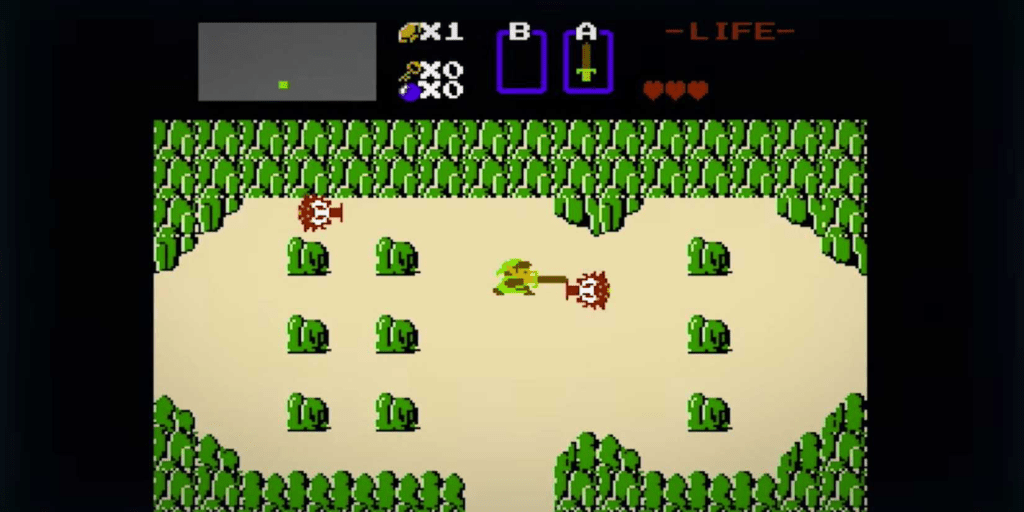
But this is tricky. All of the long-running first-party Nintendo games are, more or less, about exploration. Metroid is a game about exploration. Mario, however linear, is about exploration insofar as it is about finding secret powerups and shortcuts and exploits—and that can be extended to Starfox as well with only a little bit of adjustment. But I think it’s easy to see that Metroid and Zelda lie in one camp by virtue of allowing (and necessitating) backtracking, where Starfox and Mario (at least in their original iterations) did not. In the original Mario Bros., the screen could only move right; in the original Starfox, your Arwing could only ever move forward. Whatever lay to the left (or behind) is lost; only by replaying the game could you revisit those areas.
But “exploration” covers a lot of ground in video games. Plenty of games allow you to backtrack without really being about exploration. Most PC adventure games of the early 1990s indifferently featured exploration: Myst and Zork were clearly exploration-focused, along with the genre’s namesake, Colossal Cave Adventure, while The Secret of Monkey Island and The 7th Guest tended to be more about solving puzzles or problems. And none of these are quite akin to any of the Zelda games, even though Zelda features both spatial exploration and a bunch of puzzles and problems barring progress.
So if we want to talk intelligently about exploration in Zelda games, we’re necessarily going to have to talk about kinds of exploration, and not just the blanket term. In some ways, I expect everything in Zelda comes back to exploration of one kind or another, but the relationship between these kinds may seem so subtle as to be indistinguishable. So let’s jump in.
#1: Spatial Exploration
In Zelda games, there is a space, and you have to explore it.
This seems simple enough, but let’s talk about execution.
In The Legend of Zelda, along with the top-down 2D games, this means a (mostly) flat set of screens arranged on a two-dimensional grid, with possible exits to North, South, East, and West (North = top). There are barriers to progress that must be overcome using specific items, or by triggering certain events (like going on a date with Marin in Link’s Awakening to get the walrus to stop blocking the road; Link’s Awakening can get weird…). By exploring the map, you get access to more areas with their own dungeons, secrets, and powerups—so it is always to your advantage to open up as much of the map as you can. This translates pretty directly to the 3D space, so I don’t think I need to explain it here. Breath of the Wild could be considered an exception, since you can theoretically explore the whole map as soon as you finish the tutorial, but even Breath of the Wild won’t let you access the Divine Beasts until you’ve fulfilled their related quests, and some areas of the map are strategically gated by mechanical obstructions (high walls, cliffs, or flying areas) until you figure out how to overcome these obstacles.
#2: Secrets
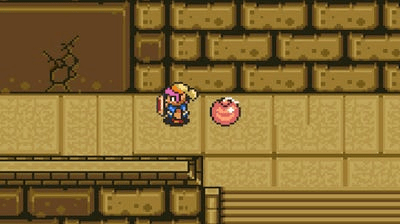
As early as The Legend of Zelda there were bomb-able walls and burnable trees that concealed hidden grottos. Once you find one of these grottos, you’ll likely get cool powerups—like heart pieces, rupees, ammunition, or other bonuses. In The Legend of Zelda, these are rarely signposted, but later games like A Link to the Past might clue you in to a secret (like a bulging wall) before you could access it (i.e., before you unlock the bombs). The player is encouraged, therefore, to come back to these suspicious areas once they’ve unlocked other items or abilities and explore the secret area. Which brings us, quite naturally, to:
#3: Items
Up until Breath of the Wild (and, to a lesser degree, A Link Between Worlds), there is a pretty basic gameplay loop that every Zelda knows by heart.
As you explore the map, you discover items that empower you, which allows you to explore more of the map, which allows you to find more items: wash, rinse, repeat.
You can’t cross the river in The Legend of Zelda until you get the raft; Milo won’t let you see the Deku Tree until you find a sword and shield; you can’t cross the ocean in Wind Waker until you learn how to command the wind.
This dynamic is, on the one hand, why Zelda games seem akin to Metroidvania games; but it is also one of the key things that distinguishes the two, namely:
#4: Mechanical Exploration
In Western gaming circles, the term “immersive sim” became popular as a descriptor for certain first-person games like Thief: The Dark Project and Deus Ex right around the same time as Ocarina of Time and Majora’s Mask were getting popular. The thinking was that “immersive sims” were different from your usual run-and-gun FPS (like Doom or Quake) because “immersive sims” had a consistent set of rules that governed the world and allowed you to craft your own solutions to in-game problems. You could sneak past enemies rather than shoot them, dismantle (or trap) alarms to prevent enemies from summoning reinforcements, set mines along guards’ predictable patrol routes, and find alternative routes to your objectives, rather than shooting everything in your path.
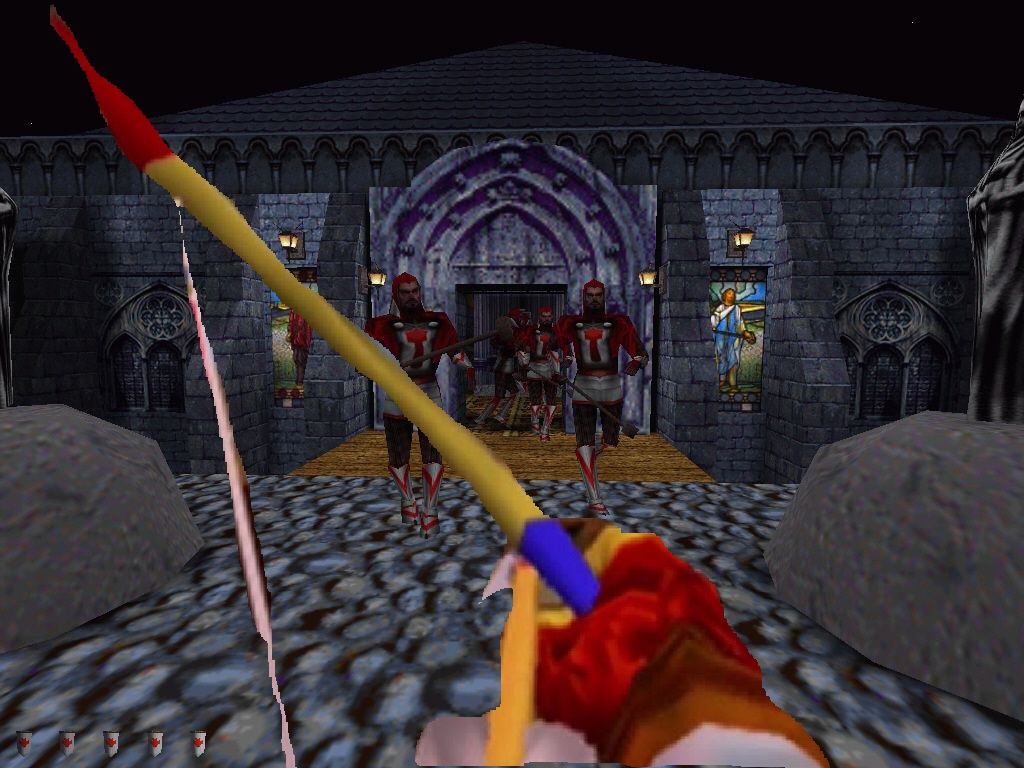
I don’t think anyone would (or should) call Zelda an “immersive sim,” but applying the genre conventions of the “immersive sim” to Zelda yields some interesting similarities.
Even as early as The Legend of Zelda, there is an attempt at building a world with predictable, logical rules that the player can exploit to their advantage. These tend to be very simple: bombs can be employed as weapons, but can also be used to reveal caves in walls. Enemies cannot travel from screen to screen, and can thus be evaded rather than fought.
By A Link to the Past, these rules begin to grow more sophisticated. Enemies have predictable patrol routes, so you can avoid them when you are first sneaking into Hyrule castle. Both you and enemies can fall into pits, so many dungeon combat encounters rely on careful combat positioning. Most of your items have a clear puzzle-solving purpose (like shooting targets with the bow or hookshot), but also have a clear combat function (the hookshot freezes enemies and knocks them back, or draws one of you toward the other).
As the series grows more and more sophisticated, with 3D environments and higher-fidelity graphics, there is a clear effort to make these mechanics complicated and engaging in their own right. In Ocarina of Time, burning bats can destroy your wooden shield, and bats will set fire to themselves if there are torches in the room. In Wind Waker, you can trick enemy ships into firing on one another with sneaky sailing.
And by Breath of the Wild and Tears of the Kingdom, you have a massive set of interlocking “immersive sim”-style rules about fire, water, electricity, momentum, and enemy behavior that you can exploit to your advantage. As the series goes on, it seems like the games are less and less interested in bespoke puzzles with hidden solutions, and more interested in giving the player a wide variety of tools that they can use to creatively solve problems however they like.
This is not really a feature of Metroidvanias, where puzzles (what few there are) tend to have straightforward (hit the boss many times) or bespoke (open purple doors with the wave beam) solutions. Castlevania and Metroid games may offer the player a variety of powers and abilities, but they are usually only different ways of dealing damage to enemies, rather than dramatically affecting the environment or enemy behavior in interesting ways. Only in the Metroid Prime games do we start to see this in the Metroid franchise, and only as a result of the move to 3D.
Honestly, puzzles are pretty rare in Metroidvanias on the whole. Which reminds me…
#5 Puzzles
Though the original Legend of Zelda had only the most rudimentary puzzles (i.e., the door to the dungeon will only unlock after you defeat all the enemies and move one of the blocks a certain way), puzzles, and especially puzzles in dungeons, became a staple of the series after A Link to the Past. But we probably need to break these down into sub-categories, since these puzzles can test a number of different skills.
#5.1 Combat Challenges
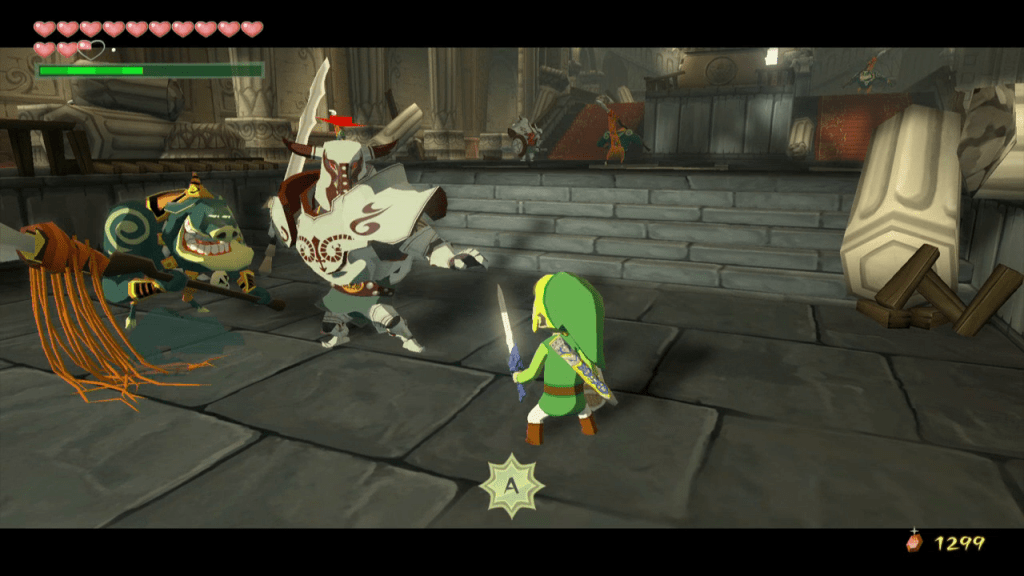
It might seem weird to call combat a puzzle, but since Zelda games typically want you using your items in battle to cause different effects, it seems silly not to include them. Especially since many enemies can only be defeated with certain items, or are especially vulnerable to certain elements—which means that combat is as often a tactical challenge as a test of reflexes, speed, and nerve. Walking into a new room in a dungeon and finding an especially tricky selection of enemies waiting for you (a favorite move of Wind Waker and some of Breath of the Wild’s combat challenges) should count as a puzzle, I think.
#5.2 “Get Out of the Room” Puzzles
For all we’ve talked about Zelda having characteristics of the “immersive sim”, with its real-world-logic and creative solutions to problems, we can’t help but note that Zelda will often stick you in a locked room with no explanation and expect you to do some particular action to let yourself out. Maybe you have to light a torch. Or maybe you have to move a certain block. Or maybe you have to press down a switch. Later games try to make this more obvious (like Wind Waker with its vine-wires leading to doors), but there is a long tradition in Zelda of doing an unrelated thing to get the door to open.
It’s rare, though, that the game hasn’t prepared you for it. As much as we tend to think of Zelda dungeons as final challenges, they function just as well as tutorials, especially when there’s some cool new item stashed in the dungeon somewhere. For example, in the room where you find the slingshot in Ocarina of Time, you can’t get to the exit door without shooting the ladder suspended above it with the slingshot. (Essentially, the game tests you as soon as you get the new tool.) Then, you’ll be expected to use it on the vine-crawling skulltullas outside the room in order to climb up to the next floor. And the boss fight functions as a kind of live-fire final exam—you’ll be expected to shoot Gohma’s eye while she crawls around on the ceiling of the boss chamber. (Because, again, combat challenges are puzzles, too.)
So when you walk into some random locked room and can’t find a way out, even the most inexperienced Zelda player will start fiddling with the stuff in the room—pushing blocks around, lighting torches, shooting suspicious doodads with arrows, bombing suspicious-looking walls—in an attempt to get the door to open. It’s worth remembering that this is kind of weird and unintuitive, but it’s worth remembering that it works, too.
#5.3 “Where Do I Go Next” Puzzles (Navigation Puzzles)
This is essentially an iteration on the “spatial exploration” idea we discussed before, but we should distinguish between the act of wandering around unimpeded for the sake of familiarizing yourself with the area, and the business of actually understanding the area well enough to know where to go next and how to get there.
On the overworld, this can be as simple as remembering where that one gap in the ground was, so you can come back to it once you unlock the roc’s feather, or hookshot, or what have you, and open up a new area.
In a dungeon, this can be as complicated as building a mental map of the dungeon so you can choose when to use keys or remember what doors you haven’t opened, or what rooms you haven’t explored. In some cases, this requires a good sense of spatial awareness—some 2D Zelda dungeons will ask you to strategically fall to the floor below so you can land in a previously inaccessible space. In 3D Zelda dungeons, this requires less imagination than observation (think of the puzzle in the Deku Tree in Ocarina where you have to jump into the spiderweb in the center of the primary chamber). Most Zelda dungeons are an exploration activity in microcosm, laid out by the developers with their own arcs of combat, puzzle-solving, setup and payoff.
This is also a key component of Metroidvania exploration, and while Metroidvanias usually lack proper dungeons, many include these sorts of maps-in-microcosm, where you’ll be locked out of prior areas until you navigate one particular section of the map, or where all progress is semi-linear until you beat the local boss. I mention this because I think it is growing clear that Zelda games include many of the elements that make up other genres (like Metroidvania, or immersive sims), and combine them in unusual ways to create their own hybrid genre of sorts. Or, since Zelda predates many of these genres, we could just as easily argue that Metroidvania and immersive sims are borrowing components of Zelda games, isolating them from the rest of the Zelda formula, and iterating on these particular activities or gameplay patterns, perfecting them in isolation to create a more limited, focused experience (though often no less compelling).
#5.4 Puzzle-Box Dungeons
I’m borrowing a lot of ideas here from Mark Brown’s Boss Keys series, though I’m trying to contextualize them differently.
This one I’m just going to steal. (With respect…)
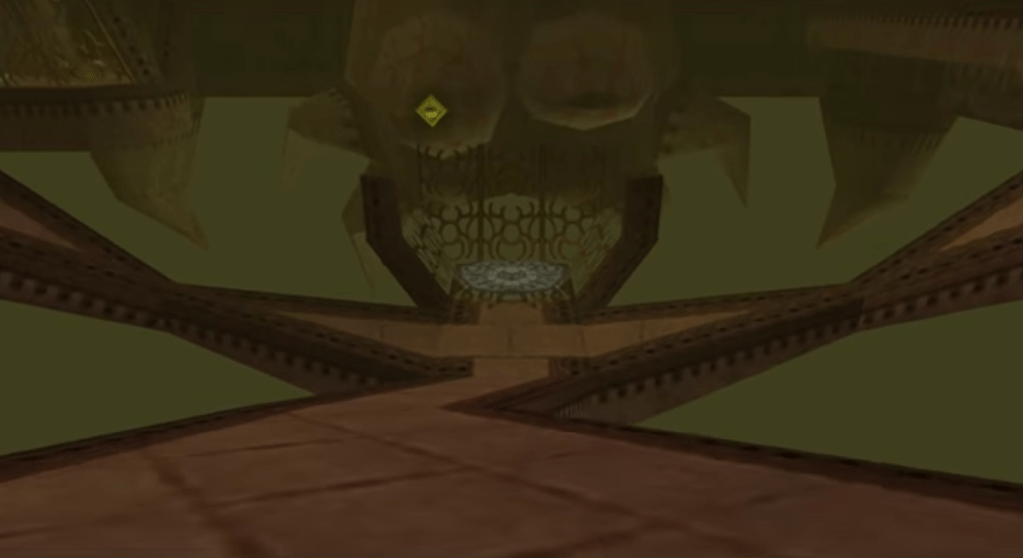
Some of the most memorable Zelda dungeons revolve around a global puzzle of some kind. In Link’s Awakening, the player must knock out the pillars of Eagle’s Tower to cause the top floors to collapse onto the floors below, reorganizing the rooms. Ocarina’s infamous Water Temple requires the player to adjust the water level to three possible settings—each of which cuts off access to some areas while opening access to others. Majora’s Mask includes one of my all-time favorite dungeons, the Stone Tower Temple, which must be flipped upside-down to access certain areas. And this extends all the way to Breath of the Wild’s Divine Beasts, each of which features some similar global effect, like tilting the wings of a bird, raising the trunk of an elephant, or rotating the belly-chambers of a camel (they don’t all have to make sense).
These are spatial awareness puzzles on steroids—beyond simply unlocking doors with keys, backtracking to remembered areas, or using your items to solve puzzles, these dungeons require you to seriously understand the layout of the dungeon and how to navigate these spaces under the changing conditions. These could be the most sophisticated tests of exploration in the franchise—if not in the whole history of gaming—insofar as these sorts of puzzles combine spatial exploration, navigational exploration, and mechanical exploration. And, in some cases, one more important piece of the Zelda puzzle:
#5.5/6 Temporal Exploration
I’m going to cheat and list this as both a puzzle and a form of exploration in its own right, since many puzzles across the Zelda games require you to manipulate time, but manipulating time can also be used for a variety of reasons outside traditional puzzles. Just as spatial exploration applied to the overworld as well as specific puzzles, so should exploring the effects of time.
I would argue that A Link to the Past was the first Zelda game to incorporate time-manipulation mechanics. Even though that game frames this as the Light/Dark World, the seven-year time jump in Ocarina of Time works in much the same way mechanically. In both cases, changing one world influences events in the other, and the player must recognize and anticipate the effects of their actions.
But this goes into whole new directions with Majora’s Mask and its NPC schedules, time-loop gameplay, and ever-ticking clock. Where “temporal exploration” in Ocarina is limited to seeing how changes to the past affect the future, Majora’s Mask will force you to choose branching paths across its repeating three-day period, to make sure you perform (or don’t perform) certain actions earlier in the week to ensure desired outcomes later. It’s one of the most sophisticated systems for exploration I’ve seen in gaming, and only a select few games have successfully iterated on this formula (like the mystery adventure game Lucifer Within Us, or the impeccable time-loop exploration game Outer Wilds). Even later Zelda games didn’t try to duplicate it.
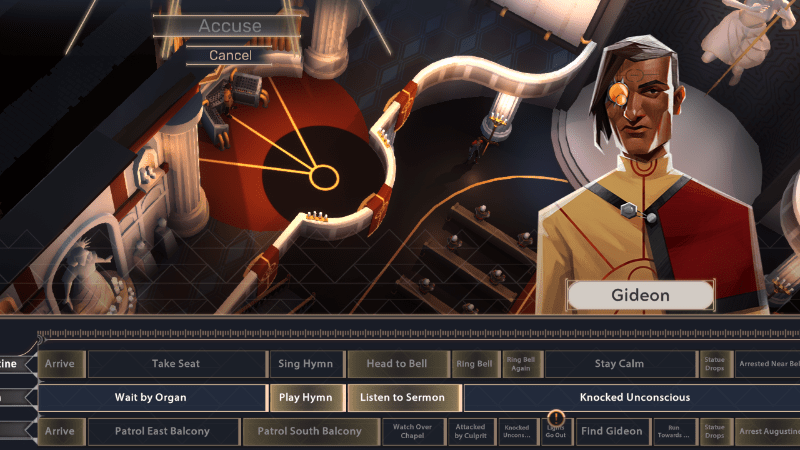
The past/future dynamic of Ocarina also made a brief and underrated appearance in Oracle of Ages, while Oracle of Seasons iterated on this idea by giving you the ability to change the overworld map to any one of the four seasons, with significant changes to the layout as a result. Twilight Princess revisited the idea of the light/dark world, though there weren’t many puzzles using the mechanic, as I recall. And, of course, Minish Cap changed this formula to a normal/miniature world, which was a nice twist on the “two-worlds” idea. And much as I’ve been ragging on Skyward Sword this whole essay, I have to give it credit for doing some really cool puzzle design with the past/future dynamic, which goes from being a binary state to a localized effect that can be toggled in a whole room, certain parts of the room, or even a whole dungeon, with interesting consequences.
Whether or not these puzzles and states are framed as changes in time, the basic concept is consistent: the world is subject to multiple player-controlled states, changes made in one state will affect changes in others, and the player must explore the space not just by wandering around in it, but by figuring out and controlling these actions and consequences to make progress in the game.
#7 Social Exploration
I’m going to include this here with the caveat that this, like our discussion of immersive sims, is better informed by comparison with other games.
Interactions with NPCs in Zelda games tend to be pretty limited and functional. NPCs will sell you items, give you rewards, assign quests, or attack you. Compared to the complicated dialogue trees of contemporaneous CRPGs like Baldur’s Gate, Planescape: Torment, or Morrowind, Zelda’s pseudo-social interactions are downright rudimentary. You can’t manage NPCs’ dispositions like in Morrowind, or offend someone beyond reconciliation like in Planescape: Torment, or make morally-fraught decisions that alienate or endear you to your party members, like in Mass Effect.
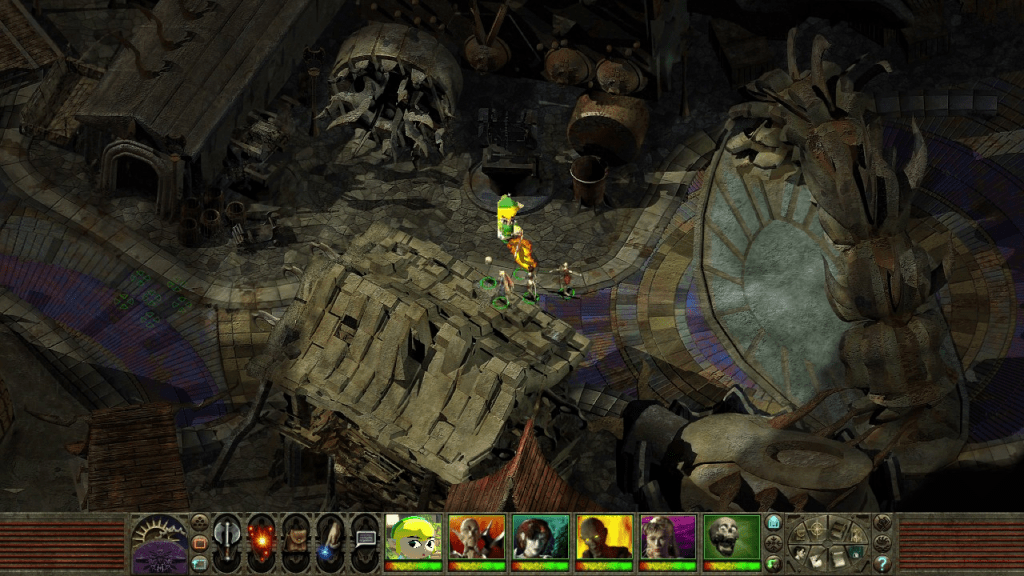
But many Zelda games do feature a quest chain about trading, whether it’s the path to the Boomerang in Link’s Awakening, or the Biggoron’s Sword in Ocarina of Time, or populating a whole dang town in Breath of the Wild. In each of these quests, the game expects you to know and understand the roles of the various NPCs in the community, and find the right next person in the quest chain, often with very little prompting. As often as not, the player can stumble across these connections by dumb luck or brute force (just talk to EVERYONE), but the astute and observant player (or the one who looks it up online) can deduce the best person to talk to based on their insights into character relationships, or their social roles, or by remembering previous conversations.
And, again, there’s Majora’s Mask, with its wildly complicated interlocking NPC schedules. It might be an outlier to the franchise, but it builds on the precedent set by these trading chains, and should be part of our discussion.
But now that we’re talking about outliers and rare cases, that’s probably a good indication that we’ve exhausted (finally) our list of different ways that Zelda encourages players to explore. This might not be a totally comprehensive list, and your organization may vary, but it should be a good working taxonomy.
So what does it tell us?
First and foremost, that Zelda is interested in many different kinds of exploration, that these kinds are often interrelated in subtle and complicated ways, and that the games can change up the mysteries, puzzles, combat encounters, and dungeon layouts in a multitude of ways for the sake of pacing, storytelling, challenge, or whatever else is going on.
Second, for all the painstaking categorization I’m doing here, we should also recognize that this is an unnatural classification. Your average Zelda dungeon (or overworld map area, for that matter) will feature many of these at once, overlapping and contrasting in interesting ways.
Take, for example, the Lost Woods in Ocarina of Time. You can stumble into the Lost Woods very early in the game, though you’ll almost certainly get lost (as the name would suggest). The first time you’re supposed to go there, looking for Saria, you’ll encounter a wide variety of these exploratory activities: new enemies like the skull kids or the deku scrubs carefully positioned around blind corridors; you can wander off the path to find hidden grottoes with rupee stashes or deku merchants selling items; there’s a slingshot puzzle and two ocarina puzzles, all of which have valuable rewards like pieces of heart or a upgraded slingshot pouch; the navigation itself is a puzzle, as you have to figure out where Saria’s music is coming from and follow it to the Sacred Forest Meadow; there are bean sprout locations which you can revisit as adult link to reach secret areas; and there are even secret shortcuts to the Goron Village and the Zora Fountain which you can use to fast travel across the overworld. This is a dense location, and the player must discover all of these things for themselves by exploring, testing, and tinkering. And that’s all before you come back as an adult with the hookshot, where you’ll find new enemies stalking the narrow corridors of the Sacred Forest Meadow, and the entrance to the Forest Temple, which Saria teases to your childhood self on your first visit to the location. The story, the spatial and temporal mechanics, item puzzles and rewards—all converge here in this one location.
And, from the point of view of the first-time-player, this is all new. This is all mysterious. I can list details until I’m blue in the face, but it’s essentially just missing the Lost Woods for the trees. Walk into the Lost Woods for the first time and you’ll just have no idea what’s going on. You won’t know why the game keeps kicking you back to the beginning of the area, or how to interact with the flute-playing skull kid, or how to get into the doorway blocked by boulders. Every one of these things is just a mystery to be unraveled and understood—a new puzzle to solve and explore. To say that Zelda is about “exploration” is more pat than descriptive. As with the story, the feeling is more important than the components needed to evoke it.
“Exploration” is about the experience of awe, wonder, discovery, mystery, and the joy of making sense out of the unknown. And Zelda games routinely deliver these things, game after game, for forty years. Let’s not lose sight of that remarkable track record.
Genre Experiment #6: The Zelda Aesthetic
Let’s make some more people angry, shall we?
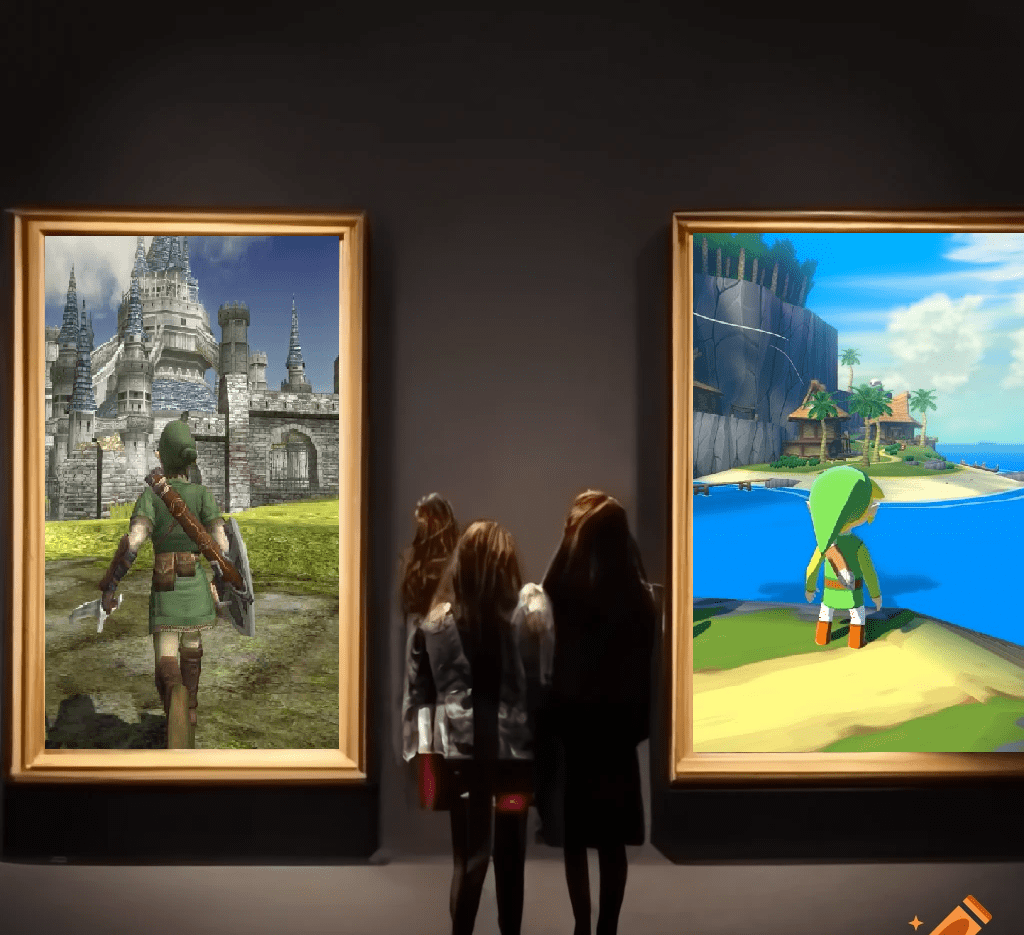
In my experience, there’s no faster way to rile up a fandom than starting an argument about aesthetics. Aesthetics involve superficial elements of a work—genre, art style, sound design, tone, etc.—and thus is something we can immediately notice and appreciate (for better or worse). Since everyone immediately notices and appreciates any changes to these things, we often have strong opinions about them, and those opinions tend to be almost totally subjective. We usually don’t like to admit that those opinions are subjective, though (since we feel so strongly about them), so we concoct any number of nonsense explanations to justify ourselves, cloaking our taste in pseudo-rationality—which further derails our discussions.
Worse, a lot of a game’s aesthetic comes down to tone, which is a more holistic aesthetic feel than a simple addition of elements, and toneis both immediately noticeable AND very difficult to talk about. “It feels wrong,” is an appropriate critique, but requires a lot of technical unpacking and tends to be rather difficult when tempers are heated or you’re having a debate online.
Case in point: when Wind Waker first came out, sporting its cel-shaded, cartoony aesthetic, Zelda fans threw a fit. Zelda was, in the eyes of many gamers of the time, the “adult” alternative to the obviously kid-friendly Mario, and this shift toward a kid-friendly aesthetic made a lot of pre-teen, teen, and young adult Zelda fans a bit self-conscious about the fact that they were playing a video game for little kids. Majora’s Mask was a dark, serious game for serious gamers; Wind Waker betrayed that “serious gamer” self-image. Which is almost certainly why Twilight Princess course-corrected back toward Majora’s darker, serious-fantasy aesthetic and tone. (Phantom Hourglass and Spirit Tracks would return to the Wind Waker aesthetic, though, since it was less resource-intensive and suited the DS games nicely.)
Now you might well question: Why are gamers getting mad about a game series whose most famous and beloved entry, Ocarina of Time, is literally about being a kid and being able to go back to being a kid, choosing to adopt a more kid-friendly aesthetic?
This is why aesthetic is important, and often controversial. Ocarina’s themes are imbibed without the average gamer noticing, but the aesthetic is immediate and unavoidable. Ocarina may have been about being a kid, but Link still got to be a super-cool adult badass with a sword, slaying Ganon in a badass climactic showdown. Wind Waker leaned into the silliness of the Zelda premise, saddling players with a character who stumbled, fumbled, and bumbled his way through the plot, at best a surprisingly competent goofball rather than a straight-up badass.
But let’s back up a bit. If we start this discussion by trying to unpack the reactions to Wind Waker, we’ll be here all day.
Let’s start with the obvious.
Zelda games employ a wide multitude of aesthetics across the franchise’s history.
Some of this is by necessity. It’s not that much of an exaggeration to say that the original Legend of Zelda’s aesthetic is: “this is what fits on the NES cartridge.” Likewise, the Game Boy games like Link’s Awakening and Oracle of Ages/Seasons are similarly limited by the restrictions of the console.
Other choices are expedient. Breath of the Wild uses a lot of tall towers on its landscape because they can be easily seen from a long distance away and they provide implicit landmarks and guideposts to the player.
But even within these limitations, some clear choices have been made to distinguish the Zelda games from other franchises, and from one another.
From its inception, The Legend of Zelda was set in a Western Medieval fantasy setting. Link wields something closer to a broadsword than a katana. The castles and dungeons of the original game resemble the architecture of British fortifications, not Sengoku jidai architecture.
However, Ganon and his minions resemble pig-demons, which imply, however gently, that they are an organized army (supplemented by the grab bag of boss designs in the original Legend of Zelda), but also likely work as a way to unite Western and Eastern mythological traditions—pig demons have precedents in Chinese and Japanese mythology, while the pig is an unclean animal in Abrahamic traditions.
There’s a lot of subtext we could examine about these differing traditions in Zelda games, but I’m less interested in interpreting the meaning here than seeing how that tradition shifts over time.
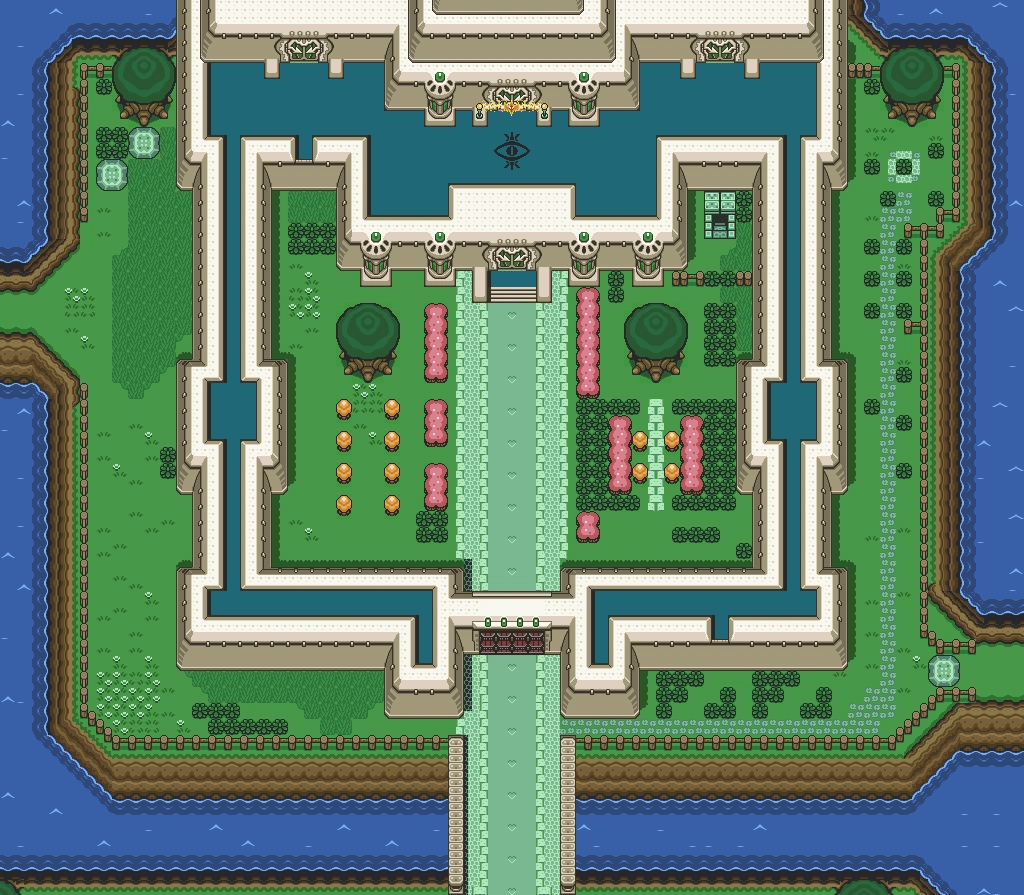
By A Link to the Past and Ocarina of Time, the franchise established a sort of “neutral” or “default” aesthetic: the Medieval European setting has been codified with crenellated castles and damp, stone-wrought dungeons. Link’s green tunic and blue-hilted Master Sword were now staples of the franchise, along with Zelda’s pink robes and pervasive role as princess and sorceress. Medieval-style cathedrals appeared in A Link to the Past’s Sanctuary and Ocarina’s Temple of Time.
But this formula allowed for a great deal of flexibility as well. The persistence of pig-demon enemies was phasing out by Ocarina of Time—only Ganon and the few moblins in the Sacred Forest Temple retain pig-characteristics. Instead, enemies were often tailored to the region where you would find them: fireball-spitting Zoras in A Link to the Past’s rivers, animated statutes in its ruins, bandit thieves in Kakariko Village’s Dark World.
Meanwhile, Ocarina of Time introduced a new staple to the franchise: friendly races like the Kokiri, Gorons, Zora, and Gerudo (the Zora seem especially interesting, seeing as they were adapted from the enemies in A Link to the Past). Over the course of the franchise’s history, these peoples will be rotated in and out, seemingly arbitrarily. The birdlike Rito replace the Gorons in Wind Waker, and the wood-sprite Koroks replace the childlike Kokiri. Hylians are a fixture, along with their pointed ears, and Kakariko village recurs through many of the games, but its architecture varies over time, without ever straying too far from its Medieval-European origins (and its prominent windmill).
But all of these details—the region-specific enemies and architecture, along with fixtures like the Hylians—are subject to dramatic change from game to game, platform to platform. Majora’s Mask outright copies many of the character models from Ocarina of Time, but Termina represents a dramatic architectural departure from Kakariko Village with its bright colors, round clock motifs, and crowded urban alleys and streets. Oracle of Ages/Seasons borrows recognizable characters from Ocarina and Majora, but adapts their design to the top-down 2D setting.
And then Wind Waker, as we said, radically shifted the art style and character design toward its more cartoony, expressive aesthetic, to the ire of many fans, but brought back piggy enemies to infest its pirate-themed fortress and varied dungeons.
The takeaway here is that, like the franchise’s focus on exploration, the aesthetic of Zelda games has been consistently inconsistent. The aesthetic decisions are usually dependent on other choices made for the game: Wind Waker Link is cartoony because the story is often light-hearted and silly, and the characters need to be expressive and relatable. Termina is alien and unfamiliar because Majora’s Mask is about alienation and loneliness.
The question then becomes: when does an individual game’s aesthetic stray too far from the standard set by other games? And this really is a matter of taste, I think.
But here’s my hot take.
I don’t like the increasing reliance on Shiekah technology as a feature of Zelda worldbuilding.
I was initially a bit put off by Majora’s pervasive weirdness as a kid, and I was resistant to Wind Waker’s cartoony aesthetic—but both of these are decisions I’ve come to accept, appreciate, and enjoy.
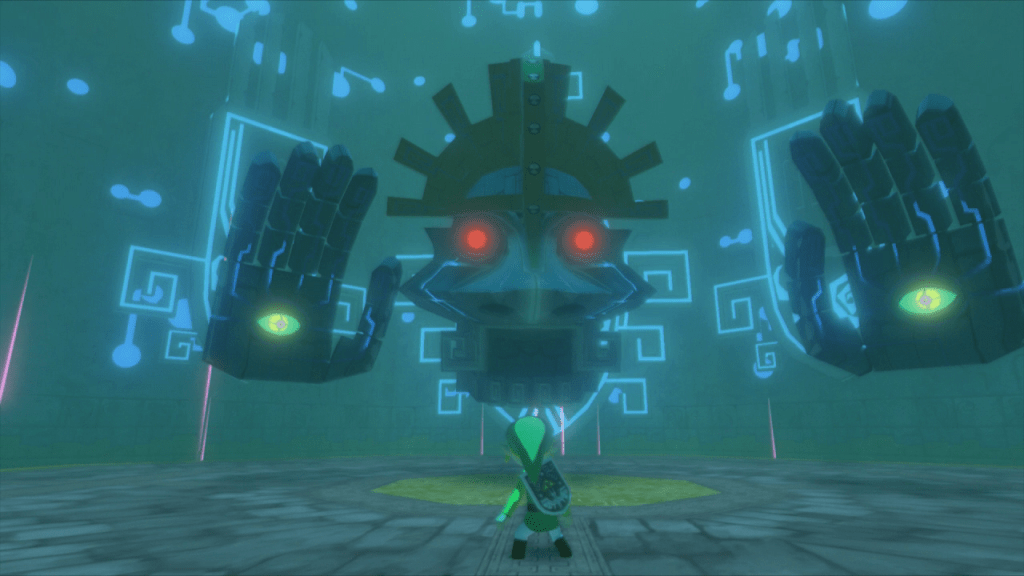
But ever since Wind Waker, the games have gradually leaned more and more on the trope of an ancient precursor race with sophisticated technology that Link must master and/or overcome on his journey. You really start to see it in Wind Waker’s Temple of the Gods, with its glowing wire/pipe motifs and puzzles about moving statues around. By Twilight Princess, the motif is more pervasive—most obviously in the Temple of Time, but also throughout the designs of the Twilight world (and Midna herself). In Skyward Sword, it’s everywhere, and the whole time jump mechanic at the center of many dungeons relies on this circuit-board-by-way-of-Olmec-statue aesthetic.
And then there’s Breath of the Wild, which starts by giving Link his own Shiekah smart phone, and then proceeds to design every. Single. Dungeon. with this one aesthetic. The Divine Beasts, the shrines, the towers—all are modeled after this one design philosophy.
Here are some reasons I don’t like this. Your mileage may vary.
First, this marks a gradual shift in Zelda games from fantasy to science-fiction. On its face, this is not a bad thing. But Zelda is, thematically, always about loss and the past. Whether it’s Ocarina’s story about losing and regaining childhood, or Wind Waker’s themes about accepting what is lost, or Breath of the Wild and its post-post-apocalyptic story of Zelda containing Ganon for millennia, these games are about nostalgia and regaining what was lost. Fantasy, and medieval fantasy in particular, are well-suited to these kinds of stories and these sorts of themes—from Tennyson and the romantics to Tolkien’s medievalism to romantasy’s lionization of loyalty and traditional gender roles, fantasy has been a tool for rediscovering valuable habits of the past and celebrating the mundanity of our world. Science-fiction, by contrast, is forward-looking, interested in the promise and dangers of the future. So the more Zelda games rely on futuristic technology rather than high-fantasy magic, the less I’m inclined to see its world as a nostalgic throwback to a lost childhood, and the more I tend to see it as a mirror to the present and its technological terrors. (If I don’t want to keep my smart phone on me 24/7, I definitely don’t want to roleplay Link using an app to cook meals every five minutes.)
Second, I feel like the game is trying to explain away its own mysteriousness. In Ocarina of Time, there is no good reason why the Song of Time makes blocks move from one place to another. None. And this is fine. If my ocarina can teleport me halfway across the map by playing a specific song, I don’t need an explanation for why it can move blocks around. It’s magic. End of story.
But when you frame these mechanics not as “magic” but as “technology,” it implies that there is an explanation, and that this explanation is knowable and sensible. And the more the world of Hyrule is knowable and sensible, the less reason I have to wonder at it, or think about the artistic value of what is happening. When I use a conductor’s baton to direct the winds in Wind Waker, there are rich artistic implications about enchanted artifacts of power, the connection between music and natural forces, and some sentient force that controls the wind and can be persuaded or appealed to. But if you’ve got an app for teleporting you from tower to tower, there’s no artistic value to this explanation beyond “some dudes figured out teleportation a long time ago, and you’ve got their doodad.” It’s banal, and cuts many of the gods, fairies, and other magical forces out of the world.
Third, and most egregiously, it violates one of those key central principles underlying Zelda’s design. As I said earlier, Zelda games since A Link to the Past vary enemy design and architecture according to region. You get watery enemies and damp dungeons in the swamp; lava and firebreathers in the volcano; birds and chasms in your floating sky-fortress. And I think this is a consistently good choice for the franchise, if only because it makes exploration all that much more rewarding and exciting when you see the varied aesthetics in each dungeon. But in Breath of the Wild, it’s Shiekah tech, all the way down. There’s no aesthetic differentiation between one area’s dungeons and another. The puzzles aren’t distinct from one another, tailored to the priorities of whatever culture used to worship at a particular shrine or temple. Honestly, calling Breath of the Wild’s puzzle-chambers “shrines” seems altogether misleading—they are technological labs, not ancient sites of worship. The fig leaf of establishing dungeons as “temples” in Ocarina of Time, where Darunia and the Gorons or Princess Ruto and the Zoras worship their guardian deities,is indefensible here.
And I’m not the kind of guy who sits well when you confuse the language and iconography of “worship” with the language of “technology.”
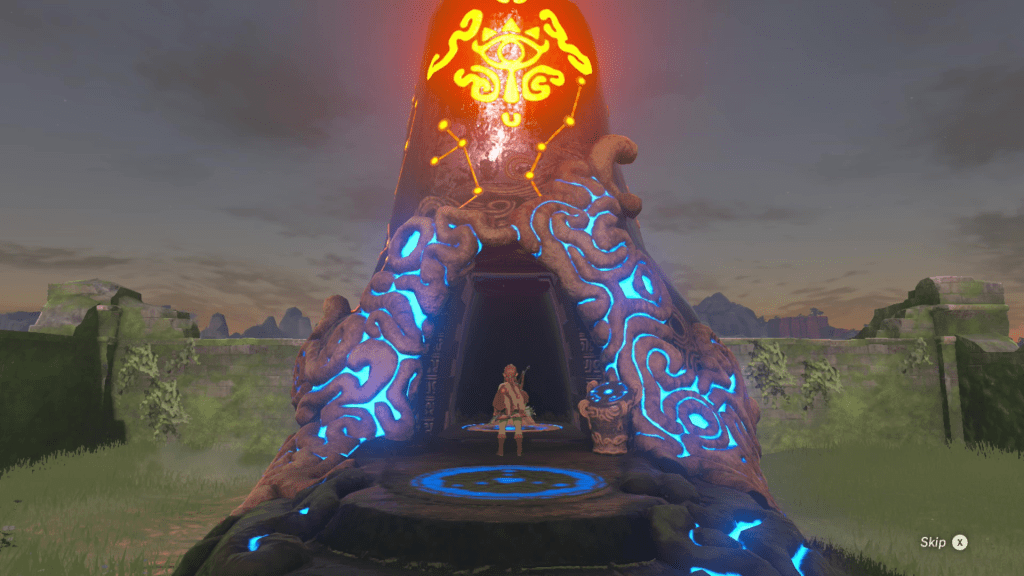
But, as I said, this is subjective. I recognize that the precursor-Shiekah trope is another way at getting at Zelda’s themes of nostalgia and lost greatness. I just don’t think it works especially well. I think it’s well-intentioned, but represents a fundamental misunderstanding about how this iconography communicates theme. But maybe that’s because I’m still working with a 1990s-era iconographic lexicon, with chivalry as a shorthand for lost virtue and luminous cyberpunk teal as a shorthand for a threatening uncertain future. Maybe those associations just aren’t current anymore. It doesn’t seem to bother Gen Z or my nephews all that much. Or at least the other virtues of Breath of the Wild seem to make up for it.
It still bugs me, though.
Intermission
Alright. Let’s take a breather. We’ve come a long way, and we don’t want to get lost among all the experiments here.

At the outset of this essay, I established that my relationship to the Zelda franchise has changed, rather dramatically, over the last ten years or so. I no longer return to these games as frequently as I once did, and I wasn’t sure exactly why that was the case. I connected this personal problem to a larger generational phenomenon—millennials seem to largely bounce off the newer Zelda games (Breath of the Wild and Tears of the Kingdom in particular), while Gen Z and little kids seem to like them just as much as we liked Ocarina of Time in the 1990s. This led me to interrogate the conventions of the Zelda franchise, with the implicit understanding that we could find out what different people want from these games, and why some of us seem dissatisfied by the newer entries.
And by now we’ve looked at a LOT of genre conventions. We’ve compared the Zelda games to Metroidvanias, immersive sims, and adventure games, noticing that certain elements of each genre are borrowed (or anticipated) by Zelda. We’ve talked about Zelda’s flexibility between 2D and 3D spaces. We’ve talked about dungeon design, puzzle design, and art design. And we’ve talked about how all these things have changed over time.
We have, in short, explored the genre conventions of Zelda games. And like any good exploration, it was more intuitive than organized, less categorical than meditative.
And I think we’ve reached several good conclusions, despite the rangy nature of these “genre experiments.” Namely:
- Zelda is fundamentally about exploration and discovery. It has been since its inception, and the most recent entries in the franchise are true to this principle.
- Since Zelda is about exploration and discovery, it must always change. Zelda games are fundamentally innovative, changing mechanics, art styles, gameplay features, etc., in order to make every new game feel like a new, unknown world for the player to explore.
- However, the story in these Zelda games are fundamentally about nostalgia and childhood. They often feature a divided world (Dark and Light, Past and Future), a lost world (Hyrule of Wind Waker and Breath of the Wild), or a threatened world (Wind Fish island in Link’s Awakening, Termina in Majora’s Mask). Zelda games are fundamentally conservative—they are about protecting or restoring a status quo rooted in the past.
- Zelda games that prioritize their story over exploration and discovery will, to a greater or lesser degree, remove or reduce player exploration in order to predictably guide the player through that story. These games will restrict the player in order to more carefully shape their experience.
Put this way, I think we can easily see a fundamental tension between the two main goals of the franchise. Zelda—as a game—is always forward-looking and innovative. Zelda—as a story—is always backward-looking and traditional. Each game seeks its own balance between these two goals, prioritizing the linear, story-driven themes of nostalgia and restoration, or the non-linear, mechanics-driven themes of discovery and exploration.
But this is a tension, not a contradiction. Tolkien would be quick to point out that fantasy, in all its forms, is a medium that strives to revitalize our understanding of the mundane—recontextualize familiar old things in new ways. The “green sun” of the fantasy writer makes us re-evaluate both greenness and the sun—two things we take for granted in our day-to-day lives.
So Zelda’s task is to make swords and shields, Ganon and Zelda, Hyrule Castle and Kakariko Village, dungeons and block puzzles and items—and, on an even more fundamental level—the hero’s journey, feel new and exciting and unknown with every new game.
That’s a pretty tall order. And, in the spirit of not taking things for granted, we should acknowledge and appreciate the fact that Nintendo has been doing this successfully for forty years over dozens of games.
But it also gives us some pretty good metrics for understanding how players react to each new game in the franchise.
A Link to the Past represented a move away from free exploration and discovery with its narrative and gatekeeping, but a move toward clarity and intelligibility. It became more accessible to new players with that clarity, but frustrated fans of the original game with its hand-holding.
Link’s Awakening doubled down on the story and structure of A Link to the Past—and removed even more freedom.
Ocarina of Time innovated dramatically in its adaptation to the 3rd dimension, but, presumably to offset the possible disorientation caused by navigating the 3D space, included even more gatekeeping and hand-holding.
And now that the Zelda formula has been established, player reactions vary according to whether the games adhere to that formula too much or too little.
Majora’s Mask, with its time loop and strange aesthetic, was too innovative. Oracle of Ages/Seasons, with its strict linearity and familiar items, was too derivative. Wind Waker alienated fans with its innovative art style and sailing mechanics; Twilight Princess alienated fans by being too familiar and predictable. And, of course, Breath of the Wild is too innovative, breaking down the linearity that had become a staple of the franchise since A Link to the Past in favor of the radical freedom to explore that defined the original Legend of Zelda.
But here’s the thing. On a long enough timeline, the games that are too familiar get forgotten, while the games that are too innovative remain sources of lively discussion and debate. Many gamers still fondly remember Twilight Princess, Minish Cap, or Oracle of Ages/Seasons, but they didn’t change the formula, and they’re remembered for being just fine. Nobody hates them, but nobody would call them their favorite, either.
Majora’s Mask, Wind Waker, and Breath of the Wild, however, are beloved. Even though they were often controversial and their innovative choices were questioned at the time. Some may still argue that they are bad, or claim they were the worst games in the series, but others will always gravitate to these as their favorite Zelda game.
(I’m pretty sure everybody kind of hates Skyward Sword, though. It wasn’t innovative enough to warrant love, but it was also annoying enough that even the traditionalists don’t defend it.)
So we can chart a rough divide between the fans of Zelda who prefer the linear, crafted experience of Ocarina of Time and its successors, and the fans of Zelda who prefer the freedom to explore that is exemplified by the original Legend of Zelda and, now, Breath of the Wild. Both schools of thought have their virtues: Ocarina was a carefully-crafted experience that guided the player along its linear track; Breath of the Wild was a carefully-crafted world that encouraged the player to wander, play, and explore. For the many years between Ocarina and Breath of the Wild, the fans of Zelda’s story were happy while the fans of exploration were underserved; now we live in Breath of the Wild’s world, and those of us raised on Zelda’s stories grumble, dismayed.
But anytime you’ve got a disgruntled player base yearning for a nostalgic throwback, you’re almost sure to find someone in the indie space serving up a solution. So let’s talk about:
Genre Experiment #7: Zelda-likes
So far we have been defining Zelda games by looking at the recurring elements and changes within…Zelda games. Which is a reasonable and intuitive approach to understanding the Zelda formula. We’ve also compared games in the series to related genres when appropriate, sometimes to compare similarities, other times to explore contrasts.
But if Zelda belongs to a “genre,” that genre should include other games. And especially in an age where indie developers are regularly aping the conventions of games past to evoke nostalgia, you would think that there would be plenty of designers cashing in on the Zelda formula, seeing as it’s one of the most beloved and storied in video game history.
I mean, look at Mario. The original Super Mario Bros. on NES basically started the platformer genre. Since then, developers have iterated endlessly on the formula. Sonic is basically a Mario game with much more emphasis on speed. Metroid used the same 2D-sidescroller, platform-jumping structure but emphasized exploration and incremental persistent powerups. Donkey Kong Country was Mario with more lavish design and animation. More recently, Braid was (quite explicitly) Mario where the platforming served puzzle design rather than combat; Super Meat Boy was Mario, but emphasizing quick precise jumps in small, confined levels; Spelunky is roguelike Mario. This is reductive, sure: many of these games have more complicated lineages, but they all descend, however indirectly, from Mario. Anyone familiar with these games can see the obvious connections.
But Zelda’s descendants are often not as obvious. And I find that very curious. Anyone can point to the connection between Super Meat Boy and Mario with little effort, and will meet little controversy. But to say that The Binding of Isaac has the same relationship to Zelda requires a bit more explanation.
Some of that is the same problem of ill-defined genre parameters that we’ve been tackling throughout this essay. Since different people want different things from Zelda, they’ll point to different games as inheritors of the Zelda tradition. For gamers raised on Ocarina of Time rather than the original Legend of Zelda, The Binding of Isaac doesn’t seem all that Zelda-ish.
This leads us to a few possibilities:
- Zelda is a unicorn; it has no genre and no game can be “like” Zelda without being Zelda.
- Zelda belongs to multiple genres; due to the diversity of styles and mechanics in Zelda, different games in the series may belong to different genres
- Zelda exists at the nexus of other genres; while many games can draw lineage from Zelda, none are truly “Zelda-likes”
- Something is preventing us from clearly seeing what genre Zelda belongs to.
In order to figure out which of these is the case, we’ll need to look at the games in Zelda’s neighborhood, and determine which, if any, can truly be called “Zelda-like” and why. We’ll need to examine the similarities and deviations, as well as the reasons why gamers accept the game’s kinship to Zelda, or disqualify it from inclusion in the “Zelda-like” canon.
Which will be very tricky and make lots of people grumpy, I expect.
LET’S DO IT!
1. The Binding of Isaac
Edmund McMillen is like the Weird Al Yankovic of video games. He’s a product of the Newgrounds school of gross-out humor and irreverent game design, but his particular aptitude is making weird, inside-out versions of classic games. Super Meat Boy is his love letter to Mario, but the main character is a literal blob of meat thrown into an endless succession of cruelly difficult levels full of traps and buzzsaws and wildly overpowered bosses.
Meanwhile, The Binding of Isaac is a similarly weird, gross sendup of The Legend of Zelda. Like Link, Isaac is a young boy dispatched on an epic quest, but instead of venturing across a fantasy landscape full of hope and adventure, Isaac is imprisoned in his basement by his abusive hyper-religious mother, and is forced to escape his literal dungeon by fighting endless hordes of worms, crap-monsters, demons, and other scatological and irreverent enemies. The Binding of Isaac is a roguelike—one of the reinventors of the genre, in fact—you’ll navigate procedurally-generated dungeons and pick up random items and powerups to aid your journey, with each dungeon progressively more difficult than the last. And the whole game is played in classic top-down 2D Zelda style, with each screen as its own little combat-challenge (or shop, or boss fight, etc.).
The Binding of Isaac is an undoing of Zelda in the same way that Super Meat Boy undoes Mario. The gameplay, themes, and art design are all deliberate deconstructions of Zelda tropes. The quasi-religious iconography of temples, sacred swords, ancient deities, chivalric courage, and divine purpose in Zelda is now perverted into squalid items and grotesque demonic pacts. The childhood-nostalgia theming of A Link to the Past and Ocarina of Time are flayed into an examination of child-abuse-survival as heroic narrative.
It’s a disturbing game to play, and I’ve never beaten it. But the inheritance is unmistakable, and its legacy as one of the great early indie successes is assured.
It’s also intrinsically linked to the Zelda franchise. We could point out its many deviations from the Zelda formula: it doesn’t have Metroidvania-esque item progression, or Zelda’s nostalgia-based story and theming, or an open world to explore—all of which seem to be essential components to whatever genre describes Zelda—and we can also point to its status as a progenitor of the modern rogue-like: a genre convention far removed from the Zelda franchise—but we can’t deny its obvious debt to and kinship with Zelda, despite that.
This is McMillen’s take on Zelda—what he thought was important to the series, and what he could replicate on his shoestring indie budget with his limited game-making resources. To argue that it is “not Zelda” or a wild misinterpretation, is to essentially reject an artistically-thoughtful and personal take on Zelda—even if it is full of poop jokes and violence.
Whatever our conclusions about Zelda’s genre, we must address McMillen’s view.
2. Anodyne
Anodyne shares the same top-down 2D perspective of The Binding of Isaac, but is closer to Zelda proper in its gameplay and theming. No scatological deconstruction; no rogue-like elements; no juvenile sensibilities. Most would compare Anodyne to Link’s Awakening since it indulges in the same surreal dream-like storytelling that is central to Link’s Awakening’s plot, though it serves as a more metatextual, meditative analysis of the whole hero’s journey video game structure.
But if Binding of Isaac is interesting because it warps the Zelda formula to an almost unrecognizable extreme, Anodyne is relatively boring because it doesn’t stray especially far from that same formula. This is another game I haven’t played to completion, but know by reputation (it was another early indie success story), and part of the reason I gave up on it was that it didn’t offer the sort of mechanical progression that I look for from Zelda. Unlockable items are reduced to some weapon upgrades and keys, along with mechanically-irrelevant collectibles for completionists. Like Zelda the first, or Breath of the Wild afterward, Anodyne presents you with its world and lets you explore it at your leisure, with very little in the way of guidance, handholding, or even an arc to your accumulation of power; unlike these games, there is no proper overworld and the dungeons are very linear. It’s short, static, vibes-y. Which is fine, for a game that you can reasonably finish in three hours.
I fell off Anodyne because it was doing everything I didn’t like about Zelda design (2D combat challenges, simple puzzles, linear level design) without any of the elements that draw me to the franchise (vivid storytelling, open world, lateral-thinking problem-solving, Metroidvania-esque item progression). But Anodyne has a substantial fanbase, many of whom love it for its abstracted story and uncanny, surreal vibe. It’s a minimalist Zelda game, and I respect that, but don’t feel terribly compelled to invest in it.
But I think Anodyne teaches us something terribly important about Zelda games. They are, at the end of the day, a triple-A affair. Indie games will often borrow some one mechanic or idea from a higher-profile, more complicated video game, and develop that one thing out into a whole game. Anodyne abstracts the 2D dungeon designs and combat from Zelda’s 2D roots, but leaves behind many of the elements that made those 2D games compelling. And, logically, it picked up the player base that was attracted to that kind of 2D design for its own sake, but lost players (like me) who saw that design space as a kind of medium for other mechanics and ideas.
Zelda, therefore, is an organic whole composed of many parts. Even games as simple-seeming as the original Legend of Zelda or Link’s Awakening have many interconnected parts that rely on one another, and our understanding of “what makes a Zelda game” is difficult to identify precisely because it depends on many of these interrelated pieces, united into this one game.
3. Project Temporality
Binding of Isaac and Anodyne both include Zelda’s 2D top-down combat in screen-to-screen scenarios obviously reminiscent of Zelda’s early games. Binding of Isaac remixes the items and combat while discarding the puzzles; Anodyne remixes the puzzles and combat while discarding the items. But what if you took classic Zelda dungeon puzzle design and abstracted it into a game without the combat?
Well, you’d get a ton of games in the indie space if I’m being honest. You’ll find plenty of space-manipulation 2D top-down indie puzzle games like Stephen’s Sausage Roll or Baba Is You, all of which riff on the “move blocks/navigate space” puzzle formula of 2D Zelda games in one way or another. If we expand this to the world of 3D Zelda puzzles, things get even messier—at least in part because we’re going to bump into Portal and its complicated lineage of spatial manipulation puzzles.
And, look. I’m sitting here wondering if we should consider Portal indebted to Zelda puzzles, and I’m really not sure where I land. Portal is obviously a Valve invention, though the legend goes that it was designed by some student who Valve hired basically as soon as they saw his demo. But it’s also hard not to think of the light-reflection puzzles with the Mirror Shield in Ocarina of Time’s Spirit Temple and Majora’s Mask’s Stone Tower Temple, too. The puzzles in Portal, which are all about navigating and manipulating space, would feel pretty natural in a Zelda game—and that’s not just speculation: Turnip Boy Commits Tax Evasion actually incorporates the basic portal mechanic in its otherwise-straightforward top-down 2D Zelda-like and it feels very appropriate. And if we accept Portal as a successor to Zelda puzzle design, we’ll almost certainly end up talking about The Talos Principle, Antichamber, and The Turing Test, too.
But I don’t want that argument to take over my essay, so let’s talk about a lesser-known game that I think deserves more press.
Project Temporality is a science-fiction puzzle game about time manipulation, lasers, cloning, and standing on buttons. But the trick is that you have to use time-manipulation to duplicate yourself and position your copies strategically to solve puzzles. It, too, takes a certain amount of inspiration from Portal, but the time-manipulation and duplication puzzles read much more like Zelda and Braid. Cloning yourself to solve puzzles sounds especially like some of the puzzles you’ll find in the Four Swords games, or moving statues in Wind Waker and Twilight Princess, or summoning homunculi in Majora’s Mask.
I know I’m reaching for the connection here: Project Temporality lacks an overworld, dungeons, combat, item progression, and most of the features that makes a Zelda game a Zelda game for virtually all of its fans. But that’s my point: Zelda historically includes a spectacularly wide variety of puzzles across its dozens of games’ worth of dungeons, and many of those puzzles can be abstracted away into their own games. And as much as Project Temporality has lasers and cloning instead of torches and magic, its puzzles are about understanding and navigating spaces, only on a smaller scale than you might find in Ocarina’s Water Temple, or any of the similarly-complicated dungeons across Zelda’s history. The feeling is much the same, and that’s key here.
It’s also worth pointing out that there are plenty of puzzle games out there that distinctly aren’t Zelda-like. Puzzle-platformers like Toki Tori, Thomas Was Alone, or Braid seem a step further removed than Baba Is You, 2D block-arrangement games like Love, Hate, and the Other Ones or Snakebird seem more akin to Tetris than Zelda, and there’s a whole line of exploration-based puzzle games running from Myst to Monument Valley to The Witness to Viewfinder that seem distinctly more adventure-game-y than Zelda-like. There is, however fuzzy, a distinct kind of puzzle appropriate to a Zelda game—namely a puzzle rooted in understanding and navigating space, optionally with unlockable tools that change how we view, understand, or interact with that space.
There’s a much larger discussion we could be having here, and a lot of these choices would be subject to debate. But I think we can at least identify the language we would use in that debate, even if we don’t want to have that discussion here.
We would say things like:
Portal is closer to Zelda than Minesweeper is.
Project Temporality shares a lot of puzzle design ideas with Zelda.
The Witness is less indebted to Zelda than it is to Myst.
There’s a spectrum here, and whether we navigate that spectrum by intuition or stark categorization, we’ll probably reach some similar conclusions. Puzzles in Zelda have rules and expectations, and the experienced Zelda player knows when those rules have been broken. And, looking at other puzzle games, we can start to gauge whether Zelda was an inspiration, however distant.
4. Hack ‘n’ Slash
Because of course Double Fine made a Zelda game.
Hack ‘n’ Slash splits the difference between the utterly deconstructionist Binding of Isaac and the more faithful adaptation in Anodyne. It’s a clear homage to Zelda: it opens with a prison escape, includes item progression, dungeons, bosses—all the mechanical characteristics you’d expect from a 2D Zelda game—but the hook is that you have a tool that allows you to “hack” enemies (and items, and most game world objects) and change their characteristics around. Reduce an enemy’s health to -1 and it will die on the spot; alternatively, you can change its allegiance and make it an ally. It’s a fun gimmick, and it’s implemented reasonably well, but it works better as a joke than a game mechanic.
I remember the story as a bog-standard hero’s journey, but with the winking self-satire you would expect from a game as self-aware as this. Hack ‘n’ Slash knows it’s a Zelda game, knows it’s making fun of Zelda tropes, and jovially nudges the player from time to time to make sure we’re all in on the joke together.
And it’s…fine. The hacking pretty much breaks the game wide open, so there’s not a lot in the way of balance, and when later puzzles start to rely on more finicky coding problems, the pacing just deflates. This was yet another game I did not play to its end, though I regret it more than the others.
What we should note in this case is the growing trend of Zelda-likes that are inherently unserious or self-satirical. Zelda’s overwhelming earnestness is not a quality these indie games are terribly interested in copying, either because it’s so difficult to get it right, or because these tropes are so familiar that they beg to be mocked. It’s strange to think that the only game on this list so far that we could call truly earnest is The Binding of Isaac, and that because McMillen’s pain is so manifest in its design that its takedown of Zelda’s forthrightness reads as a legitimate and warranted critique. Hack ‘n’ Slash, by contrast, wants to keep and eat its cake by turns: use the mechanical structure of Zelda while poking fun at it the whole way. And it isn’t terribly successful at either.
- Ittle Dew
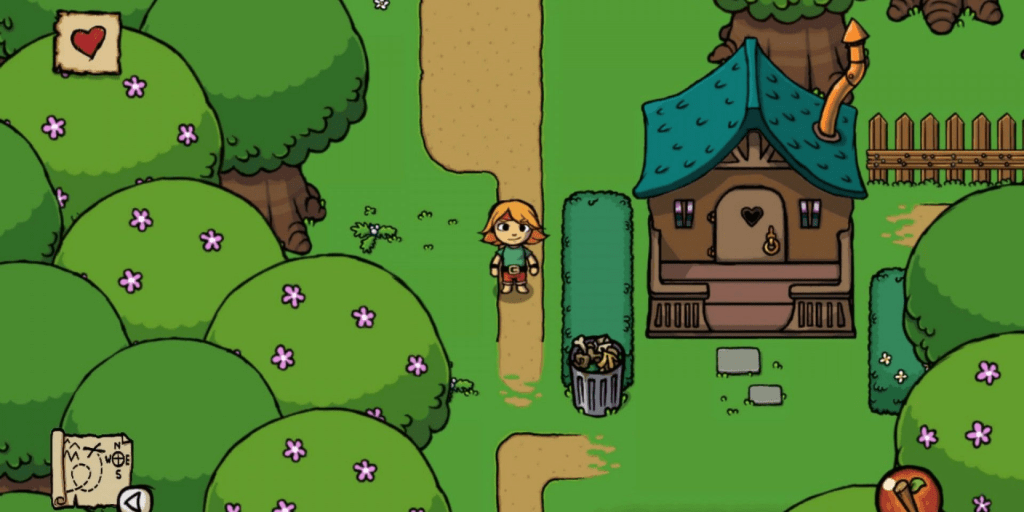
I’m honestly less interested in the straight-up Zelda-likes that don’t mix up the tropes than I am in the odd duck descendents like Binding of Isaac and Minit, but it’s worth mentioning that straight homages are out there. Ittle Dew is a Zelda game. It’s got a plucky heroine (who, like the protagonist of Hack ‘n’ Slash, actually speaks). With your help she’ll unlock cool items that solve puzzles and function in combat, you’ll explore the overworld and some dungeons, and then you’re off to fight the big bad.
Interestingly, Ittle Dew also lets you skip dungeons. You can beat the game with only 2 of the game’s 3 dungeon items, and there are actually achievements for each of the potential combinations. That was a neat trick in 2013, and it preceded A Link Between Worlds by several months, and Breath of the Wild by several years. Which is especially interesting to me because it means that Ittle Dew anticipated the trajectory of the Zelda franchise before it started wandering away from the Ocarina/Link to the Past formula. Ittle Dew pulls this off by letting each dungeon exist in isolation from the others: there is no item progression so to speak, and you’ll only use the relevant item in its corresponding dungeon—and all the puzzles in the final dungeon are soluble with any two of the three items. Very tricky; very cool.
It’s a good game—a bite-sized 2 hour Zelda game that manages to capture much of the key Zelda experience without any of its epic scope. Kind of the quintessential indie Zelda game prior to Tunic, in my opinion. One of these days I should get around to playing the sequel.
- Hyper Light Drifter
But before we can talk about Tunic, we have to talk about another genre that’s creeping in at the edges of the discussion.
Is Dark Souls a Zelda-like?
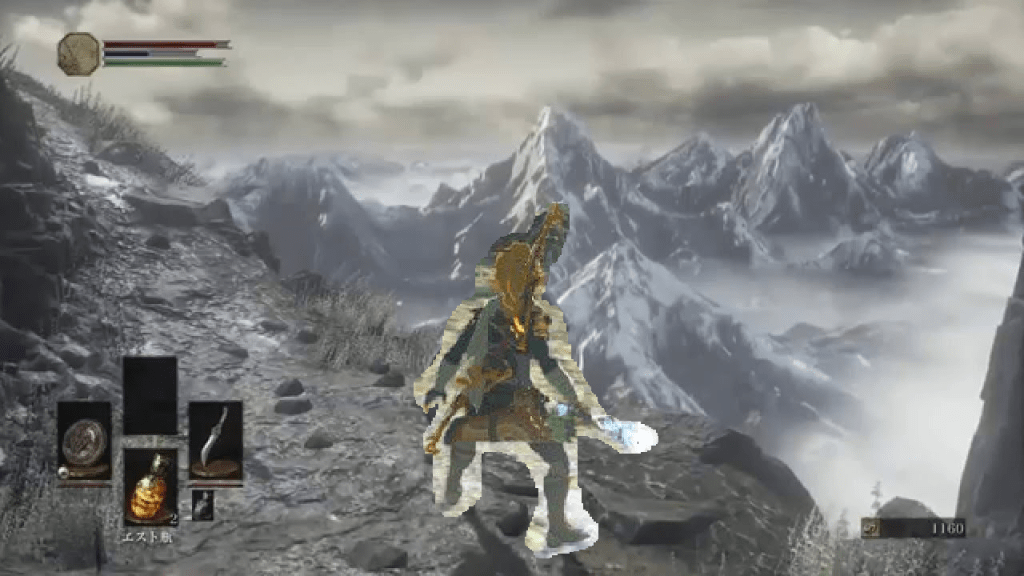
It’s easy enough to say that Zelda isn’t a souls-like. All the things that define the souls-like genre, like the emphasis on dodges and parries, cripplingly difficult bosses, and punishing failure states are very much absent from Zelda. (Except, of course, for Breath of the Wild, which uses heavy reliance on dodges and parries and cruel overworld enemies frequently enough to make us wonder if Breath of the Wild and Elden Ring aren’t copying each others’ notes.)
But read another way, Dark Souls is an atmospheric (like Zelda) 3rd-person action game (like Zelda) that uses Metroidvania elements (like Zelda) to gate off parts of its otherwise largely open world (like Zelda), where you’ll alternate between combat encounters, avoiding map hazards, and fighting spectacular bosses (Zelda, Zelda, Zelda) as you try to explore (Zelda) a broken world (Zelda).
But no, you say. Link is fixed as the player avatar in Zelda, where you can often choose from a variety of characters with different fighting styles in souls-likes. And there are those aforementioned RPG elements with unlockable spells and stat boosts. And you don’t pick up items (except for the occasional key) that unlock areas; you just have to fight the bosses instead.
But then you’ve got Hyper Light Drifter, which has a lot of those souls-like elements (punishing fail states, cruel bosses), but omits the RPG system and plays from a top-down 2D perspective—and now we made a Zelda souls-like or a soulsy Zelda-like.
Take one step further, and you’ve got Tunic (which I admit I haven’t played yet)—an isometric game about fighting enemies, exploring dungeons, and possibly saving a fallen world, where the protagonist is literally dressed in Link green with a blue shield and sword, and the connections become painfully explicit. Check the reviews on Steam and half compare the game to souls-likes, the other half to Zelda, and it’s pretty obvious we’re talking about the same genre space here. Zelda, Metroidvania, and souls-likes are all copying off each others’ notes these days, and it’s getting harder and harder to discern the boundaries between any of these genres.
- Batman: Arkham Asylum

Deal with it.
It’s not an indie game, but it’s time we started talking about what other big-name studios do to adapt the Zelda model, and this one is both a classic in its own right, a radical aesthetic departure from Zelda, but a clear inheritor of Zelda-style mechanics.
In Arkham Asylum you’ll explore the titular Asylum, which is largely open to you after you escape the first building. Other areas are initially locked, but you’ll gradually unlock gadgets and powers that allow you explore those areas. Unlike Zelda, Arkham Asylum indulges in distinct combat encounters—stealth (predator) and brawl encounters where you’ll have to either pick off enemies one-by-one without being seen by gun-toting goons, or where you’ll use the game’s novel (for the time) combat system to punch up large groups of baddies with combos and careful timing. But the rest of the game is Zelda to its core: you can use your gadgets to lay traps or navigate the environment to get the drop on enemies, mechanics organically interact (immersive-sim style) so you are always looking at enemy patrol routes and environmental hazards to exploit, and all your gadgets have navigation and combat utility. Certain asylum areas have dungeon-like qualities, with linear navigation complicated by areas that require certain items to traverse, and usually end in a boss with a classic Batman villain that must be outsmarted or cleverly overcome. It might be more linear than your average Zelda game (though probably on par with something like Twilight Princess or Skyward Sword), but it’s still about exploring the map, discovering secrets (like Riddler trophies), and navigating the environment.
It’s a Zelda game, but Batman. Fight me.
So…why does nobody call this game a Zelda-like? Why isn’t anyone else making this comparison? What about this game radically disqualifies comparison to Zelda?
Because it’s a Batman game, I assume. Duh. All those Zelda-like mechanics are buried under a distinctly un-Zelda-like veneer of gothic urban grime and superhero tropes. There’s not a whiff of the usual Zelda aesthetic of high fantasy, nostalgia, or childhood. Despite its T-for-Teen rating, this is a Dark and Gritty game for grown-ups, much at odds with Zelda’s child-centric presentation. And it’s much easier to see the differences in the aesthetic than the similarities in the mechanics.
But if we’re trying to talk intelligently about genre, we’re going to have to look past the aesthetic signifiers. Tunic may look more like a Zelda game, and may wear its debt on its sleeves, but that doesn’t make its inheritance any more or less strong than something aggressively un-Zelda-like in its presentation, that takes as much or more from Zelda’s mechanics.
So here’s a question: can we find a game that does the opposite? That superficially mimics Zelda’s aesthetic and presentation, but removes the mechanical core?
- Oceanhorn: Monster of Uncharted Seas
This might be the only game on this list that has earned the moniker “Zelda clone.”
And that’s a little disparaging, but not incorrect.
Oceanhorn is an isometric game, but adopts all the aesthetic nuances, mechanics, and storytelling conventions of a Zelda game. It’s probably closest to Wind Waker (or Phantom Hourglass) with its nautical themes and gameplay, but it feels pretty close to any of the Zelda games between Link’s Awakening and Skyward Sword, more or less. It’s got the epic fantasy aspirations, the straightforward swordplay, the dungeon puzzles and bosses—you name it, it’s all there. Poke around under the hood and you might find it a bit disappointing, though. The item progression is very limited, and it’s more linear than it first appears. The puzzles are very straightforward, and never involve the kind of sophisticated spatial reasoning that we might expect from something like Ocarina’s Water Temple.
But that “Zelda clone” label gives me pause.
I like the game well enough. It’s a faithful reproduction of the Zelda formula, without even so much deviation as Ittle Dew, but there is something fairly inert about it for that very reason. And the reviews of the game seem to echo this sentiment.
This is a game that embodies Zelda’s superficial characteristics, but isn’t actually interested in that core theme of exploration and discovery. I wouldn’t call it a complete departure from that principle, but this game is a pretty good example of giving people what they say they want while not actually providing what makes Zelda so special.
It is just a “clone” in some ways—lifeless, soulless, a mere facsimile of the thing fans want. I remember liking this game a lot when I played it; I remember virtually nothing else about it. And in a discussion about Zelda games, that’s not just damning with faint praise, that’s an acknowledgement that this game does not capture those key memorable moments that linger in the minds of Zelda fans, anchoring them to the franchise forever. There’s no equivalent to Saria promising to be friends in the Lost Woods, or staying up with Anju to await Kafei, or discovering the time-frozen halls of a submerged Hyrule castle, or going on a date with Marin in Link’s Awakening.
What we want from Zelda may vary from person to person. And, like me, you might find what you want in this game. But it’ll almost certainly be empty calories—entertaining and engaging, but not nourishing or memorable.
(And now we’re up to three games on this list with sequels I haven’t played.)
- FEZ
So what if we threw it all out. Throw out the top-down 2D and the 3rd person 3D. What if we dump the dungeons, the bosses, the story, the themes, and reduce Zelda down to that core theme of exploration and discovery. And what if we find another way—some fascinating and innovative mechanic—that allows us to explore the game-space and navigate it in a unique way.
FEZhas a lot of early-indie lore behind it: the developer, Phil Fish, took his toys and went home after some heavy-duty 2010s-era Internet drama. And the game stands as a strange monument to his prickly personality and the Internet’s inability to have nice things. Some would argue Fish is still a giant asshat and we should boycott his game. I think most have forgiven him at this point.
Whatever you think of Phil Fish, though, his game is amazing.
Because, again, FEZis nothing like Zelda. It’s a 2D puzzle-platformer-y thing, except you can rotate the world to traverse it. This is not a thing you can explain easily in prose, but a fifteen-second gameplay clip makes this core mechanic obvious with mindblowing simplicity. But it shares Zelda’s vision for video gaming, I think. FEZis just as interested in exploration, in mystery, in venturing out into the world without fear or trepidation, and in depicting that world full of mysteries and secrets and half-glimpsed lore. If Arkham Asylum has the mechanics of a Zelda game with none of the aesthetics, and Oceanhorn has all the aesthetics (and some of the mechanics) while missing its soul, FEZhas the soul of a Zelda game, and literally nothing else.
Naturally, it goes on the list.
- Evoland, DLC Quest, and The Hex
Like Hack ‘n’ Slash, these are all games about video gaming. Evoland is a love letter to the history of gaming, and starts as a top down black-and-white Zelda-like with Game-Boy-style graphics before unlocking higher resolutions, color, and other features over time that correspond to the gradual evolution of video game graphics. DLC Quest was a vitriolic little tantrum against microtransactions that required you to buy basic in-game features like jumping or items that permitted progress with fictional, in-game currency. And, of course, The Hex is a murder mystery set against the story of a fictional game company whose games became more and more slipshod and commercial over the course of its career.
All three games feature Zelda-like sections, with clear homages to the franchise. Evoland is probably the closest to a proper Zelda game—its mechanics never wander far from that Ocarina-era linear progression—but all three make a fair approximation of the Zelda experience and aesthetic within the greater stories they’re trying to tell.
And like Hack ‘n’ Slash, I think the takeaway here is to recognize Zelda as a symbol in the history of gaming. None of these games aspire to replicate Zelda as anything more than a historical artifact. The Hex is the only one of the three to have clear artistic aspirations beyond its efforts at homage or parody, but that aspiration is largely divorced from anything connected to Zelda itself. Each of these games is reasonably engrossing, but none invite the player to fall into the Zelda fantasy the way Ittle Dew or Anodyne tries to do. The player is expected to know and recognize the Zelda tropes, but remain at arms’ length, invested more in the metatextual commentary than the Zelda-ish story itself. It’s all artifice.
(And Evoland 2 makes four sequels…)
- Immortals: Fenyx Rising
I feel bad saying this, but I enjoyed Immortals: Fenix Rising more than I enjoyed Breath of the Wild.
Shouldn’t I know better than this? Immortals is just another freaking Ubisoft collect-a-thon open-world game with a zillion map symbols and an endless series of side quests. It’s clearly just ripping off the Breath of the Wild world design formula, but crowding the map with obvious side activities rather than Breath of the Wild’s organic-feeling vistas of empty space. Breath of the Wild takes great pains to feel like a functional world in its own right, full of dangers and interlocking mechanics, and a new mystery on every horizon; Immortals just crams the world full of stuff to do and it feels like a dumping ground for Greek-mythology-themed carnival rides.
And I still liked it better. I’ll happily admit that Breath of the Wild is the better game, according to some abstract quasi-objective metric of artistic integrity, but I’ll probably go back and play Immortals before I finally get around to Tears of the Kingdom.
Because I like the dang hand-holding, guys. OK? ARE YOU HAPPY NOW? I like the side quest markers instead of wandering around trying to figure out where the shrine is. I like that the minibosses are signposted, and the fights are less about split-second dodge timing than protracted slugfests where you can use a wide variety of (non-breakable) powers and items. I like feeling powerful. I like unlocking more cool doodads throughout the game rather than getting them frontloaded to me in the tutorial, where I promptly forget to use them for the rest of the game, and can’t really find convenient places to use them in your average combat encounter.
And I like the story. The running commentary between Zeus and Prometheus is legitimately funny, and rich with mythological allusions. I like that the stakes aren’t some plot setup from a thousand years ago, and that the enemy isn’t some malevolent purple ghost we won’t encounter until the last moments of the game. I even like the dang shrine aesthetic better.
I think Breath of the Wild wants me to be a better person, and I appreciate that. But the person Breath of the Wild wants me to be also has to be comfortable committing to long play sessions and dying a whole lot, and losing significant progress on a regular basis. And Immortals: Fenix Rising is willing to meet me where I’m at, instead. In some ways it’s more polished than Breath of the Wild—the hard edges sanded off and the loose, rangy world boiled down to a tighter, more densely-packed size; in other ways it’s less polished—it’s uglier and messier and less believable and more plainly video-game-y.
But if this is the cheap commercial cash-in, why haven’t more people played this game? Why am I the only weirdo recommending this game to my mythology students as a top-five Greek mythology video game (after the immaculate Apotheon, Hades, and that weird FMV adventure game Wrath of the Gods that absolutely nobody but me remembers because I’m the only person in my 3rd grade class that managed to make it all the way to the end—but that’s not relevant now…).
Immortals: Fenix Rising probably isn’t as good as Breath of the Wild. But that doesn’t make it a bad game. And I think it’s very interesting that it might successfully bridge Breath of the Wild—style Zelda-ing with Ocarina of Time—style Zelda-ing, while not actually being a Zelda game. If, like me, you’re a millennial a bit turned off by Breath of the Wild, I recommend you give it a go. For science.
- Okami
And then there’s Okami. Capcom is literally the only other studio Nintendo trusted with the keys to the Zelda franchise—they made Oracle of Ages/Seasons and Minish Cap, all of which are faithful and appropriately innovative, though none rate as anyone’s favorite game in the series. And then those sneaky developers made their own Zelda game, but stripped off all the serial numbers so nobody would ever know.
Of all the games on this list, Okami is probably the most uncontroversial choice for the name “Zelda-like.” And it’s by far the most ambitious game aspiring to that role. Okami is a retelling of Japanese mythology: you play as Amaterasu, the sun god, currently wandering around on Nippon as a white wolf with magical powers. You have a Navi-esque companion, Issun, who takes on exposition duties; you learn magical calligraphy powers that allow you to summon the sun, or hookshot to grapple points, or cause plants to bloom; and you wander around helping the world’s incompetent goofs perform heroic deeds by traversing dungeons, overcoming bosses, and taking on sidequests.
It’s also flatly gorgeous. The whole game is depicted in the Japanese watercolor style, full of lavishly-colored natural features like ponds and mountains and cherry-blossom-trees, stylized depictions of gods and goddesses, while brush-strokes intimate wind and dust and other effects of your actions on the world. It’s also fiercely ecological: you gain experience for powerups through feeding animals, encouraging plants to bloom, and fighting off the corrupting effects of demons and monsters. Like every good Zelda game, you are the force for preservation and protection—in this case, a literal god.
So this absolutely checks all the boxes. Zelda’s high-fantasy aesthetic—yes, though we’re replacing the western medieval trappings with stylish Japanese medievalism instead. Zelda’s item-progression—absolutely. Dungeons—check. Bosses—check. Exploration and discovery—check, though we should mention that the game world opens up more incrementally than your average Zelda game, not that you’ll know it until hours into the game. Careful balance between puzzles and combat encounters—check. Hero’s journey—check.
I know I’m picking fights by pointing to Arkham Asylum or Dark Souls or FEZ as Zelda-likes, but Okami is pretty indisputable. It is a Zelda game without being a Zelda game. It innovates, but not so much as to alienate. It scratches the same itch as an Ocarina of Time or Twilight Princess, while offering a radically unique experience at the same time.
And it is, to my knowledge, the only game of its kind.
As I said at the outset of this section, I can point to a dozen Mario-likes easily. Even Mario 64 has its successors in games like A Hat in Time or Yooka-Laylee or Demon Turf. These games might lack Mario’s polish, but they’re at least reaching toward the same goal. But if you want the full 3D Zelda experience without playing a straight-up 3D Zelda game, your only real option is Okami.
Why is that?
Conclusions (at long last)
Let’s take a step back and review those genre possibilities we entertained at the beginning of our foray into Zelda-likes:
- Zelda is a unicorn; it has no genre and no game can be “like” Zelda without being Zelda.
- Zelda belongs to multiple genres; due to the diversity of styles and mechanics in Zelda, different games in the series may belong to different genres
- Zelda exists at the nexus of other genres; while many games can draw lineage from Zelda, none are truly “Zelda-likes”
- Something is preventing us from clearly seeing what genre Zelda belongs to.
At this point, we can successfully rule out #1. Okami exists, and even if it’s the only game that can truly stand as a rival to Zelda, that’s proof enough that it is possible, however difficult, to produce a proper Zelda game without the Zelda brand.
I think #4 is, at this point, solved. We’ve discussed how the Zelda aesthetic interferes with our ability to recognize other Zelda-like qualities in other games, and we should be wary of that going forward, but we can (hopefully) see past it now.
What’s left is something in the vicinity of #2 and #3. On the one hand, there’s truth to the idea that we should regard different Zelda games as belonging to different genres: that initial distinction between the top-down 2D Zelda (like A Link to the Past and Minish Cap) and the 3D 3rd-person Zelda (like Ocarina of Time and Skyward Sword) still seems to be useful. We might even extend this distinction to a 3rd category with Breath of the Wild. But we were right to question that judgment at the time. There are strong kinships among all the Zelda games, regardless of their presentation and platform, and whether or not the individual games should be subdivided into sub-genres, it seems weird to think that there wouldn’t be some super-genre that includes all of them, given how strong those kinships are.
But at the same time, we keep running into the problems of #3. Zelda also has kinships to point-and-click adventure games with their puzzles and plots; and to Metroidvania with its progression-based exploration; and to immersive sims with their organic environmental mechanics; and to souls-likes with their love of dungeons and bosses and exploration of fallen worlds. We might point out connections to other genres, too: Zelda and JRPGs have a lot in common in the ways they navigate their worlds, but Zelda has only incorporated a true JRPG leveling system one time (in Zelda II, which we’ve largely sidelined in our discussion, perhaps unfairly). God of War, the quintessential action game, both in its nascent form in 2005, and its 2016 reboot, was much indebted to Zelda for its game design, and all its copycats and successors share that debt. To declare a super-genre for Zelda would be to risk lumping all of these other genres into it as well, and at that point the genre definition would be too broad to be useful.
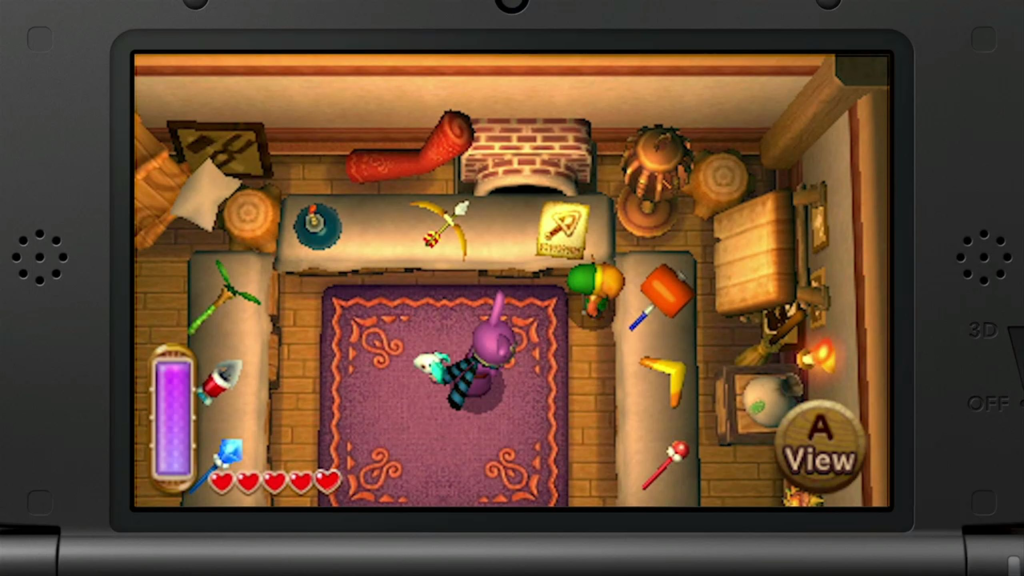
So what the heck is a Zelda game, then?
Language, Games, and Language-Games
It was only a matter of time until Wittgenstein got involved here.

In the Philosophical Investigations, Wittgenstein writes this oft-quoted observation on the nature of definition:
Consider, for example, the activities that we call “games”. I mean board-games, card-games, ball-games, athletic games, and so on. What is common to them all? — Don’t say: “They must have something in common, or they would not be called ‘games’” — but look and see whether there is anything common to all. — For if you look at them, you won’t see something that is common to all, but similarities, affinities, and a whole series of them at that. To repeat: don’t think, but look! — Look, for example, at board-games, with their various affinities. Now pass to card-games; here you find many correspondences with the first group, but many common features drop out, and others appear. When we pass next to ball-games, much that is common is retained, but much is lost. — Are they all ‘entertaining’? Compare chess with noughts and crosses. Or is there always winning and losing, or competition between players? Think of patience [solitaire]. In ball-games, there is winning and losing; but when a child throws his ball at the wall and catches it again, this feature has disappeared. Look at the parts played by skill and luck, and at the difference between skill in chess and skill in tennis. Think now of singing and dancing games; here we have the element of entertainment, but how many other characteristic features have disappeared! And we can go through the many, many other groups of games in the same way, can see how similarities crop up and disappear.
And the upshot of these considerations is: we see a complicated network of similarities overlapping and criss-crossing: similarities in the large and in the small.
This is Wittgenstein’s famous description of “family resemblances.” He rejects the Platonic notion that these categories must be definable (“Don’t say they must have something in common…”), and instead acknowledges that definition is fluid, intuitive, progressive, and indistinct. Words do not apply to reality except as rough-and-ready, partial descriptions of the world we observe. Derrida would go a step further and argue that language and reality have nothing in common: language is like a net overlaying reality, mapping roughly onto its contours, but never actually coming into contact with it.
“Game,” then, is a useful term for approximating and roughly describing the activities Wittgenstein describes, but it falls apart under the slightest scrutiny. It no more sets the boundaries for “game-like” activities than it can police those boundaries. And therefore “that’s not a game” isn’t a useful response to the examples he considers. It’s not a binary; it’s a continuum. Chess might be somewhere near the center of “game-ness,” while the child bouncing a ball against a wall alone might be toward the periphery.
This is all very interesting, and any philosopher with a basic command of the philosophy of language might point out the same principles here. And you might think I’m gearing up to tell you all that “definition is useless!” before closing down this forty-plus page essay in an anticlimactic huff. And there is some truth to the idea that “Zelda” is a placeholder for a series of games united only by these “family resemblances,” and that genre is as vague as the term “game” is to Wittgenstein.
That’s not what I’m saying.
And I don’t think that’s what Wittgenstein is saying, either.
Instead, I want to draw attention to his method.
“Look,” he says. And he repeats it: “don’t think, but look!” This whole passage, with its idiosyncratic syntax and repeated imperative commands, attempts to bypass description. Wittgenstein isn’t claiming a dang thing about board games or card games or ball games—instead, he invites you to look at the things themselves, and not the words we use to represent them.
Elsewhere in the Philosophical Investigations, Wittgenstein says something particularly apt to this method:
One cannot guess how a word functions. One has to look at its application and learn from that.
But the difficulty is to remove the prejudice which stands in the way of doing so. It is not a stupid prejudice.
The goal of all these “genre experiments” was comparable to Wittgenstein’s goal in his “language-games,” early in the Philosophical Investigations—to tackle the question of Zelda’s genre from a variety of unexpected angles, as though we might be able to sneak up on the truth if we come at it from behind. And, on another level, the goal was, as Wittgenstein might put it, “to show the fly the way out of the fly-bottle” and demonstrate how to avoid getting locked in our own linguistic bottle-necks.
Despite what the hardline Wittgensteinians may say, I think genre is a useful tool for categorizing games, and I think we can identify certain characteristics that differentiate genres effectively, even if we do have to consider them “guidelines” or “commonalities” rather than hard rules or sufficient characteristics. As we said earlier, we should probably say things like “Zelda has a lot in common with Metroidvania,” rather than “Zelda is or is not a Metroidvania.” And, likewise, I think that we have come up with a pretty good, if fuzzy, list of characteristics that describe the Zelda franchise. Mechanical characteristics, thematic characteristics, aesthetic characteristics, and even the more subjective features, like how it makes us feel or why we’re drawn to some games in the franchise over others.
But for all we’ve managed to outline the “genre” of The Legend of Zelda, I find it equally interesting that we gamers don’t have a word that effectively describes the genre of a Zelda game. Because, from a linguistics standpoint, that means we don’t need one. We aren’t actively searching for one. I’ve used the term “Zelda-like” here, mostly because I want to draw attention to the fact that we use this form for many of our other genre definitions in video game discourse (rogue-like, souls-like, even “Doom clone” before we started calling them “First-Person Shooters”). They’re pretty bad terms, but they also reveal something pretty endemic to the industry.
We chase trends.
Doom came out in 1993 and suddenly everyone was making “Doom clones” like Turok and Goldeneye 64 and Marathon and Blood. Rogue did not immediately spawn a legion of copycat games, but The Binding of Isaac and Spelunky sure did, and Rogue was the common inspiration. And, of course, Dark Souls and Demon’s Souls have their legion of imitators today.
But The Legend of Zelda is one of the most well-known, well-respected, and profitable franchises in the history of video games. And, to my knowledge, there has never been a video game gold rush to cash in on its success by making “Zelda-likes”—and for evidence I present the fact that I had to pretty much coin the term “Zelda-like” for this essay. I had to freaking reach to get that list of 12 games to discuss. And while I still have a few in my back pocket (like Supraland, Turnip Boy Commits Tax Evasion, Shadow of the Colossus, and Minit), it’s not nearly as prolific a genre as “rogue-like” or “bullet heaven” or “boomer shooter”—all of which have a pretty narrow genre definition at their core, but dozens of games crowding the Steam storefront for attention.
And at this point in the essay, I think it’s become clear why that is.
Zelda games are a wildly complex and delicate fusion of disparate genre elements. There is not just one mechanic or set of mechanics, easily duplicated, that defines the Zelda formula. Zelda games borrow the puzzles from adventure games, but only certain kinds of puzzles about navigating and manipulating digital spaces. Zelda games borrow the combat from action games (including Breath of the Wild’s debt to souls-likes), but that combat has to be finely tuned for younger players’ sensibilities. Zelda games borrow Metroidvania item-based progression, and immersive sim mechanical complexity, and adapt these features to one another to build combat systems and puzzle solutions that, at their best, feel organic and improvisational. The stories of Zelda games are archetypal, but rarely abstract or formulaic—and they build to evocative, heartfelt story moments that linger in the mind long after the game has been turned off.
These games are mechanically complex, intricately-designed works of handcrafted, carefully-composed art, that can’t be summoned into being with a series of focus tests or out-of-the-box game mechanics. They are largely resistant to the indie strategy of isolating individual mechanics or ideas and expanding them into their own games—as you can see from misfires like Hack ‘n’ Slash and Oceanhorn or the alternative trajectories taken by The Binding of Isaac or FEZ. At their best, Zelda games incorporate many complicated pieces into unique wholes—puzzle box dungeons and rousing boss fights and heartbreaking character moments and emotional triumph (and setback) that tugs at the heart with mythic force. All of the components of the Zelda formula are necessary to reach these highs—without the puzzles the dungeons would not mystify; without the dungeons, the bosses would not feel appropriately climactic; without the bosses, the world would not feel menacing; without the world, the story would fall flat; and without the story, there would be no urgency to solve all these dang puzzles and fight all these dang enemies and explore this big, mysterious world. It’s all of a piece.
And yet, even more miraculously, you cannot do it twice. Zelda must move. The rules must change. It must be novel in order to be mysterious. So the pieces must shift. Some must be jettisoned. Others must be added. And a new whole must be crafted out of them. For Ocarina of Time, this meant combining the successful formula for navigating 3D spaces from Mario 64 with Metroidvania-style item-based gatekeeping and the aesthetic and open world of Zeldas past. For Majora’s Mask, this meant reducing the size of the world to manageable proportions to accommodate the time-loop mechanics, the variety of reactions prompted by different masks, and the complex schedules of the NPCs. For Wind Waker, this meant finding an aesthetic that could communicate both the characters’ emotional expressions and the practical concerns of exploring a vast open world of seafaring adventure. And for Breath of the Wild, this meant combining the crafting systems of something like Minecraft with the combat threats of souls-likes and some of the open-world architectural lessons taught by Ubisoft, while phasing out the Metroidvania gatekeeping for the sake of a truly vast open world that felt expansive and dangerous at the same time as it provided the player with the tools to overcome its threats and navigational signposting at a glance.
The Zelda formula is: there is no formula. Each new game must come up with its own. Chuck out the old thing altogether and start from scratch, every time.
Or not every time. But the games that we remember—that feel revolutionary and surprising and beautiful? Those are the ones that started from scratch, again and again and again. The Legend of Zelda, A Link to the Past, Link’s Awakening, Ocarina of Time, Majora’s Mask, Wind Waker, A Link Between Worlds, Breath of the Wild. And, I would say, Okami, Batman: Arkham Asylum,and FEZ. These are all games that kept only a handful of ideas from the games before, then incorporated those ideas with the radically new to build a new whole. Not all were equally successful; it’s a big ask, after all; but the success rate for this franchise is improbably good for the ambitious demands of this anti-formula formula.
What is a Zelda game?
It’s whatever this particular Zelda game needs to be.
Don’t think, but look!
Not a Stupid Prejudice
But looking is hard.
In my experience, modern life is a constant battle to find a balance between automization and “presence”. There is just so much we have to do, every day—work responsibilities packed into work days and surrounded by family responsibilities, social responsibilities, civic responsibilities, responsibilities to personal welfare, hygiene, and growth—that the only way to survive these overwhelming duties is to outsource and automate the vast majority of them. We let AI write our e-mails for us. We trust news outlets and political commentators to shape our political outlook (or just ignore the news altogether). We auto-pay our bills and optimize our workout regimens. We play podcasts while we wash dishes, or drive, or play video games, so that no minute is wasted. We scroll through our social media feeds while we spend time with family or friends, or while sitting in meetings. We multitask whenever we can, giving each task only a portion of our attention.
Because we need to.
There’s a growing effort to resist this part of our lives, and it’s tempting to denounce all these automatic habits and the desire to multitask as a social ill (and it is), but it is also, as Wittgenstein might say, not stupid. It is a logical, appropriate reaction to an attention economy that pushes us to react and respond in the moment, at every moment, and that pays no mind to the danger of overwhelming us with too many dang stimuli. We physically, mentally, cannot respond to every thing that clamors for our attention, even when those things warrant our attention, except by rote, by habit, and by half-assing it.
As a writer and a philosopher of language, I am especially sensitive to the ways we speak habitually. When we are passionate, we don’t think through the implications of what we say, but reach immediately for familiar, stock phrases. When we find a game moving, or it elicits an emotional reaction, we say that it is “impactful,” as though it is not we who are moved, but the game that compels us to move (and how or why we are moved, we do not bother to address). When we try to explain why we liked one game but did not like another, we blame “vibes” or point to some superficial “aspect” without seriously addressing the differences between these two games, much less how our reactions might have been affected by our time, place, and state of mind when playing them. We use these terms and phrases because they are convenient, popular, familiar, and spring to mind quickly, without having to think through the implications of our word choice. These terms and phrases are automatic. And taking the time to truly understand our art, and our reactions to it, is difficult (as this fifty-page essay should attest.)
Even more insidiously, there is a reciprocal relationship between the language of the corporation and the language of the fan: when Nintendo tells us that Zelda is “an epic adventure,” we unconsciously parrot their talking points when we react to the game, and accept their name “adventure” as a key word in the discussion of the game. As publishers mimic popular and established game models (like The Binding of Isaac or Dark Souls or DOTA 2), we accept the necessity of these mechanically-driven descriptors (rogue-like, bullet hell, MOBA, FPS) because we have been told to understand genre in the same way these corporations do—as a series of superficial and mechanical characteristics that can be easily repackaged and duplicated.
These are not stupid prejudices. But they are prejudices. And they add up to stupefaction: a semi-conscious and habitual acceptance of a frame of reference not necessarily apt or appropriate to our experience. The difference between a Metroidvania and a souls-like shouldn’t be especially relevant to a designer of games, who should aim at making the best holistic game they can (like the best Zeldas), but it is very relevant to publishers and marketing teams, who are trying to cultivate a certain image of a game in potential buyers’ minds. And those publishers will demand that designers meet genre conventions so they can sell the game more easily. And, as a bonus, players are trained to search for these terms, become “fans” of these particular types of games, favor brand names over reviews and quality and the continuity of developer teams, which makes them even easier to market to. The automization of language by fans allows publishers to automatize their marketing, too.
And just like that, we have the brand. Genre, quality, and player taste all become secondary to the loyalty to the brand. Dead Space fans return to Dead Space games, even if the genre changes midway through the franchise. God of War fans will be loyal to whatever game is released under that title, even if it’s a crass, ill-conceived game like God of War III. This is, in many ways, the ultimate expression of automation in art and gaming: the fan shows automatic loyalty to the game for its name alone; the publisher need only release a game with that name and the superficial conventions of the franchise, and the fans will buy it before it has been proven, tested, or even finished.
I hate brand loyalty. I am not immune, and there are some brands I celebrate, but I always feel kind of gross doing it. Which is part of the reason I devote so many essays to deconstructing brands like Final Fantasy or Zelda—because I want to bring fans back to artistic appraisal, and reject blind loyalty to the brand.
But Zelda strikes me as a very interesting, and surprisingly positive case study in brand loyalty and management. Zelda is a brand divorced from genre, per se, but which evokes a sense of high fantasy adventure, exploration and discovery, artistic integrity and quality paired with childhood nostalgia. And, happily, to preserve that brand, Nintendo is placed in the position of having to support it with high-quality, innovative, holistically-minded games that must, each time, be considered and developed anew, without relying on conventional industry wisdom or checklists of features or a hard-and-fast mechanical template. If Zelda’s formula rejects formulas; Zelda’s brand is creativity and innovation.
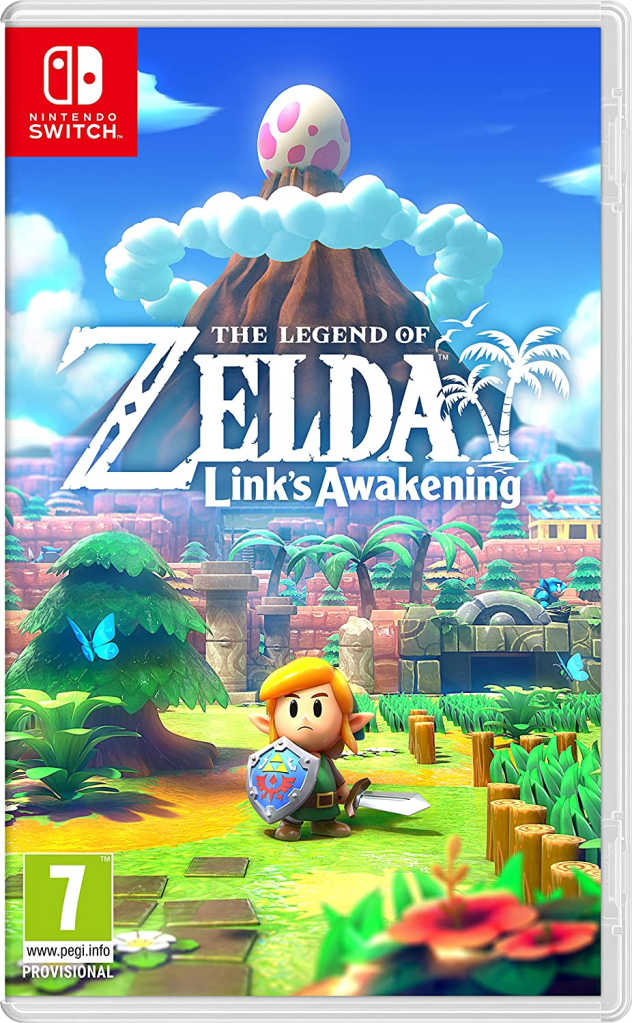
Zelda is a game that looks. Zelda is a game that inspires us to look. It is a game that, at its best, demands our full attention and awareness—without multitasking, without distraction, and without the preoccupations of our AFK life. At its absolute best, it will even help us unload that baggage for a time, absorbing us into its game world so that all our other anxieties and obligations melt away into the zen-like state of solving the puzzle in front of us. For some of us, we may be more present in Hyrule than we ever are on Earth.
And just as I think some of us come to Zelda for the exploration, and some come to Zelda for the sense of empowerment, and some come to Zelda for the emotional catharsis, I imagine that many of us come to Zelda for this exact reason: to let the world take over our minds and senses—transporting us to its world by consensual force.
Because for all our need to optimize and automate and multitask, I think we struggle to figure out why we’re doing all that optimization and automation and multitasking: what we’re doing it all for. We struggle to turn it all off and be in the moments that are supposed to be important and valuable in themselves. We enjoy our free time as outsiders to ourselves, prioritizing the composition of the photograph over the long sweet sigh of self-contentment. We document ourselves by habit, more concerned with the opinions of others and the failing memories of our future selves than the act that memory preserves.
And Zelda helps break that habit for us.
If we let it.
The Triforce of Wisdom
Breath of the Wild released in 2017. I didn’t own a Switch at the time, but I got one for Christmas that year and spent my winter break (December 2017-January 2018) racing through the game, as I discussed above.
I believe Wes and I played through and discussed Majora’s Mask in 2021. It was my first time playing the 3DS port.
Tears of the Kingdom released in 2023. I played through the tutorial, but little further.
And somewhere in there I replayed Ocarina of Time, apropos of nothing.
I could be wrong, but I believe that is the sum total of my Zelda experience since 2017. In nine years, I’ve played through only three games, and a few hours of Tears of the Kingdom.
In the twenty years before that, I played every other Zelda game ever released. And beaten them (except for the final boss of Zelda II—that guy sucks). I’ve probably played through A Link to the Past, Link’s Awakening, Ocarina of Time, Majora’s Mask, and Wind Waker at least three times each. I think it would be a conservative estimate to say that between 1996 and 2016, I averaged about two-to-three Zelda games per year.
In preparation for this essay, I replayed none of them. Deliberately. I wanted to write from memory and memory alone (so if there are any grave errors about the games’ contents, that’s probably why). I did start replaying Okami, which I thought appropriate. I’m enjoying it quite a bit. (The dungeons are simpler than I remember, though.)
It appears I’ve lost my appetite for Zelda. There might be any number of reasons for this. Maybe Breath of the Wild and Tears of the Kingdom spoiled my interest in the franchise. Maybe I didn’t have the time, what with my newfound teaching responsibilities. Maybe I lost my appetite for games that demanded my full attention. Maybe I’ve replayed the older games so many times that they’ve begun to lose their mystique. Maybe I’ve found the same joy of discovery and exploration in my research projects. Maybe I’m starting to get too old to pick up games with radically new mechanics as often as I used to.
Some of these are good reasons, and reflect positive changes in my life; some of these are bad reasons, and reflect bad habits or deteriorating behaviors. To pick these all apart would probably require another, longer essay, and I don’t want to subject you to that. (This one is already very long, and very self-indulgent, without me explaining my every little life’s vicissitude to you.)
In the end, I believe I can simply say that I’ve grown a bit old for Zelda. It is designed for kids, after all—or at least preteens and teenagers, since that’s almost certainly when I enjoyed the game the most. I’ve gone on to have some real adventures, some of which I undertook voluntarily, some of which were thrust upon me—in true “hero’s journey” fashion. And, as Joseph Campbell and J.R.R. Tolkien would agree (however rare that might be), I came back changed. Not all of us get our childhood back, after all. (Though who knows…maybe this particular adventure isn’t over yet…)
But this isn’t a bad thing. Our language and culture inclines us to associate childhood with innocence and purity and fosters nostalgia for our youth, but that’s just another flybottle. (Edmund McMillen might help show us the way out of that one.) Instead, I tend to like watching my nephews puzzle their way through Breath of the Wild and the Link’s Awakening remake. I look forward to seeing what they think about the upcoming remaster of Ocarina of Time. I like talking about Zelda with my students, and with my friends’ kids. Zelda rightly belongs to them more than it does to me.
Nowadays I think I identify more with the crusty old sages than the plucky young Link. I’ve long internalized the lessons these games have to teach, and I like to think I’ve accustomed myself to “being present” as I write an essay like this one, or think through a tricky puzzle of history or philosophy. With Zelda’s help, and Wittgenstein’s, I’ve learned how to navigate my way out of many flybottle-dungeons, and how to flip the whole world upside-down with a well-placed arrow of light. I no longer need to carry a sword and shield to feel like I’m saving the world, protecting the precious treasures of an earlier age, uncovering the mysteries of a forgotten past, or discovering a new world yet unexplored. Instead I trek off to the libraries and colleges—our modern day Temples—and perform my archaic and mysterious rituals of note-taking and essay-writing and lecturing, with book in one hand and pen in another. And each fall new adventurers arrive with the Triforce of Courage shining from their hand…
“It’s dangerous to go alone,” I tell them. “Take this.”