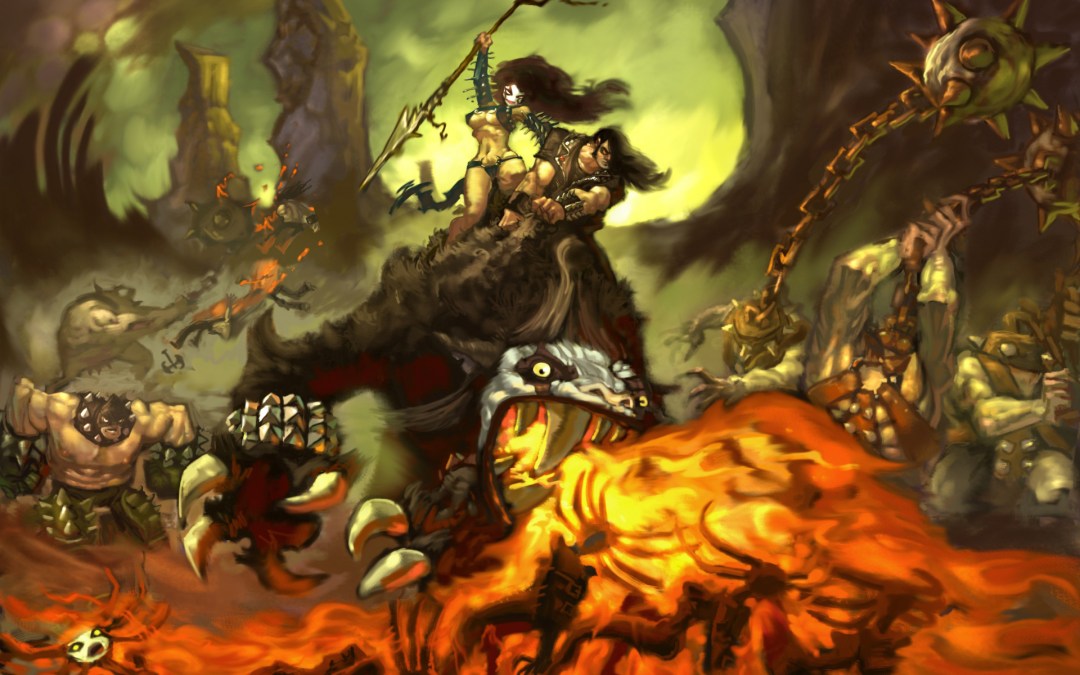
Our story begins with one of the greatest video game developers of all time: LucasArts.
LucasArts started life as Lucasfilm Games in 1979, originally created by George Lucas himself in an effort to explore the artistic possibilities of video games, shortly after the success of Star Wars. In creating Lucasfilm Games, Lucas worked closely with Atari, the biggest name in video games at the time, and the holder of the Star Wars video game license.
But this partnership would prove rather fraught. Since Atari owned the license to Star Wars, this meant that the fledgling Lucasfilm Games couldn’t actually make Star Wars games, and had to concoct their own IP instead. Worse, in 1983 Atari essentially tanked the entire video game industry with the disastrous release of E.T. the Extra-Terrestrial video game in 1982, leading to a crash that wouldn’t recover until the release of the NES in 1985. When Lucasfilm Games finally did develop their first games, Ballblazer and Rescue on Fractalus! in 1984, they handed them over to Atari to publish on the Atari 5200, but the unprotected copies were promptly leaked online and were widely available through pirating forums a year before they were officially released.
So in 1987, lead designer Ron Gilbert released Maniac Mansion—the first game developed and published by Lucasfilm Games—and began the legendary run of point-and-click adventure games that would include The Secret of Monkey Island, Day of the Tentacle, and many of the early Indiana Jones adventure games.
Along the way, in 1989, a computer science student and short story writer by the name of Tim Schafer applied for a job at Lucasfilm, after reading a listing for a programmer who could also write video game dialogue. The interview went horribly: Schafer raved about the Lucasfilm game Ballblaster, not realizing that this was the pirated version of Ballblazer. Happily, Schafer got hired anyway. Soon he was working in Ron Gilbert’s inner circle on the SCUMM engine Gilbert had designed for Maniac Mansion. And not long after that, Gilbert had Schafer working on The Secret of Monkey Island.
In 1990, Lucasfilm Games became LucasArts, and their dominance over adventure gaming soon followed, with Schafer integral to their rise. In addition to co-writing The Secret of Monkey Island and its sequel, Schafer co-directed Day of the Tentacle with Dave Grossman, and personally led the teams for Full Throttle (released in 1995) and Grim Fandango (released in 1998)—the last of which won many awards and is widely acclaimed as one of the greatest adventure games ever made.
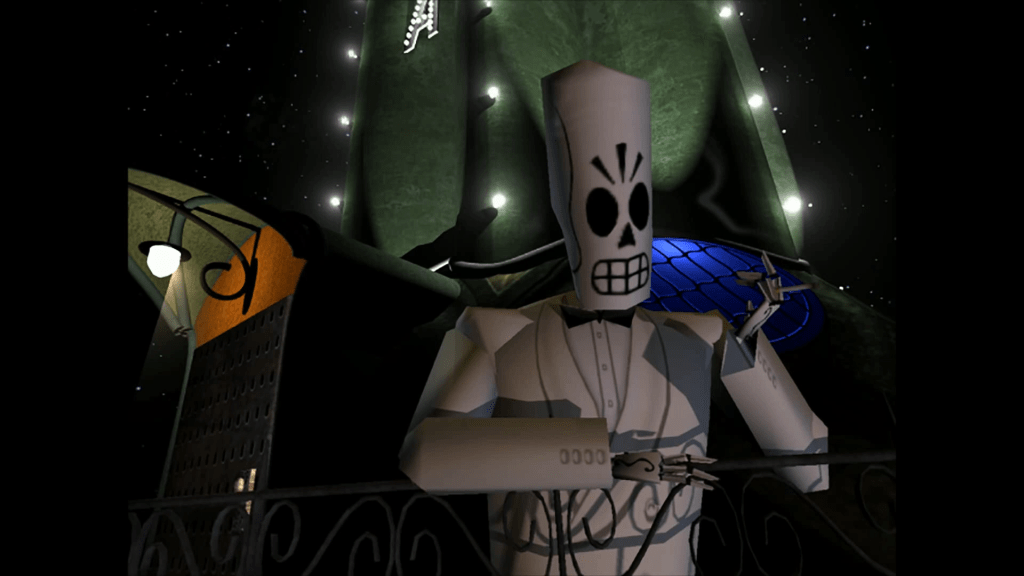
But by 1998, adventure games were passé. Doom released in 1993, and first-person shooters were now the dominant genre in video games. The fast-paced action of the shooter made the slow, exploratory gameplay of adventure games look embarrassingly outmoded. And Quake in 1996 had full-3D graphics, which put to shame the 2D static images of adventure games past. Grim Fandango tried to update the adventure game model with full-3D environments, but its puzzle design was still pretty firmly in the 2D mindset, and traversing the game space of Grim Fandango still seemed painfully slow and cumbersome next to the rapid-fire action of Doom and Quake.
Meanwhile, LucasArts had reacquired the Star Wars license, and found a lot of success using the license in faster-paced genres. Rebel Assault in 1993 was an arcade-style on-rails shooter that recreated key scenes from the Star Wars movies. X-Wing, also in 1993, was the first in a long line of space combat simulators that became the gold standard in combat flight sims for years to come. And Dark Forces in 1995 adapted the Doom-style first-person shooter to the Star Wars universe. All of these games were huge hits, and spawned even more successful sequels.
By 1998, even with Grim Fandango winning awards, the writing was on the wall. LucasArts was pivoting hard into marketing their Star Wars brands, and laying off many staff members in the adventure game division. Despite the company’s assurances that they would still work on non-Star Wars games, and despite their work on sequels to Full Throttle and Sam and Max until 2004, the company was hemorrhaging adventure game employees, and diverting more and more of their resources to the Star Wars properties.
So in 2000, some disgruntled employees (and ex-employees) came to Tim Schafer with plans for founding a new studio, where they could explore their creative interests and play to their strengths. And so, in July, Tim Schafer founded Double Fine Studios.
One Shot At Glory
Despite all the creative talent on the payroll, Double Fine got off to a rocky start.
Their first project was Psychonauts—a game based on an idea Schafer had come up with during his work on Full Throttle. The premise was a platformer/adventure game in the style of a 3D Mario or Banjo-Kazooie, set at a summer camp for psychically-gifted children, and would involve traveling into the psychic landscapes of a wide variety of colorful characters as the protagonist unravels an conspiracy surrounding an insane asylum and mad scientist’s evil plot.
Initially, the game was slated as a release title for the brand-new XBox console, but the deal fell through when both Double Fine and XBox suffered some unexpected reversals. When Psychonauts’ champion, Ed Fries, left Microsoft, Microsoft dropped the publishing rights, and Double Fine had to scramble to find a new publisher. Eventually, Majesco picked them up, and the game ultimately released to Windows, XBox and PS2 in 2005, but Majesco suffered some severe unreleated losses afterward, and closed up shop.
The game itself had a kind of mixed reception. Critics loved the game for its wildly creative ideas and design, but players were less enthusiastic. The gameplay was a bit ungainly, which seems pretty understandable for a team that had just made a ridiculously complicated 3D platformer after a long history of static adventure games, but which didn’t look great next to more polished 3D releases like Super Mario Sunshine, now three years old in 2005. The game is revered as a stone-cold classic in hindsight (if you haven’t, go play it!), but not all masterpieces are recognized in their own time.
And I could just as easily have spent this essay talking about Psychonauts. Maybe I should have. In many ways it is the superior game. In many ways, it’s even more thematically appropriate, seeing as I want to talk about worldbuilding, and also riff on the theme I established last summer in my essay on Morrowind of “vacationing” in distinctive and interesting video game worlds. After all, Psychonauts is kind of a quintessential “vacation” game: the world is rich and inventive, the conceit of visiting other minds yields incredible creative worldbuilding depth and ingenuity, and there would be a lot to say about how Schafer and co. use worldbuilding to explore character and character to inform worldbuilding. Never mind all the problematic stuff we’re going to bump into by talking about the next game instead.
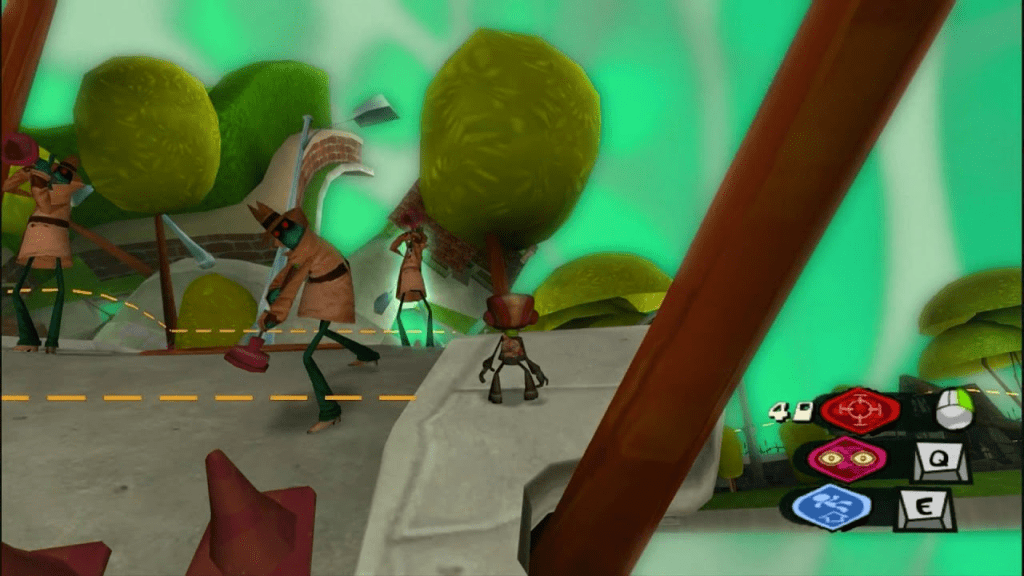
But in 2026, I’m not interested in making smart choices or talking about classic games revered by the gaming community. And, on a stubbornly personal level, as much as I love Psychonauts, it’s not a “world” I “visit”. It’s a “game” I “play”. A dang good game. And one that is, if anything, underrated and underappreciated. But its game world only exists for me between the time I start it up and the time I shut it down.
Brütal Legend, however,is a world I love down to the marrow of my bones, that just happens to have a pretty great game set in it.
I’m not sure what Schafer and the rest of Double Fine were smoking in 2005, when Psychonauts underperformed and the future seemed pretty uncertain. But apparently their proposal was to double down and make an even more ambitious game for the next hardware generation—an open world game in an utterly-unique fantasy setting inspired by heavy metal album covers. Rather than relying on their usual stable of voice actors, they got freaking Jack Black to play the lead, Tim Curry to play the villain, and somehow enticed some of the living legends of metal—Ozzy Osbourne, Rob Halford, Lemmy Kilmister, and Lita Ford to voice key roles as well. They licensed over 100 metal songs for the soundtrack, many of which were deeply integrated into key moments in the game. And they essentially devised their own genre as well, incorporating a complicated God-of-War-style combat system, vehicle combat right out of an old Carmageddon game, and even real-time-strategy elements into the design. The whole project is just a batshit-crazy endeavor.
And it looked like it was going to pay off. They released a demo of the game that won instant acclaim and attention. They hyped the game with some grand promotional stunts, like a Guinness-record-breaking air guitar performance, a concert featuring Gwar and 3 Inches of Blood, sponsorships for the 2009 Mastodon/Dethklok tour, and appearances by Schafer and Jack Black on late night talk shows.
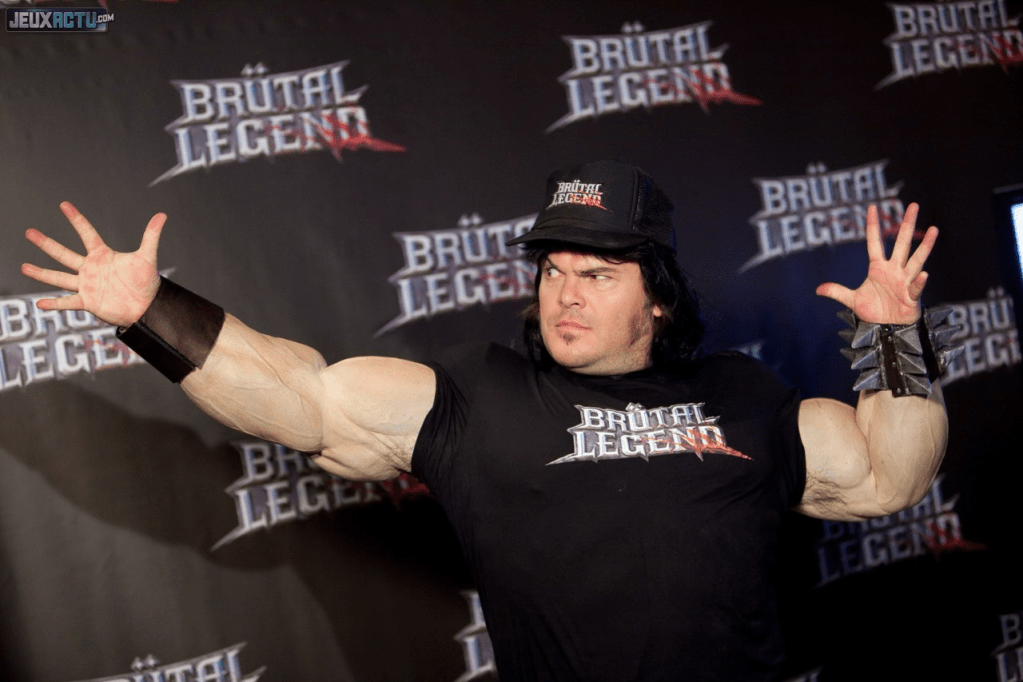
But there was more publisher trouble: Activision pulled out in 2008 after acquiring Blizzard, then sued Double Fine in 2009 after they cut a deal with Electronic Arts, at the same time as the large-scale promotions were underway. The suit stalled promotion and production, but the game finally released in October of 2009.
It flopped. Hard.
Even the critics were pretty divided on Brütal Legend, and its legacy isn’t nearly as stellar as that of Psychonauts. Worse, EA canceled their plans for a sequel, which effectively tanked Double Fine entirely. In the years to come, they would be reduced to releasing a handful of small indie titles. The next time they released a game as ambitious as Brütal Legend (or even Psychonauts) was the release of Psychonauts 2 in 2021, twelve years after the failure of Brütal Legend.
So this is the tale of the game that nearly sunk a studio. It’s a tale of passion and ingenuity, and, perhaps, of hubris and excess. It’s a tragic tale of a fledgling game developer flaming out spectacularly after producing one of the weirdest games in gaming history.
In short, it’s fucking metal.
Whoa, there. Don’t you think it’s time for a content warning?
Right, right. I got carried away.
(Are content warnings metal? Does it matter?)
Today we’re talking about Brütal Legend. Mostly because I want to. Also because it’s fucking awesome. And because it’s one of my all-time favorite video game settings, which means we have to talk about it in “The Year of Worldbuilding” or I’ll seriously regret it.
But we’re also going to do a few things differently with this essay.
For one, I’m going to swear. A lot. Because swearing is metal.
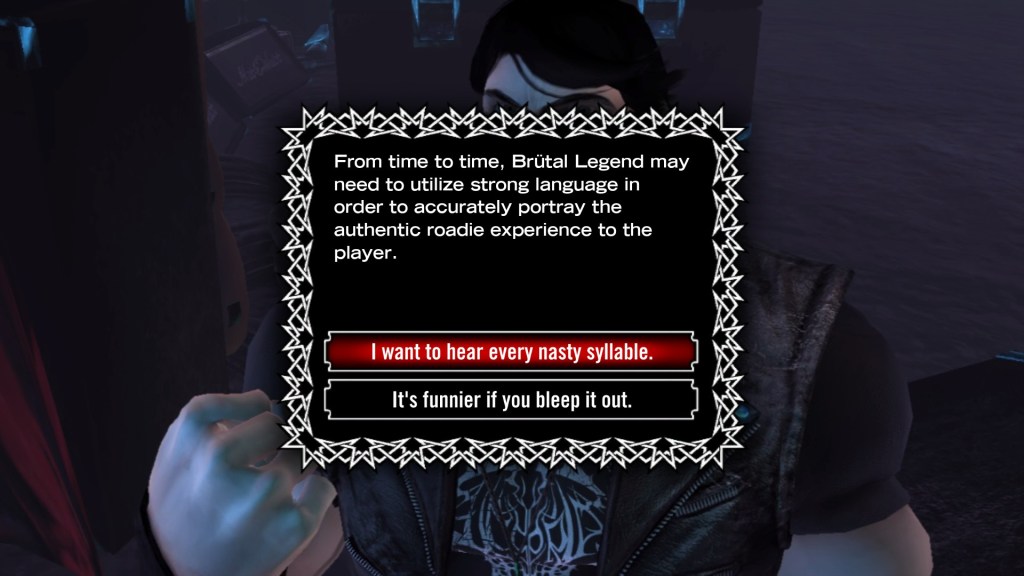
The game actually has this amazing bit at the very beginning where Jack Black is obviously about to let loose a string of curses, but a dialog box pops up and asks the player if she’d rather bleep out the foul language (“because it’s funnier”). I unfortunately don’t have that luxury, but you could always copy-and-paste the essay into Google Docs and bleep out the swears yourself if you like. Weirdo.
For two, there’s going to be nudity. And violence. Because they are also metal. (The game also has a dialog box for blood and gore which is even better than the first dialog box, because the beat is a misdirect to boot. This is literally in the first two minutes of the game after you press start.)
So let’s just lay down a blanket statement here: this is going to be an R-rated video game essay. Which I consider appropriate for an M-rated video game that is self-consciously indulgent about its adult material. Consider yourself warned.
Third, we’re going to SPOIL EVERYTHING. Or pretty close to it. So if you haven’t, go play the game. It’s great, it’s a nice tight 15 hours to get through the campaign, and it’s pretty cheap ($15 on Steam/GOG).
(Incidentally, pirating is also metal.)
Fourth, we’re going to spend a pretty substantial amount of this essay talking about heavy metal. It’s kind of unavoidable. The game is inspired by heavy metal music. It features heavy metal songs. And its conflict is, ingeniously, rooted in heavy metal politics (yes, that’s a thing). So I’m going to refer often to songs in the game. And I honestly recommend you listen to them when I do. Or just listen as you read. Or whatever. Here’s a fan page that collects the links to every song in the game: just follow along whenever you feel like it. You’re welcome.
But I also don’t want to present myself as an expert, which brings us to a related caveat (call it 4.5).
4.5: I don’t know a whole lot about heavy metal music culture. (Like, I read a couple books about it, which is the least metal way to learn about heavy metal.)
Unlike Tim Schafer and Jack Black, who are obviously dyed-in-the-wool fans, I was never really a part of the heavy metal subculture. My roommate in college was, and he introduced me to a lot of what was going on in the mid-2000s, but my real love of heavy metal came about as a result of this game.
Which is honestly going to be part of my thesis, namely that the game is infectiously enthusiastic about heavy metal, and I very much responded to that.
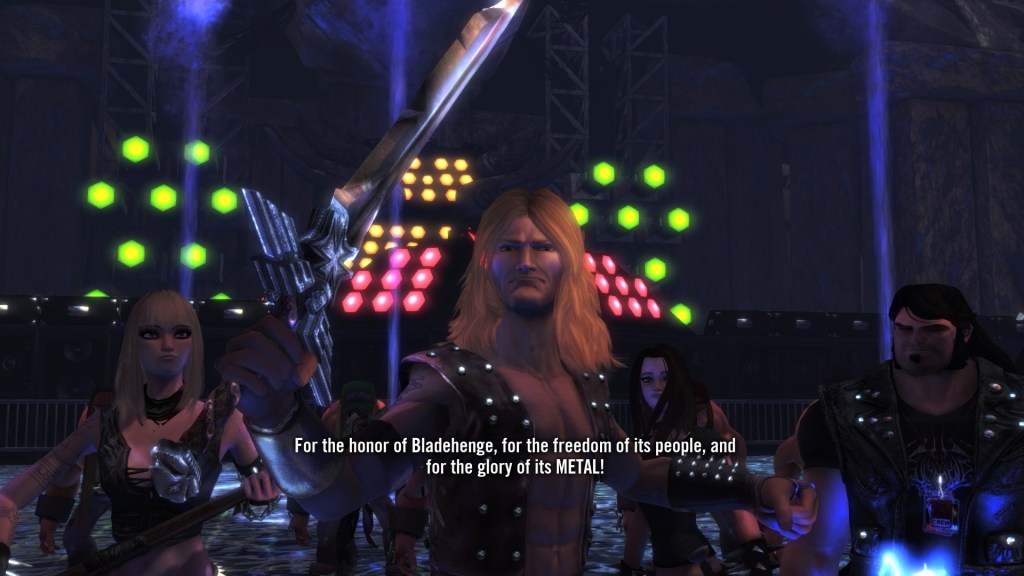
But this means that I am very much a heavy metal poseur, and if you are a legit heavy metal fan, you are perfectly justified in calling me out on that shit. I’ve never been to a concert, I’ve listened to very few metal albums all the way through, and I own zero merch.
I mention this, because metal fans are crazy fucking possessive about heavy metal. And I don’t mean that as a dig or a criticism. Just as a fact (tinged a bit by honest respect). Metal-heads love talking endlessly about sub-genres, ridiculing each other for liking or disliking certain bands or styles, and occasionally (very rarely) even murdering each other over it.
So I’m just going to get out in front of this right now:
Yup, I am wrong. I’m just repeating what I’ve heard. So feel free to torch me in the comments, or inscribe my name on your list. But I’m not going to fight you over it. ‘Cuz I know I don’t have a leg to stand on. Which makes it all the worse that:
Fifth, we are occasionally going to talk about some of the weird, controversial shit involved in heavy metal sub-culture. That includes:
Rape
Nazism
Satanism/Occult imagery
Suicide
Misogyny
Mental (and Physical) Illness
Murder
Extreme Violence (including Dismemberment/Death)
Arson
Hyper-Masculinity
Homophobia
Fascism and Anti-Fascism
Glam Metal
Like the Internet, metal is often steeped in layers of irony and earnestness that are occasionally very tricky to unpack, so I’m honestly not going to try. Since I’m still a novice about all this, I really don’t feel like I’m in a position to say whether Darkthrone is pro-Nazi, or Dub Buk is super-racist (especially in a post-Ukranian-War world).
(If you don’t know, don’t worry about it.)
My plan is actually to avoid most of the controversies altogether. This is an essay about Brütal Legend, not an apology for heavy metal culture in general. Double Fine largely avoids the most controversial elements of heavy metal culture, preferring to focus on and celebrate “classic” metal like Black Sabbath, Judas Priest, and Mötorhead, while neglecting the most messy contemporary metal developments like Norwegian Black Metal and its legacy of arson, murder, and Nazism—so we can largely avoid talking about them, too. But Double Fine is also aware of the Black and Industrial scenes, seeing as music by Prong, Marilyn Manson, Ministry, and Rotting Christ does make it into the game. Consequently, I’m forced to conclude that Double Fine is being selective about its inclusions.
And, again, I’m a novice, so I’m not sure exactly what to think about this. Is Double Fine deliberately whitewashing the most objectionable elements of a subculture it otherwise celebrates? Or are these members of the subculture correctly rejected by the community at large? Is this a kind of censorship, and, if so, isn’t it disingenuous to censor any part of a movement entirely dedicated to inflammatory, extreme expressions of controversial subject matter in order to shock and disturb the complacency of a placid bourgeois liberalism which hides its atrocities under banal reassurances and sickly, entertaining optimism?
I don’t fucking know. So we’re not going to talk about it.
But Isn’t That What You Do With These Essays? Highlight the Complicated Implications of—
NOPE. I said we’re not going to talk about it.
But…
NOPE.
…
…
…
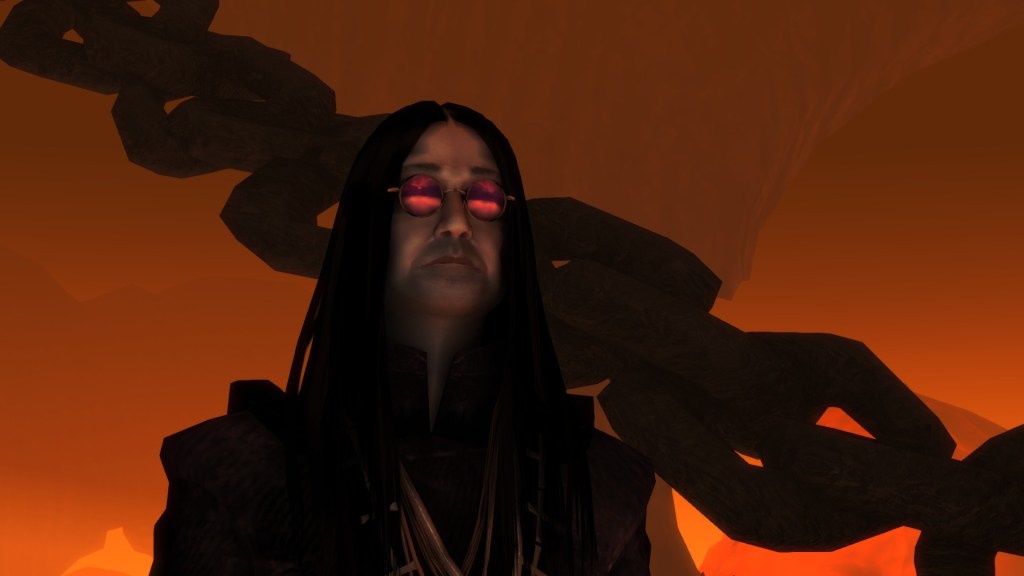
(Alright, maybe a little bit. But not until the very end. And only if you’re very good.)
OK. So. Brütal Legend.
Brütal Legend opens at a concert.
Our protagonist, roadie Eddie Riggs (voiced by Jack Black in what is almost certainly his best performance to date, don’t @ me), begrudgingly helps a band of poser nu-metal pop musicians to put on a concert, while bemoaning that he missed the time when the music was “real.” He has to go on stage to rescue one of the little pricks from a stupid stunt, when part of the stage collapses on him and he is seriously injured. Some of his blood runs into his stylized belt buckle, at which point the stage comes to life, kills the obnoxious band members, and transports Eddie to the “Age of Metal,” where the rest of the game will transpire.
This cutscene is wonderful. It’s entertaining, it’s funny, and it does a lot to establish our main character, the aesthetic of the game, and the thematic conflicts at stake in the world. Namely,
- Eddie is presented as a hyper-competent roadie whose job is to “stay out of the spotlight” and “make someone else look good.” Even when those people are ungracious little snots.
- Metal is lost. Eddie wishes he had been born earlier. (“Like, the seventies?” asks another roadie. “No, earlier. Like, the early seventies.” He replies.) The music now is corrupt and inauthentic, but Eddie represents that lost authenticity.
This second point is wonderfully demonstrated with an actual original song by the fictional boy-band-slash-would-be-metal-artists, Kabbage Boy, “Girlfriend,” which starts with a pretty epic metal riff before dissolving into lyrics more typical of vapid 2000’s-era boy band silliness, including a gratuitous rap solo.
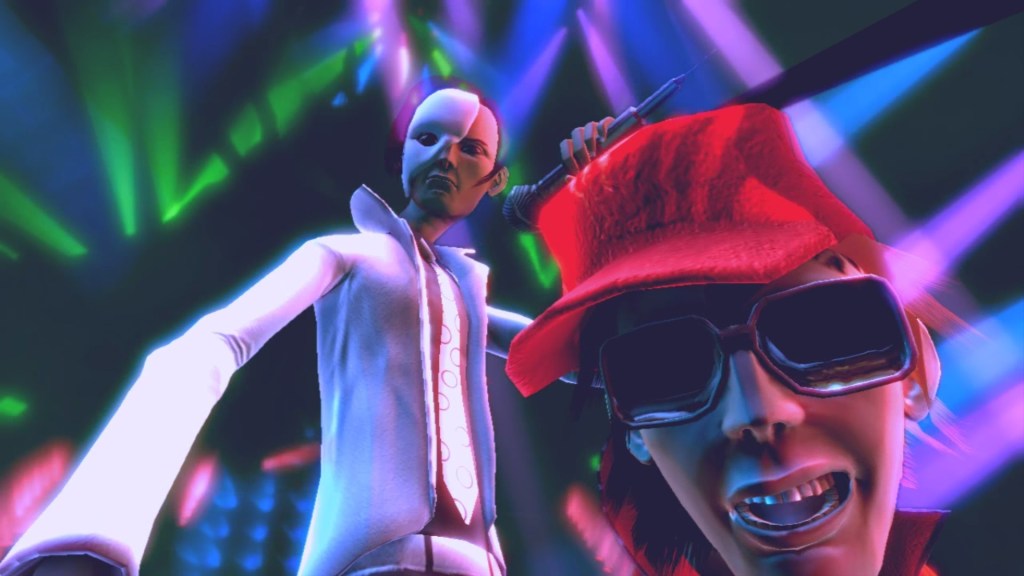
Even better, the song is listed in the soundtrack menu as “Second Wave of American Tween Melodic Rap Metalcore (SWOATMRM)” in a mischievous nod to the complicated taxonomies and cryptic nomenclature of metal nerds—which we’ll talk about shortly.
Eddie wakes up in an ancient-looking cathedral, surrounded by bone-filled sepulchers. He is attacked by demonic dudes in red cultist robes carrying knives while Black Sabbath’s “Children of the Grave” plays over the action. This serves as a combat tutorial, first for the axe (your primary weapon), then for the guitar (your secondary weapon). Yup. Turns out that playing the guitar at enemies zaps them with lightning or blasts them with fire. Metal music is physically powerful in this world.
After you dispatch the demon-cultist dudes, surprise! Turns out one of the robed cultists is a hot girl in goth makeup and spikes named Ophelia (“Oh no,” Eddie murmurs, “have I been killing hot girls this whole time?”), who was trying to sneak into the cathedral and undermine the ritual. She kicks butt, too, and keeps the demons at bay while Eddie, using his roadie expertise, assembles a hot rod (The Druid Plow) from nearby parts. Together they jump in the car and you run over a bunch of goons, Carmageddon-style, before fighting a demon tentacle in a boss fight where you ram its tongue in a giant circular arena. Ophelia figures out how to escape from the arena, but not before the entire location begins to crumble away, which culminates in a frantic race to the mainland while the road collapses away beneath you and the moon inexplicably explodes in the sky.
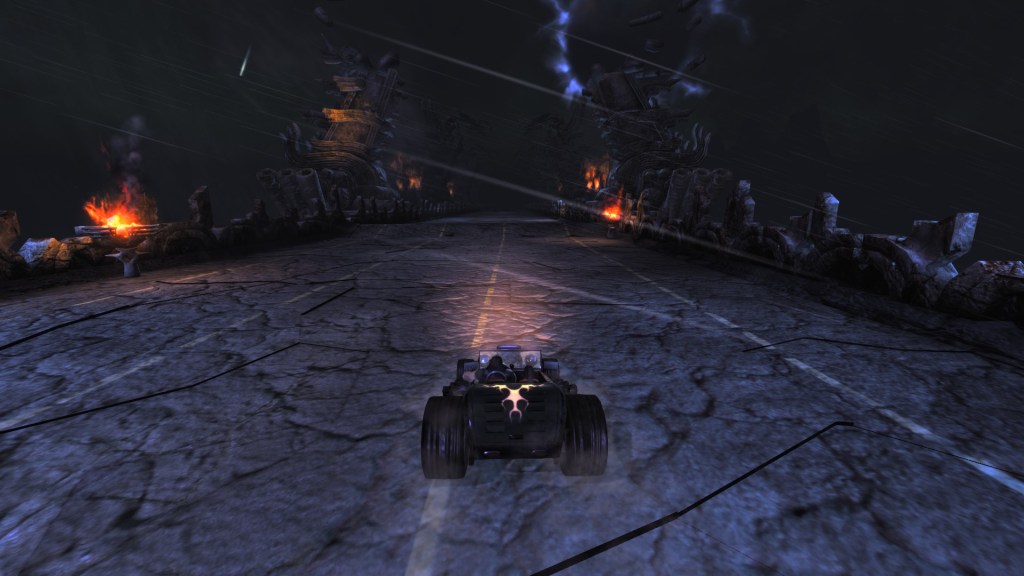
It’s got to be one of the greatest openings in video game history, and I know I just said that about Clair Obscur, too. I stand by it. The whole opening sequence, from the cutscene at the concert, to the combat tutorial, to the driving-boss-fight, still feels energetic, bad-ass, and fresh, even seventeen years later.
I emphasize this because it was also, start-to-finish, the demo for the game, available for at least a year before the game came out.
And I think everybody played this demo, back in 2008.
This was kind of a big deal, and kind of a unique cultural moment, so I want to dwell on this for a bit. In 2008, we were just a year or two into the Wii/XBox 360/PS3 console generation, and this was the first time home consoles were really designed with Internet access in mind. All three consoles had an Internet-based store where you could digitally download games (or demos, or DLC, or what have you), which marked a dramatic change from consoles past, where the game you bought was the game you were stuck with. I know we’re all pretty accustomed to digital download now, but it was truly novel in 2008, and the potential hadn’t really been explored yet.
So when Brütal Legend released a demo, this was big news. Everybody played it, because it was awesome that you could play it. That, for no charge, you could stick this little chunk of gameplay on your console and play it as often as you liked.
And it was fucking awesome. Again, breath-of-fresh-air gameplay, harsh and violent and cathartic, with great comic timing and brilliantly original designs, Jack Black’s charismatic voice work livening the otherwise mundane business of tutorializing—this was a great demo that got everyone truly psyched for the game.
The thing is…the game we got wasn’t exactly what was promised.
The Somber Grounds of Truth
So Brütal Legend is a real-time-strategy (RTS) game.
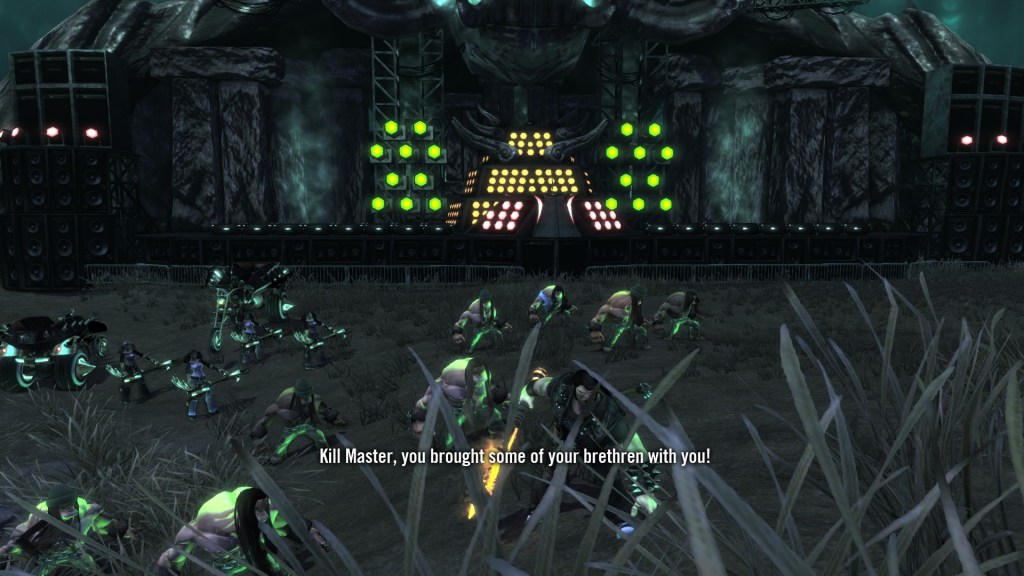
Like, it’s got a pretty robust, God-of-War-style combat system, sure. And it’s got the really cool car-combat mechanics, that even includes adding rocket launchers and flamethrowers to your hot rod, just like Carmageddon or Streets of Sim City (for a really deep cut). These are consistent features of the game.
But the real meat of the gameplay is its “stage battles”. Your stage goes up on one side of the battlefield, your enemy’s stage goes up on the other side, and you throw dudes at each other until one of you destroys the other one. You can run around hitting people with your axe and playing music in these battles, and you can even summon your car and run over/machine gun enemies with it, but you’ll also be managing your economy via control points and summoning troops via a menu, and even giving orders on the battlefield in real time.
This was not in the demo, though. And I don’t think Double Fine intended to omit it, or that they thought this would somehow be a dealbreaker for players of the demo. But it kind of was. The industry has since learned that demos are a double-edged sword: if they’re good, they can hype up your game, but if they’re good and unrepresentative, they’ll actually hurt your overall sales. People will get wise, once copies start selling, that the demo they played was different from the game you want them to buy, and they’ll absolutely give the game a pass. And if the demo is bad, well, forget it. Way to shoot yourself in the foot.
So I think the demo was a major contributing factor to why Brütal Legend just didn’t sell so well—and why it seemed like such a disappointment to EA, specifically.
What’s more, this is just one of the most baffling moves on the part of Double Fine.
Real-time-strategy just does not translate to consoles!
Look, I love the RTS genre. Age of Empires was one of my earliest, favorite games, followed closely by the release of Starcraft in 1998. I’ve been a faithful fan of the genre through thick and thin, and I’m always interested to see what kind of weirdo innovations emerge. But it’s a tough genre to get right, and the most successful iterations of the RTS tend to position the player in a god’s-eye perspective, with mouse and keyboard to enable fine-tuned positioning and rapid, complex commands.
In 2009, the history of RTS on console was pretty dang sparse. Prior to 1996 and the advent of 3D, there were a handful of semi-successful top-down 2D games that worked on SNES, but they were rudimentary at best. The clumsiness of the controls necessitated slow, ponderous movement, and it was usually better to just make your game turn-based, rather than real-time.
In the N64 era, with 3D, there was even less room for real-time strategy. Animating all those dang models took a lot of resources, and the controller had extremely limited power for quick, precision movement, seeing as we didn’t even have a second control stick yet. But somehow they still ported Starcraft to N64 for some reason. It was…not an ideal format for the game.
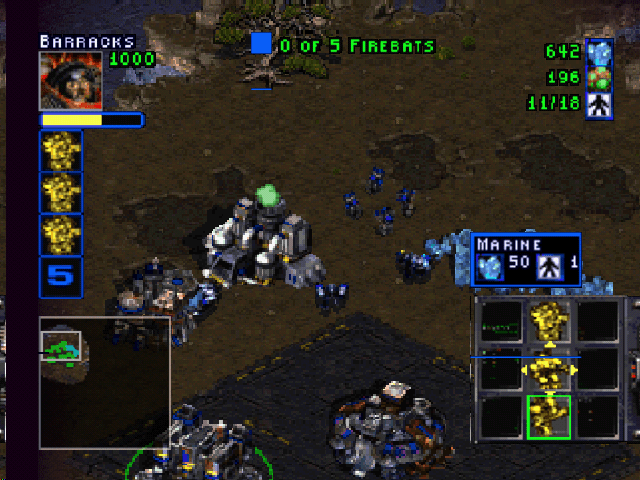
A more successful formula was pioneered by Rainbow Six. These are typically called “tactical shooters” rather than “real-time-strategy,” but they are in the same ballpark. The key with Rainbow Six is that you plan your team’s movements beforehand, making adjustments on the fly, so most of the fine-tuning happens before the real-time gameplay properly starts.
The second iteration started becoming more prevalent in the next console generation, with games like Oddworld: Munch’s Oddysee, Pikmin and Battalion Wars (and, while we’re on the subject, Lost Kingdoms). These games gave you a player character, usually in 3rd-person perspective, and a suite of commands that allowed you to order your allies to move, attack, or perform other commands. Oddworld made this work by giving you a manageable number of allies to command, rarely more than twenty. Pikmin gave you many more, but the commands were simplified, and, in many cases, contextual. Throwing a Pikmin at something would cause the Pikmin to act on it—attack an enemy, build a building, harvest a resource—but you did not have to specify which. Additionally, the game used the second control stick to great effect by making it possible to direct the whole following army so you could avoid hazards or sweep the lot of them into enemies. It was nowhere near the sophisticated control you could find in a typical PC RTS, but it was getting a bit closer.
Battalion Wars was almost certainly the most ambitious of these games I played. Battalion Wars was an ambitious development on the successful Advance Wars formula for GBA, with the turn-based tactical gameplay updated to real-time with the same player-avatar character as Pikmin or Oddworld, just with the ability to build a variety of unique units and give orders to them individually or in groups, according to context, as well as occupy any unit on the battlefield. It was pretty rough, though, with a complicated interface and control scheme, and the clumsiness of the controls had to be balanced by some pretty weak level design. In 2005, though, I would have called it the gold standard for the genre, even if I would then go on to question why we even have this genre.
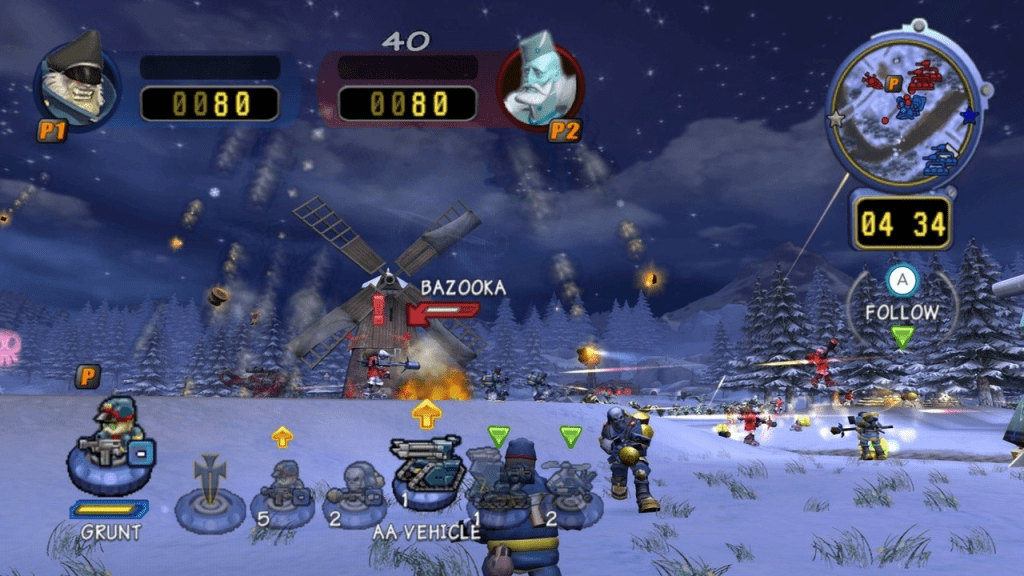
I say all this to emphasize, first, that RTS was a justly unpopular genre on consoles in 2009. The formula really hadn’t been cracked yet (and, I would argue, hasn’t been successfully cracked to this day). And that I know what I’m talking about when I go on to say:
Brütal Legend is probably the single best, most ambitious implementation of a console-based RTS I’ve ever played.
Yes, this is a back-handed compliment. The RTS gameplay in Brütal Legend is still clumsy, awkward, and inexact. But also, Brütal Legend kind of borrowed liberally from all the ideas that had existed before this, improved upon them, and did so with style. To the point that most of the console-friendly RTS games I see nowadays are still riffing off the Brütal Legend formula—except that it isn’t a formula, and it is clear that it isn’t a formula because these newer iterations get stuff wrong that Brütal Legend got right.
Marching Off to War
First, Brütal Legend tutorializes its strategy elements gradually and deliberately. Starcraft is the gold standard here, and Brütal Legend basically follows the Starcraft formula beat-for-beat, except that it’s subtler about it because your strategy-battles are broken up by driving missions, side quests, and futzing about the open world.
Starcraft, like Brütal Legend, has a zillion units the player needs to learn about, along with complicated production chains and economic management. So Starcraft solves this problem by basically turning its 30-mission campaign into one huge tutorial. The early levels introduce fundamental mechanics (like moving, attacking, harvesting resources, etc.), but later levels typically introduce one (and only one) new unit to the player at a time. Typically you’ll see the unit in action before you have to build it yourself, so you can see the unit’s strengths, weaknesses, and special abilities, and how it fits into your army. Then the game strongly suggests you build some of your own, by designing the level in such a way that you need to master that particular unit to progress. Wash, rinse, and repeat until the entire suite of units is available to the player.
Brütal Legend does the exact same. The first mission with strategy elements introduces the most basic unit of your army, the Headbanger (which is, as the name suggests, a metal fan with grotesquely overdeveloped neck muscles, who attacks enemies by headbutting them). Over the course of the mission you learn how to give orders using the D-pad (attack, defend, follow), as well as how to apply bonuses by playing guitar riffs.
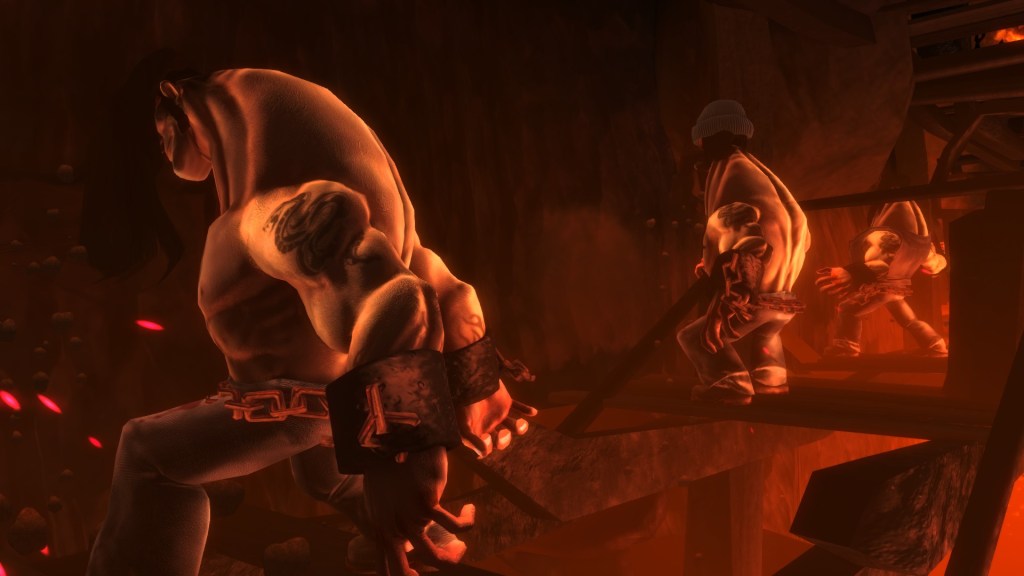
Over the next few missions the game introduces Razorgirls (blond girls with blowouts wielding long-range rifles) and the Thunderhog (mustachioed bassists on motorcycles who heal units with the power of their soothing basslines). Only then does the game introduce stage battles, where the player has to defend their stage from waves of attackers by summoning units (Headbangers, Razorgirls, and Thunderhogs), harvesting resources (fans), and using the stage’s defensive powers.
From there the game continues to introduce one unit at a time, with periodic stage battles to test the player’s knowledge, all the way up to that second-to-last mission of the game, which introduces and requires the final unit (the Rock Crusher). Consequently, Brütal Legend never overcomplicates a mission or requires the player to make a leap in logic. The stage battles have the same array of units you might find in a proper RTS, but the production pipeline and resource management are streamlined, and each unit has been carefully introduced over the course of the missions. The player can concentrate instead on tactical unit management from battle to battle.
Which still isn’t great, to be honest. The basic commands (follow, attack, defend) are reasonably effective, but imprecise. The game gives you several key songs for tactical value, like moving the rally flag (where units will naturally congregate after being built) and summoning all units on the map to your location, but they are no substitute for the standard powers at your disposal in most PC RTS games. And while the game does have a mechanism for individually selecting units and giving them unique orders, it’s slow, cumbersome, and tough to execute in the fray of battle. It is there, though.
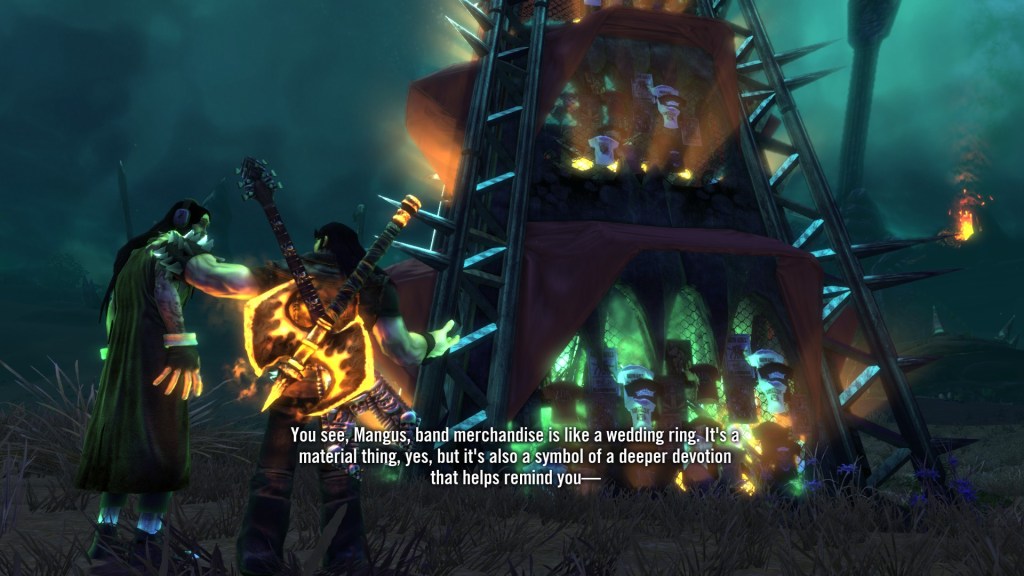
The basic level design and rhythm of battle, though, don’t require these sorts of precise maneuvers. The only resources in a stage battle are fans, which come out of a geyser and need to be harvested by building a merch booth. So the battles are essentially moving your units from geyser to geyser, defending them from attack as you mount attacks against more distant positions. It’s a pretty fundamental unit of strategy gameplay, as typical of MOBAs as Tactics and Strategy games. And it means that you really only need the tools that are given to you—basic orders for positioning and attacking and a rally flag for point control. This gets a bit more complicated when there are multiple routes of attack, but there’s really only one stage battle that has two distinct lanes, even though the multiplayer maps more frequently employ them.
Hold that thought.
Second, Brütal Legend makes the player character a powerful unit in its own right. Captain Olimar of Pikmin, Abe/Munch of Oddworld, and Katia/Tara of Lost Kingdoms rely on their allies to fight for them; they can’t really turn the tide of battle under their own power. In Battalion Wars the player avatar has an attack (as I remember; it’s been ages since I’ve played that game), but it’s weak and doesn’t really sway the tide of battle. But Eddie very much does. This is comparable to (but almost certainly not modeled on) the hero system in Warcraft III, where each commander has a powerful, unique unit with special abilities that often serves as a buff to nearby units and a strong warrior in its own right—but I think it’s more likely that Double Fine had planned the action elements of the game before their incorporation into the strategy game around it.
But Eddie is very much a tactical consideration in battle. You can change his axe and guitar upgrades for different purposes: the flaming axe does damage over time to individual enemies, while the lightning axe zaps multiple nearby enemies with each strike, and the blood axe saps health from enemies and restores it to Eddie for a survivability advantage. Likewise, you can upgrade the guitar strings to do bonus fire damage, bonus shock damage, or to shorten the refresh times on your guitar solos, giving you access to your powers more frequently. And you can drive the car around on the battlefield, choosing its weapons to suit your strategic purposes: you can get the mine dropper and lay mines at key choke points, or buy the heat seeking rocket launcher to do more damage to buildings and high-profile targets, or buy the subwoofers to knock away infantry units. And Eddie’s solos have a wide variety of battlefield effects. You can immediately kill nearby infantry with Facemelter, block unit construction with Rock Block, negate debuffs with Light of Dawn, or do a whole bunch of damage by crashing a blimp into the battlefield with Bring it on Home.
You can also team up with any of the units in your army, sacrificing Eddie’s individual combat prowess for a powerful special attack. Team up with the Headbangers, and you’ll make a Mosh Pit, surrounding Eddie with a defensive perimeter of Headbangers doing damage to anyone foolish enough to get close. Team up with the ballista-esque Headsplitter, and you can do precise, super-long range damage to distant enemies. Team up with the stealthy Roadies and you can sneak up to enemy buildings undetected and do massive damage with their amplifier feedback. And these team attacks are as simple and straightforward as approaching a unit, pressing one button to team up, and the same button to fire their attack, with the ability to cancel at any time. Simple, straightforward, and versatile.
As much as I lament the imprecision inherent in any console RTS, it’s clear that Double Fine knew this was a problem and planned around it. And, honestly, it’s kind of weird to think that a game about HEAVY METAL-THEMED BATTLES would place a lot of emphasis on precision. Like, there’s honestly some complicated conversations to be had in the metal world about sheer raw volume versus fine-tuned technical proficiency, but it’s clear that the priority in Brütal Legend is and should be making the player feel like a fucking badass. And it does. Wherever the player character is on the battlefield, you can bet that they are the biggest threat out there. At any moment you could be running over a pile of infantry with your car and setting them on fire with the side-mounted flamethrowers, or using the stage effects to lay waste to attackers, or teaming up with your allies to do major damage to specific targets, or dropping a fucking blimp on a mass of enemy units. Brütal Legend isn’t a game for tactical subtlety. It doesn’t ever stop being an action game, even when it does choose to also be a strategy game. And that makes it very much unlike (and rather superior to) every other console strategy game I’ve ever played.
Third, did I mention that Eddie flies?
Eddie flies.
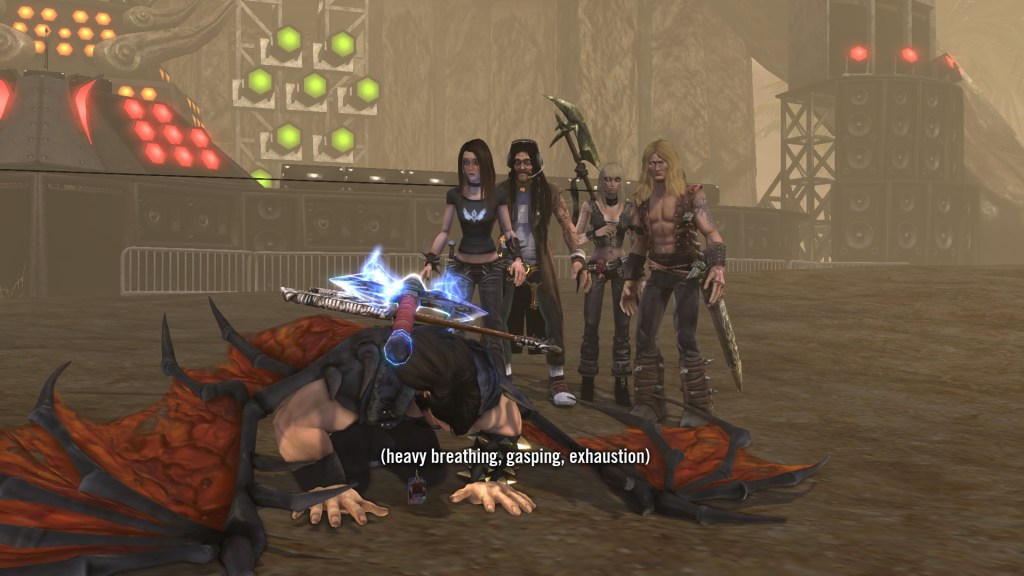
Only during stage battles, and the game slaps you around if you ever try to fly out of the arena, but you can zip around the battlefield from the typical RTS god’s-eye-perspective, giving orders, making plans, and looking for enemy movements. You can’t be attacked while airborne, so it can also be used to retreat out of battle when necessary.
More than any of the other choices made by Double Fine, I think this one is brilliant—and largely unreproduced. We’re still not at the level of using the mouse to command groups of units or the keyboard to set command groups, but this goes a long way toward giving the player real strategic power over the whole battlefield.
If anything, it might be too powerful, seeing as you can fly to specific targets and attack them before the rest of your units arrive. Or fly to the enemy base at the very beginning of a mission, summon a fucking hextadon on their doorstep, and then drive around harassing their towers while you build up your army.
Except, of course, for one key factor.
Fourth, Brütal Legend is multiplayer. Competitive multiplayer.
I know, right?!?!
I don’t think it would be right to call Brütal Legend the first console-RTS with multiplayer—but it’s probably the earliest one that deserves the title without caveats. Pikmin 2 and Lost Kingdoms both had PvP multiplayer, but you’d be hard-pressed to call them “strategy games” in the same sense as Brütal Legend, seeing as the resource management in both games were very rudimentary, and neither has nearly the variety or complexity of units that you can see in Brütal Legend. Battalion Wars didn’t even try to include multiplayer. And all of these games, by necessity, would have been split-screen multiplayer, since Internet-based multiplayer was still very new to console gaming in 2009. I might still be overlooking some games, since I’m not omniscient, but I defy you to come up with a console RTS as effective, dynamic, and varied as Brütal Legend—even today.
Because I’ve saved the best for last…
Fifth, Brütal Legend is asymmetrical.
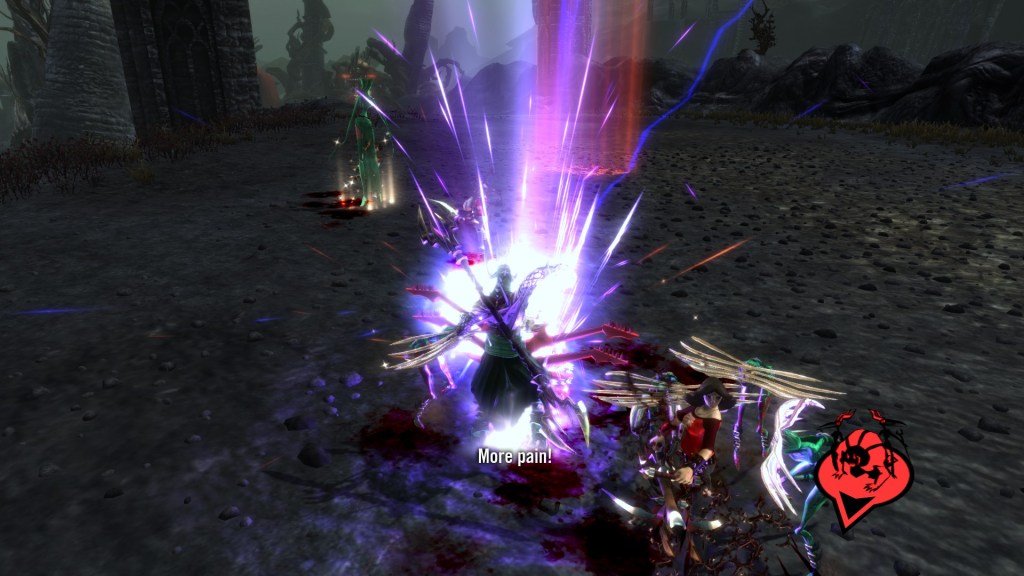
I KNOW, RIGHT?!?!?!
Asymmetrical real-time-strategy is the holy grail of strategic game design. It’s crazy difficult to pull off, and even more difficult to pull off well. Starcraft was the trailblazer here, and remains an e-sport in South Korea to this day. Warcraft III attempted the even more ambitious feat of having four asymmetrical factions to Starcraft’s three, but it was not nearly as well-balanced. Grey Goo tried to do the three asymmetrical factions, and was reasonably successful, but the game just never caught on.
And here’s Brütal Legend, with the biggest fucking balls in the world, saying, “yeah, we’re going to do asymmetrical faction design, but we’re going to do it on console, and we’re going to give the player characters crazy powers, and we’re going to make each faction deeply connected to the world-lore which is actually rooted in heavy-metal culture of the 1980s and ‘90s—what of it?”
But, yeah. There are *technically* four factions in the game, though Lionwhyte’s hair-metal-inspired faction is basically just a costume swap for the player faction, Ironheade. (“With an ‘e’ on the end, so they know we’re not messing around!”) But you’ve also got the Drowning Doom, the Goth/Death-metal inspired army with deep gothic-horror elements, and the Tainted Coil, the demonic faction with its S&M/bondage-inspired designs and associations to Black/Industrial metal music. And in each case, the player controls a powerful avatar (Eddie, Lionwhyte, Ophelia, or Doviculus), each of whom has their own unique attacks, guitar riffs, car, and team-up abilities with every one of the units in their faction.
Unfortunately, it’s still just a goddamn console RTS.
It’s obvious that Double Fine designed this game with grand aspirations in mind. They were aiming to make a game with a thriving competitive multiplayer scene, carefully balanced, lavishly designed, and with a truly unique and rich strategic gameplay loop. And, as always, I champion exactly this kind of weird, ambitious, innovative, and unique design. But this was all kind of a waste. It’s fascinating and beautiful as a curio, and it’s metal as hell that they spent so much time and energy lovingly designing all of these factions and units, but RTS just isn’t a mainstream genre. As much as I respect the sheer audacity of trying to make a mainstream RTS by fusing it with action elements, in truth Double Fine didn’t make a hybrid game to appeal to RTS fans and action fans alike, but a niche game that alienated RTS fans with its oversimplicity, and alienated action fans with its RTS stage battles. Rather than appealing to a wider audience, it narrowed the pool of fans to a very limited circle.
Which is, honestly, also very metal.
But it’s there. At this point, I’ve played the campaign at least a half-dozen times, and I’ve mastered the rhythm of the stage battles to the point that I can absolutely see what they’re going for, and I respect the hell out of it. All the tools for commanding the battlefield are there. The units are all carefully balanced, as well as being aesthetically fascinating. Every problem you encounter has a strategic solution which you can rapidly implement. And the action elements of the game make the strategic battles a fascinating blend of frenetic combat and tactical prowess. It’s a good game.
But in 2009, there was no precedent for this, even if you were quietly playing Pikmin and Battalion Wars and wishing they were more like Starcraft and Age of Empires (which I very much was). Hell, there’s still no precedent, even in 2026. (RTS is probably even more niche now than it was in 2009, if I’m honest.) Gamers broadly dismissed the game as this clumsy mess, without bothering to explore its unique potential. The gameplay was just too alien for players to really crack it open and see what it had to offer, including myself. Consequently, it never got the player base it needed to be a multiplayer sensation. Those who did remember the game remembered it as an open world game set in a cool, heavy-metal world, without realizing how much that world and its mechanics were designed to integrate into the strategic battles. It’s all of a piece, but I don’t think there were many players out there interested in seeing the whole picture.
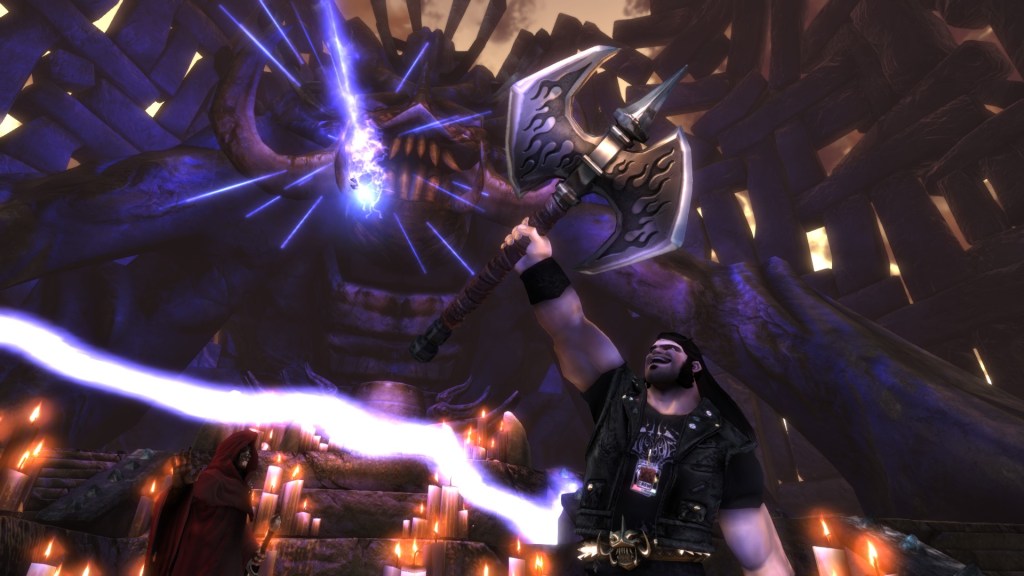
But fortunately, I’m here now—oracle to the heavy metal gods, ready to interpret the cryptic designs of Tim Schafer and Jack Black to the metal-hungry masses. BEHOLD!
…
Hello?
Is anyone listening?
…
Maybe let’s just talk about the world instead.
World of Hurt
So the world, plot, lore, gameplay, music, and unit design is all of a piece in this game, as I’ve suggested, and abstracting away any one of those pieces is kind of difficult. The lore of the game is fed to the player when the discover “Artifacts of Legend” dotted around the map, and the game carefully limits the player’s access to the lore until they experience certain events in the plot. The world itself is divided into three main continents, gated by choke points that are also locked by the plot. But you’re most likely going to stagger your experience of the plot with futzing around the open world, doing side quests, unlocking upgrades (and lore), and running over the game’s fauna with your car while 3 Inches of Blood’s “Deadly Sinners” blasts on your car’s radio. Metal.
So let’s divide up the game into (roughly) three parts, each corresponding (roughly) to one of the game’s continents. Then, for each part/continent we’ll discuss (1) the world, its landmarks, and its wildlife; (2) the plot; and (3) the new units, factions, and lore we discover along the way. Cool? Cool.
Continent 1: The Epic Plains of Metal
(That’s not the real name, but I think it’s fairly descriptive.)
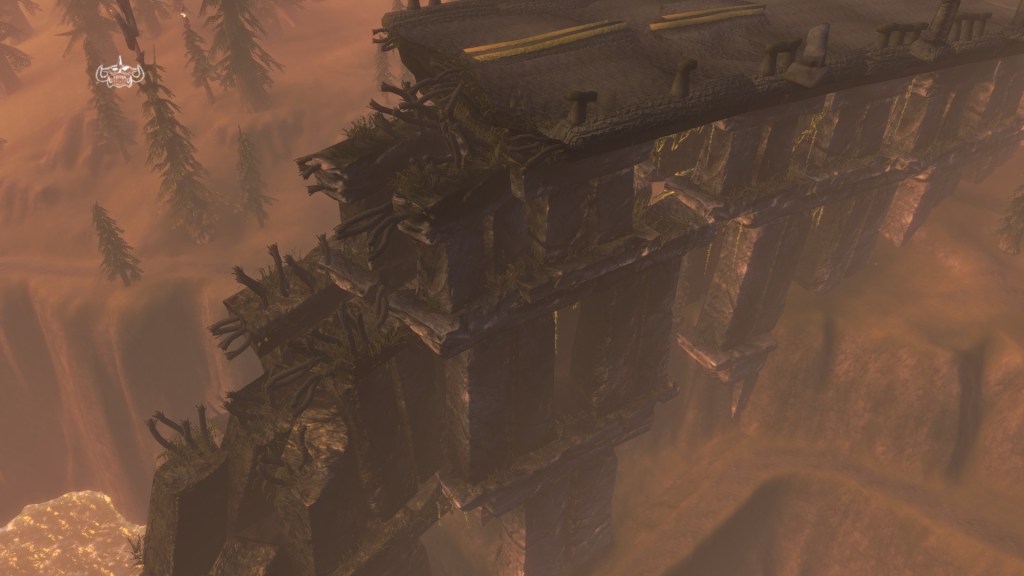
Once you exit the part of the game that was in the demo, there’s a huge chunk of the open world available to you. The road behind you is destroyed, making it impossible for you to go back to the demo/tutorial area, and you’d be wise to follow the plot long enough to unlock some side quests and weapons to facilitate exploration, but if you just want to drive around and run over quill pigs, that’s your business.
It’s clear that the designers wanted the first continent to be familiar, but distinct. The landscape is mostly composed of the familiar green rolling hills of any medieval fantasy game or setting, but with distinctly heavy-metal themes landmarks, accents, and flourishes. Think The Shire of Peter Jackson’s Lord of the Rings movies, but with the trees bladed like halberds at the top, the bushes made of cymbals, and suspiciously prominent asphalt highway ramps enabling hot rods with flame decals to perform sick jumps into the open sky. The world is also prone to dramatic shifts in weather. There’s a typical day/night cycle to the game, but you’ll also encounter dramatic thunderstorms, volcanic eruptions, blinding dust storms, and occasional blasts of feedback from the Screaming Wall. Familiar, yes, but never safe or comfortable.
Home base for the first few missions is Bladehenge, a Stonehenge-inspired ring of stone arranged in amphitheatre-like tiers, surrounding a giant stone sword plunged into the ground by the titans of old. On the tiers of the amphitheatre rest tents, campfires, stacked bottles of beer, colorful stage lights, trees made out of exhaust pipes, racks of weapons, and training dummies (with General Lionwhyte’s huge hair) which passing troops will occasionally headbang, shoot, or stab.
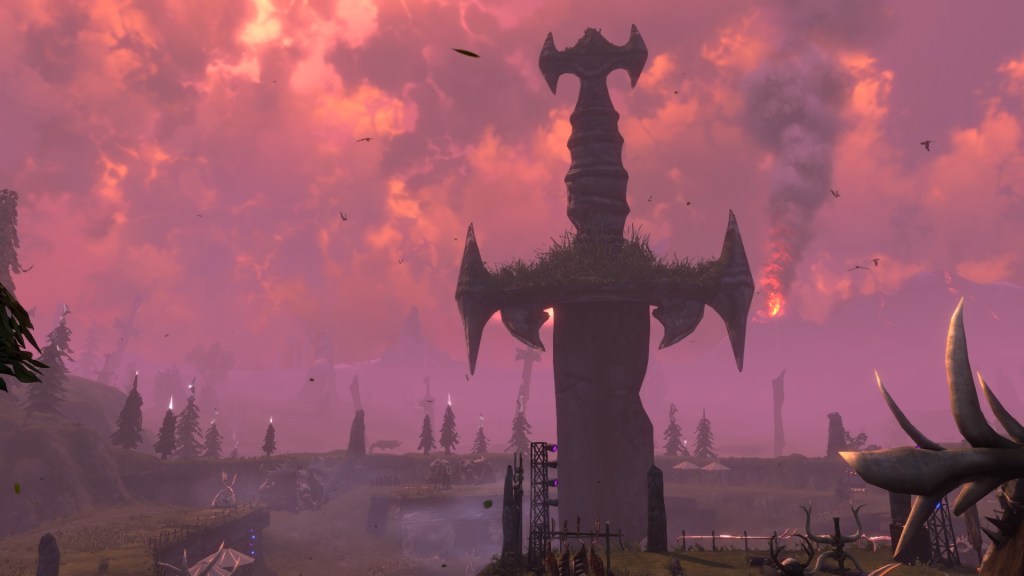
Drive around and you’ll find similarly imposing (and similarly-themed) landmarks dotted across the landscape: a giant stone statue of a guitar cradled in hands with studded cuffs; Mount Rockmore, whose four faces (initially of Lionwhyte) can be changed if you climb a rock monument of an upraised fist throwing metal horns; a massive raised highway on stone blocks bisecting the continent into its northern and southern halves; the Screaming Wall: a massive bank of amplifiers extending way out into the sea—to name just a few. Scott Campbell writes in the Introduction to The Art of Brütal Legend that they were inspired by metal album covers and Frank Frazetta art. According to Campbell:
We covered the walls with reference images: Frank Frazetta paintings, metal album covers, green cliffs and hills of Nordic lands, medieval weaponry, Vikings, demons, hot rod-culture monsters, Bosch paintings depicting hell. We spent a week in this heavy metal den we had created for ourselves, trying to outdo each other with the most ridiculous creations we could possibly imagine for the world of Brütal Legend. Volcanoes of molten chrome! Lighters in the skies creating the stars! Massive anvil mountains with titans hammering upon them from the heavens! We piled up so many ideas that we could have made a hundred games.
The iconography of the game is the most immediately distinct. The landscape is littered with car parts, massive stone monuments invoking Nordic symbols or musicianship, and creatures with jagged metal spines, horns, and jaws. The heavy-metal aesthetic is imposed on every rock, tree, animal, and character.
This is explained by the creation myth you’ll gradually unravel by finding Artifacts of Legend.
Ormagöden, the Fire Beast, Cremator of the Sky, came down upon the dark, demon-riddled world, and enriched it with his fire and light. But the demons hated Ormagöden, lured him into a trap with the beautiful music of the goddess Aetulia, and killed him by drowning him in mud. But Ormagöden sensing his last moments, exploded in an earth-shattering scream, dotting the world with his metal flesh, creating the sun with his fire, and drowning the demons in the oceans of his blood.
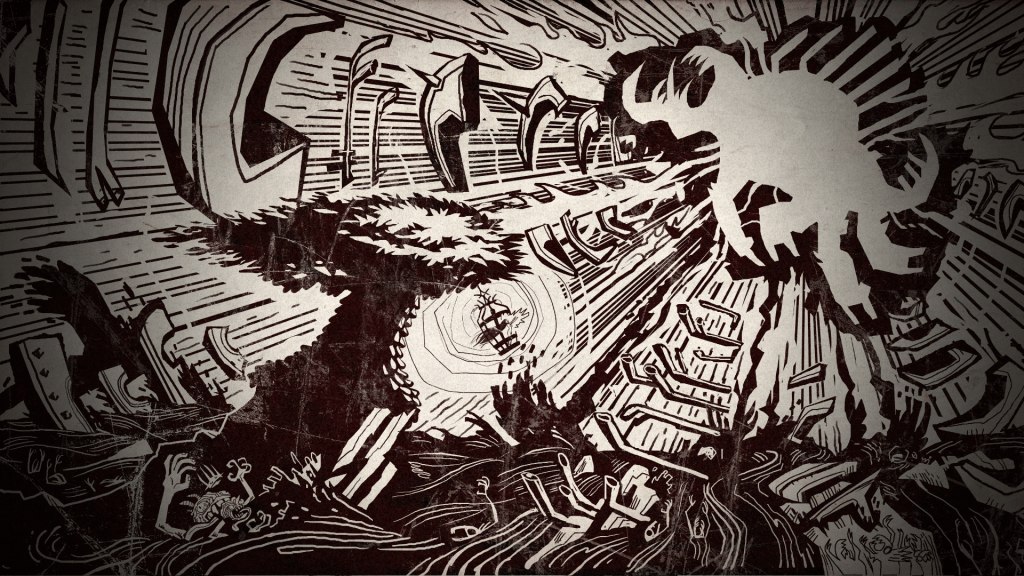
From the oceans rose the Tainted Coil, a race of hideous, self-loathing demon-like creatures, and the Titans, who took the metal of Ormagöden from the earth and built skyscrapers, hot rods, and, of course, heavy metal music, before ascending into heaven—heavy metal gods. Before they left, though, they wrote instructions for all they’d built and inscribed them into the land itself—but the Tainted Coil could not read or understand or replicate what they had wrought.
Metal.
But that’s all in the distant past. We have new problems to deal with.
Ironheade vs. Lionwhyte
Ophelia, the bad-ass hot girl who fought with you in the opening act, takes you to Bladehenge to meet Lita and Lars Halford. Lars and Lita represent all that is left of the resistance to General Lionwhyte, the glam metal stooge who has enslaved all humanity under Emperor Doviculus of the Tainted Coil (voiced by Tim Curry, but with all menace and no levity). Your first mission for the resistance is to liberate the Headbangers from Lionwhyte’s mines, and return them to Bladehenge.
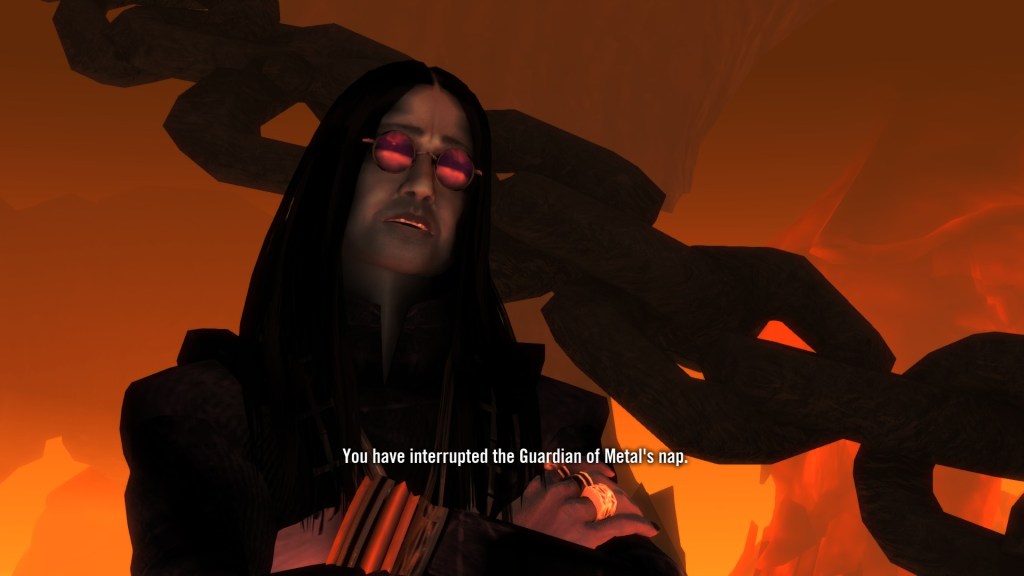
Along the way you’ll probably run into the Guardian of Metal (voiced by and clearly designed after Ozzy Osbourne), who resides deep underground, accessible only by the “Metal Forges” dotting the landscape, which you’ll need to raise out of the ground with a guitar riff. The Guardian of Metal gives you upgrades to your weapons, car, and combos in exchange for fire tributes (symbolized by raised lighters), which you earn for “pleasing the metal gods” (i.e., fulfilling side quests, freeing bound dragons, making sick jumps off of ramps—the usual stuff).
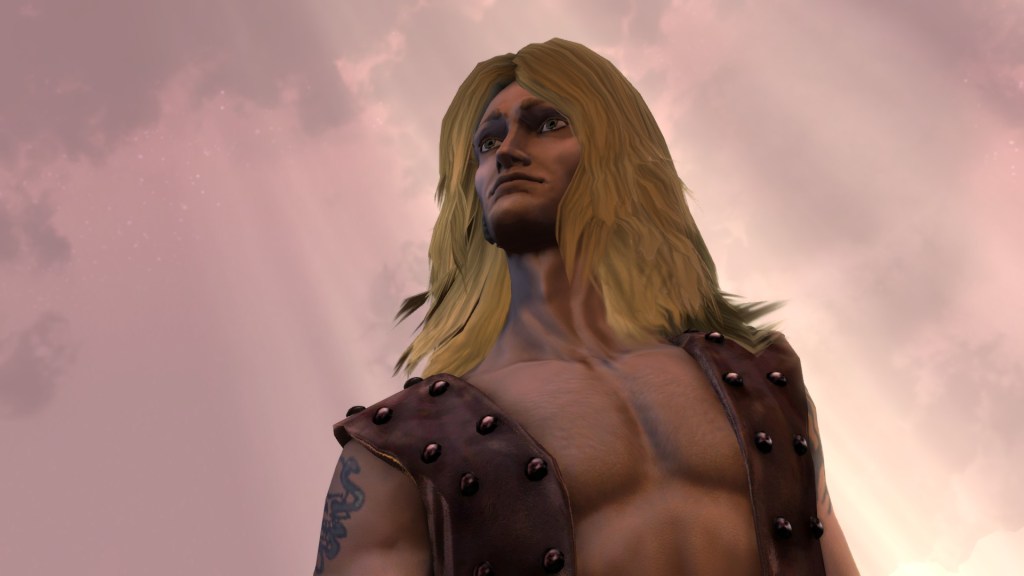
In your ongoing battle against Lionwhyte, you’ll pick up many new allies: Ophelia’s Razorgirls, Killmaster’s Thunderhogs, the stealthy Roadies, and the Bouncers, with their massive oversized fists. Lionwhyte, meanwhile, has rivals to each of your units: Hairbangers, Groupies, Glamhogs, Watt-R-Boys, and Glitter Fists—all glamm’d out with oversized, over-sprayed hair, fishnet stockings and gloves, makeup, feather boas, and other colorful accessories (in stark contrast to the jeans-and-leather look of Ironheade units).
But we should probably take a second to unpack this a bit.
Andrew O’Neill in The History of Heavy Metal, writes in a footnote to his chapter on Glam Metal (“Fucking Glam Fucking Metal”):
I will state for the record here that on the whole I fucking hate this style of music. It represents everything I despise musically, aesthetically, politically and morally. It is a corruption of a thing I love and I would happily kill it with knives. In the live-show version of this book I have only ninety minutes to cover everything and so I can arrogantly and blissfully dismiss it as shit and move on. Sadly for both of us, dear reader, this book needs to be a bit more comprehensive and so we just have to do our best to glean something positive out of our coverage of a musical movement that can only accurately be described as a stinking ditch full of rotting pus.
But how do you really feel, Andrew?
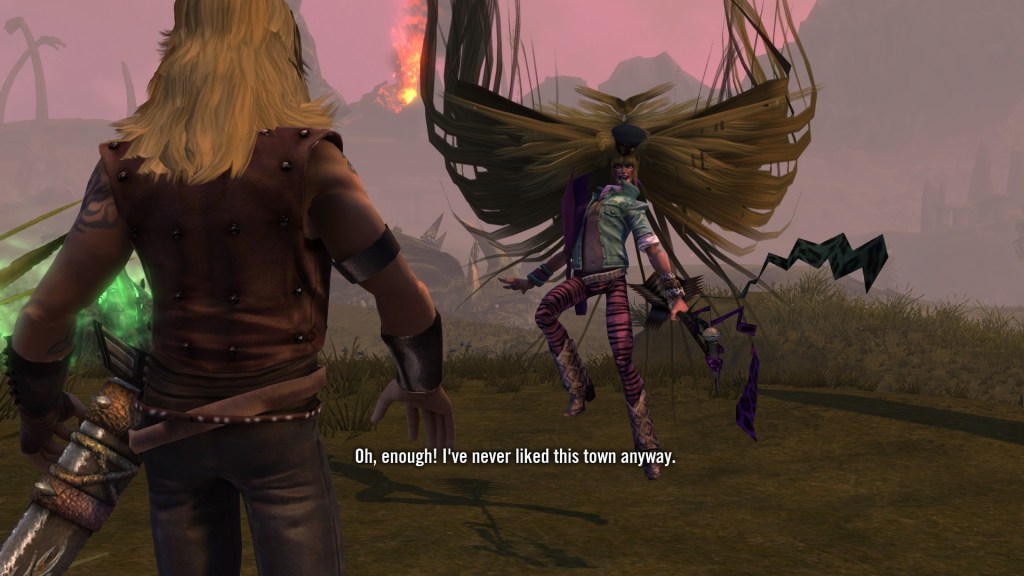
Deena Weinstein (in Heavy Metal: The Music and Its Culture) more charitably refers to the glam metal scene as “lite metal,” and sees it as a perfectly acceptable and logical alternative to the “thrash metal” scene growing around bands like Testament and Megadeth—because she’s a scholar conducting a study and she’s keeping it professional. Or maybe she’s a fan. I don’t know.
The key point of contention here, expressed by O’Neill and echoed by Double Fine, is that Glam Metal is hyper-commercial and therefore inauthentic. Heavy metal, starting with Black Sabbath, Judas Priest, and possibly Led Zeppelin (depending on who you ask), tended to grow out of an underground, independent tape-trading scene. Pioneers were amateur musicians innovating a new, heavy sound reacting against successful rock and pop musicians of the ‘60s and ‘70s and favoring the blues style of artists like Jimi Hendrix. Through the New Wave of British Heavy Metal (universally referred to as NWOBHM), artists were typically blue-collar musicians wearing street clothes on stage (jeans, T-shirts, and, in the case of Rob Halford, leather biker gear), and directly addressing politically controversial or socially dark subject matter in their lyrics. Thrash Metal, which O’Neill identifies with Bay-Area metal, continued this trend, while Glam Metal, associated more with the L.A. metal scene (and especially early MTV), eschewed the working-class trappings and political activism in favor of hedonistic excess, fanciful costumes, and big hair. The excess had also always been a part of metal (especially for Zeppelin), but fans are divided about whether it was a core part of the subculture. O’Neill, for his part, tends to cordon off Zeppelin as “hard rock,” which lends credence to his argument that “glam metal” is an aberration. (See, this is why taxonomies are powerful.)
Symbolically, this is the conflict Schafer and Double Fine construct at the beginning of Brütal Legend. Lionwhyte’s army are glam metal sellouts—Lionwhyte talks endlessly about the success of “his project,” his minions’ barks usually mention how much they’re getting paid or how they’re (vainly) concerned about their looks, and it’s emphasized that Lionwhyte has sold out humanity to the demonic Doviculus for the sake of peace (and profit). They are the sort of simpering, villainous sellouts players love to hate.
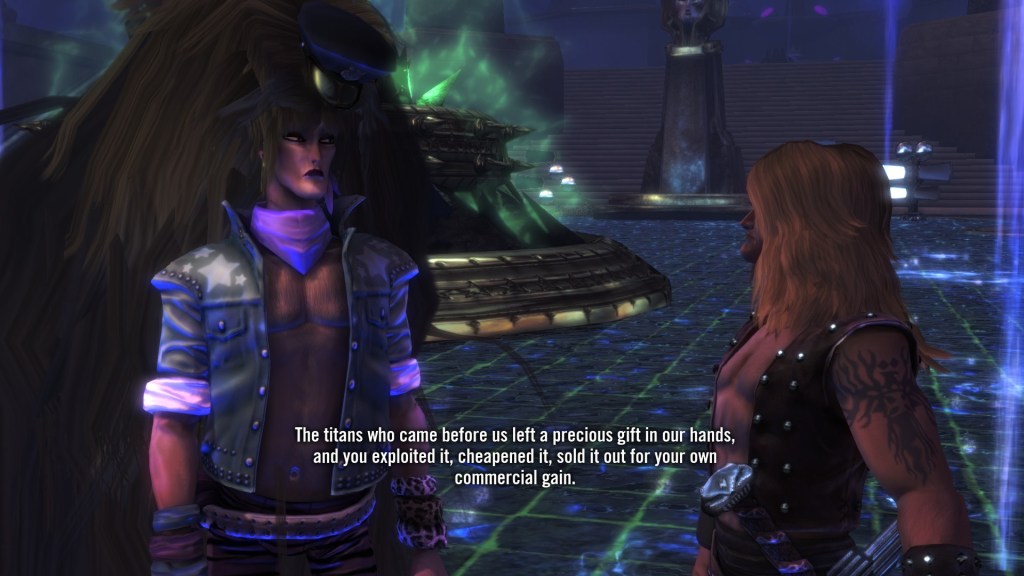
And, as you would expect, confrontations with Lionwhyte are usually accompanied by glam metal tracks from the soundtrack. Sneakily, Double Fine actually categorizes the soundtrack (if you bother to look) by “alignment,” with Lionwhyte tracks coming from Whitesnake (“Fuck Whitesnake”—Andrew O’Neill), Ratt, Mötley Crüe (you can tell they’re poseurs because they use TWO umlauts), and Quiet Riot. Ironheade tracks include “classic” or “traditional metal” (like Black Sabbath, Judas Priest, or Motörhead), as well as “thrash,” “speed,” or “power metal” (like Testament, Megadeth, Overkill, and 3 Inches of Blood).
So, whether or not they intended to, Double Fine is definitely staking a claim in the politics of Heavy Metal. Thrash is metal; Glam is less so.
I think Double Fine is being more careful than O’Neill, though. As much as Lionwhyte’s glam metal army are the villains to Ironheade’s classic-and-thrash metal heroes, I suspect Double Fine are less interested in making a normative statement about metal than they are portraying a conflict that deeply informs metal culture. The conflict between thrash and glam metal is as good a setting as any for having metal-themed units beat the ever-living shit out of each other, and it’s fun for the artists to indulgently design units according to glam sensibilities.
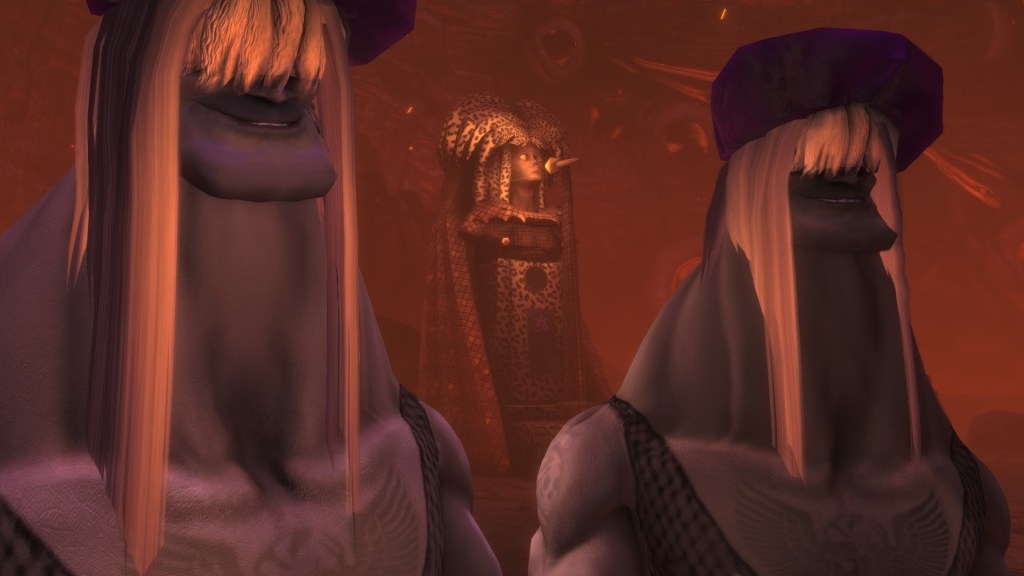
…but they are still the villains. And while it’s clear that their villainy springs from their vapid commercial interests, rather than the “authenticity” that describes Ironheade and its quest for liberation, it’s hard not to notice that Lionwhyte’s army (and his glam metal inspirations) are often queer-coded—or that they are especially feminized, compared to the hyper-masculine, heterosexual-coded, leather-wearing Jack Black/Eddie Riggs and his blue collar Ironheade army. Weinstein even points out that glam/lite metal fans are predominantly women, so maybe there’s a bit of misogyny here, too…
NOPE. NOT HAVING THAT DISCUSSION.
Continent 2: The Wilds
At long last you drive the tour bus full of Ironheade soldiers through the Cleave and into Lionwhyte’s pleasure palace. After an epic stage battle set to glam metal ballads, you conquer Lionwhyte once and for all, and he dies when an ostentatious golden mirror shatters under the power of his voice and impales him. Hooray! Fuck that guy!
But the celebration is short-lived. Doviculus shows up to find out what all the ruckus is about. He holds Ophelia’s dagger from the demo/intro and says that he smells “the blood of Succoria”—the demon emperor, which Eddie interprets to mean that Ophelia has betrayed the army to Doviculus. When Lars confronts Doviculus, the demon king promptly impales poor Lars on his double-bladed pike. After an epic escape (to Dragonforce’s “Through the Fire and the Flames”), Ironheade emerges into a desolate, snowy wasteland. Eddie confronts Ophelia, accusing her of betraying the cause to the demons, but she protests that she is innocent. She believes it is Eddie who has betrayed them (and her), and she abandons the cause. Lita murmurs that she is a “Tear-Drinker”—her parents rebelled against the human cause in the “Black Tear Rebellion” of years past.
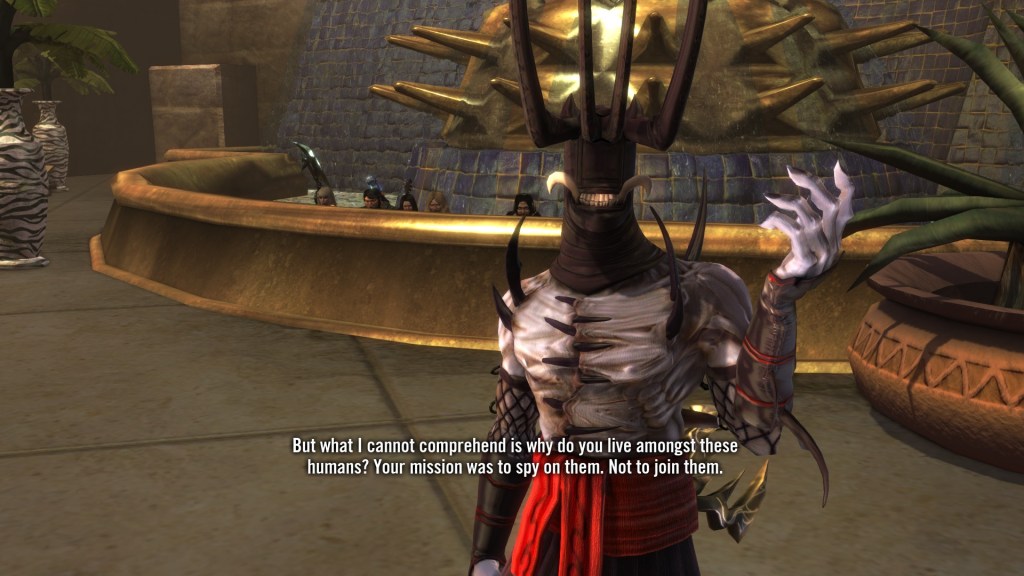
Three months pass. Without Lars’ leadership, the army/band languishes in the frozen wastes. Until one day they are attacked by an army of undead soldiers—zombies in black, haunted brides, bloated men in trenchcoats spewing forth armies of rats, and disembodies heads walking on their medusa-like coils of hair. The Ironheade army barely fights off the attack, only to learn that Ophelia leads the dread army under the power of the Sea of Black Tears—and so we meet the Drowning Doom.
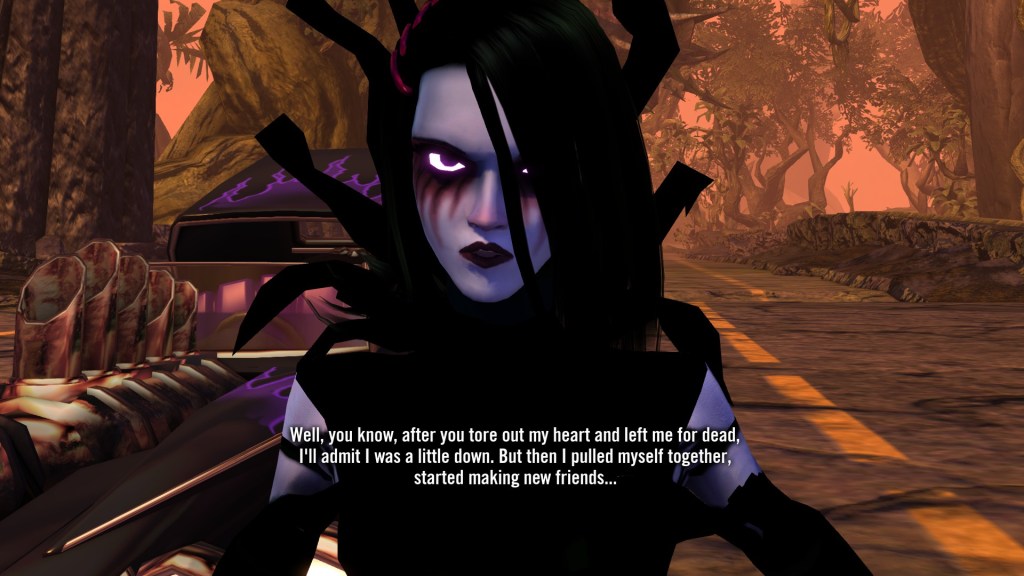
Rock Bottom
Geographically, the second continent only includes Lionwhyte’s Pleasure Palace and the frozen northlands of Death’s Clutch, though I include the jungle of the Zaulia in this section because there’s a lot of thematic, dramatic, and aesthetic overlap here. After the battle with Lionwhyte, you are barred from accessing the third continent until you rebuild the fallen bridge that once spanned the gap between the two—and the game only opens up a little more of the map with each mission until you finally guide the bus into the dry ice mines deep in Drowning Doom territory, at which point you have access to the whole map. So our “second act” covers basically all this territory, all the related plot, and each of these piecemeal gains.
Compared to the open world of the first continent, this all feels pretty claustrophobic. It works dramatically, but is a little frustrating for the open-world explorer. Worse, if you try to go back to Bladehenge and the other locations on the first continent, you’ll find that the skies have turned a dirty red and the land is infested with Tainted Coil troops. Bladehenge itself is now ensnared in Tainted Coil-style bondage, and it’s honestly too dangerous to dwell in for very long. It’s a sobering transformation, and truly the game’s lowest point.
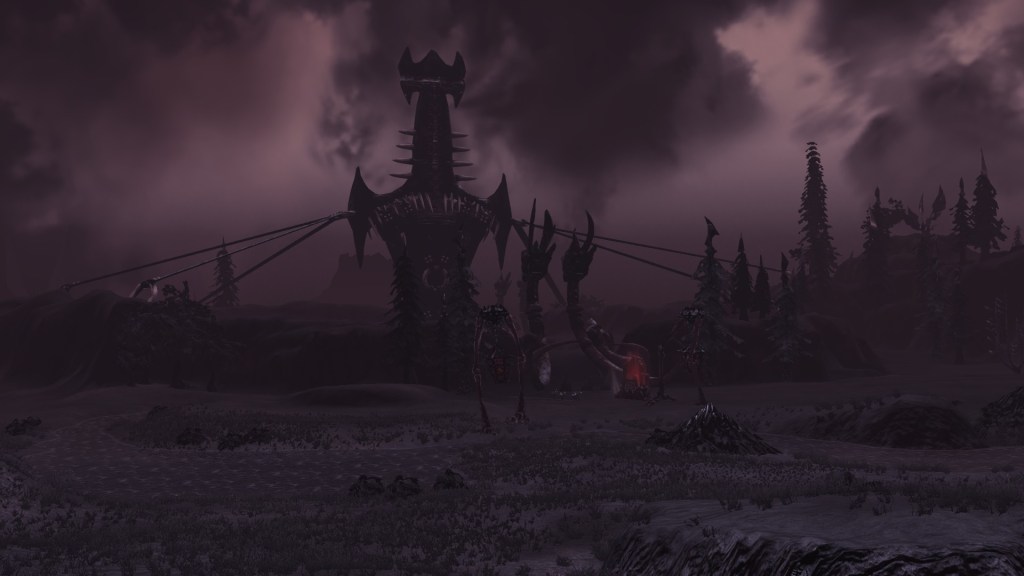
But that doesn’t make the imagery any less evocative. Driving through these areas, you’ll find icy caverns, dusty foothills, oppressive jungle, and thick, fog-strewn swamp. Among the landmarks dotting the landscape you’ll find a colossal Perseus-like statue holding an iced-over medusa head, an enormous jungle tree towering over the landscape, an Aztec-style step pyramid (with insinuations of human sacrifice), and, of course, the ruined stone bridge you must help to rebuild (with “five thousand cubic buttloads of scaffolding”). If the first continent was composed of familiar landscape: woodland, rolling green hills, and sandy beaches, this marks a clear trend toward more hostile, dangerous territory. And the game drives this point home by turning the familiar world of the first continent hostile under Doviculus’ rule.
The fauna also turns mean. Death’s Clutch is populated by massive wooly mammoths with huge metal tusks (Hextadons), and the jungle is home to the wily Laser Panthers and fire-breathing Metal Beasts. The Zaulia, Amazonian women wearing scanty fur garments and Kiss-style white facepaint (their leader voiced by Runaway’s Lita Ford), are also initially hostile, until you remind them of their ancient allegiance to Riggnarok, human hero of ages past.
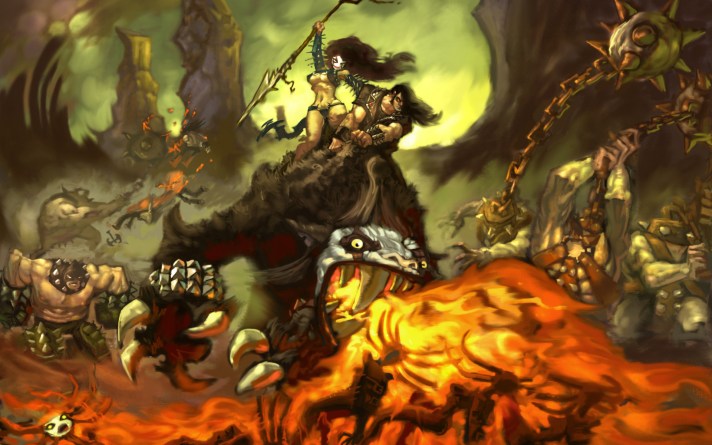
Follow the lore and you’ll get the whole story. Apparently, after the Titans ascended into heavenly Metal God-hood, the Tainted Coil tried to summon them back by performing twisted rituals on a lost Titanic Toenail. But all they managed to produce were human beings—which they promptly hated and enslaved. But the humans rose up against the Tainted Coil and, let by their hero, Riggnarok, they fought the demons back into the darkness. In response, the demons opened the way to The Sea of Black Tears, the sea created by the goddess Aetulia’s endless tears for lost Ormagöden. Many humans were tempted by the waters and, drinking, turned into despairing, half-dead monsters. They turned on Riggnarok and the human forces, and the division allowed the demons to conquer and capture the human leaders. Riggnarok, however, escaped, and embarked on a final mission to assassinate the demon emperor, Succoria, as she made a desperate attempt to reach the future and bring back reinforcements for the demon cause.
The Zaulia remember Riggnarok, and swear allegiance to Ironheade, bringing along their trained, firebreathing Metal Beasts. You’ll also pick up the Headsplitters, motorized ballistas culled from Lionwhyte’s defensive emplacements in the Cleave, and the Fire Barons, a gang of motorcyclists with fire attacks, lead by “The Baron” (voiced by Judas Priest’s Rob Halford).
Most of the missions in this section are travel missions. After the initial confrontation with the Drowning Doom and the first standoff with Ophelia, you need to drive into the heart of the demon-controlled Bladehenge to retrieve scaffolding, and then escort the bus back (to Ministry’s “Thieves”) to rebuild the ruined bridge. The band gets captured by the Zaulia after trying to ensnare their Metal Beasts, and then you have to think your way out of their prison. And, finally, you have to escort the bus through the swamps to the ice mines, where your next major confrontation with the Drowning Doom awaits.
Ironheade vs. Drowning Doom
Drowning Doom is the first truly distinct faction encountered in the game (though there have been numerous skirmishes with armies of the Tainted Coil, no stage battles yet), and each of the units presents a unique challenge to the Ironheade forces.
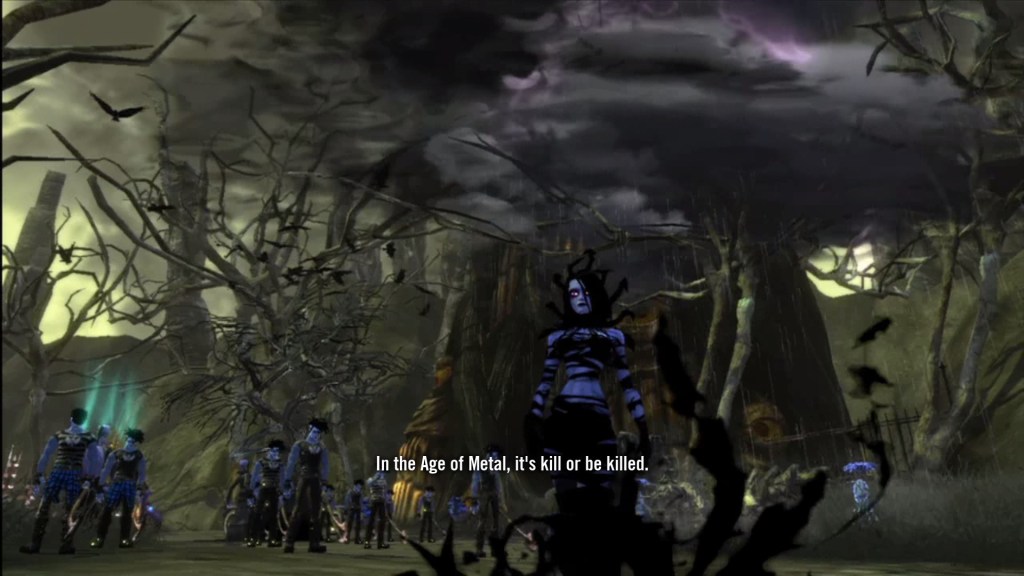
Comparing the two armies side-by-side, the distinct strategy of the Drowning Doom is debuffing your forces. The Bride slows down units while the medusa-like Frightwig pelts them from a distance. Ratgut and the gothic-baby-carriage Brood swarm your forces with damage-over-time effects. And the haunted Pipe Organ turns your weapons a ghostly blue, reducing the amount of damage you deal to your enemies. Consequently, the Drowning Doom fights a war of attrition. Their units are tough, even if they don’t do a whole lot of damage, and they’ll wear you away with debuffs and damage-over-time effects.
And this makes sense, thematically. In-game, the Drowning Doom represents the humans who have given in to despair, and who urge the holdouts in Ironheade to do the same. The debuff effects whittle away the army’s morale, and sap their will to fight.
This gets trickier, though, when we start poking at the symbolic references to metal culture. If Lionwhyte is a clear surrogate for glam metal culture, Ophelia’s Drowning Doom seems to be a stand-in for Death or Doom Metal (and maybe a little Black Metal, too). The Drowning Doom is introduced with Enslaved’s “Frost”—a haunting little ambient number with no vocals, and Ophelia’s ghostly gothic look is revealed in an explicit connection to Lita Ford’s “Betrayal” (itself released the same month as Brütal Legend):
Crawling by the Sea of Black Tears give your soul to me
My man is gone, betrayed I don’t need your sympathy
She is the ruler of the world you know
You’re so predictable now give her your soul
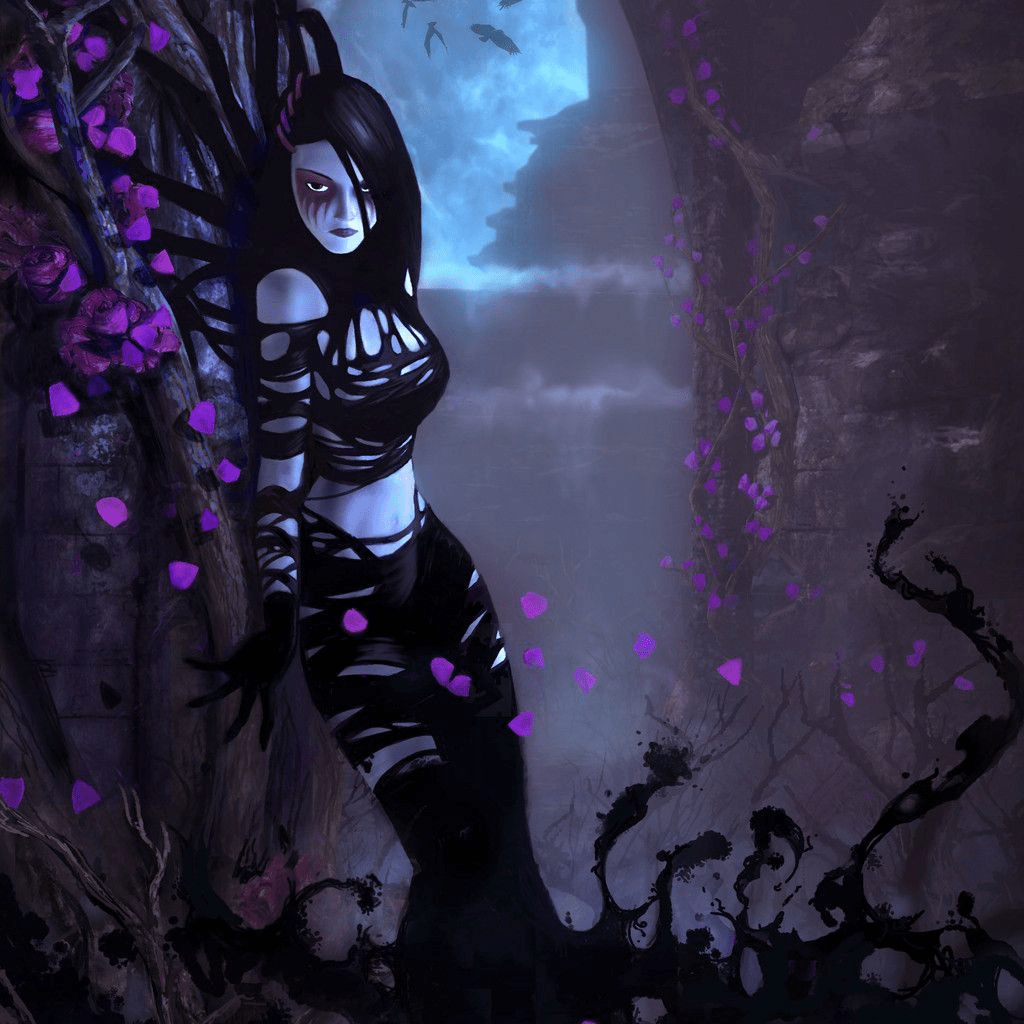
Ophelia recounts her transformation over Ozzy Osbourne’s “Mr. Crowley” (a song addressed to early-twentieth-century magician Aleister Crowley), and the trip into the swamps is accompanied by Osbourne’s “Diary of a Madman” (which I swear has to be a Gogol reference).
But any metal fan worth their salt would see this as a bit of a taxonomical muddle. Lionwhyte’s a clear reference to glam metal, but Ophelia’s gothic turn draws as much of classic Ozzy Osbourne as anything explicitly rooted in Death or Doom Metal, and “Betrayal” is labeled in the game as straight “Hard Rock”—which is yet another taxonomical battle waiting to happen. (A lot of Ironheade songs are also classified as “Hard Rock,” including Michael Schenker Group’s “Assault Attack,” Kiss’ “God of Thunder,” and Def Leppard’s “Rock of Ages,” and some Lionwhyte songs like Motley Crue’s “Live Wire” and Scorpions’ “Blackout.”)
Later Drowning Doom songs are more obviously rooted in Black/Death Metal—like Cradle of Filth’s “Her Ghost in the Fog” and Dark Tranquility’s “Cathode Ray Sunshine,” but there is a more deliberate line being drawn by Double Fine from Ophelia and the Drowning Doom to the Classic Metal tradition of Black Sabbath and Judas Priest. If Lionwhyte is supposed to be a dastardly, villainous sellout, Ophelia is framed more as a tragic victim of circumstance and misunderstanding. And the Drowning Doom, while a villainous faction, seems even less subject to some kind of normative, “No True Metal”-type argument.
But now might be a good time to ask: What is true metal to Schafer and Double Fine?
Fortunately, they give us a pretty good answer in the lore:
From this collision of artistic passion, invention, and sonic overload, a new kind of music was born. It was as hard and heavy as the Fire Beast’s metallic flesh. It had the power of his blood, the heat of his fire, the speed of his flight, and the mighty roar of his death cry. But it also had the angelic beauty of Aetulia’s song and a touch of her mournful wail. Its words told the story of a fierce and noble age. It was an anthem of the people, and they called it HEAVY METAL.
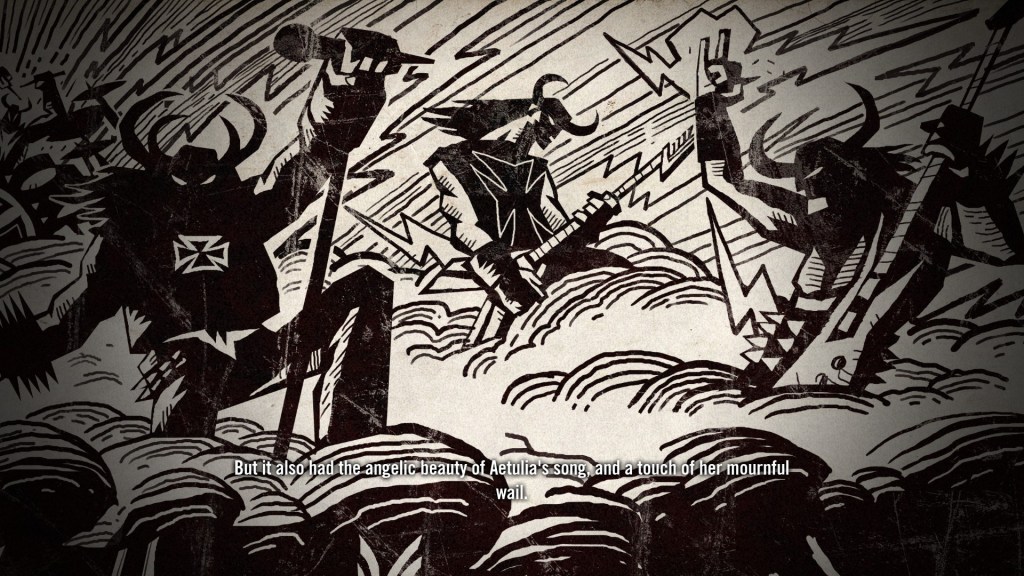
In the world of Brütal Legend, metal always has a touch of the sad and tragic. And it’s hard not to see that strain in the work of Black Sabbath, Judas Priest, and many of the quintessential pioneers of the metal genre (and especially those identified in Brütal Legend). It may even be an inheritance from their inspirations—1960s blues, the tragedy suffusing Tolkien’s Lord of the Rings, and the political pessimism following the assassinations of Martin Luther King Jr. and Robert Kennedy.
If anything, Lionwhyte is a villain specifically because of his shallow optimism. That’s what makes him worse than a sellout—a panderer and a deceiver. At this point in the game Lars Halford has been unjustly killed, Bladehenge has been lost to Doviculus, and the rebellion has been divided by tragic misunderstanding. Despair is a reasonable reaction, but resisting despair is the heroic alternative.
Ophelia isn’t the enemy—she’s a damsel in need of rescuing.
(SHUT UP. WE’RE NOT TALKING ABOUT THAT YET.)
The takeaway here is that Brütal Legend presents Ophelia with much more respect and sympathy than Lionwhyte. And, by extension, Double Fine seems to be offering more legitimacy to doom/death metal than they do to glam metal. The standard here seems to be that all-important “authenticity:” doom, death, and black metal may be rooted in despair, but that despair is more “authentic” than the shallow corporate optimism espoused by Lionwhyte’s goons. The game will often poke fun at the melodramatic Drowning Doom and their mournful, self-pitying aesthetic, but there is also a real love for their music, a real sympathy for their sadness, and a reverence for their gothic aesthetic.
Continent 3: The Haunted Forest
Once you traverse the Zaulias’ jungle and the Infinite Mire, you’ll find the game’s second-largest biome: The Haunted Forest. It’s an imaginative, wonderfully creepy, gothic horror landscape with its own suite of imaginative landmarks: a stone bridge covered in flickering candelabras, a small wooden church impaled on a massive tree root, mazes of gothic cathedral spires and dark purple rose windows, and a massive hill covered in toothy mouths and roving eyes, surmounted by a single withered tree. The roadways are lined with twisted wrought-iron fencing, the trees bear hangmen’s nooses, and dry ice fog covers everything. The Haunted Forest is home to spectral horses with lightning-blue manes, flying skeletal monsters with scythes for arms, and the mighty Guillotar, which stands on four tall wooden legs, pounding the ground with its pendulum blade.
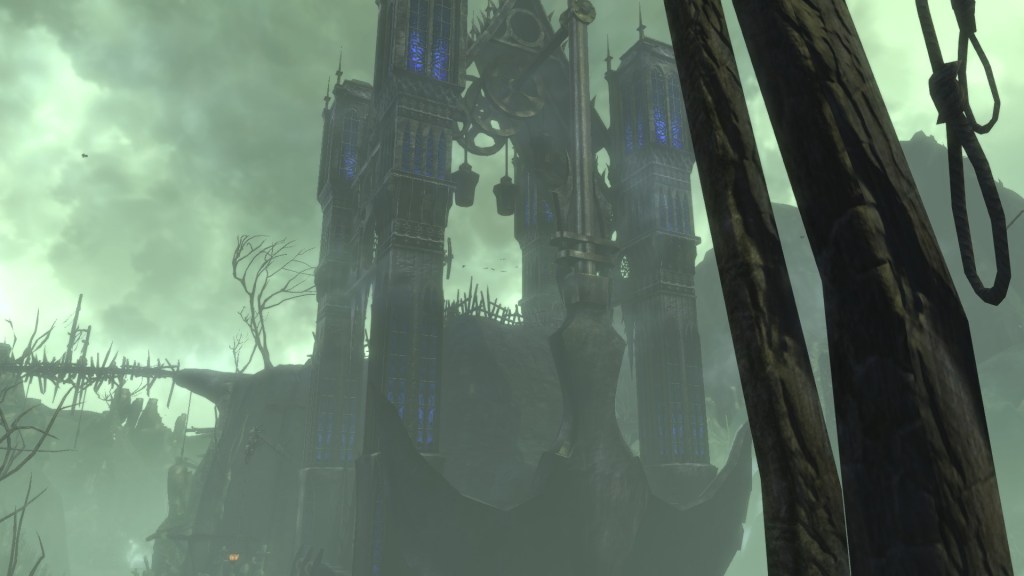
Metal.
It’s also not at all safe. Drowning Doom units wander the area in force, some of the roadways give way to sheer, insta-kill drops, and it’s easy to get lost in the dark, misty, labyrinthine woods. There are plenty of sidequests to do, metal forges to raise, and collectibles to find here, but there isn’t actually much plot or lore left to the game. I suspect Double Fine had grander aspirations for this third act, but that whole legal business with Activision likely derailed them. What we get is still a lot of fun, but not much that’s new or surprising (beside one side quest where we help a family of bats move back into their home).
As far as the plot goes, we’ve got a big ol’ stage battle in the dry ice mines while Cradle of Filth’s “Her Ghost in the Fog” plays, before we pack up the bus to the Sea of Black Tears and start the big finale.
I should note that there is a pretty noticeable change to the tone here, though. Brütal Legend is one of the funniest games I’ve ever played. Throughout the foregoing, even when Ironheade is under attack by zombies or Lionwhyte is getting impaled by giant shards of his own mirror, the game has an uncanny sense of comic timing. The gloom-and-doom barks of the Drowning Doom units are, themselves, often a joke, as zombies moan about losing their heads, or The Bride murmurs “…and on my wedding day” when she dies in a melodramatic heap. The Ironheade characters also joke with each other: Eddie messes with the bus driver Mangus before they venture into the swamp, telling him there are ghosts there. (“I’m only joking,” Eddie reassures him. “No you’re not,” says Rima of the Zaulia.) It’s often entertaining to talk to the assembled characters before big stage battles, as some of the best lines occur there, easily missed. (Like one where Rima tells Eddie she would totally perform the mating ceremony with him if he wasn’t hung up on that drowned girl. “Uh…um…I’ve got to go think about some stuff,” Eddie replies. I say again—Jack Black’s greatest performance to date.)
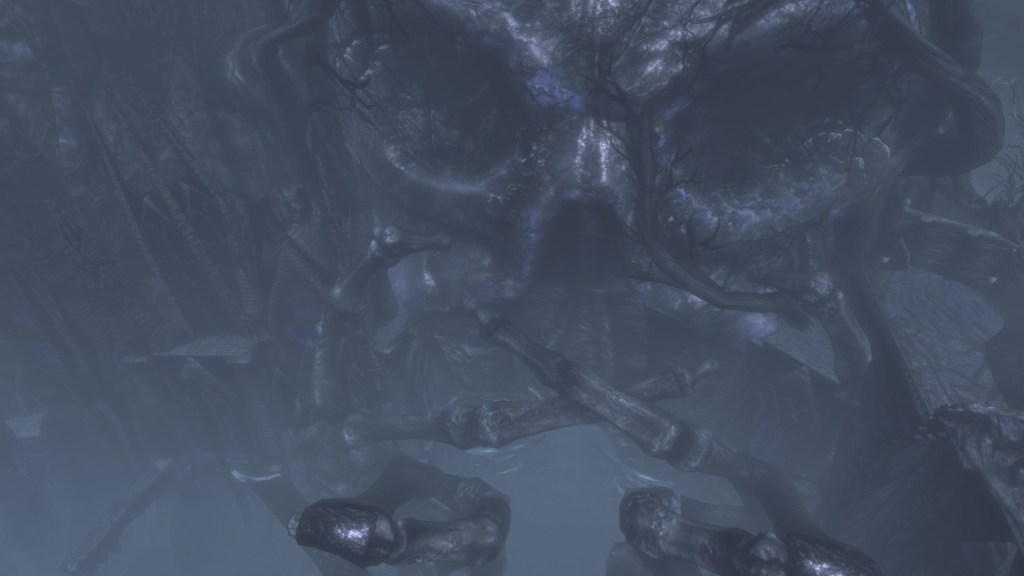
But as you drive through the cave that houses the Sea of Black Tears, Ophelia’s voice recites a poem:
Through the woods a girl came sadly.
Something broken in her chest.
She had dared to love another.
Alas, no better than the rest.
Up my path the girl came gladly.
Something opened up my doors.
I longed to stop her bleeding heart.
And so I called her to my shores.
Those you trust will hurt you badly.
Something now I’m sure you see.
So drown your tears in me my dear.
As you drown, my dear, in me.
As much as Eddie is our protagonist, and the rift that separated him from Ophelia is rooted in a mere misunderstanding, it doesn’t change the fact that Ophelia trusted him to trust her, and he betrayed her. He refused to trust her over what he (mistakenly) understood Doviculus to say. Eddie is wrong, and I think the poem drives home that point. The battle that ensues remains unavoidable, but it is framed as tragic, especially since it is immediately preceded by a wistful, funny cutscene of Eddie and Ophelia slaying demons together on a sunny beach—which fades into the death metal screaming of the oncoming battle as Eddie’s demonic blood awakens and the battle begins. It’s honestly a heartbreaking moment, and the game will be relentless in its heartfelt tragedy as the final battles continue.
Defeat Ophelia and Doviculus will show up to steal her heart and begin the final battle proper. Eddie’s hatred for Doviculus at this point is palpable—where most of Eddie’s rivals enjoy the butt of his wit, Eddie only flips off Doviculus without anything resembling a joke. Worse, Doviculus reveals that Eddie is the son of Succoria—hence his demonic wings and powers. There was no traitor, and his accusations of Ophelia were entirely rooted in a misunderstanding. Eddie is the son of Riggnarok and Succoria, who slept together in a kind of sallow comfort upon reaching the modern age and realizing that their mission was doomed. When Doviculus claimed to smell the blood of Succoria, he was not referring to some betrayal by Ophelia, he was smelling Succoria’s blood “coursing through [Eddie’s] veins.”
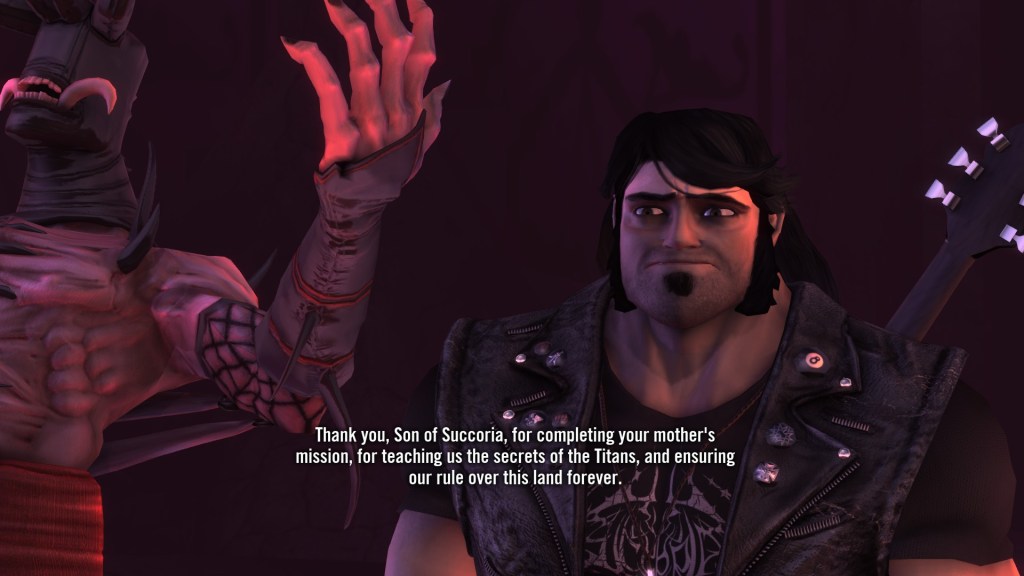
But we’re getting ahead of ourselves. This is the only stage battle with the Tainted Coil in the game (again, I suspect more was planned at some point, but it is what it is), so I suppose it’s time for the last big showdown.
Ironheade vs. Tainted Coil
Ironheade has often encountered the Tainted Coil at this point, especially if you’ve visited the first continent since Doviculus conquered it, so the aesthetic should be fairly familiar by now. According to the game’s lore, the demons of the Tainted Coil are hideous monstrosities who loathed the sight of themselves, so the titans clad them in “restrictive garments” (read: bondage) to save them the sight of themselves. They delight in pain and self-harm, and are often covered in scars, horns, and twisted musculature. Doviculus himself stands upright like a man, but on cloven hooves, and with four tall horns protruding up from his forehead. His face and horns are totally covered in black leather, leaving only his gnarled teeth and two backward-curling tusks visible—no eyes. His chest is a mess of scar tissue, and opens when he stores Ophelia’s heart beside his own.
His soldiers are no less grotesque. Battle nuns are tall, sexy, and effeminate in blood-red, tight-fitting leather vestments, but their faces are all teeth, like a zipper. The basic infantry unit, the soul kisser, covers its face with silver tentacle blades and attacks by embracing enemies with its bladed face. The Punishing Party plucks throwing knives out of the flesh of a gimp-suit-and-ball-gag-wearing slave, who cannot be attacked, but who explodes out of frustration if his tormentors are killed. The Skull Raker flings its giant morning-star-like head at enemies for massive damage, and the Scream Wagon pours boiling oil and flame onto a prostrate body for healing bonuses. And I don’t even know how to describe the Hate Cage or Bleeding Death except as grotesque nightmare monsters of twisted flesh, horn, and iron.
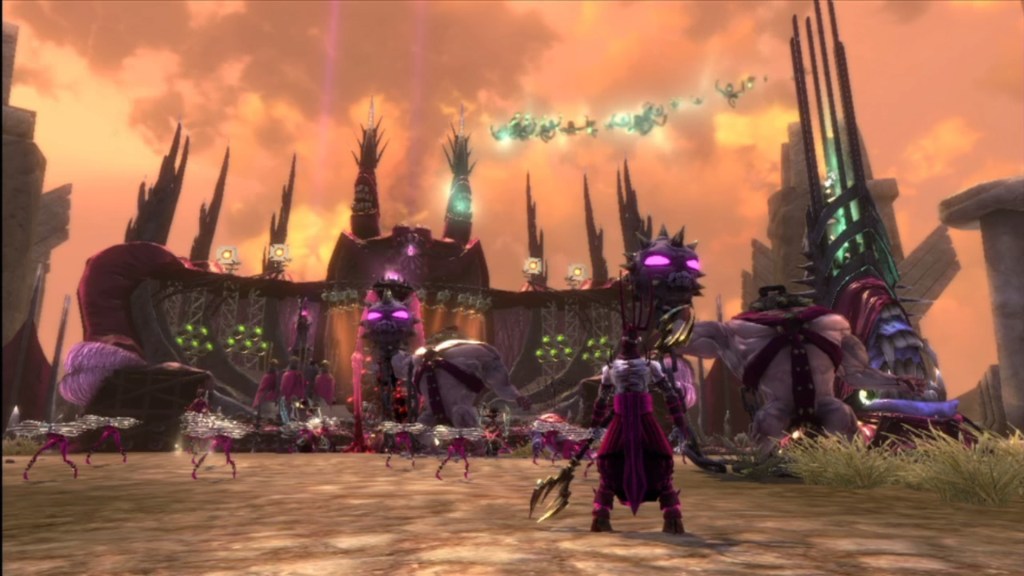
Scott Campbell, the production designer, is quoted in The Art of Brütal Legend:
The Tainted Coil were inspired by Bosch paintings depicting writhing demon and human orgies. This is the industrial metal faction, so we wanted to get the self-mutilating vibe in there. Lots of zippers and suffocation suits, tied up guts, and surgical scenes. I have to say that research for this faction was quite disturbing.
Metal…?
Can We Talk About It Now…?
Alright. I guess.
For all the taxonomical noise apparent between heavy metal fans disputing what is or is not heavy metal, and what dimensions of heavy metal are or are not within heavy metal’s scope, we don’t seem to be a whole heck of a lot closer to a thesis on what heavy metal actually is. And given all of the heinous shit associated with heavy metal at this point—even in the cleaned-up, palatable version presented by Schafer and Double Fine—we might also be warranted in asking why? Why make a game celebrating heavy metal, when heavy metal is so fraught. When the culture is so divided, so violent, so misogynistic, and so grotesque. What is the value of all this?
Schafer himself writes, in his foreword to The Art of Brütal Legend,
Heavy metal doesn’t worry if it’s mixing genres. Heavy metal doesn’t try to be true to canon. The only cannon heavy metal gives a damn about is the one that shoots great white sharks. All heavy metal wants to do is be awesome. It wants to punch you in the gut, rip out your eyes, and have you begging for more…[H]eavy metal artists don’t care about the rules set down by anybody. Their creativity is unrestrained. Their body of work is like an epic explosion of darkness, anger, madness, heroism, and, occasionally, boobs. It’s hard to think of a better world in which to set a videogame. The Double Fine artists whose work you see in this book strove for that same level of unbound expression, and when you read through its pages, I think you’ll agree they achieved it.
I’m not sure this is wholly accurate to the culture of heavy metal proper. I suspect many of the taxonomists of heavy metal would disagree with the statement “Heavy metal doesn’t worry if it’s mixing genres,” though I suspect “Their creativity is unrestrained” would go over better. Likewise, I suspect that this definition of heavy metal (along with the lore one about Aetulia I quoted earlier) neatly avoids some of the clear political messaging inherent to heavy metal—its preoccupation with climate destruction, for example, or its rebellious, anti-authoritarian spirit. Some of that political messaging makes it into the game anyway—like Black Sabbath’s “Children of the Grave,” which unmistakably warns the younger generation of the need for political action in the face of nuclear annihilation. Or Cradle of Filth’s “Her Ghost in the Fog,” which recounts the rape and murder of the narrator’s girlfriend by priests. Or whatever is going on with Ministry’s “Thieves” and its apparent rejection of all authority as “Thieves, liars.”
I don’t think any of this is meant to reflect the views of Tim Schafer or Double Fine. But I do think they believe these perspectives are an integral part of heavy metal culture.
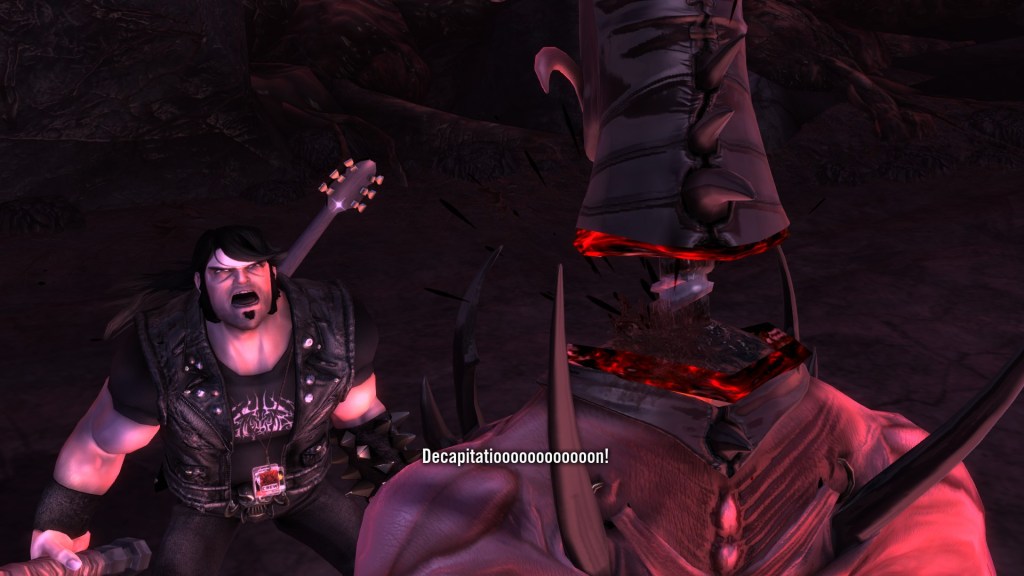
I think that anger, in particular, is utterly essential to heavy metal. And as much as Brütal Legend is, overall, a funny, silly game—a celebration of unbridled creativity in an often-maligned genre of music—I think it also respects that anger in those final moments. Doviculus is fucking evil. He killed Lars. He tried to kill Ophelia. He deserves to die. Eddie is right to want to kill him. And there’s nothing funny about it.
Rage, in this case, is perfectly justified.
And there is a tremendous cathartic release when you finally get to decapitate that sick motherfucker.
Am I Evil
I think there’s a sizable amount of mixed messaging in Brütal Legend. I think it’s reasonable to see the vilification of Lionwhyte as having a homophobic undertone. I think the game’s designers inappropriately conflate S&M culture with grotesquerie and contribute (however inadvertently) to its misunderstanding. I think there’s a misogynistic streak to this game’s frequent portrayal of women in ridiculously revealing clothes. And I think there’s a tendency in the game to see some sub-genres of metal as pure and good, while others are evil and corrupt.
But I also think that every one of these flaws is complicated by the game’s subject matter. Every one of those flaws is also a faithful depiction of hang-ups in the heavy metal subculture. We’ve already talked about the “No True Metal” taxonomical arguments between metal fans, and the frequent rejection of glam metal. Regarding homophobia, Rob Halford famously wore studded biker jackets at performances—at the time, a hallmark of the gay movement of the 1970s—and metal fans took up the look, only to discover much later in his career that Halford was, in fact, gay (reactions to this news were…divided). Attitudes about sexuality among heavy metal fans run the gamut from the hedonism of the glam metal scene to the depraved orgies of Led Zeppelin and Metallica, to the strict (and often judgmental) celibacy of White and Black metal. And women—well, there are misogynistic metalheads and female metal leads aplenty. It’s true that many early metal songs treat women as sexual objects, but it’s also true that metal (along with punk) was a major inspiration for the Riot Grrl movement that kicked off the third wave of feminism in the ’90s.
On that last point especially, I think Brütal Legend does a surprisingly good job incorporating feminine perspectives into the game. Ophelia is a villain, but she’s presented sympathetically, and her villainous turn only serves to underscore her power and equality to the male lead. Lita Halford actually serves as the moral center of the whole game, and the final scene suggests that she will lead Ironheade in the future, while Eddie (as befits a roadie) stays to the shadows. And Lita Ford seems to have been integral to the game’s creation, given that she has a major voice role, and seems to have released “Betrayal” as an original tie-in song to the game’s release. It’s not perfect, but Brütal Legend pretty clearly celebrates women in metal more than is usual, and does substantial work toward elevating women’s voices in the subculture.
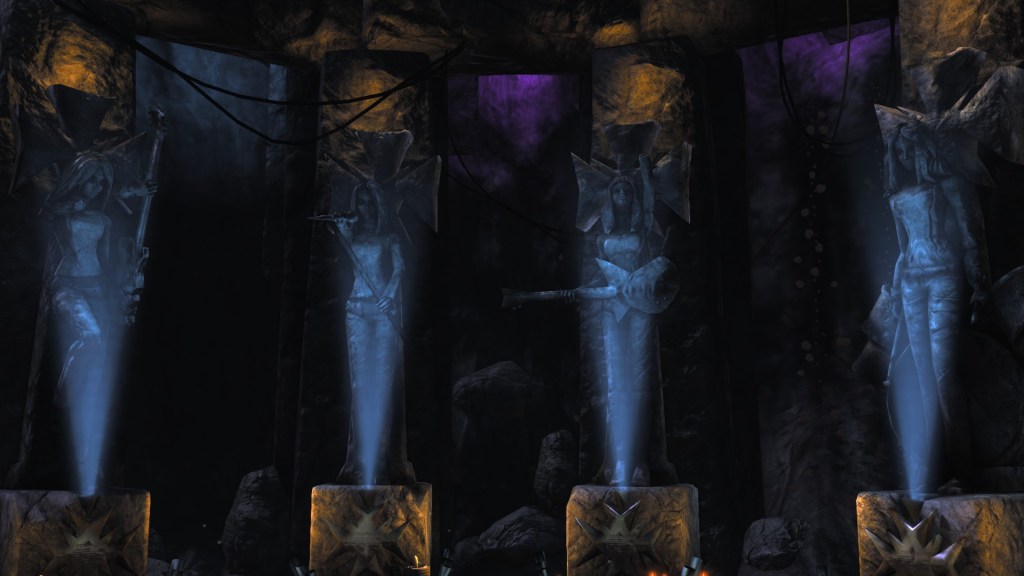
What I see, both in metal culture and in the Brütal Legend game, is a celebration of confrontationalism. A refusal to let complacency lie. That explains to me the blasphemy (a rejection of Christian prejudices and complacency), the celebration of violence (a rejection of obedience and legalism-as-oppression), and even the occasional apparent celebration of Nazis (to inspire offense, anger, and even violence, and force others to confront the evils in the world). The messaging isn’t always clear, and could serve to cover up some pretty terrible behavior (and probably does), but, at its best, heavy metal is music that galvanizes, demands action, demands movement, and perhaps even demands violent resistance to injustice and evil. To the heavy metal musician and fan, complacency is death. To let the corrupt and powerful continue to destroy, unchallenged, is cowardice. Anger, therefore, is essential. Heavy metal is the sonic equivalent of the bumper stickers people used to have in the mid-2000s—the ones that read:
If you’re not angry, you’re not paying attention.
Or, as Ozzy Osbourne put it in “Children of the Grave”:
If you want a better place to live in
Spread the word today
Show the world that love is still alive
You must be brave
Or you children of today
Are children of the grave
Metal.
Die For Metal (?)
The truth of the matter is that I don’t have some thesis on heavy metal, and I suspect it’s a bit wrong-headed to go looking for one. I’m not sure I agree with Schafer’s “extreme creativity” take on heavy metal, but I’m also not sure it would excuse some of the worst excesses of the metal community even if it were true.
Instead, I suspect we need to take each metal artist—and metal fan—on a case-by-case basis. Hate the player, not the game, after all. If Mötley Crüe are sellouts, then that doesn’t necessarily reflect on the rest of heavy metal, or even the rest of glam metal. And if Darkthrone are Nazis, that doesn’t reflect on the rest of heavy metal, or the rest of black metal. The context that informs each band, each artist, and each song is crucial to its interpretation. And there’s just no sense in trying to lump all of these bands, artists, and songs together into a single unit for the sake of judgment.
The first rule of art criticism is that you should always have a reason to dislike something, but you don’t necessarily need to have a reason to like it.
And I like heavy metal. It’s raw. It’s loud. It makes me feel powerful and it vindicates my own anger. I like the political awareness of Black Sabbath and Ozzy Osbourne, the riffs of Judas Priest, and that insane guitar solo in “Through the Fire and the Flames.” I like the guttural screaming of Dark Tranquility’s “Cathode Ray Sunshine.” And I even like the reflexive, undirected anger of Ministry’s “Thieves.” I might learn something about any one of these artists that causes me to re-evaluate my regard for them, but there’s nothing you can say that would cause me to reject the whole genre, any more than you could get me to reject the whole medium of video games, just because there are toxic communities, abusive developers, and bad games (and all of these are very real problems in the culture).
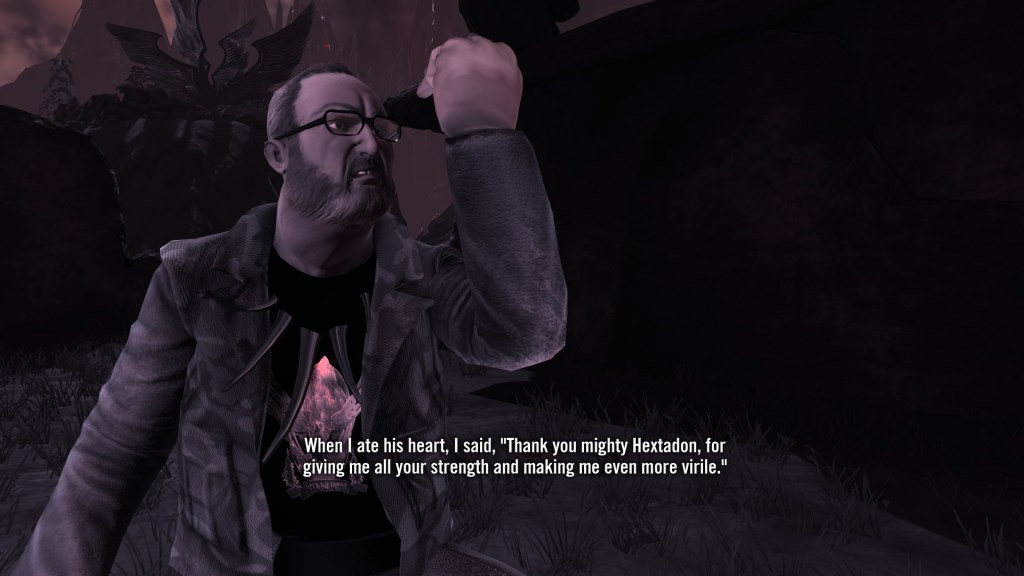
And I don’t think the connection between metal and video games (or their similar bad habits) is incidental, either. Doom in 1993 was every bit as much a product of heavy metal as Brütal Legend in 2009—and it shares the same directionless anger and self-importance as any of the Metallica songs it ripped off on its soundtrack. Heavy metal and video games have always been the refuge of outcasts, and have always been an outlet for aggression (and particularly the aggression of middle-class white dudes). Both have been plagued by bad actors, both have been maligned by ignorant naysayers, and both have been the site of truly great art and boundless creativity, just as Schafer suggested. The good does not excuse the bad, and the persecution does not excuse the misbehavior, but there’s nothing inherent to these genres or media that makes them evil. Even the symbolic embrace of evil itself reads, at its deepest, like a Blake-ian celebration of rebellion and individualism than a condemnation of “good,” and at its most shallow, an edgy aesthetic decision intended to sell albums. Like Bulgakov in The Master and Margarita, heavy metal musicians and video game developers who align themselves with the devil tend, really, to draw attention to how much evil passes under the name and aesthetic of “goodness,” so that the best solution is to align oneself to the good that passes under the name of “evil.” When Christians preach hate and the government murders innocents in the street, what choice do we have but to renounce their symbols and adopt their opposites? (Not sure I’d go so far as to burn churches, though.)
I’m not sure how much Brütal Legend is interested in any of this, but I think it’s a powerful case study in the disconnect between aesthetic and essence, whether it intends to be or not. Just as I think heavy metal is a potent case study in the tension between its extreme aesthetic and its complicated messaging. Even if you don’t like the music (or the game, for that matter), these are the questions that pester the twenty-first century world. What is irony? What is sincerity? How do we get our voices heard over the noise? How do we separate the heroes from the hypocrites? How do we hold those hypocrites accountable? How do we balance our anger against our love? Who speaks for our movement? And how do we endure and combat the relentless injustices of our time?
Heavy metal may not give us consistent answers, but it is asking the right questions. And in the case of Brütal Legend, I think we have a unique and powerful work of art that smuggles these questions into our minds under its “just for fun” sense of humor and over-the-top aesthetic. Whether intentionally or not, Double Fine walks us through the progressively more extreme modes of heavy metal music, and serves to teach us how to appreciate what these musicians are trying to say. We learn to listen, in short, and that’s a powerful, valuable skill.
But whatever its politics, Brütal Legend remains wonderfully creative, utterly unique, and deeply rooted in a genre the makers clearly loved, however they may have interpreted it. I think Double Fine took much of the best of heavy metal and embodied it in a new medium, using the artistic power that only video games could provide. I think they managed to celebrate the music, iconography, ideology, and culture of heavy metal in every detail of this game, from the details of the world, to the designs of the units, to the fundamental choice of turning battles of bands into actual strategic battles, guitars into weapons, and music into a force that literally changes the world. I think Brütal Legend is a fascinating study in adaptation and world-building, insofar as Double Fine carefully and lovingly translated so many of the tangible details of heavy metal music and culture into a world we could explore and conquer, and in doing so, translated the experience of a heavy metal concert, and the experience of belonging to a rebellious, angry, righteous subculture—into a video game. Whether or not heavy metal is an act of “extreme creativity,” Brütal Legend certainly was, and that’s a noble enough aspiration on its own.
And it just. Fucking. Rocks.
Never Say Die
In the years that followed Brütal Legend’s release, Double Fine decreased its ambitions significantly, but did not decrease its output. The failure of Brütal Legend conveniently coincided with the rise of the indie culture, and suddenly there was a new market for smaller-scale games with lower budgets and weirder ambitions—which was kind of the perfect place for Double Fine to thrive.
Especially since Double Fine had, in the darker years during the development of Brütal Legend, created a new mechanism for exploring the design team’s weirdest sensibilities: Amnesia Fortnight—an in-house game jam where developers could build demos of their weird ideas and pitch them to Schafer and the other leads. In 2010, Double Fine released Costume Quest, an endearing little RPG about kids trick-or-treating at Halloween with powers granted by their costumes. In 2011, they released Iron Brigade—a co-op Tower Defense/Action game where players fight evil television sets with mechs—and Stacking, a weird adventure/puzzle game where the player inhabits a series of Russian nesting dolls with unique powers.
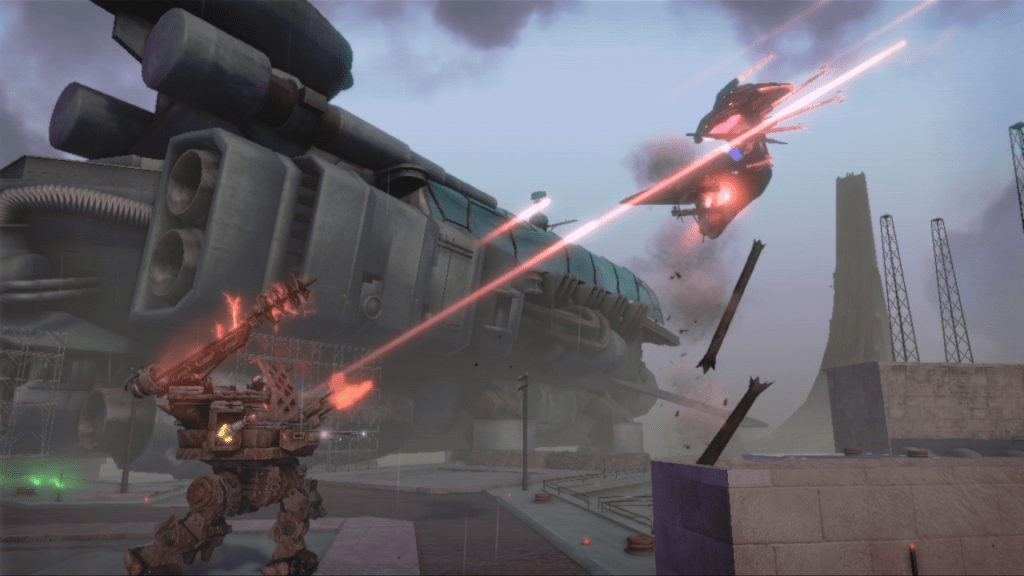
In 2012, Amnesia Fortnight was expanded through Humble Bundle to the fans. The prototypes were sold as a bundle and participants could vote on their favorite games. Hack N’ Slash, a Zelda-like that gave the player the power to reprogram enemy AI, and Spacebase DF-9, a management sim set on a Star Trek: Deep Space Nine-esque starbase, both went on to get full releases.
And also in 2012, Double Fine launched a kickstarter for a new point-and-click adventure game called only “Double Fine Adventure”—which raised more than a million dollars in 24 hours, and was one of the first high-profile kickstarter campaigns. The game would become Broken Age, and released in two parts over 2014 and 2015. Jack Black had a prominent voice role.
Tim Schafer, meanwhile, has gone on to host the GDC awards frequently, and is widely respected in the industry.
It’s not all good news, though. Microsoft bought Double Fine in 2019. Schafer has said that the acquisition has been mostly hands-off, but it’s a shame to see such an important leader in indie video gaming under the thumb of a major publisher, all the same.
More encouraging is the news that Double Fine applied for unionization with the CWA earlier this month.
As for Brütal Legend, I’m not the only converted fan out there. There’s a thriving wiki I often used in my research, and I even stumbled across a 2017 comment to the YouTube video for Dark Fortress’ “Insomnia” that points Brütal Legend fans to the band’s other songs. The video game that celebrated heavy metal culture has, perhaps unsurprisingly, become a part of heavy metal culture. It’s become an entry point, not just for me, but for many video gamers who discover a love of heavy metal music through its presentation in the game.
And somewhere in all this, between the passionate creatives concocting art designs among the album covers and Frazetta posters, the voice performances of Ozzy Osbourne, Lemmy Kilmister, Lita Ford, and Rob Halford, the insanely ambitious asymmetrical RTS design, the all-or-nothing promotional stunts and concert, the flame-out of the game itself, Double Fine’s visibility as an early indie star, the tape-trading-esque Amnesia Fortnight prototypes, the ongoing friendship between Schafer and Jack Black, all the way to the time Double Fine offered free copies of Brütal Legend for 666 minutes to commemorate the passing of Ozzy Osbourne last year—in all of this I see a rich, creative community of passionate people sharing their interests and mutual loves with each other and their fans, passing larger-than-life rock star status from one generation to the next, and using that power to change the world.
And that’s the most metal thing of all.


