99 Hours of Clair Obscur: Expedition 33 (Part Three)

ACT III: In which we discuss the final revelations of this game, the theme of grief as it is represented by its characters, and its personal stakes: for the characters, for me, and for the rest of the audience

Act II concludes with devastating failure: Lumière is destroyed, Lune and Sciel are gommaged, and the Expedition is, effectively, over.  It even fades to black, as if preparing to roll credits.  But what we get, instead, is another dramatic recontextualization.

This is it, folks.  The big spoilers.  If you’ve got the chance to play this game and want to be surprised by any of its twists or revelations, get out now.

The Dessendres

Once upon a time, there was a family of painters.  Renoir, the father; Aline, the mother; and their children: Clea, Verso, and Alicia.
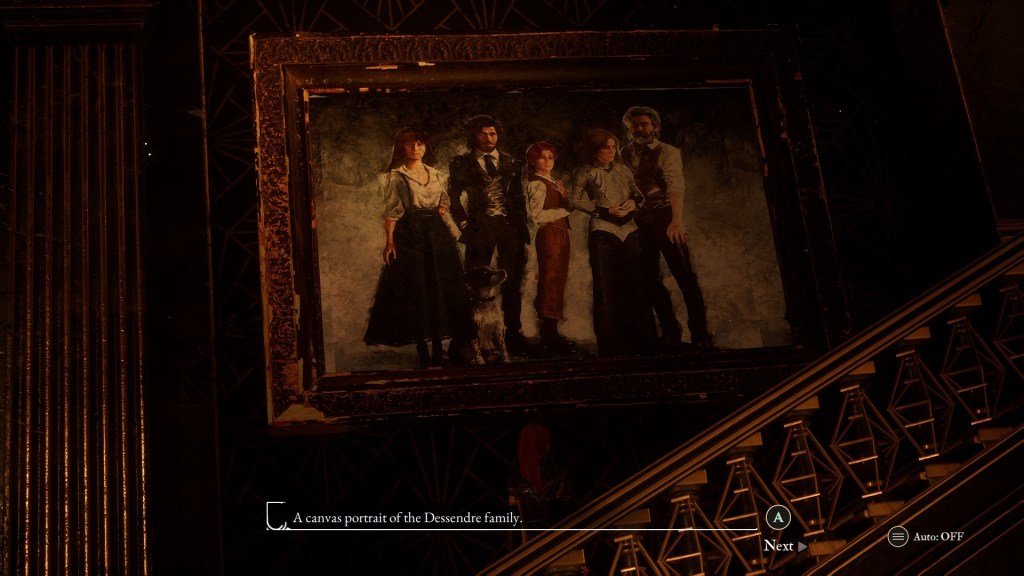
But these were not ordinary painters.  When they painted, they made whole worlds in their Canvases—living places with living people that they could visit and share.  Each of the children was raised to paint in this way, and each developed their own distinct style.

But tragedy struck: the Writers (your guess is as good as mine here) attacked the Manor where the Dessendres lived, setting fire to the children’s rooms.  Verso died in the fire, and Alicia became horribly disfigured: her face was scarred and her voice destroyed by the smoke.

All that remained of Verso was a Canvas he had been working on since he was a child.  So Aline, devastated by the loss of her son, entered the Canvas and refused to leave.  Renoir, her husband, feared for his wife’s well-being—it is dangerous to stay too long in a Canvas—so he barged into the Canvas and tried to destroy it.  He warred with Aline, who defeated and contained him, but only for a little while.  Clea, frustrated and fed up with her parents’ squabbles, left the house altogether to pursue her own goals.

Alicia, now completely abandoned, entered the Canvas in the hope of making peace between her parents, but lost her memory and was born into the infant body of a girl within the Canvas:

Maelle.

The Two Dessendres

When Verso painted his Canvas originally, he included his family.  All of his family members (including himself) have versions of themselves in the Canvas when they arrive.  So, during the events of the game, there are two of each of these characters running around the Canvas.  The real Aline teams up with the Canvas Aline to make The Paintress (hence the two figures in the climactic battle of Act II).  The real Renoir is bound by Aline under the Monolith, but his avatar, The Curator helps the party defeat Aline before escaping to destroy Lumière.  Meanwhile, the Canvas Renoir, oblivious, benefits from Aline’s protection and tries to protect the Paintress, as we’ve discussed.  Canvas-Alicia is the disfigured girl Verso identifies as his sister (and Renoir’s daughter), but real-Alicia is Maelle, who only now, in Act III, remembers herself and reclaims the power to paint and shape the Canvas.

Our Verso, then, is just the invention of child-Verso: a dream of what Verso wanted to become when he grew up.

There’s a lot to unpack here, so let’s start by tying up some loose ends.

  1. Is the Myst connection obvious yet?

I’ve still got no evidence that Broche considers Myst an inspiration for Clair Obscur, but it sure seems unmistakable to me.  Myst is also a game with a richly-realized world that has been devised by a writer.  The paintings of Clair Obscur seem a natural analogue to the books of Myst and its sequels.  But especially in Riven, we find that A’trus’ family is divided and at war with one another.  A’trus’ sons, Sirrus and Achenar, are trapped in books on the island of Myst, but not before trapping their own father. A’trus’ father Gehn, in particular, has to be trapped in Riven to prevent him destroying the lives of the people in these books.

So in Clair Obscur we also have an emotional drama of supernaturally-powerful artists feuding with one another by using their creative works as battlegrounds.  There’s more substance here in Clair Obscur—the events underlying the Myst games are only alluded to in the games themselves, while Clair Obscur spends a lot of its time exploring the relationships between the Dessendres—but the basic setup seems very similar.

  1. Une vie a t’aimer

Again, it seemed weird to talk about it back at the end of Act I, but this song, and many of the others that have played over key moments in the game, directly refer to the characters here.  Une vie a t’aimer is literally a song where Renoir and Aline sing-battle each other, calling each other by name, expressing their love and their regret.  And I honestly suspect this is more baffling to French-speakers than English-speakers, since we can just write it off, like in NieR: Automata or “One Winged Angel,” as cool-sounding background music.  And it is really freaking cool.  But this is a French game, presumably intended for French audiences especially.  And I think it’s significant that they get some great actors to do the English voicing (including Andy FREAKING Serkis as Renoir), but they don’t bother to translate the singing (except, interestingly, in one of the songs that plays when you explore the area beyond the suicide cave, where we are reassured “don’t be afraid”).  I suppose the music is meant to be unintelligible to most audiences.

Also on the list of crazy on-the-nose musical cues is “Lumière s’eteint”—the song that plays when you visit the tiny deserted island where Renoir’s Manor can be found after its disappearance from Old Lumière in Act II.  This one is particularly striking, since Testard’s recitation of the poem is read, without singing, over the song playing underneath.  There isn’t actually anything terribly important at the location, but it’s ominous as hell, and I spent a lot of time running around in circles trying to figure out if there was something I was missing.  (There wasn’t, so far as the Internet knows.)
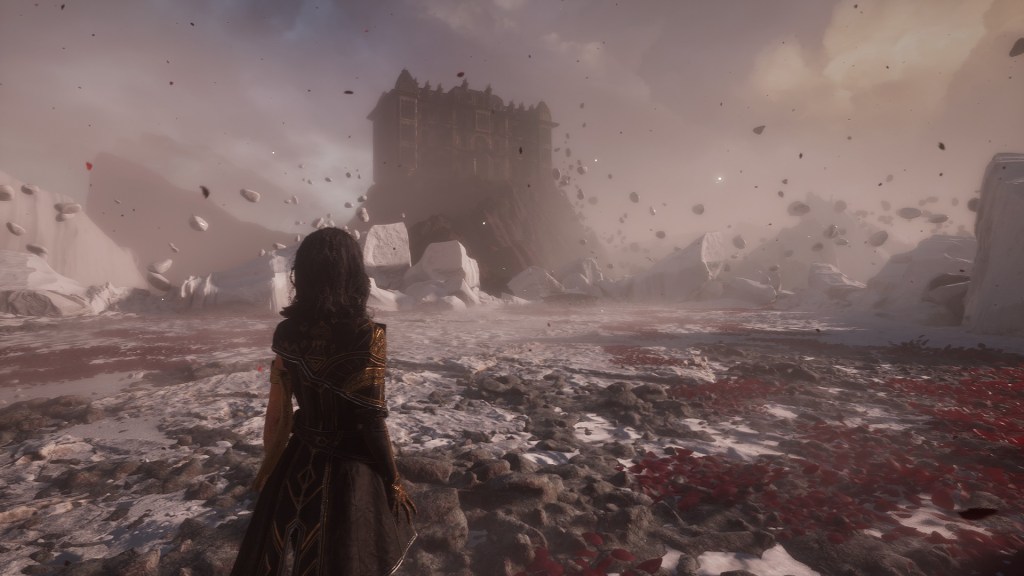
“Lumière s’eteint,” by the way, roughly translates to “Light [Lumière] goes out.”

  1. A Built World About World-Building

The world of Clair Obscur must also now be elevated to a new level of contextualization.  Each Act does this, I think—that’s why I structured the essay in this way.  Our relationship to the world radically changes from the prologue (where we have a clear-cut mission and goal) to Act I (where our mission is complicated by the discovery that this world is both more dangerous, and more benevolent, than we expected) to Act II (where our power over the world proves more destructive and consequential than we had hoped).  Now, in Act III, it is clear that this is not just about Lumière and its denizens fighting their fate, but that fate is in fact the product of squabbling creators—like the mythic gods of Olympus—each with their own complicated agenda and ideological assumptions. 

Aline wants to protect and preserve the world, even at the cost of her own life, in her desperation to connect with her lost son one last time.  Renoir wants to destroy the world to keep his family together, even if it means losing his son’s greatest work.  Alicia wants to repair what has been broken, but finds herself restored by the Canvas’ magic: she is whole here, in the Canvas, saved from the scarred and disfigured body she left in the real world.

This is a game about why we create—and why we destroy.  It is about world-building as a way of escaping our own limitations (like Alicia), or escaping our own suffering, grief, and loss (like Aline), or a way of exerting power and control when circumstances in the real world make us feel powerless and weak (like Renoir).  Each of these characters wants something different from this Canvas, but each is acting selfishly, changing and distorting the created world to suit their purposes.

And, lest we forget, this is Verso’s Canvas.  He made this world.  Some of the discordant elements and fanciful inclusions are the products of youth, or personal fascinations: his own characteristic style.

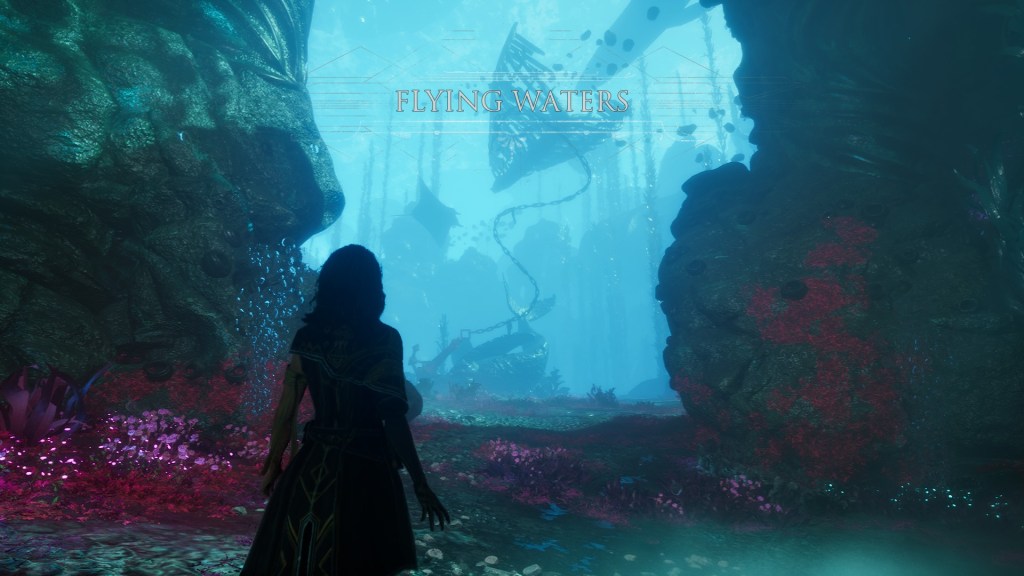
The world we see in Clair Obscur, then, is a product of all these forces.  It is not the creation of a single artist, but an inadvertent collaboration of each of these artists.  The Gestrals, Esquie, François, Monoco, the fanciful landscape with its coral canyons, red forests, mountains and seas, and the people of Lumière (including the facsimiles of Renoir, Aline, Alicia, Clea, and Verso himself)—this is the world Verso created.  The Fracture that destroyed the world decades ago was the product of Renoir’s attempt to destroy the Canvas—the floating debris, smeared buildings, or ruined landscapes are his addition (or subtraction, depending on your perspective).  The gommage—the people dissolving into red-and-white petals, seem to be the product of Renoir’s destructiveness filtered through Aline’s mercy.  But we also begin to see layers to this creation.

The Axons, for example, were created by Renoir, not just as agents in his war, but as symbols of hubris and challenges to Alicia and the Expeditioners.  Most of the other Nevrons were, in fact, Clea’s contribution—or Clea’s by proxy.  The creator the white Nevrons allude to in their speeches is Verso’s Clea-facsimile, who was apparently empowered by the actual Clea during one of her visits, and who can now paint and create under her own steam.  (Verso points out that Clea was the only painter in the family talented enough to paint over the creations of the other family members. Clea’s creations are typically the most terrifying in the game, and her avatar presides over the “Endless Tower” where you can find the most challenging battles.)  The lamplighter who defends the coast and resurrects regularly, was, along with several of the other caretaking bosses, a product of Aline’s, as we discover in a museum where the surviving Aline-facsimile resides.

And then there are the Drafts.  Once Esquie finds the rock that enables him to go underwater (François had it the whole time!), the party can find the early drafts of the Canvas made by Verso, and the drafts of Renoir’s army where he was trapped by Aline. 

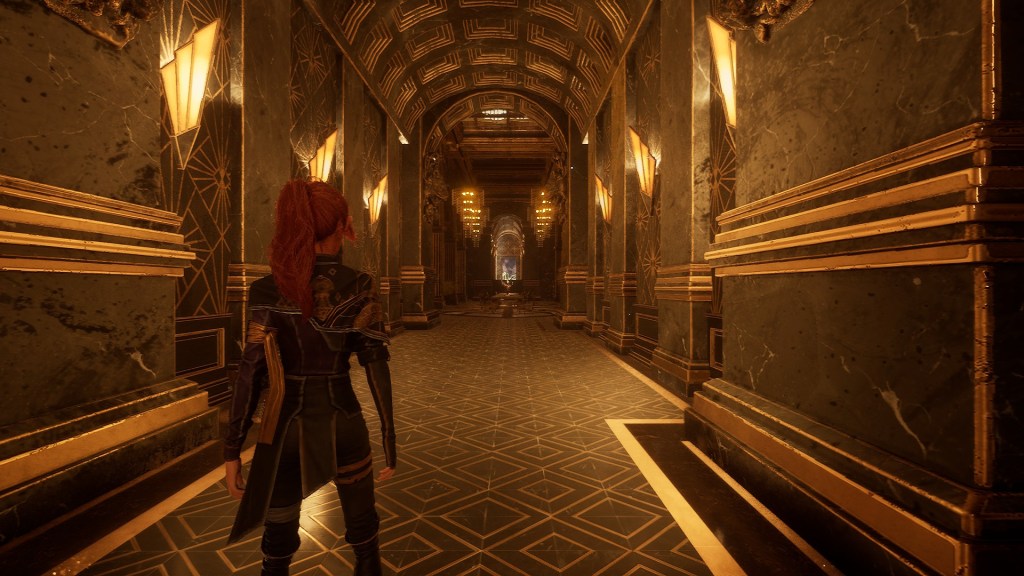
Renoir’s Drafts is a dark place, gold-and-black, filled with some of the strongest and scariest enemies in the game.  His creations are characterized by void: a horse with a black-hole singularity in its mane; Clair and Obscur—the light and dark-wielding swordsmen we frequently find in the monolith, and again in the endgame.  We also find drafts of the Axons and their typical enemies.
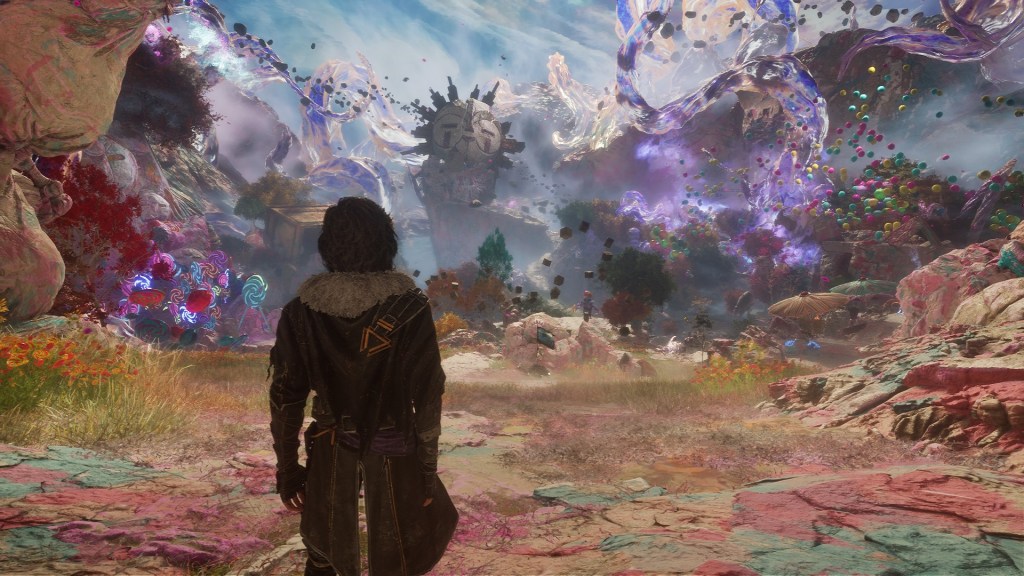
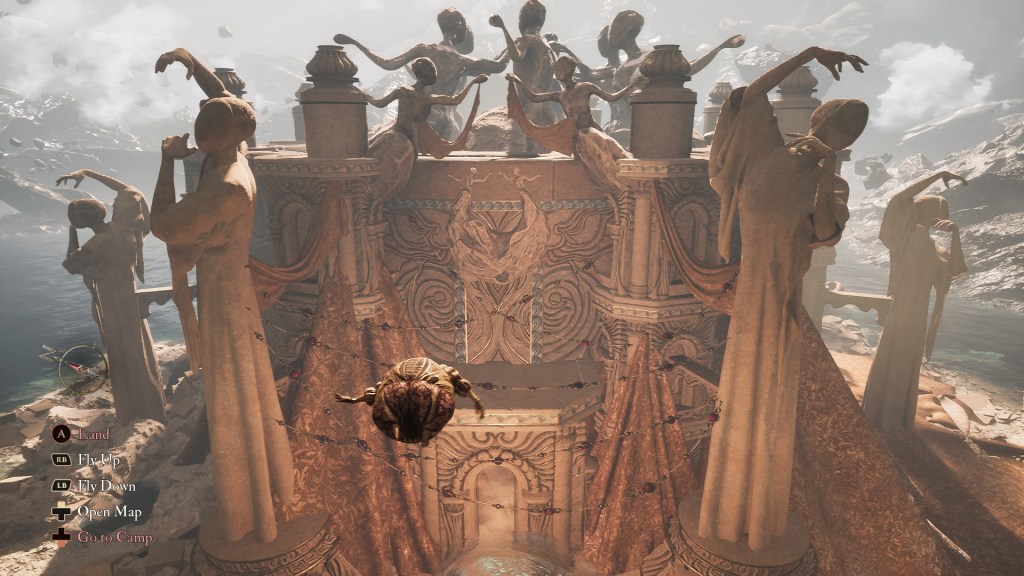
Verso’s Drafts, meanwhile, is a kid’s paradise, full of toys and trains, candy, balloons, and carnival rides.  Here we find the early drafts of Gestrals and Grandis (the yeti-like beings inhabiting Monoco’s peak), as well as drafts of François the cantankerous turtle.  We fine statues and monuments to Esquie, the central figure of Verso’s world, it seems.  And we find magical floating trains that turn midair somersaults in their movement from one part of the drafts to the other.

Look—the world of Clair Obscur is beautiful, full stop.  Throughout Acts I and II, I often felt enthralled by the world and just wanted to dwell there—busy as I was with my own problems to avoid. But by Act III the world takes on such deep new meaning, and Verso’s Drafts in particular became one of my favorite places in the whole game, as a kind of vision of Edenic paradise: this was the original intent of the author, before the breaking of the world by Renoir or the tragic degeneration of Lumière.

And as much as the aesthetics of the game evoke surrealism with its superficial characteristics and qualities, really this is surreal because it is the reflection of the creators’ own minds—not just the creators at Sandfall, but the characters invented within the game.  I am invited to identify with Verso—not just the avatar-Verso in the game world, because I guide his actions and movements—but the true artist-Verso who made this place for me—and I am invited to appreciate his view of the world: what he likes (Trains!), what he loves (His family!), and what he values (Esquie’s gentle generosity).

In a sense, this game is guiding us to a position of artistic criticism and appreciation.  We are initially asked to reckon with this world as a world—a place hostile and out of our control, that we must fight with and overcome.  But by the end of Act II it is a place where our power must be used responsibly—where we will, by necessity, shape and change (i.e., re-make) the world to suit our purposes and goals.  And in Act III we are invited instead to see the world as a made space, already shaped and changed by others’ ideas and goals—so we can question and interrogate what that meant to each of these shapers and makers.  By the end of the game we have gone from being players, to being critics and artists ourselves—that’s what it means to dwell in this space and play the game.

And, logically, that means looking at Broche’s contribution as well.

The Characters We Made Along the Way
Every year in The Philosophy of Love and Friendship, I read Plato’s Symposium with my students, and every year I try to walk them through the three levels of analysis Plato urges on us.

  1. We need to understand, on a basic level, what each speaker is saying.
  1. We need to understand, on a character level, why each speaker is saying this.
  1. We need to understand, on an artistic level, why Plato makes each speaker say this.

Clair Obscur has taken us from (1) to (2)—we started looking the world in terms of what it means and how it affects us; and gradually we have started to understand what the world’s details say about the characters who have created this place.  But to get to (3 – Broche’s opinion) we have to zoom out a bit more and understand the way the themes inform the way these characters are designed.

Unfortunately, the Dessendres aren’t terribly accessible to us, except as larger-than-life archetypes—the gods of this world.  We can see the broad strokes of how grief informs their choices, and their world-affecting choices specifically, but if we want to examine characters—and our primary theme of grief—more deeply, we have to look at the ones closest to us.

Yes.  We are long overdue to talk about our party members.

Gustave

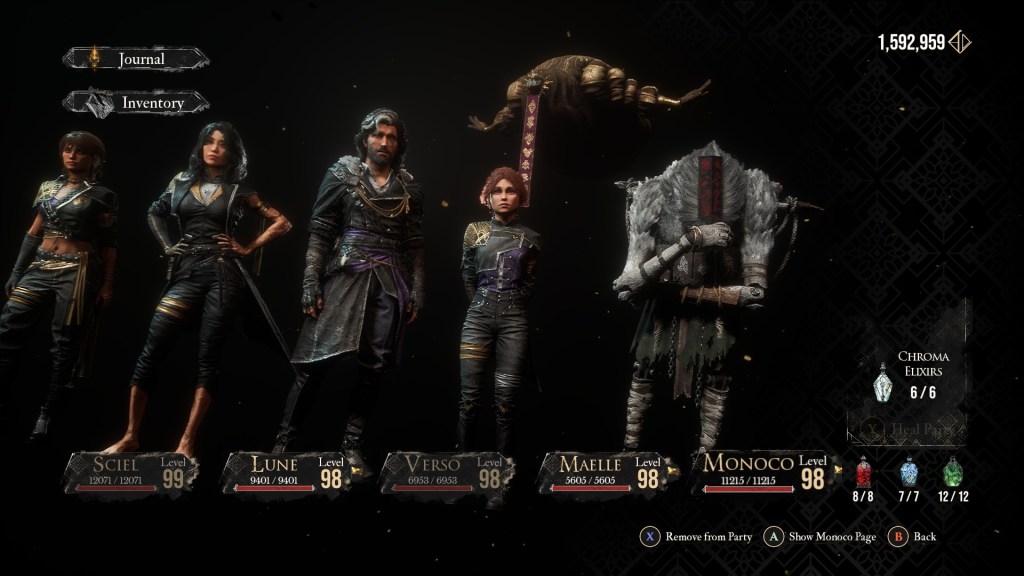
Gustave is the first character we’re asked to seriously identify with, and his motivations may be the clearest of all our characters.  His conversation with Sophie reveals his motivation, and the struggle that brought him here.  He wants to save Lumière, where Sophie has opted to accept her fate.  She spends her last year thinking of herself and not the future, trying to enjoy her life rather than fight against her fate or work toward the future that will follow.  This is why she and Gustave broke up; this is why she refused to have a child.  But Gustave has spent that same time designing the lumina-extractor that enables our party to wield so many Pictos, and thus compete with the Nevrons and other threats on the continent.

It’s not clear, though, whether either of the two are really “right” in this decision.  Losing Sophie almost certainly drives Gustave’s determination to the Expedition’s cause, but I suspect this is also part of the reason Gustave nearly gives up after the Expedition is wiped out by Renoir, and part of the reason why he’s so protective of Maelle.  Gustave hung all his hope on the mission, and when the mission seems lost, he’s lost, too.  What gives him the power to hang on are the other people in his life: first Lune rescuing him from himself, then his desire to rescue and protect Maelle.  In fact, when he finds the note alluding to Maelle’s abduction, he is ready to give up on the mission altogether—it is Lune who must remind him of Expedition protocol.

And, seeing that the Expedition results in the destruction of Lumière when Renoir is released, it really isn’t clear how much the Expedition was a worthy cause for Gustave.  Maybe it would have been better if he’d settled down with Sophie and met his fate with equanimity.  Maybe Lumière would have been better off winding down its remaining years until its last citizens gradually died out altogether. Maybe fighting fate only hurried that fate along, like any Greek tragedy would tell you. Maybe the citizens would have been better off if the Expeditions had never bothered to seek out the Paintress. (It wouldn’t have made for a great game, though…)

For all that, though, I think it’s no accident that Gustave spends more time as a martyr than a living character exploring his motivations.  By the time he confronts Renoir, he has completed his arc and made his decision to prioritize Maelle over the mission.  He will spend more time being mourned than mourning, and that might well be intentional, since the other characters’ relationships to grief tend to be more complicated.  Just as he introduces us to the mechanics of the game and prepares us for their later complexity, Gustave introduces us to the themes of the game as well, but will be overshadowed by the other characters’ struggles.

Lune

Really the only thing I’ve said about Lune’s character so far is that she’s a “space-cadet.”  And I stand by that.

Lune has been preparing for this Expedition since she was a child.  Her parents set off on their own Expedition many years ago, and raised her to support the cause.  The whole family are scientists—easily fascinated by the world around them, eagerly trying to harness the powers of this world.  This is almost certainly why Lune fits the role of mage on the team.  She’ll almost certainly be the first member of the team to learn healing skills, and learns a wide variety of elemental skills as well. 

To talk about this we have to back up just a little bit: each of the characters in the party has a dynamically different set of skills and weapons unique to that character.  Taken all together, along with the Pictos (which any character can use), there are still a staggering variety of approaches to utilizing each character, but they all tend to focus on certain rhythms and themes.

For Lune, that will almost certainly involve her elemental and healing abilities.  Each time she uses an elemental skill, she generates elemental power which can be used to enhance her other skills.  In my experience, this meant that there were two basic approaches to using Lune: you could carefully deploy skills in a certain order, ensuring that each skill generated the elements you needed for the next; or you could play more chaotically, generating as many elements as quickly as possible, then dump them all for big damage.
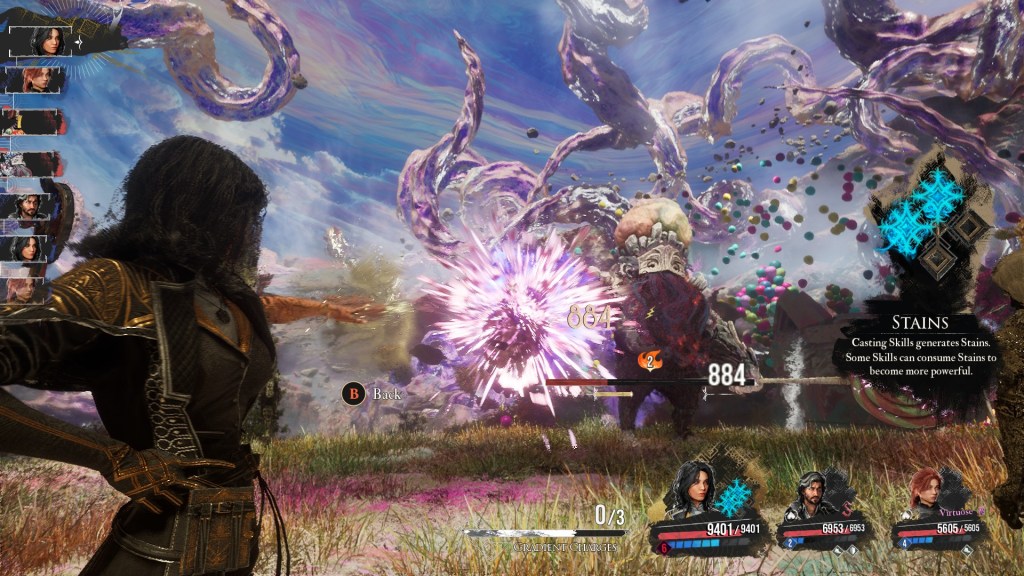
But these are, effectively, just two sides of the business of scientific inquiry: the first strategy is the methodical approach of the data collector; the second is the haphazard style of the recklessly curious.  And Lune suits both roles.  In dialogue, she often gets distracted easily, asking the native Gestrals about their society or biology, investigating environmental oddities, or asking questions about past expeditions.

Interestingly, though, I believe she’s also the first to be entranced by—and the first to snap out of—Sirene, the dancer Axon’s, hypnotic undulations.  The scientist is the first to observe, grow too curious, and fall victim to the trap, but she is the quickest to escape as well, once she’s assessed the danger.  She’s also the most consistently skeptical and untrusting of Verso when he joins the team: she’s the first to condemn him when he’s caught withholding information, and the angriest when he lies or obscures.

But all this investigation and fascination serves a secondary purpose, I suspect.

It distracts her from her grief.

Eventually, if you build her relationship with Verso, she’ll ask him to help her find her lost parents.  And they go, and they do.  But the find is anticlimactic: they are dead, just outside Sirene’s tower.  If you follow their lead and play the music they were using, you’ll be attacked by the same powerful Chromatic Nevron that killed them (and win Sirene’s dress as an outfit for Lune).  And, at long last, Lune will face her childhood grief—both the loss of her parents and her regret at the pressure they placed on her to excel and study.  Lune’s curious, scientific mind is truly a part of her nature, but her pursuit of knowledge and truth also serves to distract her from the fact that she never really had another choice but to follow in her parents’ footsteps.  Lune doesn’t regret what she’s become, but that makes it no less forced, and no less restrictive (especially for a woman who we first see playing music). Perhaps there was another way, but that way has been long lost, now.

Maelle

There’s a lot happening in Maelle’s story over the course of the game.  She is orphaned by her parents’ gommage.  She chooses to embark on Expedition 33 despite being only 16—by far the youngest Expeditioner in history (most only join Expeditions in their last year before gommaging, when they have nothing to lose).  There is a sort of devil-may-care indifference about Maelle that seems both refreshingly confident and dangerously reckless.
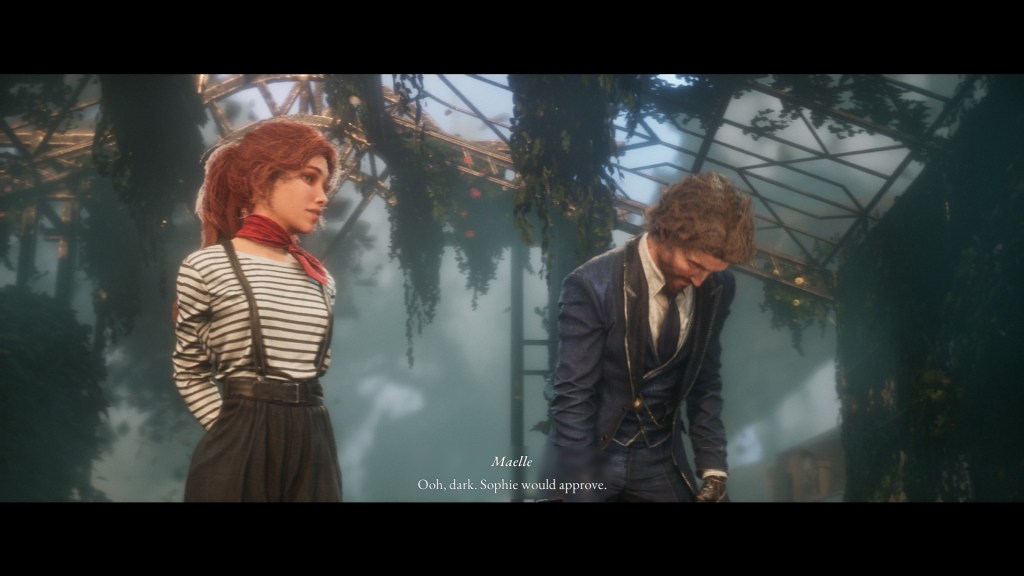
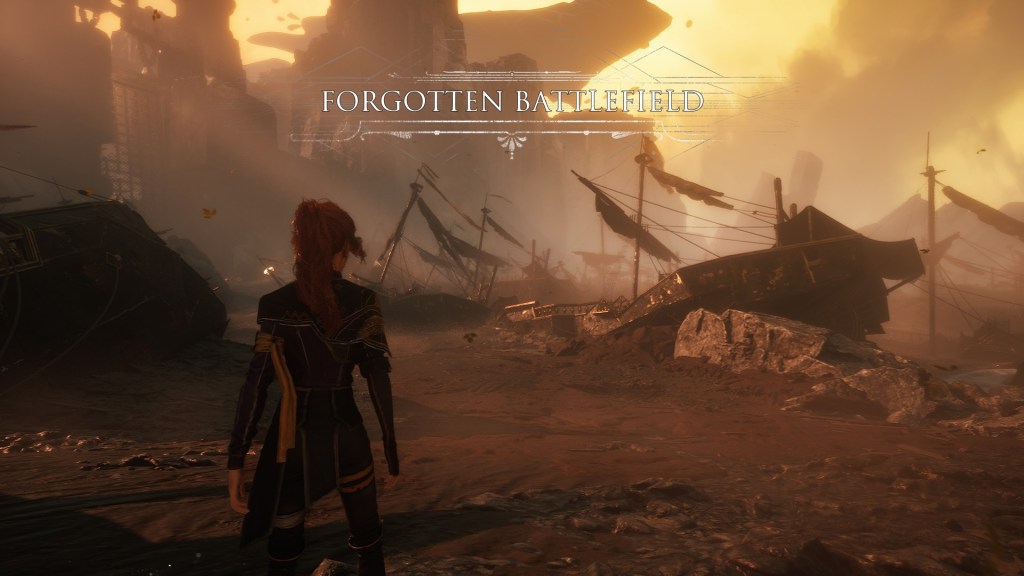
But then, of course, she loses Gustave—her surrogate father and brother—and must travel through the awful battlefield level to put his remains to rest.  And all throughout the game she must wrestle with her visions of Renoir and Alicia—visions that are almost certainly a symptom of her forgotten identity as the true Alicia.

In Act III, Maelle transforms completely into Alicia: her hair goes completely white and she gets the outfit she wore in the flashback that reveals her backstory.  Through Act III she unlocks her new power as a Paintress in her own right, even to the point of resurrecting Lune and Sciel to the party after Renoir gommages them.  Maelle/Alicia also sets the player’s goals in Act III: confront Renoir and drive him out of the Canvas.  Once they do, Maelle/Alicia will be able to bring back all those lost to Renoir: including, presumably, the other many victims of the gommage, and perhaps Gustave as well.  She is, therefore, a symbol of hope to the rest of the party. Her willfulness and strength is the only way the Expeditioners can undo all the damage done by Renoir, and possibly save Lumière after all.

But she is still just a child.  Time is wonky here in Clair Obscur: somehow Renoir and Aline have been in the painting for over 60 years, while Alicia only entered (and became Maelle) 16 years ago.  Presumably time moves differently in the Canvas than it does outside of it.  But Alicia outside the Canvas and Alicia inside the Canvas are roughly the same age, and that youth suffuses the character.

In combat, Maelle behaves like a duelist.  She with fences her opponents, switching between an offensive stance (that does and receives more damage), a defensive stance (which reduces damage taken), and the “virtuoso stance,” (which deals double damage without penalty).  Consequently, Maelle is perfectly suited to high-risk high-reward play: for most of the game I had her equipped with Pictos that made her immune to healing, but capable of doing much more damage, which stacks under the right stance.  There were many encounters where her first attack would completely destroy an enemy in a single shot.  But she also tends to have low health, and without the ability to heal her, she would often be the first to fall in protracted battles.  All of which speaks, I think, to that same youthful recklessness and exuberance.  Maelle is incautious and impulsive, and her new lease on life and health here in the Canvas contributes to her overconfidence.

But Maelle is also in denial.  She is here in the Canvas, quite literally avoiding reality.  Life has become so harsh, so painful, so unbearable, that Expeditioning with Gustave, Verso, and the rest of the party becomes a welcome escape.  Here Verso is alive.  Here she can speak, and her face is whole.  Here she can go on fun adventures, rather than try to keep the peace between her parents.  (I totally get it—why do you think I’m playing this game?)

The cracks do start to show, though.  Godlike as Maelle’s Act III powers become, she also asks Verso to help her find facsimile-Alicia, who apparently has hidden herself with the third Axon, at the top of a fantastically-high and rickety tower, only reachable now that Esquie can fly.  After a long, laborious journey up the tower, Maelle and Alicia do confront one another, and Alicia asks Maelle for death.  Maelle gommages her—and learns to use the skill in battle, too.  But this scandalizes Verso—couldn’t she have waited until he said goodbye?  Maelle assures him, though, that this is what Alicia wanted.

It’s an unsettling look into Maelle’s perspective.  It seems she would rather die than go on living in the real world with her burnt face and voice.  Here she wields godlike power; there she is the voiceless daughter of a broken family.  But as true-Renoir has pointed out—anyone who stays in the Canvas too long will die.  Is that a price Maelle is willing to pay?  Would she rather die in this fantasy than live in reality?

Verso

I’m not sure Verso ever stops being enigmatic—even to himself.  The Verso we see in the Dessendre family portrait is a young man, between 20 and 30, I suspect, and it seems that was his age when he died. But the Verso who fights in our party is well over 60, according to the game’s internal lore. And the Verso who created this painting was just a child, barely ten, I should think.  It’s unclear, then, if the Verso in this Canvas wasn’t some youthful invention—an idea of what Verso wanted to grow up to be, rather than someone he ever was.

Because that’s kind of the key to Verso’s whole identity: he is a fiction.  Lune and Sciel are only as real as the Canvas they inhabit—even if this is a fantasy, they are real, true parts of that fantasy, a product of its own internal logic, children of Lumière’s inhabitants.  Monoco, by contrast, is a direct invention of Verso’s, like Esquie, the Grandis, and the other Gestrals.  It’s heavily implied that Monoco was also a fundamental part of that creation—there’s a toy Monoco (and Esquie) in Verso’s room in the Manor.  Meanwhile, Maelle has discovered her real identity: she is Alicia, and must come to terms with the fact that she belongs to the reality beyond the Canvas.

But Verso?  He is the invented memory of a dead boy, or the lingering memory of a dead man.  He is precious to Renoir and Aline, both the Canvas facsimiles and the true Dessendres—but for what he represents, and not who he is.  Verso is living a kind of a lie, but a lie told by someone else. He is a created image of his creator, neither an organic part of the fantasy, nor the actual boy lost to Aline, Renoir, and Alicia.  He is all that is left of Verso, but he is not Verso, all the same.

What the heck are you supposed to do with that information?

Worse, Verso isn’t always sure what to do with himself.  He is initially very guarded with the Lumière Expeditioners—Lune, Sciel, and Maelle.  It takes him a while to open up, but when he does, he explains that he has gotten close to other Expeditioners in other Expeditions—but they inevitably die, and that grief can haunt him.  Especially in the case of one particular Expeditioner, who he apparently grew very close with indeed…

By contrast, Verso seems most at ease with Monoco and Esquie—it’s clear they have a long history of going on adventures together, and their friendship does not need to be explained or strengthened.  Verso will happily accept Esquie’s offers to hug him (at least my Verso did—not sure what your guy is hung up about), and he will spar with Monoco—just for fun.  He and Monoco also prank the rest of the party at one point: Monoco cuts him in half and he waddles over to the others with only his hands and torso. (He’s immortal, remember?  Good times…)

But that is the contradiction inherent in Verso’s character.  He seems guarded and secretive with his new allies, but there is, absolutely, a silly streak to him that reveals the child-Verso that made Verso’s Drafts.  For all his staid mannerisms, he still gets excited by trains, and he likes Esquie’s hugs and Monoco’s shenanigans.  It is still fun—wandering around the Continent, getting in and out of scrapes, telling stories and doing the sorts of stupid things that will make for good stories later.  He’s been eaten by Serpenphare (and, presumably, pooped out); he’s been squashed by the Axons.  At one point he and Monoco were apparently frozen in ice for a whole year.

These things happen, I guess.

He’s also terrifying in combat.  Gustave had a pretty simplistic battle system where he would accumulate charges by hitting enemies, only to release those charges in big hits with certain moves.  Verso has a similar system: he builds his “rank” with multiple hits, which multiplies his damage and enables bonus abilities on moves with a matching rank.  But each time he takes a hit, his rank decreases, making him capable of great damage, but only with the right timing.

But those high-ranked moves—sheesh.  Verso has plenty of crazy powerful light and physical moves, many of which will hit all enemies at once, often many times in a single attack.  It might have just been my build, but he was absolutely on par with Maelle for sheer damage potential in my game, and I think that was what the developers had in mind.  But he’s also well-rounded: he’s got healing moves, status moves, you name it.
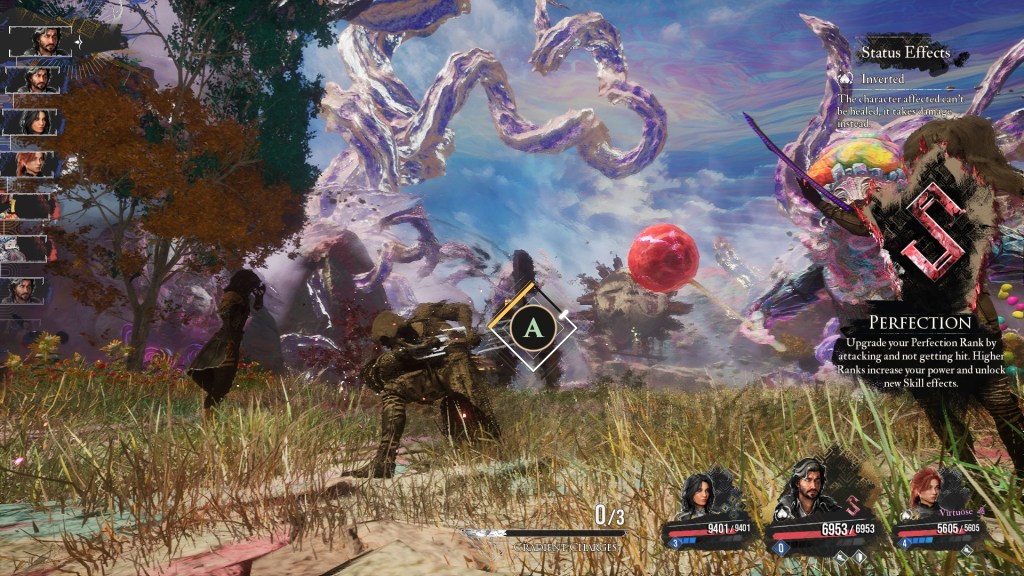
He’s also significantly more durable than Maelle—his ultimate move, learned only after hanging out with Esquie, gives him an auto-revive ability that is frankly invaluable in late-game fights.  And that also tracks nicely with his immortality and his silly misuses of that immortality. (Especially funny is his bark upon reviving: “What did I miss?” What a punk.) He also has several self-healing abilities, but, true to his character, I don’t believe he has any skills that heal other party members. The closest he has is “Burden,” which allows him to take all the negative status effects from his allies. To Verso, co-operation is a liability.

But this describes Verso’s fundamental relationship to grief.  Immortal, he is utterly unafraid for his own sake, and reckless to a fault.  But he is also unwilling to get close to others, for fear of losing them.  Verso is guarded because he is guarding himself from the possibility of loss.  Joining Expedition 33 is a sign of growth, but it also means that he will have to make confessions—about his father, Renoir, who destroyed the other Expeditioners; about his past choices and deeds, supporting or opposing other Expeditions; and about the fact that he probably could have saved Gustave, but chose not to…

In combat and in dialogue, Verso is self-sufficient, but that self-sufficiency is as much a matter of trained resilience and confidence as an unwillingness to trust others and let them affect him.  He would rather be alone than risk grieving another lost soul.

Monoco

Like most Gestrals, Monoco is a rowdy punk.  His moves are all stolen from Nevrons when he takes their legs (?!), and his fighting style is therefore rather weird and quasi-random.  Each time he uses a move, it manipulates a little wheel that gives an advantage to certain moves.  So, like Lune, you can carefully move the wheel around with strategically-chosen moves, or you can play chaotically, taking advantage of whatever you have in the moment.  I ended up using Monoco as a tank—he had a ton of health and defense, and I prioritized moves that healed or buffed the rest of the party.  It felt true to his character, and took advantage of the wide variety of moves he could use.
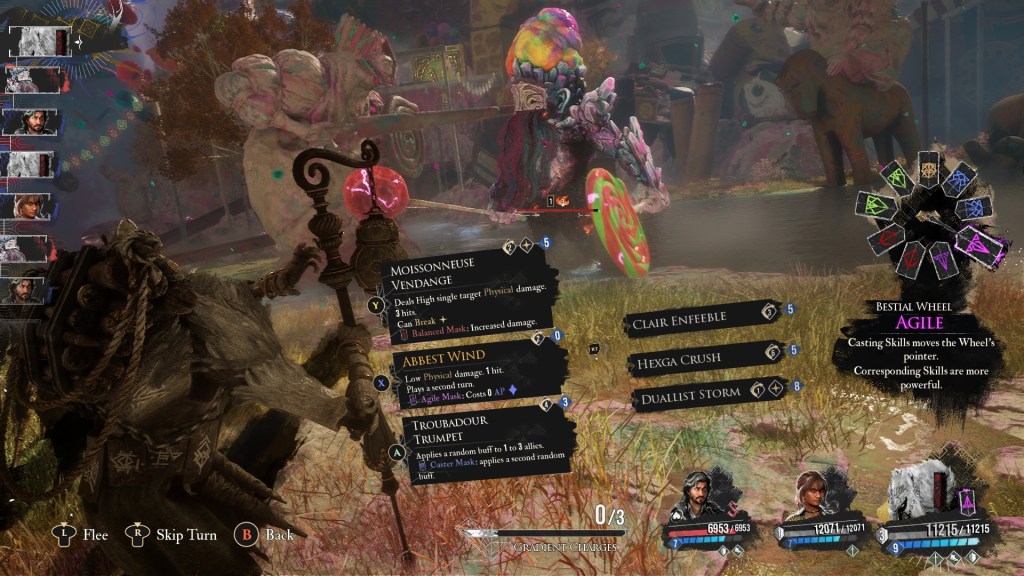
In the game, Monoco doesn’t tend to be very deep.  He’s got his rivalry/friendship with Verso, and the two like to exchange stories about old times, like army buddies sharing beers and growing nostalgic.

The one exception is Monoco’s relationship to Noco, the Gestral merchant who tags along with the part for much of the game.  Noco was apparently Monoco’s mentor, and Monoco thinks of him like a father.  But in the confrontation with Renoir in Old Lumière, Renoir blasts Noco, killing him outright.  The other party members console Monoco: Noco will be reborn, after all, like all Gestrals—but Monoco snaps back that it’s not the same: he won’t remember, and is therefore not the same Noco.

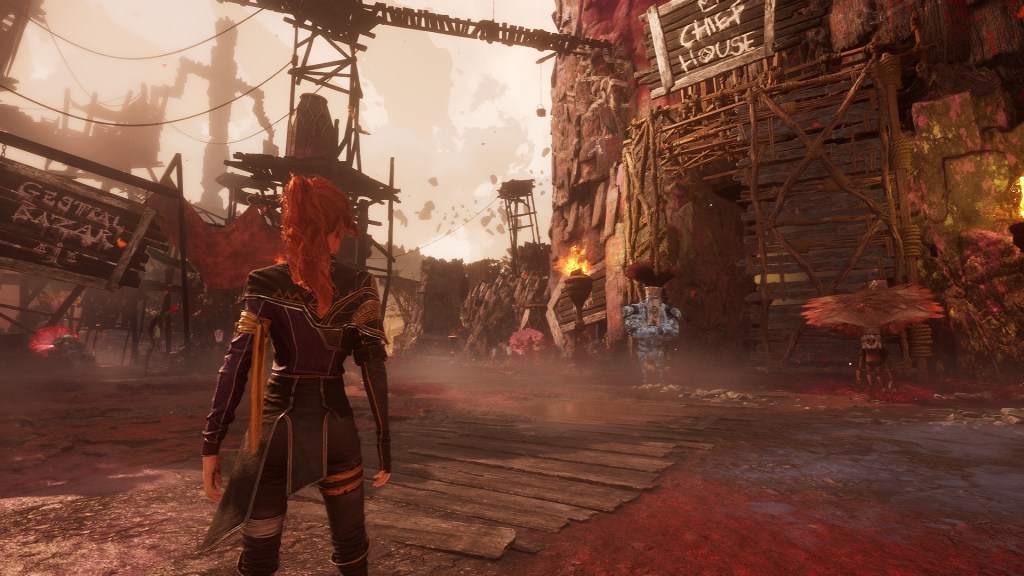
Eventually, he asks Verso to bring Noco to the stream where Gestrals are resurrected, and the party agrees.  But there Monoco must confront and defeat the Gestral village chief, Golgra—which risks reigniting a long feud between the two.  But Golgra, defeated, allows Monoco to skip the line for Noco’s sake, revealing a surprising compassion for her prodigal rival.  Noco revives, but, as Monoco predicted, he doesn’t remember his mission to explore the world and become the greatest merchant—and he doesn’t remember Monoco, either.

You can visit Noco back at the Gestral village: Monoco openly weeps each time that you do.

And there is something truly tragic and horrible, but also refreshing about this, I think.  Of all of the characters, Monoco seems the most honest about his grief, and is the most open in his mourning.  I guess Gestrals play hard and grieve hard, too.  We should all be so lucky.

Sciel

The one possible rival to Monoco’s honesty is Sciel’s.

And, look.  I’ve said virtually nothing about Sciel up to this point.  Because I think she might be the key to understanding everything about the themes in this game.

Sciel is dark-skinned, heavily tattooed with pictos, and wields a double-bladed reaper’s scythe.  Her attacks are usually dark-elemental, though some of her other weapons can mix up the type if you make the deliberate decision to do so.  Her skills come in two varieties: sun skills mark enemies with sun counters; moon skills use up sun counters, usually to do bonus damage or inflict bonus effects.  And once you’ve used both a sun and moon skill, Sciel enters “Twilight” (one of our translations of Clair Obscur, remember), which enables her to do extra damage for two turns.  So the key to Sciel is balancing these two types of skills: stacking sun counters until you expend them with a moon skill and unleash hell during her twilight phase.

It’s a rhythm I never fully mastered, I think.  I found some interesting ways to use Sciel, and even managed to so some major damage, but I always felt I was under-utilizing her in battle.

What I did like, though, was giving her the Pictos that caused her to do damage and inflict status when she died, then equipping her with Pictos that automatically killed and resurrected her at the beginning of each battle.  There were several times when I would walk into a fight with Sciel in my party, and she would automatically wipe out the enemy squad just with these effects alone.  And this, too, seemed appropriate to a character emblazoned with the symbols of death (scythe, twilight, and dark, sunken eyes).
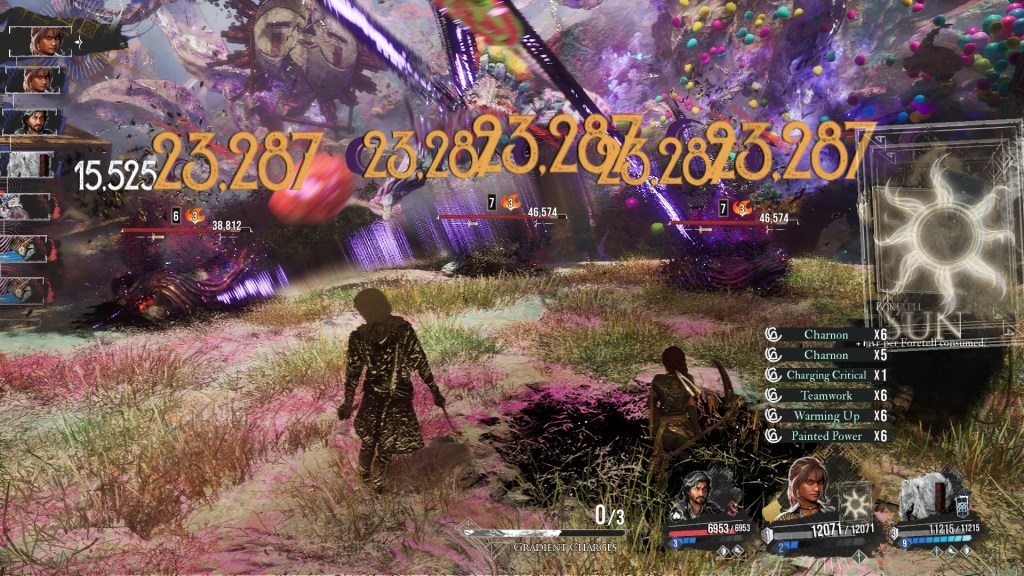
In her conversations, too, Sciel seems strangely comfortable with death.  She confesses to Verso that she doesn’t fear death, and isn’t worried about what happens to her on the Expedition.  She even offers to sleep with Verso—the only sexual opportunity Verso will receive, to my knowledge.  She’s not subtle about it, but it also isn’t crass or salacious—there’s no awkward sex scene, just Sciel’s offer and the tacit understanding that she and Verso are both consenting adults seeking comfort in a pretty awful situation.

But the rabbit hole continues deeper: it turns out that Sciel was married, and her husband died (I don’t remember exactly why).  Sciel loved him terribly, and couldn’t imagine a life without him—so one night she took a long swim from Lumière into the sea, with no intention of coming back.

She did, though.  She washed up on shore the next day, utterly baffled how she’d arrived there.

And so she chose to join the Expedition, using her new lease on life for some more positive purpose.

In a game about grief, it seems natural that suicide should come up, and come up more than once.  But as harrowing as Gustave’s suicide attempt may be at the very beginning of the game, I think Sciel’s affects me more.  There is a frankness about Sciel that I find utterly incompatible with her admission of suicide.  Gustave was a ball of tensions, regrets, and insecurities.  But Sciel is so wildly alive, so uninhibited, and so comfortable with herself—after surviving suicide, what does she have left to fear, after all?  She does not fear death because she has walked with death, and has even come to find solace in its presence.

This changes, though, when Maelle promises to revive the lost citizens of Lumière.  Abruptly, Sciel is committed to the cause, in the hope of getting her husband back.  She even cuts off her relationship with Verso (though she offers one last roll in the hay, which my Verso turned down), now that she must once again consider her loyalty to her husband.

Sciel’s relationship to grief is a troubling one.  Where Monoco grieves openly and directly, Sciel seems to have transmuted her grief into something self-destructive.  Her liveliness is both a manifestation and a cover for her death wish.  She does not fear death; she wants it, I suspect.  I don’t think it’s as simple as saying that she’s outright suicidal—it’s more that I think she has nothing to live for.  Her life is over—has been over—ever since her husband died.  The consolation for her grief is knowing that it won’t last much longer.  And there’s something truly, truly terrible about this, even if it may be a form of healthiness.

It also struck me as somehow terribly appropriate—and terribly inappropriate—that I had somehow incorporated this death-rebirth cycle into the way I used Sciel in combat.  Here was a suicide survivor that I had been routinely killing each time she entered the battlefield.  I stopped using the strategy for quite a while, choosing instead to find a different way to employ Sciel on my team.

But I also suspect that this, too, was intentional.  If surrealism is supposed to speak directly to the subconscious mind, I think the game had effectively persuaded me to use these Pictos on Sciel for this reason.  I think I intuited, or was guided, to employ this strategy before I knew it resonated with her background—and that’s the mark of some damn fine world-building, I think.

Esquie

Hold on.  We’re not done with Sciel just yet.

Verso’s conversations with the other characters are activated according to a mechanical trigger I haven’t fully explored, but most of these conversations happen in parallel with one another.  You might have gotten farther with one than another, but you’ll likely be closing in on the end of all these conversations at the same time.

Which means that it’ll be right about the same time as Sciel confesses her suicide attempt to Verso that Esquie reveals that he saved Sciel from the sea.  Which Verso then relates back to Sciel.  Apparently this is why Esquie recognized Sciel at their first meeting.

Which leaves the mind racing—did Esquie lead Lune to Gustave as well?  Is this big, velvety puffball some kind of avatar of rescue, an elemental enemy of despair?

It’s just a touch—nothing more—but the laws of dream-logic that govern a surreal work like this are clear.  Esquie—the ever-gentle, ever hugging, idiosyncratic goon with the Expedition 33 sash draped across his sunshine mask—is a kind of saint, a bodhisattva, a childlike savior of the lost and suffering.  He is enigmatic, but only insofar as his actions do not abide by the logic of we mere mortals.  He’s a goofball, always losing his magical stones, but he does not grieve for them: “they’re going on adventures,” he says.  And Verso, teasing, suggests that Esquie loses them on purpose.  (Esquie does not deny this.)
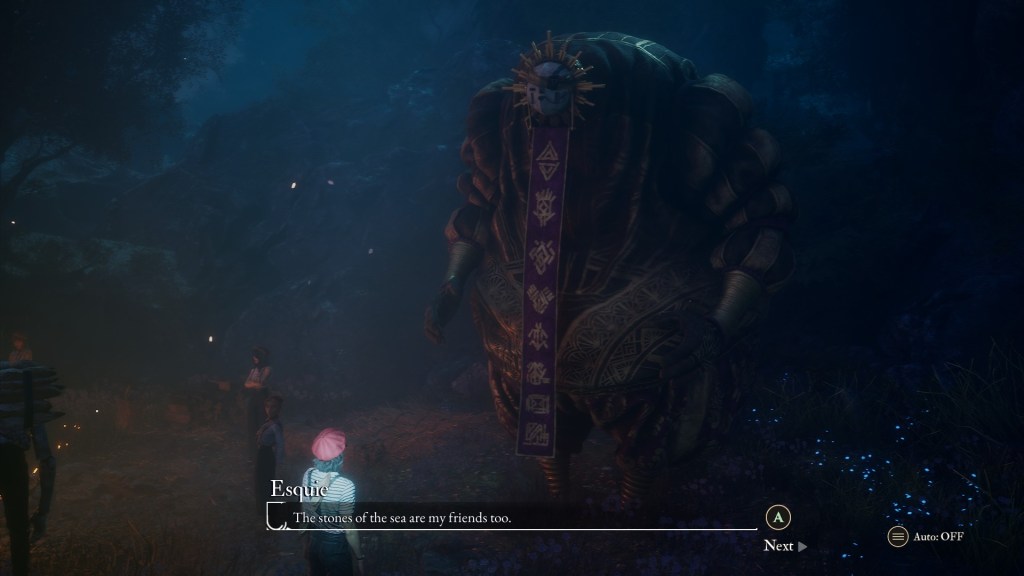
I love Esquie, like I don’t think I’ve ever loved a video game character before.  Not because he is realistic, or because he is well-characterized, but because there is something of raw mythic power in his portrayal here.  He is utterly unique, utterly fantastical, utterly unlike anything else I’ve ever seen, except these connections to Buddha or Christ that keep popping into my head, despite the strangeness of that comparison.  He is eternally warm, eternally gentle, eternally loving, and some kind of supernatural rescuer of the lost and despairing.

I love him, because I want to believe in him.

Tolkien spoke of fantasy as consolation—the escape of the prisoner (from the pain and suffering in this world), rather than the escape of the deserter.  Esquie is, by that logic, a perfect fantasy being: the huggable, gentle, loving force which, like a guardian angel, stands always just a little ways away, ever-laughing and ever-droll, but also ever watchful: bringing joy to the joyless and comfort to the lost.  It is truly comforting to think of every suicide, every drug addict, and every hopeless soul visited by Esquie in those darkest final moments, taken in hand like Sciel was, and led to someplace peaceful and warm.  Whatever makes Sciel healthy and vivacious is something she has borrowed from Esquie, I think—and something he happily lends to whoever might need him.  Esquie is the unequivocal force for good in this game—a benevolent savior who grieves, but does not let that grief interrupt or disturb his joyful equanimity.

And he’s almost certainly the reason why I’ve now written fifty freaking pages about this game.  Because you need Esquie (or at least what he represents) in your life.  To me, he represents a terribly powerful part of some terribly old ideas, and a distillation of what is missing from contemporary religion and morality. Any Christianity that has forgotten Christ’s mission to the lost and despairing, that argues Christians should inflict their short-sighted judgment on others, and that contends that empathy can be toxic, is no Christianity at all.  Esquie is the most believable reminder I’ve seen in years that Christian love does not judge, does not condemn, but is no less powerful or weak for being gentle, kind, and joyful.

And perhaps the clearest indication of this is in Esquie’s relationship to François.  As I mentioned earlier, François is apparently holding on to Esquie’s diving stone, so Esquie and Verso confront him to get it back.

Now François is a prickly soul, superficially cantankerous and mean-tempered—the very opposite of Esquie’s enlightened benevolence—but here it is revealed that François’ prickliness derives from his own grief: he and Clea used to be friends, back when Clea would visit Verso’s Canvas.  But since the tragedy, Clea no longer visits anymore, and François misses her.  All you need to do, then, is bring François a carved stone depicting Clea sitting on François’ turtle-shell back, and François will relinquish the stone—and weep.

Like all the characters in this game, François, too, is suffering from deep grief and loss.  And only Esquie can see, understand, and speak to that grief.  Only Esquie has the patience to uncover and solve this simple little problem.  Only Esquie can befriend poor François, who really only needs that little bit of love and compassion.

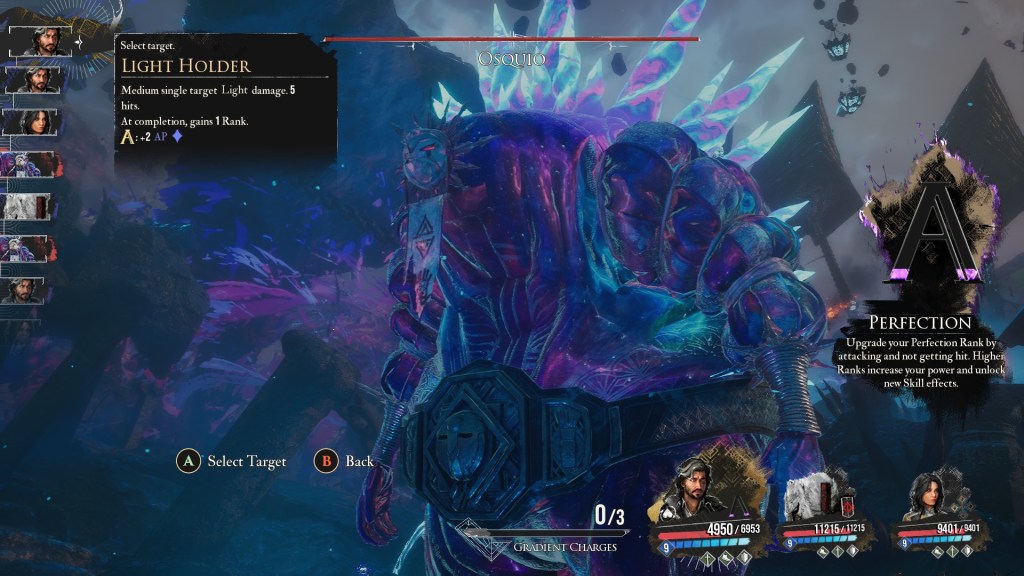
Esquie, as I said, is elemental in this game.  In Verso’s Drafts, you’ll see depictions of him everywhere: statues and monuments, as well as Esquie’s nemesis, Osquio.  Esquie is some pure, distilled form of Verso’s earliest childhood—perhaps an imaginary friend now raised up to a mythic being.  And it is, therefore, the purest expression of creativity this game has to offer, both from Verso and Broche, I think.  I would not be surprised to learn that this game began with Esquie.  Among so many great ideas, it is certainly the greatest.

I should note that the battle with Osquio is also just wonderful.  After you enter “The Root of All Evil” (a subsection of Verso’s Drafts), Esquie talks about Osquio with the bated breath of a stage whisper.  Verso and Maelle have to announce their challenge dramatically, and Verso even asks if Maelle “remembers how to do this”—it’s clearly a staged adventure the two siblings had undertaken many times before.  After winning the fight, the cutscene even transforms into comic-book primary colors for the final blow.  It’s a joy to see.  Osquio is a patsy, a theatrical heel, every bit as goofy and inept as Esquie, but with a fourth-grader’s understanding of evil and a seventh-grader’s understanding of cool.  He is both the manifestation of a superficial adolescent sense of maturity imposed on the childlike Esquie, but with all the self-seriousness deliberately undercut and sabotaged by his clumsy attacks and delusions of megalomaniacal grandeur (including a final attack which announces “Osquio decides to destroy the world. Bye Bye.”).  It’s perfect, and another wonderful example of the combat-as-game that is so typical of the Gestrals (another Verso original).
Verso (the child)

All of this seems to point right back to Verso, but not the adult Verso in our party—the young Verso, now dead.  And the emotional truth of all these places, all these peoples, and all these beings (like Esquie and Monoco) points directly back to the boy who created them all.  We are not just playing a game with a rich, well-realized world: we are playing in Verso’s world.  And the more I learn about Esquie, Monoco, and the Gestrals, the more I realize (and understand) what a loss this death has been.

Which is something no video game has ever shown me before, I think.  What Remains of Edith Finch gets at some of the same truth—by playing the minigames representing each life, we get a sense of the life lost.  But here the scope is so much grander, and the creations so much more personal.  It’s hard to blame Aline for her drastic and self-destructive actions, or Alicia/Maelle’s desire to stay in Verso’s Canvas, when we, too, grow to love the child-creator who made these wonderful places and things.  It is tempting to dwell in Verso’s Drafts forever—this magical, childlike refuge from Clea’s Nevrons, Renoir’s Axons, and all the other threats that essentially manifest the conflicted feelings of their creators.  Here, in Verso’s mind, we are protected, safe, and surrounded by joys and pleasures.

But if you wander into Verso’s room in The Manor, a different picture begins to emerge.

Verso didn’t want to become a painter.

He painted, mostly to make his parents happy, and because he felt obliged.  But Verso loved trains.  He loved candy.  Maybe he wanted a different life, in a different career.  Verso’s Canvas may be a loving, wonderful place where his childlike imagination runs wild and rampant—but it was only a part of him, and only a fiction.  Aline takes refuge in this Canvas, seeking the child she lost, but it is a kind of lie, too.  She only sees the part of him who performed obedience for her.  Like the Verso of our party, this Verso is only a projection, incomplete and inaccurate: the true Verso is gone, to our loss as well as to Aline.

And behind this decision, I think I can begin to see Broche’s hand at work. These characters have all been designed to showcase the different ways we deal with grief, but they all rely on this fictional Verso, the fiction which persists as an object of this grief, rather than an accurate portrayal of the lost Verso himself. Grief, in some sense, has nothing to do with the grieved, and everything to do with the griever. We grieve what we, ourselves, wanted from our loved ones, and not necessarily the loved ones in-themselves. The Verso who painted this Canvas is a ghost, a memory, clung to by his parents. But he is not real.

We cannot go back.  We cannot undo what is done.  Verso is lost.

What do we do now?

The Player

For me, the answer was: linger.

I think I managed to finish both Acts I and II in about forty-to-fifty hours or so.  The other half of my 99 hours I spent in Act III, lingering.

At the end of Act II, Maelle/Alicia explains that she will need to gather the Chroma of fallen Expeditioners to wage war against Renoir—but this is accomplished in a cutscene, not through gameplay.  When it is done, the game simply stops giving directions.  Renoir is in Lumière.  You are free to fight him whenever you are ready.  But the rest of the world is now open to you, now that you have Esquie’s flying stone.  Like Chrono Trigger’s Lavos, you can go fight now, or wait to fight him later.

Most of the online sources advise fighting Renoir sooner, rather than later.  The fight is more tense that way; you don’t want to be overpowered.

I did exactly the opposite.  I did EVERYTHING.  I fought EVERYTHING.  I flew to every location I could find on the map and scoured every corner for secrets and treasures.  I revisited old locations looking for missed items and hidden paths.  I hunted down dozens of optional bosses.  I bought every item on sale from the Gestrals. I climbed the endless tower and fought EVERY challenge and boss I could find.  I nope’d out of the plot for a solid 50 hours.  And that’s how I know as much as I do about the family Dessandre, about the side quests and character missions, and we haven’t even talked about Simon, stuck down at the bottom of the Abyss under Renoir’s Drafts, or the boss fight with Clea’s avatar, or the lost Gestrals, or finding the Canvas itself in the main room of the Manor—or any of a number of other secrets I found on my own, before ever opening a wiki or strategy guide.

And in all that time I never regretted a moment.  Even when my fight with Serpenphare took dang near three hours, I took a screenshot as a point of pride.  It was all joy, all eager exploration, and all organic play-for-the-sake-of-play.
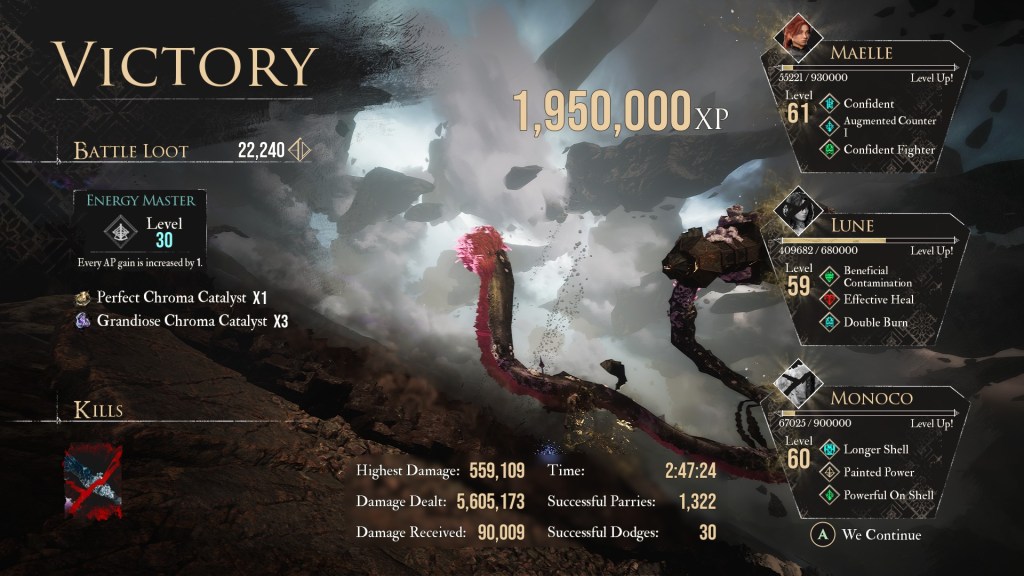
I probably should have just waited to fight it until I was higher-leveled. But this was also fun.

I did not go fight Renoir, because I did not want the game to end, in short.  Because this game brought me the sort of joy I haven’t experienced from a video game in years—if ever.  I wanted to stay here forever, adventuring with Maelle and Verso and Sciel and Esquie until the end of time.

But, as happens, my winter break ended.  Classes started up again.  Bills needed to be paid.

I did not expect to fall so hard into the world of Clair Obscur, to become so entranced by its characters, by its combat, by its story, or its warmth.  But I suspect I needed it.  I’d burnt myself out over the three months of summer I spent preparing my class on political philosophy, then over the four months of fall I spent teaching that class, and, of course, the revelation that I would not be teaching it again, despite all the work I’d done and the importance I believed it had to my students.

I was, in short, grieving.  I was grieving the destruction of American Democracy.  I was grieving the loss of my time and energy.  I was grieving my own aging body.  Perhaps I was even grieving the losses I’d had no time to grieve before: friends and relatives lost to COVID, to old age, to accident and ideology and bad decisions.

I’m damn near forty years old.  I’ve saved up a lot of reasons to grieve, and I haven’t afforded myself the time to grieve them properly.  The line between proper grief and self-pity is a tricky one, after all.  But you need the first as badly as I wanted to avoid the second.

And there are, as this game would point out, a lot of ways to avoid grief.  Like Lune, I’ve been throwing myself into my work for years.  Like Renoir, I’ve believed it too important to move forward than wallow in my sadness.  Like Verso, I’ve been guarding myself from the hurt of new friendships, preferring reliable self-sufficiency.

And, like Maelle, I threw myself into a world that seemed better than the reality I did not wish to face.

But right around the 97th hour, I found that world exhausted.  My party was level 97, I’d beaten every threat I’d encountered, and there were no more challenges to overcome.  There was no avoiding it anymore.  It was time to go confront Renoir, and finish the game.

Returning to Lumière

At level 97, nothing Renoir could muster posed a threat to my party.  I was defeating every one of his enemies in a single hit.  I walked into Lumière like Neo at the very end of The Matrix, utterly unstoppable, apotheosized.

And, honestly, it felt right.  My team had grown, changed, learned, suffered, and struggled.  We had lost so much, gained so much, and now we were ready to decide the fate of this world, no matter what Renoir had to say about it.  It was our world, now.  Not his.  I’d confronted Clea’s avatar—the inventor of Nevrons.  I’d defeated Simon, The Divergent Star.  I’d opened every door to the Manor.  I’d beaten Osquio at the Root of All Evil.  Renoir was just some chump to me.

And Renoir really was an easy fight—like his goons, I could defeat each phase of the final battle in one hit.  And this, too, felt right somehow.  Even as the music swelled with an intensity that did not match the one-sided battle I was having, and Aline held back his strongest attacks, it felt right for Maelle to blow him away with a single shot, and banish him from the Canvas once and for all.

It was our world, now.

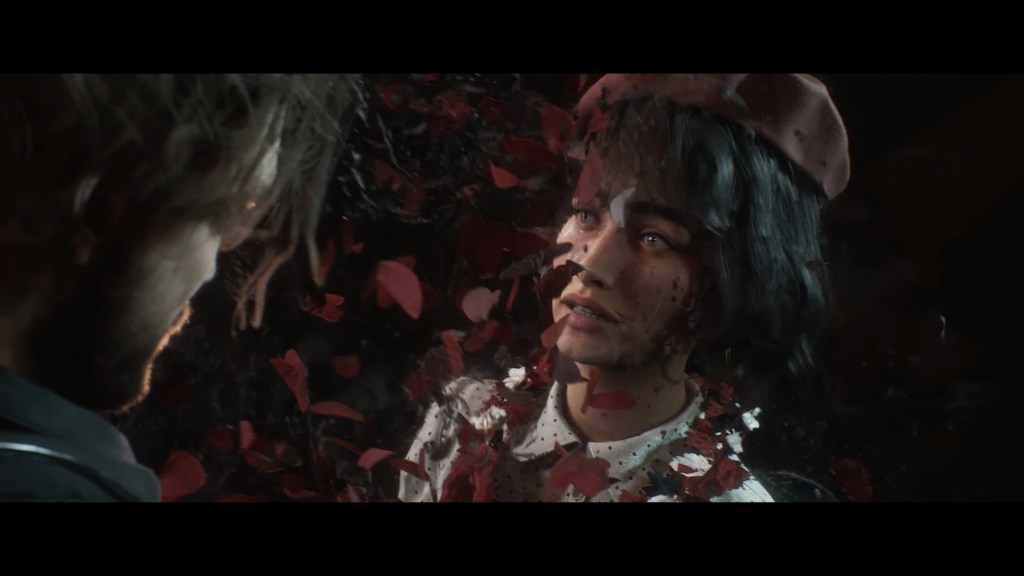
But the battle opened a window into the world beyond the world—a space only Maelle could safely enter.  Nonetheless, Verso entered first.  And there, in a void composed of Chroma and darkness, sat the little boy with the blasted face, hunched over a Canvas, painting this world before us.  A boy who didn’t want to be there, but who had been forced to, for who knows how long.
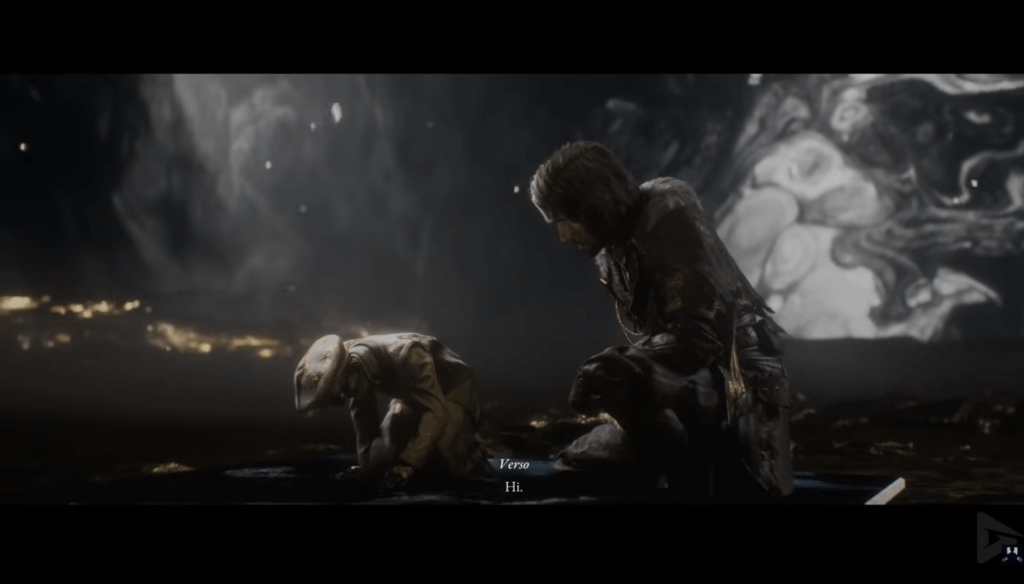
I did not replay the ending for this essay, so the footage from the final cutscene is courtesy of Gamer’s Little Playground on Youtube

Verso, I presume.  Not the projection, but whatever part of Verso created this world and is bound to it, upkeeping and supporting it.

Then Maelle entered.  The battle was won.  We could live in peace, now.  She could resurrect the fallen and fix the world.  She could protect everyone from Renoir.

But she would also die.  And the world she made would die too—Renoir would return and scour it once Maelle/Alicia could no longer protect it.

Maelle draws her sword.  Verso draws his.  And the game offers a choice.

Who will you control in this final confrontation?

Whose vision of the future will you choose?

Will you support Maelle, rebuild the Canvas (but only for a time), and let her die in the effort?

Or is it time to let go—let Renoir destroy Verso’s world, and send Maelle back to the real world to fix her life?

The Choice

There is a sense in which neither choice is satisfying.

To choose Verso in that moment is to undo so much we have fought for.  It is to tacitly endorse Renoir’s destruction of the Canvas.  It is to condemn Lumière, the Gestrals, Monoco, and Esquie to oblivion.  It is to fail Sciel and her wish to see her husband again.  It is to once again strip Maelle of her freedom to choose, using force to tell her what is best.

But Maelle wants a fantasy.  She will just prolong the inevitable, return us to the Paintress’ ticking clock.  It is to preserve a work of art at the cost of a living person and her family, and that only for a little while.

It is a horrible choice.

There are even elements of the choice that I find a bit reductive, or cruel.  Can we really dismiss the lives of all the people of Lumière?  Are they truly worthless, because they aren’t “real” enough?  Can we really override Maelle’s choice to stay?  Isn’t she an autonomous human being, rational and mature?  Isn’t it wrong to support yet another older man telling her what to do and believe?

But that is what I chose.

I condemned Lumière.  I condemned the Gestrals.  I condemned Monoco.  I condemned Sciel.  And I condemned Esquie.

But I saved Alicia.  And what remains of the Dessendre family.

And I wept.  I wept through the entire ending cutscene.  I wept like I haven’t wept in nearly twenty years.  I wept harder than I had when my grandmother died.  I wept, though I hadn’t wept at the election, or during the pandemic, or when my condo was condemned, or when my cousins passed away—three in a row between 2021 and 2022.  I wept because of these things.  I wept because I could not weep for all the time I’d wasted trying to make money, or because my employers have never adequately recognized or rewarded me for the work I’ve done for my students, or at the death of my dreams.  I wept because I couldn’t weep for the house I would never have, or the life of leisure I would never lead, or the success I would never reach.  I wept because I will never know security under a president more concerned with his social media profile than the well-being of his citizens.

I wept because it was time, finally to leave.  Because I was giving up the same exact fantasy Alicia would now have to give up.  I chose to be Verso in that moment, because I believed Verso was right, but it did not stop me suffering like Maelle—the girl everyone had been trying to protect, and who would now, finally, be protected.  Just—everyone else had to die to do it.  And Maelle—Alicia—would go forward without them, knowing that Verso’s Canvas would be well and truly gone.

I wept because I wanted, honestly, to stay.  Because it was so much better here in this world Verso and Guillaume Broche had made for me, than it would be to face the world out there.  I didn’t want to teach anymore.  I didn’t want this reality anymore.  I wanted Esquie, and Verso, and Sciel’s happy ending.

Verso—my Verso, went over to the boy Verso—the real Verso, and told him, rather quietly:

“It’s time to stop painting.”
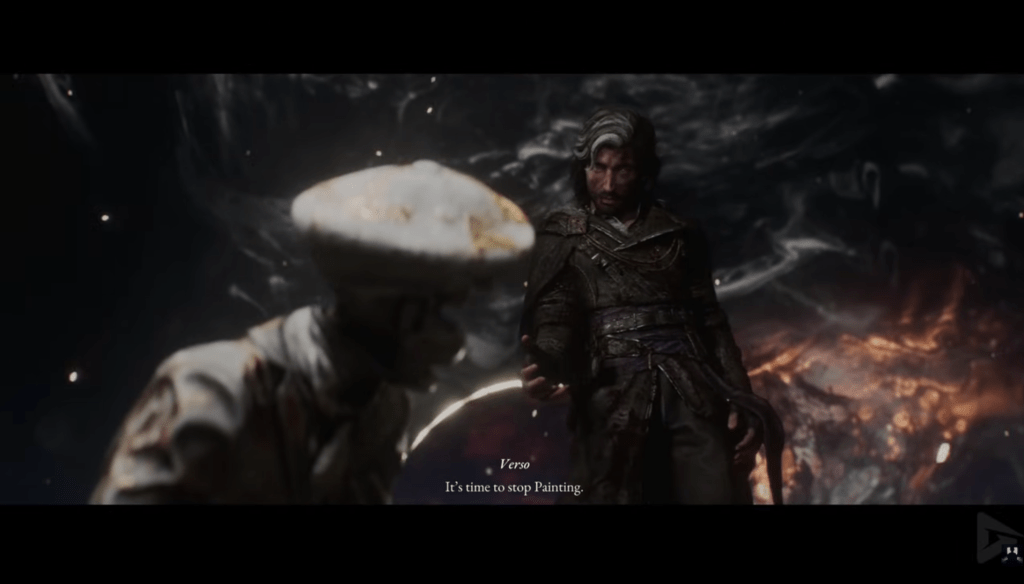
And I wept at that, too.  Because I so desperately wanted to stop.  Stop working at what I’d been doing for so long, and rest instead.  End my toil.  Take my reprieve.  That boy was every bit as important as Maelle in that moment.  Whether or not the whole of Lumière should perish, it should not be up to that poor boy to sustain it.  Just ask Ursula K. LeGuin.

Like Sciel, Verso was ready to die.  Like the false Alicia, he wanted to die.  It was right to let him go, at long, long last.  All the hopes of Mother, Father, and Sister fighting over his painting: it had stopped being his long ago, hadn’t it?  He had made a place of joy, but it had become a place of suffering and loss.

Yes.  Better to stop, then.

One by one, the other characters enter the little bubble of unreality.  Monoco and Esquie enter, and Verso embraces them as they disintegrate into petals.  Sciel walks across the bubble to Verso, already fading.  They look at each other, and Verso offers his hand.  Sciel takes it as she disintegrates.  Lune walks in, sees Verso, and sits.  She glares, fiercely, at him all the while—judgmental, perhaps?  I can’t think of what I would tell her—would anything suffice?  Then the two Versos join hands and walk into oblivion.

At last, Verso is well and truly dead.

In the final scene, Alicia—the true Alicia Dessendre—stands with Aline and Renoir at Verso’s grave.  Alicia clutches a plush doll—Esquie.  Some ways off, Clea stands—not quite ready to embrace the family she’s hurt, and that hurt her.  And, looking upward across the garden, Alicia sees a final vision: of all her partners: Lune, Sciel, Monoco, Esquie, Verso, Gustave, and, indeed, Maelle all waving one last farewell.
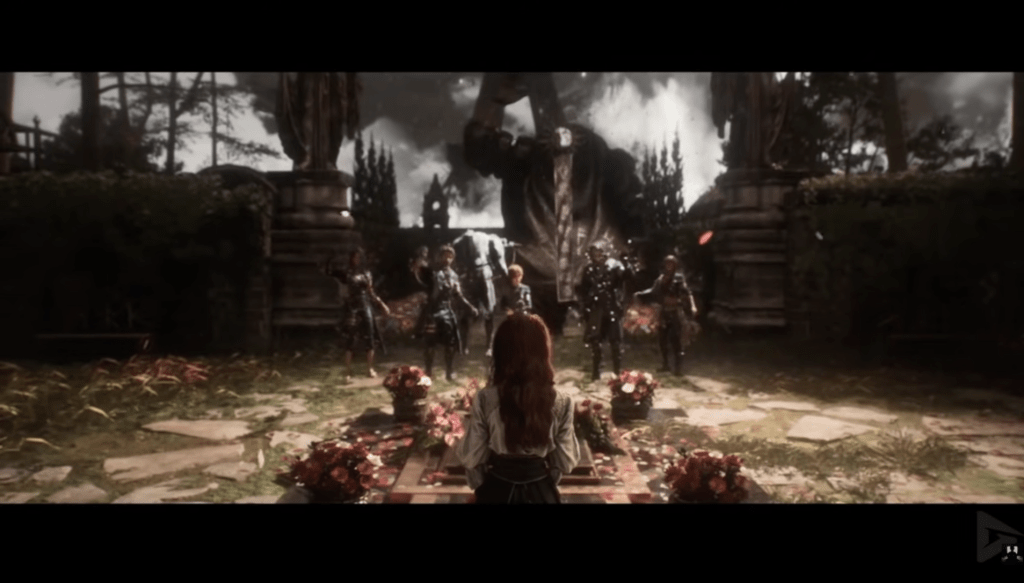
Roll credits.

I’m told this is the “good ending” by most accounts.  And it is good.  It is artistically satisfying, powerfully cathartic, even if it feels like cutting off a limb—perhaps because of that.  The Greeks wept at their tragedies after all; they are meant to hurt. We are meant to weep at them because we cannot weep for ourselves. 

I haven’t watched the alternative.  I wouldn’t want to.  I think it’s probably horrible, and I’ve invested myself so completely in this choice, it is the only ending that could have meaning to me.

EPILOGUE: In which we confront the meaning of our words and decisions

I said before that “Clair Obscur” could have roughly three translations.

The first, “Obscured light,” seems to apply to the difficulty of our understanding.  It might point to the half-glimpsed, half-felt, half-intuited emotional experience evoked by surrealism.  Or it might point to grief itself—the experience of watching a light extinguished (“Lumière s’eteint”).  Or it might refer to the incomplete understanding you receive from a game that does not reveal all its secrets, or that sings in another language, or that does not allow for a truly happy ending.

It could also mean “twilight,” as in the end of the light and the beginning of the dark.  As might be relevant for a city on the verge of death, a painting about to be destroyed, or characters who suffer and die so that others might live.  It refers to Sciel’s dance on the razor’s edge of death.  It refers to the gloomy ashen skies of battlefields and the blue glow of alien forests.  It refers to a night of revelry before you and all your friends embark on an adventure together.

But that third definition, “chiaroscuro,” has perhaps the deepest meaning of all.

Renaissance painting, in its search for balance and spiritual perfection, tended to use flat lighting.  Even when you surrounded a character’s head with a halo, each detail of the painting was lit at the same level—every detail rendered equally important to every other.  Chiaroscuro, the invention of Mannerists like Tintorello, evoked a different feeling.  These paintings were dark and brooding, with details highlighted by dim or selective light.  The painters of the time understood it as: “revealing the light through darkness.”

And that is a powerful metaphor when it is applied to the body of my work.  Often I find that a work must be willing to confront darkness to believably reveal light.  I’ve argued that the new run of Star Wars movies fail to properly depict Hope because they do not understand real evil.  I’ve argued that Lobotomy Corporation is compelling specifically because it earnestly addresses the relentless horror of our lives.

And Clair Obscur reveals goodness and hope through its profound exploration of grief and loss.  We must face the darkness.  We must make the terrible choice.  Only then, can we stop painting—stop endlessly repeating the same mistakes, the same rote stupidity.  Only through sacrifice, through suffering, and through grief may we clearly see what is worthwhile and good.

Only through change can we find release.

When I finished Library of Ruina, I believed I would never encounter another game so personally meaningful to me.  I believed that the state of gaming, my busy-ness, and my age would prohibit me from investing so deeply in any other experience.  I believed that it was a bottled-lightning experience, brought about by the expert writing of Project Moon, and the particular set of horrible circumstances that brought me, on hands and knees, to its truths.

I am happy to be wrong.

I am happy I found an oasis of sanity, gentle kindness, harrowing emotional honesty, and forgiving challenge at exactly this moment in my life—when I so desperately needed someone to tell me: “It’s time to stop painting.”  And I am happy that it made me leave, weep though I might.  I am happy that it was familiar enough that I never felt frustrated as I learned its mechanics and quirks, yet unfamiliar enough to make me constantly hungry for more.

I’m glad that, for 99 hours, this game saved me from myself—my anger, my self-pity, my despair, my suicidal desire to get out of my own oppressive responsibilities, and, indeed, my grief.

I think it was enough.

But now it’s time to go back to reality.

Not so I can repeat the mistakes that have alienated myself from my family and my friends, or so I can go on suffering the way that I have…

…but because it’s finally time to move on.
99 Hours of Clair Obscur: Expedition 33 (Part Two)

If you haven’t, perhaps read PART ONE first?

ACT II: In which we begin our explanation of the world of Clair Obscur, in the hopes of understanding its artistic priorities, themes, and aspirations

I’m still not entirely sure how I want to tackle this section.  I would normally prefer to avoid spoilers, but we can’t very well talk about the world of Clair Obscur without spoiling what you’ll find there, and we can’t talk about it without also talking about the plot and lore of the game.  And, further complicating the matter is the fact that I’m writing this with people who can’t play it in mind.  I want to share how awesome this game is with friends and family who really won’t ever have an opportunity to play it, because they don’t play video games, are don’t play these kinds of video games.

So we’re going to do something fairly unprecedented—at least for me and my essays.

I’m going to treat this as an adaptation.  I’m going to effectively try and transmute the experience of playing the game to prose.  I will walk through the major plot points, and the major areas of the game.  I will describe, as best I can, the locations and beats.

That means that this will be all spoilers going forward, but I will be intentionally staggering them, since I’ll be following the game’s own story and plot and revealing what happens in chronological order.

BUT:

  1. We will save the major major plot spoilers (i.e., the endgame) to Act III of our essay.
  2. We will break up this section by the organization of the game’s own Acts, so you can ditch the essay anytime we get too spoiler-y for your liking.  (Hopefully, I’ll also be able to sell at least some of you on the game while we go…)

AND:

  • CONTENT WARNING: Things are going to get pretty dark here.  This is a violent game about the ways people react (and overreact) to grief and loss.  There are multiple depictions of suicide, trauma, waning mental health, and physical disfigurement.  I think the game handles these subjects with understanding and maturity, and I hope to do the same, but use your judgment going forward.

Alright.  Let’s do this.

Prologue: Lumière

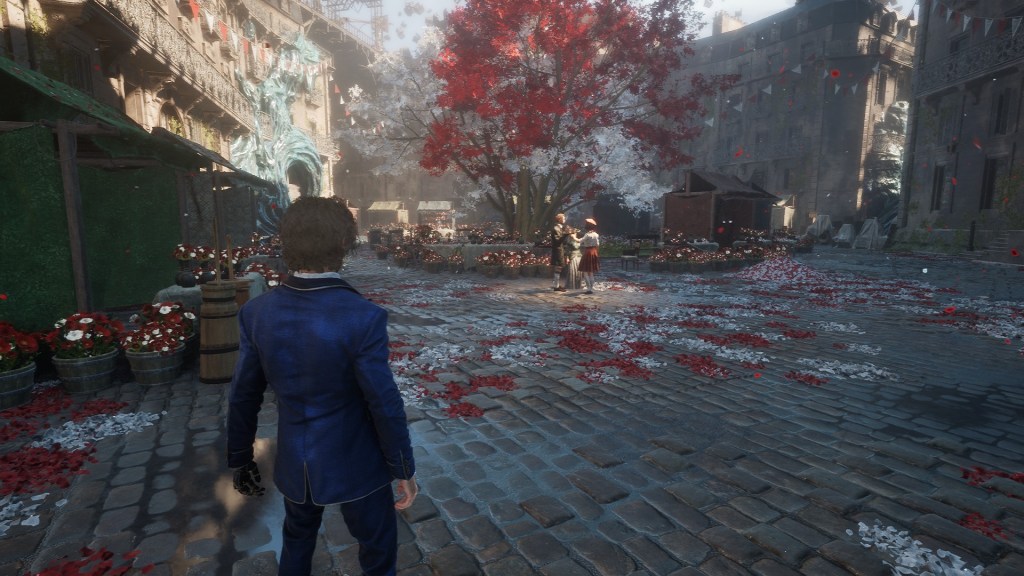
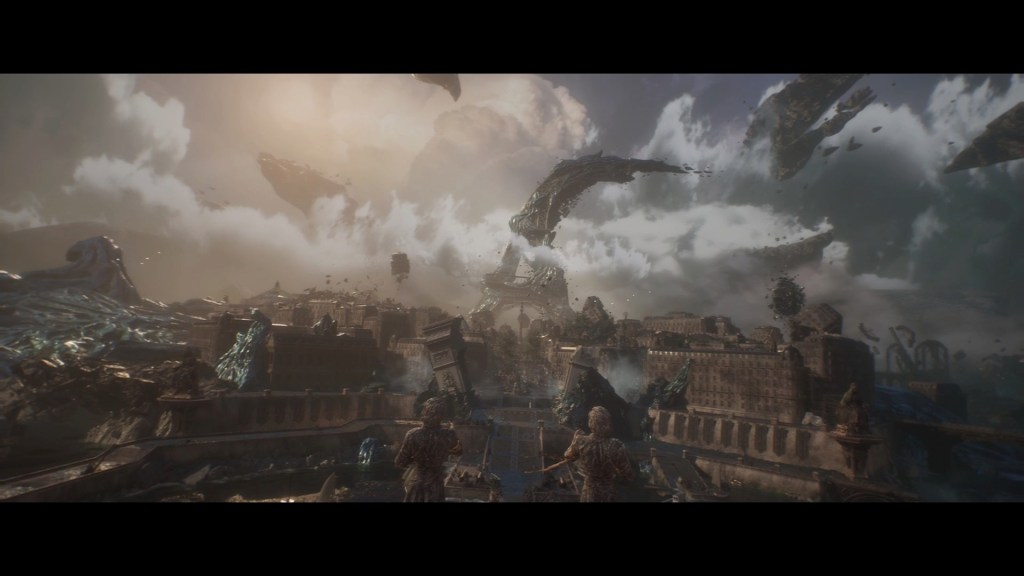
Lumière is Paris—though the Belle-Époque Paris in that state of static-disintegration we discussed earlier.  The top of the Eiffel Tower is smeared to one side; the Arc de Triomphe’s shattered peak floats in a rough arch over its two legs.  Nondescript Parisian apartment buildings line crowded streets.  But the city is surrounded by the sea, and in the distance you can see a giant monolith, and, at its base, the form of a woman with long ash-gray hair, huddled into the fetal position.  Above her head glows a number: 34.

We are introduced to Gustave and Maelle.  Gustave is man in his early thirties, wearing an elaborate dark purple suit; Maelle is a young girl in her teens, wearing a stereotypically-French horizontal-striped shirt and red kerchief.  They talk together like brother and sister: she teases him about the fact that he is throwing rocks ineffectually at the distant monolith; he plays along, wry and kind.  We get a combat tutorial, and traverse the rooftops of Lumière together.

The greater heft of the scene is only gradually revealed, though.  Gustave is in the rooftop garden to avoid going to see Sophie, an ex-girlfriend he’s lost touch with.  Today is her gommage—and that means that this is Gustave’s last chance to set things right.  He has a flower for her—this is apparently traditional—and she thanks him for it.  It comes out that they separated over some pretty important differences in perspective.  Gustave has been working hard, preparing for this year’s Expedition onto the dangerous continent; Sophie has been trying to enjoy this last year of her life.

Because here’s the thing: the gommage means the death of Sophie, and everyone else her age.

As the characters watch, the woman at the faraway monolith—the Paintress, they call her—wipes away the “34” inscribed on the stone and replaces it with a new number: “33.”  And when she does, all the citizens of Lumière over the age of 33 (including Sophie) slowly dissolve into red-and-white flower petals: gone forever.

Hence our call to action, and our title.  Gustave (and Maelle) has committed himself to joining Expedition 33—not the 33rd Expedition, but closer to the sixtieth or seventieth, with each Expedition naming itself after the number on the monolith when it set out—and the mission of these Expeditions is to travel to the unknown continent across the sea, confront the Paintress, and kill her, so the gommages will stop and the citizens of Lumière can live their lives without fear.

But Expedition 33 is an unmitigated disaster.  Immediately after landing on the shore of the continent, they are confronted—impossibly—by an old man (why hasn’t he gommaged…?!) in the company of the monstrous Nevrons (Nevrons come in many varieties: these are nightmare creatures with no head or eyes but two hands composing a kind of face), who start to lay utter waste to the Expedition with power beyond anything they could have prepared for.  There’s a frankly harrowing cutscene where all the characters we’ve met are positively wrecked. 

Gustave tries desperately to find safety.  Eventually, though, he is knocked unconscious and blacks out.

We rejoin Gustave as he wakes up—but nobody else is around.  He’s been relocated from the horrible beach—where the massacre took place—to a glowing blue tree, but he’s completely alone.  Dazed, he walks for a little while, calling out for the others, but nobody comes.  He eventually arrives at a cave full of the corpses of past Expeditions (it would seem theirs was not the only one to be immediately thwarted by terrible powers), sits down, and withdraws a pistol to end his own life.

But he is stopped.  Lune—one of the other Expeditioners—takes his hand.  He is not alone.  Others have survived, but presumably only a few.  Together, Gustave and Lune will try to find the survivors and continue the mission together.

Prologue – Debrief

OK, so we’re barely an hour into the game and it is already more emotionally harrowing than most full games I’ve played.  The folks at Sandfall pull no punches with their emotional beats, but it is also not just some grim-dark tragedy-porn experience either.  The scenes in Lumière especially are buoyant and lively; even the festival leading up to the gommage is full of surprisingly-rich characterization.  These are people trying to figure out how to live their lives in the shadow of this terrible situation.  They have traditions.  There are little kids running around.  Sophie even has a bit of a tense conversation with a mother about whether or not it is responsible (or, indeed, imperative) to have children in light of the gommage (most of these children are orphans, after all—including Maelle).

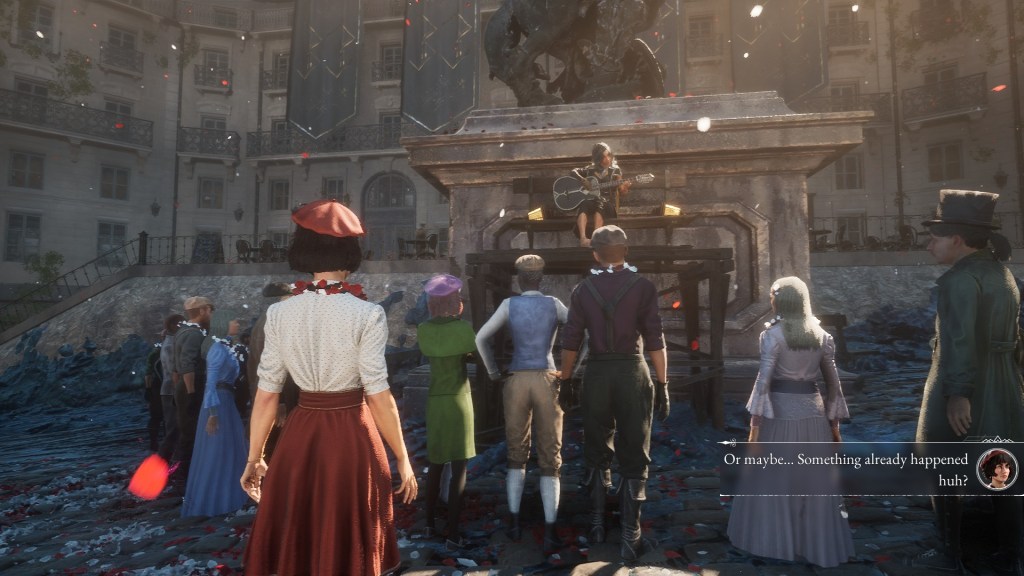
During the send-off celebration for the Expedition, in particular, many of the characters confess their hopes and dreams.  Some are apprehensive; others defiantly resolute.  Lune herself, if you notice her among the crowd, comes off as a bit of a space cadet.  She can be found sitting on the pedestal of a statue, playing her guitar and singing, barefoot, before the gommage.  They’re people—not props.  The situation is terrible, but they are trying to make the best of it anyway.  Because that’s what people do.  This is a game about grief, sure.  That much is clear even from this first hour of play.  But specifically, this is a game about how we deal with grief.  And I think the game wants us to notice that the people of Lumière have made a certain amount a peace with their situation. They don’t consider the broken fragments of buildings strange or disruptive, even though they are the result of a historical catastrophe only dimly-remembered. Their surreal situation has become normal, even if it is strikingly abnormal to the player. Sophie and Gustave disagree about whether they should accept, or fight against this situation (which itself serves as a good indication of normalcy to the player – we’re not going to question the floating bricks, but we are going to question the arbitrary mass killings that also serve as a death-clock for the whole society). Gustave intends to fight, but Sophie intends to accept. It isn’t clear who is right; it will, after all, get much, much worse by the end.

Still, the scene with Gustave—this lively, wry, caring character—sitting down to commit suicide…?  It has to be one of the most affecting scenes in any video game I’ve ever played.  Even in the one short hour we’ve had to get to know him, he’s been characterized as standoffish, warm, protective, creative, and a little irritating.  For him to lose all hope so quickly is both understandable and horrifying.  As he walks toward the cave, reduced to a stupor, eyes blank and staring, I feel all that despair and loss and helplessness, even from a man who had said that he would do all he could “for those who come after.”

This doesn’t read like a plot point, orchestrated by some writer for shock value.  This reads like an actual human being, reduced to despair by unfathomable trauma.

(It’s almost a shame I’m not still running my “The First Hour” series—because this should be on the short list for “most impressive first hour of a video game ever.)

The World To This Point

This is intended to be an essay about world-building, and, as such, I want to make sure we circle back around to the world at every stage of our discussion.

But there isn’t a whole lot to say at this point.  So far we have only seen the town of Lumière (which is very nice, don’t get me wrong), the beachhead where the massacre took place (which we only see in a cutscene), and a little bit of the verdant—if alien—meadow and macabre cave where Gustave faces his despair.  We’ve only fought Maelle in a tutorial sparring match, possibly a rogue mime in Lumière, and a Nevron or two along the path to the cave.  We haven’t seen much, in short.

But that doesn’t mean it isn’t important.  Lumière is festooned with red-and-white for the gommage: the people about to gommage wear garlands of red flowers, and the dominant landmark (even Gustave and Maelle draw attention to it) is a massive red-and-white tree in the square where Gustave meets Sophie.  It isn’t “lore,” exactly, but every part of the design of Lumière resonates with and anticipates the gommage that’s about to happen.  By contrast, the sending-off celebration for Expedition 33 takes place at night, and we are introduced to the stark, snappy-looking black-and-purple-with-gold-trim uniforms of all the Expeditions past.  Here, again, the color palette reinforces the theme.  Red-and-white for lost innocence, grief, and aborted happiness; purple-and-black for resolution, purpose, and sacrifice.

When we do reach the continent, the beach is a barren, ashy stretch of sand and debris.  The mysterious old man wears a white beard and a severe black suit (and seems to resemble an older Gustave).  The entire cutscene is nearly monochromatic: the Expeditioners wield colorful pictos, but the enemies fire devastating bursts of pure white energy that light up the black sand.

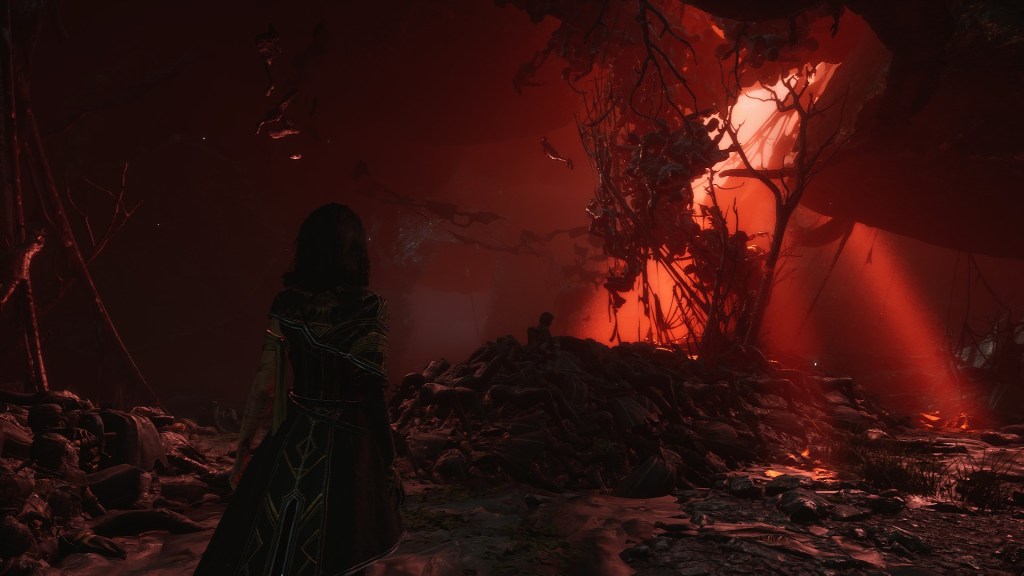
Then there is the glade, with its verdant greens and alien blues.  And the cave, its ashy-gray bodies lit blood-red by some trick of the light filtering into the cave.

This isn’t what we usually mean when we talk about “world-building” in video games.  Instead, we’re used to thinking of lore, or environmental storytelling, or details that add up to a larger picture of social complexity or backgrounds for character development.  When I wrote about Morrowind, I emphasized that its believability as a place derives from its complex social dynamics, which are foregrounded, but have to be learned.  In some of my other favorite worlds (say, that of Bioshock or Batman: Arkham City), much of the world-building is rooted in environmental details: Bioshock’s bloody messages scrawled across walls, or Arkham City’s villain-related details spread across Gotham.

Here in Clair Obscur, though, world-building is almost always in service to the emotional weight of the scene.  Like any good surrealist work, we are not speaking to the conscious mind, but to the unconscious mind.  These spaces aren’t necessarily logical, don’t have to make pragmatic sense, and don’t typically invite analysis for the purpose of piecing together a puzzle.  You are, in a very real sense, supposed to feel these places.  Walking through Lumière, the experienced video-game explorer is likely alert to details that describe the day-to-day lives of its people.  And there are some: Gustave and Sophie remark that the piles of furniture (that conveniently block access to alleys the game doesn’t want you to explore) are the belongings of people about to gommage—now free to anyone who wants or needs them.  And there’s a café where people have congregated to eat, performances (like Lune’s song) by its denizens, and even a dance that uses the colorful Pictos you’ll use in battle for visual spectacle.  But it isn’t really a livable space, the way some other games (like Bioshock) would emphasize.  It’s a vibe.  And it’s less important to convince the player of its reality than to anticipate the emotional value of this place in the game to come.  Lumière doesn’t need to make sense as a lived-in space; it needs to stick in the player’s mind: a symbol of life, normality, and grief that must be protected and saved in the player’s travels.  Likewise, the beach doesn’t need to make topographical or geological sense; it needs to represent horror, death, and despair—and, hopefully, scare the player away from it for the foreseeable future (you can go back and get your butt kicked there only later in the game).  And, most glaringly, the blood-red light of the cave doesn’t need to make sense; it needs to highlight Gustave’s own bloody despair and failure in his darkest hour.

That’s what makes this so frustrating to discuss: this is a carefully-crafted world, but it exists in service to the experience—to the emotional heft of the story, the characters’ suffering, and to the themes of grief and survival.  It is not a world that can be dissected into its speculative elements, but it is no less calculated, no less intricate.  Here on The Continent, we will discover, and we will explore, but we will rarely be intellectually satisfied.  Instead, we will feel—and that is a noble, if underappreciated goal of the world-building craft.

Act I: Gustave’s Journey

I’m not going to summarize the whole game in this kind of detail.  But I felt it necessary to explain the emotional weight of the world here, where we can get into the specifics, and let this be our default understanding of the rest of the world as well.  There will be specific locations I want to investigate in more detail, but certainly not all of them.

Leaving the cave, Gustave and Lune quickly find themselves in a forest of these alien-blue trees.  Night is falling, it seems, and we have to find a safe place to camp where the Nevrons can’t reach us.  This is made especially urgent when we encounter our first Nevron boss—who kills one of the other survivors in front of us, just to drive home the stakes.  Beat him, and Gustave and Lune discover a message scrawled at the top of a massive blue tree: Maelle is alive, and has been carried away by someone determined to protect her—but not an Expeditioner, it seems. They aren’t following protocol.

The trail leads us to our first encounter with the world map, where we are given a little bit of space to explore. (And a few world-map enemies to challenge!)  But our next destination is one of the truly spectacular and memorable places on the continent: a canyon of rock populated by a forest of coral and kelp.  Whatever surrealist elements we may have seen before, this is an idea that would seem right at home in a Magritte painting.  The land even has little spouts ejecting bubbles into the air—I honestly couldn’t tell in my first game whether I was supposed to be underwater, or on land, or what.  The characters are also a bit mystified, but press on. (Surreal-as-normal, remember?  We’re on a mission; no time to figure out the physics…)

In the middle of the coral caves we find more oddities.  First, one of the Gestrals: a supposedly-mythical race of paintbrush people.  This Gestral’s name is Noco, and he’s a traveling merchant who would also love to fight you, if you’re interested (most Gestrals love a good fight).  Second is an out-of-place ornate black-and-gold door in a pillar of rock.  Go inside, and you will find the Manor, where it seems Maelle has become quite comfortable.  She’s met a strange, but not hostile, denizen of the Manor she calls The Curator—he has a blasted hole where his face would be and speaks only in hollow grunts, but he has apparently been helping her, and will join the party to help us manage our resources and strengthen our weapons (but not fight).

From here, Maelle and Noco lead us to the Gestral village, where we are attacked by autonomous Gestral guardians (who turn out to be massive mechanical armor suits being tested by Gestral engineers).  We meet the leader of the village, who encourages us to seek out Esquie, and offers us passage to Esquie’s lair, but only if we go a few rounds in the Gestral arena and confront their new champion.  That champion turns out to be the fourth (and final) survivor of the beachhead massacre: Sciel, who will in fact fight us before joining the party properly (she, too, just loves a good fight).

Esquie turns out to be a big, silly, masked guy who would normally have the power to ferry us over the water, but has recently lost his stones that allow him these powers (this apparently happens).  He asks us to get his rock-traversal stone from François, his cantankerous turtle-esque neighbor, who attacks us with his “Strongest Ice Attack Ever”—but he isn’t really much of a threat, and seems a bit fond of Esquie despite his grumpiness.

Once Esquie has his stone back, he asks us to help him find Florrie, the stone that allows him to swim over the sea.  He believes he dropped it in a cave network nearby, which is our next destination.  It’s a massive, sprawling area with lots of smaller caverns and tough enemies, and when we finally find Florrie, it’s guarded by the Lamplighter—a terrifying, multi-armed enemy who attacks us with its lamps, and who resurrects after he is beaten.  Once he is finally put to rest, we restore Florrie to Esquie, and he offers to swim us to the next land mass.

But just as we’re about to embark, with half the party in the water below and Gustave and Maelle still in the cave, the mysterious old man from the beachhead suddenly appears and impales Gustave.  Gustave urges Maelle to leave and confronts the man in a heroic last stand, but is killed.  Maelle is likely to be next, but she is saved by another mysterious outsider with a wild mane of graying hair, who confronts the old man and rushes the party out onto the sea.

Act I ends with the party disheveled: Gustave is dead; Maelle is rattled, and the newcomer, Verso, is little more than an enigma.

Act I: Debrief

Gustave’s loss is devastating, and will haunt the rest of the game.  There aren’t many games daring enough to kill off the primary player character (though the death of 2B in NieR: Automata comes to mind), but this seems especially heartbreaking because Lune saved his life at the cave.  There is something senseless, tragic, and wasteful about his death, even if it is, also, a kind of heroic last stand.  And you’ll often be reminded of it: Gestral merchants will still list Gustave’s cosmetic items in their inventory with the message that you’ll need to find a missing party member before they will sell to you.  Many times in the rest of the game you’ll be reminded of his absence.  And Maelle will take over his responsibility of writing in the Expedition journal “for those who come after.”

It also seems like the last straw for poor Maelle.  Throughout the first act, when the party camps for the night, Maelle suffers from dreams or visions of a similar-looking girl with a ruined face.  Sometimes she is confronted by the mysterious old man in these visions, who speaks to her as a familiar, but not in any way loving or friendly.  Her relationship with the Curator, too, seems strange: she is the only one who understands his moans. Gustave was her anchor to herself, to her former life, and to her sanity. Gustave was like a brother, but also her caretaker and protector through the Expedition.  Now that he is dead, she begins the next Act devastated, and it will take some time before she recovers.

Verso, by contrast, is pure enigma at this point.  He slots into Gustave’s spot in the party without any trouble (he even uses all of the weapons you’ve collected for Gustave), but he is slow to trust the rest of the party with personal details, and they are slow to trust his advice and insight.  Like the old man, Verso should not be here—he should have gommaged by now, or been killed by the many hostile Nevrons.  His very existence is somehow wrong, and the other characters worry that his help may hide ulterior motives.

Esquie, too, is more than he appears.  When he first meets the party, he mentions that he has met Sciel before, but she does not remember it.  The party has heard stories of Esquie (there’s even a statue in Lumière), but assumed (like the Gestrals) that he was just a myth.  But where Verso is immediately suspicious, Esquie is impossible to suspect.  His awkward intonation and mannerisms, his goofy affectations, and his plump, huggable, velvety body seem totally unthreatening.  He’s not designed to be familiar or inviting, but he has all the otherworldly childlike charm of the laughing Buddha.

We’ll have a lot more to say about Esquie later.

The World of Act I

Compared to the strictly linear path of the Prologue, Act 1 offers a lot of room to explore.  The World Map is littered with collectibles and enemy fights; many of the individual locations hide secrets down optional paths (especially in the cave system where Gustave meets his end), and all are just as evocative as the locations from the prologue.

But along the way there are some particular details I’d like to point out:

  1. The Gestrals

Once you meet Noco and visit the Gestral village, you’ll start finding Gestrals everywhere.  And they are delightful.  Noco is child-sized, and has a child’s temperament: rowdy, inquisitive, and eager to explore.  His stated mission is to become “the greatest merchant ever!” which will apparently involve exploring the far corners of the continent.  But the rest of the Gestrals are equally enthusiastic, equally rowdy, and equally bumbling.  As much as the big Gestral constructs (sakapatate!) present real threats to the player, the area where you fight them is serene—a red forest known as the “Sanctuary” which the Gestrals consider sacred.  And the music that plays when you fight these sakapatates is upbeat, cheery, and wistful, not at all menacing like the other combat music so far.  (The title of the track is literally “Gestral Summer Party.”)  Fighting the Gestral merchants, too, is framed as a fun side activity: you have to duel with only one party member, and neither Gestral nor party member risks death in the encounter.  Outside of the Sanctuary (and the arena) you will rarely find Gestrals who are hostile, but most are still spoiling for a fight if you’re willing.

I want to emphasize this because the game is careful to walk us through our different emotional reactions on The Continent.  Our first encounter with the old man makes the Continent seem terribly threatening, but the mysterious, beautiful, and alien places we experience next suggest that this is just as much a place of wonder, beauty, and serenity.  The Gestrals in particular add a layer of whimsical fun to that feeling.  Coming off of the strange undersea canyon, the Gestral community feels odd, but comfortable and lived-in.  They like to fight, but their aggression is posture, not threat.  You can even challenge the village leader (who will immediately whup you at this stage of the game), but it’s not personal or anything.  Gestrals are also apparently immortal.  When they are killed—for whatever reason—they are reborn, though without their memories.  You will see dead Gestrals on the world map from time to time, and their tell-tale (paint) jars with brushes sticking out of them as they wait to reincarnate.  But that just helps to explain why they seem so unconcerned with fighting and dying—it is all just a kind of game to them.  These are comic relief characters, essentially, though their endearing sincerity overrides their buffoonery.  It’s easy to fall in love with the silly little guys.

  1. The Nevrons

At this point in the game, there is no single aesthetic that describes the Nevrons.  The monstrous hand-faced creatures of the beachhead echo the whirling arms of the Lamplighter, but we also encounter the diamond-headed spearmen of the world map, massive club-wielding bruisers with porous, pumice-like bodies, and smaller, quicker Nevrons that dodge traditional attacks.  In the coral canyon there are skinny floating Nevrons wearing what look like diving helmets, holding old-school porcupine-like sea mines like balloons floating over their heads (shoot them in combat and they’ll explode, damaging all the enemies in the fight).  Some seem stone-like and heavy; others are spry, floating in place or flying across the battlefield to attack.  Most seem distinct to their environments: stony four-legged eyeless brutes with luminous hexagonal crystals in the caves by the sea; divers and anchor-wielding toughs in the coral canyon; spear- and swords-men on the world map.  There is something suggestive about them, like the sexually-themed monsters of Silent Hill 2, but the theming is rarely so obvious.  They may well be the most surreal element of this surreal world—insofar as they are hostile, but conscious, automatic, and not social like the Gestrals or people of Lumière.

Some, though, are not hostile at all.  By this point in the game, you may have found several “white Nevrons,” who don’t attack you and will offer you quests.  Usually they are missing something—the white Nevron who wields a lamppost as a weapon wants to light the lamp like his friends.  The miniature Nevron in an optional area near the coral canyon wants to be huge like the massive, hulking monsters who loom over the landscape (and who Esquie advises you avoid, at least for now).  When you help them, they will clue you in to the origin of the Nevrons (and their creator…?), but you will also always have the option to fight them (instead, or after finishing their quests).  I never took the game up on the option—there seemed to be enough violence and death going on, thank you very much—but I think the game wants this choice to be deliberate.  It won’t be the last time that we mix up our friends and enemies, after all.

And, of course, there are the Chromatic Nevrons—palette-swapped variants of familiar Nevrons, but much stronger, and often with radically different attack patterns.  Chromatic Nevrons tend to hide down optional paths or in optional areas, and while you may have beaten several by this point in the game, you’ve probably been beaten by several as well.  They are nasty tough, compared to their counterparts.

  1. The Fallen Expeditions

The cave where Gustave considers suicide is littered with bodies of fallen Expeditioners, but we’ll find more as the game progresses.  They leave behind flags, which serve as the game’s save points, and will also refill your health and supplies (though at the cost of respawning all the defeated enemies in the area).  Some leave behind journal entries as well, which helps to explain the circumstances of their final hours in audiolog style (like Bioshock).  Gustave and Maelle also remark on the goals of Expeditions past: one installed all the grapple points you encounter throughout the game; one made the rough maps we use to navigate The Continent.  One employed giant Ferris Wheels to traverse the land.  It is important to remember that so much of your ability to progress depends on those who have gone before: as much as this is a game about grief, the sacrifices of the foregoing are rarely vain.  Every time you save, every time you climb the ledges installed in a wall, you have other Expeditioners to thank.  Much as your party is left alone by the disastrous beachhead landing, you are protected by the efforts of the fallen and the lost.

  1. Mimes and Petanks (sic)

In addition to the typical run of Nevrons blocking progress, you’ll also occasionally encounter (with a little exploration), weirdo mimes and ball dudes running around the locations.  These critters tend to mind their own business (you actually have to trap the Petanks by chasing them into dead-ends before you can fight them), but offer up pretty great rewards if you do in fact fight them.  Leveling up in Clair Obscur is a pretty boilerplate affair, but real strength comes from finding Pictos and the Lumina you need to equip them.  So it is usually worth your while to fight the Petanks for their goodies, and you may as well fight the Mimes for their cosmetic items while you’re at it.  These fights are also tests: unlike the usual Nevrons, which can typically be brute-forced into submission, Mimes tend to be very high-powered, but they all share the same predictable attack patterns (which can be easily dodged or parried), and Petanks all have unique defense patterns that must be overcome before they run away (denying you rewards).  These are tricky fights, and the satisfaction of winning is matched by the wealth of rewards.

  1. Optional Locations

I didn’t actually spend much time exploring optional areas outside the plot-related locations during the first acts of the game: I felt the urgency of the plot necessitated my progress, and I also liked playing the game a bit underpowered, so each new area pushed me to get better at learning attack patterns and employing Pictos strategically.  I always felt a little weak, and that’s how I thought the game should feel.  But there are several little areas you can visit to find collectibles and pickups.  Many are simple one-screen affairs (like the 2D pictures you traverse in the PS1 era of Final Fantasy), and only have a single music record or other doodad to find.  Others feature quest-giving white Nevrons in a limited space.  The truly deep and complex optional areas remain mostly gated off at this point, but the game is training you to look for them and wonder about the places you can’t access, even now.

  1. The Manor

When we first find the Manor in the coral canyon, it is an ornate gold-and-black mansion, in a style that’s art-deco-by-way-of-Baroque detailing.  We can walk throughout the manor’s main halls, but all the doors are locked.  As we explore the world, we will find more doors to the Manor, and each one places us in a different room of the manor, usually with a collectible, cosmetic item, or journal entry as a reward.  Many of these rooms have obvious, familiar purposes: bedrooms, bathrooms, a kitchen, a library; but the decorations are often strange: statuettes and paintings of Nevrons or other locations on The Continent.  Without more context, it’s hard to say what it means, beyond a kind of “hallways under the Matrix” or “Ways beyond the World” vibe.  But it’s no hub: you only ever come in and out of the Manor in the same place.  You cannot use it as a shortcut across the Continent, and while you may find yourself dumped in a bedroom or kitchen when you encounter a door on the Continent, walk through that door and it will only ever take you to the manor’s main hall, and its main door, which will drop you off at the very same place you entered.  It’s as good as a save point, and you are safe as long as you are inside, but there’s no explanation for its presence in a world it does not seem to belong to.

  1. The Faceless Residents

Like the Curator, you will occasionally encounter other human-like beings with broken faces as you travel from location to location.  It’s unclear what exactly they are: they aren’t hostile, speak in riddles, and go silent after they’ve made their meditation on life, art, or grief.  It’s also unclear how many there are.  There are several distinct models—a long-haired woman, a short-haired woman, a boy in a jaunty hat, a man in a top hat—but they recur, and it’s unclear whether you are meeting the same ones over and over, or if they are all supposed to be different persons.  Chalk this one up to “needs more context,” too.

  1. Music

Now that we’re starting to pick up records, we should probably talk about Clair Obscur’s frankly incredible score.

It’s not terribly atypical of RPGs like this to have different music for different areas, but it is unusual (at least in my experience) for them to have different combat music for different areas as well (like the “Gestral Summer Party” for the Sanctuary).  Clair Obscur also indulges in a lot more sung music than is typical of a game like this.  The Lumière theme, Gustave’s theme, the Lamplighter boss fight music (yes, most of the boss fights get their own unique themes, too), and even some of the routine combat encounters feature singing—in French—over the orchestral score.  Plainly, a lot of time, effort, and money went into the composition of the score, and I believe it pays off—it is a masterpiece on its own merits.

Most notably of all, the climactic encounter between Gustave and the Old Man features an incredibly dramatic piece: “Une vie a t’aimer” (= “One life to love you”), which evolves from heartfelt piano music to a rock ballad duet of vying pleas—all, again, in French.

And, look.  I speak a little bit of French, and could pick up on some of what was saying, but not much.  And I think that’s actually intentional.  Because if you understand the lyrics of “Une vie a t’aimer,” it kind of spoils what is going on behind the scenes of the game so far.  It is meant to be dramatic and emotional, but not necessarily understandable to the majority of Clair Obscur’s audience.  Like the opening music to an animé, the Latin chanting behind a Final Fantasy boss, or the nonsense ballads of NieR: Automata, it is meant to be evocative, but the foreignness is intentional.  We are supposed to intuit the stakes, but not understand them.

What you need to know is that the music is ambitious, striking, beautiful, dramatic, and also weirdly direct in its discussion of the deep lore of the game.  We’ll circle back around when it’s appropriate.

Though maybe now is as good a time as any to mention that “Clair Obscur” (a phrase often repeated in the game’s musical score, as well as its title) translates literally to “Light Obscured”—which could mean “twilight,” but is also the French term for the Italian “chiaroscuro”—the technique of employing sharp contrasts between light and shadow for effect in post-Renaissance painting.

All three of these translations seem relevant, and I have no doubt that the ambiguity of the term is intentional, however lost to non-French-speaking audiences.  Again “light obscured” seems especially relevant here: we can intuit the emotional weight of what’s going on, but we can’t understand it.

For now, we should keep moving.  There’s still much to do.

Act II: Verso’s Journey

Verso is cagey about revealing his past to the party, but he does explain enough to give the Expedition new purpose.  He explains that the Old Man, Renoir, is his father.  They were part of the first Expedition (Expedition Zero), which penetrated deep into the heart of The Continent, but Renoir, Verso, and his sister Alicia were granted immortality by the Paintress, and have lived on the Continent since.  Renoir has taken to annihilating the Expeditions, lest they defeat the Paintress and end his immortality, but Verso has decided to oppose Renoir, and aid the Expedition, even if it means death.  To do this, the party must destroy the Paintress’ Heart, which Renoir protects, so they can travel beyond the otherwise-impassable barrier that protects the Monolith.

Our first stop after the death of Gustave is a battlefield.  According to Verso, some of the earliest Expeditions mustered massive armies to invade the Continent and challenge the Paintress directly, but they were all thwarted by the armies of Nevrons that roamed the area, and, in particular the Dualliste—a devastatingly fast and powerful Nevron who could single-handedly decimate armies with his powerful swords.  Maelle, already traumatized by the loss of Gustave, seems especially fragile in this place, but Verso assures her that there is a tranquil glade beyond the mountains of dead Expeditioners where they can lay Gustave to rest.

That’s little consolation.  This area is full of grueling fights, twisting paths, and dead ends.  Then, finally, with the glade just over the horizon, the team is ambushed by the Dualliste, who destroys the bridge we are trying to cross and plunges us into a hellish void of bloody water and mountains of fallen Expeditioners.  Maelle, her face covered in blood, seems on the verge of losing what little grip on reality and hope remains to her, but Verso and the other Expeditioners swoop in to combat the Dualliste—certainly the most challenging fight so far—and carry Maelle out of this horrible place.

There is great, terrible catharsis in finally laying Gustave to rest beneath a gold-leaved tree, where the graves of many other Expeditioners dot the landscape, their numbered armbands flapping in the breeze.  The trials were many, and unkind, but Maelle may finally start to heal.

From there, we must pass through the mountains to Old Lumière, where we can finally confront the Old Man—Renoir—and destroy the heart of the Paintress (which he protects).  First, we must cross the Mountain pass and meet Monoco, a grouchy, hair-covered Gestral who lives in a strange train station near the mountain summit.  He apparently has a long history with Verso, and he challenges us to a fight before joining the party (our last member).  Interestingly, Monoco can transform into Nevrons when he attacks—an ability reminiscent of Final Fantasy’s Blue Mages—but we’ll discuss that when we break down each character in the next essay.

Beyond the mountain pass lies Old Lumière, a blackened ashy wasteland littered with the ruins of Parisian city blocks—like Lumière itself.  Verso explains that the city was sundered in the cataclysm that destroyed the world: half remains here, but the other half lies across the sea (where we started our game).  Standing amongst the ruins are glowing golden swords, presumably a token of whatever force destroyed the city.  The Nevrons here are also martial: swordsmen who impale themselves before attacking the whole party with many sweeping blows.  Beyond the ruined city lies The Manor—nestled between two gardens, its distinct black and gold aesthetic is a familiar contrast to the broken city we just left.  And there we confront Renoir again—after he rebukes Verso for being an ungrateful son.

It’s a tough fight, and the party doesn’t “win” so much as “survives.” The disfigured, masked girl—Alicia—intervenes with Renoir, and Maelle discovers a power that threatens Renoir enough that he transports himself, the Manor, and Alicia away, beyond the barrier.

But Verso has another plan.  He suggests the party should destroy the Axons—two terribly-powerful beings on islands near the monolith—and claim their essences.  With them, the Curator can make a weapon that will penetrate the barrier.

The player can fight the Axons in any order they choose—the game offers more of these freedoms (and more optional areas) the farther the player proceeds.  The easier of the two Axons (or so Verso suggests) lives on the island of Visages: a stony outcrop composed of endless stone masks.  In addition to challenging the Axon directly, the party may overcome three masked minibosses: one expressing rage, another expressing joy, and a third expressing grief.  The Axon itself seems to be a three-faced giant (weakened if you defeated the optional minibosses), but in fact the giant just supports the true Axon, a faceless messenger who uses the giant’s power to unleash devastating attacks.  The second Axon is Sirene, a faceless dancer in a sandy tower; her dance entrances the party at first, and they must resist falling into a stupor watching her.  Here, too, the party can overcome an optional boss to weaken the Axon, but must ultimately face a difficult fight against the boss proper.

Both Axons, though, are powerful surreal symbols with greater depth than the usual run of enemies so far.  In Visages, each mask-miniboss has its own area, and the enemies change according to the mask.  The rage mask’s enemies will attack one another, ignoring you unless you get too close; the other masks’ enemies will be too preoccupied grieving or dancing to interact with you at all—unless you attack them outright.  Each time the characters voice their misgivings: if the enemies aren’t hostile, why are we attacking them?  In the case of the Dancer, the approach to the boss is populated by miniature dancing enemies, all of whom are dangerous, and will attack you on sight, but there is also a wistfulness to the music both in- and outside-combat that suggests you don’t belong here—and that you are destroying something worthwhile and beautiful by fighting here.  Combat against the Nevrons is usually framed as a matter of necessity and survival; combat against the Gestrals is a fun challenge—it is strange that combat here should feel just as necessary, but still wrong somehow.

Having defeated the Axons, you can forge Maelle’s barrier-breaking sword, pass beyond the barrier around the monolith, and confront the Paintress.  First you must overcome her heart.  Then you are challenged by Renoir again in his last defense.  Finally, after a long journey through a pastiche of familiar locations with familiar enemies, you confront the Paintress herself.

It’s a tough fight: she has many powerful attacks and, like the Axons, she seems to come in two forms: a faceless homunculus like the Curator, and the giant avatar we first saw sitting at the base of the monolith.  At one point, to reach her, Verso suddenly reveals that he has Esquie’s flying stone (how long has he been holding onto that?), and the whole party takes to the sky.  But when she is defeated, she does not give up, but instead starts healing and buffing the party as we lay down the final blows.

When she is finally cut down for good, Esquie flies the party to Lumière.  But the celebration is quickly cut short.  The Paintress was not the one gommaging the citizens of Lumière—she was protecting them.  Her painted numbers were not a death sentence, but a warning: she could only protect those under the age inscribed on the monolith from the power of…

…The Curator.

Act II Debrief:

There’s a lot of heavy-duty spoilers up ahead, so let’s take a moment to recap.

There is a marked shift in tone between Act I and Act II of the game.  The locations become darker, bleaker—starting with the battlefield where the party fights the Dualliste, and proceeding through the ruined city of Old Lumière.  There are upbeat moments, too—like when Maelle sees snow for the first time on the slopes of Monoco’s mountain—but the world is growing more hostile the closer we get to the Paintress, and that reflects the grave stakes that we discover as more of the story is revealed.  Visages and Sirene aren’t as bleak or hostile, but our relationship to their beauty has changed: now we are the destroyers and they are the victims.  Power, it seems, has come at a cost.  At the beginning of Act II we are woefully outmatched by threats like the Dualliste.  By the end of Act II we are making real mistakes about how we use our power: the Paintress and the Axons seem more like innocents, and our destructive efforts have proven ultimately self-destructive: we have in fact freed the Curator to gommage all the surviving citizens of Lumière—including Lune and Sciel.

There is also a deeper intimacy to the story at this point.  Gustave set out to destroy an existential threat to his community, but now we’ve found that Verso, Renoir, and Alicia were living rich, full lives under the protection of the Paintress.  Verso has deep friendships with Esquie and Monoco, and his conflict with his father smacks as much of personal rebellion as ideological disagreement.  There is love there, but a love ruined by divergent convictions.  As much as Renoir has been the villain throughout this game, he acts out of sadness and grief—to protect his family and his world.  He is not evil, and not even all that short-sighted.  Like Gustave and Maelle, he fights to protect the ones he loves.  But he also loves them according to his terms: he cannot capitulate to Verso’s choice to opt out of immortality, presumably out of a wish to protect Verso from himself.  Renoir will have security at the price of freedom.  And that is a valid choice, though one still worth fighting against.

We also learn much more about the world during this Act, thanks to Verso’s insights.  Verso and Renoir both remember the Fracture that broke the world and killed most of its inhabitants.  That first Expedition was not a venture based in Lumière, but a rescue mission to save as many survivors as possible, and had the unexpected consequence of Verso, Renoir, and Alicia’s immortality.  Verso knows the world, too.  He’s been everywhere.  He’s fought the Axons (and failed) many times before.  Even into Act III, when you start taking on some of the most impressive threats in the world (like the dragon, Serpenphare), he mentions that he’s been beaten by them hundreds of times before.

But more than anything, this act leaves us conflicted.  We have grown much more powerful, but seem even more helpless to save Lumière, our friends and family, or complete our mission.  As powerful as we become, it seems the sense of it all is slipping away.  How much more will we lose in order to “win”?  Gustave is dead.  Verso’s relationship with his father is irreparably damaged.  Now Lune, Sciel, and all of Lumière are gone—what is left to lose?  What have we actually gained?  Was the yearly gommage really so bad that we should risk destroying all Lumière for the hope of something better?  And, now that it’s happened—now that Lumière is lost—what can we possibly do next?

The World We Found

Obviously we have much more to say about the plot and themes of the game, but I would like to conclude this part of the essay with some discussion of the world as it stands, here at the end of Act II. Our relationship to that world is going to change dramatically with the revelations of Act III, and we’ll have plenty to say once we’re ready to have that discussion. But for now, we should discuss the world as it has been presented to us so far, without that complicated contextualization.

First, and most obviously, the world of Clair Obscur is beautiful. I doubt my screenshots do justice to the place as a world to explore, traverse, and interact with, but it is clear that the developers and artists put a lot of time and effort into crafting the landscape, the non-linear paths, and the vistas stretching out to the horizon. Some of these vistas are clearly intended: the game often uses bottlenecks, area entry points, or high ground to show off its most impressive visions of the world. Sometimes this feels a bit manipulative, but more often it’s just gorgeous. And the unplanned views are often equally impressive. There is a clear mastery of visual design on display here.

But I should stress that even the manipulation happening as developers funnel players into especially scenic areas is a part of the world-building efforts I see here, which brings us to our second point. As I mentioned earlier, this is a game that uses its world to deliberately heighten the emotional effect of the plot. Color, light, and texture are all carefully applied to evoke a specific emotional reaction in the player that dovetails with whatever is going on around them. Perhaps the clearest example occurs at the beginning of Act II. We fight our way across the desolate battlefield, full of grueling fights on a dusky, burning plain. We are dropped into a dark mass grave by the attack of the Dualliste, and must fight the most difficult battle so far. Then we are treated to the tranquil gravesite for fallen Expeditioners. We are, through the design of the world, the plot of the game, and even the basic symbolism of descent and ascent, led on an emotional journey in parallel with Maelle’s despair and regained hope. Start to finish, this has been an emotionally harrowing experience, and every step of the way has been carefully plotted by the art team behind the game.

I stress this because I don’t think it’s a craftsmanship we gamers are likely to appreciate otherwise. Gamers tend to be a left-brained lot, more enamored with logic and science than emotional earnestness. We tend to resent emotional manipulation when we are able to detect it. And we tend to associate the skill of world-building with a game’s lore, rather than its effect on the player. When we write thinkpieces or film YouTube videos about our favorite games, we tend to emphasize these lore details, and how they add up to richer stories or more sophisticated metaphysical systems. We prefer the sorts of worlds that convince us they do not need the player, rather than appreciating when the whole world conspires to perfectly evoke certain player reactions. We like our fantasy complex and nuanced, like Brandon Sanderson or Tolkien, with only a limited appreciation for the fact that the latter can lead us to tears where the former cannot. We poo-poo the craftsmanship of Steven Spielberg, ignoring his pitch-perfect emotional manipulation in movies like E.T. or Close Encounters of the Third Kind.

Clair Obscur has its lore, and there is plenty for the left-brained gamer to appreciate about the characters, themes, and story details embedded in the text. But, like the great works of surrealism, it is also a work more interested in engaging with our subconscious, with our emotional life, and with mysteries we cannot explain. Much of this world will be “explained” in our coming discussion, but much will not. The mimes and petanks, the strange doppelgangers we find across the world, the logic of Verso’s immortality or Esquie’s ability to fly: we are not invited to answer or solve these questions. They are here because, on some level below logic, they should be. They are here because the artistic and emotional logic of the game demands them, even if that breaks the rules of the game world.

There are many reasons to want to dwell in a fictional world, and many qualities that could draw us to those worlds. We may want a fantasy full of verisimilitude, like Tolkien’s languages or cultural histories. We may want a fantasy full of sophisticated rules to follow, like Sanderson’s metaphysical complexities. We may want a realistic social fiction like Morrowind, or a plausibly grand speculative experiment like the future described by Cixin Liu. We may want fun characters to hang out with, like the heroes of the Marvel Cinematic Universe. We may want to dwell in a particular historical period, like those offered by Assassin’s Creed. And we may want to feel the sort of catharsis offered by Clair Obscur. Some of these are easier to praise in prose; others are more difficult to explore, since we run up against the limits of a linguistic medium. I worry that, like E. T., Clair Obscur may be underappreciated by future gamers, simply because it is considered “emotional” and therefore less valuable or important to our masculine, stoic, logic-driven tendencies.

Clair Obscur is a masterpiece, and its world, however illogical and contrived, should be held up as one of the greatest this medium has produced. Perhaps because it isn’t typically the sort we appreciate. And because we tend to de-prioritize the works of art that speak to our emotions rather than our logic, or that resist explanation in words.

Beauty is an audacious enough goal, after all.

So let’s take a minute to appreciate the world on its own terms, before we reckon with its underlying meaning.

99 Hours of Clair Obscur: Expedition 33 (Part One)

I honestly feel a bit daunted by the prospect of writing about Clair Obscur: Expedition 33.

I want to—it’s a truly great game that moved me emotionally, intellectually, and whatever adverb describes the thrill of a good, strong challenge—but it’s also a true work of art, with depth and nuance and personal investment beyond the scale of many of the other video games we discuss at Video Game Academy.  In our “year of world-building,” especially, it seems apt to discuss this game that not only builds one of the most engrossing worlds I’ve ever wandered, but that also discusses the business of world-building and why we world-build as a central theme.  And it’s a game I spent 99 hours in without regretting a single one of them—every hour was spent eagerly, raptly engaged with this game without a drop of boredom and only the most passable frustration. 

But I also feel like it is a game that must be experienced.  I don’t think I can effectively convey the emotional highs and lows of following Gustave, Maelle, and their band of Expeditioners through the mysterious world beyond Lumière, nor the joy of walking into some strange new location with the pure curiosity of wanderlust (and the confidence that I will be satisfied by some new wonder), nor the white-knuckle concentration of tackling some insanely daunting boss fight and overcoming it through a mix of ingenuity, trained skill, and dumb luck.

Instead, I want to tell you to just quit reading this and GO PLAY IT.  The hype is real and justified.  There simply isn’t another game this good, this creative, and this insightful—to my knowledge at least.

The trouble is, I’m not sure I can.

PROLOGUE: In which we discuss PC Privilege and other caveats, then make a plan of attack for our foray into Clair Obscur’s Continent

I: PC Privilege

Since I started playing Clair Obscur, I’ve found a deep need to discuss it with my friends and found a pretty serious difficulty:

It’s only on PC, PS5, and Xbox Series X.  Which doesn’t sound that bad to the serious gamer, but PS5s and XSX’s aren’t terribly ubiquitous these days, outside those serious gaming circles.  I know a lot of folks who own Switches, and one or two who own high-end PCs, but only one with a PS5, and nobody with an XSX.  (I assume people do, in fact, own these?)  I suspect the coincidence of the new console generation with outrageous inflation and economic hardship may be to blame here (though I’m sure PS5 scarcity didn’t help, either…)

This is not a problem I’ve run into often—or at least, not recently.  I’m usually behind-the-times in my video gaming.  I still haven’t played any of the Horizon games, or the new God of War games, and only just got around to Red Dead Redemption 2 in 2024.  Clair Obscur represents the first time since Triangle Strategy (2021) that I was excited to buy and play a major release that came out in the same year.  Sure, I’m always on top of the weird indie stuff from my favorite developers—I’ve been playing Mewgenics and Slay the Spire 2 since their release in the last month or so—but I’m rarely so excited about the big new mega-hyped releases from big name studios.  At time of writing, the buzz is hanging around Resident Evil: Requiem, and I’m politely interested, though also very conscious of the fact that I probably won’t ever play it.  Which is usually how these things go.  Sometimes I’ll make a mental note to go back and play something especially exciting, interesting, or suited to my tastes (again, Red Dead Redemption 2 comes to mind, but I’m also waiting for the right time to dig into Cyberpunk 2077, Death Stranding, and Final Fantasy VII: Rebirth), but it usually takes me a few years, seeing as I really only have the time for one or two of these in a given year.  Plus, it’s cheap: I can wait three years before playing Final Fantasy XV and find it for $20 when I finally pick it up.

But we PC gamers do not realize the luxury of being able (whether we take advantage of it or not) to click on virtually any game and download it to our magic box.  It might only happen once in a blue moon, but it is a power I enjoy unthinkingly.  I so rarely have to consider platform limitations, console exclusivity, or even price (the mighty Steam sale reduces all games to their most reasonable rates), that it did not occur to me how privileged I was when I bought this on a whim.

So very, very easy…

But when I started contacting my friends to say “Clair Obscur is really good, actually—let’s talk about it!”—the typical response was: “I can’t play it.”  I do have one friend who played it on PS5, but that’s it.  The rest are stuck either watching Let’s Plays (which I can’t in good conscience recommend on this one), waiting for a port to Switch (which would be nice, but I’m not counting on it), or waiting for the price of a PS5 to come down (which seems especially unlikely in our current tariff-hell).

Even more strange is the fact that I want to talk about this game with people outside my usual video-game circles.  Like I said, I consider this a work of art, beyond being just a good game, and consequently I want to talk about it with people who aren’t gamers.  My Mom, an ardent Francophile and decades-long French teacher, would love this game (even though she really doesn’t play video games like this).  So I’ve shared some of the music with her and she’s gone nuts for it.  My wife, whose video game experience reaches just further than Animal Crossing, also likes the music well enough, but I’ve got no way to share the game itself with her.

This is all kind of surreal to me.  And it gives me pause while I take up this essay.

II. The Discourse

Also giving me pause is the extremely strange place this game has now found itself in video game criticism and discussion.

When Clair Obscur came out, early in 2025, it became something of a quiet critical darling.  I saw a few scattered thinkpieces about it, most notably a piece by Second Wind’s Marty Silva about its use of turn-based combat, and Yahtzee Croshaw’s review on Fully Ramblomatic (which I want to circle back to), but it didn’t exactly cause a huge stir when it first arrived.  Most of my other favorite gaming commentators gave it a pass.  I bought it on the summer Steam sale, mostly on the grounds that: 1) it looked pretty; 2) it looked interesting (Revisionist history Belle Époque France? Surreal, wildly speculative story and world-building? Light horror imagery with psychologically-taxing stakes?  Sign me up!); and 3) Yahtzee said (however begrudgingly) that it was good.

And then the Game Awards happened and it WON ALL OF THE THINGS.  And I’m honestly not sure anyone saw this coming—least of all the devs, who seemed over the moon throughout the whole thing.  Suddenly this was the biggest game of the year, despite everyone kind of sleeping on it for six months or so.  I actually think there are more thinkpieces and reviews and discussions now than there were when it came out (or maybe it’s just the algorithm adapting to my research). 

This adds up to what might be a new landmark in video-game discourse:

Namely, this may be our first Oscar-bait discussion.

Where is Weird Al’s EGOT?

I mean this in a very narrow (but hopefully apt) sense.  We’ve had critical darlings in the past.  I remember when Journey came out back in 2012, when we were young and innocent (just before GamerGate) and there was a bunch of talk about whether or not it was actually a game, whether or not the critics were just pretending to like it, and whether or not it was any good.  And it was right around the same time that the indie boom was really starting in earnest, and people were celebrating indie games in parallel with big-budget games, largely because that seemed the safest way to highlight the cool new stuff coming out from smaller studios without alienating the Call of Duty/GTA crowd who wanted to see their big-budget slaughterfest validated as art.

But here in 2026 Clair Obscur won all the indie awards and the big-budget awards, kicking off a whole wave of discussion about its deserts.  Now that we’ve got mid-tier studios like Bloober Team, Ninja Theory (pre-acquisition, anyway), and Sandfall, is it right to call them “indie” when they clearly have more resources than some tiny one-man affair like Toby Fox’s Deltarune, or small-team projects like Supergiant’s Hades?  Are The Game Awards—usually mocked for its slavish devotion to big-name brands and promotional stunts—attempting some kind of artistic coup here?

And, perhaps most relevant to my Oscar-bait comparison:

Is this weird arty game that so few have played (since, again, it’s only out on PC and PS5), really good enough to deserve all this praise?

In his review, Yahtzee agreed that Clair Obscur was good, but only with the major caveat that it was pretentious.  And, in retrospect, after winning its butt-ton of awards, it’s hard not to wonder—was Clair Obscur our first-ever awards-bait video game, designed for critical success?

III: On Pretentiousness

No.  Just…no.

Again, The Game Awards is a manic, Red-Bull-fueled ceremony built on promotional stunts and corporate sponsorships.  It’s come a long way since Madden 2004 won Best game in 2003, but it’s still as much a vehicle for promotional announcements and publisher grandstanding. You can’t pander to their critical tastes the way you can with proper Oscar-bait.

Still a ways out from real legitimacy here, guys.

But that word pretentious does bother me a bit.

As a lover of modern art, Dostoevsky, and indie video games, I wonder sometimes if I’ve gotten pretentious without noticing.  And if I love this game that others call pretentious, and then defend it from these accusations of pretentiousness, there’s always the possibility that I’m just so danged pretentious that I can’t appreciate it in the things I like.  In the same way that someone fully six-and-a-half feet tall probably wouldn’t consider someone six feet tall to be properly “tall,” presumably I could be so dang pretentious that I can’t see that this obviously pretentious thing is pretentious.

So let’s define our terms.

I’m not going to Oxford English Dictionary this one (that would be pretentious), but just define from context here.  And with that in mind, I think we’ve got three different plausible definitions of pretentious.

  1. Having the pretense of quality without its presence (i.e., pretending)

When people accuse a person or work of art of being pretentious, the assumption is usually that there is some element of hypocrisy here.  When we criticize a movie for being “Oscar-bait,” the assumption is that the producers have made something that fakes or affects (as in affectation) quality without actually providing it: the movie is set in some “important” period like World War II or the Cold War, or it’s about “important” things like AIDS, developmental disorders, racism, or concentration camps. Whether or not the movie is any good, people will hem and haw about its “cultural value” and it will ultimately get more attention than it deserves.

This is tricky, though.  By this definition, a movie that pretends to be more important, serious, or “thinky” than it actually is would be the most obvious candidate for the accusation of pretentiousness, but this is rarely the case in practice.  When a movie like Joker comes out, and virtually all the critics agree that it’s pretending to be smarter than it actually is, the word “pretentious” still doesn’t seem to come up all that much.  Likewise, when some obviously-corporate-IP-related blockbuster movie shows up with something emotionally-resonant or intellectually-stimulating to say (like, say The Lego Movie or Barbie), whether or not it succeeds, we’re usually not talking about “pretentiousness.”

So as much as I think this is the right definition, and I suspect we would all agree about this, the actual use of the word suggests something else.  We want “pretentiousness” to be our word for calling out the emperor’s nakedness, but in fact it’s doing something else.

2. Aspiring to critical attention without popular appeal (i.e., awards-bait)

We’re only a shade removed from (1) here, but I think it’s an important shade.  (1) was specifically about quality—whether or not the work in question was actually good; (2) is about audience—and thus discards the notion of quality altogether.  It could explain why Joker and Barbie don’t get called “pretentious”—they are intended for a mass, popular audience and critical appeal.  By contrast, movies that do get accused of “pretentiousness” usually go hand-in-hand with accusations of “Oscar-bait.”  These are typically films with limited releases, made by auteur directors celebrated by a cinephile elite.  They often feature unsubtle celebrations of industry history (think Mank, The Artist, or Argo) which appeal to the vanity of the people immersed in that industry.  They are often technically flashy, even to the point of distracting or alienating audiences.  And they win lots of awards, despite most movie-goers never having heard of them until Oscar-time.

But in Hollywood, there’s a function to all this, and a well-trodden trajectory for talented artists to walk.  You make your big box-office blockbuster for a major studio (say, The Dark Knight), and you win the trust of your industry to make more auteur-driven independent projects (like Inception), which enables you to make more daring, artistic decisions to attract the attention of your colleagues in the industry (like Dunkirk or Oppenheimer).  The idea is that you need lots of actors, directors, and other talented artists to make expensive, crowd-pleasing, tent-pole fare, and so most folks are going to get their start doing the work that attracts the crowds.  But Hollywood also has its pretensions to grandeur and artistry, so the most talented and successful of those artists will go on to make movies that appeal to a more discerning (and International) body of critics.  Hollywood gets to have its cake and eat it, too: make all the money at the box office to keep the lights on, AND make art from time to time to keep the prestige of the studios intact.

But video games just don’t do this.  Sure, if you work in the indie space and make a big splash (like with Hellblade: Senua’s Sacrifice), there’s a chance that your company will get bought out by some big studio (like Microsoft), but that usually ends with the studio dissolving, no job security for any of the employees, and half the devs going back to other indie projects.  Meanwhile, the developers for big-budget games like GTA, Call of Duty, Assassin’s Creed, or God of War don’t become rock stars followed by the community—they just get handed the reins of more big-budget games by the same publisher.  There are exceptions (Miyamoto, Kojima, and Suda 51 all come to mind—notice, though, that they’re all Japanese), but the pipeline of video game success just looks very different from cinematic success.  For most gamers, (and most employees working for video game companies, I suspect), it’s the studio, the corporation, or the brand that gets the praise for a successful game.  So it makes sense that The Game Awards is less interested in the individual developer than the corporate entities they work for.  (Sort of.  This also works to the advantage of the corporations, since they can fire talented people without disturbing their brand integrity.)

But that means you can’t pander to The Game Awards.  By and large, this is not the place where the community rewards the accomplishments of its own. (I suspect that’s more GDC’s line.)  The Game Awards is more of a money-making venture, and therefore has a vested interest in keeping the publishers and fans happy, rather than making some artistic statement.

So the winners of The Game Awards’ Game of the Year of the last decade or so tend to be the most popular big-budget game with some aspiration to artistic merit, like God of War (2016), or Breath of the Wild, or Elden Ring.  Meanwhile, the indie awards, similarly, tend to go to the most popular indie darling of the year, like Inside, Cuphead, Disco Elysium, Stray, or Balatro.  But it’s hard to say that any of these choices should be considered “awards-bait,” or that the critics are in love with games the fans don’t care for.  How the heck are you supposed to call Balatro pretentious?  I’m pretty sure the designer himself had zero expectations for how popular the game became.  Nor is there anything especially critic-friendly about the game.  You could make a case for some patterns: Stray, Inside, and Kena: Bridge of Spirits are all variations on “aesthetically-striking platformer about a lone player character navigating a hostile world”—but most of these games are wildly different from one another.  If Disco Elysium is pretentious, it’s not because it’s sticking to some formula of success.

Nor is there any distance between die-hard fanbases and critical success.  Every one of these games—big budget or indie—is wildly popular, or at least beloved by its fans.  Again, you can make a case for Balatro’s artistic merits, but it got to The Game Awards because it was popular as buttered toast.  If Disco Elysium appealed to the critics, it appealed to gamers first, if the thinkpieces and memes and cosplaying is any indication.  There just isn’t really any such thing as “awards-bait” for The Game Awards, and if there is, Clair Obscur is not it.

Which brings us to our final definition:

3. Highbrow, artsy (i.e., French)

(That last bit is Yahtzee-specific: he spends most of his Clair Obscur review railing about the French-ness of the game, which leads me he’s more preoccupied with his Francophobia than the actual merits of the game.)

I think this definition is the one we most need to wrestle with.  I don’t think we like it.  I don’t think we want to admit it.  But every time I hear the word “pretentious” these days, it’s in reference to the aesthetic decisions rather than some critique of the work’s substance.  A movie set in World War II like The Brutalist or which adapts a famous work of literature like “Wuthering Heights” will almost certainly get an “is it pretentious?” discussion, where movies that fail to live up to their intellectual aspirations (like Joker) get a pass if they are sufficiently lowbrow.  Artsy movies like Anora or Poor Things will inevitably get called “pretentious” while pandering lowbrow fare like Sound of Freedom are ignored, whatever their artistic merits (or demerits).  Nobody called out The Bourne Identity for pretentiousness when it applied novel cinematic techniques to action scenes, because it’s still a crowd-pleasing action movie with fistfights, car chases, and explosions.

And I can’t deny it: Clair Obscur is highbrow.  It’s a French game about grief, loss, and escapism set in a world resembling surrealist/impressionist paintings, with a full orchestral soundtrack, art deco architectural highlights, and characters wrestling with deep trauma.  It’s about creativity and world-building and, just, art.  And it’s beautiful.  And it’s trying to be beautiful (which may be exactly the problem).

And, yes: it’s also French as hell.

Speaking of France, Hell, and Prententiousness, here’s a No Exit joke.

Which isn’t to say “all highbrow things are pretentious”—I’m pretty sure that’s why we have these discussions about whether or not a particular work of highbrow art is pretentious—but it means that aspiration to “highbrow” or “artsy” is a prerequisite for pretentiousness.  Nobody is interested in whether or not a Quentin Tarantino film is only pretentiously schlocky, or whether Lego Batman is only pretentiously metatextual, or Red Dead Redemption 2 is pretentiously graphics-intensive, but everyone wants to know whether Clair Obscur is only pretentiously great art.

What frustrates me is that every time I hear it accused of being pretentious, I can’t help but respond:

“But it’s so heartfelt!  So achingly, gut-wrenchingly sincere!”

But that’s my confusion.  I think we’re talking about (1) when we’re actually talking about (3).

And, like Clair Obscur, I suspect I, too, am guilty of (3) while being innocent of (1).  (After all, I can gush ad nauseum about Dostoevsky, or Homer, or Faulkner—my love of these highbrow things is pretty dang sincere.)  By my logic, that makes me unpretentious (and for the same key reasons: sincerity and enthusiasm), but I can understand, however irritating I find it, that (3) is the more important criterion.

Worst of all, though, is that this is not an accusation you can successfully defend against.  Like being called “racist” or “sexist” (or “woke,” for that matter), the accusation functions as a “poisoning the well” argument, rather than a subject for serious discussion.  The goal isn’t to engage meaningfully with the art, it’s to introduce a suspicion to the minds of the audience that the art is not worth engaging with.  Once the accusation of pretentiousness is out there, it won’t go away.  It lingers, like a bad smell, tainting all the discussions it touches.  You can’t disprove the pretentiousness of a work of art, because you will necessarily fall into that “but what if you’re pretentious, too” trap.  And if our definition of “pretentious” is, roughly, “not as highbrow/artsy as it thinks it is”—how the heck are you even supposed to disagree? 

IV: Accessibility

I suspect all of this is exacerbated by the game’s inaccessibility.  Just as the usual criticism of Oscar-bait boils down to “but they only showed it in a few theaters for a limited run!”—so, I suspect, does a lot of the criticism here boil down to “but I couldn’t play it!”

And I really wish I could help you with that.

Seriously.  I don’t want to contribute to any more video-game class-elitism than is already out there.  The “git gud” gatekeepers irritate the crap out of me because I’d like to enjoy the world of Dark Souls but do not have the time or patience.  I was never much for the console wars of my childhood and have no real allegiance to Nintendo, Playstation, Microsoft, or even Steam—and I worry we might be returning to that idiocy, now that the Switch/PS5 dichotomy is growing stronger again.  At least part of the reason I love novels (and, indeed, indie games) is because they are so dang accessible.  You have to go to New York City to see a Broadway show, or the paintings on display at the Met, or any number of other works of performance art, ballet, musical performance, or what have you—and that’s just not feasible for 99.9% of people.  Whatever the other merits of these works, I will always consider that exclusivity a huge, glaring demerit. 

Meanwhile, I can buy a copy of Dostoevsky’s The Brothers Karamazov for a dollar at a used book sale and engage with one of the greatest artistic experiences man has devised.  For five bucks you can download Morrowind to a used laptop and play it for a hundred hours.  With a cursory Internet search you can find most of the greatest poetry ever written.  That’s the kind of art I love.

Pictured: The Democratization of Art at its finest (at the Friends of the Library Book Sale in Ramsey County, MN)

You should be able to play Clair Obscur: Expedition 33.  We should be able to talk about it.  I don’t want this to just be mine.  So I hope it gets a Switch port (or at least a Switch 2 port).  I hope it gets a dozen re-masters for whatever future consoles dominate the 2030s.  I hope it becomes a part of our shared gaming lexicon.  But it probably won’t in the near future.  Whether or not this game is highbrow, exclusive, or pretentious, I don’t think that was ever part of its intention.  Everything I’ve seen about the devs and the development suggests that this was a labor of love by talented, creative, passionate people, intended as an expression of our common humanity and experience—like all great art should be.  And I worry that this “is it pretentious” discussion drowns out that fundamental truth—that Clair Obscur wants to talk about universal human truths like loss and creativity and escapism.  And I worry that it might betray some fundamental reluctance on our part to discuss those very same truths—or at least, to discuss them directly, without the smokescreen of genre conventions or metaphorical abstraction or artistic distance between us and them.

But I suspect that’s just me getting all pretentious again.

V. Plan of Attack

With all this in mind, here’s how I want to tackle this essay.

Clair Obscur is divided into three acts, with a prologue and epilogue.  So it seems appropriate to structure this essay in the same way.  And, like the game, we’ll dole out our information carefully and deliberately.

In Act I, I want to talk about the game’s inspirations.  One of the most immediately striking things about Clair Obscur’s game design is its diversity of brilliant thefts.  There’s the DNA of a dozen or more great game design choices on display here, and this is an opportunity to talk about the game without actually talking about the game at all.  Instead, we can discuss the game as the sum of its spoiler-free parts.

In Act II, I want to talk about the game’s world.  It is the “year of world-building” after all, and we’ve got a doozy of a world on display here.  But, naturally, this will require discussing the details of that world, and a good bit of plot information to boot.  So there will be mild-to-moderate spoilers throughout.

And in Act III, I want to talk about the game’s biggest reveals, its characters, and its ending.  Spoilers will abound; beg, borrow, or steal a PS5 before you proceed.

And maybe we’ll have an Epilogue, too.  It’ll probably be warranted by the time we get there.

ACT I: In which we explore the many possible inspirations, real and imagined, that echo the experience of exploring and playing Clair Obscur: Expedition 33, in the hopes of explaining its basic mechanics and priorities in a way that effectively describes the game without spoiling anything.

Let’s not beat around the bush here: this is as much an excuse to talk about a bunch of great games and their great design choices as it is an opportunity to talk about Clair Obscur’s genius in bringing these ideas together.  So there’s probably going to be a good bit of gushing about games I love, and we’re going to be looking at how these ideas and mechanics work in their original game, as well as how they transition to Clair Obscur.

There’s also the possibility that these ideas are not unique or original to the games I discuss here.  Some of that comes down to my own inexperience; these are just the games I thought of while playing Clair Obscur.  And, indeed, it seemed like I spent hours of this game just saying—“Wait!  They took that from XXXXX!  Like that meme from Once Upon a Time in Hollywood

No, but seriously…

I apologize for none of this; mostly I just want to express this part of the experience to you.

And, finally, if I do get a bit sidetracked, I want to remind you here and now that this does not make Clair Obscur some kind of stitched-together Frankenstein’s Monster of good ideas.  This happens sometimes, but not here.  In my experience, these ideas and mechanics fit together seamlessly, and added up to a game that was radically original, not hopelessly derivative.  This is not Immortals: Fenix Risinglevels of messy duplication; this is Breath of the Wild-level synthesis into originality. 

Cool?  Cool.  Let’s get started.

  1. Reactive Turn-Based Combat from Paper Mario

I’ll happily concede Marty Silva’s thesis from the video I linked in the prologue: turn-based combat did not need saving.  I love roguelike deckbuilders, tactics games, creature-collector RPGs, and I’ve seen a zillion different interesting takes on turn-based combat in the past few years.

But that doesn’t change the fact that the turn-based combat of Clair Obscur feels like a freaking revelation.

The truth is, though, that it’s a very old idea.

Gaming historians may well point to the fact that Mario was hopping to avoid turn-based attacks as far back as Super Mario RPG, but I think Clair Obscur is more obviously indebted to the more recent iterations of Mario-style turn-based reactivity.  That might be bias on my part (I’ve never made it through the whole of Super Mario RPG, but I’m replaying Paper Mario for the umpteenth time on Switch as we speak), but I also think it has to do with the contextualization.

In 2001, when Paper Mario first came out, it released on the N64: a notoriously RPG-hostile console.  Final Fantasy had been wrecking shop on the PS1, and Final Fantasy X released the same year as Paper Mario.  If Paper Mario had been designed to compete with Final Fantasy X, it wouldn’t have stood a chance.

But the genius of Paper Mario is that it didn’t try to compete with Final Fantasy.  Instead, it filled the need Final Fantasy had left behind.  On NES and SNES, Dragon Quest and Final Fantasy had been the JRPGs that introduced new players and Western audiences to JRPG-style games; but Final Fantasy had grown into an adolescent-targeted property with its dense narratives, fate-of-the-world stakes, and edgy teen heroes, while Dragon Quest had fallen out of favor with Western audiences.

And in walks Paper Mario with its cute papercraft aesthetic, its too-clever-by-half sense of deconstructionist humor, and its simplistic but engaging combat system, and it almost certainly introduced a whole generation to story-based (read: non-Pokemon) JRPGs in a way that was gentle, fun, and lasting.

Just don’t jump on the spiked goomba…

It’s also important to note that turn-based-combat in 2001 was kind of in a strange place.  Final Fantasy had been using the Active Time Battle system since Final Fantasy IV, and RPGs were increasingly trying to avoid the analog “everybody take a turn in order” approach, as though it had become outdated with the advent of higher-end graphics.  Pokemon was one major exception, but it was also a handheld game, exclusive to Game Boy (and thus given a pass).  It also had a unnoticeably-unique simultaneous execution design to accommodate competitive battling (which always reminds me of samurai movies, where both charge forward and one falls over after a slight, tense delay).

Paper Mario, following its Super Mario RPG predecessor, bypassed the need for any ATB-like real-time system by making the player able to react to and mitigate the damage on the opponent’s turn.  Where Final Fantasy made combat time-sensitive with its gradually charging bars, Paper Mario made it possible to block attacks with carefully timed, quick-time-event-esque button prompts.  Simple ones: a single well-timed button press would prevent one damage of your adversary’s attacks—but that gets important in a game where you’re likely to top out at seven or eight damage at a blow.  On the offensive, a similar button prompt would increase the damage you inflicted.  So it was still run of the mill, polite turn-based JRPG combat, without all the complexity and particle effects of Final Fantasy, but it was still engaging, required skill and practice, and was especially satisfying to execute.

Later games iterated on this formula.  The sequel, Thousand-Year Door, introduced additional timed button presses on the offensive for fancy flourishes (winning audience appeal) and the extremely powerful (but difficult-to-execute) parry, which allowed you to negate enemy damage altogether (especially relevant to our discussion here).  Later still, the Mario and Luigi games would ask you to respond to different attacks with different button presses: enemies would attack either Mario or Luigi and you’d have to press A or B depending on which one was in the line of fire, canceling damage.  (My knowledge runs out after Superstar Saga, though.  If Origami King is doing something really cool, I don’t know about it…)

I gotta say, though: much as I love these games, and much as I’m enjoying replaying them, the difference in style from Paper Mario to Clair Obscur is like trading in your Cozy Coupe for a Cadillac.  Where Paper Mario is slow and methodical, with the clear intention of teaching new players the joys of engaging with JRPG combat scenarios, Clair Obscur is fast-paced, intense, and relentless.  Where Paper Mario is visually simple and clear, Clair Obscur revels in elaborate, balletic, Final-Fantasy-style acrobatics during attacks.  In Clair Obscur, successful dodges negate all enemy damage, but enemy attack patterns hit multiple times—sometimes many times in the case of bosses and unique enemies.  Even more challenging, rather than dodge (which takes longer and is more forgiving), players can parry attacks (but it requires more exact timing), and if every instance of damage in an attack is parried, the character performs a counter-attack, often for substantial damage.  Clair Obscur players must also react to many different attack types: some must be jumped, others can’t be dodged and must be parried, some special attacks require a separate kind of parry altogether, and enemies often feint, draw out attack animations, or vary attack patterns to throw off timing.  It’s the difference between having a snowball fight with a neighbor, and entering a paintball match with a dozen opponents.  The scope, scale, and requirements on the player’s reflexes are multiplied exponentially.

But if it felt good in Paper Mario to block or parry some otherwise-lethal attack, it feels amazing in Clair Obscur to parry every damage in some stupidly complicated attack pattern that flattened you in battles past, then rain sweet destructive hell on the monster who foolishly dared to provoke you.  It feels like that famous video of the Street Fighter II championship, where one competitor blocked every hit of Chun Li’s spinning kick only to counterattack and knock her out—only it feels like this every time.  Omigosh what a high.

Apparently, this is known as Evo Moment 37 by real nerds.

But here’s the secret:

They want you to do this.

As much as the fancy animations and effects contribute to the Cadillac/Cozy Coupe divide in player experiences, the real secret here is the way Clair Obscur structures its battles.  As I said above, the dodge move is more forgiving than the parry—it lasts for more frames and doesn’t have to be as precisely-timed.  But if you do time it precisely, the game lets you know.  That’s a perfect dodge, and the character flashes to indicate you’ve executed the dodge perfectly.  But the timing for a perfect dodge is the same as a parry.  So the game is effectively treating dodging like training wheels or bowling-alley bumpers: it’s a teaching tool to get you to parry.  Once you’re consistently executing perfect dodges against the enemies you’re fighting, you’re ready to start parrying instead—and getting those sweet, sweet counterattacks in.

Moreover, each instance of combat is treated like its own tutorial.  If you beat all the enemies on the first try—good for you, here’s your experience and other rewards.  But if you fail, the game offers you two options: keep fighting with the rest of your party (at most, you have five party members, but only three can fight at a time; continuing with your remaining two party members represents a significant power decrease, but you could still win if you’ve figured out the enemy attack patterns and can consistently dodge or parry), or you can start the fight over from the beginning.

This means that Clair Obscur is far more difficult than Paper Mario, but actually less punishing.  You’re supposed to fight the same goon squad, or boss, or mime multiple times in a row, building muscle memory until you can not only dodge but parry every attack thrown at you.  The game is oh-so-gently guiding you toward the incredible high of knocking back the enemy’s attacks and flattening them with a counterattack.  It’ll wait as long as it takes for you to figure it out.  As much as the intense music and battle animations suggest this crazy, pitched battle with epic stakes—and you get caught up emotionally, trembling as you hover your fingers over the right buttons—really this game is wonderfully forgiving, and accommodates failure without missing a beat.

Brilliant, brilliant stuff here.

We should also probably point out that Clair Obscur’s Pictos are little more than Paper Mario’s Badges. 

In Paper Mario, character customization was very limited.  Each time you leveled up, you got to choose to augment your health points, flower (magic) points, or badge points.  Badges would give you new moves, augment your damage or decrease flower-point-use, or give you other passive bonuses.  Badges could be equipped and unequipped at will, which enabled players to build their own playstyle from their favorites, and/or adapt to difficult fights or levels by choosing badges that suited the situation (like using fire attacks on ice enemies).

This honestly isn’t terribly far from some of Final Fantasy’s combat systems—especially the one in Final Fantasy IX—but it is, predictably for Paper Mario, simple, versatile, and easy-to-use.

Not the last time we’ll be comparing to Final Fantasy…

I suspect Clair Obscur is borrowing from Final Fantasy IX more than Paper Mario with its Pictos, but the mechanics are functionally identical.  You discover Pictos in the wild, either lying around the world, bought from merchants, or won in fights, and you can equip them on whichever character you choose.  Each character has a fixed number of points to use, though that number can be increased using a relatively common item (my characters all had over 200 points by the end of the game).  Unlike Paper Mario (and like Final Fantasy IX), one character must “learn” the Picto by equipping it in four battles before its power can be equipped apart from the item, though each Picto also augments your basic statistics like damage, defense, and speed—so there is a bit of a balancing act between the Pictos you use for abilities, and the Pictos you use for stat increases.

But unlike Final Fantasy IX, the Pictos are not tied to specific characters, and therefore allow a much greater level of character customization, more akin to Paper Mario.  And the sheer variety of Pictos you can use dwarfs both games.  It’s not quite Final Fantasy VIII’s Junction system—there are severe limitations here than cannot be contravened—but it is extraordinarily powerful, nonetheless, and figuring out the potential combinations of character skills, weapon choice, and Picto allocation yields an enormous variety of potential playstyles for each character.

Again, it’s a forward-thinking reinterpretation of familiar systems, exponentially expanding the possibilities these older games allowed.  The systems are both expanded and streamlined—or would be, if the interface wasn’t just a bit too clunky to make these customizations straightforward to implement.

You can’t win ‘em all, I guess.

II. Style Lessons from Persona

A strong aesthetic covers up a multitude of sins.  And I doubt anyone understands this quite as well as the Persona games.

That’s not to say that the games are bad—not at all: Persona 4 remains one of my all-time favorite games—but all the Persona games suffer from repetitive gameplay through simple, meager levels, featuring monsters that reappear, re-skinned, throughout the game and a battle system that remains largely unchanged after several sequels.  Take away the music, the textures, the dialogue barks, and the dynamic combat animations and it might be tough to support five games with these mechanics.

But music, textures, dialogue, and dynamic combat animations make all the difference.  Combat in Persona always feels quick, strategic, joyful, and tense—and rewarding to boot.  The big, broad, primary colors and overly-expressive animations all serve to make every combat encounter feel like a party, with the monsters as the killjoy party crashers whose collective butts desperately need kicking.  Even the subtler touches—the rapid edits, the bobbing of the characters’ idle poses, the simple but stylish menus—all contribute to the game’s lively, fast-paced vibe.  And it’s hard not to get caught up in it all.

Even to the point that nobody, but nobody criticizes the Persona games for their strict turn-based combat.  There are no reaction prompts here, no ATB system, and no half-measure real-time mechanics either.  Everybody takes their turn in a regular, predictable order, makes their move, and passes to the next.  And it still feels great because of that bouncy music, snappy editing, and bold color scheme.

Pictured: Style for days

On the surface, Clair Obscur steals nothing from the Persona games—it’s plausible deniability all the way down.  You won’t find the garish colors or character designs or pop music sensibility anywhere.  But every combat encounter features the same propulsive, snappy editing top-to-bottom.  The camera whips around every time you press a button, whether it’s to aim your projectile weapon, select a command, or suffer an attack—all wonderfully functional (zoom out when enemies attack so you can see and time your dodges; zoom in when choosing attacks to emphasize the character’s face and expression; level out when choosing an item or support skill so you can see your other characters’ ailments and status), but also stylish and propulsive.  Once you’ve committed the menus to memory, selecting even the most routine actions turns into a dance of camera, character, and enemy: the view swoops and dives even as the characters fling themselves headlong across the battlefield at their enemies.  It’s even more balletic than the Persona games tend to be.

Because the trick here is that Clair Obscur’s style is all so much its own.  The stark primary colors and jagged, irregular edges of Persona’s pop-art menus are here replaced with something more stark and Baroque: black-with-gold-trim art-deco-by-way-of-steampunk sensibilities that feel wonderfully timeless, realistic, and otherworldly.  Clair Obscur is operatic where Persona feels jazzy.  Clair Obscur is stylishly ornate where Persona is ultramodern simplicity.  Clair Obscur is Monet’s Paris to Persona’s Tokyo-by-way-of-Worhol.  The styles themselves couldn’t be more different, but the boldness of execution are much the same.  They feel worlds different to play, especially given the reactive combat we discussed above, but the pedigree is unmistakable.

There is another combat detail I might attribute to Persona, but it’s a bit less obvious, and I suspect the inspiration is coming from elsewhere.  Like Persona, Clair Obscur has a six-color elemental system (fire, water, earth, wind, light, and dark) where specific enemies have specific elemental weaknesses.  Unlike Persona, these weaknesses do not instantly stun enemies; instead, Clair Obscur has a “break” bar parallel to the health bar, which gradually accumulates progress over time.  Once “broken,” enemies are, like fallen enemies in Persona, more susceptible to damage and stunned for a turn (though there’s nothing like an “all-out-attack” here, either).

I suspect that this feature of the combat honestly has more in common with other JRPGs.  I’m specifically reminded of Octopath Traveler, but I’m pretty sure there are earlier precedents.  Nor is it such a huge feature of the combat that it warrants its own discussion.  There will be plenty of battles where you don’t think to use the break system at all; there are others where it is critical.  It is a weapon in your arsenal, not a core principle of the game’s design—but it does bear mentioning while we’re here talking about Persona anyway.

Instead, let’s talk about the elephant in the room.

III. Eating Final Fantasy’s Lunch

There were probably a dozen times during my 99 hours of playtime when I felt like shouting at my computer screen, “I hope Square Enix is taking notes!”

I played Clair Obscur right on the heels of Final Fantasy VII: Re-Make, which might have been a mistake.  Part of the reason I want to emphasize that I played 99 hours of Clair Obscur without boredom or frustration, is because I played a mere 40 hours of Re-Make and still felt like it was about fifteen hours too long.  It took me four or five months to log those 40 hours, but it only took me a month-and-a-half to blow through Clair Obscur’s 99.  And while some of that was purely a matter of timing (I played Clair Obscur during my December-January break), a lot was purely self-motivated.  Many an evening in the chill November I considered playing Final Fantasyand really just…didn’t want to—but I always felt eager to return to Clair Obscur.

So let’s talk about why.

  1. Dialogue scenes

Probably the first time I wanted to scream at my screen was about one-and-a-half-minutes into Clair Obscur, in the very first dialogue scene between Gustave and Maelle.  Gustave is throwing rocks into the sea, Maelle suggests he use his fancy robotic arm for more distance.  They banter.  It’s a breezy little scene.

That’s it.  It’s just a breezy little scene.  It’s not weighted down with heaving sighs or emotional angst or dire stakes.  The stakes are there—Gustave is actually avoiding meeting his ex-girlfriend because she’s ABOUT TO DIE, but the characters are playful and maybe a little flirtatious because people don’t look grave stakes straight in the eye, and they talk around their problems rather than confronting them.

It just felt so dang natural, especially on the heels of Re-Make’s affected anime mannerisms.

Though, admittedly, Cloud seems too dense to get subtlety from the ladies in his life

And I realize this is dangerous ground I’m treading on.  We could be in cultural divide territory here—at the very least, I know enough about the distinct artistic conventions in the West and East to know that some of those over-the-top gestures in Re-Make are genre expectations, and even Kurosawa and Ozu will drop one now and then to drive home a point.  But Kurosawa and Ozu are also carefully subtle where Re-Make very much is not.  And I doubt either filmmaker would ever condone the naked fan service Tifa and Aerith regularly commit in Re-Make.  I’ll willingly chalk up my preference for Western mannerisms to cultural upbringing, but that doesn’t mean Re-Make gets a pass, even by its own cultural standards.  Less is more.

  1. Maturity

I’ve talked a fair bit about the weird relationship between video games and the appearance of maturity.  And I’ve talked about it with respect to Final Fantasy specifically.  The short version is that I think Final Fantasy often panders to a juvenile sense of maturity rather than aspiring to maturity itself.  This isn’t always the case: there have been plenty of Final Fantasy games that really do manage to engage with mature themes and mature questions (I would argue Final Fantasy VI, despite its superficial silliness, is among the best), but especially since Final Fantasy X, the games as often seem to mistake soap-opera hysterics, adolescent posturing, or melodramatic tragedy for “maturity.”  It is, in some sense, an adolescent’s understanding of maturity, rather than maturity proper.

Which is fine, by the way.  Teenagers have to vibe just like anyone else.

But when Clair Obscur came along and said, “Hey, we’re an adult-oriented, visually-striking, turn-based RPG set in a fantastical open world full of strange technology, and our posse of playable characters are going to set out to fight the powers that govern the world!”—it’s hard not to take it as a challenge to Final Fantasy.  That’s been their turf for decades now.  And the sheer artistic success of Clair Obscur reveals just how darn pretentious Final Fantasy has been this whole time.  I’ve enjoyed my time with Final Fantasy X, XII, XIII, and XV, but it doesn’t change the fact that they all look pretty shallow, immature, and awkward when you see Clair Obscur pull off a rich story with real, serious emotional and moral stakes for its characters, seemingly effortlessly, and with very little of the bombast or “cinematic” flourishes Final Fantasy constantly indulges in.  And, yeah, Clair Obscur willingly embraces its “M” rating where Final Fantasy has typically stayed in “T” territory—until XVI, anyway, which makes this comparison all the more unavoidable.

I admittedly haven’t played XVI; maybe it’s just as good?

It doesn’t sound like it, though.

Time to get your shit together, Final Fantasy.  The newbies are coming for your turf.

  1. Turn-Based Combat

But we’re not done!  Not by a long shot!

The weird addendum to all that discussion about Final Fantasy and Paper Mario earlier is that Final Fantasy X actually did polite, run-of-the-mill turn-based combat.  They threw out the ATB system altogether for that one game and just lined ‘em up old-school.

It was also great?  I give Final Fantasy X a lot of crap, but it is a really good game, and its combat system is really engaging. 

XII for me is the low point in the attempt to fuse turn-based and real-time combat in the Final Fantasy franchise: I could not figure out their pseudo-programming triggers in that game.  It drove me nuts.  But since then it seems like Final Fantasy is really struggling to figure out how to do combat in the modern video gaming landscape.  XIII was perfectly functional (I liked it, anyway), but apparently a bit too turn-based for the fans.  So XV was basically just real-time combat with menus, and XVI (which, again, I haven’t played, and thus operate on hearsay) is basically just Dark Souls.

I get the theory; but in practice, this is maddening

Then here comes Clair Obscur and just eats Final Fantasy’s lunch.  Like, sits down in their turn-based combat backyard, which Final Fantasy had condemned and shuttered and ignored, and Clair Obscur just shows up, slaps a new coat of paint on the walls, and takes all the money Final Fantasy could have been making.  And now they’re winning all the awards and selling a zillion copies (or at least making everyone wish they had a PS5), and everybody is talking about how awesome the turn-based-combat was in this game and how turn-based JRPG combat can totally be fun again, because this Western RPG showed it was possible.

ARE YOU WATCHING, SQUARE ENIX?  TURN-BASED COMBAT CAN STILL BE A LOT OF FUN IF YOU DO IT RIGHT!

  1. Level Design

Some of these others are jokey-jokes.  This one is super-serious.

When did Square Enix forget how to do basic level design in Final Fantasy games?

‘Cuz it’s been a while.  I remember the first two-to-three hours of Final Fantasy XIII were basically just a series of literal linear corridors, where you would just walk down the hallway in front of you while flashy stuff happened off to the left or right, and you would get interrupted by text dumps of lore, exciting cinematic cutscenes, menu and combat tutorials—and that was it.  That was the first two hours of the game.  And I remember spending a lot of that game wandering around pretty lackluster environments with more aesthetic flourish than intricate level design, wondering why it took so dang long to run down all these hallways.

It sucked.  And everyone said that it sucked.  And everyone made fun of Final Fantasy for it.

In Final Fantasy XV, you can see the devs taking this lesson to heart.  It’s a big, sprawling open world game where you drive your car around the big sprawling open-world map doing sidequests like it’s Borderlands or something.  But then you get to the back half of the game and there’s this truly god-awful dungeon where you’re trapped in some King jerk’s basement running down cement corridors and I had to wonder: is this where the budget ran out?  Did we just give up?  Are we padding out the game for two hours to make the ending more climactic?

And as much as Re-Make covers up a lot of these sins with some really great aesthetic flourishes—Midgar really does come alive in this game—it doesn’t change the fact that you will spend hours running around linear corridors (most of which look very nice, though some of those laboratory levels don’t), A-to-B, just like in those first hours of Final Fantasy XIII.

Meanwhile, pick virtually any location in Clair Obscur, and you’ll find these complex webs of overlapping paths, often looping back around to make shortcuts or open new areas, with the occasional platforming challenge to mix things up.  Where there are linear corridors (as in the first hours of the game), they are gorgeous, with lots of things to see and do, people to talk to or nooks and crannies to investigate, or world-building happening all around.  Never mind the fact that each of these areas is aesthetically unique, sometimes in wildly divergent ways.  I was always exploring, always discovering, always getting a bit turned around, and always, always present.

Which brings us to a pretty controversial, and not quite Final-Fantasy-relevant detail…

  1. No Minimap

Yahtzee called this one out, and so have some other critics, and I get it.

But you can keep your stinking minimap.

Clair Obscur, a bit aggressively, does not have any minimap at all.  There is a worldmap you can peruse when you’re on the overworld, but anytime you are in a location, there is no map present for guidance.

This is, in fact, something I would change—gently.  If it were up to me, the minimap would be something you unlock in the later stages of the game, probably in Act III.

But I respect the crap out of this decision.  Having played so many games with minimaps, you eventually reach the point where you watch the minimap more than the actual world around you.  Final Fantasy may not be the worst perpetrator of this crime, but it’s hardened nonetheless, and I can remember looking at the minimap for more topographical detail than the actual world in front of me on multiple occasions in Final Fantasy XIII and XV.  But in Clair Obscur, that is not an option, so you are constantly looking at the world.  Which is good, because it is beautiful, and carefully designed to be intelligible and logical (even when it is also labyrinthine and confusing).  This is a game that demands exploration, and I love it in the same way that I love Morrowind for foregoing quest markers and Hollow Knight for making you find mapmakers.  This is a bold choice, and frustrates completionist players, but it is wonderful for the explorer in touch with the world.  In Clair Obscur I was occasionally lost, and occasionally confused, but I was also, always, emphatically present in its world.

And, like Morrowind, I suspect I’ll be vacationing on The Continent again someday, but that’s a conversation for a later act.  For now, let’s blow this out to its logical conclusion:

  1. The World Map

At no point did I feel more triumphantly embarrassed for Square Enix than when Clair Obscur gave me the ability to fly over the World Map.

“They did it,” I thought. “The crazy bastards finally did it.”

This might technically count as a spoiler, but I don’t even think it’s that big.  It’s teased early in the game, and seems like an inevitability for most of Act II.

But seriously, when did we give up on airships?

Airship travel in FFX: more adventures in menu navigation!

Final Fantasy X was apparently too invested in its own prettiness to include a low-fidelity world map for the player to fly around, and that choice followed through the rest of the franchise.  You get the car in XV, but only in the front half of the game; the back-half rather mercilessly repossesses the open world for the sake of its plot, which is frustrating.

But here it is in Clair Obscur.  Final Fantasy’s classic locations-on-a-world-map setup, complete with a couched linear progression for early areas, unlocked modes of transportation for water travel and other obstacles, and, finally, the mighty airship which allows you to seamlessly fly all over the map in the endgame.

It is weird how cathartic it was to do this again.  And it’s weird that Clair Obscur feels more like a classic Final Fantasy game (i.e., pre-X) than any more recent Final Fantasy game in this way.

They ate your lunch, guys.  They ate your whole lunch.  It was right there on the table, but you weren’t eating it, so they did instead.

What I find so surreal about all this is how effortless it all seems.  Clair Obscur doesn’t even explain itself with plot points or dramatic setups or anything like that.  It just does Final Fantasy, often better than Final Fantasy, without any pretense or fanfare or veiled allusion.  It’s just being itself, I think—doing what comes naturally.  Of course its dialogue is understated and naturalistic; and of course it has excellent, engrossing turn-based combat; and of course it has a single world map linking together all of its locations which you can traverse via land, sea, or air.  Why wouldn’t it?  These are all well-worn artistic and design solutions to storytelling problems that video games have been ignoring for decades.  Why not trot them out again?  Why can’t we do this with our advanced hardware?  And isn’t it more cost-effective for a smaller, lower-budget team than some of the back-of-the-box features boasted by bigger studios?  When did we stop thinking these things were cool?  Or necessary?  Or just good ideas?

Why does this feel so freaking original?

IV: The Broken World of NieR: Automata

With our discussion of Final Fantasy finished, we can broaden our view a bit, but that means the allusions are also going to grow a bit more abstract.  It’s easy to pin down the design decisions that inform Clair Obscur’s combat system, or its traversal mechanics; the art style, themes, and bigger-scale decisions are trickier beasts.

But it’s also really hard not to think of NieR: Automata while playing Clair Obscur.

There are a few reasons for this.

First, there are some notable, if undefinable, aesthetic similarities.  There’s a graininess to the graphics in both games that I can’t quite place—since I’m not terribly knowledgable about the engines or animation decisions informing both games.  Apparently NieR: Automata used a homegrown graphics engine, completely unique, even among the other Platinum titles; Clair Obscur used good old Unreal, though they did switch from 4 to 5 during development.  So that means it’s not some kind of common ancestry, but a deliberate choice.  But that’s as much as I’ve got here.

Second, there is the world.  Both games feature a kind of post-apocalyptic setting: NieR: Automata is located in some unknown, familiar city long overtaken by nature; Clair Obscur is located in a world where the very laws of reality seem to have been broken in some prior cataclysm.  Consequently, both games use a fascinating blend of urban and natural environments, familiar (and even iconic) architecture and locations broken apart by these forces.

Clair Obscur has fewer skyscrapers, but the landscape is no less evocative

Third, there is the character design.  This might be a subtler touch, but the cast of both games are young(ish) people, dressed in fairly conservative uniforms, but with some effort expended to animate the hair in a way that is free-flowing and natural.  And these choices tie in to some of the themes and iconography of these games: in both we play as soldiers lost in a hostile world; in both we are the arm of an organization we have largely left behind; in both we are explorers mapping a frontier.  And in both we are trying to figure out how to balance our identity and personal goals with the goals of our collective organization.  But now we’re wandering into the next category…

Fourth, and perhaps most obviously, there is the theming.  Both games are about loss.  Both games are about being caught in cycles of violence.  Both games are about rediscovering or asserting humanity.  And, importantly, both games are highbrow (read: pretentious).  NieR: Automata is full of allusions to philosophy and literature; Clair Obscur is full of allusions to painting and sculpture.  Which means they’re both artsy according to our reductive definition in the prologue.  But that counts—because big sprawling RPG games usually aren’t about these things unless they’re coy about it.  Xenogears and Final Fantasy can get away with their dense allusions to philosophy and literature and mythology because the moment-to-moment gameplay is about giant mechs and casting spells and toppling governments—but they’re not about art and philosophy.  Not explicitly, anyway.

Right? 

(Not really, but the aesthetic difference is relevant…)

At the end of the day, both games are off-beat RPGs by mid-tier studios, using unusual mechanics and a bold visual style to explore a rich post-apocalyptic world, though organically—without lore dumps or expository speeches or some non-diagetic glossary.  And, yeah, when you put it that way, it seems kind of obvious.  Except that “off-beat RPG using unusual mechanics and a bold visual style to organically explore a rich post-apocalyptic world…etc., etc.” could also describe another really important influence that very obviously belongs in this discussion.

V. The Long Tail of Dark Souls

It always comes back to Dark Souls one way or another, doesn’t it?

I imagine some of you would like to push back against my inclusion of Dark Souls as an “off-beat RPG…etc.,” but I stand by it.  In the year of our Lord 2026, with “soulslike” as a genre determination and a good ten of these things on the market, it might seem weird to call Dark Souls “off-beat” or “unusual,” but that’s only because it was the one of these things that hit big and became the new normal.

I imagine some others of you are waiting to pick up your torches and pitchforks on the off-chance that I dare to call Clair Obscur a “soulslike.”  Don’t worry.  I’m not going to.

But I will say that Clair Obscur is clearly borrowing a lot of ideas from Dark Souls and the rest of From Software’s catalogue.  That damage-cancelling dodge we discussed as an upgrade to the Paper Mario combat system?  That seems like a pretty Souls-y addition to the pre-established formula.  Quietly pottering around a post-apocalyptic fantasy world?  Also pretty Souls-y.  Crazy difficult combat encounters?  A world defined by generational conflict over many years?  Narrative and lore drip-fed to the player in the form of environmental design and boss encounters?  All pretty Souls-y.

But there is one major influence that I think it entirely unmistakable, though it only comes in the last portion of the game.  Clair Obscur is positively littered with optional boss fights.  These are by far the most difficult combat encounters in the game.  Many have their own locations or areas devoted to them, and many of them are used as opportunities to reveal the deep lore of the game: they are the footprints of characters or aftermath of events we do not personally meet or see, but hear about and deduce through snatches of dialogue, journal entries, and exploration.  Clair Obscur is more charitable with lore dumps than Souls games typically tend to be (it is, after all, a character-driven RPG, rather than the more typically Souls-y mute player avatar with an RPG leveling system), but if you want to know the game’s real secrets, or reveal more of the story than the characters are willing to literally tell you, you’ll have to do some serious spelunking, and pick fights with some truly terrifying bad guys.

That is unmistakably a Souls-like influence.

Of my 99 hours, I think I spent fully half on the last Act of the game—exploring optional areas, getting into tense boss fights, and piecing together the deep lore of the game.  Which I suspect is fairly typical of the devoted FromSoft player, based on what I’ve heard from commentators and let’s plays.  And it is the part of Soulslike design that I am most attracted to—my favorite part of Hollow Knight or the little bit of Demon’s Souls I’ve played.  You can’t sell me on the punishing gameplay, or the arcane character customization, or the unusual multiplayer experience, but you can absolutely sell me on the drip-fed storytelling through exploration.

And if you’ll remember, I mentioned earlier that Clair Obscur was less punishing than Paper Mario, with its careful combat encounter design—this means, to me at least, Clair Obscur is the perfect balance.  It removed the punishment of Dark Souls but retained much of its difficulty.  It enabled the careful storytelling-by-exploration and conflict without the frustrating limitations of the bonfire system.  I bounce off of Dark Souls because I can’t afford the time to “git gud” and can’t afford the emotional investment of its punishment and frustration—but Clair Obscur was exactly as welcoming as I needed to make my investment of time, energy, and curiosity.

Maybe one day I’ll be able to give what Dark Souls asks of me, but I did not need to wait to meet Clair Obscur’s demands.

VI. Exploring History with Assassin’s Creed

Guillaume Broche, the lead designer on Clair Obscur, is an ex-Ubisoft employee who used to be a Narrative Lead at Ubisoft Shanghai.  He’s the primary founder of Sandfall Interactive, the independent development team behind the game, and I suspect that many of the designers, artists, and writers who worked on the game were also working at Ubisoft at some point.

This information is not impossible to find, for those willing and patient enough to do the work, but I’m not making money writing these essays, and I don’t think it’s really worth my time to track down all the possible connections I could make here.  What research I have done suggests that most of the games on this list were artistic inspirations—not projects the designers worked on themselves.  Broche grew up on Final Fantasy VIII, IX, and X, fell in love with the parry system in Sekiro, and the team cites Persona as an inspiration as well.

But I have to wonder if some of the artists working on this game had experience in some of Ubisoft’s past projects.  And Assassin’s Creed—especially Assassin’s Creed Unity—immediately springs to mind.  To my knowledge, Broche doesn’t talk about working on Assassin’s Creed—the two Ubisoft games he does seem connected to are Ghost Recon: Breakpoint, and Might and Magic: Heroes VII.  But Ubisoft Shanghai is credited with doing some of the work on Unity, even if Broche isn’t credited specifically.

It could be purely coincidental; Unity is the distinctly French game in the franchise, and Clair Obscur is unapologetically French as well.  But Unity also played with surreal, disintegrating imagery in a side-mission taking place (anachronistically) in Belle-Époque Paris, and that seems too obvious a connection to be a coincidence here.

I still include this shot in my desktop image rotation

All I really have to say here is the obvious: like Assassin’s Creed Unity, Clair Obscur is a game rooted in a particular place at a particular moment.  It is interested in history and real-world locations and architecture, as much as it is interested in the fantastic revisions it makes to that history and these places.  Like Assassin’s Creed Unity, it is inspired by Parisian architecture, past and present, and uses it to set the stage and tone of the game. 

And I wouldn’t be surprised if a few of these creators were burned in the fallout surrounding Unity’s botched launch, and decided to make a game studio—and a game—they could be proud of, instead.

VI. The Worldmakers of Myst

If you thought that last one got a little tin-foil-hatty, this one’s going to be way worse.

With the exception of Paper Mario and NieR: Automata, all of the games on this list are cited as direct inspirations by the developers or the team—or, in the case of Assassin’s Creed, they seem connected by virtue of the developers’ history and possible past projects. 

Myst fits neither of these categories.

Sort of.

So the history of the Myst games is nearly as tortured and complicated as Assassin’s Creed.  Cyan, the original development team, produced Myst and Riven, but the rights to the franchise were transferred out of Cyan’s hands and into Ubisoft’s.  Ubisoft independently developed Myst III: Exile and Myst IV: Revelation while Cyan put together Uru and, eventually, Myst V: End of Ages, which closed out the series in 2005. 

We can’t really talk about the artistic connections between Myst and Clair Obscur until we get some spoilers under the belt, but suffice to say there is a kinship, at the very least because both are games that are about world-building in addition to both having richly realized worlds themselves.  I’d like to suggest that some old Ubisoft hands worked on both Revelation and Clair Obscur, but that would be a crazy reach.  More likely Broche’s team was inspired by the games themselves, but nobody has mentioned them to my knowledge.

On some level, though, I’m not sure how much that matters.  Even more than Paper Mario, Myst is deep in the DNA of contemporary gaming traditions.  Any game with a richly realized world is almost certainly indebted to Myst’s revolutionary commitment to an immersive world in 1993.  It transformed gaming as surely and completely as Doom that same year, or Dragon Quest on NES.  But at that point we might as well also point to other gaming legends like The Legend of Zelda, Ultima, or even Dungeons & Dragons itself.  At some point we have to stop going backward in time, if only because the intervening causes and effects become impossible to tease out of the direct line we’re trying to draw.

Or we would, if it wasn’t for the unmistakable similarities we’ll be discussing later.  It’ll have to wait though.

For now, I have one more major inspiration to highlight.

VII. Surrealism

Magritte – The Castle of the Pyrenees

I keep using the term “surreal” to describe Clair Obscur.  That term might not be entirely accurate, but it is deliberate.

Clair Obscur’s world is caught in a kind of stasis of disintegration.  The buildings, the objects, and even the land itself seem to be paused in the act of tearing itself apart.  Even the starting town and its famous Parisian landmarks are in this state: the Eiffel Tower is bent and smudged into a left-leaning smear; the Arc de Triomphe is broken at its peak, the two legs of the arch falling away as the top scatters into the sky.  Cobblestones and roofing tiles float impossibly above the street.  Rocks float out of reach.  And there are even platforming sections in the game where you have to hop from floating debris to floating debris like in Bastion.  (I’m not confident in calling that an inspiration, though.)

And nobody talks about this.  It isn’t explained in dialogue or journal entries.  It is, by the standard of the game world and its inhabitants, normal.  What is obviously, manifestly impossible to our eyes is routine to theirs.

I call it “surreal” because that’s the best descriptor I’ve got.  This stasis-of-disintegration isn’t necessarily a hallmark of surreal painting, but it is one of the many oddities you’ll find there. 

But let’s back up and do this one right.

Surrealism has been a fascination of mine since I was a little kid.  My mother introduced me to the work of Salvador Dali at a very young age, and I never tired of puzzling through his dream worlds.  Later, in high school, I encountered the famous French surrealist Rene Magritte, whose simple and iconic images have burrowed deeply into my brain.  These days, I find myself running into the postwar British surrealists strangely often, and I’m gradually tracing a direct line from the work of these British surrealist painters through Pink Floyd’s animation in The Wall to the novels of Alan Moore and Brian Catling.

Surrealism is usually characterized as “dreamlike”—one of the stated goals of the surrealist movement was to bypass the conscious mind and reach the subconscious directly.  Surrealist art in all its forms aspires to reach a kind of subconscious iconography, a rearranging of the world into impossible shapes that baffle or frustrate our efforts to interpret them.  In surrealist art, recognizable shapes are used in unrecognizable ways: clocks melt, castles float, and drawers grow out of human chests.  Faces are obscured or transformed or are half-suggested by strategic conglomerations of objects.  Landscapes are composed out of metal and water, barren of detail or filled with confusing objects.

For the surrealists, this was all within their scope (along with plenty more besides).  As an art movement, it was open to many interpretations, and tended to be free of judgment or boundaries.  Many surrealists took their cues from the foregoing Dada movement, which deliberately challenged artistic conventions, incorporating found objects (like Duchamp’s famous urinal, re-titled “Fountain”), mass media clippings, or photographs.  Like Dada, surrealism was aggressively anti-political: artists were sick of having their work co-opted by politicians to serve as propaganda, so Dadaists and Surrealists both composed works of art that could not be co-opted, that could not serve to heighten emotions of national pride or fervor, but could only speak for themselves, antagonistic to contextualization and interpretation.

Many surrealists were also unapologetically commercial.  Dali in particular sold the shit out of his paintings, turning himself into one of the twentieth century’s first pop-star artists.  He saw no shame in marketing himself, or his most iconic images (like the melting clocks of The Persistence of Memory); he regularly photographed himself in promotional or advertising photos, and even encouraged the rumor that his pointed mustache received messages from aliens.  For the surrealists, it was all part of the game: the weirder and the crasser, the better.  Where abstract painters like Klee, Kandinsky, and Pollock tended to practice a kind of artistic austerity, the surrealists were all about excess and confusion.  Anything goes; whatever sticks is worthwhile.

I think this is part of the reason why “surreal” seems to have become so broad a term.  It was intentionally broad, intentionally open, and intentionally left without boundaries.  One might look at a Kandinsky painting and reasonably argue that it is “surreal,” but it would be more difficult to look at a Dali and call it “abstract”.

But here in video game land, surrealism has its own complicated baggage.  For a long time now, games have often incorporated a kind of surrealism into the basic lexicon of play.  As early as Final Fantasy VII and VIII we have images of characters superimposed on one another, or floating in some kind of void, or in a twisted illogical space to communicate their internal division or a conscious break from reality.  Batman: Arkham Asylum famously used twisted, surreal stealth sections to characterize Batman’s encounters with Scarecrow’s fear-gas: Batman had to metaphorically face his own inner demons while being hunted by a gigantic monstrous Scarecrow avatar looming over hollow buildings suspended in a void.  Since then, the trope has been everywhere: walking simulators like Dear Esther or Ether One, Corvo’s encounters with the Outsider in Dishonored, even major franchise games like Call of Duty or Alan Wake have gotten in on the platforming-through-a-void surrealism-as-internal-metaphor action.

Come out, come out, wherever you are…

A trope this ubiquitous naturally becomes trite and frustrating, but I think it speaks to something special in the medium of video games.  The barren voids or senseless spaces of surrealist painting have an actual historical value in the medium of video games: in the distant history of the medium, when assets were expensive and space limited, many of our games took place in barren spaces, with only the merest suggestion of a sky and earth to guide our play.  Some of our most iconic mechanics—like the wrap-around maze of Pac-Man where you can march off one edge of the screen only to emerge on the opposite edge, or the floating blocks and coins of Mario, or the invisible walls that prevent players from wandering beyond the game space—these are all nonsensical in the real world, but accepted shortcuts and conventions of games.  It is known that, just beyond the walls and skybox of our field of view, you’ll find a different kind of empty void: every video game world is just construct, and you need only slip through the world geometry or clip through a faulty surface to be suddenly exposed to the true unreality of a space no developer thought you could reach.  Some games, like Daniel Mullins’ The Hex or The Magic Circle even invite you to explore those spaces: violating the developer’s intentions is a part of the developer’s intentions.

Clair Obscur, then, sits at the intersection of these two surrealist traditions.  On the one hand, the visual language is rooted in painting—not only are the images of broken buildings and floating objects something easily found in surrealist painting, but the game’s resources: chroma, lumina, picots, and colors—are all tools of the painter.  The floating debris could easily have fallen from a Magritte painting, and the static destruction seems especially evocative of Dali’s The Disintegration of the Persistence of Memory.  But on the other is the video game language, where a bolder claim is being made.  In this game, the unreal is real; the video game signifiers of a mental state—disconnected floating objects in a void—are here permanent and constant.  This aesthetic of the abnormal has been made normal.  The artificiality of the game is ever-present, despite the clear effort devoted to making the world real and believable.

Dali – The Disintegration of the Persistence of Memory

And that’s before you meet any monsters or see any of the real disintegrations before your eyes.

I don’t know how much of this is deliberate or intentional.  For most players, I suspect they would just say that “it looks cool.”  Even for some of the artists, that may be as far as they wanted to reach.  I suspect we’re supposed to intuit the unreality of the space, and almost certainly understand this static destruction as a kind of world-paused-in-its-disintegration.  But I don’t know if we’re supposed to be thinking about dreams, or apolitical statements, or Batman’s encounters with Scarecrow.

But I also think that Clair Obscur is tapping into the same cultural zeitgeist Moore has found with The Great When, or Jeff Vandermeer in Annihilation, or that the animators at Sony have found with the Spider-verse movies.  Surrealism is back in a big way, it seems.  The absurdity of its unreal spaces and its rejection of fascist political statements resonates with us in our own absurd, fascist, hyper-commercial time.  Maybe in spite of AI art; maybe because of it, we find meaning in images and virtual spaces that speak to the subconscious, rather than the conscious mind.  Ours is the era of the “elevated” horror movie, the absurdist meme, and the guerrilla artist: all children of surrealism in one way or another.  We don’t reach far in our memory to find images of smoking skyscrapers, human shadows in Chernobyl, or streets abandoned in the wake of the pandemic.  And the imagery of today’s protestors against fascism are dancing frogs and dirty jokes.  We live in a surreal age.

Clair Obscur’s odd tension, then—the surreal made normal—seems especially apt.  Many of us have ceased to question the strangeness of our circumstances; why would the residents of a literally-disintegrating world do any different?

But enough of this.  We’re right on the verge of exploring Clair Obscur’s own unique world.  Let’s stop here; next time, we’ll take the plunge.

Continued in PART TWO