ACT III: In which we discuss the final revelations of this game, the theme of grief as it is represented by its characters, and its personal stakes: for the characters, for me, and for the rest of the audience
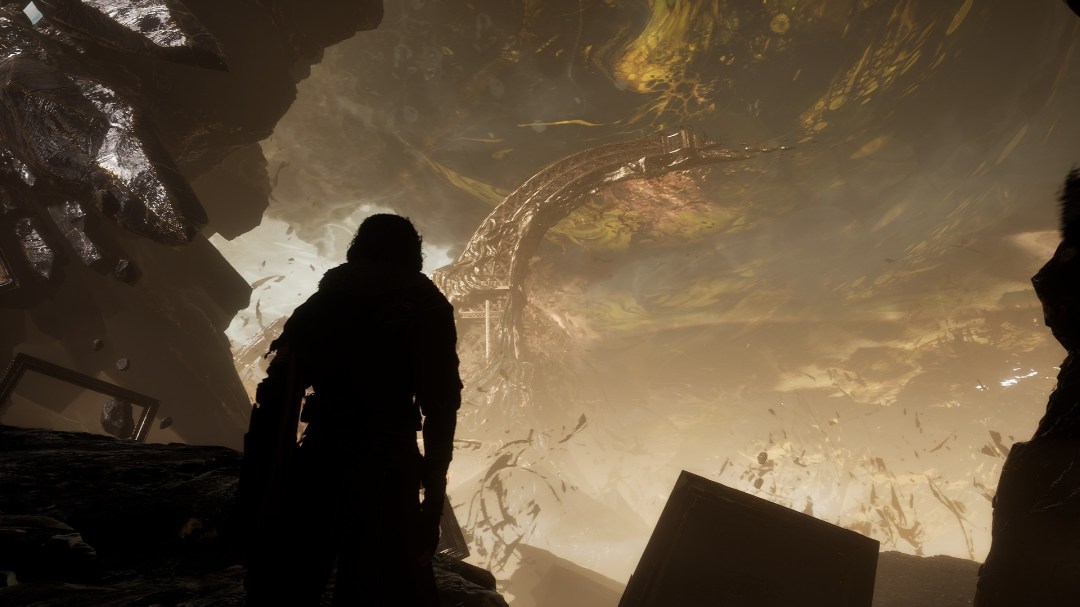
Act II concludes with devastating failure: Lumière is destroyed, Lune and Sciel are gommaged, and the Expedition is, effectively, over. It even fades to black, as if preparing to roll credits. But what we get, instead, is another dramatic recontextualization.
This is it, folks. The big spoilers. If you’ve got the chance to play this game and want to be surprised by any of its twists or revelations, get out now.
The Dessendres
Once upon a time, there was a family of painters. Renoir, the father; Aline, the mother; and their children: Clea, Verso, and Alicia.
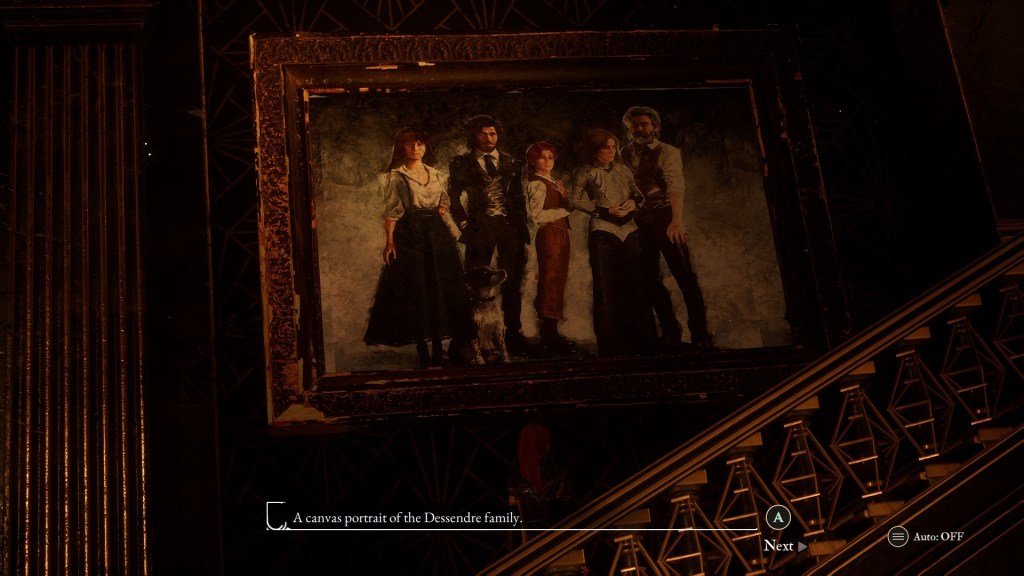
But these were not ordinary painters. When they painted, they made whole worlds in their Canvases—living places with living people that they could visit and share. Each of the children was raised to paint in this way, and each developed their own distinct style.
But tragedy struck: the Writers (your guess is as good as mine here) attacked the Manor where the Dessendres lived, setting fire to the children’s rooms. Verso died in the fire, and Alicia became horribly disfigured: her face was scarred and her voice destroyed by the smoke.
All that remained of Verso was a Canvas he had been working on since he was a child. So Aline, devastated by the loss of her son, entered the Canvas and refused to leave. Renoir, her husband, feared for his wife’s well-being—it is dangerous to stay too long in a Canvas—so he barged into the Canvas and tried to destroy it. He warred with Aline, who defeated and contained him, but only for a little while. Clea, frustrated and fed up with her parents’ squabbles, left the house altogether to pursue her own goals.
Alicia, now completely abandoned, entered the Canvas in the hope of making peace between her parents, but lost her memory and was born into the infant body of a girl within the Canvas:
Maelle.
The Two Dessendres
When Verso painted his Canvas originally, he included his family. All of his family members (including himself) have versions of themselves in the Canvas when they arrive. So, during the events of the game, there are two of each of these characters running around the Canvas. The real Aline teams up with the Canvas Aline to make The Paintress (hence the two figures in the climactic battle of Act II). The real Renoir is bound by Aline under the Monolith, but his avatar, The Curator helps the party defeat Aline before escaping to destroy Lumière. Meanwhile, the Canvas Renoir, oblivious, benefits from Aline’s protection and tries to protect the Paintress, as we’ve discussed. Canvas-Alicia is the disfigured girl Verso identifies as his sister (and Renoir’s daughter), but real-Alicia is Maelle, who only now, in Act III, remembers herself and reclaims the power to paint and shape the Canvas.
Our Verso, then, is just the invention of child-Verso: a dream of what Verso wanted to become when he grew up.
There’s a lot to unpack here, so let’s start by tying up some loose ends.
- Is the Myst connection obvious yet?
I’ve still got no evidence that Broche considers Myst an inspiration for Clair Obscur, but it sure seems unmistakable to me. Myst is also a game with a richly-realized world that has been devised by a writer. The paintings of Clair Obscur seem a natural analogue to the books of Myst and its sequels. But especially in Riven, we find that A’trus’ family is divided and at war with one another. A’trus’ sons, Sirrus and Achenar, are trapped in books on the island of Myst, but not before trapping their own father. A’trus’ father Gehn, in particular, has to be trapped in Riven to prevent him destroying the lives of the people in these books.
So in Clair Obscur we also have an emotional drama of supernaturally-powerful artists feuding with one another by using their creative works as battlegrounds. There’s more substance here in Clair Obscur—the events underlying the Myst games are only alluded to in the games themselves, while Clair Obscur spends a lot of its time exploring the relationships between the Dessendres—but the basic setup seems very similar.
- Une vie a t’aimer
Again, it seemed weird to talk about it back at the end of Act I, but this song, and many of the others that have played over key moments in the game, directly refer to the characters here. Une vie a t’aimer is literally a song where Renoir and Aline sing-battle each other, calling each other by name, expressing their love and their regret. And I honestly suspect this is more baffling to French-speakers than English-speakers, since we can just write it off, like in NieR: Automata or “One Winged Angel,” as cool-sounding background music. And it is really freaking cool. But this is a French game, presumably intended for French audiences especially. And I think it’s significant that they get some great actors to do the English voicing (including Andy FREAKING Serkis as Renoir), but they don’t bother to translate the singing (except, interestingly, in one of the songs that plays when you explore the area beyond the suicide cave, where we are reassured “don’t be afraid”). I suppose the music is meant to be unintelligible to most audiences.
Also on the list of crazy on-the-nose musical cues is “Lumière s’eteint”—the song that plays when you visit the tiny deserted island where Renoir’s Manor can be found after its disappearance from Old Lumière in Act II. This one is particularly striking, since Testard’s recitation of the poem is read, without singing, over the song playing underneath. There isn’t actually anything terribly important at the location, but it’s ominous as hell, and I spent a lot of time running around in circles trying to figure out if there was something I was missing. (There wasn’t, so far as the Internet knows.)
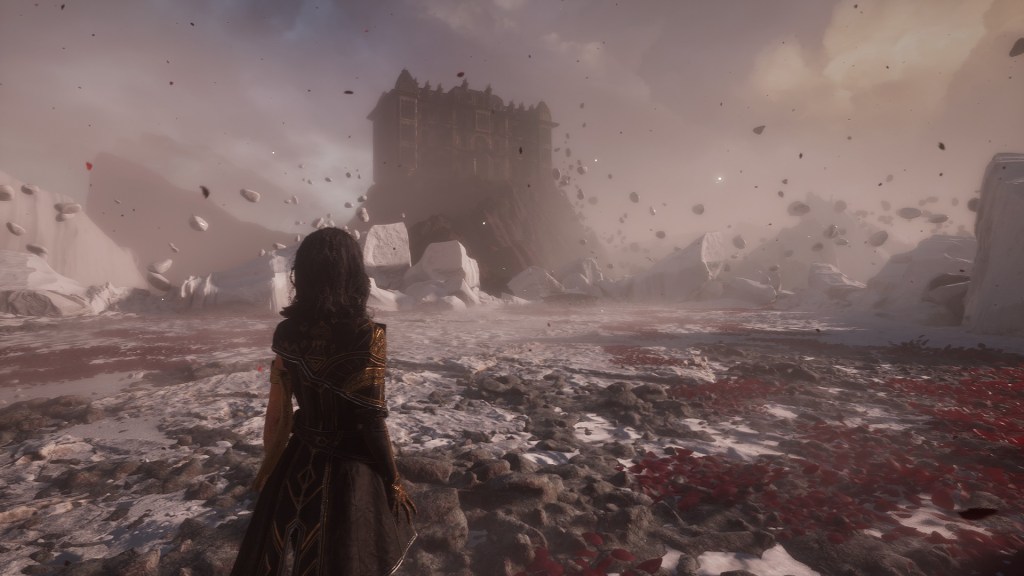
“Lumière s’eteint,” by the way, roughly translates to “Light [Lumière] goes out.”
- A Built World About World-Building
The world of Clair Obscur must also now be elevated to a new level of contextualization. Each Act does this, I think—that’s why I structured the essay in this way. Our relationship to the world radically changes from the prologue (where we have a clear-cut mission and goal) to Act I (where our mission is complicated by the discovery that this world is both more dangerous, and more benevolent, than we expected) to Act II (where our power over the world proves more destructive and consequential than we had hoped). Now, in Act III, it is clear that this is not just about Lumière and its denizens fighting their fate, but that fate is in fact the product of squabbling creators—like the mythic gods of Olympus—each with their own complicated agenda and ideological assumptions.
Aline wants to protect and preserve the world, even at the cost of her own life, in her desperation to connect with her lost son one last time. Renoir wants to destroy the world to keep his family together, even if it means losing his son’s greatest work. Alicia wants to repair what has been broken, but finds herself restored by the Canvas’ magic: she is whole here, in the Canvas, saved from the scarred and disfigured body she left in the real world.
This is a game about why we create—and why we destroy. It is about world-building as a way of escaping our own limitations (like Alicia), or escaping our own suffering, grief, and loss (like Aline), or a way of exerting power and control when circumstances in the real world make us feel powerless and weak (like Renoir). Each of these characters wants something different from this Canvas, but each is acting selfishly, changing and distorting the created world to suit their purposes.
And, lest we forget, this is Verso’s Canvas. He made this world. Some of the discordant elements and fanciful inclusions are the products of youth, or personal fascinations: his own characteristic style.
The world we see in Clair Obscur, then, is a product of all these forces. It is not the creation of a single artist, but an inadvertent collaboration of each of these artists. The Gestrals, Esquie, François, Monoco, the fanciful landscape with its coral canyons, red forests, mountains and seas, and the people of Lumière (including the facsimiles of Renoir, Aline, Alicia, Clea, and Verso himself)—this is the world Verso created. The Fracture that destroyed the world decades ago was the product of Renoir’s attempt to destroy the Canvas—the floating debris, smeared buildings, or ruined landscapes are his addition (or subtraction, depending on your perspective). The gommage—the people dissolving into red-and-white petals, seem to be the product of Renoir’s destructiveness filtered through Aline’s mercy. But we also begin to see layers to this creation.
The Axons, for example, were created by Renoir, not just as agents in his war, but as symbols of hubris and challenges to Alicia and the Expeditioners. Most of the other Nevrons were, in fact, Clea’s contribution—or Clea’s by proxy. The creator the white Nevrons allude to in their speeches is Verso’s Clea-facsimile, who was apparently empowered by the actual Clea during one of her visits, and who can now paint and create under her own steam. (Verso points out that Clea was the only painter in the family talented enough to paint over the creations of the other family members. Clea’s creations are typically the most terrifying in the game, and her avatar presides over the “Endless Tower” where you can find the most challenging battles.) The lamplighter who defends the coast and resurrects regularly, was, along with several of the other caretaking bosses, a product of Aline’s, as we discover in a museum where the surviving Aline-facsimile resides.
And then there are the Drafts. Once Esquie finds the rock that enables him to go underwater (François had it the whole time!), the party can find the early drafts of the Canvas made by Verso, and the drafts of Renoir’s army where he was trapped by Aline.
Renoir’s Drafts is a dark place, gold-and-black, filled with some of the strongest and scariest enemies in the game. His creations are characterized by void: a horse with a black-hole singularity in its mane; Clair and Obscur—the light and dark-wielding swordsmen we frequently find in the monolith, and again in the endgame. We also find drafts of the Axons and their typical enemies.
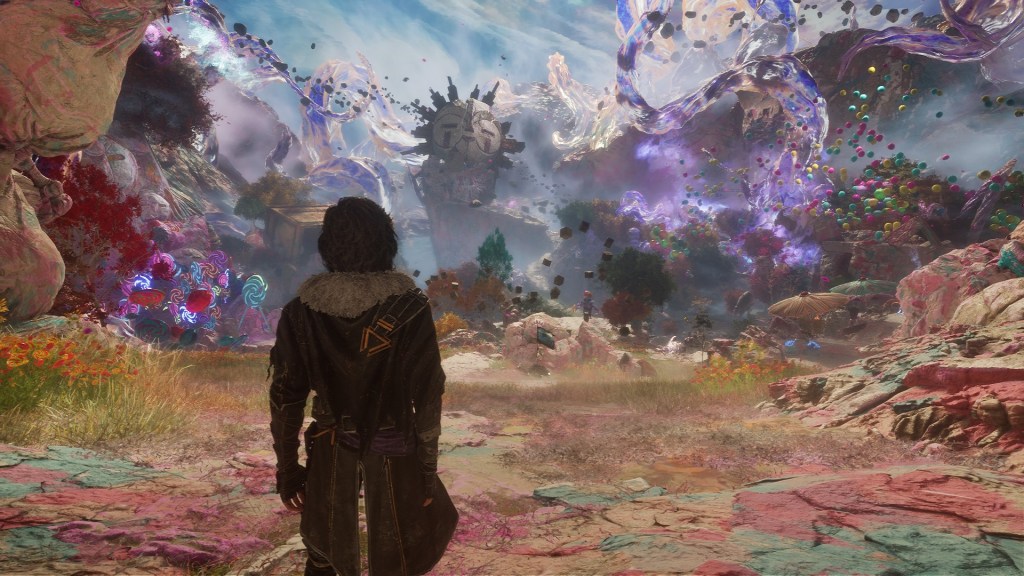
Verso’s Drafts, meanwhile, is a kid’s paradise, full of toys and trains, candy, balloons, and carnival rides. Here we find the early drafts of Gestrals and Grandis (the yeti-like beings inhabiting Monoco’s peak), as well as drafts of François the cantankerous turtle. We fine statues and monuments to Esquie, the central figure of Verso’s world, it seems. And we find magical floating trains that turn midair somersaults in their movement from one part of the drafts to the other.
Look—the world of Clair Obscur is beautiful, full stop. Throughout Acts I and II, I often felt enthralled by the world and just wanted to dwell there—busy as I was with my own problems to avoid. But by Act III the world takes on such deep new meaning, and Verso’s Drafts in particular became one of my favorite places in the whole game, as a kind of vision of Edenic paradise: this was the original intent of the author, before the breaking of the world by Renoir or the tragic degeneration of Lumière.
And as much as the aesthetics of the game evoke surrealism with its superficial characteristics and qualities, really this is surreal because it is the reflection of the creators’ own minds—not just the creators at Sandfall, but the characters invented within the game. I am invited to identify with Verso—not just the avatar-Verso in the game world, because I guide his actions and movements—but the true artist-Verso who made this place for me—and I am invited to appreciate his view of the world: what he likes (Trains!), what he loves (His family!), and what he values (Esquie’s gentle generosity).
In a sense, this game is guiding us to a position of artistic criticism and appreciation. We are initially asked to reckon with this world as a world—a place hostile and out of our control, that we must fight with and overcome. But by the end of Act II it is a place where our power must be used responsibly—where we will, by necessity, shape and change (i.e., re-make) the world to suit our purposes and goals. And in Act III we are invited instead to see the world as a made space, already shaped and changed by others’ ideas and goals—so we can question and interrogate what that meant to each of these shapers and makers. By the end of the game we have gone from being players, to being critics and artists ourselves—that’s what it means to dwell in this space and play the game.
And, logically, that means looking at Broche’s contribution as well.
The Characters We Made Along the Way
Every year in The Philosophy of Love and Friendship, I read Plato’s Symposium with my students, and every year I try to walk them through the three levels of analysis Plato urges on us.
- We need to understand, on a basic level, what each speaker is saying.
- We need to understand, on a character level, why each speaker is saying this.
- We need to understand, on an artistic level, why Plato makes each speaker say this.
Clair Obscur has taken us from (1) to (2)—we started looking the world in terms of what it means and how it affects us; and gradually we have started to understand what the world’s details say about the characters who have created this place. But to get to (3 – Broche’s opinion) we have to zoom out a bit more and understand the way the themes inform the way these characters are designed.
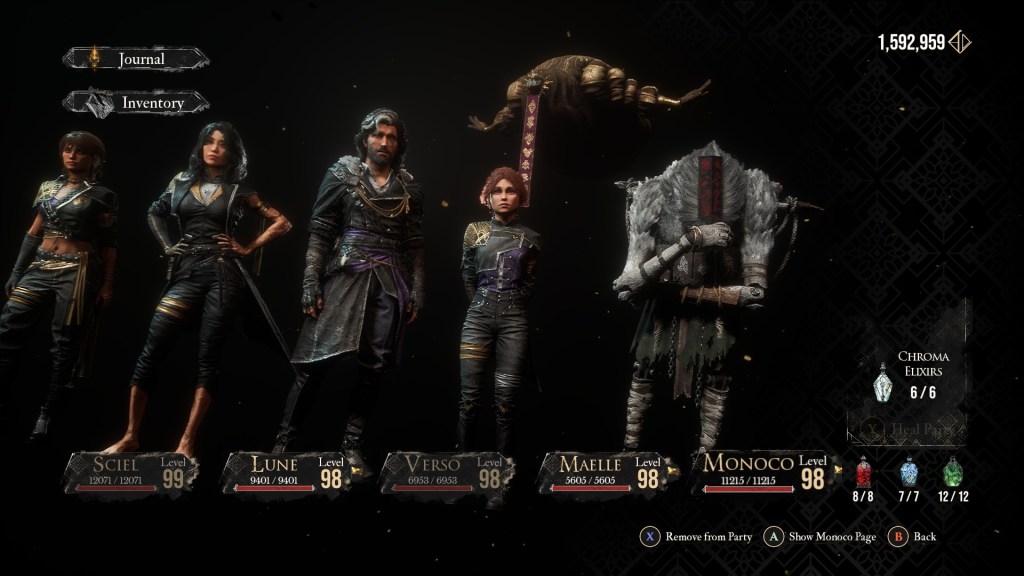
Unfortunately, the Dessendres aren’t terribly accessible to us, except as larger-than-life archetypes—the gods of this world. We can see the broad strokes of how grief informs their choices, and their world-affecting choices specifically, but if we want to examine characters—and our primary theme of grief—more deeply, we have to look at the ones closest to us.
Yes. We are long overdue to talk about our party members.
Gustave
Gustave is the first character we’re asked to seriously identify with, and his motivations may be the clearest of all our characters. His conversation with Sophie reveals his motivation, and the struggle that brought him here. He wants to save Lumière, where Sophie has opted to accept her fate. She spends her last year thinking of herself and not the future, trying to enjoy her life rather than fight against her fate or work toward the future that will follow. This is why she and Gustave broke up; this is why she refused to have a child. But Gustave has spent that same time designing the lumina-extractor that enables our party to wield so many Pictos, and thus compete with the Nevrons and other threats on the continent.
It’s not clear, though, whether either of the two are really “right” in this decision. Losing Sophie almost certainly drives Gustave’s determination to the Expedition’s cause, but I suspect this is also part of the reason Gustave nearly gives up after the Expedition is wiped out by Renoir, and part of the reason why he’s so protective of Maelle. Gustave hung all his hope on the mission, and when the mission seems lost, he’s lost, too. What gives him the power to hang on are the other people in his life: first Lune rescuing him from himself, then his desire to rescue and protect Maelle. In fact, when he finds the note alluding to Maelle’s abduction, he is ready to give up on the mission altogether—it is Lune who must remind him of Expedition protocol.
And, seeing that the Expedition results in the destruction of Lumière when Renoir is released, it really isn’t clear how much the Expedition was a worthy cause for Gustave. Maybe it would have been better if he’d settled down with Sophie and met his fate with equanimity. Maybe Lumière would have been better off winding down its remaining years until its last citizens gradually died out altogether. Maybe fighting fate only hurried that fate along, like any Greek tragedy would tell you. Maybe the citizens would have been better off if the Expeditions had never bothered to seek out the Paintress. (It wouldn’t have made for a great game, though…)
For all that, though, I think it’s no accident that Gustave spends more time as a martyr than a living character exploring his motivations. By the time he confronts Renoir, he has completed his arc and made his decision to prioritize Maelle over the mission. He will spend more time being mourned than mourning, and that might well be intentional, since the other characters’ relationships to grief tend to be more complicated. Just as he introduces us to the mechanics of the game and prepares us for their later complexity, Gustave introduces us to the themes of the game as well, but will be overshadowed by the other characters’ struggles.
Lune
Really the only thing I’ve said about Lune’s character so far is that she’s a “space-cadet.” And I stand by that.
Lune has been preparing for this Expedition since she was a child. Her parents set off on their own Expedition many years ago, and raised her to support the cause. The whole family are scientists—easily fascinated by the world around them, eagerly trying to harness the powers of this world. This is almost certainly why Lune fits the role of mage on the team. She’ll almost certainly be the first member of the team to learn healing skills, and learns a wide variety of elemental skills as well.
To talk about this we have to back up just a little bit: each of the characters in the party has a dynamically different set of skills and weapons unique to that character. Taken all together, along with the Pictos (which any character can use), there are still a staggering variety of approaches to utilizing each character, but they all tend to focus on certain rhythms and themes.
For Lune, that will almost certainly involve her elemental and healing abilities. Each time she uses an elemental skill, she generates elemental power which can be used to enhance her other skills. In my experience, this meant that there were two basic approaches to using Lune: you could carefully deploy skills in a certain order, ensuring that each skill generated the elements you needed for the next; or you could play more chaotically, generating as many elements as quickly as possible, then dump them all for big damage.
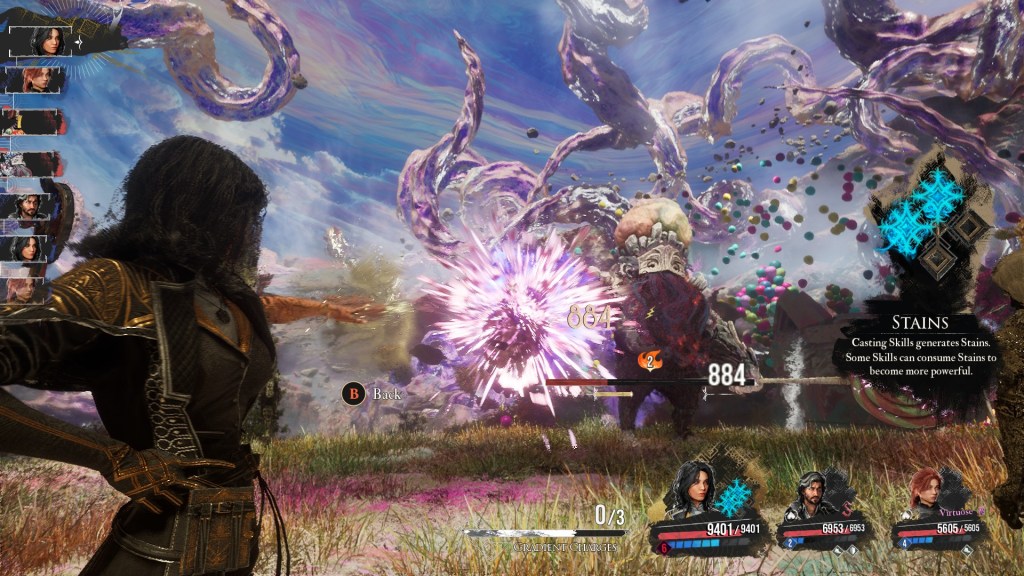
But these are, effectively, just two sides of the business of scientific inquiry: the first strategy is the methodical approach of the data collector; the second is the haphazard style of the recklessly curious. And Lune suits both roles. In dialogue, she often gets distracted easily, asking the native Gestrals about their society or biology, investigating environmental oddities, or asking questions about past expeditions.
Interestingly, though, I believe she’s also the first to be entranced by—and the first to snap out of—Sirene, the dancer Axon’s, hypnotic undulations. The scientist is the first to observe, grow too curious, and fall victim to the trap, but she is the quickest to escape as well, once she’s assessed the danger. She’s also the most consistently skeptical and untrusting of Verso when he joins the team: she’s the first to condemn him when he’s caught withholding information, and the angriest when he lies or obscures.
But all this investigation and fascination serves a secondary purpose, I suspect.
It distracts her from her grief.
Eventually, if you build her relationship with Verso, she’ll ask him to help her find her lost parents. And they go, and they do. But the find is anticlimactic: they are dead, just outside Sirene’s tower. If you follow their lead and play the music they were using, you’ll be attacked by the same powerful Chromatic Nevron that killed them (and win Sirene’s dress as an outfit for Lune). And, at long last, Lune will face her childhood grief—both the loss of her parents and her regret at the pressure they placed on her to excel and study. Lune’s curious, scientific mind is truly a part of her nature, but her pursuit of knowledge and truth also serves to distract her from the fact that she never really had another choice but to follow in her parents’ footsteps. Lune doesn’t regret what she’s become, but that makes it no less forced, and no less restrictive (especially for a woman who we first see playing music). Perhaps there was another way, but that way has been long lost, now.
Maelle
There’s a lot happening in Maelle’s story over the course of the game. She is orphaned by her parents’ gommage. She chooses to embark on Expedition 33 despite being only 16—by far the youngest Expeditioner in history (most only join Expeditions in their last year before gommaging, when they have nothing to lose). There is a sort of devil-may-care indifference about Maelle that seems both refreshingly confident and dangerously reckless.
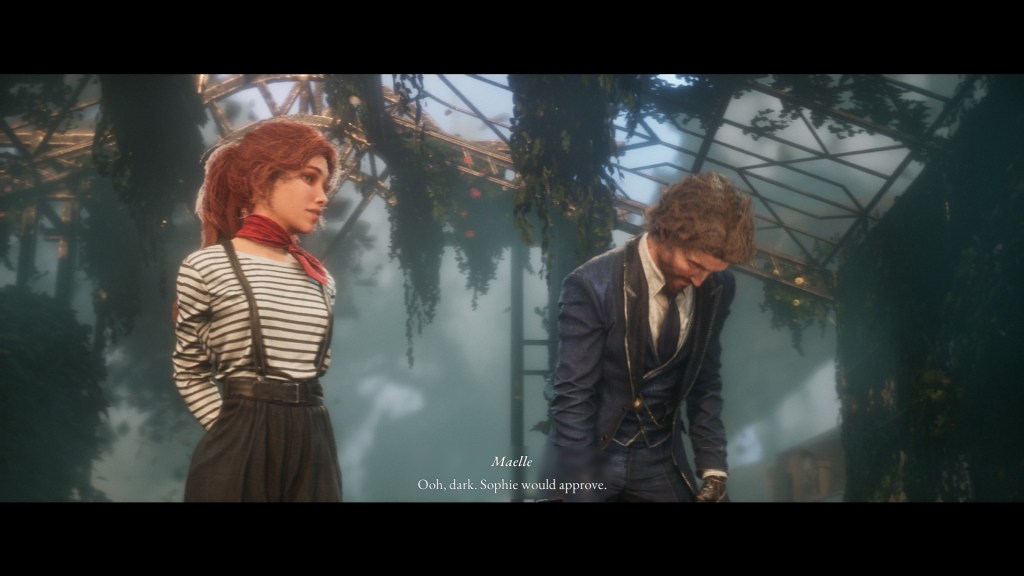
But then, of course, she loses Gustave—her surrogate father and brother—and must travel through the awful battlefield level to put his remains to rest. And all throughout the game she must wrestle with her visions of Renoir and Alicia—visions that are almost certainly a symptom of her forgotten identity as the true Alicia.
In Act III, Maelle transforms completely into Alicia: her hair goes completely white and she gets the outfit she wore in the flashback that reveals her backstory. Through Act III she unlocks her new power as a Paintress in her own right, even to the point of resurrecting Lune and Sciel to the party after Renoir gommages them. Maelle/Alicia also sets the player’s goals in Act III: confront Renoir and drive him out of the Canvas. Once they do, Maelle/Alicia will be able to bring back all those lost to Renoir: including, presumably, the other many victims of the gommage, and perhaps Gustave as well. She is, therefore, a symbol of hope to the rest of the party. Her willfulness and strength is the only way the Expeditioners can undo all the damage done by Renoir, and possibly save Lumière after all.
But she is still just a child. Time is wonky here in Clair Obscur: somehow Renoir and Aline have been in the painting for over 60 years, while Alicia only entered (and became Maelle) 16 years ago. Presumably time moves differently in the Canvas than it does outside of it. But Alicia outside the Canvas and Alicia inside the Canvas are roughly the same age, and that youth suffuses the character.
In combat, Maelle behaves like a duelist. She with fences her opponents, switching between an offensive stance (that does and receives more damage), a defensive stance (which reduces damage taken), and the “virtuoso stance,” (which deals double damage without penalty). Consequently, Maelle is perfectly suited to high-risk high-reward play: for most of the game I had her equipped with Pictos that made her immune to healing, but capable of doing much more damage, which stacks under the right stance. There were many encounters where her first attack would completely destroy an enemy in a single shot. But she also tends to have low health, and without the ability to heal her, she would often be the first to fall in protracted battles. All of which speaks, I think, to that same youthful recklessness and exuberance. Maelle is incautious and impulsive, and her new lease on life and health here in the Canvas contributes to her overconfidence.
But Maelle is also in denial. She is here in the Canvas, quite literally avoiding reality. Life has become so harsh, so painful, so unbearable, that Expeditioning with Gustave, Verso, and the rest of the party becomes a welcome escape. Here Verso is alive. Here she can speak, and her face is whole. Here she can go on fun adventures, rather than try to keep the peace between her parents. (I totally get it—why do you think I’m playing this game?)
The cracks do start to show, though. Godlike as Maelle’s Act III powers become, she also asks Verso to help her find facsimile-Alicia, who apparently has hidden herself with the third Axon, at the top of a fantastically-high and rickety tower, only reachable now that Esquie can fly. After a long, laborious journey up the tower, Maelle and Alicia do confront one another, and Alicia asks Maelle for death. Maelle gommages her—and learns to use the skill in battle, too. But this scandalizes Verso—couldn’t she have waited until he said goodbye? Maelle assures him, though, that this is what Alicia wanted.
It’s an unsettling look into Maelle’s perspective. It seems she would rather die than go on living in the real world with her burnt face and voice. Here she wields godlike power; there she is the voiceless daughter of a broken family. But as true-Renoir has pointed out—anyone who stays in the Canvas too long will die. Is that a price Maelle is willing to pay? Would she rather die in this fantasy than live in reality?
Verso
I’m not sure Verso ever stops being enigmatic—even to himself. The Verso we see in the Dessendre family portrait is a young man, between 20 and 30, I suspect, and it seems that was his age when he died. But the Verso who fights in our party is well over 60, according to the game’s internal lore. And the Verso who created this painting was just a child, barely ten, I should think. It’s unclear, then, if the Verso in this Canvas wasn’t some youthful invention—an idea of what Verso wanted to grow up to be, rather than someone he ever was.
Because that’s kind of the key to Verso’s whole identity: he is a fiction. Lune and Sciel are only as real as the Canvas they inhabit—even if this is a fantasy, they are real, true parts of that fantasy, a product of its own internal logic, children of Lumière’s inhabitants. Monoco, by contrast, is a direct invention of Verso’s, like Esquie, the Grandis, and the other Gestrals. It’s heavily implied that Monoco was also a fundamental part of that creation—there’s a toy Monoco (and Esquie) in Verso’s room in the Manor. Meanwhile, Maelle has discovered her real identity: she is Alicia, and must come to terms with the fact that she belongs to the reality beyond the Canvas.
But Verso? He is the invented memory of a dead boy, or the lingering memory of a dead man. He is precious to Renoir and Aline, both the Canvas facsimiles and the true Dessendres—but for what he represents, and not who he is. Verso is living a kind of a lie, but a lie told by someone else. He is a created image of his creator, neither an organic part of the fantasy, nor the actual boy lost to Aline, Renoir, and Alicia. He is all that is left of Verso, but he is not Verso, all the same.
What the heck are you supposed to do with that information?
Worse, Verso isn’t always sure what to do with himself. He is initially very guarded with the Lumière Expeditioners—Lune, Sciel, and Maelle. It takes him a while to open up, but when he does, he explains that he has gotten close to other Expeditioners in other Expeditions—but they inevitably die, and that grief can haunt him. Especially in the case of one particular Expeditioner, who he apparently grew very close with indeed…
By contrast, Verso seems most at ease with Monoco and Esquie—it’s clear they have a long history of going on adventures together, and their friendship does not need to be explained or strengthened. Verso will happily accept Esquie’s offers to hug him (at least my Verso did—not sure what your guy is hung up about), and he will spar with Monoco—just for fun. He and Monoco also prank the rest of the party at one point: Monoco cuts him in half and he waddles over to the others with only his hands and torso. (He’s immortal, remember? Good times…)
But that is the contradiction inherent in Verso’s character. He seems guarded and secretive with his new allies, but there is, absolutely, a silly streak to him that reveals the child-Verso that made Verso’s Drafts. For all his staid mannerisms, he still gets excited by trains, and he likes Esquie’s hugs and Monoco’s shenanigans. It is still fun—wandering around the Continent, getting in and out of scrapes, telling stories and doing the sorts of stupid things that will make for good stories later. He’s been eaten by Serpenphare (and, presumably, pooped out); he’s been squashed by the Axons. At one point he and Monoco were apparently frozen in ice for a whole year.
These things happen, I guess.
He’s also terrifying in combat. Gustave had a pretty simplistic battle system where he would accumulate charges by hitting enemies, only to release those charges in big hits with certain moves. Verso has a similar system: he builds his “rank” with multiple hits, which multiplies his damage and enables bonus abilities on moves with a matching rank. But each time he takes a hit, his rank decreases, making him capable of great damage, but only with the right timing.
But those high-ranked moves—sheesh. Verso has plenty of crazy powerful light and physical moves, many of which will hit all enemies at once, often many times in a single attack. It might have just been my build, but he was absolutely on par with Maelle for sheer damage potential in my game, and I think that was what the developers had in mind. But he’s also well-rounded: he’s got healing moves, status moves, you name it.
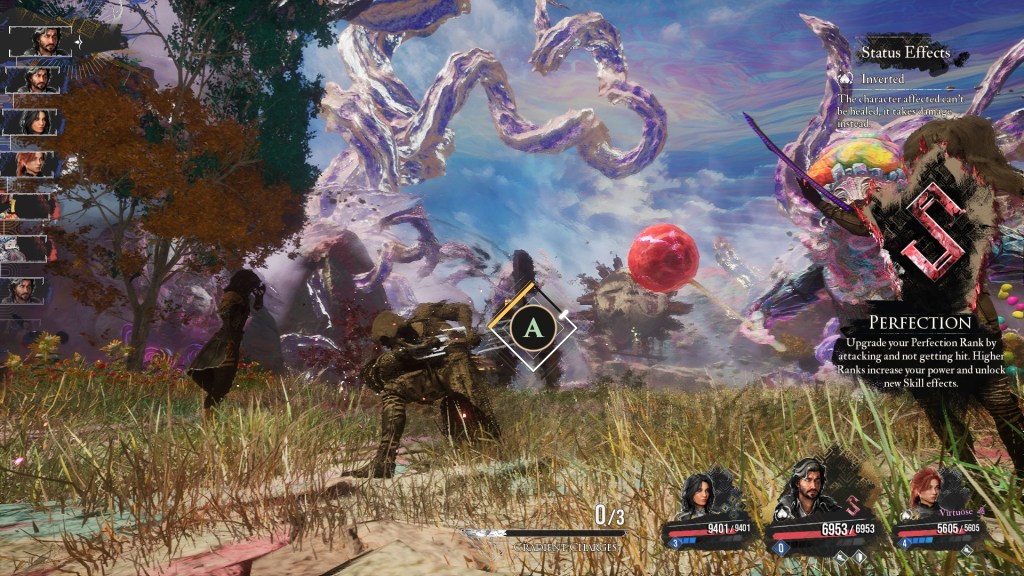
He’s also significantly more durable than Maelle—his ultimate move, learned only after hanging out with Esquie, gives him an auto-revive ability that is frankly invaluable in late-game fights. And that also tracks nicely with his immortality and his silly misuses of that immortality. (Especially funny is his bark upon reviving: “What did I miss?” What a punk.) He also has several self-healing abilities, but, true to his character, I don’t believe he has any skills that heal other party members. The closest he has is “Burden,” which allows him to take all the negative status effects from his allies. To Verso, co-operation is a liability.
But this describes Verso’s fundamental relationship to grief. Immortal, he is utterly unafraid for his own sake, and reckless to a fault. But he is also unwilling to get close to others, for fear of losing them. Verso is guarded because he is guarding himself from the possibility of loss. Joining Expedition 33 is a sign of growth, but it also means that he will have to make confessions—about his father, Renoir, who destroyed the other Expeditioners; about his past choices and deeds, supporting or opposing other Expeditions; and about the fact that he probably could have saved Gustave, but chose not to…
In combat and in dialogue, Verso is self-sufficient, but that self-sufficiency is as much a matter of trained resilience and confidence as an unwillingness to trust others and let them affect him. He would rather be alone than risk grieving another lost soul.
Monoco
Like most Gestrals, Monoco is a rowdy punk. His moves are all stolen from Nevrons when he takes their legs (?!), and his fighting style is therefore rather weird and quasi-random. Each time he uses a move, it manipulates a little wheel that gives an advantage to certain moves. So, like Lune, you can carefully move the wheel around with strategically-chosen moves, or you can play chaotically, taking advantage of whatever you have in the moment. I ended up using Monoco as a tank—he had a ton of health and defense, and I prioritized moves that healed or buffed the rest of the party. It felt true to his character, and took advantage of the wide variety of moves he could use.
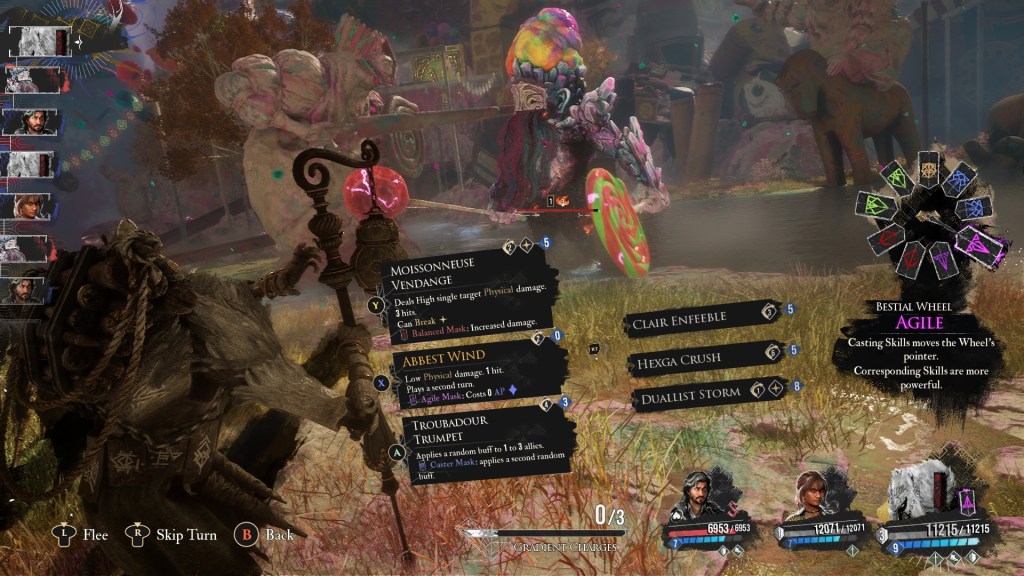
In the game, Monoco doesn’t tend to be very deep. He’s got his rivalry/friendship with Verso, and the two like to exchange stories about old times, like army buddies sharing beers and growing nostalgic.
The one exception is Monoco’s relationship to Noco, the Gestral merchant who tags along with the part for much of the game. Noco was apparently Monoco’s mentor, and Monoco thinks of him like a father. But in the confrontation with Renoir in Old Lumière, Renoir blasts Noco, killing him outright. The other party members console Monoco: Noco will be reborn, after all, like all Gestrals—but Monoco snaps back that it’s not the same: he won’t remember, and is therefore not the same Noco.
Eventually, he asks Verso to bring Noco to the stream where Gestrals are resurrected, and the party agrees. But there Monoco must confront and defeat the Gestral village chief, Golgra—which risks reigniting a long feud between the two. But Golgra, defeated, allows Monoco to skip the line for Noco’s sake, revealing a surprising compassion for her prodigal rival. Noco revives, but, as Monoco predicted, he doesn’t remember his mission to explore the world and become the greatest merchant—and he doesn’t remember Monoco, either.
You can visit Noco back at the Gestral village: Monoco openly weeps each time that you do.
And there is something truly tragic and horrible, but also refreshing about this, I think. Of all of the characters, Monoco seems the most honest about his grief, and is the most open in his mourning. I guess Gestrals play hard and grieve hard, too. We should all be so lucky.
Sciel
The one possible rival to Monoco’s honesty is Sciel’s.
And, look. I’ve said virtually nothing about Sciel up to this point. Because I think she might be the key to understanding everything about the themes in this game.
Sciel is dark-skinned, heavily tattooed with pictos, and wields a double-bladed reaper’s scythe. Her attacks are usually dark-elemental, though some of her other weapons can mix up the type if you make the deliberate decision to do so. Her skills come in two varieties: sun skills mark enemies with sun counters; moon skills use up sun counters, usually to do bonus damage or inflict bonus effects. And once you’ve used both a sun and moon skill, Sciel enters “Twilight” (one of our translations of Clair Obscur, remember), which enables her to do extra damage for two turns. So the key to Sciel is balancing these two types of skills: stacking sun counters until you expend them with a moon skill and unleash hell during her twilight phase.
It’s a rhythm I never fully mastered, I think. I found some interesting ways to use Sciel, and even managed to so some major damage, but I always felt I was under-utilizing her in battle.
What I did like, though, was giving her the Pictos that caused her to do damage and inflict status when she died, then equipping her with Pictos that automatically killed and resurrected her at the beginning of each battle. There were several times when I would walk into a fight with Sciel in my party, and she would automatically wipe out the enemy squad just with these effects alone. And this, too, seemed appropriate to a character emblazoned with the symbols of death (scythe, twilight, and dark, sunken eyes).
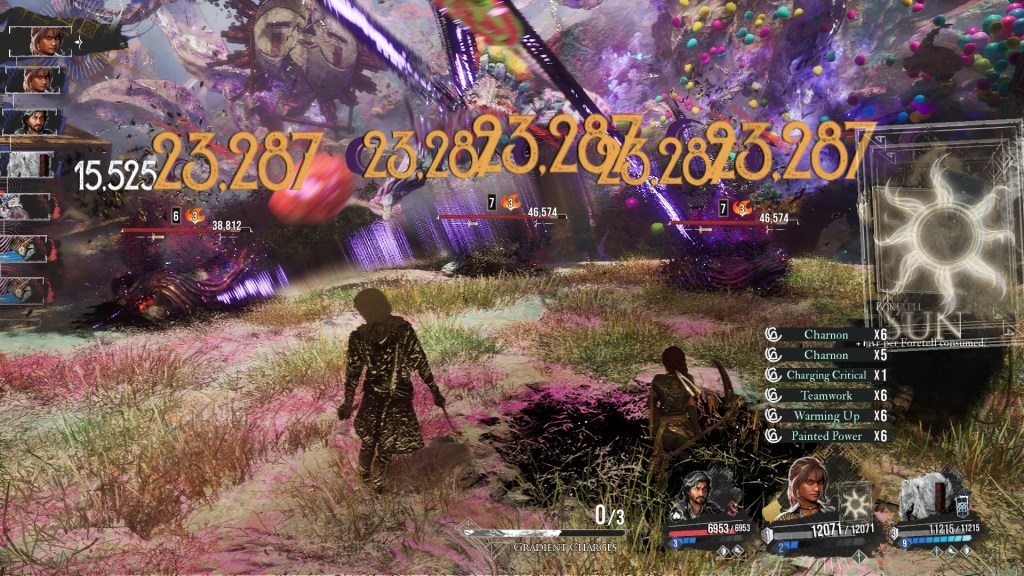
In her conversations, too, Sciel seems strangely comfortable with death. She confesses to Verso that she doesn’t fear death, and isn’t worried about what happens to her on the Expedition. She even offers to sleep with Verso—the only sexual opportunity Verso will receive, to my knowledge. She’s not subtle about it, but it also isn’t crass or salacious—there’s no awkward sex scene, just Sciel’s offer and the tacit understanding that she and Verso are both consenting adults seeking comfort in a pretty awful situation.
But the rabbit hole continues deeper: it turns out that Sciel was married, and her husband died (I don’t remember exactly why). Sciel loved him terribly, and couldn’t imagine a life without him—so one night she took a long swim from Lumière into the sea, with no intention of coming back.
She did, though. She washed up on shore the next day, utterly baffled how she’d arrived there.
And so she chose to join the Expedition, using her new lease on life for some more positive purpose.
In a game about grief, it seems natural that suicide should come up, and come up more than once. But as harrowing as Gustave’s suicide attempt may be at the very beginning of the game, I think Sciel’s affects me more. There is a frankness about Sciel that I find utterly incompatible with her admission of suicide. Gustave was a ball of tensions, regrets, and insecurities. But Sciel is so wildly alive, so uninhibited, and so comfortable with herself—after surviving suicide, what does she have left to fear, after all? She does not fear death because she has walked with death, and has even come to find solace in its presence.
This changes, though, when Maelle promises to revive the lost citizens of Lumière. Abruptly, Sciel is committed to the cause, in the hope of getting her husband back. She even cuts off her relationship with Verso (though she offers one last roll in the hay, which my Verso turned down), now that she must once again consider her loyalty to her husband.
Sciel’s relationship to grief is a troubling one. Where Monoco grieves openly and directly, Sciel seems to have transmuted her grief into something self-destructive. Her liveliness is both a manifestation and a cover for her death wish. She does not fear death; she wants it, I suspect. I don’t think it’s as simple as saying that she’s outright suicidal—it’s more that I think she has nothing to live for. Her life is over—has been over—ever since her husband died. The consolation for her grief is knowing that it won’t last much longer. And there’s something truly, truly terrible about this, even if it may be a form of healthiness.
It also struck me as somehow terribly appropriate—and terribly inappropriate—that I had somehow incorporated this death-rebirth cycle into the way I used Sciel in combat. Here was a suicide survivor that I had been routinely killing each time she entered the battlefield. I stopped using the strategy for quite a while, choosing instead to find a different way to employ Sciel on my team.
But I also suspect that this, too, was intentional. If surrealism is supposed to speak directly to the subconscious mind, I think the game had effectively persuaded me to use these Pictos on Sciel for this reason. I think I intuited, or was guided, to employ this strategy before I knew it resonated with her background—and that’s the mark of some damn fine world-building, I think.
Esquie
Hold on. We’re not done with Sciel just yet.
Verso’s conversations with the other characters are activated according to a mechanical trigger I haven’t fully explored, but most of these conversations happen in parallel with one another. You might have gotten farther with one than another, but you’ll likely be closing in on the end of all these conversations at the same time.
Which means that it’ll be right about the same time as Sciel confesses her suicide attempt to Verso that Esquie reveals that he saved Sciel from the sea. Which Verso then relates back to Sciel. Apparently this is why Esquie recognized Sciel at their first meeting.
Which leaves the mind racing—did Esquie lead Lune to Gustave as well? Is this big, velvety puffball some kind of avatar of rescue, an elemental enemy of despair?
It’s just a touch—nothing more—but the laws of dream-logic that govern a surreal work like this are clear. Esquie—the ever-gentle, ever hugging, idiosyncratic goon with the Expedition 33 sash draped across his sunshine mask—is a kind of saint, a bodhisattva, a childlike savior of the lost and suffering. He is enigmatic, but only insofar as his actions do not abide by the logic of we mere mortals. He’s a goofball, always losing his magical stones, but he does not grieve for them: “they’re going on adventures,” he says. And Verso, teasing, suggests that Esquie loses them on purpose. (Esquie does not deny this.)
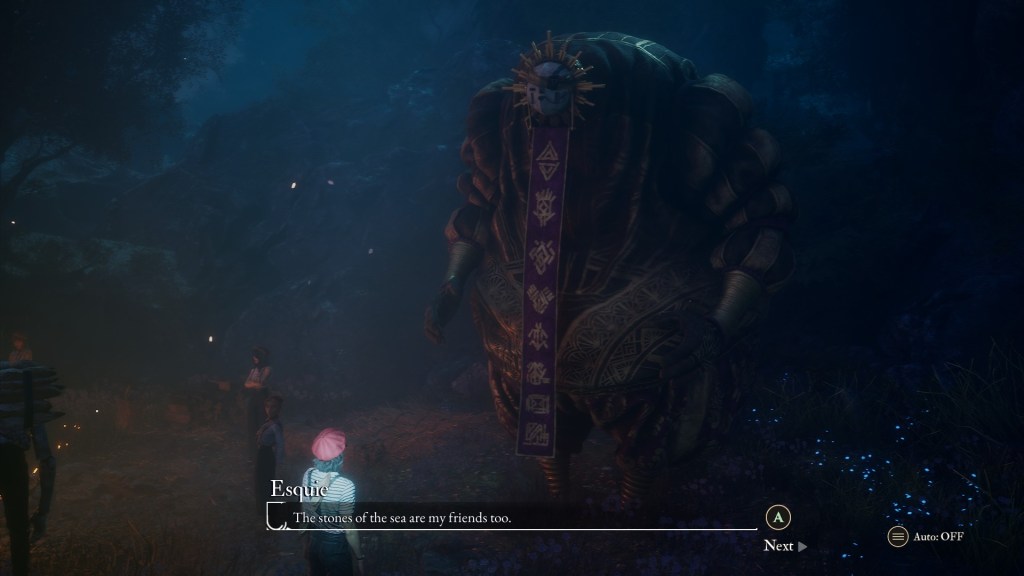
I love Esquie, like I don’t think I’ve ever loved a video game character before. Not because he is realistic, or because he is well-characterized, but because there is something of raw mythic power in his portrayal here. He is utterly unique, utterly fantastical, utterly unlike anything else I’ve ever seen, except these connections to Buddha or Christ that keep popping into my head, despite the strangeness of that comparison. He is eternally warm, eternally gentle, eternally loving, and some kind of supernatural rescuer of the lost and despairing.
I love him, because I want to believe in him.
Tolkien spoke of fantasy as consolation—the escape of the prisoner (from the pain and suffering in this world), rather than the escape of the deserter. Esquie is, by that logic, a perfect fantasy being: the huggable, gentle, loving force which, like a guardian angel, stands always just a little ways away, ever-laughing and ever-droll, but also ever watchful: bringing joy to the joyless and comfort to the lost. It is truly comforting to think of every suicide, every drug addict, and every hopeless soul visited by Esquie in those darkest final moments, taken in hand like Sciel was, and led to someplace peaceful and warm. Whatever makes Sciel healthy and vivacious is something she has borrowed from Esquie, I think—and something he happily lends to whoever might need him. Esquie is the unequivocal force for good in this game—a benevolent savior who grieves, but does not let that grief interrupt or disturb his joyful equanimity.
And he’s almost certainly the reason why I’ve now written fifty freaking pages about this game. Because you need Esquie (or at least what he represents) in your life. To me, he represents a terribly powerful part of some terribly old ideas, and a distillation of what is missing from contemporary religion and morality. Any Christianity that has forgotten Christ’s mission to the lost and despairing, that argues Christians should inflict their short-sighted judgment on others, and that contends that empathy can be toxic, is no Christianity at all. Esquie is the most believable reminder I’ve seen in years that Christian love does not judge, does not condemn, but is no less powerful or weak for being gentle, kind, and joyful.
And perhaps the clearest indication of this is in Esquie’s relationship to François. As I mentioned earlier, François is apparently holding on to Esquie’s diving stone, so Esquie and Verso confront him to get it back.
Now François is a prickly soul, superficially cantankerous and mean-tempered—the very opposite of Esquie’s enlightened benevolence—but here it is revealed that François’ prickliness derives from his own grief: he and Clea used to be friends, back when Clea would visit Verso’s Canvas. But since the tragedy, Clea no longer visits anymore, and François misses her. All you need to do, then, is bring François a carved stone depicting Clea sitting on François’ turtle-shell back, and François will relinquish the stone—and weep.
Like all the characters in this game, François, too, is suffering from deep grief and loss. And only Esquie can see, understand, and speak to that grief. Only Esquie has the patience to uncover and solve this simple little problem. Only Esquie can befriend poor François, who really only needs that little bit of love and compassion.
Esquie, as I said, is elemental in this game. In Verso’s Drafts, you’ll see depictions of him everywhere: statues and monuments, as well as Esquie’s nemesis, Osquio. Esquie is some pure, distilled form of Verso’s earliest childhood—perhaps an imaginary friend now raised up to a mythic being. And it is, therefore, the purest expression of creativity this game has to offer, both from Verso and Broche, I think. I would not be surprised to learn that this game began with Esquie. Among so many great ideas, it is certainly the greatest.
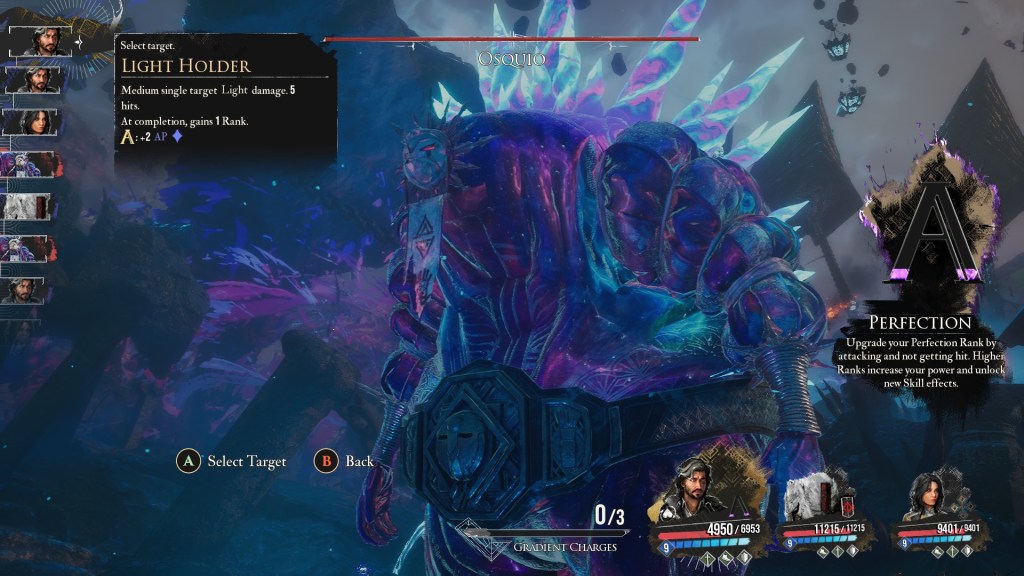
I should note that the battle with Osquio is also just wonderful. After you enter “The Root of All Evil” (a subsection of Verso’s Drafts), Esquie talks about Osquio with the bated breath of a stage whisper. Verso and Maelle have to announce their challenge dramatically, and Verso even asks if Maelle “remembers how to do this”—it’s clearly a staged adventure the two siblings had undertaken many times before. After winning the fight, the cutscene even transforms into comic-book primary colors for the final blow. It’s a joy to see. Osquio is a patsy, a theatrical heel, every bit as goofy and inept as Esquie, but with a fourth-grader’s understanding of evil and a seventh-grader’s understanding of cool. He is both the manifestation of a superficial adolescent sense of maturity imposed on the childlike Esquie, but with all the self-seriousness deliberately undercut and sabotaged by his clumsy attacks and delusions of megalomaniacal grandeur (including a final attack which announces “Osquio decides to destroy the world. Bye Bye.”). It’s perfect, and another wonderful example of the combat-as-game that is so typical of the Gestrals (another Verso original).
Verso (the child)
All of this seems to point right back to Verso, but not the adult Verso in our party—the young Verso, now dead. And the emotional truth of all these places, all these peoples, and all these beings (like Esquie and Monoco) points directly back to the boy who created them all. We are not just playing a game with a rich, well-realized world: we are playing in Verso’s world. And the more I learn about Esquie, Monoco, and the Gestrals, the more I realize (and understand) what a loss this death has been.
Which is something no video game has ever shown me before, I think. What Remains of Edith Finch gets at some of the same truth—by playing the minigames representing each life, we get a sense of the life lost. But here the scope is so much grander, and the creations so much more personal. It’s hard to blame Aline for her drastic and self-destructive actions, or Alicia/Maelle’s desire to stay in Verso’s Canvas, when we, too, grow to love the child-creator who made these wonderful places and things. It is tempting to dwell in Verso’s Drafts forever—this magical, childlike refuge from Clea’s Nevrons, Renoir’s Axons, and all the other threats that essentially manifest the conflicted feelings of their creators. Here, in Verso’s mind, we are protected, safe, and surrounded by joys and pleasures.
But if you wander into Verso’s room in The Manor, a different picture begins to emerge.
Verso didn’t want to become a painter.
He painted, mostly to make his parents happy, and because he felt obliged. But Verso loved trains. He loved candy. Maybe he wanted a different life, in a different career. Verso’s Canvas may be a loving, wonderful place where his childlike imagination runs wild and rampant—but it was only a part of him, and only a fiction. Aline takes refuge in this Canvas, seeking the child she lost, but it is a kind of lie, too. She only sees the part of him who performed obedience for her. Like the Verso of our party, this Verso is only a projection, incomplete and inaccurate: the true Verso is gone, to our loss as well as to Aline.
And behind this decision, I think I can begin to see Broche’s hand at work. These characters have all been designed to showcase the different ways we deal with grief, but they all rely on this fictional Verso, the fiction which persists as an object of this grief, rather than an accurate portrayal of the lost Verso himself. Grief, in some sense, has nothing to do with the grieved, and everything to do with the griever. We grieve what we, ourselves, wanted from our loved ones, and not necessarily the loved ones in-themselves. The Verso who painted this Canvas is a ghost, a memory, clung to by his parents. But he is not real.
We cannot go back. We cannot undo what is done. Verso is lost.
What do we do now?
The Player
For me, the answer was: linger.
I think I managed to finish both Acts I and II in about forty-to-fifty hours or so. The other half of my 99 hours I spent in Act III, lingering.
At the end of Act II, Maelle/Alicia explains that she will need to gather the Chroma of fallen Expeditioners to wage war against Renoir—but this is accomplished in a cutscene, not through gameplay. When it is done, the game simply stops giving directions. Renoir is in Lumière. You are free to fight him whenever you are ready. But the rest of the world is now open to you, now that you have Esquie’s flying stone. Like Chrono Trigger’s Lavos, you can go fight now, or wait to fight him later.
Most of the online sources advise fighting Renoir sooner, rather than later. The fight is more tense that way; you don’t want to be overpowered.
I did exactly the opposite. I did EVERYTHING. I fought EVERYTHING. I flew to every location I could find on the map and scoured every corner for secrets and treasures. I revisited old locations looking for missed items and hidden paths. I hunted down dozens of optional bosses. I bought every item on sale from the Gestrals. I climbed the endless tower and fought EVERY challenge and boss I could find. I nope’d out of the plot for a solid 50 hours. And that’s how I know as much as I do about the family Dessandre, about the side quests and character missions, and we haven’t even talked about Simon, stuck down at the bottom of the Abyss under Renoir’s Drafts, or the boss fight with Clea’s avatar, or the lost Gestrals, or finding the Canvas itself in the main room of the Manor—or any of a number of other secrets I found on my own, before ever opening a wiki or strategy guide.
And in all that time I never regretted a moment. Even when my fight with Serpenphare took dang near three hours, I took a screenshot as a point of pride. It was all joy, all eager exploration, and all organic play-for-the-sake-of-play.
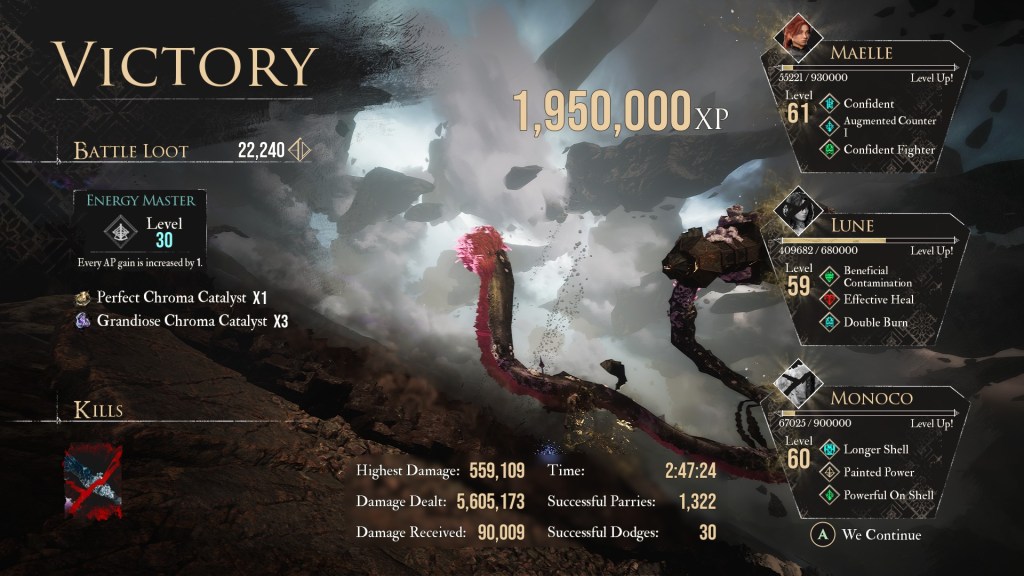
I did not go fight Renoir, because I did not want the game to end, in short. Because this game brought me the sort of joy I haven’t experienced from a video game in years—if ever. I wanted to stay here forever, adventuring with Maelle and Verso and Sciel and Esquie until the end of time.
But, as happens, my winter break ended. Classes started up again. Bills needed to be paid.
I did not expect to fall so hard into the world of Clair Obscur, to become so entranced by its characters, by its combat, by its story, or its warmth. But I suspect I needed it. I’d burnt myself out over the three months of summer I spent preparing my class on political philosophy, then over the four months of fall I spent teaching that class, and, of course, the revelation that I would not be teaching it again, despite all the work I’d done and the importance I believed it had to my students.
I was, in short, grieving. I was grieving the destruction of American Democracy. I was grieving the loss of my time and energy. I was grieving my own aging body. Perhaps I was even grieving the losses I’d had no time to grieve before: friends and relatives lost to COVID, to old age, to accident and ideology and bad decisions.
I’m damn near forty years old. I’ve saved up a lot of reasons to grieve, and I haven’t afforded myself the time to grieve them properly. The line between proper grief and self-pity is a tricky one, after all. But you need the first as badly as I wanted to avoid the second.
And there are, as this game would point out, a lot of ways to avoid grief. Like Lune, I’ve been throwing myself into my work for years. Like Renoir, I’ve believed it too important to move forward than wallow in my sadness. Like Verso, I’ve been guarding myself from the hurt of new friendships, preferring reliable self-sufficiency.
And, like Maelle, I threw myself into a world that seemed better than the reality I did not wish to face.
But right around the 97th hour, I found that world exhausted. My party was level 97, I’d beaten every threat I’d encountered, and there were no more challenges to overcome. There was no avoiding it anymore. It was time to go confront Renoir, and finish the game.
Returning to Lumière
At level 97, nothing Renoir could muster posed a threat to my party. I was defeating every one of his enemies in a single hit. I walked into Lumière like Neo at the very end of The Matrix, utterly unstoppable, apotheosized.
And, honestly, it felt right. My team had grown, changed, learned, suffered, and struggled. We had lost so much, gained so much, and now we were ready to decide the fate of this world, no matter what Renoir had to say about it. It was our world, now. Not his. I’d confronted Clea’s avatar—the inventor of Nevrons. I’d defeated Simon, The Divergent Star. I’d opened every door to the Manor. I’d beaten Osquio at the Root of All Evil. Renoir was just some chump to me.
And Renoir really was an easy fight—like his goons, I could defeat each phase of the final battle in one hit. And this, too, felt right somehow. Even as the music swelled with an intensity that did not match the one-sided battle I was having, and Aline held back his strongest attacks, it felt right for Maelle to blow him away with a single shot, and banish him from the Canvas once and for all.
It was our world, now.
But the battle opened a window into the world beyond the world—a space only Maelle could safely enter. Nonetheless, Verso entered first. And there, in a void composed of Chroma and darkness, sat the little boy with the blasted face, hunched over a Canvas, painting this world before us. A boy who didn’t want to be there, but who had been forced to, for who knows how long.
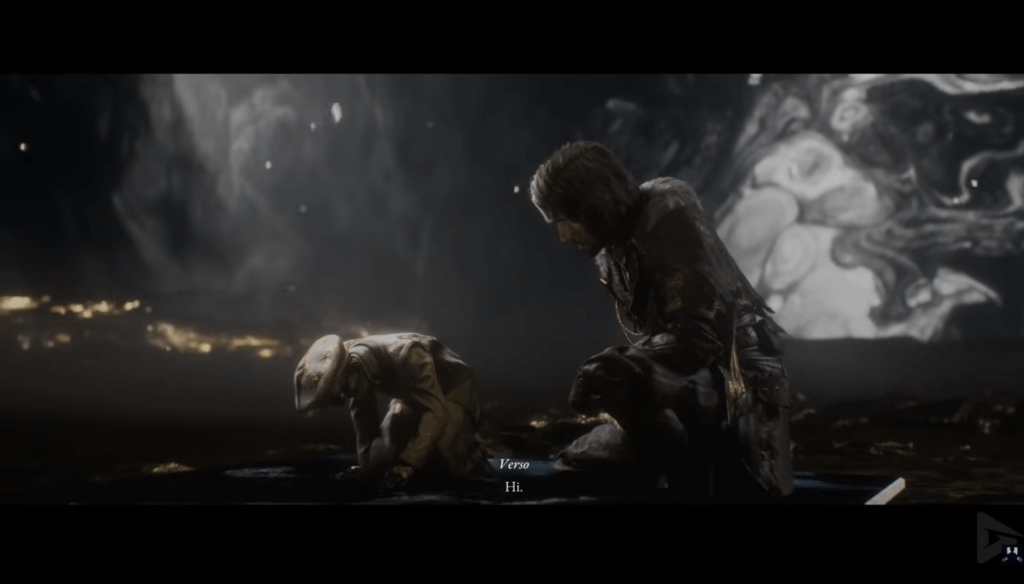
Verso, I presume. Not the projection, but whatever part of Verso created this world and is bound to it, upkeeping and supporting it.
Then Maelle entered. The battle was won. We could live in peace, now. She could resurrect the fallen and fix the world. She could protect everyone from Renoir.
But she would also die. And the world she made would die too—Renoir would return and scour it once Maelle/Alicia could no longer protect it.
Maelle draws her sword. Verso draws his. And the game offers a choice.
Who will you control in this final confrontation?
Whose vision of the future will you choose?
Will you support Maelle, rebuild the Canvas (but only for a time), and let her die in the effort?
Or is it time to let go—let Renoir destroy Verso’s world, and send Maelle back to the real world to fix her life?
The Choice
There is a sense in which neither choice is satisfying.
To choose Verso in that moment is to undo so much we have fought for. It is to tacitly endorse Renoir’s destruction of the Canvas. It is to condemn Lumière, the Gestrals, Monoco, and Esquie to oblivion. It is to fail Sciel and her wish to see her husband again. It is to once again strip Maelle of her freedom to choose, using force to tell her what is best.
But Maelle wants a fantasy. She will just prolong the inevitable, return us to the Paintress’ ticking clock. It is to preserve a work of art at the cost of a living person and her family, and that only for a little while.
It is a horrible choice.
There are even elements of the choice that I find a bit reductive, or cruel. Can we really dismiss the lives of all the people of Lumière? Are they truly worthless, because they aren’t “real” enough? Can we really override Maelle’s choice to stay? Isn’t she an autonomous human being, rational and mature? Isn’t it wrong to support yet another older man telling her what to do and believe?
But that is what I chose.
I condemned Lumière. I condemned the Gestrals. I condemned Monoco. I condemned Sciel. And I condemned Esquie.
But I saved Alicia. And what remains of the Dessendre family.
And I wept. I wept through the entire ending cutscene. I wept like I haven’t wept in nearly twenty years. I wept harder than I had when my grandmother died. I wept, though I hadn’t wept at the election, or during the pandemic, or when my condo was condemned, or when my cousins passed away—three in a row between 2021 and 2022. I wept because of these things. I wept because I could not weep for all the time I’d wasted trying to make money, or because my employers have never adequately recognized or rewarded me for the work I’ve done for my students, or at the death of my dreams. I wept because I couldn’t weep for the house I would never have, or the life of leisure I would never lead, or the success I would never reach. I wept because I will never know security under a president more concerned with his social media profile than the well-being of his citizens.
I wept because it was time, finally to leave. Because I was giving up the same exact fantasy Alicia would now have to give up. I chose to be Verso in that moment, because I believed Verso was right, but it did not stop me suffering like Maelle—the girl everyone had been trying to protect, and who would now, finally, be protected. Just—everyone else had to die to do it. And Maelle—Alicia—would go forward without them, knowing that Verso’s Canvas would be well and truly gone.
I wept because I wanted, honestly, to stay. Because it was so much better here in this world Verso and Guillaume Broche had made for me, than it would be to face the world out there. I didn’t want to teach anymore. I didn’t want this reality anymore. I wanted Esquie, and Verso, and Sciel’s happy ending.
Verso—my Verso, went over to the boy Verso—the real Verso, and told him, rather quietly:
“It’s time to stop painting.”
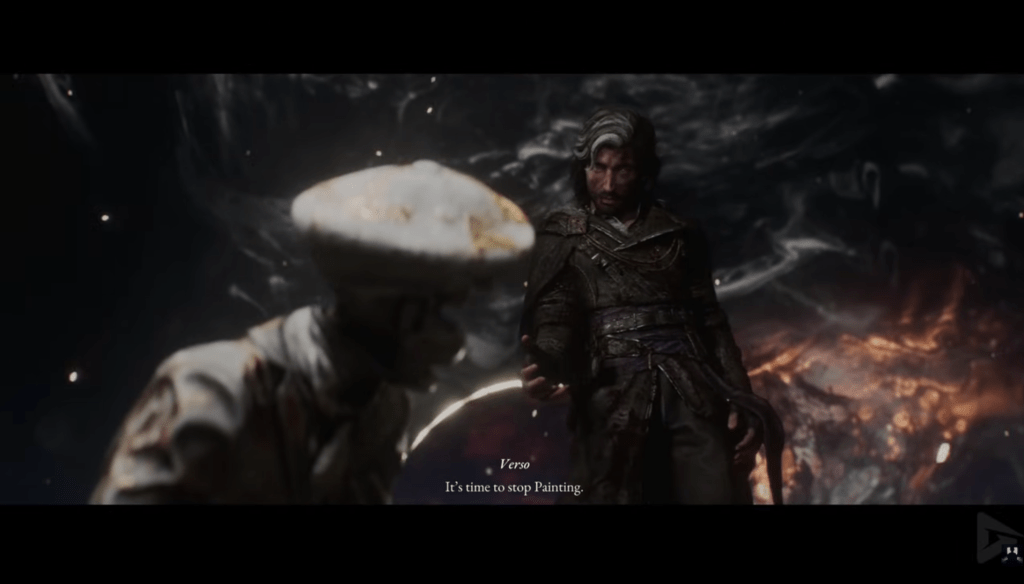
And I wept at that, too. Because I so desperately wanted to stop. Stop working at what I’d been doing for so long, and rest instead. End my toil. Take my reprieve. That boy was every bit as important as Maelle in that moment. Whether or not the whole of Lumière should perish, it should not be up to that poor boy to sustain it. Just ask Ursula K. LeGuin.
Like Sciel, Verso was ready to die. Like the false Alicia, he wanted to die. It was right to let him go, at long, long last. All the hopes of Mother, Father, and Sister fighting over his painting: it had stopped being his long ago, hadn’t it? He had made a place of joy, but it had become a place of suffering and loss.
Yes. Better to stop, then.
One by one, the other characters enter the little bubble of unreality. Monoco and Esquie enter, and Verso embraces them as they disintegrate into petals. Sciel walks across the bubble to Verso, already fading. They look at each other, and Verso offers his hand. Sciel takes it as she disintegrates. Lune walks in, sees Verso, and sits. She glares, fiercely, at him all the while—judgmental, perhaps? I can’t think of what I would tell her—would anything suffice? Then the two Versos join hands and walk into oblivion.
At last, Verso is well and truly dead.
In the final scene, Alicia—the true Alicia Dessendre—stands with Aline and Renoir at Verso’s grave. Alicia clutches a plush doll—Esquie. Some ways off, Clea stands—not quite ready to embrace the family she’s hurt, and that hurt her. And, looking upward across the garden, Alicia sees a final vision: of all her partners: Lune, Sciel, Monoco, Esquie, Verso, Gustave, and, indeed, Maelle all waving one last farewell.
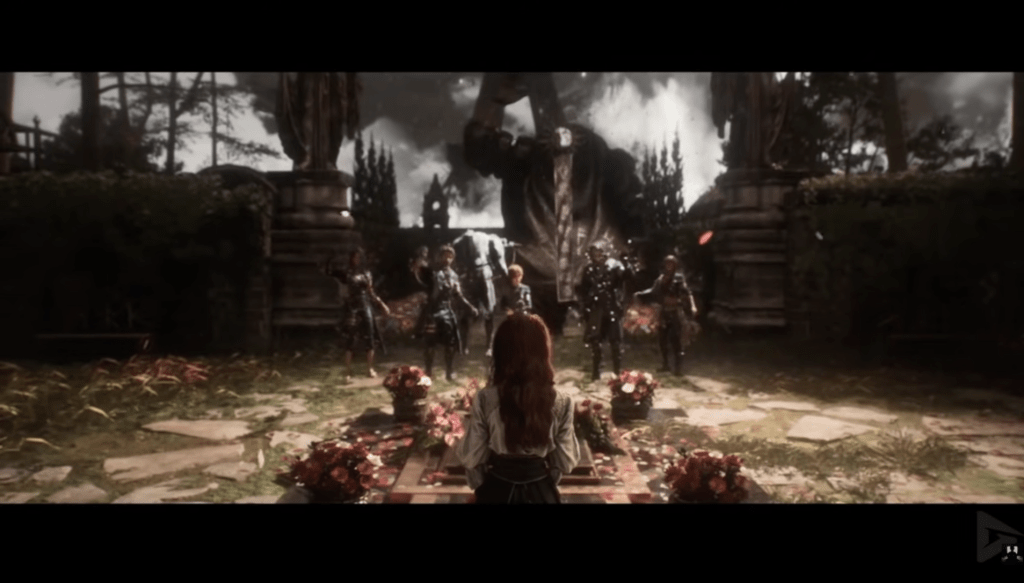
Roll credits.
I’m told this is the “good ending” by most accounts. And it is good. It is artistically satisfying, powerfully cathartic, even if it feels like cutting off a limb—perhaps because of that. The Greeks wept at their tragedies after all; they are meant to hurt. We are meant to weep at them because we cannot weep for ourselves.
I haven’t watched the alternative. I wouldn’t want to. I think it’s probably horrible, and I’ve invested myself so completely in this choice, it is the only ending that could have meaning to me.
EPILOGUE: In which we confront the meaning of our words and decisions
I said before that “Clair Obscur” could have roughly three translations.
The first, “Obscured light,” seems to apply to the difficulty of our understanding. It might point to the half-glimpsed, half-felt, half-intuited emotional experience evoked by surrealism. Or it might point to grief itself—the experience of watching a light extinguished (“Lumière s’eteint”). Or it might refer to the incomplete understanding you receive from a game that does not reveal all its secrets, or that sings in another language, or that does not allow for a truly happy ending.
It could also mean “twilight,” as in the end of the light and the beginning of the dark. As might be relevant for a city on the verge of death, a painting about to be destroyed, or characters who suffer and die so that others might live. It refers to Sciel’s dance on the razor’s edge of death. It refers to the gloomy ashen skies of battlefields and the blue glow of alien forests. It refers to a night of revelry before you and all your friends embark on an adventure together.
But that third definition, “chiaroscuro,” has perhaps the deepest meaning of all.
Renaissance painting, in its search for balance and spiritual perfection, tended to use flat lighting. Even when you surrounded a character’s head with a halo, each detail of the painting was lit at the same level—every detail rendered equally important to every other. Chiaroscuro, the invention of Mannerists like Tintorello, evoked a different feeling. These paintings were dark and brooding, with details highlighted by dim or selective light. The painters of the time understood it as: “revealing the light through darkness.”
And that is a powerful metaphor when it is applied to the body of my work. Often I find that a work must be willing to confront darkness to believably reveal light. I’ve argued that the new run of Star Wars movies fail to properly depict Hope because they do not understand real evil. I’ve argued that Lobotomy Corporation is compelling specifically because it earnestly addresses the relentless horror of our lives.
And Clair Obscur reveals goodness and hope through its profound exploration of grief and loss. We must face the darkness. We must make the terrible choice. Only then, can we stop painting—stop endlessly repeating the same mistakes, the same rote stupidity. Only through sacrifice, through suffering, and through grief may we clearly see what is worthwhile and good.
Only through change can we find release.
When I finished Library of Ruina, I believed I would never encounter another game so personally meaningful to me. I believed that the state of gaming, my busy-ness, and my age would prohibit me from investing so deeply in any other experience. I believed that it was a bottled-lightning experience, brought about by the expert writing of Project Moon, and the particular set of horrible circumstances that brought me, on hands and knees, to its truths.
I am happy to be wrong.
I am happy I found an oasis of sanity, gentle kindness, harrowing emotional honesty, and forgiving challenge at exactly this moment in my life—when I so desperately needed someone to tell me: “It’s time to stop painting.” And I am happy that it made me leave, weep though I might. I am happy that it was familiar enough that I never felt frustrated as I learned its mechanics and quirks, yet unfamiliar enough to make me constantly hungry for more.
I’m glad that, for 99 hours, this game saved me from myself—my anger, my self-pity, my despair, my suicidal desire to get out of my own oppressive responsibilities, and, indeed, my grief.
I think it was enough.
But now it’s time to go back to reality.
Not so I can repeat the mistakes that have alienated myself from my family and my friends, or so I can go on suffering the way that I have…
…but because it’s finally time to move on.

 Video Game Academy